


Six thoughtfully chosen Chinese products show how practical design, surprising value, and small everyday improvements can make unfamiliar gadgets worth trying.
***
Editor’s note: This article is part of a series reviewing Chinese products that may be of interest to international readers. This installment combines selected product reviews by SSPAI staff editors from articles published on July 23, 2026 and August 6, 2026. Product details and RMB prices may have changed; approximate USD conversions use CNY 1 = USD 0.1483 as of August 14, 2026. No affiliation or partnership with the manufacturers unless expressly disclosed.
Yaxiaoman Replacement Brush Heads for Laifen Electric Toothbrushes (Ultra Comfort)
Approx. price: RMB 35 (US$5.19) for four
Laifen’s electric toothbrushes are affordable and work well, but the company has yet to break free of the industry’s familiar “cheap handle, pricey refills” playbook: its first-party replacement heads start at more than RMB 30 (about US$4.45) apiece. That felt a little steep to me, so I did a quick search for a cheaper alternative and found these third-party heads from Yaxiaoman (牙小满).

Yaxiaoman’s quality is genuinely impressive. In terms of how the brush feels in your mouth, I can’t tell it apart from the original. I bought the Comfort Shock-Absorbing version, whose head is larger than Laifen’s and feels a little fuller in the mouth. The bristle tips are also very well rounded, so brushing feels smooth rather than bluntly scratchy, as it can with cheap heads.
If you prefer the same compact feel as the original head, Yaxiaoman’s Standard and Pro versions both use a similar shape and may be worth trying. There isn’t much else to say about a toothbrush head: Yaxiaoman delivers first-party quality at a much lower price, which is already quite an achievement. Even if it doesn’t last as long as the original, replacing it a little more often still won’t cost much.
– Nick
CENO Pure Grain Cat Litter
Approx. price: RMB 110.80 (US$16.43) for four 2.5 kg bags
This is the best cat litter I’ve used so far, so I have to recommend it.
Household cat litter generally falls into two categories. The first is mineral litter, made primarily from minerals ground into fine granules. Its advantages are that it feels similar to the sand cats would dig in outdoors and that it absorbs liquid and forms clumps well. The downsides are that it gets smelly easily, and the fine grains become trapped in a cat’s fur and end up all over the house, making cleanup a pain. The other category is tofu litter, whose main ingredient is plant fiber that has been broken down and compressed into small pellets. It is also commonly mixed with a certain amount of minerals or other ingredients to improve absorption and odor control. Tofu litter is less prone to smelling and doesn’t scatter gritty particles throughout the house, but it is usually used up more quickly and doesn’t clump as well as mineral litter.
CENO’s Pure Grain Cat Litter belongs to the second category. Unlike conventional tofu litter, however, CENO uses grain alone, with nothing else mixed in. The company has also refined the way its grain litter is made, so it performs much better in practice.

Here’s how that shows up in everyday use.
First, it is excellent at controlling odors. According to CENO’s product description, the company focused its research on suppressing hydrogen and hydrogen sulfide in cat waste, thereby improving odor control. In my experience, it neutralizes the smell of a cat’s day-to-day business immediately. I only notice a clear decline in odor control after the same batch of litter has been in use for a week.
Many tofu litters suppress odors by adding deodorizers or fragrances. They do stop the litter box from smelling, but I’m not entirely comfortable with those substances ending up on a cat’s body and then being licked into its stomach. Cats also come out of the litter box smelling of cheap perfume, which isn’t pleasant for people either. CENO achieves better odor control using nothing but natural grain. After using the litter box, the cat carries a natural grain scent—which, at a stretch, you could call a fragrance—so nothing gets in the way of more cuddles and kisses.
Second, it clumps better than any of the other tofu litters I’ve tried. I’m sure every longtime cat owner has already worked their way through all the recognizable litter brands on the market, and I’m no exception. CENO would easily rank among my top three for clumping. Most of what I scoop out comes away in intact clumps, with very little debris, so the litter box is easy to maintain.
Third, this litter produces very little dust. Over the past few months, I’ve tested a large number of litters in quick succession, mainly because most of them were extremely dusty. Every time I poured a fresh bag into the box, the cloud of dust would make me cough before the cat even got near it. CENO doesn’t have that problem: the amount of airborne dust is negligible.
One final warning: in addition to this Pure Grain Cat Litter, CENO sells a blended version containing other ingredients. It is considerably cheaper, but it plainly strays from the whole idea of not putting random additives into cat litter, so make sure you choose the right one when ordering.
– Nick
Roborock A30 Pro Combo Wet-and-Dry Vacuum
Approx. price: RMB 2,288.79 (US$339.43)
My wet-and-dry vacuum of several years recently broke, forcing me to find a replacement. Of the major brands currently making these machines, Roborock was the only one I had never properly tried. After weighing my options, I chose the Roborock A30 Pro Combo.
The A30 Pro line comes in a bewildering number of versions. There is the entry-level A30 Pro, the foam-cleaning A30 Ultra, and the more premium A30 Pro Steam. Every model also has an upgraded 2.0 edition. My Combo sits somewhere in the middle. What makes it a “Combo” is the vacuum attachment kit included alongside the main wet-and-dry unit: detach the motor module and you can assemble it into a conventional vacuum cleaner. If my aging Dyson ever gives out, I’ll already have a backup.

Because it had been years since I last replaced a wet-and-dry vacuum, the generational leap felt enormous. Once I started using the new machine, it seemed to have advantages everywhere I looked.
What I like most is how little hassle it creates. For one thing, it genuinely separates solid waste from dirty water. Every manufacturer promotes “solid–liquid separation,” but the real-world results vary widely. My previous machine couldn’t manage it, so cleaning the dirty-water tank meant spending ages digging around with a long brush while rinsing it out. It was an enormous nuisance.
I emphasize this because cleaning the dirty-water tank is the most troublesome and time-consuming part of using a wet-and-dry vacuum. The easier and more pleasant that process is, the more willing you will be to use the machine regularly.
The Roborock A30 succeeds because its dirty-water tank is thoughtfully designed. Solid debris is caught neatly on the filter, leaving only dirty water in the tank, and both can be cleaned with nothing more than a rinse.

The A30 also leaves its roller-brush compartment cleaner after a self-cleaning cycle than any other wet-and-dry vacuum I’ve used. There are no stray hairs or stains left in the crevices. Anyone who has owned one of these machines for a while will know that this area usually needs to be cleaned by hand every so often, or grime starts to accumulate. I’ve had the A30 for more than a month and clean my floors once or twice a week. I haven’t manually cleaned this area once, and judging by its current condition, I probably won’t need to for quite some time.

The A30 is also much lighter and more compact than my previous machine. Its powered wheels help it glide along, and even lifting it to reposition it in a tight corner doesn’t feel like a chore.
As for the fundamentals—how well it cleans and how much water it leaves behind—I don’t feel the need to belabor them. The previous generation of wet-and-dry vacuums had already solved those problems, and the A30 naturally performs just fine. If you’re interested, there are plenty of individual reviews and comparisons online.
I do have two complaints. First, the machine doesn’t switch off automatically when placed upright. It can even be turned on while sitting on its charging dock, which is a questionable design choice. Second, the model I bought dropped in price by several hundred yuan shortly after I ordered it, probably because Roborock had just released the 2.0 edition and discounted the older model. All I can do is remind myself that a wet-and-dry vacuum should last for years; spread over its useful life, a few hundred yuan isn’t too painful.
– Nick
Hagibis Folder-Shaped Card Reader
Approx. price: RMB 99 (US$14.68)
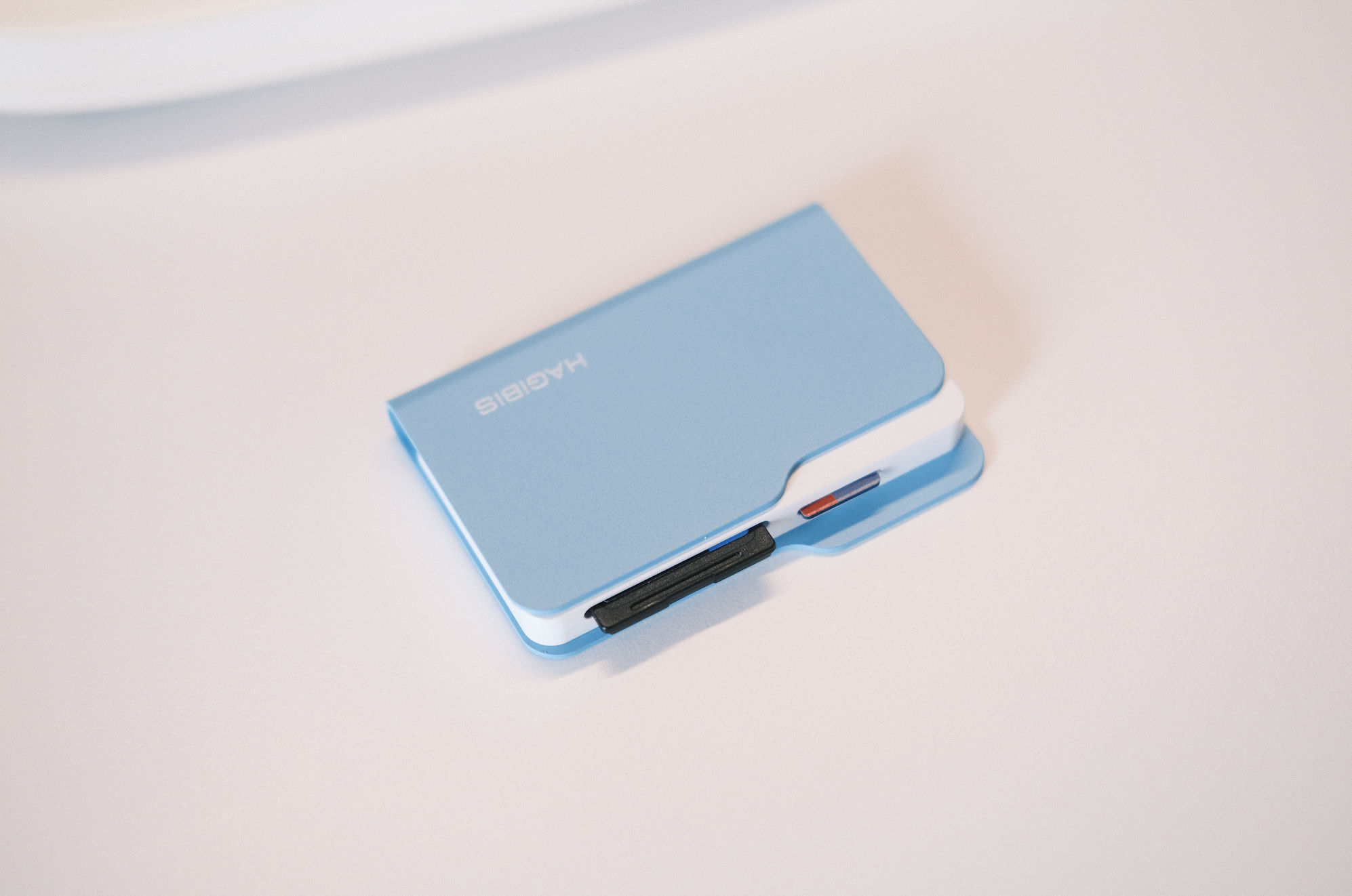
The first time I saw this card reader on Xiaohongshu (RedNote), I was immediately drawn to its design. Plenty of companies had already made card cases, MagSafe accessories, and other products styled after the macOS folder icon. Most of them, however, struck me as objects whose design mattered more than their usefulness, so I had never quite convinced myself to buy one of these “macOS accessories.”
A card reader, on the other hand, is something I genuinely need. I previously used the reader built into my desktop dock. It is extremely convenient when permanently connected to a computer, but of no use once I’m away from my desk. This Hagibis reader is small and portable enough to serve as a handy fallback while I’m on the move.

The reader has one standard SD slot and one microSD slot—a perfectly conventional setup. Hagibis says it supports the SD/TF 4.0 standard and can theoretically reach 312 MB/s. That is only a theoretical figure, of course, and actual performance is also limited by the read and write speeds of the memory card itself. In practice, importing photos doesn’t feel especially slow, and that is good enough for me.

Returning to the design, the body is made entirely from aluminum alloy and feels quite nice. One pleasant surprise is the lanyard hole: attach the included strap and the reader can easily hang from your bag for everyday carry. Even without the strap, it is small enough to sit unobtrusively in a camera bag.

If you are shopping purely for a card reader, there are plenty of cheaper alternatives, and the RMB 99 (US$14.68) price isn’t particularly competitive. But if, like me, you are buying it for the “macOS accessory” aesthetic, this reader is satisfying. If you don’t need it immediately, wait for a sale and you may be able to get it for less.
– Lotta
FaSoLa Long-Handled Bottle Brush
Approx. price: RMB 13.80 (US$2.05)
Summer means cold-brew tea, cold-brew preserved-plum drinks, and the like—followed by chugging straight from a large, strawless bottle. So in early April, I ordered a 1.25 L bottle through a Taobao purchasing agent. One bottle during the day and another at night takes care of my daily water intake.

I’m extremely happy with the bottle, except that it doesn’t fit in the dishwasher. I also like to mix juice and other drinks with water and ice in it, which makes cleaning the bottle a nuisance. My trusty old IKEA long-handled bottle brush had already seen years of service, so a replacement was inevitable. After diligently aggregating the collective wisdom of countless Xiaohongshu posts, I became convinced that the FaSoLa brush is the one to beat right now:
- It is long enough. The extended stainless-steel handle easily reaches into cold-brew coffee makers—and my beloved giant bottle.
- It has a simple design. It is just a stainless-steel handle gripping a sponge. Replacement sponges are available, or you can fit it with a scouring pad or another cleaning material yourself.
- It is cheap. A little over RMB 10 (about US$1.48) gets you the brush plus four replacement sponges. Sets with straw brushes and other accessories are also available.
Allow me to introduce my bottle’s trusty sidekick:

I’ve used it for two or three months and keep it hanging in the kitchen. I also use it to clean double-walled cups that can’t go in the dishwasher. For the milk residue left by a milk-based coffee, for example, I soak the cup in water, give it a blast with the kitchen sprayer, and finish with a couple of passes from this brush. That usually does the job.
The brush does have a few shortcomings. First, the metal is exposed on both sides. If you clean by pushing it into a bottle and vigorously twisting it around, the metal can scrape against the bottle and make an unpleasant noise. The product page also warns that after cleaning colored stains, you need to rinse the brush or its sponge will become discolored. Mine has already turned slightly yellow.

– LuZhNan
MOMAX 1-Power S.Pass Air Magnetic Power Bank
Price paid: RMB 253 (US$37.52)
It is difficult to express just how much I hate carrying things when I go out. For any same-day trip within a 100 km radius, I will do everything in my power to avoid taking a bag. Even when I’m going farther afield or hiking, I will generally add no more than a single compressed towel to my pockets.
When pockets are all I have to work with, there is basically no room for a power bank; even if one fits, it is uncomfortable to carry while moving around. Rental power banks are available everywhere these days, but when I’m actually out, laziness or stinginess often keeps me from renting one in time. The result has been more than one 11 p.m. journey home with a single-digit battery percentage, plus one traumatic occasion when my phone died while I was recording a concert.
Clearly, I needed a power bank. Unfortunately, the models pushed most heavily on shopping sites still looked too bulky, and for a long time I couldn’t find one I wanted to buy. A few weeks ago, while browsing Fortress in Hong Kong, I spotted an exceptionally slim model: the MOMAX IP180. Its 5,000 mAh capacity isn’t huge, but it is enough to get me through a day trip. I bought it from JD.com for RMB 253 (US$37.52)—the original RMB 298 (US$44.19) price, less a RMB 25 (US$3.71) price-protection refund and a RMB 20 (US$2.97) JD.com gift card for leaving a review.

Once it arrived, I was indeed impressed by its appearance and build quality. At 6 mm thick and 112 g, it barely feels like a burden. If I had to find fault, the mirrored surface scratches far too easily. Attached to a phone, it gives me flashbacks to the scratch-prone back of an iPod. Perhaps the manufacturer could borrow a line from Steve Jobs and say that the wear allows every user to own a truly unique power bank. Also, as someone who hates catching sight of myself in mirrors, having to look at my own face while charging my phone is rather awkward. Depending on what you want, of course, the mirror might instead be a bonus feature.
There isn’t much else to say about its features, which are all standard for a MagSafe power bank. If you are interested, the table below compares several slim models on the market, with a conventionally sized Belkin model sold through the Apple Store included for contrast.
| Product | Model | Capacity | Dimensions | Weight | Wired input | Wired output | Wireless output | MSRP |
|---|---|---|---|---|---|---|---|---|
| Anker Air Ultra-Slim Magnetic Power Bank | A1115 | 5,000 mAh | 102 × 70.6 × 8.6 mm | 120 g | Up to 20 W | Up to 20 W | Up to 15 W | RMB 399 (US$59.17) |
| MOMAX 1-Power S.Pass Air Magnetic Power Bank | IP180 | 5,000 mAh | 102 × 71 × 6 mm | 112 g | Up to 18 W | Up to 22.5 W | Up to 15 W | RMB 298 (US$44.19) |
| iPhone Air MagSafe Battery | A3466 | 3,149 mAh | 122 × 71 × 7.5 mm | 126 g | Up to 27 W | Up to 7.5 W | Up to 12 W | RMB 799 (US$118.49) |
| Belkin BoostCharge Pro Magnetic Power Bank 5K | BPD006 | 5,000 mAh | 94 × 64 × 17 mm | 150 g | Up to 12 W | Up to 18 W | Up to 15 W | RMB 498 (US$73.85) |
– PlatyHsu
Share: