

A practical framework for escaping recommendation algorithms and building a more intentional, personal system for discovering and organizing music.
***
Translator’s note: A version of this article by ChandlerLin appears on July 28, 2026 on SSPAI with the title “在流媒体时代,我们如何发现和管理音乐?”. Translated and published by agreement.
The real problem in an age of information overload is not that we cannot get more, but that we do not know what to leave out.
—Brian Eno, British composer, record producer, and music theorist
Introduction
In the past, discovering—and eventually developing a deeper affection for—a musician or an album was a relatively deliberate, slow process.
In the record era, the uncertain and roundabout path to discovering a musician might unfold like this: you heard a record at a friend’s house; you came across a review in a magazine; a mysterious album cover caught your eye while you browsed a record store; or, because you liked one singer, you bought records by the artists who had influenced them. Only at the end of that journey did you finally own an album of your own. Music, in this experience, was not merely a piece of digital information attached to a vinyl record, CD, or cassette. It was a process of exploration, deeply imprinted with your personal taste.
The streaming era changed everything. Today, an ordinary listener can open Spotify, Apple Music, NetEase Cloud Music, or QQ Music and face a catalog of tens of millions—sometimes more than a hundred million—songs. In theory, this should be the happiest moment in the entire history of music. You no longer need to wait for a record to be released, pay for a physical album, or depend on a limited selection of radio programs. It feels as though you possess the whole world. Strangely, however, many people have instead found themselves in a predicament that is difficult to describe: we try different new songs every day, yet we never seem to find music we truly love.
I am simply an ordinary music lover without much writing experience, but I am going to make a bold attempt to document every method I use to discover music. I would not presume to claim that I have exhausted every way of using streaming services to find something new. I will, however, shamelessly claim that these methods are enough to bring variety back into a music-discovery routine that has grown increasingly homogeneous under the pressure of algorithmic bubbles and a fragmented age.
I will discuss several main ideas: why discovering music has become difficult in the streaming era; the most fundamental overall method—building a music discovery system of your own; and the value of recommendations made by people. I will offer a few modest lessons from my experience as a music and technology enthusiast. The article moves from abstraction to practice: I will first describe the overall structure of my discovery system, then introduce the websites and tools I actually use. Along the way, I will recommend some of my favorite music creators on platforms including NetEase Cloud Music and YouTube, before moving on to somewhat less mainstream discovery and rating platforms such as Rate Your Music and Discogs. My hope is to cover as many paths to discovery as I can—and perhaps give us all something useful to work with.
Why Does New Music Feel Further Away in the Streaming Era?
Algorithmic recommendations are convenient, but they make everything sound the same
Spotify and Apple Music are two of the most widely used platforms in the streaming era, yet the flexibility of their recommendation systems leaves much to be desired.

The image on the left shows my Spotify Daily Mix 2 playlist, while the one on the right shows my Apple Music Heavy Rotation playlist. I am not exaggerating when I say that the only song in either playlist I had genuinely never heard before was the Kinks’ “All Day and All of the Night.” For streaming services that position music discovery as a central function, both clearly fall short. I have not shown their other discovery playlists here, but even a standout such as Spotify’s Discover Weekly usually offers only slightly more obscure tracks within genres I already enjoy. It does little to broaden the range of genres I hear.
This brings us to a major weakness of recommendation algorithms on mainstream music platforms: they excel at recommending more of the genres we already listen to, but struggle to help us discover music that is significantly different—or apparently unrelated.
These are two entirely different tasks. An algorithm reinforces your established interests by learning from your history: what you play, save, and skip. If you listen to the Beatles every day, it might keep recommending the Rolling Stones, Oasis, Blur, and the Smiths—mostly British pop and rock bands. There is nothing inherently wrong with that. But music discovery is a much broader, more adventurous process of crossing boundaries. The most rewarding discoveries are often built on difference. Someone who loves the Beatles may be interested not only in British rock, but in more diverse music with an underlying affinity that is not limited to a similar sound: Motown’s distinctive approach to harmony, perhaps; soul and funk; the ballads of R&B singers; the bedroom-oriented production and arrangements of artists such as Sufjan Stevens; or the melodic writing of city pop.
Streaming services are unquestionably adept at using algorithms to connect genres. But when asked to calculate the ineffable emotional connection between different kinds of music, they are helpless.
From the album era to the singles era
In the past, a music lover who bought a record would generally listen to the album in full. Hearing a song could naturally lead to knowing an album, then knowing the artist, and eventually understanding an entire era. Today, it seems increasingly common to hear the hits, add those hits to a playlist, play them on repeat, and never even learn who the singer or artist is.

If we take a longer view, we can see that this change did not begin with Spotify. It is the result of several decades of evolution in the way popular music is consumed.
In 2019, researchers from Germany’s Max Planck Institute and other institutions analyzed nearly fifty years of music-chart data from the United States, the United Kingdom, Germany, and the Netherlands.1 They found that the life cycle of popular music was growing shorter: new songs and styles entered public view more quickly, only to be displaced by the next wave of popularity, and the cycle repeated. The study called this phenomenon cultural acceleration.

In the record era, an album might stay with a listener for months or years. We carefully put CDs and vinyl records back into their sleeves and stored them on a shelf or in a record cabinet. Faced with limited choices, we played the same record repeatedly until we knew every detail of its sound. In the streaming era, by contrast, music circulates through singles charts and recommendation feeds, and the pace of consumption keeps accelerating. We no longer stop to ask why an album is sequenced the way it is, what its creator’s background was, or which works influenced it. Anyone who wants to develop a genuine musical sensibility and resist the fragmented rhythm of modern life must ultimately confront questions like these.
How to Build Your Own “Music Discovery System”—Logical and Beautiful as a Symphony
We have finally made it through the tangled problems of discovering music in the streaming era. Thank you for staying with me this far. Now I can begin explaining how I built a music discovery system of my own. This section is an abstract overview—the metaphysical part, if you like.
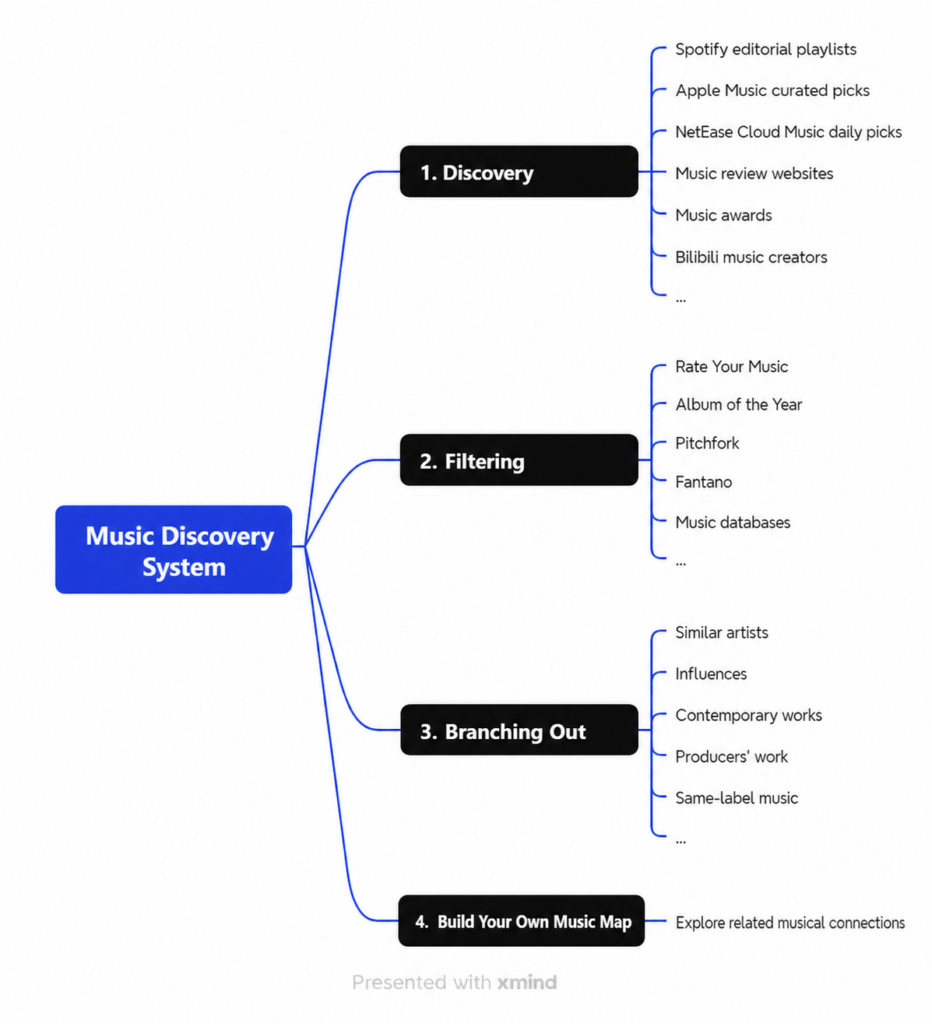
In my view, there is no magical piece of software that will keep delivering new music forever. What you need is a logical system. Mine consists of four parts:
- Discovery
- Filtering
- Branching out
- Building a music map
I turned the system into a mind map that roughly lists some of the tools I commonly use at each stage. I will touch only briefly on familiar discovery methods such as Spotify’s editorial playlists and algorithmic features. More advanced sites used for filtering, including RYM and Discogs, will receive a detailed introduction in the later section on specific music-discovery channels and tools. If you are mainly interested in collecting advanced resources, feel free to jump directly to that section.
Layer One: Discovery
The purpose of the discovery layer is to give unfamiliar music a way into our field of view.
This is the most basic part of the system: it brings in new music. Its many channels expose us to music from different sources and directions. One channel might be a streaming algorithm; another might be a casual recommendation from a creator on Bilibili or NetEase Cloud Music. At this stage, we might hear plenty of popular, mainstream music, or encounter music that is considered more artistic or obscure. It is therefore essential to keep your ears—and your mind—open.
Use streaming algorithms
I have already described the limitations of algorithms, but some recommendation features on Spotify, Apple Music, NetEase Cloud Music, and other platforms are undeniably powerful. Spotify, for example, offers the following:
- Discover Weekly: recommends similar works you have not encountered, based on your listening habits
- Release Radar: tracks new releases from artists you like
- Radio: expands outward from a song, album, or artist to similar works
These features help us expand our musical knowledge within a certain range, and they do so efficiently. What they cannot do is break completely through the boundaries of our taste.

The two features I use most are Spotify editorial playlists and song radio. Spotify’s public editorial playlists are curated by people—or so I assume—and updated weekly with different styles based on their themes. In my experience, they are among the more valuable parts of Spotify’s discovery system. The “my life is a movie” playlist shown above, for instance, collects songs that suit a cinematic, life-story mood.
Song radio, meanwhile, is an algorithmic playlist generated when you right-click a track and choose to start a radio station from it. It is not hand-curated, but several features added in recent years make it worth highlighting. These are the buttons shown along the bottom of the following image. They let you choose the direction in which you want the recommendations to move—toward folk rock or singer-songwriters, for example, or toward familiar music versus a greater number of new tracks. They are extremely useful.

Use communities and content platforms
If algorithmic discovery has begun to feel repetitive and homogeneous, you can explore music communities and content platforms instead. For example:
- Community charts on RYM and AOTY
- Album introductions and music-history content on Bilibili and YouTube
- Annual lists published by music media
Suppose I want to try jazz that an algorithm is unlikely to recommend. I open RYM, go to the All Genres page, and select Jazz. RYM then presents a chart ranking releases within the broad category of jazz by their aggregate user ratings:

Compared with algorithmic recommendations, these channels usually provide more context, including introductions to the musicians and the stories behind the albums. They tell you why a song or album is worth hearing.
Layer Two: Filtering
With an enormous volume of new music appearing every day, filtering is often more important than discovery.
Take Pitchfork—sometimes jokingly nicknamed “Bitchfork” on the Chinese internet. From the vast amount of music available, it selects works for charts organized by year or by genre, with separate lists for albums and songs. It also scores individual albums. After discovering something new, you can search online for ratings from publications and other organizations. Those ratings will not necessarily match your personal taste; sometimes they may be completely at odds with your own opinion of an album. In most cases, however, they are just about adequate as a rough filter. Your own listening experience should, of course, remain the final standard.

Sources you might consult include:
- Professional reviews from outlets such as Pitchfork and Rolling Stone
- Music awards such as the Grammys and the Mercury Prize
- Community ratings on sites such as RYM
- Recommendations from musicians
I love looking up ratings and reviews of newly discovered music across different platforms. Some people find this a little troublesome—and perhaps slightly utilitarian. But after a hard day at work, I would rather do that than come home, turn on the speakers, and somehow end up sitting through an album I dislike or one that is very poorly produced. For me, it is an unfortunate necessity.
Layer Three: Branching Out
This stage focuses on expanding outward through the larger characteristics of a work. An album is not simply a bundle of songs. It is an integrated whole whose parts share certain qualities and express a common character. Finding the connections behind music therefore serves an irreplaceable function. An album can connect to an enormous number of things: the musician’s other work; the producer and production team; music influenced by the album; and earlier music that influenced its creation.
If you like Radiohead’s OK Computer, for example, your exploration does not have to remain confined to art rock and alternative rock from the same period. Try their later albums, such as Kid A and In Rainbows, and you may find yourself transformed from someone who simply enjoys traditional alternative rock into a fan of electronic and experimental music.
Musical commonalities are found not only across an artist’s catalog, but also in the work of an album’s producer.

One of the clearest examples is the legendary record producer Phil Spector, who pioneered the revolutionary recording technique known as the Wall of Sound. The method has its critics, but it also has a great many admirers. My love of the Beach Boys’ album Pet Sounds inevitably led me to Brian Wilson, the band’s creative leader. Through the producer connection, I learned that Wilson had been influenced by Spector’s Wall of Sound. Exploring that legendary 1960s recording technique naturally brought me to work by the Ronettes and the Crystals, both of whom used it extensively. From there, I moved into Motown, soul, and other recording traditions influenced by the technique—and, before I knew it, I had entered an entire era of music.
Music history is a vast network of relationships. If you love a particular sound, try asking yourself: “Where did this sound come from, and whom did it influence?” If you love My Bloody Valentine’s Loveless, for example, exploring shoegaze might lead you to consider the Jesus and Mary Chain’s influence on the combination of noise and melody, and then to listen to Slowdive and Ride. It is the same process I described above.
Layer Four: Build Your Own Metadata-Driven Music Map
After going through all the preceding stages, we may find that the more music we hear, the more disorderly it all becomes. This is where a music map proves its value. A music map does more than record which songs you have heard: it uses metadata to make your collection easier to understand at a glance. Saving music has become effortless in the streaming era. It takes only a moment to tap Like or add an album to a playlist. But doing so can make us forget why the music moved us, where it came from, and why it matters. If you want to listen seriously, building a metadata-driven music map can be profoundly worthwhile.
Sites that record detailed metadata make it easy to uncover information hidden by streaming platforms. When I organize information about Pet Sounds, for example, a streaming service will probably show me only:
- Artist: The Beach Boys
- Year: 1966
- Track titles and sequence
On Discogs—a marketplace and music-information database—I can also find:
- Producer: Brian Wilson
- Label: Capitol Records
- Other musicians who participated in the recording
- Release details for different editions
- The photographer and company responsible for the cover

Once this metadata has been recorded, the album begins to look like a cultural work with a history of its own. We can then reproduce the discovery method described in the branching-out stage. By following Discogs metadata from Radiohead’s OK Computer to producer Nigel Godrich, and then onward to Beck and Paul McCartney, we complete a loop through data. The much-admired approach to metadata management on the iPod follows the same principle.
An album entry might therefore look something like this:
- Prince — Purple Rain — 1984
- Genres: funk / pop / rock / R&B
- Influences: James Brown, Jimi Hendrix, Sly and the Family Stone
- Why I like it: the guitar solos, the arrangements, and Prince’s stage presence
- Related works: 1999, Sign o’ the Times
You might also record when you first heard a song or album, why you liked it, and your general impressions of it.
A metadata map can be organized into three layers:
- A basic-information layer: artist, album, year, genre, and producer
- A musical-relationships layer: influences, similar works, and music from the same period
- A personal-experience layer: when you first heard it, why you like it, and the experiences in your life to which it became connected
With a layered metadata map, discovering music becomes much easier. Sites and services relevant to music metadata include Rate Your Music, Discogs, MusicBrainz, Last.fm, and the Apple Music library. Ultimately, all great music leads not to a classification table, but to a singular portrait of a life—one intimately connected to every living individual.
A Guide to Music-Discovery Channels and Tools—Do Not Underestimate Human Recommendations
At last, we have reached the most important section of all. Much of what came before was abstract, even metaphysical. Here, I will introduce the specific tools I use to discover music.
Before streaming platforms existed, recommendations from other people were one of the most important ways to discover music—although, admittedly, there were no algorithms back then. In parts of China during the 1990s and 2000s, for example, imported audio and video products known as dakou discs circulated widely. These were surplus CDs and records from Western markets, physically cut or damaged before being imported as plastic waste. Vendors who sold them would often recommend their personal favorites to customers. In an era of scarce information, musical taste spread quietly through exchanges like these. Then there was radio: even now, I sometimes hear friends of different ages reminisce about classic stations such as Hit FM and Music Radio.
In the streaming era, human recommendations have not lost their value simply because they are less efficient. On the contrary, they have become an important means of breaking out of algorithmic bubbles.
Rate Your Music (RYM)

Among recommendation systems driven by people, RYM may be the best place for music lovers to explore. Unlike Reddit, which is a relatively loose-knit discussion community, RYM combines a music database with community features, an encyclopedic body of information, a rating system, and discovery tools. Countless music lovers use it to rate albums, EPs, and singles; write reviews; build collections of albums or tracks; create public lists; and explore music by year, genre, and region.
Some Chinese users have called it “a more music-focused Douban for the rest of the world,” but the musical relationships covered by RYM are far more extensive than those on Douban. Born from the internet culture of the 2000s, it inherits both the traditional record enthusiast’s appetite for musical information and the internet-era listener’s desire to acquire music quickly. In other words, it moved the circulation once handled by magazines and radio onto the internet.
Charts

Charts are among RYM’s most widely used features. They include all-time charts, which rank the highest-rated albums in the site’s history, and year charts, which rank the highest-rated albums from a particular year. You can browse a list such as “the 100 highest-rated albums of all time,” or filter by period to see lists such as “the best albums of the 1980s” or “the best albums of 1969.” If we take 1991 as an example, the list includes:
- My Bloody Valentine’s Loveless at No. 1
- Nirvana’s Nevermind at No. 4
- Massive Attack’s Blue Lines at No. 21
These stylistically distinct albums appear side by side on a single chart. Their only shared characteristic is their year of release: 1991. Listen carefully and consider why shoegaze, grunge, and trip-hop could all flourish in that same year—is that not part of the pleasure of musical exploration?
Genre Charts
Genre Charts are among RYM’s most powerful features, allowing us to explore by genre. Take Sufjan Stevens’s album Illinois as an example:

In the Genres field shown above, we can see that the album’s primary genres are chamber pop and singer-songwriter, with chamber folk, progressive pop, and other secondary styles listed below. If you know which aspects of the album you enjoy—progressive pop, for instance—

—you might discover Kate Bush’s celebrated Hounds of Love. Open its page and you will find even more distinctions among the album’s subgenres. Through this repeating cycle—identifying the styles you like, exploring more albums, then discovering still more styles—the possibilities truly become endless.
RYM’s sophisticated classification system
Spotify and Apple Music usually apply only broad genre tags such as rock, alternative, and indie. RYM retains these general categories while adding narrower subgenres such as dream pop and shoegaze, along with classifications called descriptors, which identify characteristics of the sound.

The page for the Flaming Lips’ Yoshimi Battles the Pink Robots, for example, assigns descriptors such as melancholic, psychedelic, and atmospheric. Used together with the weighting of sound characteristics in its recommendation system, these descriptors let you analyze the music you like in more technical terms.

RYM’s home page also surfaces user reviews of albums from different categories. When you find an album you like, you can explore other albums reviewed by the same user. The result is a community atmosphere built around something like musical research, and that too forms part of RYM’s sophisticated classification culture.

One drawback is that RYM’s user base leans toward indie music, experimental music, and alternative rock. It therefore tends to rate highly commercial mainstream pop more harshly. The community is also strongly album-oriented, so its judgments of singles and more populist music can occasionally be skewed. Some albums may receive inflated scores because of their distinctive status and aura in music history. A highly rated album is not necessarily right for everyone.
Discogs

Where RYM is known for its ratings and community, Discogs is famous for documenting every kind of data associated with records, making it easy to look up music metadata. The liner notes of CDs and vinyl records once routinely listed the label, edition, producer, and recording engineer. In the streaming era, Discogs has gathered and reorganized information that services have stripped back, making it particularly useful for building a music map. The site also has a marketplace where people can buy records.
Releases
On an ordinary streaming platform, an album is presented as a single version. Discogs documents something that sounds similar but is actually quite different: the release.

Although these releases belong to the same album, they may differ considerably in region, label, and mastering. Such distinctions may be unimportant to an ordinary listener. To a collector, however, an album is not a fixed file but a cultural object that changes over time under the influence of society. Discogs’ great achievement is to bring the logic of collecting physical records onto the internet.
Credits
Earlier, I described using music metadata as a path to discovery, and this Discogs feature is the primary way to do it. My previous example focused on producers, but the same principle applies to any role. I bought a vinyl copy of Masayoshi Takanaka’s album Seychelles, for example, and found that I loved its expansive soundstage and pronounced dynamic contrasts. By looking through other records credited to the album’s mastering engineer, Alex Wharton,2 I could discover music in completely different styles that shared a technically similar sound.


Labels
Another excellent starting point for exploration on Discogs is the record label. In the record-industry era, a label was an important expression of an aesthetic direction. It was not merely a company that released music; over time, it became a broader cultural phenomenon extending beyond the industrial system itself.
Motown,3 for example, became virtually synonymous with Black popular music in the 1960s, renowned for its precise production system and the collaboration of a vast number of exceptional musicians—think of James Jamerson playing bass on recordings by Marvin Gaye and Stevie Wonder. Exploring labels on Discogs creates connections through the culture of the recording industry. Browse the page for a label such as Blue Note, the celebrated jazz label, and it can carry you from Miles Davis to John Coltrane, Thelonious Monk, and Art Blakey.

The Mercury Prize, Pitchfork, and Other Awards and Charts
sspai has published other articles introducing mainstream awards and charts. If you are interested, you can read “Can’t Find Any Good New Songs? Expand Your Chinese-Language Music Library with These Sources” and “Never Run Out of Music: How to Discover Great Songs in Other Languages”.
Different awards uncover very different kinds of music. The Mercury Prize, for example, tends to strike a balance between reach and artistry, bringing attention to works with limited commercial value but exceptional artistic merit.4 The example that left the deepest impression on me came when I had only just begun listening to music seriously. One day, YouTube served me Wolf Alice’s performance at the 2018 Mercury Prize ceremony. From there, I fell down the rabbit hole of alternative-leaning bands such as Beach House and Alvvays. I also discovered PJ Harvey and Primal Scream through the Mercury Prize, which is why it remains my favorite music award to this day.

Review outlets such as Pitchfork have a similar quality. From the vast amount of music available, they select works for charts organized by year or genre, with separate album and song lists suited to different discovery needs.

Every award and reviewing organization has its own focus and genre preferences. At the end of the article, I have included tables listing the characteristics of some major awards, publications, and platforms for reference.
Popular-Music Curators
RYM, Discogs, awards, and reviews are all, at heart, tools for structuring information. Yet the oldest method of musical exploration—finding someone who knows music—still works in 2026. In practice, it may even be easier and more convenient than before. The activity has moved online, and the people involved have changed from DJs and record-store clerks into internet music figures such as Fantano and Amoeba. The principle remains the same, even if their visibility has been suppressed by the rise of short-form video and other new forms of entertainment.
I believe the scope of music curation has quietly expanded in the streaming era. It once referred to the process of selecting, organizing, and sequencing music to create a particular atmosphere and emotional experience for a setting, brand, or audience.5 With the help of the internet, however, every individual can now be “curated.” Paying particular attention to this channel can be enormously rewarding.

The most famous channel in this field is Fantano’s The Needle Drop. Perhaps we are straying into crate-digger territory at this point—but who cares? Music is what matters most, is it not? Reviews by people like Fantano are personal, entertaining, and embedded in a community. They offer an intuitive response that feels closer to everyday experience. Unlike Pitchfork, which assigns a score and then explains it in solemn prose, this more irreverent approach may offer another viable direction for music in the information age.
Amoeba is also an example of a traditional independent record store successfully reinventing itself. Its “What’s in My Bag?” series invites all kinds of musicians and bands to choose their favorite music—something like a Criterion Closet Picks for records. KEXP and Tiny Desk Concerts, meanwhile, have evolved from traditional media into discovery platforms. They are my two favorite places to find live music performances.


The Chinese-language internet has similar curatorial creators. This group includes both straightforward music recommenders and somewhat controversial personalities such as Gulingjie Shaonian, also known as Yuan Zheng. Judged purely by their usefulness for discovering music, however, these creators can be extremely efficient. I have recommended several of the ones I watch most often at the end of the article, so you can explore them for yourself.
Conclusion
At last, I have finished this brief introduction to my methodology and tools. The article is admittedly a little rough, and the sections introducing individual tools could have gone into greater depth. Still, writing an article of this kind for the first time has not been easy. If you found it useful, would you consider leaving me a tip or saving the article? It would mean a great deal to me.
As Eason Chan sings in “Song of Praise”: “Thank goodness there are always songs to give voice to how we feel.” Music truly is one of the weightiest parts of my life. Without it, I would feel utterly lost, bewildered, and trapped. I hope that, even in this fast-moving streaming era, we can all keep discovering new songs—and always have a song that gives voice to how we feel.
Appendices
Major music awards:
| Musical field | Awards to follow | Best for exploring |
|---|---|---|
| Global mainstream popular music | Grammy Awards | Major releases of the year, mainstream trends, and notable new artists |
| British pop / alternative music | Brit Awards | British pop and rock, and trends in the development of British music |
| Best albums / artistic merit | Mercury Prize | Outstanding albums of the year and creative, artistically ambitious work |
| Independent music | A2IM Libera Awards | Independent labels, lesser-known artists, and non-mainstream releases |
| Alternative / independent music | Polaris Music Prize | Artistically significant work from Canada and beyond |
| Chinese-language popular music | Golden Melody Awards | Outstanding Chinese-language singers, albums, and songwriting |
| Chinese-language independent music | Golden Indie Music Awards | Independent Chinese-language music, emerging artists, and experimental work |
| Japanese music | CD Shop Awards | High-quality Japanese music recommended by record-store staff in Japan |
| Jazz | DownBeat Critics Poll | Jazz masters, classic recordings, and developments in modern jazz |
| Classical music | Gramophone Classical Music Awards | Outstanding classical recordings, performers, and works |
| Electronic music | DJ Awards | Important work in electronic music, DJ culture, and dance music |
| Hip-hop / R&B | BET Hip Hop Awards; Soul Train Music Awards | Important artists and releases in hip-hop and R&B |
| Metal / heavy music | Heavy Music Awards | New work in metal, hardcore, and heavy music |
Major music-review publications and platforms:
| Focus | Publication / platform | Characteristics |
|---|---|---|
| General / independent music | Pitchfork | One of the most influential contemporary music publications, with strong coverage of new releases in indie, alternative rock, electronic music, hip-hop, and related fields |
| Video reviews / accessible introductions | The Needle Drop (Anthony Fantano) | Reviews new albums in video form; useful for quickly learning an album’s strengths, weaknesses, and musical background |
| Music information / all-genre reference | AllMusic | A vast music database suited to researching artists, album descriptions, genre classifications, and related recommendations |
| Alternative rock / British music | NME; Stereogum | Covers emerging bands, indie rock, and contemporary trends; useful for discovering younger artists |
| Independent / underground music | Bandcamp Daily | In-depth coverage of independent artists and smaller labels; an important source for music beyond mainstream streaming services |
| Electronic music | Resident Advisor | A major global publication for electronic music, well suited to exploring techno, house, experimental electronic music, and related genres |
| Classic rock / music history | Rolling Stone; Mojo | Useful for learning about classic albums, their place in music history, and the creative backgrounds of legendary artists |
| Experimental / avant-garde music | The Quietus | Focuses on avant-garde, experimental, post-punk, and other non-mainstream music; useful for finding challenging work |
NetEase Cloud Music creators:
- 05ERSHI
- 流亡大街 (Liuwang Dajie)
- tlmgt
- xept
Bilibili creators:
- 发达星期四 (Fada Xingqisi)
- GOATFANS
- 杨牧俑 (Yang Muyong)
- HOPICO
Share: