
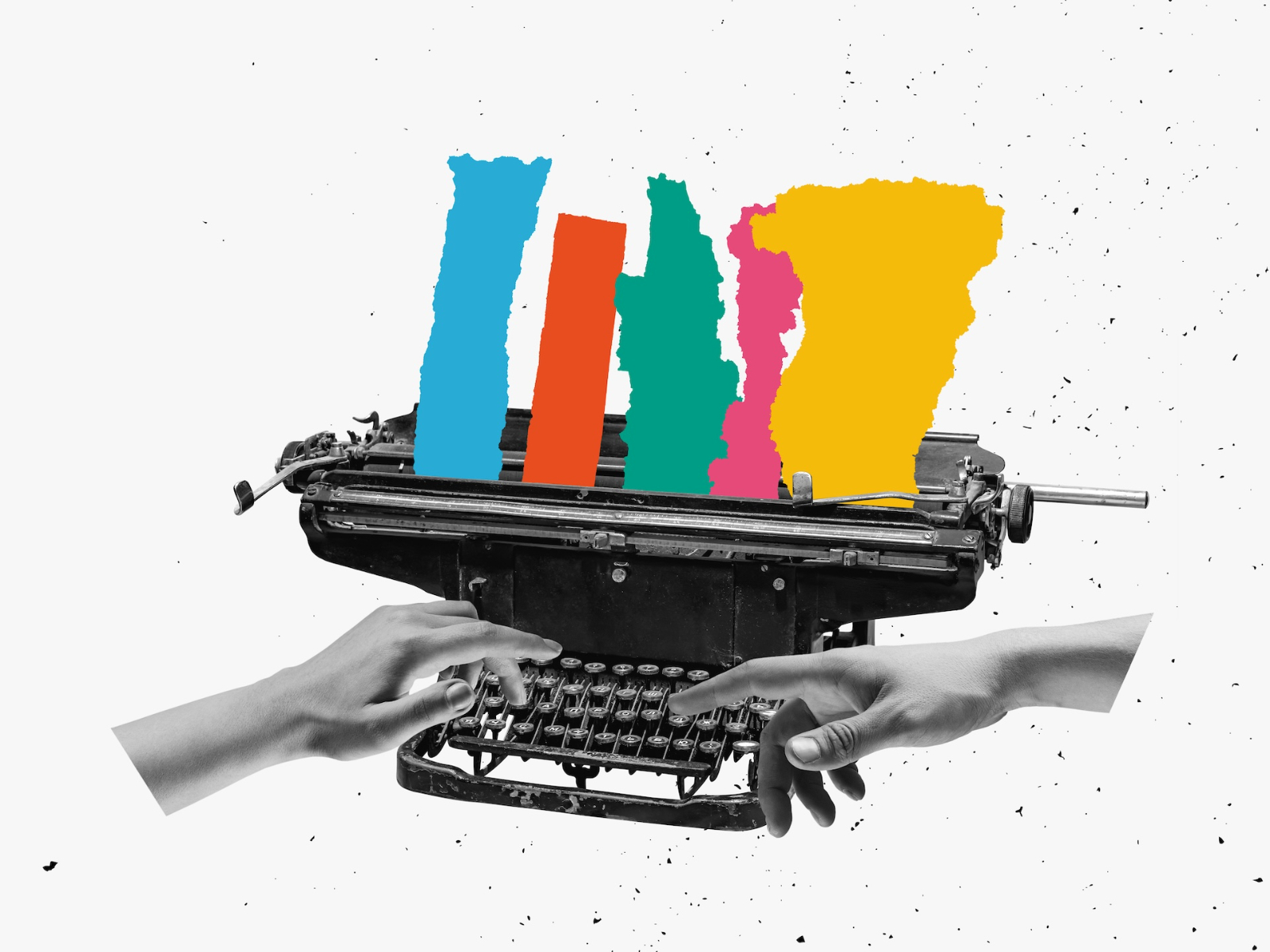
AI dictation can clean up spoken text and speed up replies, but writing is not a race. AstrianZ explains why composing at a keyboard is inseparable from thinking, revising, and finding the right words.
***
Editor’s note: A version of this article by AstrianZ appears on July 30, 2026 on SSPAI with the title “思考,不要说话”. Translated and published by agreement.
After the demise of Smartisan’s now-defunct TNT voice-driven desktop system, voice input has recently become a topic of conversation again. This time, the discussion was sparked by AI dictation tools led by Typeless. They claim that users can produce flawless text simply by speaking. Typeless has even added a “manifesto” to its website, confidently declaring that “Voice is our default”—all to underscore just how revolutionary the product is supposed to be.
One major reason conventional dictation falls short is that its algorithms tend to transcribe everything they hear verbatim. When we pause or start speaking before a thought is fully formed, the software puts it all into the output without a second thought. Newer tools such as Typeless and Wispr Flow pass the transcript through a large language model (LLM), remove filler words such as “um,” “uh,” and the like, interpret self-corrections such as “No, wait—what I meant was…,” and polish the result before placing it in the text field.
I first saw this in action on a friend’s phone. He demonstrated Typeless inside the ChatGPT app, speaking a long prompt in natural language and more or less saying whatever came to mind. On the surface, the final transcript was remarkably clean: Typeless removed all the filler words and even smoothed out the prose. In our group chats over the past few months, plenty of people have been lavish in their praise for it.
It all looked wonderful. But when I tried Typeless myself, the experience could not have been further from what I had imagined.
The first issue is disturbing other people. For me, Typeless is most useful when I am chatting with someone—but in precisely that situation, there may well be other people around me. Dictating chat messages in front of uninvolved bystanders feels a little like failing to read the room. (Typeless supposedly has a whisper mode, but I have not tried it, so I cannot comment on it.)
Still, this is at least a drawback users can work around. If you absolutely have to use Typeless in public, you can move somewhere empty or cover your mouth with your hand. What truly makes me want to keep Typeless at arm’s length is the sense that tools like it are taking my thinking process away from me.
To be fair, if most of what you do is send quick replies, Typeless can make you much more efficient. A lawyer friend in our group loves it because he needs to respond to clients quickly, and because those replies involve professional legal advice, each one also needs to be thorough. For him, using Typeless to dictate detailed, professional responses in very little time is an entirely sensible choice.
But my needs are different. Apart from chatting, a large share of my energy right now goes into producing written content. Ever since I last tried letting an LLM take the lead in my writing—and had a distinctly unpleasant experience—I have insisted on steering the drafting myself. I may use an LLM along the way, but at most to catch awkward sentences and typos, or to help me organize my thoughts (as I did for this piece).
Typeless and Wispr Flow both market an idea they want you to accept without thinking: because speaking is faster than typing, speaking must be the better input method. Wispr Flow has even launched a typing challenge: if you can type faster than you speak, you can win a Porsche. Such tests typically have you enter the same fixed passage twice—once by keyboard and once by voice—and compare the speeds.
But the problem is that, at least as I write this article, every part of writing and creating requires weighing and refining every word. A typical writing process for me looks like this: first, I decide how to express a sentence, and then I type it. I notice that a word is not quite right, select it with the trackpad, delete it, and consider what would work better. Sometimes I get halfway through and go back over what I have already written: “There’s an idiom that sums this up.” “This sentence is awkward.” “Is this really saying what I mean?” The questions vary. After finishing a first draft, I still have to read the whole thing from beginning to end, find what does not work, and revise it piece by piece.
So the claim marketed by these “revolutionary” dictation apps—that speaking is faster than typing—simply does not hold, at least when it comes to creating text. Writing original material is much slower than copying a set passage in a speed test. Put differently, creation is not a speed-first activity in the first place. Typing is, at heart, part of the thinking process: I put these words down, read them back, and decide whether they fit. That is very different from expressing myself in a linear stream that offers no easy way to go back and revise, forcing me to interrupt my own thinking with phrases such as “No, that’s wrong—I mean…” whenever I need to correct a mistake.
A couple of days ago, I wanted to share a passage in an instant messaging app and add my own note. A bug in the app’s macOS client caused garbled characters in its pop-up text field whenever I used a Chinese input method with a composition buffer. In a panic, I had no choice but to use Typeless. What followed was thirty seconds of hell. Speaking to Typeless, I kept saying things such as “um” and “you know,” and I repeatedly tripped over my words. In the end, Typeless could barely polish my verbal jumble into a coherent sentence. I had to write the note in another notes app and paste it in instead.
So, at least for me and my creative process, typing and speaking are not two interchangeable options. Creation is intellectual labor. Voice input tries to take my thinking process away from me and force me to outsource it, so naturally I do not see it as a better choice than keyboard input. From that perspective, both Typeless’s so-called “manifesto” and Wispr Flow’s typing challenge are castles in the air, built on an understanding of writing that ignores what creation actually entails.
A friend shared with me a passage from Italo Calvino’s Six Memos for the Next Millennium. I have not read the book, but I think this passage captures part of my own philosophy of writing with remarkable precision:
It seems to me that language is always used in a random, approximate, careless manner, and this distresses me unbearably. Please don’t think that my reaction is the result of intolerance toward my neighbor: the worst discomfort of all comes from hearing myself speak. That’s why I try to talk as little as possible. If I prefer writing, it is because I can revise each sentence until I reach the point where—if not exactly satisfied with my words—I am able at least to eliminate those reasons for dissatisfaction that I can put a finger on. Literature—and I mean the literature that matches up to these requirements—is the Promised Land in which language becomes what it really ought to be.
Featured image via Getty Images / Unsplash+
Share: