@路中南: Hagibis Qi2.2 Double-Sided Magnetic Wireless Charger
Reference Price: ¥99
In my review of that Qi2.2 charging stand with active cooling from the previous issue, I mentioned at the end that the Qi2.2 protocol itself has significantly improved thermal management, making passive cooling more than sufficient. I also casually suggested that those early-generation 7.5W magnetic chargers were probably due for retirement. Since I’d already said it publicly, I couldn’t exactly leave the charging spots around my own home untouched, so I ended up buying three different products to upgrade to the new standard. It also turned into a small comparison test of sorts:
Both passively cooled models place the power management chip on the USB-C end rather than inside the magnetic charging pad itself, separating the heat source from the charging surface and reducing heat buildup;
The budget model that cost around ¥40 felt underwhelming in both packaging and build quality. This Hagibis model looks far more polished and also supports double-sided magnetic attachment, which was the feature I was most interested in trying;
The actively cooled double-sided magnetic version costs even more and is positioned more toward gaming users. The cooling system is clearly the main attraction, while charging and RGB lighting are optional features that can even be turned off. It does seem ideal for running performance tests on a phone, though.
Double-sided magnetic attachment is a surprisingly clever design. What makes it clever is that it allows magnetic accessories to attach to other magnetic accessories. Any magnetic stand or charging base you already have at home can attach to one side, while your phone attaches to the other, instantly creating an additional Qi2.2 wireless charging spot. Buying it feels less like purchasing a charger and more like unlocking the potential of all those magnetic accessories you already own. Hagibis also sells matching desktop stands and magnetic semiconductor cooling accessories, but they aren’t cheap, so I skipped those.
Before buying it, I was worried that removing the phone might pull the charger off along with it. After testing, I found that the magnetic strength on each side isn’t the same. The aluminum-alloy side on the back has a noticeably stronger magnetic connection, so that concern turned out to be unfounded. Speaking of the aluminum alloy, it also contributes a bit to heat dissipation. Another advantage is that the Qi2.2 protocol can adapt dynamically to different input power levels and doesn’t strictly require a 15V/3A power source. In my testing, it worked perfectly fine with a 9V/2A adapter.
What really made this charger earn its keep, though, was an unexpected use case. A friend of mine drives a Tesla and absolutely refuses to use the built-in Baidu Maps navigation, insisting on using Amap on his phone instead. Tesla’s factory wireless charging tray charges slowly, makes navigation difficult to view, and turns the phone into a hand warmer. It’s basically decorative. So I bought another magnetic mount and installed it right below an air-conditioning vent. Snap this Hagibis charger onto it, and the problem is solved. Cool air blows directly onto the aluminum backplate while the phone runs Amap navigation. By the end of the drive, the phone stays cool and fully charged, with no need for additional active cooling at all.
@怡宝: Miwu Wireless Silent Mouse
Reference Price: ¥20
While browsing Xianyu, I came across this brand-new, still-sealed mouse. The seller even threw in a power bank (with wireless charging and 3C certification), and at just ¥20, it was simply too good a deal to pass up. Without thinking twice, I bought it. The seller also included a USB-C charger, so I’d say this bargain hunt was definitely a success 😝
This little mouse happens to fit my needs perfectly. Silence is my top priority, making it ideal for office use. As an introvert, the last thing I want is to disturb others while they’re resting, so a silent mouse is a must—keep love & peace. Compared to Bluetooth mice (I normally use a Logitech Pebble 2 at home, which still has a soft click sound), I actually prefer this type of mouse with a 2.4GHz wireless receiver. The receiver can be stored inside the compartment on the back of the mouse, so there’s no need to worry about losing it.
It measures 32mm × 115mm, with a cute, rounded shape that fits my relatively small hands nicely. For a ¥20 mouse, it even offers three DPI settings. Although the maximum is only 1600 DPI, that’s more than enough for everyday use. The red-and-white color scheme also pairs perfectly with my K3 Max keyboard. As someone with a bit of obsessive attention to visual consistency, that combination is incredibly satisfying to look at. It can even operate using just a single battery, which turned out to be unexpectedly practical. For ¥20, what more could you possibly ask for? 😄
@西鸽: Supor Modular Food Warming Tray
Reference Price: ¥246
I’m one of those working folks who has to get up at 6:30 every morning to cook. After preparing breakfast and lunch, I leave the dishes on the table, wash the rice, and set my Xiaomi rice cooker on a timer so everything is ready by the time my child comes home from school around 12:30. A while ago, my child took a plate of food to the microwave to reheat it. The plate came out too hot to handle and ended up being dropped on the floor. That’s when I started wondering whether there was a way to keep food warm so my child wouldn’t have to reheat it alone.
After looking around, I settled on a food warming tray. Some models in Supor’s lineup can even be used to keep a hot pot simmering directly on the surface. My needs, however, were much simpler: cook in the morning and keep the food warm until lunchtime.
The warming tray is made up of three modular sections. Most of the time, I only plug in the first section because I usually prepare just two dishes in the morning, and one panel is enough. It can be expanded to two or three connected sections, reaching a maximum size of 60 × 40 cm, which provides plenty of room for multiple dishes.
Before buying it, I did a bit of research. Some of the latest warming trays use flexible silicone mats that can be rolled up for storage. However, I figured a metal surface would be easier to clean. A quick wipe with a wet cloth and it’s spotless.
The model I bought is the 822D. It offers nine temperature settings ranging from 40°C to 120°C. Most of the time I simply leave it in the default warming mode, which is 100°C. Once warming mode is activated, the surface becomes noticeably hot to the touch in just over ten seconds. For the best heating performance, it’s recommended to use plates with completely flat bottoms rather than those with raised circular feet, allowing full contact between the plate and the warming tray.
There are also several other modes for tasks like defrosting and warming milk, though I rarely use them. I’ve heard people even use it to warm dried sweet potatoes or heat up socks. Living in southern China, though, I don’t think I’ll ever have a need for that.
Doubao Confirms Launch of Paid Subscription Service
Moonshot AI Launches Kimi Work Beta
OpenAI Expands Codex Use Cases
Amazfit Introduces the Balance 3 Smartwatch
CHERRY Unveils the XTRFY K63W Pro Gaming Keyboard
Longsys Announces AIDIMM and AILPBGA Memory Solutions
Doubao Confirms Launch of Paid Subscription Service
On June 3, AI assistant Doubao published a statement announcing plans to introduce Doubao Professional, a premium version designed for the productivity needs of professional users. The service will include specialized capabilities for software development, data analysis, professional design, workflow automation, financial analysis, and scientific research.
For everyday users, Doubao’s existing features—including search-based Q&A, writing assistance, image generation, voice conversations, and video chat—will remain free of charge. The company also stated that some Professional Edition features will be made available to users within certain usage limits at no cost.
Doubao emphasized that recent rumors regarding a paid version of the service are inaccurate. Doubao Professional is still undergoing testing, and further details will be announced at a later date. Source
Moonshot AI Launches Kimi Work Beta
On June 3, Moonshot AI announced that its large language model Kimi will gain a new Work feature, now available in beta testing. Kimi Work is a general-purpose local agent designed for knowledge workers and is being introduced alongside the latest beta versions of the Kimi desktop client for macOS and Windows.
Kimi Work supports agent clusters and can autonomously create a team of up to 300 sub-agents depending on task complexity, enabling it to handle more sophisticated and time-consuming workloads. Like similar products, Kimi Work also supports importing Skills to perform more specialized or professional tasks. The beta version is currently available on macOS, while the Windows release will arrive at a later date.
OpenAI Expands Codex Use Cases
On June 3, OpenAI announced an expansion of Codex’s capabilities, introducing six new professional role plugins covering 62 applications and 110 skills. The new plugins target data analysis, creative production, sales, product design, public equity investing, and investment banking. The data analysis plugin helps teams query business data, explain metric changes, and generate reports or dashboards through integrations with tools such as Snowflake, Databricks Genie, Hex, and Tableau. The creative production plugin is designed for marketing teams, transforming briefs into ad variations, campaign boards, product images, and lifestyle visuals.
In addition, OpenAI introduced a new Sites feature for Business and Enterprise subscribers, allowing users to create and share interactive hosted websites and applications. Codex can transform ideas, analyses, and plans into dashboards, planners, review workspaces, project boards, portfolios, and lightweight tools. These can be shared via URL with specific team members, providing a collaborative workspace for exploring projects, contributing ideas, tracking progress, and making decisions together. Annotation capabilities have also been extended to documents, spreadsheets, and presentations. Users can select navigation elements, investment thesis statements, or chart labels within slides and instruct Codex to modify only those specific sections. Source
Amazfit Introduces the Balance 3 Smartwatch
On June 3, Amazfit launched the Balance 3 smartwatch in overseas markets. The device features a stainless-steel body, measures approximately 14.6mm thick including the sensor module, and has a case diameter of 51.4mm. It is rated for 10ATM water resistance.
The front is equipped with a 1.5-inch AMOLED display with a peak brightness of 3,000 nits and comes standard with a sapphire crystal cover. In terms of health tracking, the Balance 3 supports 24/7 heart rate monitoring, blood oxygen tracking, skin temperature measurement, and stress monitoring. It can also detect abnormal heart rate conditions, low blood oxygen levels, and elevated stress levels. Additional features include sleep tracking and menstrual cycle monitoring.
The smartwatch supports more than 180 sports modes and includes a built-in GPS module for standalone activity tracking. Other features include a 658mAh battery, with Amazfit claiming up to 21 days of battery life under typical use and around 7 days with the always-on display (AOD) enabled. The device also includes a speaker, microphone, NFC functionality, and other smart features. The Amazfit Balance 3 is priced at $369.99. Source
Product image, courtesy of the original news source.
CHERRY Unveils the XTRFY K63W Pro Gaming Keyboard
On June 3, CHERRY’s gaming hardware brand CHERRY XTRFY introduced the world’s first gaming keyboard to support 8K UWB (Ultra-Wideband) wireless connectivity — the CHERRY XTRFY K63W Pro.
According to CHERRY, traditional wireless solutions used in peripherals often suffer from crowded and narrow communication channels. UWB technology, by contrast, transmits data using short-duration pulses across a much wider frequency spectrum, enabling more precise timing, reduced interference, and more stable communication.
The K63W Pro features a compact 70% layout and is equipped with the upgraded CHERRY MX LOW PROFILE 2.0 mechanical low-profile switches. It comes with ABS keycaps featuring laser etching and UV coating. Internally, the keyboard uses a gasket-mounted structure, supports an 8kHz polling rate, and includes a 6,000mAh battery capable of delivering up to 1,100 hours of battery life. The MX LP 2.0 switches have been redesigned with a smoother keystroke, improved stability, more consistent actuation, and a crisp yet fluid linear feel. An optimized lubrication process further reduces friction while enhancing both typing feel and key acoustics. The switches are rated for up to 100 million keystrokes. The keyboard will launch in Europe in early July with a suggested retail price of €179.99 (and the equivalent price in GBP), followed by a U.S. release in August with an MSRP of $169.99. Source
Product image, courtesy of the original news source.
Longsys Announces AIDIMM and AILPBGA Memory Solutions
At COMPUTEX 2026, Longsys unveiled two specialized memory products designed for on-device AI inference: AIDIMM and AILPBGA. Both solutions are based on LPDDR5X memory, feature a 256-bit wide interface, and support transfer speeds of up to 9600MT/s.
The AIDIMM architecture shares some similarities with server-side SOCAMM2 modules but has been specifically optimized for AI agent host systems. Its four LPDDR DRAM chips are arranged horizontally along the shorter edge of the module. Measuring 80mm in length and 30mm in width, the module supports capacities of up to 128GB and uses a tool-free high-pin-count connector.
AILPBGA, meanwhile, targets embedded AI inference scenarios where compact size is a key requirement. It offers capacities ranging from 24GB to 64GB and is fully compatible with standard LPDDR interfaces. The solution uses a 22mm × 22mm BGA1764 package, delivering high memory bandwidth while maintaining a compact footprint and a high level of integration. Source
Apple Announces Winners of the 2026 Apple Design Awards
Microsoft Build 2026 Roundup
Sony State of Play June 2026 Roundup
Trump Signs Executive Order on AI Regulation
Dashlane Admits to 2FA Brute-Force Attack Incident
Google Introduces Android Anti-Scam Calling Features and Expanded AirDrop Support
News Worth a Quick Look
Apple Announces Winners of the 2026 Apple Design Awards
On June 2, Apple announced the winners of the 2026 Apple Design Awards, recognizing 12 outstanding apps and games selected from 36 finalists. This year’s awards featured six categories, with one app and one game winning in each category. The winners are as follows:
Developers of the winning entries will be honored during WWDC26. Source
Microsoft Build 2026 Roundup
On June 2, Microsoft unveiled a range of new AI models and developer tools at Build 2026, including its in-house reasoning model MAI-Thinking-1, featuring 35 billion active parameters and a 256K context window; the MAI-Image-2.5 family with text-to-image and image-to-image generation capabilities, including a flash variant; the MAI Transcribe 1.5 audio model supporting 43 languages; MAI-Voice-2 and its flash variant; and MAI-Code-1, designed for GitHub. Microsoft also introduced Web IQ, an AI-powered web search technology, the Microsoft Scout personal work agent, and the open-source security evaluation project ASSERT alongside the Agent Control Specification.
On the hardware and systems side, Microsoft announced the Surface RTX Spark Dev Box, designed specifically for local AI model fine-tuning. Powered by NVIDIA’s RTX Spark chip, it delivers 1 petaflop of AI performance and 128GB of unified memory, enabling local execution of models with up to 120 billion active parameters. The system also incorporates a new sandboxing environment called Microsoft Execution Containers (MXC) for secure isolation. The device will launch later in 2026 through Microsoft’s online store in the United States. For cloud and developer services, Microsoft introduced a preview version of the GitHub Copilot desktop application, the managed backend service Rayfin, and Azure HorizonDB, a fully managed PostgreSQL database service. Source
Sony State of Play June 2026 Roundup
On June 2, 2026, Sony Interactive Entertainment hosted a new State of Play livestream presentation, showcasing more than 60 minutes of game announcements and updates.
On the hardware and first-party exclusive front, Santa Monica Studio revealed a new entry in the God of War franchise titled God of War Laufey. Insomniac Games confirmed that Marvel’s Wolverine will launch on September 15 and showcased new gameplay footage, while Firesprite Games announced that Until Dawn 2 is scheduled for release in 2027. Among third-party and multiplatform titles, Ace Combat 8: Wings of Sif was dated for October 2; Bancho The Chef, an independent prequel to Mintrocket’s Dave the Diver, was announced with extensive support for PS5 DualSense controller features; Remedy’s Control: Resonance and Konami’s Silent Hill: Townfall are both scheduled to launch on September 24; Tomb Raider: Legacy of Atlantis, a remake developed by Flying Wild Hog and published by Amazon Game Studios, is set for release on February 12, 2027; meanwhile, No Rest for the Wicked is scheduled to launch in October, and Onimusha: Way of the Sword will release on September 25, with a demo featuring the first 30 minutes of gameplay available immediately. Source
During the same event, S-Game founder and producer Liang Qiwei announced that the action title Phantom Blade Zero has been delayed from its previously planned September 9, 2026 release date to October 29, 2026. He also confirmed that pre-orders will begin this summer. The delay is intended to provide an additional 50 days for upgrading a number of character models and rebuilding selected environments, allowing the game to present more visually expansive and distinctive levels while maintaining a unified “Wuxia-Punk” aesthetic. The team also aims to preserve most of the visual fidelity of these upgrades without relying on ray tracing technology. In addition, two new videos will be released this summer, including a new gameplay trailer launching alongside pre-orders and a subsequent 15-to-20-minute deep dive presented during a dedicated Sony State of Play event, covering the game’s world-building, combat, exploration, and progression systems. Source
Trump Signs Executive Order on AI Regulation
On June 2, U.S. President Donald Trump formally signed an executive order aimed at introducing pre-release review procedures for powerful AI models. The order requests that certain AI companies voluntarily submit new models to the government for testing or evaluation 30 days before public release. Earlier drafts had proposed a review period of up to 90 days, but this was shortened following objections from industry executives, including David Sacks. The order explicitly states that it must not be interpreted as authorizing any mandatory government licensing, pre-approval, or market-entry system for AI models. It also directs the Department of Justice to prioritize AI-assisted hacking and unauthorized system access as key enforcement areas.
Due to strong opposition from within the technology industry, the order was ultimately signed privately by Trump and did not include the originally planned closed-door signing ceremony attended by leading Silicon Valley CEOs. Source
Dashlane Admits to 2FA Brute-Force Attack Incident
On June 2, password manager provider Dashlane announced that its two-factor authentication (2FA) system had been targeted by a brute-force attack, resulting in approximately 20 users’ password vaults being downloaded by attackers. Dashlane stated that the attackers used automated software to rapidly submit all possible numeric combinations in an attempt to bypass SMS or email verification codes while also trying to register new devices on existing user accounts. Due to the unusually high volume of login attempts generated by the attack, Dashlane’s security systems automatically locked affected accounts, blocked malicious traffic, and notified impacted users. Dashlane emphasized that the downloaded vaults remain encrypted unless attackers also possess the users’ master passwords. Source
Google Introduces Android Anti-Scam Calling Features and Expanded AirDrop Support
On June 3, Google announced new anti-deepfake call fraud and impersonation scam detection features for devices running Android 12 and later. The verification system requires both the user and the caller (Editor’s note: ?) to have Phone by Google installed, while the user must also use Google’s Contacts and Messages apps. When the system detects a call that may be spoofing a caller ID through network relays, it sends an authenticated RCS ping through Google Messages to the contact believed to be impersonated. If the recipient confirms that they did not place the call, the system displays a warning notification to the user.
At the same time, Google announced that the previously Pixel 10- and Galaxy S26-exclusive “Circle to Search” and Find the Look features will be expanded to all devices running Android 14 and later. Google Photos will also gain an AI-powered outfit image generation feature. In addition, Quick Share’s compatibility with Apple’s AirDrop ecosystem will be extended to more devices. Supported models include the Samsung Galaxy S25 series, Galaxy Z series, and Galaxy S24 series, as well as the OnePlus 15, Xiaomi 17T Pro, vivo X300 series, and Honor Magic V6, all of which will be able to transfer files directly with AirDrop-enabled devices through Quick Share. Source
News Worth a Quick Look
Nintendo Music is now available on the web, allowing users to browse all available songs and playlists on computers and large-screen devices without installing an app. In addition, recent updates to the Nintendo Music app have added support for tablets and in-car infotainment systems. Source
On June 2, Anthropic announced that it has expanded access to its Claude Mythos Preview model to more than 150 new organizations across over 15 countries. Claude Mythos is capable of identifying zero-day vulnerabilities within a short period of time. The newly added partners span sectors including energy, water utilities, healthcare, telecommunications, and hardware, and include organizations such as Okta, Samsung, SK hynix, SK Telecom, NATO, and the European Union Agency for Cybersecurity (ENISA). Source
On June 2, Withings introduced the BodyFit smart scale, designed specifically for users of GLP-1 medications. The device inherits the design of the company’s Body Scan product, supports body composition analysis and single-lead electrocardiogram (ECG) monitoring, and is priced at $280. Source
Prominent Chinese tech leaker @冰宇宙 (Ice Universe) shared key specifications and real-device mockup images of Samsung’s upcoming Galaxy Z Fold 8 series foldable smartphones on overseas social media platforms. According to the leak, a new model codenamed “Wide” adopts a wider chassis design, reduces weight to 201g, and features a new 50MP primary camera sensor capable of native 24MP output. Meanwhile, the Galaxy Z Fold 8 Ultra retains the same 215g weight as its predecessor while featuring a 5,000mAh battery with 45W charging support, alongside a thinner unfolded profile. Source
@ElijahLee: After 18 months of development and refinement, the renowned mobile photography app Halide has officially launched Mark III. We introduced the preview version of Mark III earlier this year, and now the final release is finally here.
The core of Mark III is its film-style system, known as Looks. Unlike traditional filters, Halide’s Looks dynamically adjust the image rendering pipeline based on shooting parameters, including color tone, contrast, highlights and shadows, film grain, film-like highlight bloom, HDR rendering behavior, and more. Lux specifically highlighted its collaboration with Hollywood colorist Cullen Kelly in developing the Looks for Mark III.
Currently, Halide Mark III includes five primary Looks:
Valencia: Designed for landscapes and urban photography, featuring strong contrast, high saturation, and clear color separation.
Rembrandt: Designed for portraits, emphasizing facial structure with pronounced midtone contrast and natural, consistent skin tones.
Nova: Ideal for vibrant landscapes, night scenes, and urban neon environments. Colors are highly saturated, highlights lean toward peach tones, and the overall look delivers a strong cinematic feel.
Zephyr: Suitable for a wide range of scenarios, offering gentle film-style contrast and natural skin rendering.
Chroma Noir: A black-and-white style characterized by moderate contrast and noticeable film grain.
The second major highlight of Mark III is that every Look supports HDR rendering. While preserving a film-inspired aesthetic, HDR allows significantly more highlight detail and richer shadow gradation. Lux also revealed that each Look actually has both SDR and HDR versions, meaning every style is powered by two separate rendering pipelines. Users can freely choose between them and enable or disable HDR within the settings.
The newly added Photo Lab introduces manual photo editing capabilities. Rather than being a full-featured image editor, it focuses on providing a fast and streamlined editing experience. Users can quickly switch between different Looks, toggle HDR and film simulations, adjust exposure, and use real-time previews to find the most suitable result. For those who need more control, a swipe through the tabs at the top reveals advanced editing options, including various photographic parameters, white balance adjustments, cropping, and horizon correction. Photo Lab also supports iPad, allowing users to edit photos on a larger screen.
As we mentioned in our earlier coverage, Mark III completely redesigns the app’s interface. After downloading the latest version of Halide from the App Store, users can tap the new ③ button on the screen to switch to Mark III. The default interface is now cleaner and more streamlined, keeping core functions such as focus, focal length selection, and RAW capture readily accessible, while moving most other controls into the “…” menu on the right.
Overall, Halide Mark III pushes innovation in digital film-style photography even further. By leveraging modern imaging technology, it significantly enhances the film photography experience while remaining easy to use. With just a few adjustments, users can create images that feel far more like finished photographic works. Halide can be downloaded for free from the App Store, but a paid subscription is required to access Mark III. Pricing is ¥68 per month, ¥148 per year, or a one-time purchase of ¥398.
Raycast for Mac v2: A New Era for Productivity Launchers
Platform: macOS
Keywords: Launcher, AI
@Vanilla: As one of the most successful newcomers in the Mac launcher space, Raycast has firmly secured its place among the top-tier productivity tools. With the recently released Version 2.0 update, Raycast has undergone another major round of improvements and refinements, pushing launcher applications into an era where they feel both all-in-one and indispensable. In the following sections, I’ll highlight some of the most important additions and changes in this release to help you better understand the new Raycast experience. If you’re unfamiliar with launcher tools or Raycast itself, you may want to start with our previous introduction article.
First, Raycast 2.0 introduces an entirely new design language, primarily created to align with the Liquid Glass aesthetic of macOS Tahoe. The interface is now more compact and streamlined, allowing more items to fit within the same window size. At the same time, Raycast has improved data interoperability across its ecosystem. For example, information retrieved through AI Chat can now be saved directly into Raycast Notes without leaving the workflow.
Second, Raycast’s file search functionality has become a genuine replacement for the system Spotlight search. In the new version, Raycast has upgraded its indexing engine, making file searches noticeably faster. More importantly, file searches can now be initiated directly from the main search interface, eliminating the need to first invoke a dedicated file-search command before entering keywords. This significantly improves workflow efficiency.
The Quicklink feature has also received a comprehensive overhaul. First, Quicklinks can now be pinned, allowing users to access them directly without searching by keyword. Second, multiple tags can be assigned when creating a Quicklink, making it easier to organize and filter results. Third, a new “Prefer Existing Tabs” option has been added to the settings; when enabled, Raycast will reuse tabs that are already open in the browser instead of creating duplicates. Fourth, when Finder or a browser window is active, creating a Quicklink automatically populates the current local file path or URL.
AI has also become a central pillar of the Raycast experience. In Version 2.0, Raycast not only redesigned the AI Chat interface, but also introduced features commonly found in modern coding assistants, including Agents, Memory, and Skills.
Finally, Raycast has launched a new speech transcription feature. It automatically detects the spoken language, transcribes the content without requiring manual language selection, and can automatically paste the result into the currently active application window.
Raycast v2 is currently available in beta. You can visit the official website to learn more about the update and download the client. I would recommend every Mac user give Raycast a try. It brings together nearly every productivity tool commonly used on macOS, works out of the box, and requires no knowledge of scripting or automation commands to get started.
Mactracker 5.0: Build Your Own Apple Product Collection Database
Platform: iOS / iPadOS / macOS
Keywords: Apple Product Database
@化学心情下2: As one of the world’s most influential consumer electronics companies, Apple’s extensive lineup of products released since its founding effectively tells the story of the evolution of modern consumer technology. Because of this, developers have compiled detailed information on Apple’s products over the years, making it easier for digital archaeology enthusiasts like us to explore some of the company’s most fascinating historical devices. Mactracker is one of the most well-known Apple product databases available today, offering comprehensive information through its Mac, iPad, and iOS apps. Recently, its mobile version received the major v5.0 update, introducing several noteworthy new features.
The most eye-catching addition is the new comparison feature, which works similarly to Apple’s own product comparison tool—much like when you’re considering a new iPhone in the Apple Store and want to compare it with the previous generation. In Mactracker 5.0, after locating a product, you can tap the “Compare” button in the upper-right corner to add it to a comparison list. Then, from the comparison page, tap the search button in the upper-right corner to add another product and compare both devices side by side on the same screen. Tapping the marker icon near the top of the screen highlights specifications that differ between the two products, making it easy to spot the key differences at a glance.
Another new feature is “My Models,” which is designed to catalog the Apple devices you currently own and use. Switch to the My Models section, tap the add button in the upper-right corner, and select “Change Model” to search the product database for your specific device, or allow the app to automatically retrieve information from the current device. You can also record details such as serial numbers and exact model identifiers, gradually building a personalized Apple product collection of your own.
As a feature that debuted in v5.0, My Models still feels somewhat basic at this stage. Beyond displaying your collection, the “Summary” view in the upper-right corner provides statistics on device categories, color variations, and release-year distribution. Thanks to iCloud Drive integration, this information can also be synchronized across Mactracker installations on your other Apple devices.
In addition, Mactracker 5.0 expands and refines parts of its database, including new MagSafe battery information for the iPhone Air and detailed entries covering the latest Apple operating systems.
If you’d like to carefully organize your own Apple hardware collection—or if you’re simply interested in Apple’s product history—it’s well worth giving Mactracker a try. The app is available as a free download from the App Store.
Caffeine Health: Maybe It’s Time to Cut Back on Coffee
Platform: Android
Keywords: Coffee Logging, Caffeine Tracking
@Peggy_: As the coffee market continues to expand, coffee drinks—once a relatively niche interest—have become increasingly mainstream. Coffee is now marketed much like milk tea, and many consumers casually drink two cups a day without much thought. At the same time, caffeine levels in milk tea products continue to rise, while energy drinks are being promoted more aggressively than ever. We have likely never consumed as much caffeine as we do today.
Caffeine has long been celebrated for its stimulating effects, but every coin has two sides. Excessive caffeine intake can disrupt sleep quality and negatively affect digestive health. Caffeine Health is an app designed to track caffeine consumption. By recording both the amount of caffeine consumed and the timing of intake, the app makes caffeine’s effects on the body visible and presents them clearly through charts and visualizations.
When first launching Caffeine Health, users are asked to answer a series of questions. Information such as age and body weight is used to estimate a personalized caffeine baseline. Users also provide their typical sleep schedule, allowing the app to recommend an appropriate time to stop consuming caffeine each day. To improve the accuracy of its recommendations, Caffeine Health also asks about habits such as smoking and alcohol consumption. Impressively, the app even cites scientific literature to support how these factors may influence caffeine metabolism.
Most caffeine-tracking apps focus solely on recording consumption data, but Caffeine Health also takes factors such as liver function and medication use into account—variables that many people tend to overlook in daily life.
After completing the setup process, Caffeine Health generates personalized recommendations. Based on my own data, for example, the app estimated that caffeine has a half-life of approximately five hours in my body, while the residual caffeine threshold likely to affect my sleep is around 44 milligrams. Of course, these values are only estimates. If you have a better understanding of your own physiology, the app allows you to adjust them later through the settings menu.
On the app’s home screen, the most prominent element is the chart displayed at the top. As you begin recording caffeine intake, the chart visualizes the timing of each consumption event and provides intuitive recommendations. Tapping “Add” allows you to start logging beverages. Caffeine Health includes a wide range of common coffee drinks for quick entry, as well as many popular energy drinks available on the market.
If you also enjoy caffeinated beverages such as cola or hot chocolate, Caffeine Health provides estimated caffeine content for those drinks as well. Since the app was not developed specifically for the Chinese market, some beverages and milk tea brands commonly found in China are not included in the database.
Using today’s coffee intake as an example, I had a homemade pour-over coffee at 9 a.m. and an Americano at 1 p.m. After accurately logging both the quantity and time of consumption, the home screen chart clearly showed how the caffeine from each drink was metabolized over time. It was easy to see that the caffeine from the morning pour-over had largely been processed and was unlikely to affect my sleep. The afternoon Americano, however, pushed my caffeine level significantly higher and would most likely have an impact on my sleep later in the day.
The greatest strength of this chart is that it quantifies caffeine metabolism in a meaningful way. Advice such as “don’t drink coffee in the afternoon” transforms from a generic warning everyone has heard into a concrete, data-driven visualization that is far more convincing. Additionally, whenever caffeine is consumed during a period that may affect sleep, the app provides appropriate warnings and recommendations. Over time, users naturally develop a better understanding of when they should be more cautious.
If Caffeine Health sounds interesting to you, you can download it through F-Droid and give it a try. The app is open source and completely free to use, although it does not currently offer a Chinese-language translation.
PairPods: A Simple Audio Sharing Utility for macOS
Platform: macOS
Keywords: Audio Sharing
@Snow: Two people sharing a pair of wired earphones has long been a classic romantic trope in movies and TV shows. But in a world dominated by true wireless earbuds, sharing a single pair no longer brings people physically closer—instead, it often means dealing with mono audio and uneven ear pressure. Fortunately, since Apple introduced Audio Sharing for AirPods in 2021, other manufacturers have gradually followed suit, giving wireless earbuds a much more elegant way to share audio.
Perhaps Apple has yet to realize the enormous potential of the Mac as a portable streaming machine, because enabling audio sharing on macOS still requires more than simply pairing Bluetooth headphones. Users must open Audio MIDI Setup, create a Multi-Output Device, and manually select the desired audio outputs before sharing can work. For average users, that’s a fairly high barrier. PairPods simplifies and visualizes the entire process. Whether you want to listen to music with a friend on a train or watch a horror movie with someone special in a tiny rented apartment, PairPods makes shared listening easy.
Before using PairPods, I have one piece of bad news and one piece of good news. The bad news is that you still need to follow the instructions and pair all Bluetooth headphones you want to share audio with manually through macOS. The good news is that PairPods is not limited to a specific ecosystem—any Bluetooth audio device compatible with macOS can be managed through the app.
Once your Bluetooth devices are connected, click the PairPods icon in the menu bar to open its pop-up panel, where all connected audio devices will be displayed. PairPods provides individual volume controls, sharing checkboxes, and sample rate information for each device. Some devices can even display their remaining battery level. Simply enable the “Share Audio” switch at the top of the panel, and the menu bar icon will turn blue while all selected devices immediately begin receiving shared audio.
When Audio Sharing is enabled, the system volume controls are disabled and PairPods takes over volume management entirely. Turning off the switch immediately stops sharing and routes audio to the device marked with the illuminated crown icon, while restoring the system’s normal volume controls.
That said, in the current version, switching audio output devices while Audio Sharing is disabled is not entirely seamless. On my MacBook Air, changing the crown-designated device alone had no effect; I had to toggle the Share Audio switch off and on again before the new output device became active.
To improve stability and usability when multiple Bluetooth devices are connected, the app also includes an automatic reconnection feature. Users can enable automatic reconnects and configure timeout intervals of 5, 10, or 30 seconds. In practice, however, this feature mainly helps reconnect headphones when you briefly move out of Bluetooth range and then return. It cannot solve connection drops caused by highly congested environments such as train stations or shopping malls filled with countless wireless devices.
PairPods is completely free and open source. You can download and use it from its GitHub project page.
MedTimer: An Open-Source, Local-First Medication Reminder
@化学心情下2: After being diagnosed with Generalized Anxiety Disorder (GAD), I found myself needing long-term medication and began searching for a tool that could remind me to take my medication accurately and consistently.
At first, I relied on to-do list apps for reminders. The biggest drawback, however, was their inability to provide detailed medication statistics—such as total doses taken over a week or the exact time each dose was actually taken. Later, I switched to dedicated medication reminder apps like Medisafe. Compared to the bare-minimum functionality of a to-do list app, Medisafe felt almost perfect: it includes a built-in medication database, allows users to search for medications and add daily reminders, offers multiple reminder methods beyond standard notifications, provides detailed usage statistics, and even unlocks professional medication guidance with its Pro subscription.
For someone like me, however, who has already been undergoing long-term treatment, Medisafe’s premium features and account synchronization weren’t particularly useful. What I really needed was a medication reminder app that worked entirely on-device. Since Android is my primary platform, the open-source MedTimer eventually caught my attention.
At the time of writing, I’ve been using MedTimer for over a year. The two features that impressed me most are its open-source nature and local-first philosophy. Being open source means there are no bloated commercial features that I’ll never use. Being local-first means I don’t need to synchronize account data—having reminders delivered reliably to my Android phone is all I need, and it perfectly matches my workflow.
Of course, compared to commercial alternatives, MedTimer still has some limitations. The most obvious one is that medications must be entered manually by name. In Medisafe, entering a brand name is usually enough to retrieve detailed medication information and dosage specifications. That said, manual entry has its advantages as well—you can organize medications however you prefer, and after all, the reminders are meant for your own use.
The next step is creating recurring reminders. Tapping the “New Reminder” button in the lower-right corner presents several reminder types, each accompanied by Chinese-language explanations. For my own needs, I selected “Scheduled Reminder.” Simply entering the dosage and time in the dialog box is enough to create a reminder. Afterward, tapping “Advanced Settings” unlocks additional options such as reminder status, recurring schedules, weekday-only reminders, reminders on specific dates each month, and more. There’s also an “Enter Actual Dosage” option, which allows users to record the amount actually taken when a reminder appears. This is particularly useful for tracking remaining medication supplies—especially psychiatric medications—and helps remind me when it’s time to schedule a prescription refill.
Once everything is configured, the MedTimer home screen displays the day’s medication schedule: when reminders were triggered, when doses were actually taken, and which medications still need to be taken today. In addition to the current day, users can also review records from the past week. There is also an “Add One-Time Medication Record” button on the home screen, making it easy to quickly log unscheduled doses.
The “Record Analysis” section provides a comprehensive view of recent medication history. The summary view shows overall adherence and completion rates, the list view displays individual records with medication names, dosages, reminder times, and actual intake times, while the calendar view organizes medication history by day. The entire treatment process becomes easy to review at a glance.
Overall, MedTimer is already a remarkably complete open-source, local-first solution. It not only delivers reliable medication reminders, but also records and analyzes medication history in detail, helping users avoid missed doses during long-term treatment. It even supports special scenarios, such as “sleep-in reminders” for weekends and holidays, allowing the first daily reminder to be postponed when sleeping later than usual. If you’re looking for a medication reminder app without excessive commercial features, MedTimer’s open-source and local-first approach makes it an excellent choice. The app is available for free with all features included through both the Play Store and F-Droid.
GitSync: Making Git Synchronization Easier on Mobile
Platform: Android
Keywords: Git
@大大大K: Originally designed for software development, Git has gradually found its way into many everyday workflows, from synchronizing knowledge bases to backing up configuration files. As these use cases become increasingly common, the demand for using Git on mobile devices has grown as well. Unfortunately, working with Git on a phone is rarely straightforward: command-line tools like Termux can be cumbersome, while traditional third-party Git clients often feel too geared toward power users. When I was looking for a Git-based solution to synchronize my Obsidian vault, GitSync turned out to be exactly what I was looking for.
Unlike many Git tools that overwhelm newcomers with complex terminals and command-line interfaces, GitSync adopts a clean and intuitive graphical interface. That simplicity doesn’t come at the expense of functionality, however. The app includes virtually all of the Git operations most users need on a daily basis. In addition to the standard workflow of cloning, pulling, committing, and pushing, GitSync supports full branch creation and switching capabilities. It even includes a visual interface for resolving Git merge conflicts. What impressed me most was that GitSync comes with its own file manager and a lightweight text editor with syntax highlighting. This allows developers to perform quick code reviews directly on their phones, while regular users can make simple edits to Markdown notes without switching to another app.
Another standout feature of GitSync is its flexible synchronization system. The app can automatically perform background synchronization whenever a specific app is opened or closed, and it also supports scheduled synchronization tasks. For users who prefer manual control, synchronization can be triggered through quick settings toggles or the app icon’s context menu. Personally, I prefer triggering GitSync whenever I open or close Obsidian, as it helps ensure my knowledge base remains fully synchronized. That setup does require enabling Android’s Accessibility Service, however.
Configuration is also remarkably user-friendly. GitSync supports OAuth authentication for popular hosting platforms such as GitHub, GitLab, and Gitea. It can also connect to self-hosted Git services through HTTP or SSH keys. In most cases, you simply follow the app’s setup wizard step by step, and everything is configured without much hassle.
Beyond basic Git functionality, GitSync also supports connecting to large language models through API keys, enabling AI-assisted Git workflows and content completion. This makes lightweight development tasks on mobile devices even more convenient.
Although GitSync is not a brand-new app, the growing popularity of AI-driven tools such as OpenClaw and Vibe Coding has sparked renewed interest in “AI-ready” knowledge bases, particularly Obsidian, along with the desire to access and manage them on the go. In that context, having a capable Git client that can handle a variety of scenarios becomes increasingly valuable.
Thanks to its combination of ease of use and comprehensive functionality, GitSync was featured on Obsidian’s annual tools list in 2024. If you have similar needs, this open-source and community-endorsed tool is definitely worth trying. The free version supports connecting a single repository, while the paid version allows multiple repositories to be managed simultaneously. The Google Play version additionally supports Git LFS and filter features. GitSync is available for download from both GitHub and Google Play.
App Briefs
Previous rumors suggested that Apple plans to introduce a standalone Siri app in iOS 27, featuring both text and voice conversations, conversation history, and more. Last week, Mark Gurman stated that he had obtained several screenshots of the app and shared them with readers.
NVIDIA unveils DLSS 4.5 Ray Reconstruction technology
NVIDIA introduces RTX Spark PC processors and the Surface Laptop Ultra
ASUS announces multiple new products
Intel reveals Xeon 6+ server processors and other new offerings
AMD launches new processors and graphics cards at Computex 2026
Huawei unveils the nova 16 series and several other products
The next-generation AV2 video codec standard is officially released
MiniMax launches the M3 model
Sennheiser begins sales of the MOMENTUM 5 over-ear headphones
iFLYTEK introduces the Fika smartphone-shaped E Ink reader
Bambu Lab launches the A2L 3D printer
Dell announces the new XPS 13
News Worth a Quick Look
NVIDIA unveils DLSS 4.5 Ray Reconstruction technology
On June 1, NVIDIA announced DLSS 4.5 Ray Reconstruction technology. The new technology will officially launch this August and will be available on all GeForce RTX GPUs, with support already confirmed for 38 games. DLSS 4.5 Ray Reconstruction replaces traditional hand-tuned denoisers with neural rendering, improving image quality in ray-traced and path-traced scenes. By integrating denoising and super-resolution into a single model trained on a significantly larger dataset, it can generate higher-quality pixels between sampled rays. Compared to previous versions, the DLSS 4.5 Ray Reconstruction model delivers 35% more computational capability and increases parameter count by 20%. Relative to DLSS 4.5 Super Resolution, the new model features deeper spatial awareness in every scene and makes more intelligent use of game engine pixel sampling and motion data, resulting in improved lighting accuracy, temporal stability, and motion clarity. The model is also accompanied by a dedicated developer masking tool, allowing developers to fine-tune parameters more precisely and further optimize image quality. Source
In addition, NVIDIA unveiled new RTX 50 Series graphics cards from partners including ASUS, Gigabyte, MSI, and PNY, alongside two RTX 50-powered laptops—the Acer Nitro 16 and Mechrevo Yaoshi 16 Air—as well as multiple new monitors, desktops, and other products. Source
NVIDIA introduces RTX Spark PC processors and the Surface Laptop Ultra
During its Computex 2026 keynote on June 1, NVIDIA announced the RTX Spark PC processor. The chip combines a 20-core Grace CPU developed in collaboration with MediaTek and an NVIDIA Blackwell RTX GPU featuring 6,144 CUDA cores, delivering up to 1 petaFLOP of AI performance. Manufactured using TSMC’s 3nm process, it includes 128GB of unified memory. RTX Spark is designed to enable creators, AI developers, and gamers to render massive 3D scenes exceeding 90GB, edit 12K 4:2:2 video, generate 4K AI videos, run local AI agents powered by 120-billion-parameter large language models with context windows of up to one million tokens, and play AAA games at over 100 FPS at 1440p resolution. Adobe is currently redesigning the architecture of Photoshop and Premiere to support RTX Spark, with the goal of delivering up to twice the AI and graphics performance. RTX Spark laptops feature an ultra-thin design measuring just 14mm thick and weighing only 3 pounds. They will be available in 14-inch and 16-inch sizes, with precision-machined aluminum chassis, OLED displays, and NVIDIA G-SYNC support. The first RTX Spark-powered products will include premium thin-and-light Windows laptops offering all-day battery life and high-end displays, as well as compact desktop systems. Products from ASUS, Dell, HP, Lenovo, Microsoft Surface, and MSI are expected to launch this fall, with Acer and Gigabyte models arriving later. Source
NVIDIA and Microsoft also jointly announced the Surface Laptop Ultra, powered by the RTX Spark PC processor. The device will be available in Platinum and Nightfall color options and features a 15-inch mini-LED PixelSense Ultra touchscreen with up to 2,000 nits of peak HDR brightness and a pixel density of 262 PPI. It will also feature the largest trackpad ever included in a Surface device, along with HDMI, USB-C, USB-A, SD card, and headphone ports. For power efficiency, Microsoft and NVIDIA have collaborated to implement the Microsoft Power and Thermal Framework on RTX Spark systems, maximizing performance while reducing power consumption during mobile use. This enables RTX Spark PCs to remain cool while delivering industry-leading efficiency. Microsoft is also enhancing Windows support for unified memory architectures, increasing the amount of system memory accessible to the GPU, allowing larger local AI models and more complex creative workloads to be loaded. The Surface Laptop Ultra is scheduled to launch later this year. Source
ASUS announces multiple new products
On June 1, ASUS unveiled a wide range of new products at Computex 2026.
Leading the announcements was the next-generation ProArt lineup of AI-focused creator PCs, including the ProArt P16 and P14 laptops as well as a new ProArt mini PC, all powered by NVIDIA RTX Spark processors. Both the ProArt P16 and P14 feature ASUS Lumina Pro OLED displays, while the ProArt mini PC delivers 140W of cooling performance within a compact 150 × 150 × 51 mm chassis and supports M.2 PCIe Gen 5 x4 expansion. Source
On the display side, ASUS and ROG jointly introduced more than ten new monitors. Updates include the ROG Swift 4K Dual-Layer OLED monitor, ROG Strix OLED gaming monitors, ROG Strix 5K gaming monitors, ProArt professional creator displays, TUF Gaming Series 5 monitors, and ASUS ZenScreen products. ASUS also announced the ZenScreen Duo MB14FCD dual-screen portable monitor, which combines two 14-inch 16:10 FHD IPS panels into a display area equivalent to approximately 20 inches. Another new product is the 13.3-inch ZenScreen Color ePaper MP13UC color E Ink display. Source
ROG also unveiled the ROG XBOX Ally X20 handheld gaming device. Finished in a black-and-gold color scheme, it features a 7.4-inch 120Hz ROG Nebula HDR OLED display with up to 1,400 nits of peak brightness. It is powered by the AMD Ryzen AI Z2 Extreme processor, paired with 24GB of LPDDR5X memory and 1TB of storage, and supports Auto SR image-enhancement technology. The device incorporates an Xbox-style eight-direction D-pad and TMR analog sticks, along with a native Xbox mode. The package also includes the ROG XREAL R1 (20th Anniversary Edition) gaming AR glasses. When connected to the handheld, the glasses can project a virtual 171-inch display at a viewing distance of four meters with a 240Hz refresh rate and support native 3DoF head tracking. Source
To celebrate the 20th anniversary of the ROG brand, ASUS also introduced the ROG Edition 20 Series featuring the same black-and-gold design language. The lineup includes the ROG Crosshair X870E Edition 20 motherboard, ROG Crosshair X870E Edition 20 graphics card, ROG Thor 3000W Titanium III Edition 20 power supply, ROG GR20 Edition 20 open-frame chassis, ROG NUC 16 Edition 20, ROG G1000 Edition 20 desktop PC, ROG Swift OLED PG27AQWP-G Edition 20 monitor, and the ROG Rapture GT-BE98 Pro Edition 20 router, alongside various accessories such as mouse pads, keycaps, mice, keyboards, gaming chairs, and backpacks. Source
Intel reveals Xeon 6+ server processors and other new offerings
At Computex 2026 on June 1, Intel unveiled the Xeon 6+ server processor family. Designed for cloud-native workloads and 5G core networks, the Xeon 6+ adopts the E-core architecture built on Intel’s 18A process technology. In terms of internal chip structure, each Clearwater Forest compute tile consists of six modules, with each module integrating four Darkmont E-cores, resulting in 24 E-cores per compute tile. By stacking 12 such compute tiles, Intel has created a flagship model with up to 288 cores, delivering extremely high core density and parallel processing capability. Xeon 6+ features up to 576MB of “enhanced low-latency” LLC cache and supports 12-channel DDR5 memory at speeds of up to 8000 MT/s. In terms of performance, Intel claims the flagship Xeon 6990E+ delivers up to 30% higher average per-thread performance than the AMD EPYC 9965. Under typical workloads, the Xeon 6990E+ can also provide up to 30% better performance per watt compared with similarly positioned EPYC processors. Compared to Intel’s own previous-generation Xeon 6780E, the company expects approximately 55% higher efficiency and an overall performance increase of around 126% in comparable scenarios. Source
Intel also previewed its next-generation Xeon processor, codenamed Diamond Rapids, scheduled for release in 2027. Diamond Rapids continues Intel’s large-die, modular design approach and adopts the enhanced Intel 18A-P process technology. It features a scalable SoC architecture while maintaining uniform memory latency. Core counts will increase by 50%, with strong single-threaded performance optimized for high-end IaaS workloads. The processor will deliver double the memory bandwidth through expanded channel counts and higher supported frequencies, while also adding support for PCIe Gen 6. Source
In addition, Intel introduced the next-generation Crescent Island GPU platform for AI data centers, emphasizing large memory capacity and energy-efficient inference performance. Crescent Island is based on Intel’s Arc Xe 3P architecture, which is also used in the integrated graphics of the current Panther Lake platform. It represents Intel’s latest high-performance graphics and compute platform for data centers. According to Intel, it is one of the company’s most powerful data center GPUs to date, offering up to 480GB of onboard memory per card, clearly targeting AI and high-performance computing (HPC) workloads that require large-scale models and datasets. For cooling, Crescent Island uses an air-cooled design and is rated for a 350W TDP. Intel says the card is designed to meet the demands of next-generation AI workloads and supports a wide range of data formats and low-precision quantization types, from native FP4 and MXFP4 to FP64, enabling both training and inference across different accuracy and performance requirements. Crescent Island is specifically optimized for AI inference while delivering higher performance density and lower overall data center operating costs. Source
AMD launches new processors and graphics cards at Computex 2026
At Computex 2026 on June 1, AMD announced several new products. The company first introduced two new 3D V-Cache gaming processors for desktop platforms: the Ryzen 7 5800X3D 10th Anniversary Edition for the AM4 socket and the Ryzen 7 7700X3D for the AM5 platform.
The Ryzen 7 7700X3D belongs to the Zen 4-based Ryzen 7000 series and is an 8-core, 16-thread desktop processor positioned below the highly popular Ryzen 7 7800X3D. In terms of specifications, the two processors share the same core count, cache configuration, and 3D V-Cache stacking design, with the primary differences being clock speeds. The 7800X3D features a 4.2GHz base clock and boosts up to 5.0GHz, while the 7700X3D runs at a 4.0GHz base clock with a maximum boost frequency of 4.5GHz. Both processors carry a default TDP of 120W. The 7700X3D retains 96MB of L3 cache, along with 512KB of L1 cache and 8MB of L2 cache, and uses TSMC’s 5nm FinFET process for the CPU cores alongside a 6nm I/O die. Memory support includes dual-channel DDR5 with capacities up to 128GB. AMD officially rates support at up to DDR5-5200 with two single-rank or two dual-rank DIMMs, and DDR5-3600 with four single-rank or dual-rank DIMMs installed.
The Ryzen 7 5800X3D 10th Anniversary Edition is AMD’s tribute to the 10th anniversary of the AM4 socket. Over the years, AMD has continued extending the lifespan of the AM4 platform with products such as the Ryzen 7 5700X3D and Ryzen 5 5500X3D, both featuring 3D V-Cache technology. The newly unveiled Ryzen 7 5800X3D 10th Anniversary Edition retains identical specifications to the original version, including its 8-core, 16-thread design, cache capacity, and clock speeds, meaning performance is expected to be unchanged.
The Ryzen 7 7700X3D will retail for $329 and launch on July 16, while the AM4-based Ryzen 7 5800X3D 10th Anniversary Edition is priced at $349 and will become available on June 25.
AMD also introduced EXPO ULL (Ultra Low Latency), a new memory overclocking technology. Built upon the existing EXPO memory profile overclocking system, EXPO ULL aims to further reduce DDR5 memory timings to deliver higher frame rates and smoother gaming performance on Ryzen platforms. The technology primarily focuses on lowering DDR5 CAS latency values. According to AMD’s demonstration, compared to standard JEDEC-spec DDR5-5600 CL40 memory, a DDR5-6000 CL28 EXPO ULL configuration can improve average gaming frame rates by approximately 13%, representing about four percentage points more performance than a conventional EXPO configuration on the same platform.
AMD also officially announced that it will extend the lifespan of its current mainstream desktop socket, AM5, through 2029. This means the platform is expected to support at least one more generation of Zen processors. While AMD did not explicitly name future products, industry observers widely interpret the announcement as confirmation that AM5 will support Zen 6 and related Ryzen 10000-series processors.
Finally, AMD unveiled the Radeon RX 9070 GRE graphics card. Positioned in the mid-range segment, the RX 9070 GRE features 48 Compute Units, 3,072 stream processors, 48 third-generation ray accelerators, and 96 second-generation AI accelerators. The card operates at a game clock of 2070MHz and can boost up to 2790MHz. Memory specifications include 12GB of GDDR6 on a 256-bit memory bus running at up to 20Gbps, providing 640GB/s of bandwidth, along with 48MB of AMD Infinity Cache. The card has a typical board power rating of 220W, requires a recommended 650W power supply, and uses dual 8-pin power connectors. It also features 96 ROPs and 192 texture units. Compared with the RX 9060 XT’s 128-bit memory interface, the RX 9070 GRE doubles memory bus width, although its 12GB memory capacity is lower than the 16GB found on the RX 9070 and RX 9070 XT. The Radeon RX 9070 GRE is priced at $549. Source
Huawei unveils the nova 16 series and several other products
On June 1, Huawei held its nova 16 Series and All-Scenario New Product Launch Event. Source
The nova 16 series includes the nova 16 Ultra, nova 16 Pro, and nova 16, all powered by the Kirin 9010S processor. Both the nova 16 Pro and Ultra feature 6.84-inch displays and a quad-camera rear setup. The Pro model includes a 200MP RYYB ultra-high-resolution large-sensor camera (F1.8 aperture, OIS), a 50MP RYYB periscope telephoto camera (F2.6 aperture, OIS), a 50MP ultra-wide macro camera (F2.2 aperture), and a Red Maple Color camera. The Ultra model upgrades the telephoto lens aperture to F2.2. On the front, both models feature a 50MP camera paired with a Red Maple Color camera, with an F2.4 aperture on the Pro and F2.2 on the Ultra. The nova 16 Pro offers IP65 dust and water resistance, a 7000mAh battery, and starts at RMB 3,899 (12GB+256GB). It is available in Sky Blue, Horizon White, Starry Black, and Iridescent Pearl. The nova 16 Ultra features IP68 and IP69 dust and water resistance, a 7000mAh battery, and starts at RMB 4,699 (12GB+256GB). Color options include Sky Blue, Horizon White, and Starry Black.
The nova 16 features a 6.68-inch display and a triple-camera rear setup consisting of a 50MP ultra-high-resolution camera (F1.9 aperture), a 50MP RYYB periscope telephoto camera (F2.6 aperture, OIS), and a Red Maple Color camera. The front camera does not include a Red Maple Color sensor. It is equipped with a 7000mAh battery, supports IP65 dust and water resistance, and starts at RMB 2,999 (12GB+256GB).
Pictured: nova 16 Pro
Huawei also introduced the nova 16z, powered by the Kirin 8020 processor. It features a 6.7-inch display and a rear camera system consisting of a 50MP ultra-high-resolution camera, a 12MP RYYB telephoto portrait camera with OIS, and a Red Maple Color camera. The device is equipped with a 6000mAh battery, supports IP65 dust and water resistance, and starts at RMB 2,699 (12GB+256GB). Available colors include Horizon White, Starry Black, and Iridescent Pearl.
The HUAWEI MatePad Pro Max is available in Glow Blue, Moonlight Silver, Deep Space Gray, and Obsidian Gray. It features a 13.2-inch display, with an optional Soft Light Edition equipped with a flexible OLED CloudClear Soft Light display. The tablet is powered by the Kirin T93 Pro processor, while the Enjoy Edition uses the Kirin T93. It packs a 10,400mAh battery and supports up to 40W wired reverse SuperCharge. The device weighs 499g and is only 4.7mm thick. The Enjoy Edition starts at RMB 5,999 (12GB+256GB), the standard Wi-Fi version starts at RMB 6,199 (12GB+256GB), and the Soft Light Edition starts at RMB 7,399 (12GB+256GB).
Huawei also announced the HUAWEI FreeClip 2 Collector’s Edition clip-on earbuds, the Huawei Lingxiao Q7 Powerline Mesh Router, the HUAWEI Watch GT Runner 2 Track Legend Edition, and the Huawei Nova Watch X1 and X1 Pro.
The next-generation AV2 video codec standard is officially released
The Alliance for Open Media (AOMedia) officially released version 1.0 of the next-generation AV2 video coding standard on May 29. Like AV1, AV2 continues to follow an open-source model centered on being efficient, royalty-free, and open. According to AOMedia, AV2 builds upon AV1 with further optimizations, enabling higher-quality video delivery at lower bitrates for evolving use cases such as streaming, broadcasting, and real-time video conferencing. It also enhances support for AR and VR applications, improves split-screen multi-program transmission and screen-content coding, and operates effectively across a broader range of visual quality targets. In terms of compression efficiency, official testing shows that AV2 reduces bitrate by approximately 28.63% compared to AV1 under the PSNR-YUV metric, while achieving a reduction of 32.59% under the VMAF metric, with virtually no loss in image quality. It is worth noting that AV2’s reference software, AVM (AOMedia Video Model), currently runs very slowly, with encoding speeds on mainstream hardware typically reaching only around one frame per second, meaning practical deployment is still a long way off. Source
MiniMax launches the M3 model
MiniMax officially launched its next-generation model, MiniMax M3, on June 1. The model combines state-of-the-art coding capabilities, up to 1 million tokens of context length, and native multimodal support, including image input, video input, and desktop computer operation. It is the first model in China to offer all three capabilities simultaneously and currently the only open-source model to do so. According to official benchmarks, M3 achieved a score of 59.0% on the SWE-Bench Pro programming benchmark, surpassing GPT-5.5 and Gemini 3.1 Pro while approaching Opus 4.7. It also achieved the highest score on the Claw-Eval agent benchmark and outperformed Gemini 3.1 Pro on the multimodal benchmark OmniDocBench. M3 is built on a new sparse attention architecture called MSA (MiniMax Sparse Attention), reducing per-token computation at a 1-million-token context length to just one-twentieth of the previous generation. The architecture delivers more than 9× acceleration during the prefilling stage and over 15× acceleration during decoding. Alongside the model launch, MiniMax updated its Agent product, MiniMax Code, and introduced a Token Plan subscription service, with Plus priced at RMB 49/month, Max at RMB 119/month, and Ultra at RMB 469/month. The M3 API is available immediately, while model weights and the technical report will be open-sourced within 10 days. Source
Sennheiser begins sales of the MOMENTUM 5 over-ear headphones
The Sennheiser MOMENTUM 5 over-ear headphones went on sale on May 31 with the slogan “Lossless Audio, Even Wirelessly,” priced at RMB 3,299. The new model features Sennheiser’s self-developed 42mm dynamic driver units. It supports major audio codecs including SBC, AAC, aptX, aptX HD, and aptX Adaptive, while also incorporating Snapdragon Sound TT technology and aptX Lossless support. This enables CD-quality lossless audio transmission (16-bit/44.1kHz) over Bluetooth. The headphones are Hi-Res Audio certified and support Dolby Atmos spatial audio. For noise cancellation, the number of microphones has doubled to eight. With active noise cancellation enabled, battery life can reach up to 57 hours, while a 10-minute charge provides up to 7 hours of playback. Source
iFLYTEK introduces the Fika smartphone-shaped E Ink reader
iFLYTEK introduced the Fika e-book reader on June 1. Designed in a smartphone-like form factor, the device is priced at RMB 2,399. It is available in “Aussie White” and “Iced Americano” color options, weighs 140g, and measures 6.7mm thick. The reader features a 6.13-inch 300 PPI Carta 1300 E Ink display, paired with a 32-level dual-tone front light system and the IFR 2.0 fast-refresh algorithm. It is powered by an octa-core MediaTek processor, with 6GB of RAM and 128GB of storage. Buyers receive 2GB of mobile data per month free during the first year. The device includes a 2,580mAh battery and offers up to 21 days of standby time. Source
Bambu Lab launches the A2L 3D printer
On June 1, Bambu Lab introduced the Bambu A2L 3D printer. The A2L features a single-nozzle design and supports a maximum build volume of 330 mm × 320 mm × 325 mm, representing a 105% increase compared to the A1. It incorporates an adaptive vibration compensation algorithm and built-in granular dampers within the frame to reduce print artifacts caused by vibrations. The printer supports quick switching between a blade-cutting module and a brush module. It also features active motor noise reduction, allowing operating noise to drop as low as 49 dB in Silent Mode. The standalone Bambu A2L is priced at RMB 2,549 and is eligible for government subsidies, with limited-time launch promotions available. Source
Dell announces the new XPS 13
On May 31, Dell unveiled the new XPS 13 laptop. Positioned against the MacBook Neo, the new XPS 13 starts at $699, weighs 1kg, and measures 12.7mm thick. It is powered by the Intel Core 5 320 processor, with Core Ultra 7 355 variants planned for a later release. Memory configurations include LPDDR5x-7467 MT/s, with 8GB to 16GB single-channel options at launch and future higher-end models offering 16GB to 32GB dual-channel configurations. The laptop features a 13.4-inch InfinityEdge touchscreen display. It supports Wi-Fi 7 and Windows Hello, and comes with a backlit keyboard. The device will go on sale in June. Source
News Worth a Quick Look
According to 36Kr, Doubao is expected to officially launch a paid subscription service in late June. In the third quarter, the platform is also expected to further integrate with Douyin E-commerce features and expand its monetization scenarios. Source
Leaker Ice Universe posted what appears to be a mock-up image of the rumored iPhone Ultra/Fold on Weibo. Source
Microsoft has announced that Fable has been delayed and is now scheduled for release in February 2027. Source
On June 1, iReader and WIKO respectively introduced AI-powered collectible companion devices called CreMoMo and Xingzai. Xingzai is powered by Huawei’s Xiaoyi large language model, while CreMoMo focuses on a growth-oriented, personality-driven AI companion experience. Source 12
Randy Pitchford, founder of Gearbox Software, the studio behind the Borderlands series, posted on X that a friend of his found what appears to be an unreleased Google Pixel Watch 5 while diving near Saint Martin, recovering it from the ocean floor. Source
Around my birthday, a certain brand’s “stringless guitar” went on sale, and I almost bought one as a gift for myself. But after thinking it over, I realized that while the concept and form factor were appealing—especially for complete beginners or people focused on singing and accompaniment—it still wasn’t really a true musical instrument.
That thought, however, led me in a different direction: if even entry-level electric guitars cost well over a thousand yuan, and there are already ready-made 3D-printable models online, why not just build one myself?
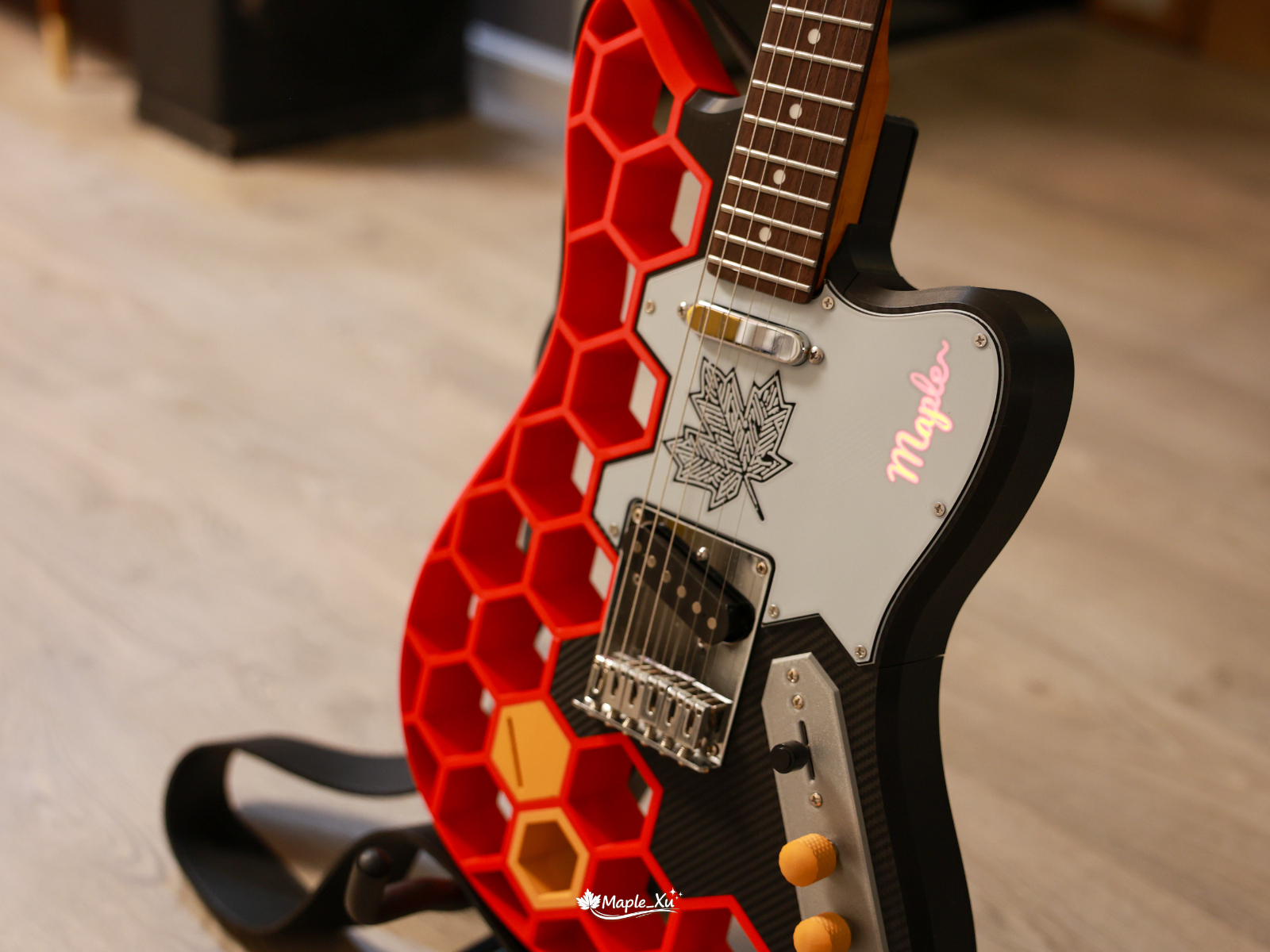
You always have to start with a few glamour shots of the finished product to grab everyone’s attention 📸
And so began a 20-day project (including the May Day holiday) full of trial and error. Starting from scratch, I learned how to solder, repeatedly reworked parts, burned through wires, snapped guitar strings… and eventually ended up with a fully playable electric guitar that cost only RMB 570 to build. This article documents the entire journey, including the lessons learned and pitfalls encountered along the way. Hopefully it can serve as a useful reference for anyone interested in trying something similar.
The “teaser” I posted on social media earlier—the snapped second string 💥 was actually edited in using GPT-image 🤖.
Project Overview: From Model to Finished Instrument
Overall Build Process
Choose the model → Select materials → Purchase parts and components → Decide on the color scheme → Design the pickguard graphics and LED effects → Plan the LED circuitry and switch placement → Print → Assemble → Tune and test
After carefully weighing the options, I ultimately chose the first model. Although the second model was created by a Chinese designer, featured a beginner-friendly Stratocaster-style body, and even included a built-in speaker, I felt it might introduce additional complexity for a first-time build. On top of that, I simply preferred the look of a Telecaster-style body, which sealed the decision.
The quality of the Bambucaster model is genuinely impressive. It is based on the Prusacaster—a design inspired by Prusa, the well-known 3D printer manufacturer—and there are even professionally produced build videos available on YouTube. The model includes a number of thoughtful improvements, such as heat-set threaded inserts for securing the body, slots for reinforcement rods to improve structural strength, and a rather eye-catching LED lighting system.
The only downside is that the original creator’s documentation is extremely concise. Looking back after completing the build, I can see that every point they mentioned was important. However, because I lacked some fundamental knowledge—both about electric guitars themselves and about electronics soldering—I ran into quite a few obstacles along the way. At one point I was even joking to friends that the instructions felt a little too “free-spirited” and assumed far more prior knowledge than a beginner would realistically have.
Material Selection: PLA Is Actually a Better Choice Than PETG
The materials discussed here mainly refer to the guitar body. The honeycomb section, the upper shoulder piece, and the pickguard do not appear to have particularly strict material requirements.
Most people would naturally assume that PETG is the stronger option. However, after taking a closer look at the Prusacaster blog, I discovered that what the guitar body actually needs is a material with greater stiffness to resist the tension of the strings. Somewhat surprisingly, the recommended choice is PLA. Of course, if you have access to them, PLA-CF or ABS would likely be even better options.
Since the body design incorporates reinforcement rods, my understanding was that standard PLA Basic would be perfectly adequate. The original designer used 8mm carbon tubes for reinforcement, but I opted for solid carbon rods instead. They feel more robust and sturdy, although inserting them requires a bit more effort. Cheaper hardened steel rods or linear shafts would probably work as well.
Buying the Parts: Skip the Kit, Source Components Individually for More Flexibility
The original model creator purchased a Harley Benton hardware kit from an overseas retailer. There are similar kits available on Chinese e-commerce platforms for around RMB 200, but after taking a look, I felt some of the components seemed rather rough and basic. After doing a bit more research, I realized that buying a kit is completely unnecessary—we don’t actually need the body or the pickguard included in those kits, since both will be 3D printed anyway.
Main Components: Neck, pickup, bridge, and electronics assembly (standard Telecaster-spec parts work perfectly fine)
Additional Components: String tree, strap buttons, output jack, and LED-related parts
LED Components: Lithium battery charging board, 1850B lithium battery, battery holder, three-pin two-position toggle switch, wiring, and bare-board LED strip
I’m extremely happy with the roasted maple neck I purchased. When it arrived, the finish looked absolutely gorgeous under the warm glow of the evening sun 🌇.
Color Scheme Design: Red, White, and Black as the Main Palette, Yellow as an Accent
This part took quite a while.
I’ve always been the indecisive type. My artistic instincts are fairly limited, and I often struggle to visualize how a finished project will actually look. I dragged a few friends into the process and collected plenty of opinions along the way. AI image generation turned out to be a huge help, although I quickly discovered that several mainstream models tend to forget previously established constraints after multiple rounds of generation. (A quick search later revealed that this is apparently a common problem.)
The red honeycomb section paired with a white pickguard was decided on very early. I also planned to use a black-and-carbon-fiber combination for the lower body. The upper shoulder section, however, became a source of endless debate. I kept going back and forth on whether it should match the upper body, and whether it should share the same color as the neck. Since the neck had not arrived yet, I spent ages comparing color codes and trying to imagine how everything would look together. As it turned out, the PLA WOOD ochre-yellow filament I eventually purchased ended up being surprisingly close to what I had envisioned. After weighing factors such as aesthetics and structural strength, I finally settled on a primary palette of red, white, and black, with yellow serving as an accent color.
Looking at the finished guitar now, I think it was absolutely the right decision. Three main colors are already plenty—adding more would have pushed the design into toy-like territory.
Back then, when I had Gemini generate various options, I’d always remember one line but forget the one before it 😅, which ended up wasting quite a bit of my budget 💸.
Pickguard Artwork + LED Design
The artwork was initially generated using Gemini. Once the image was converted into an SVG file, it could be imported into the slicer software and used as a printable part.
The biggest hurdle was the conversion process. I tried countless websites—most either required payment or simply failed to produce a usable result. In the end, the only solution that worked reliably was an open-source project I found on GitHub. I also had to tweak the print settings several times before preventing the finer sections from sticking too aggressively to the build plate and peeling off during removal. In total, I ended up printing three extra pickguards.
The pickguard itself contains a small hidden detail: it has a subtle starburst shimmer effect when it catches the light, although my camera failed to capture it properly. For the illuminated lettering, I asked AI to recommend a script font and ended up using Pacifico, which turned out great. The only minor flaw is that, in order to avoid the charging port, I had to leave a small gap in the LED strip. As a result, the top portion of the lettering is slightly dimmer than the rest. In hindsight, shifting the text a little lower would probably have produced a more balanced result. To make the pickguard translucent, additional slicer settings were required as well, including separate layer printing for the black middle section. The original designer provided instructions for this process, but the tricky part ended up being the math involved.
LED Circuit and Switch Installation: The Most Frustrating Part of the Entire Build
Without question, this was the part that drove me the craziest—and it consumed a considerable amount of time. Since it involved soldering circuitry and wiring switches, I had to learn basic electronics from scratch. The circuit itself was probably quite simple, but when you start with zero experience, even simple things require a lot of studying. I have to admit that AI and the internet made it possible to gain at least a working understanding of a field that was completely unfamiliar to me.
The constant rework was especially discouraging. The first time around, I genuinely thought I had succeeded, only to discover that I had assembled the components in the wrong order. During the re-soldering process, I accidentally created a short circuit, burned through some wiring, and very nearly damaged the printed parts as well. Thankfully, I caught the problem in time and managed to save everything before any major damage occurred. At the time, I even wrote a postmortem analyzing what had gone wrong. Fortunately, the second attempt went perfectly.
First attempt: complete disaster 😔 + lessons learned the hard way 💪When the LEDs finally lit up successfully, though, the sense of accomplishment was absolutely off the charts ✨.
Printing and Assembly Notes
There was nothing particularly unusual about the printing process itself, aside from modifying the model to suit my own preferences. The only notable change I made was flipping the bottom surface of the upper shoulder piece so that its finish would better match the rest of the guitar body. Another first-time experience was using transfer-texture build plates, including carbon-fiber and starlight-pattern finishes. One thing worth noting is that these plates generally provide weaker adhesion than PEI surfaces, so you may need to apply glue or thoroughly clean the plate when necessary.
Assembly Order
Body assembly → LED circuitry → Pickup and electronics assembly → Bridge → Neck → Strings → Small hardware (strap buttons, string tree, etc.)
Key Things to Watch Out For
Make absolutely sure to line the inside of the body cavity with copper foil shielding. After applying it, use a multimeter to verify electrical continuity. Otherwise, your Faraday cage won’t actually function—and that can lead to all sorts of fun noise problems.
I also strongly recommend testing the electronics before installing the pickguard and neck. Once the wiring is complete, connect everything and tap the pickup poles with a screwdriver to confirm the circuit is working correctly. Check that the volume and tone controls function as intended. Only proceed with the remaining assembly after you’ve confirmed everything is working perfectly. Trust me—it’s much better than having to tear the whole thing apart and start over.
These tips may sound simple, but every one of them was learned through repeated mistakes and rework. At one point I genuinely began to question whether I had any talent whatsoever for mechanical projects.
LED Charging Port
The original model was designed around a lithium battery charging board that is commonly used overseas. I replaced it with a smaller component sourced from Taobao, which created a whole new set of challenges. As a result, I spent a ridiculous amount of time adjusting the size of the charging-port opening. After several iterations, I enlarged the hole using negative modifiers in the slicer software, then finally solved the fitment issue with a combination of a hot-glue gun and an additional custom-printed spacer.
As for why I didn’t simply print the correct dimensions from the start—the answer is that I originally purchased a female connector that would allow the battery to be charged directly. Later on, however, that connector ended up being completely unnecessary. The full story is tied to my first failed attempt at soldering the LED circuitry. One thing I would do differently next time is use more hot glue. Since it was my first time working with a glue gun, I was overly cautious and didn’t apply nearly as much as I probably should have.
String Tree Installation on the Headstock
After doing some research and studying reference photos, I determined that the classic 1960s Telecaster placement for a string tree is near the tuner for the fifth string. There are also configurations that use two string trees. One of the pitfalls I ran into here was not having a 2.0mm drill bit on hand at the beginning. Since I would also need it later for securing the tuning machines, I ended up rushing an emergency same-day delivery order. Another thing worth noting: if you plan to apply a decal to the headstock, it’s probably best to do that before drilling any holes.
While we’re on the subject of drilling, here’s a small detail that might save someone else some trouble: clockwise is for drilling in, counterclockwise is for backing out. I actually managed to get that backwards on one or two holes. According to AI, drilling in reverse can slightly affect the structural integrity of the hole. Fortunately, the impact was minimal in my case. It was simply one of those beginner mistakes that comes from working with unfamiliar tools for the first time. With a bit more experience, it’s the sort of thing that should be easy to avoid in the future.
Potentiometer Assembly
This assembly’s button situation was both frustrating and oddly amusing.
The original creator barely mentioned anything about the LED-related setup and didn’t provide any photos, so at first I had absolutely no idea where the switch was supposed to go. Later, while browsing MakerWorld, I found plenty of other folks overseas who were just as confused as I was. In one of the replies, the creator finally clarified it—the switch was meant to be mounted on the assembly’s metal plate.
But that created another problem: the assembly I originally bought was higher quality, but it was difficult to disassemble, and drilling into the metal plate wasn’t exactly practical. In the end, I had to replace it with a cheaper assembly that was easier to take apart before everything fit perfectly (another +2 days added to the project timeline). The printed plastic button doesn’t feel quite as good as the original metal one, but for the sake of keeping the color scheme consistent, I had to sacrifice a bit of tactile feel.
Rear Neck Installation
I originally thought this would be the hardest step of the entire build, but in reality, drilling the neck mounting holes wasn’t nearly as difficult as I had imagined. First, I secured the neck in place and used self-tapping screws to leave guide marks, then marked the positions with a marker before drilling. Later, when installing the strings, I thought I had mounted the neck incorrectly and ended up removing and reinstalling it. That left a few small cracks around the edges of the holes, though that’s fairly normal.
Looking back, I’m glad I didn’t print the right-side shoulder section in a different color. Otherwise, the back of the guitar might have ended up looking a little strange.
Bridge + Two Pickups
These two components also brought their fair share of trouble. I bought discounted Korean-made parts. The first bridge pickup the seller sent arrived with rusty pole pieces. After they sent a replacement, a few days later, when I was installing the neck pickup, I realized I simply couldn’t get the screws to go in. It turned out the screw holes provided by the seller were slightly smaller in diameter. To the seller’s credit, they immediately refunded me. Faced with the choice of buying a new one or gambling on the possibility that a different screw might work, I chose the latter. Fortunately, M4×12 screws came through as hoped—though the project timeline was delayed by another two days.
So I’d still recommend spending a little more on higher-quality domestic products. Also, make sure to verify that the bridge mounting holes match your guitar body model. At the time, I roughly compared them using a template and thought everything looked fine, but during installation I found the fit was a bit cramped. Another thing to remember is to route the ground wire from the assembly underneath the bridge for grounding. And definitely install the neck pickup before installing the bridge—don’t ask me how I know.
Guitar Strap Buttons
Installing these was actually one of the final steps of the whole build, but I still lacked some basic knowledge. For example, I didn’t initially understand how the button mounting hardware was supposed to work. Surprisingly, the product page didn’t include any diagrams. In the end, I had to ask the seller for help, and they sent me a screenshot from another store’s listing before I finally understood it. Based on my needs, I replaced the included self-tapping screws (which were presumably intended for wooden guitar bodies) with M4×16 screws and nuts. At the same time, I also couldn’t figure out how to thread the strap correctly at first. Unfortunately, anything involving straps and buckles has always been a weak point for me. Thankfully, all of these little issues were eventually resolved. One hurdle after another—but each one got cleared in the end.
String Installation + Setup + Playing
From this point on, anyone with guitar experience can probably stop reading. The mistakes I ran into were almost entirely the result of having absolutely no prior experience.
The first time I installed the strings, I accidentally snapped the B string… Later I learned that it’s actually a good idea to keep a few spare high E and B strings on hand. One useful tip I picked up from a video was to leave roughly the length of two tuning pegs’ spacing of slack before winding each string, while making sure the wraps spiral downward around the post. This creates a more secure winding.
After watching a lot of videos, I felt that very few of them fully explained the proper setup order for an electric guitar. After piecing everything together, this is the sequence I came up with:
The Guitar Tuner app on my phone wasn’t able to accurately detect intonation adjustments, so I eventually had to buy a dedicated physical tuner. While researching further, I also discovered that the most cost-effective solution was to get an external audio interface, so I ended up buying a Focusrite 2i2 as well.
On Windows, you’ll need an ASIO driver that can work with both your speakers and the external audio interface.
At this point, all the “preparation work” can be considered complete. Now it’s finally time to start learning the guitar. And perhaps that’s where the hardest part really begins. 😀
Conclusion
Looking back, this 570 RMB would probably only be enough to buy a decent guitar neck in today’s instrument market. But for me, it turned into a complete electric guitar, a pile of soldering experience, a few late-night rework sessions, and that wonderful feeling of pressing down a string and thinking, “I made this sound myself.”
Of course, it’s far from perfect—the lighting at the top of the pickguard is a bit dim, there are small cracks around the neck mounting holes, and the potentiometer’s feel ended up being a compromise. But it’s precisely those imperfections that give this guitar its unique character. It’s not a master craftsman’s masterpiece; it’s something I spent 20 days building with my own hands, after falling into countless pitfalls along the way.
Sometimes, finishing something is more important than making it perfect.
Now it rests quietly in the corner of the room, fully strung and tuned, with the LED strip glowing faintly in the dark. I know I still have a long way to go before I can play a song well, but at least I already have a pretty cool starting point.
As for a sound demo—I’ll definitely add one once I can finally play a proper riff.
It seems that Summer 🐱 still needs a bit more time to get used to the new member of the household.
The Pirate Bay marks 20 years since its raid and shutdown, yet remains operational today
Qualcomm launches the Snapdragon C series to compete with MacBook Neo-class notebook PCs
Last.fm returns to independent operation
vivo unveils the vivo S60 series
Beijing Internet Court says a single case involving a minor’s in-game spending exceeded RMB 600,000
Bill Gates faces an unprecedented public image crisis
News Worth a Quick Look
Anthropic surpasses OpenAI in valuation
According to The Wall Street Journal, Anthropic recently completed a $65 billion funding round, doubling its valuation to $965 billion. This allows the company to overtake its main rival OpenAI and become the world’s most highly valued AI startup.
Unlike OpenAI, which initially focused on consumer-facing products, Anthropic has concentrated on enterprise customers and code automation. Late last year, its autonomous coding tool Claude Code sparked significant interest among developers. Thanks to this momentum, the company’s annualized revenue is expected to reach $50 billion in June, while second-quarter revenue is projected to double to $10.9 billion, marking its first profitable quarter. The pace of Anthropic’s valuation growth has already set a new record in venture capital history.
Computing power has now become the central battleground between the two AI giants. Earlier this year, OpenAI completed a $122 billion funding round and has been competing aggressively for enterprise customers with rival coding products. To keep up with stronger-than-expected business growth and break through infrastructure bottlenecks, Anthropic has reportedly signed a deal worth nearly $50 billion with Elon Musk’s SpaceX to gain access to the vast computing resources of the Colossus data center.
Financial markets are also closely watching a wave of upcoming AI-related public offerings. Reports indicate that OpenAI is expected to file for an initial public offering in the near future, while Anthropic is also aiming to go public as early as this year. In addition, SpaceX is reportedly preparing for an IPO around June 12, seeking a valuation exceeding $1.5 trillion.
The Pirate Bay marks 20 years since its raid and shutdown, yet remains operational today
According to TorrentFreak, May 31 marked the twentieth anniversary of the police raid on the infamous BitTorrent-sharing website The Pirate Bay. Despite years of pressure from the U.S. government, repeated server seizures, and prison sentences handed down to its founders, the site remains online today, living up to its self-proclaimed reputation as “the most resilient torrent site in the universe.”
On May 31, 2006, sixty-five Swedish police officers raided the Stockholm data center that hosted The Pirate Bay, attempting to permanently remove its servers. However, before the operation took place, co-founder Fredrik Neij sensed that something was wrong and rushed to back up all of the site’s critical tracker infrastructure. As a result, The Pirate Bay returned online just three days after the raid. Its homepage was renamed “Police Bay,” and it adopted a new logo depicting a phoenix rising from the ashes alongside a pirate ship firing cannons at Hollywood. The message was unmistakably mocking. Rather than destroying the site, the raid attracted widespread mainstream media coverage and triggered a surge in global traffic.
The driving force behind the operation was the U.S. government. Diplomatic cables later released to the public revealed that the Motion Picture Association of America (MPA) and the U.S. Embassy in Sweden had spent months pressuring Swedish authorities before the raid. The cables explicitly demanded firm action against what they described as a major offender openly disregarding intellectual property rights, and U.S. officials viewed the operation as a significant diplomatic achievement in the broader fight against online piracy.
As the criminal investigation progressed, several key founders were ultimately convicted and sentenced to prison. The original team subsequently severed ties with the website and transferred control to anonymous organizations registered in locations such as the Seychelles. From that point onward, The Pirate Bay adopted a lower-profile approach. Although it was forced offline for several weeks in 2014 following another data center seizure, the site continues to operate today under the stewardship of anonymous administrators working behind the scenes.
Qualcomm launches the Snapdragon C series to compete with MacBook Neo-class notebook PCs
On May 28, Qualcomm announced the Snapdragon C series of SoCs, designed specifically for entry-level Windows 11 devices with starting prices as low as $300. The first products powered by the new chips are expected to launch later in 2026, targeting lightweight productivity and media-consumption scenarios while competing against Apple’s MacBook Neo and the Chromebook laptops that have long dominated education and budget markets.
The Snapdragon C series emphasizes energy efficiency, fanless silent operation, and all-day battery life. Together with the premium Snapdragon X2 lineup, it forms part of Qualcomm’s next-generation PC processor portfolio. Unlike the high-performance Snapdragon X family, however, Snapdragon C does not utilize Qualcomm’s custom Oryon CPU architecture. In addition, while the chip still includes an integrated neural processing unit (NPU), cost considerations mean that most Snapdragon C laptops are expected to ship with only 4GB or 8GB of memory. This falls short of Microsoft’s 16GB requirement for Copilot+ PC certification, meaning these devices will not be able to fully support Windows’ advanced AI features.
Acer, HP, and Lenovo have already confirmed their participation as launch partners and are expected to introduce low-cost Windows 11 devices powered by Snapdragon C.
Last.fm returns to independent operation
On May 27, veteran music platform Last.fm announced on its official forum that it had formally separated from Paramount Skydance and returned to independent ownership nearly two decades after being acquired. The company emphasized that despite the ownership change, its products, services, and operating team will remain unchanged.
Addressing concerns that might arise from the transition, Last.fm assured users that all accounts, listening histories, subscription statuses, and linked payment information would remain fully intact. The company stated that additional details regarding the transition period and future plans will be shared in the coming weeks.
Founded in 2002, Last.fm originally began as an internet radio service. In 2007, CBS Interactive—later folded into Paramount Skydance through corporate mergers—acquired the company for $280 million. In 2014, responding to shifts in the streaming market, Last.fm shut down its $3-per-month subscription radio service and refocused entirely on cross-platform music tracking and listening-data analysis.
As a cross-platform music tracking tool, Last.fm allows users to connect services such as Spotify, Apple Music, and YouTube. Every song played generates a listening record known as a “Scrobble.” Using this Scrobble data, Last.fm can accurately collect and analyze users’ listening habits in real time, helping it maintain a loyal and dedicated user base over the years.
vivo unveils the vivo S60 series
On May 29, vivo officially launched the vivo S60 series. The lineup is built around a design language dubbed “Starlight Aesthetics,” featuring a unibody floating-light cold-carved glass finish. Its signature colorway, “Starry Sea,” employs a three-dimensional starlight lithography process that layers patterns onto the film surface, combined with lithographic de-metallization techniques and triangular prism etching to create varying shimmering effects under different lighting conditions.
The vivo S60 measures as thin as 7.79mm in certain color variants. All models feature a 6.59-inch display with a 144Hz eye-comfort panel, hardware-level low blue light technology, and support for brightness as low as 1 nit. The series also introduces Wet Finger Ultrasonic Fingerprint 2.0, capable of reliably recognizing sweaty or wet fingers in everyday unlocking scenarios.
For imaging, vivo has reworked its algorithms to address common Live Photo shortcomings such as soft image quality, inadequate stabilization, and inconsistent color reproduction. The result is 4K output for every frame of a Live Photo sequence. Combined with a gimbal-level primary camera system, the phones achieve CIPA 5.0 professional-grade stabilization. The series also includes “Starlight Live” lighting enhancement features and creative collage tools. In addition, it becomes the first smartphone lineup to support glasses-free 3D spatial image sharing directly to Xiaohongshu, expanding social photography possibilities.
The standard S60 model is powered by Qualcomm’s third-generation Snapdragon 8s mobile platform. Every model in the lineup comes equipped with a 7200mAh Blue Ocean battery, 90W fast charging, a VC liquid-cooling system, IP69 and IP68 dust and water resistance ratings, and SGS-certified drop and impact resistance.
The vivo S60 series is now available for pre-order and will officially go on sale on June 3. The lineup includes a Standard Edition and a Vitality Edition. Pricing starts at RMB 3,599 for the vivo S60 Standard Edition (12GB + 256GB) and RMB 2,899 for the Vitality Edition (8GB + 256GB).
vivo also introduced several new IoT ecosystem products. The new vivo over-ear noise-canceling headphones support up to 58dB active noise cancellation and seamless triple-device connectivity across ecosystems, priced at RMB 499. The vivo TWS 5e earbuds, focused on long battery life and low latency, are priced at RMB 229. Meanwhile, the vivo WATCH GT 2 smart watch has also received an upgrade.
Beijing Internet Court says a single case involving a minor’s in-game spending exceeded RMB 600,000
According to Beijing Daily, on May 28 the Beijing Internet Court held a press conference to release the White Paper on Judicial Protection of Minors in Cyberspace (2021–2026). The report shows that disputes involving minors have expanded beyond traditional gaming-related issues into emerging sectors such as blind-box purchases and online social interaction services. It also notes that some online products continue to encourage excessive spending, while unclear responsibility among platforms, streamers, and other stakeholders makes it more difficult for minors to defend their rights.
In May 2021, the Beijing Internet Court established China’s first internet juvenile tribunal. By May 2026, the court had handled 2,581 internet-related disputes involving minors, with an average annual increase of approximately 237 cases. According to the report, disputes have gradually expanded beyond gaming top-ups and livestream tipping into areas such as social networking, digital comics, blind-box consumption, online companionship services, and casual mobile games.
Online consumption disputes remain the most common category of cases. Individual livestream tipping disputes have involved amounts exceeding RMB 6.5 million, while the largest gaming top-up case surpassed RMB 640,000. In some cases, minors spent hundreds of thousands of yuan within a short period on lottery-style mini-games and blind-box purchases. The report argues that these disputes reflect both insufficient parental supervision and shortcomings in platform mechanisms related to anti-addiction systems, spending limits, and content moderation.
Bill Gates faces an unprecedented public image crisis
According to The Wall Street Journal, the carefully cultivated public image of Microsoft co-founder Bill Gates is facing an unprecedented challenge. Ongoing revelations regarding his relationship with the late convicted sex offender Jeffrey Epstein, along with reports of multiple extramarital affairs, have reportedly led to growing isolation for the 70-year-old billionaire in both business and philanthropic circles. Gates was absent from this year’s Microsoft CEO Summit and Berkshire Hathaway’s shareholder meeting, and is expected to face questioning from a U.S. congressional committee later this month regarding his ties to Epstein.
The controversy has reportedly weakened both Gates’ reputation and his network among influential figures. In addition to Microsoft distancing itself from him, longtime friend and renowned investor Warren Buffett is said to have become increasingly reserved. Buffett reportedly skipped a recent annual charitable gathering organized by Gates and stated that he would temporarily pause his annual large-scale donations to the Gates Foundation until he had fully reviewed recently released Epstein-related documents from the U.S. Department of Justice.
Within the Gates Foundation and affiliated organizations, employee concerns and uncertainty have also intensified. At an internal foundation meeting in February, Gates reportedly acknowledged having extramarital relationships with two Russian women, one of whom had worked for a nuclear energy company in which he invested. According to internal documents cited by The Wall Street Journal, critical media coverage of Gates and the foundation has increased by more than 40% since the release of the Epstein files. Governments in countries such as India have also reportedly canceled keynote speaking invitations due to concerns about negative publicity.
During his tenure leading Microsoft, Gates developed a reputation for aggressive behavior during antitrust battles. In response, his team spent years investing heavily in reshaping his image into that of a thoughtful philanthropist focused on global health and development. These efforts reportedly extended to details as specific as the style of sweaters he wore in public appearances, and even included attempts to influence or request changes to footage used in Netflix documentaries about him.
News Worth a Quick Look
According to Axios, Nvidia and Microsoft are expected to announce the first Windows PCs powered by Nvidia CPUs this week, including Microsoft Surface devices and products from third-party manufacturers such as Dell.
On May 29, Apple leaker Sonny Dickson shared a series of iPhone 18 Pro dummy-unit photos, providing the first physical look at four color options: Light Blue, Black (or Dark Gray), Silver, and a new Dark Cherry finish. Based on multiple earlier reports, the Dark Cherry color is expected to be relatively understated. The leaked dummy units are largely consistent with descriptions previously shared by Bloomberg’s Mark Gurman and other supply-chain sources. Chinese leaker @刹那数码 previously described the color as resembling the tone of red wine.
Mark Gurman also claims that:
Apple’s first smart glasses are now expected to launch in late 2027, with a target price between $200 and $500.
Apple has begun development of iOS 28 and macOS 28 (internally codenamed “Boppy”) as part of preparations for the 20th anniversary of the iPhone next year, with more substantial system updates planned.
New versions of Apple TV and HomePod mini are currently undergoing internal testing at Apple headquarters. The new HomePod mini is expected to receive an upgraded processor capable of supporting Apple’s latest AI features. Both devices were previously delayed while Apple continued work on the next-generation Siri and Apple Intelligence platform, but they are now reportedly scheduled for release this fall.
A single cassette tape preserves the final night of three teenagers’ high school lives—and captures a carefully curated soundtrack of the era from the creators themselves.
Release Date: May 7, 2026
Platforms: PS5, Xbox Series X|S, Nintendo Switch 2, PC
Developed by Australian indie studio Beethoven & Dinosaur and published by Annapurna Interactive, Mixtape carries the musical DNA that has long defined the team. The studio’s creative director—and the creative director of this project—Johnny Galvatron is himself a musician, having previously served as the lead vocalist and guitarist of the band The Galvatrons. Beethoven & Dinosaur’s previous title was 2021’s The Artful Escape, a psychedelic music-themed platformer heavily inspired by David Bowie and his stage persona Ziggy Stardust.
Mixtape is set in Northern California in the late 1990s. Players take on the role of Stacy Rockford, a teenage girl who has dreamed of becoming a music supervisor since she was eight years old. Together with her friends Van Slater and Cassandra “Cass” Morino, she spends the final night of high school on the way to a party, reminiscing about the years they spent growing up together. In terms of gameplay, I feel the core experience lies in following the creators’ cinematic direction and immersing yourself in the narrative. Despite its musical theme, this is not a rhythm game. Instead, the journey is punctuated by a handful of light simulation-style minigames. Overall, the action elements are minimal, and players are unlikely to encounter traditional failure states. The entire experience lasts around three hours, and its cinematic presentation naturally reduces the emphasis on player input. This has drawn some criticism, but instinctively I find it perfectly acceptable—after all, the story takes place over the course of a single night. Why shouldn’t it be told in a concise and focused way?
Built with Unreal Engine 5, the game’s audiovisual style is particularly striking. You can clearly see the influence of stop-motion animation techniques, and the deliberately reduced frame rate occasionally evokes the look and feel of Spider-Man: Into the Spider-Verse. According to Galvatron himself, as well as numerous media reviews, Mixtape pays extensive tribute—both in tone and visual design—to the coming-of-age films of 1980s filmmaker John Hughes. One major sequence even serves as a direct homage to Ferris Bueller’s Day Off. The trailers already showcase plenty of playful visual touches. One moment, which I personally suspect references the music video for “What Is Love,” features a clearly 3D-modeled car driving through a cityscape rendered in the fuzzy aesthetic of an old VHS recording rather than pristine high-definition imagery. It makes me eager to discover just how many thoughtful details like this are hidden throughout the full game.
The audio side is even more distinctive. Mixtape grows almost entirely out of Galvatron’s personal memories, placing music at the center of every aspect of its storytelling. In interviews with outlets such as Kotaku, Galvatron explained that the entire project originally began with what he considers his all-time favorite song: “That’s Good” by Devo. The team ultimately secured licenses for more than twenty tracks from artists including Devo, Roxy Music, Smashing Pumpkins, Iggy Pop, Joy Division, Siouxsie and the Banshees, The Cure, and Lush. During development, the team genuinely approached the game as if they were assembling a mixtape. They treated the entire experience as a playlist, repeatedly playing through it from beginning to end, feeling the emotional rise and fall, and adjusting songs, scenes, and moods accordingly.
The soundtrack choices reflect Galvatron’s own experience growing up in Australia during the 1990s. Silverchair dominated his life from the age of thirteen. Smashing Pumpkins’ “Love” entered his world as a gift from a relative when he was fifteen. Roxy Music’s “More Than This,” meanwhile, came from the musical education his father had been giving him since childhood. In an interview with ScreenRant, Galvatron spoke about his fascination with stories that exist “on the edge of a cliff where everything is about to change and there’s no going back.” He also encourages players to “become obnoxious about the things you love.” I deeply admire and appreciate that kind of sincerity.
To be honest, I’ve never been a particularly serious music listener. When friends bring up a famous song, I often feel as though I’ve heard it somewhere before but can never quite place it. My exposure to Western popular music between the 1990s and 2010s was especially limited. It’s only in recent years that I’ve begun to spend more time appreciating classic artists such as Queen and Arctic Monkeys. So, somewhat embarrassingly, the youthful era that Mixtape lovingly revisits and celebrates feels, for me, like a reunion that arrived long after the fact. Yet that is precisely why I connect so strongly with its approach to nostalgia. Great music is like a preserved fragment of a beautiful moment in time. Even if you never lived through it yourself, it can still touch that part of you that longs for nostalgia. And besides, I really did grow up during a period—the 1990s and the turn of the millennium—that was worth remembering.
007 First Light
The studio behind Hitman has taken on the challenge of adapting James Bond. How will Agent 47’s creators differentiate Bond from their iconic assassin? The question has captured everyone’s attention.
Release Date: May 27, 2026
Platforms: PS5, Xbox Series X|S, Nintendo Switch 2, PC
Developed by Danish studio IO Interactive, the creators of the Hitman series, 007 First Light is built using the company’s proprietary Glacier engine. Following the critical and commercial failure of 007 Legends in 2012—which ultimately led to Activision losing the Bond license—this marks the first major, fully fledged James Bond game in many years.
IO began dedicating its full development efforts to the project after the completion of Hitman 3. The game tells a completely original Bond origin story inspired by Ian Fleming’s novels and decades of classic Bond films. The protagonist’s youthful and inexperienced characterization is deliberately designed to distinguish him from the Bond audiences know from the movies. Players step into the shoes of a 26-year-old James Bond, still green and unpolished as an MI6 operative, undertaking a mission that could earn him the coveted “00” designation—and the license to kill. In an interview with Game Informer, narrative and cinematic director Martin Emborg explained that the studio wanted a young man with rough edges. Meanwhile, familiar figures such as M and Q have been intentionally given traits that audiences recognize as quintessentially Bond-like, gradually guiding the protagonist toward becoming the Bond we know.
Like many players, I was particularly curious about one question: after spending so many years perfecting Hitman, would IO simply build 007 on top of the same framework, or attempt something entirely new? And if it chose the latter, could the studio pull it off? Based on what we have seen so far, First Light clearly carries over many of the design philosophies that defined Hitman, including broad-linear sandbox levels and objectives that remain fixed while solutions are left up to the player. However, IO has repeatedly emphasized that First Light is not merely a Bond-themed reskin of Hitman:
First, pacing. Hitman can be slow, methodical, and puzzle-like, allowing players to study a situation and carefully orchestrate the perfect assassination—though charging in guns blazing has always been an option. While First Light still supports both stealth and direct-combat approaches, the game is much more inclined to keep players moving forward.
Second, identity. According to IO, you are playing a spy, not an assassin. As a result, infiltration, investigation, and eavesdropping on conversations play a much larger role, while executing the perfect kill is no longer the central objective.
Third, action. In the Hitman series, open combat is generally treated as a last resort. Here, players are no longer meant to feel punished or “ashamed” for engaging in large-scale fights. Drawing inspiration from Batman, the game expands hand-to-hand combat with more elaborate combo systems, incorporates blockbuster set pieces reminiscent of Uncharted, and even introduces drivable vehicles. That may sound like a small step for the action genre, but it is a giant leap for IO Interactive itself—the studio even hired specialists in vehicle gameplay specifically for the project.
ZERO PARADES: For Dead Spies
The post-Disco Elysium era of ZA/UM officially begins.
Release Date: May 21, 2026
Platform: PC
This new espionage-themed title comes from ZA/UM, the studio behind Disco Elysium. Around 2022, many of the game’s core creators departed from ZA/UM, including producer Robert Kurvitz, art director Aleksander Rostov, and writer Helen Hindpere, none of whom remain at the studio today. The driving force behind ZERO PARADES is arguably the most prominent figure among those who stayed: Siim “Kosmos” Sinamäe, a producer on Disco Elysium, serves as the lead writer. He is joined by co-writer Honey Watson, a novelist who joined the studio more recently.
ZA/UM has repeatedly stressed that this is neither a sequel nor a spiritual successor to Disco Elysium. Even so, the game clearly inherits much of its predecessor’s DNA in both gameplay and visual design. Players take on the role of female agent Hershel Wilk, codenamed CASCADE. Five years after a disastrous intelligence operation, she is released from confinement and sent on a covert mission to the city-state of Portofiro—the very place where an intelligence network was exposed and where she, as the person in charge, was forced to flee. In practice, the game is an isometric, combat-free narrative RPG. Players explore Portofiro’s districts, converse with residents, investigate objects, and gather clues through a series of skill checks that gradually advance the story. Like the protagonist of Disco Elysium, Wilk possesses a highly active mind, and many of the game’s checks are tied to different aspects of her psyche. At first glance, it may sound like more of the same.
In terms of subject matter, however, this is a spy story. According to interviews with outlets such as Polygon, the developers believe that the world of espionage inherently lacks clear-cut notions of right and wrong, making it a natural fit for this type of system. The spies they envision are nothing like the 007-style agents mentioned earlier. In fact, they joke that the best spies are middle-ranking civil servants, while James Bond is perhaps the worst spy imaginable—“you can spot him from miles away, and everything around him is on fire.” Both writers have stated that the game draws its primary inspiration from the spy novels of John le Carré. Watson argues that compared with Bond, le Carré’s work contains far more rationality and introspection, which aligns perfectly with what ZERO PARADES hopes to explore: an ordinary person committing “petty, ugly deeds” in the name of intelligence work.
It is also worth revisiting the personnel earthquake that shook ZA/UM. The studio was founded in 2016 by Estonian novelist Robert Kurvitz, and Disco Elysium itself was adapted from his literary work. After the game launched, it swept up numerous Game of the Year awards and secured its place on countless “greatest games of all time” lists. Success, however, was followed by a tangle of legal disputes involving studio members and stakeholders. In 2022, Kurvitz and several other key creators left the company involuntarily (thank you, PC Gamer). Plans for both a prequel and a sequel to Disco Elysium were subsequently canceled, while ZA/UM underwent multiple rounds of layoffs. Those who left went on to form their own studios—such as Longdue and Summer Eternal—each developing its own contender for the title of “heir to Disco Elysium.”
Faced with this heavy and complicated history, the current developers appear surprisingly at peace. In an interview with RPG Site at GDC 2026, when asked why players should not dismiss the game simply because several key creative figures had departed, both writers responded with variations of “a good game speaks for itself.” Watson expanded on the thought: “Rather than spending our energy proving we can make a good game, we’d rather just make one.” I have to admit, that response genuinely piqued my interest, because I have an endless appetite for CRPGs like this.
For me, Disco Elysium was once my number one “game of a lifetime” (until I encountered Phantom Liberty). So when I first heard about everything that had happened to ZA/UM, my feelings were complicated. On one hand, I mourned the hardships endured by the original creators and worried about the uncertain future of any successor projects. On the other hand, I felt a strange sense of acceptance. Perhaps works with this kind of spirit really do require a touch of obsession, a touch of madness. For a while, I even thought I might deliberately avoid ZA/UM’s so-called “official spiritual successor.” But now that so much time has passed since the original team underwent its creative mitosis, that sense of acceptance has ultimately won out.
[Empathy — 10] I’m ready.
Forza Horizon 6
The Horizon Festival has finally arrived in Japan—a destination fans of the series have been calling for for years.
Release Date: May 19, 2026
Platforms: Xbox Series X|S, PC
Developed by Playground Games and published by Xbox Game Studios, Forza Horizon 6 was officially unveiled during Tokyo Game Show (TGS) 2025. A PS5 version has also been confirmed and is being developed collaboratively by Playground Games and Turn 10 Studios, with release planned for later this year.
After years of fan requests, the winds of the Horizon Festival have finally blown across Japan. Now free from the technical constraints imposed by the Xbox One generation, Playground Games decided the time had come to deliver a world that distills Japan’s most iconic elements into a single, highly concentrated experience. Centered around Tokyo and surrounded by dramatic mountain landscapes, the game features the largest map in the series’ history. According to the developers, the area of “Tokyo City” in Forza Horizon 6 is five times larger than Guanajuato, the main city from the previous game. It recreates landmarks such as the Shuto Expressway C1 Loop, Shinjuku Gyoen, and the famous ginkgo-lined avenue outside Meiji Jingu Gaien. Beyond the city lie the Japanese Alps, Mount Haruna (the real-world inspiration for Mount Akina), the Hakone mountain roads, Arashiyama, and numerous scenic routes that conveniently pass by breathtaking sights—including locations reminiscent of Kinkaku-ji. The result is a map that condenses a remarkable number of Japanese destinations into one space, creating what may be the series’ densest and most vertically layered world to date.
In the game, players arrive in Japan as visitors. After demonstrating their driving skills, they are welcomed into the Horizon Festival, opening up the franchise’s signature open-world formula. Players are free to roam the map, discover new locations, enjoy scenic views, participate in races and activities encountered along the way, smash bonus boards, and visit photo spots. These activities reward points that can be used to upgrade vehicles, expand garages, and unlock new opportunities. One of my favorite aspects of the Horizon series has always been its ability to offer “virtual tourism,” and the developers continue to push the visual experience further with each installment. Alongside the larger map and expanded scenery, the dynamic seasonal system that returned in Forza Horizon 4 has been further enhanced. Special attention has been given to iconic locations featuring cherry blossoms and golden ginkgo leaves. According to a developer Q&A published on Xbox Wire, the team placed enormous emphasis on authenticity, obsessing over details ranging from the sounds of city streets at dusk to the meanings behind shop signs and color choices. Their goal was to create an atmosphere convincing enough even for people deeply familiar with Japan.
I wouldn’t consider myself a car enthusiast, but I have experienced quite a few works associated with both “Japan” and “street racing,” and they all left a strong impression on me. Initial D hardly needs mentioning. Even now, I can vividly remember the nighttime Tokyo race sequence from Cars 2, as well as The Fast and the Furious: Tokyo Drift. Having traveled in Japan myself, I naturally developed a set of expectations for Forza Horizon 6’s version of the country—expectations built, admittedly, on a fair amount of stereotype and imagination.
I have not yet had a chance to play the game myself, but judging from the trailers, its depiction of Japan feels slightly different from what I had envisioned. Compared with Forza Horizon 3, 4, and 5, I expected debates over whether Japan felt “authentic” to be particularly intense. Yet after browsing through various reports and reactions, I realized the situation is more complicated than that.
Questions of authenticity have been a recurring challenge for every Forza Horizon game. Accusations that the series resembles a “tourism brochure” have followed Horizon 3, 4, and 5. Ironically, Forza Horizon 4—the entry I personally liked the most—received some of the harshest criticism. Polygon mocked it as “theme park England,” while Top Gear described it as a postcard version of Britain that exists only in older generations’ memories. The reception to Forza Horizon 6, by comparison, feels far more divided. Japanese outlets such as Game*Spark and 4Gamer have praised its level of authenticity, while many communities outside Japan have criticized aspects such as the radio language options, the perceived lack of urban depth in Tokyo, and the relatively sparse traffic and pedestrian density.
Thinking about it again, perhaps what many people really want from Forza Horizon 6 is not Japan as it actually is, but rather the Japan that exists in their imagination—the stereotypical version they have always dreamed of driving through.
Yoshi and the Curious Codex / ヨッシーとフカシギの図鑑
After seven years, Yoshi is finally back as the star of a brand-new adventure.
Release Date: May 21, 2026
Platform: Nintendo Switch 2
Developed by Good-Feel and published by Nintendo, this marks the studio’s latest Yoshi-led title following Yoshi’s Woolly World (ヨッシーウールワールド) in 2015 and Yoshi’s Crafted World (ヨッシークラフトワールド) in 2019. The game was unveiled during Nintendo Direct in September 2025 as part of the Super Mario Bros. (スーパーマリオブラザーズ) 40th Anniversary celebration and is exclusive to Nintendo Switch 2.
The gameplay continues the series’ long-standing side-scrolling platforming formula, though this time the familiar recipe comes with a fresh twist. Yoshi accidentally finds himself inside a talking “living encyclopedia” known as Mr. E—a playful pun on the word “mystery.” Players explore levels built entirely from the pages of this magical book, using Yoshi’s signature abilities—swallowing enemies, throwing eggs, ground pounding, and tail attacks—to interact with the many creatures documented within its pages. By observing and understanding their behaviors, players can solve puzzles, progress through stages, and gradually complete the in-game bestiary. The game adopts a hand-drawn colored-pencil art style, widely seen as a tribute to the illustrated aesthetic of the original Yoshi’s Island.
Coffee Talk Tokyo
The same late-night café returns—this time in a Tokyo where humans and yokai share the city.
Release Date: May 21, 2026
Platforms: PC, PS5, Xbox Series X|S, Nintendo Switch, Nintendo Switch 2
Coffee Talk Tokyo is the third entry in the Coffee Talk series. While the first two games were developed by Indonesian studio Toge Productions, development duties for this installment have largely shifted to Chorus Worldwide, with Toge continuing to collaborate. The setting has also changed, moving away from the alternate Seattle where humans and fantasy races coexist to a near-future Tokyo infused with elements of both science fiction and folklore.
The new game continues the series’ familiar formula. Players once again step into the role of a late-night café barista, serving a diverse mix of humans and supernatural beings during an unbearably hot summer. As customers come and go, they share their thoughts on love, loss, identity, second chances, and the many struggles of everyday life. Gameplay remains centered around preparing hot and cold drinks, creating latte art, and serving the right beverage at the right moment. Through these seemingly simple actions, players subtly influence conversations and, ultimately, the fates of the characters themselves. This installment introduces an entirely new cast of eleven characters, alongside an updated version of the dynamic social-media system, “Tomodachill 2.0,” which offers richer interactions and a stronger sense of connection. Music is once again composed by Andrew “AJ” Jeremy, whose signature tracks continue to define the series’ comforting lo-fi atmosphere.
As for why the setting was moved to Tokyo, an interview conducted by 80 Level with lead writer Anna Winterstein revealed that the team felt the world and characters of the first two games deserved a chance to “catch their breath” after their stories had concluded. Tokyo, meanwhile, was seen as the perfect example of a modern metropolis—perhaps even more suited than Seattle to capturing the tension between opportunity and loneliness. As Japan’s capital, the city also brings with it a distinctive cultural identity, along with a rich tradition of yokai folklore. In short, Tokyo offered the team a way to preserve the core themes of the series while exploring entirely new perspectives. Since many members of the development team are either Japanese or have spent significant time living in or traveling through Japan, they also felt confident in their ability to portray the setting authentically.
Winterstein also noted that, in some ways, the move represents a return to the series’ roots. After all, the original Coffee Talk was itself inspired by the Japanese television drama Midnight Diner.
Wax Heads
A deeply personal work, and a love letter to record-store culture.
Release Date: May 5, 2026
Platforms: PC, PS5, Xbox Series X|S, Nintendo Switch
Developed by the two-person indie team Patattie Games and published by Curve Games, the project brings together artist Murray Somerwolff and programmer Rocío “Rothio” Tomé.
This small-scale title blends narrative storytelling with light management-simulation elements. The story takes place in a record shop called Repeater Records, where players step into the shoes of a newly hired employee. Each day, a wide variety of customers walk through the door, describing—sometimes clearly, sometimes vaguely—the kind of music they are looking for. Players must search through the store’s inventory, examine information associated with each record—social media posts, magazine articles, reviews, song titles, and other clues—and ultimately recommend the vinyl that best matches the customer’s needs. Whether your recommendation is correct or not, the customer will leave carrying the record you chose.
The game features more than 80 hand-drawn records, over 60 hand-drawn characters, and more than 30 original songs. Beyond recommending music, players will also solve organization and storage puzzles, design posters for live performances, care for a virtual pet, and take on various other small tasks around the shop.
A major narrative thread centers on the unsolved breakup of a fictional band. In the 1980s, a group called Becoming Violet was formed by sisters Morgan and Willow. The band eventually fell apart after Willow launched a solo career, a producer became entangled in a romantic relationship, and Morgan disappeared without explanation—everyone seemed to contribute to the chaos in their own way. As it happens, the record store where the player works is owned by Morgan herself. Players will gradually uncover the truth behind the sisters’ falling-out and discover whether they can reunite for a charity performance.
In an interview with TheGamer, creator Murray Somerwolff—a passionate vinyl collector—revealed that the game’s original inspiration came while playing Wilmot’s Warehouse. He remembered thinking, “What if all these shelves were filled with records instead?” He emphasized that the project had to be deeply personal, because only then could it genuinely carry the creators’ passion.
Somerwolff also shared his concerns about what he sees as a growing trend of treating art as disposable. He admitted that he “hates Spotify,” arguing that albums are carefully structured works. Listening to a record from beginning to end offers a complete experience with its own themes, flow, and storytelling, whereas listening only to individual songs strips away their context. He hopes Wax Heads can serve as a metaphor—and a reminder of that idea.
Recent recommendations: [TV Series] Spider-Noir, [Animation] Rick and Morty Season 9, [TV Series] Dutton Ranch, [TV Series] Widow’s Bay, [TV Series] The Curious Retirement of the Townsfolk Season 1, 🔦 [Film] Everything’s Fine, [Japanese Drama] Is It Sushi Time Already!?, [Animation] Patlabor EZY Episode 1
A few notable trailers: Toy Story 5 Final Trailer, Rise of Vought First Trailer, New Trailer for The Witch Beneath the Dome, Ribbon Hero First Trailer
A few industry updates: Revealed Day set for mainland China release on June 12, Fire in the Eyes set for mainland China release on June 11, Johnny Keep Walking! 2 scheduled for August 7, Memento unveils a China-exclusive poster
Based on reader feedback, if a recommendation contains spoilers (revealing key story elements, hidden plotlines, foreshadowing, endings, or other major details), we will add a 🔦 emoji before the title of the corresponding work.
For previous recommendations, click here or browse the tag #WhatToWatch at the end of the article. For more themed watchlists, click here. If you’d like to explore more in-depth film and television content, be sure to follow our companion column, “What to Watch Café.” As always, we welcome your suggestions in the comments section. Thank you for your continued support and enthusiasm for the “What to Watch” series.
[TV Series] Spider-Noir
Keywords: Action / Mystery / Crime
Also Known As: Spider-Noir
Runtime: Approximately 46 minutes per episode × 8 episodes
If you still can’t find the answer, it’s because there is no answer.
@SHY: They say, “With great power comes great responsibility,” but private investigator Ben Reilly, who once used his powers to fight crime, failed to save the woman he loved. Ever since, he has drifted into self-destruction—until what appears to be an ordinary case pulls him into a dangerous vortex. To save the people he cares about, Reilly must confront the past he once abandoned and become Spider-Noir once again.
Anyone who watched Spider-Man: Into the Spider-Verse probably remembers the black-and-white Spider-Man who seemed completely out of place. Nicolas Cage, who voiced the character, finally gets his wish to lead a live-action adaptation, and his masterful performance has lost none of its former brilliance. The character’s built-in sense of world-weary melancholy feels almost too authentic. Unlike the friendly neighborhood heroes of other universes, this Spider-Man is a sharp and capable detective with an icy demeanor. He would rather climb stairs himself than swing across rooftops, and the show delivers plenty of unexpected dark humor along the way.
As a tribute to both the animated version and classic cinema, the series offers two viewing experiences: “Authentic Black-and-White” and “Original Full Color.” Both versions use carefully applied film grain and tasteful color grading to create a vintage atmosphere. The meticulously crafted sets also embrace the era’s aesthetics, making it feel as though viewers have stepped back into New York City in 1933. Visually, the series is captivating. While the script occasionally leans on familiar tropes, this delightfully unconventional standalone production skillfully blends hard-boiled detective fiction with superhero storytelling, resulting in a flavor best experienced firsthand.
[Animation] Rick and Morty Season 9
Keywords: Comedy / Animation
Also Known As: Rick and Morty Season 9
Runtime: Approximately 20 minutes per episode × 8 episodes; Douban Link
The internet’s craziest grandpa and the world’s unluckiest grandson.
@潘誉晗: One day, Morty decides to chat with his grandpa Rick, only to discover Rick happily texting someone on his phone. Curious about who’s on the other end, Morty tries to find out, but Rick immediately hides the device when he enters the room. Fortunately, Morty has gotten smarter. He deliberately changes the subject while sneaking a glance at the screen, but Rick instantly reaches out to stop him. After a brief struggle, Morty finally sees the name on the display—Evil Morty.
Rick and Morty Season 9 returns with a bang. Not only does fan-favorite character Evil Morty make his comeback in the very first episode, but the season also opens with a series of large-scale action sequences. The momentum is incredibly strong right from the start, showcasing production values of the highest caliber and pleasantly surprising many longtime fans. This has always been one of the series’ greatest strengths: using high-concept science-fiction storytelling and absurd comedic setups to explore deeper themes. This time, Evil Morty’s reappearance sparks a subtle sense of jealousy in Morty over the close relationship between Evil Morty and Rick. That complex, awkward, and all-too-human dynamic resonates with many viewers, reflecting the tangled relationships we often encounter in real life.
[TV Series] Dutton Ranch
Keywords: Drama / Western
Also Known As: Dutton Ranch
Runtime: Approximately 60 minutes per episode × 9 episodes; Douban Link
The eldest daughter and her husband are back.
@潘誉晗: Beth and Rip’s peaceful life at Dillon Ranch turns out to be far too short-lived. A devastating fire destroys everything they have. Six months later, they relocate to Texas and purchase the historic Edwards Ranch, a property with a long-standing reputation throughout the region. What they do not know is that Beulah, the formidable owner of the nearby Ten Petals Ranch, also has her sights set on acquiring Edwards Ranch. Beth and Rip’s arrival is bound to threaten her business empire, and the strong-willed Beulah is equally determined to stand in the way of their fresh start.
As a spin-off within the “Yellowstone Universe,” Dutton Ranch takes place after the events of the original series. By using a natural disaster as the catalyst, the show provides a believable and organic reason for Beth and Rip’s new beginning. Members of the Dutton family are destined to be tied to the land, and they are seemingly incapable of living a truly peaceful life. Even deep in Texas, that Montana-born instinct to protect their home remains etched into their bones. The series is packed with the authentic Yellowstone spirit, inviting viewers to saddle up and ride into adventure alongside Beth and Rip once more.
[TV Series] Widow’s Bay
Keywords: Drama / Comedy / Horror
Also Known As: Widow’s Bay
Runtime: 35–40 minutes per episode × 10 episodes; Douban Link
The fog over the sea swallows everything.
@潘誉晗: Widow’s Bay is a remote island shrouded in mist year-round. There is no internet, and old legends of maritime disasters continue to circulate among its residents. But Mayor Tom refuses to believe in such superstitions. Determined to revive the island’s struggling economy, he invites a journalist to visit. Thoroughly impressed, the reporter writes a glowing feature about the island, successfully attracting a wave of tourists. Yet something seems to emerge from the thick fog. A bell bound in chains begins to ring. Tom is scratched and pursued by a mysterious old man. The tranquility of Widow’s Bay is shattered beyond repair.
This horror-comedy from Apple TV+ has turned out to be far better than expected, earning a string of positive reviews on sites such as Rotten Tomatoes and Metacritic. While the isolated-island mystery setup is hardly new, the series’ greatest achievement lies in its perfect balance between suspense, horror, and comedy. Just as the atmosphere begins to draw viewers into a state of mounting tension, the cast’s deadpan humor pulls them right back to reality. At the same time, the show cleverly pays homage to numerous classic horror films, delivering the delightful feeling of discovering hidden Easter eggs.
[TV Series] The Boroughs Season 1
Keywords: Science Fiction / Mystery
Also Known As: The Boroughs Season 1
Runtime: Approximately 51 minutes per episode × 8 episodes
@潘誉晗: In New Mexico, there is a retirement community known simply as “Retirement Town,” and Sam has recently moved in. It was originally chosen by his wife as the place where they would spend their later years together, but her sudden passing leaves him to arrive alone. Still grieving, Sam keeps everyone at arm’s length. His neighbor Jack, however, is unfazed by the cold reception and even throws a barbecue party in Sam’s honor. That very night, Sam witnesses Jack’s death—and sees a massive ten-legged creature resembling a spider crawling over his body. As Sam and several other residents begin investigating, they gradually realize that the string of elderly deaths within the community were anything but natural.
Created by the Duffer Brothers, The Boroughs has often been described as a senior-citizen version of Stranger Things. Its protagonists are a group of retirees in the latter stage of life, and these seasoned veterans bring a unique energy that sets the show apart from youth-centered adventures. Once they see through the lies and realize that this supposed retirement haven may actually be a community built around death, the retired engineers, journalists, doctors, and other residents spring into action. Through its older cast, the series also delivers thoughtful reflections on aging, mortality, and what it means to face the final chapters of life.
@利兹与青鸟: Park Sumi is a second-year student at a vocational high school in a small Japanese town. To escape her hot-tempered and abusive father, she spends her nights carrying her skateboard to freestyle rap sessions, using rhythm and rhyme to vent her anger and frustration. When confronted with violence from an industry senior, she not only fights back with courage and quick thinking, but also walks away with cannabis seeds from the offender’s safe.
After her father’s suicide and her mother’s mental breakdown, Yaguchi Miruku has spent her days hiding behind a mask, playing the role of the perfect daughter and popular class president. But after a workplace accident costs her a little finger, she finally decides to be herself. Meanwhile, Iwakuma Mako loves manga, but her parents only care about seeing her settle down and get married, paying little attention to her dreams. Bringing together equal parts despair and determination, the three girls form a gardening club with the shared goal of escaping their town. Recruiting a member from the chemistry club, they hatch an ambitious plan: grow their own cannabis and make a fortune.
The film uses its cinematography to emphasize an artistic style, and cinephiles may catch glimpses of French New Wave influences throughout. However, the pacing occasionally feels slow and understated, with the highly anticipated central event—growing cannabis on the rooftop—not arriving until the latter half of the film. Although danger constantly lingers around the protagonists, it never quite reaches the level of true suspense. Thankfully, the film’s climactic burst of destructive celebration and its playful twist during the end credits add a spark of vitality, leaving audiences smiling at this youthful story that is both grounded in reality and touched by a hint of absurdity.
[Japanese Drama] Is It Sushi Time Already!?
Keywords: Drama / Comedy / Romance
Also Known As: Toki Sude ni Osushi!? (時すでにおスシ!?)
Runtime: Approximately 45 minutes per episode × 10 episodes; Douban Link
Can you start over at fifty?
@潘誉晗: Minato Machiyama is a fifty-year-old woman. After her husband’s death, she raised her son on her own through years of hardship and sacrifice. Yet when her son finally lands his dream job and moves out, she suddenly finds herself without a sense of purpose. She tries ordering takeout and booking beauty treatments, only to give up halfway each time. Encouraged by a close friend from high school, she enrolls in a three-month intensive sushi-making course at a sushi academy. Minato decides to use this opportunity as the first step toward living for herself.
This series, centered on a middle-aged woman beginning a new chapter in life at fifty, carries a gentle sense of healing. Through the character of Minato, it directly addresses a challenge faced by many middle-aged women in modern urban society after raising children: the “empty nest syndrome.” It is an issue that deserves far more attention. Countless mothers spend decades dedicating themselves to their children, only to find themselves uncertain about what comes next once those children enter adulthood and leave home. Minato’s chaotic second act begins in a whirlwind of uncertainty, but fortunately she is able to rediscover her direction in life. After all, she is only fifty.
[Animation] Patlabor EZY File 1
Keywords: Science Fiction / Action / Slice of Life
Also Known As: Mobile Police Patlabor EZY File 1 (機動警察パトレイバー EZY File 1)
For us, the best-case scenario is that nothing happens at all.
@SHY: The multipurpose humanoid construction machines known as Labors, introduced in the 1990s, greatly improved social productivity while simultaneously giving rise to new forms of crime. To counter these threats, the Metropolitan Police Department established the Special Vehicles Section 2. Now, in the 2030s, Labor technology has gradually become outdated, but the mission of SV2 remains unchanged. They continue to fight every day to protect the public.
As one of the defining works of the “real robot” genre, Patlabor has always grounded its worldbuilding in practicality and plausibility. The timeline of the series has long stayed close to real-world history, looking ahead toward the near future that is steadily approaching. EZY takes place against a backdrop shaped by pandemics, artificial intelligence, and an aging population, while its mechanical designs draw inspiration from technological developments of recent years, creating the feeling that science fiction is gradually becoming reality. Decades later, the Section 2 headquarters has transformed from a suburban outpost into a bustling urban location, yet its equipment is still based on upgraded versions of the classic Type 98 machines. Naturally, the beloved veteran characters continue to play an important role as well.
Among the original HEADGEAR creative team, original creator Masami Yuki, mechanical designer Yutaka Izubuchi, character designer Akemi Takada, and screenwriter Kazunori Ito all return. The only notable absence is director Mamoru Oshii, who has been left out of the reunion. The story is also unrelated to Oshii’s theatrical films or live-action adaptations, instead continuing the timeline established by the TV series and the New OVA. As a result, the overall tone returns to the franchise’s roots, focusing on workplace ensemble storytelling and everyday comedy. The straightforward comedic jabs in Episode 3 are sure to bring a smile to longtime fans. As a sequel arriving nearly forty years after the original, it stands as a remarkably successful and heartfelt renaissance for the franchise.
More
[Korean Drama] My Royal Archenemy@潘誉晗:After Lady Jang Dan-sim, remembered in the Joseon Dynasty as a notorious femme fatale, is sentenced to death by poisoned wine, her soul travels to the modern era and inhabits the body of Shin Se-ri, a young, unknown actress. After unexpectedly crossing paths with Cha Se-gye, the third-generation heir of a chaebol family, the two embark on a romantic love story. While the time-travel romance premise is not particularly groundbreaking, the drama’s greatest strength lies in Dan-sim’s appreciation for the second chance life has given her. Though saddened by the way history has painted her as a villain, she understands that being alive matters more than anything else.
[Korean Drama] Rookie Mess Hall Soldier @潘誉晗:After receiving his enlistment notice, Kang Seong-jae reports for military service. Already terrified of life as a recruit, he unexpectedly awakens a mysterious ability: he can see game-like recipe guides floating before him. As long as he clicks “Accept,” he receives a perfect recipe, allowing him to cook delicious meals with ease. Adapted from the manga of the same name, this fantasy comedy is outrageously funny, and its imaginative food-related sequences are especially entertaining.
[Japanese Drama] TXQ FICTION: Ryunosuke Kamiki @潘誉晗:The fifth installment in the TXQ FICTION series invites beloved actor Ryunosuke Kamiki to participate in a standalone story that follows an investigation into the disappearance of former child star Teruhisa. Continuing the franchise’s mockumentary format, the drama cleverly incorporates Kamiki’s own real-life background as a child actor. His actual experiences and career history mirror and contrast with Teruhisa’s fictional profile, making viewers increasingly curious about where reality ends and fiction begins.
[Film] Summer Restlessness @利兹与青鸟:Shai feels suffocated by her brother’s overbearing control, while Geneva struggles to care for her younger sibling after her mother abandons the family. Hoping to earn some money and escape their difficult home lives, the two best friends apply for counselor positions at a summer camp, supervising children on mountain camping trips. Along the way, they find inspiration in the children’s behavior—sometimes innocent and compassionate, sometimes mischievous and completely out of control. Through the voices of its young characters, the film explores social issues such as gender, race, class, and family, wrapping heavy realities in warmth, laughter, and youthful innocence.
[Film] The Last KPI @利兹与青鸟:Fleur is an HR professional whose anxiety leaves her battling insomnia night after night. Exhaustion and numbness are etched across her face. The harsh job market has made her both overly demanding toward candidates and deeply worried about losing her own position. She is so uncertain about the future that she cannot even imagine bringing a child into the world. And so she drifts through a life seemingly devoid of light, pushed forward only by the passage of time. Though some joke that “watching it feels like working two extra hours of overtime,” the film offers an uncomfortably realistic portrait of the struggles faced by ordinary workers today. Its cinematography and performances are outstanding, and countless small details strike with painful accuracy.
[Animation] Mating Season @SHY:Winter has passed, and mating season has arrived once again. Josh the bear wakes up from hibernation only to discover that his girlfriend Olivia has already moved on. Fawn the deer, burdened by a troubled childhood, seeks comfort from an older stag. Meanwhile, Ray the raccoon, who never does anything halfway, finds himself inseparably attached to a skunk. Created by several of the minds behind Human Resources and Big Mouth, this wildly explicit and unapologetically chaotic adult animated series fearlessly explores the tangled relationships of a forest full of restless animals. Beneath the shameless jokes and outrageous humor, it also manages to offer a surprising amount of genuine wisdom about life.
[Animation] Small Money, Big Problems @SHY:Encouraged by his friend Wild Boar, Zerocalcare decides to co-open a café. Unfortunately, the debt-ridden boar keeps robbing Peter to pay Paul until he lands himself in serious trouble. Zerocalcare and his band of eccentric friends are forced to devise a rescue plan, all while dealing with the endless frustrations of everyday life. Following the success of Tear Along the Dotted Line and This World Can’t Tear Me Down, Italian cartoonist Zerocalcare returns with another dialogue-heavy animated series. Packed with razor-sharp observations and inventive metaphors born from broad life experience, it cuts straight to the anxieties and worries of modern living. Melancholic yet comforting, it once again proves his unique talent for turning frustration into healing.
On May 26, Pixar released the final trailer for Toy Story 5, which is set to open in mainland China on June 19. Directed by Andrew Stanton and McKenna Harris, the film sees Woody, Buzz Lightyear, Jessie, and other familiar friends return as all-powerful technology begins to “invade” childhood, setting the stage for a clash between a changing era and the timeless value of companionship. Source
On May 22, Vought Rising, the prequel series to The Boys, unveiled its first trailer and is scheduled to premiere on Prime Video in 2027. Jensen Ackles returns as Soldier Boy, while Aya Cash reprises her role as Stormfront. Set during the Cold War era of the 1950s, the series explores the early rise of Vought and the politically incorrect age of the first generation of superheroes. Source
On May 27, the TV anime The Witch Beneath the Dome released a new trailer and confirmed a July 4 premiere, with the first two episodes airing back-to-back during launch week. Adapted from the manga of the same name, the series features Naoko Yamada as chief director, Abel Gongora as director, and animation production by Science SARU. Set in the Mongol Empire of the 13th century, it follows Sitara, a slave girl who has lost everything and sets a storm in motion. Source
On May 26, the animated feature film THE RIBBON HERO released its first trailer and was announced for a Netflix debut on August 8. Directed by Yuki Igarashi, with character concept designs by Kei Mochizuki, additional character concept support from Mai Yoneyama, character designs by Kazuto Araki, art direction by Cédric Hérole, and animation production by OUTLINE, the film is adapted from Osamu Tezuka’s classic manga Princess Knight. Source
More
TV Anime The Historians’ Eye First Trailer: Adapted from the manga of the same name by Hitoshi Iwaaki (Parasyte), produced by LIDENFILMS, and set in ancient Greece during the 4th century BCE. The story chronicles the turbulent life of Eumenes, secretary to Alexander the Great. The manga won the Grand Prize at the 2012 Tezuka Osamu Cultural Prize and the anime is scheduled to premiere in January 2027. Source
TV Anime You and I Are Polar Opposites Season 2 New Trailer: Adapted from the manga by Kocha Agasawa, the second season reunites director Takakazu Nagatomo, series composer Teruko Utsumi, and animation studio Lapin Track. The romantic comedy follows the relationship between the completely opposite Suzuki Miyu and Tani Yusuke, alongside their everyday school lives with friends. The new season begins airing on July 5. Source
Enola Holmes 3 First Trailer: Directed by Philip Barantini and starring Millie Bobby Brown, Henry Cavill, Helena Bonham Carter, Louis Partridge, and others, the film follows Enola Holmes as she arrives in Malta and finds herself entangled in a case more complex and mysterious than any she has faced before. It premieres on Netflix on July 1. Source
A24 Film Primetime First Trailer: Directed by Lance Oppenheim and starring Robert Pattinson, the film centers on television host Chris and his reality show, which uses decoys posing as minors online to lure child predators into a television studio, where they are confronted and arrested. The film is scheduled for release in North America this fall. Source
📽 Film & TV News Weekly
Disclosure Day Set for Mainland China Release on June 12
On May 28, the film Disclosure Day released its mainland China release trailer and poster, confirming a June 12 debut day-and-date with North America. Directed by Steven Spielberg and starring Emily Blunt, Josh O’Connor, Colin Firth, Eve Hewson, and others, the film follows a high-stakes disclosure operation on the verge of breaking through, bringing the truth about extraterrestrials to the big screen. Source
Fire in the Eyes Set for Mainland China Release on June 11
On May 27, the film Fire in the Eyes unveiled its mainland China release trailer and poster, ahead of its June 11 theatrical debut. Directed by Kenji Tanigaki and starring Tse Miu, Lin Kedeng, and Yang Enyou, with Lai Wei and Tsuyoshi Iwanaga in supporting roles and a special appearance by Yayan Ruhian, the story follows a father whose daughter is kidnapped in broad daylight. As he launches a desperate pursuit and fights his way through danger, he encounters others equally willing to risk everything for the people they love. Source
Johnny Keep Walking! 2 Scheduled for August 7
On May 28, Johnny Keep Walking! 2 released its release-date trailer and poster, confirming an August 7 premiere. Directed by Dong Runnian and written by Dong Runnian and Ying Luojia, the film stars Zhang Ruoyun and Bai Ke, with Gao Ye in a leading role and special appearances by Da Peng and Zhuang Dafei. The highly anticipated “Liu-Ma duo” officially reunites at a subsidiary of Zhonghe Group, setting a brand-new chapter of the story in motion. Source
Memento Unveils China-Exclusive Poster
On May 27, Memento released an exclusive poster for the Chinese market ahead of its May 29 theatrical release. Directed by Christopher Nolan and starring Guy Pearce, Carrie-Anne Moss, Joe Pantoliano, Mark Boone Junior, and Russ Fega, the film follows Leonard Shelby, who develops a rare form of short-term memory loss after being attacked in his home. Determined to uncover the truth, he embarks on a difficult and fragmented investigation.
Anthropic releases the flagship Claude Opus 4.8 model
Intel launches Arc G-series processors
Unicode 18.0.0 draft released
China’s Ministry of Industry and Information Technology publishes an updated catalog for hazardous substance control in electrical and electronic products
MediaTek launches two new Dimensity processors
Xiaohongshu announced as an official broadcaster of the 2026 FIFA World Cup in North America, Central America, and Mexico
The new Google Health update sparks widespread user dissatisfaction
Age of Empires II: Definitive Edition officially arrives on macOS
News Worth a Quick Look
Sony unveils its 2026 Bravia TV lineup
On May 28, Sony unveiled its Bravia 2026 television lineup, including the second-generation Bravia 9, Bravia 8, and Bravia 7. Among them, the second-generation Bravia 9 and Bravia 7 are the first models to feature Sony’s new True RGB Mini LED backlight technology.
The True RGB technology uses independent red, green, and blue LED backlight sources. Sony says this enables higher brightness, purer color reproduction, and a wider color volume, while also reducing blooming effects and improving viewing angles. The second-generation Bravia 9 serves as the flagship model, featuring RGB Backlight Master Drive Pro control technology, anti-glare and anti-reflection enhancements, and 100% BT.2020 color gamut coverage. It is also equipped with Beam Tweeter units and AI Voice Zoom 3. Pricing starts at RMB 19,999, with 65-inch, 75-inch, 85-inch, and 115-inch variants available.
The second-generation Bravia 7 also supports 100% BT.2020 color gamut coverage and starts at RMB 10,999, with sizes ranging from 50 inches to 98 inches. Meanwhile, the second-generation Bravia 8 adopts a QD-OLED panel and starts at RMB 15,999.
All Bravia 2026 televisions support Dolby Vision, Dolby Atmos, DTS:X, and IMAX Enhanced, while also offering calibrated viewing modes for Netflix, Prime Video, and Sony Pictures Core. Pre-orders for the new lineup are now open. Source
Sony also announced the Bravia Theater Trio home theater system, featuring its “360 Spatial Sound Dome 3.0” experience, with a retail price of RMB 14,990.
The Bravia Theater Trio consists of a center speaker and two independent left and right speakers connected wirelessly. Each left and right speaker houses a 100 mm woofer, a 20 mm high-resolution tweeter, and an 80 mm upward-firing driver. The center speaker includes a high-resolution tweeter and dual woofers. The system supports Dolby Atmos, DTS:X, and IMAX Enhanced, and incorporates Sony’s 360 Spatial Sound Mapping technology, co-developed with Sony Pictures, capable of generating up to 24 virtual speakers to create an immersive surround-sound environment.
In addition, the system supports Sound Field Optimization calibration using a smartphone’s USB-C microphone. Sony also introduced Bravia TV Direct Connect, allowing Bravia televisions to wirelessly connect directly to rear surround speakers and subwoofers without requiring a separate soundbar. The Bravia Theater Trio can further be expanded with Rear 8 and Rear 9 surround speakers, as well as Sub 7, Sub 8, and Sub 9 subwoofers. Source
Anthropic releases the flagship Claude Opus 4.8 model
On May 29, Anthropic released its flagship model Claude Opus 4.8, focusing on improvements in AI coding, agent execution, complex reasoning, and knowledge-work capabilities, while further reducing the likelihood of generating unsupported conclusions.
Anthropic stated that Claude Opus 4.8 is an incremental update. Without changing the existing pricing structure, the company focused on improving coding, agent workflows, and reasoning performance in ways that users can directly notice. According to Anthropic’s evaluations and early testing feedback, the new model demonstrates more stable judgment during complex multi-step tasks, is more willing to ask clarifying questions, can identify its own mistakes, and is more likely to challenge flawed plans when it detects potential issues.
According to Anthropic’s internal data, in programming scenarios the probability that Opus 4.8 notices defects in its own code but fails to acknowledge or explain them has been reduced to one-quarter of that seen in the previous generation. At the same time, the model is more inclined to explicitly communicate uncertainty, reducing the number of conclusions presented without sufficient evidence.
On the feature side, claude.ai now includes a reasoning intensity control, allowing users to flexibly balance response speed against output quality. In benchmark testing, Opus 4.8 achieved a score of 69.2% on SWE-Bench Pro. Anthropic claims that the model outperforms GPT-5.5 and Gemini 3.1 Pro across multiple evaluations, although GPT-5.5 continues to maintain an advantage in terminal-based programming benchmarks.
In addition, the Fast Mode of Opus 4.8 now runs 2.5 times faster than before, while associated costs have been reduced to one-third of previous levels. Pricing remains unchanged: Standard Mode costs $5 per million input tokens and $25 per million output tokens, while Fast Mode costs $10 per million input tokens and $50 per million output tokens. Source
Intel launches Arc G-series processors
On May 28, Intel officially introduced the Arc G-Series processors, designed specifically for handheld gaming devices. The lineup includes two models: the Arc G3 and Arc G3 Extreme.
The Arc G-Series is built on the Panther Lake architecture and features a 14-core CPU design consisting of 2 Performance cores, 8 Efficient cores, and 4 Low-Power Efficient cores. The platform also supports LPDDR5X-8533 memory, Thunderbolt 4, Wi-Fi 7, and Bluetooth 6. On the graphics side, the standard Arc G3 is equipped with the Arc B370 graphics core, while the higher-end Arc G3 Extreme features the more powerful Arc B390 graphics core. Intel says the series has been specifically optimized for handheld gaming scenarios, balancing performance, power efficiency, and battery life.
At the same time, Intel announced its first wave of hardware partners. Handheld gaming devices powered by the Arc G-Series processors will be launched by manufacturers including Acer, MSI, and OneXPlayer. Confirmed products include the Acer Predator Atlas 8 and the MSI Claw 8 EX AI+, among others. Source
Unicode 18.0.0 draft released
Recently, the Unicode 18.0.0 draft was released, adding 13,047 new characters and bringing the total number of encoded characters to 172,848.
The Unicode 18.0.0 draft introduces four new writing systems: Chisoi, Proto-Cuneiform (Numerals), Jurchen, and Seal Script. It also adds two new data files, JurchenSources.txt and SealSources.txt, which are used to document metadata sources related to these writing systems. Several Unicode Technical Standards have been updated alongside the draft, including UTS #10 (Unicode Collation Algorithm), UTS #39 (Security Mechanisms), UTS #46 (IDNA Processing), UTS #51 (Emoji Specification), and UTS #58 (Unicode Link Detection). The final release is expected in September 2026. Source
China’s Ministry of Industry and Information Technology publishes an updated catalog for hazardous substance control in electrical and electronic products
On May 28, China’s Ministry of Industry and Information Technology, together with the Ministry of Ecology and Environment, the State Administration for Market Regulation, the General Administration of Customs, the National Disease Control Administration, and other government agencies, jointly released the Compliance Management Catalog for the Restriction of Hazardous Substances in Electrical and Electronic Products (2026 Edition). The updated catalog adds 23 new product categories to the scope of hazardous substance regulation, including smart bands, smartwatches, headphones, and other consumer electronics. The new requirements will take effect on August 1, 2027.
The newly added categories primarily cover household and similar-use products, emerging information technology products, and products for which consumers place a particularly high value on safety and health attributes.
The Ministry of Industry and Information Technology stated that it will continue working with relevant agencies to optimize the hazardous substance control framework for electrical and electronic products, strengthen policy communication and implementation oversight, and promote the adoption of hazardous substance reduction and replacement technologies. The goal is to meet growing demand for green consumption while improving product safety and health standards. Source
MediaTek launches two new Dimensity processors
On May 27, MediaTek unveiled the Dimensity 8550 and Dimensity 7500 series processors.
The Dimensity 8550 is built on TSMC’s 4nm N4P process and features an all–Cortex-A725 CPU design, consisting of one 3.4 GHz ultra-core, three 3.2 GHz performance cores, and four 2.2 GHz performance cores. Graphics are handled by the Mali-G720 MC8 GPU. On the AI side, the processor upgrades to the NPU 880 and introduces LLM Booster technology, supporting the latest Google Gemini Nano V3 model and broader generative AI ecosystems. Based on the specifications released by MediaTek, the Dimensity 8550 is largely identical to the previously launched Dimensity 8500 in terms of CPU and GPU configuration, with most of the improvements concentrated in AI capabilities. Source
The Dimensity 7500 is also manufactured on a 4nm process and features four Arm C1 Pro cores running at 2.6 GHz alongside four Arm C1 Nano cores running at 2.0 GHz. Graphics are powered by the Arm Mali-G625 MC2 GPU. The platform supports LPDDR5-6400 memory and dual-channel UFS 3.1 storage, while offering cellular download speeds of up to 5.2 Gbps. It also supports Wi-Fi 6E, Bluetooth 5.4, and multiple GNSS positioning systems.
For imaging, the Dimensity 7500 supports camera sensors up to 200 megapixels and 4K 30fps 10-bit video recording. On the display side, it supports a primary display with a resolution of 1344 × 2800 at 144Hz, as well as a secondary display with a resolution of 1300 × 1200 at 120Hz.
In terms of AI, the Dimensity 7500 integrates the NPU 850 processor. MediaTek claims AI performance has improved by more than 100% compared to the previous generation. Official figures also show a 5%–9% improvement in power efficiency during everyday usage scenarios and a 4%–7% improvement during gaming. Video transcoding speeds are said to be up to 68% faster, file transfer speeds up to 40% faster, and app switching speeds up to 30% faster. Source
Xiaohongshu announced as an official broadcaster of the 2026 FIFA World Cup in North America, Central America, and Mexico
On May 27, China Media Group (CMG) and Xiaohongshu held a strategic partnership signing ceremony in Beijing, announcing that Xiaohongshu will become an authorized broadcaster of the 2026 FIFA World Cup and a strategic partner for CMG’s premier live sports coverage.
According to information released by both parties, aside from CMG’s own platforms and China Mobile along with its Migu services, which already hold licensed rights, Xiaohongshu will become the only public internet platform authorized to provide live broadcasts, delayed broadcasts (including replays), and on-demand content (including short videos and match highlights) for the tournament.
The 2026 FIFA World Cup, hosted by the United States, Canada, and Mexico, will expand to 48 teams for the first time and feature a total of 104 matches. Xiaohongshu stated that it will launch a dedicated World Cup channel, allowing users to watch all live matches, replays, and highlight content for free through the Xiaohongshu app, web version, and mobile screen-casting options. Source
The new Google Health update sparks widespread user dissatisfaction
According to a report by The Verge on May 27, user complaints increased rapidly after Google replaced Fitbit with the new Google Health app. In response, Google announced a series of improvements and stated that related updates will begin rolling out this week.
At present, the Today dashboard can display only user-selected health metrics within the upper half of the screen. To address this issue, Google plans to simplify customization for both the Today and Health dashboards, making it easier for users to reorder metrics and add or remove items.
At the same time, Google Health will restore several missing features and improve day-to-day usability. For example, users will be able to view, create, and log custom food categories and add them to dietary records. The Today and Health tabs will also gain hourly step-goal charts, while a new 24-hour sleep overview will combine primary sleep sessions and nap data into a single view. Source
Age of Empires II: Definitive Edition officially arrives on macOS
On May 28, Microsoft officially released Age of Empires II: Definitive Edition for macOS. The macOS version was ported by Feral Interactive and features native support for Apple Silicon chips, offering 4K visuals, remastered music, and optimized graphical performance. The game is now available on Steam for $34.99. Users who already own the Windows version on Steam can download the Mac version at no additional cost.
The macOS release includes the Lords of the West, Dynasties of India, and Dawn of the Dukes expansions, and supports online multiplayer. However, Microsoft has confirmed that cross-platform multiplayer is not currently available, with online play limited to Mac users only. The minimum system requirement is an Apple Silicon processor (M1 or newer), and Intel-based Macs are not supported. A Mac App Store version is expected to launch later this year. Source
News Worth a Quick Look
Bloomberg has revealed mockups of a redesigned Siri interface expected for iOS 27. The new Siri is reportedly deeply integrated into the Dynamic Island, allowing users to access a redesigned search and Q&A interface through voice activation, a long press of the power button, or a swipe down from the top of the screen. The interface supports both text and voice input, and can display web search results, local data retrieval results, and AI-generated content. Apple is also reportedly developing a standalone Siri chat application with interaction patterns similar to AI chat tools such as ChatGPT, Gemini, and Claude. In addition, Apple is working on a new “Extensions” framework that would allow third-party AI services to integrate with Siri, Writing Tools, Image Playground, and other Apple Intelligence features. Known testing partners currently include Google Gemini and Anthropic Claude. iOS 27 is also expected to introduce updates to Notification Center, customizable camera app components, AI-powered grammar correction, image expansion and reconstruction features, and more. However, all currently circulating interface images are based on insider information and concept renderings, and Apple has not officially confirmed the final design. Source
Meta has announced paid subscription tiers for its Meta AI chatbot, called Meta One Plus and Meta One Premium, priced at $7.99 and $19.99 per month respectively. Meta One Plus targets users who frequently utilize AI image generation, video generation, and advanced reasoning features, while Meta One Premium offers higher usage limits for the same capabilities. Testing will begin in June in Singapore, Guatemala, and Bolivia before expanding to additional countries and regions. Meta AI will continue to offer a free tier, although high-frequency usage of image and video generation features will be subject to usage caps. Meta has not disclosed specific limits, only stating that the Premium tier provides significantly higher allowances. Source
At the SPARK 2026 Tencent Games Conference, Tencent unveiled its AI-powered game creation platform, code-named “Craft.” The platform reportedly includes a complete AIGC toolchain and more than ten thousand pre-built art assets. Users can generate playable game prototypes simply by entering text descriptions, creating 2D or 3D game concepts and rapidly transforming ideas into functioning game worlds. For example, entering a prompt such as “design a space adventure RPG” can automatically generate environments, characters, and a foundational gameplay framework. The platform also supports game prototyping for mobile, PC, and console platforms, and can export projects in formats compatible with major game engines such as Unity. Source