NIO officially launches the executive flagship ES9
RayNeo releases new smart glasses
NVIDIA announces the retirement of the GeForce Control Panel
OM System launches the OM-3 ASTRO astrophotography-focused camera
The Witcher 3: Wild Hunt to receive a brand-new DLC
Toy Story 5 releases its final trailer
HIMA unveils the new-generation AITO M9
On May 27, HIMA officially launched the all-new AITO M9, available in both the Standard Edition and the Ultimate Extended Edition. The new model introduces more than 140 new technologies and 40 industry-first innovations. The standard model measures 5285 × 2026 × 1845 mm with a 3125 mm wheelbase, while the Ultimate version measures 5402 × 2026 × 1845 mm with a 3236 mm wheelbase.
The lineup includes both extended-range and fully electric variants. The powertrain delivers up to 903 horsepower, achieves 0–100 km/h acceleration in as little as 3.99 seconds, offers up to 750 km of pure electric range, and up to 1405 km of combined range for the extended-range version.
The new vehicle is equipped with Huawei’s dual-silicon-carbide electric drive system, the Giant Whale battery platform, a six-LiDAR sensor array, and the ADS 5 intelligent driving system. The interior offers multiple seating configurations alongside an in-car cinema system, intelligent interactive cockpit, and various innovative design features. Pricing starts at RMB 479,800 for the standard version, while the Ultimate Extended Edition starts at RMB 649,800. Source
Product exterior images, courtesy of AITO
NIO officially launches the executive flagship ES9
On May 27, NIO officially unveiled the executive flagship SUV ES9, available in three versions: the Executive Luxury Edition starting at RMB 498,000 (or RMB 390,000 with battery subscription), the Executive Signature Edition starting at RMB 558,000 (RMB 450,000 with battery subscription), and the Horizon Special Edition starting at RMB 628,000 (RMB 520,000 with battery subscription). Customers who place orders before July 31, 2026 can enjoy limited-time benefits including a “0 down payment, 5-year financing with 2 years waived” package and five years of complimentary NOP+ access.
The ES9 measures 5365 mm in length with a 3250 mm wheelbase, adopts a full-domain 900V high-voltage architecture, and features a dual-motor setup combining induction asynchronous and permanent magnet synchronous motors. The system delivers 520 kW peak output and 700 N·m of peak torque, while also offering steer-by-wire, rear-wheel steering, and intelligent terrain modes.
On the intelligent driving side, the ES9 is built on the Cedar platform and powered by NIO’s self-developed 5nm automotive-grade flagship intelligent driving chip with 546GB/s memory bandwidth. The Cedar AQUILA perception system includes NIO’s in-house “Yangjian” primary control chip, a forward-facing LiDAR capable of detecting objects up to 500 meters away, seven 8MP cameras, and four high-sensitivity surround-view cameras. The vehicle runs the Sky OS TianShu operating system alongside the NWM NIO World Model, supporting point-to-point navigation assistance and intelligent parking.
The cabin features “Aviation Executive Seats,” LC intelligent privacy dimming windows with over 99.8% light-blocking capability, an 8.8L smart refrigerator, 20-point mechanical foot massage, and an onboard video conferencing system. Two six-seat layouts are offered: center-island and aisle configurations. The front trunk provides 216L of storage space. Audio is handled by the “Jiuxiao Tianqin” 9.2.4.8 immersive sound system with 47 speakers, certified for Dolby Atmos, Dolby Vision, and Dolby Dynamic Video Enhancement.
On May 27, RayNeo officially unveiled three new smart glasses products at once: the entertainment-focused AR glasses RayNeo GT and GT MAX, as well as the AI photography glasses RayNeo V4. All three products are now available for pre-order, with the first deliveries beginning on May 30.
RayNeo GT and GT MAX focus on delivering a “next-generation cinema” experience. They feature an ultra-wide 59° field of view and can project up to a 267-inch virtual display (201 inches for the GT). Both models are equipped with the Vision 4000 image-quality chip and the Zone 360 3DoF computing chip, while using dual-layer Micro-OLED displays covering 98% of the DCI-P3 color gamut. They also support 3840Hz high-frequency eye-protection dimming and feature four Bang & Olufsen-tuned speakers. The GT MAX additionally carries Dolby Vision certification and requires pairing with the “Magic Box 2 Dolby Vision Edition.” The GT is priced at RMB 1899 (RMB 1614.15 after national subsidies), while the GT MAX costs RMB 2599 (RMB 2209.15 after subsidies).
Product images and core specification charts, courtesy of RayNeo
RayNeo V4 is positioned as an AI-powered photography glasses product under the slogan “Phones Out, Glasses In.” It features a large 1:1 square-format sensor and the “Falcon Imaging 2.0” system, supporting AI response times as fast as 0.2 seconds. The glasses use an upgraded dual-chip architecture featuring the first-generation Snapdragon AR1 chip alongside a Blue Whale semi-solid-state battery. They are rated IP67 for dust and water resistance and use titanium hinges combined with a lightweight nylon front frame. Bang & Olufsen audio tuning is also included.
The V4 is available in Midnight Black (RMB 2199), Frosted Transparent Gray (RMB 2299), Black Lens Edition (RMB 2399), and additional frame styles including Wilderness Green (RMB 2299). Pricing after subsidies starts at RMB 1869.15. Source
Product images and core specification charts, courtesy of RayNeo
NVIDIA announces the retirement of the GeForce Control Panel
On May 26, NVIDIA released the latest GeForce Game Ready 610.47 WHQL driver update, optimized for games such as 007 First Light and World of Tanks: HEAT, while also officially retiring the NVIDIA Control Panel.
NVIDIA stated that after updates to the NVIDIA App, all functions from the NVIDIA Control Panel have been modernized and preserved, leaving the old application with no further reason to exist. At the same time, NVIDIA clarified in its announcement that already-installed versions of the NVIDIA Control Panel will remain on users’ systems unless they perform a clean installation. Users who still require the NVIDIA Control Panel can continue downloading it from the Microsoft Store, though NVIDIA will no longer add features, fixes, or make any additional changes. Source
OM System launches the OM-3 ASTRO astrophotography-focused camera
The OM System OM-3 ASTRO astrophotography-focused camera officially went on sale on May 27, with the Chinese mainland body-only retail price set at RMB 14,999. At the same time, the body-mount light pollution reduction filter (BMF-LPC01) is priced at RMB 199, while the body-mount soft-focus filter (BMF-SE01) costs RMB 1499.
Compared to the standard version, this camera has been specially optimized for astrophotography. The infrared-cut filter on the CMOS sensor has been specifically enhanced for H-alpha transmission, achieving up to 100% transmittance. It supports in-camera stacked high-resolution shooting modes, features starry-sky autofocus and live composite modes, and also includes dedicated astronomy and astrophotography custom modes. In terms of specifications, the camera uses a 20MP stacked backside-illuminated Live MOS Micro Four Thirds sensor, paired with a 3-inch 1.62-million-dot articulating touchscreen LCD, a 2.36-million-dot OLED electronic viewfinder (EVF), five-axis in-body image stabilization, and IP53-rated dust and splash resistance. Source
Product appearance and pricing images, courtesy of the news source
The Witcher 3: Wild Hunt to receive a brand-new DLC
On May 27, CDPR announced through social media that The Witcher 3: Wild Hunt will receive a brand-new DLC expansion titled Song of the Past. The protagonist will once again be Geralt of Rivia. The DLC is being co-developed by CDPR and Fool’s Theory, and is scheduled to launch in 2027 on PC, Xbox Series X|S, and PlayStation 5 platforms. Source
Game poster image, courtesy of the news source
Toy Story 5 releases its final trailer
Recently, Pixar officially announced that the animated film Toy Story 5 has been scheduled for simultaneous release in mainland China and North America on June 19. The film will be available in IMAX, Dolby Cinema, RealD 3D, 4DX, ScreenX, D-Box, Fandango, AMC, and Cinemark formats.
On May 27, Pixar also released the movie’s final trailer. The trailer showcases the intense conflict between traditional toys and digital technology. Bonnie’s obsession with a new tech device known as the “Lily Tablet” causes Woody and the other toys to be nearly forgotten, facing the threat of replacement. In order to defend their mission of “making children happy,” the toys must stand up and confront the frog-shaped intelligent tablet voiced by Greta Lee, along with its army of fifty malfunctioning Buzz Lightyears. The story centers around Jessie the cowgirl doll, while legacy characters including Woody (voiced by Tom Hanks) and Buzz Lightyear (voiced by Tim Allen) all return. Source
At the end of March, KEI published the GB post for Emoji, a keycap set inspired by chat emojis. “EMOJI elements have become part of everyone’s daily conversations now, and I found them especially charming, so I wanted to incorporate them into a keycap design.”
When it comes to designs inspired by “emoji,” they are actually not uncommon in the world of keycaps. Most of the time, though, they appear only as decorative elements — novelty keys, or a small number of special alphas. Examples include Alpaca’s UwU Alphas or novelty concepts like 404. But building an entire keycap set around emojis as the core theme is still relatively rare.
In terms of color scheme, the Alpha section uses dark gray as its base, paired with lighter gray legends, while the sublegends introduce highly saturated yellow accents. The Mod section uses gray as the base with black legends. Some extension keys and novelty accents use yellow as the base color with black legends. Normally, when people think of emojis, large areas of yellow are the first thing that come to mind. However, KEI’s design instead uses grayscale as the foundation, with yellow-green accents layered on top. This approach also gives the set a much broader compatibility range. The combination of restrained cold-toned bases with bright, high-contrast symbols feels somewhat similar to colorways like GMK Nerve — using subdued foundations to carry more visually aggressive saturated elements, making the focal points stand out while avoiding an overly chaotic overall appearance.
If the Base kit alone doesn’t immediately communicate a strong connection to emojis, then the novelty and extension kits fully unleash the theme.
Visually, the set adopts a rounded “face-like” design language, somewhere between early pixel-style symbols and modern emoji expressions, while faintly resembling Pac-Man-esque shapes. At the same time, the design also incorporates quite a few memes and references rooted in the Chinese internet culture.
The PAD section takes an even more direct approach, using variations of the “👀” symbol from different angles to replace traditional numpad legends. While preserving functional zoning, it also reinforces the playful personality and recognizability of the entire set. In addition, translucent novelty keys appear as accent elements — something that has basically become standard practice in modern novelty design. Still, the absence of classics like the “sweating yellow bean” or the “Huaji” meme feels a little disappointing to me.
From a pairing perspective, the core of Emoji lies in its grayscale foundation combined with bright accent highlights, which means there are fairly clear boundaries in terms of compatibility.
It works best with keyboards that lean toward colder tones and cleaner structural designs, such as dark gray, black, or silver neutral-colored cases. These kinds of base colors naturally complement the grayscale system used in the Alpha and Mod sections, helping the overall appearance remain cohesive while allowing the yellow accents to become the visual focal point.
For keyboard kits whose design language is relatively restrained — for example, cases without excessive chamfers or aggressive decorative elements — this keycap set can effectively brighten the overall look and add personality without breaking the existing aesthetic. But if paired with keyboards that are already highly colorful or carry a strong thematic color scheme of their own, I personally don’t think the result would work particularly well.
GMK Gregory 2
At the end of April, pancake published the GB post for Gregory 2, a parody-themed keycap set inspired by the classic doge reaction meme. While most keycap designs try to establish some sort of theme or worldbuilding, this set feels more like a form of community performance art. Its inspiration does not come from films, art movements, industrial design, or cultural symbols, but from a “doge meme” printed on a Taobao desk mat. Most people make desk mats to match their keycaps — they fell in love with the desk mat first, then decided to turn that face into a keycap set.
And the set genuinely carries a uniquely internet-meme kind of energy: starting from a place of absurdity, stupidity, and even a slightly nonsensical emotional tone, then retroactively rationalizing that feeling into something cohesive. Precisely because of this, it gained extremely strong traction on Geekhack and Reddit, where many users joined in and started riffing on the joke themselves.
The R2 Base kit continues the iconic “ugly-cute” aesthetic of the original generation: large areas of black-and-yellow coloring, exaggerated facial expressions, graphics that almost resemble low-resolution texture maps, and, of course, the instantly recognizable Gregory face.
That said, despite being a meme set, the color palette itself is actually fairly traditional. Whether in industrial warning systems, engineering equipment, or street signage, black and yellow naturally create strong visual impact and high recognizability — similar to classic colorways like Serika.
As for novelties, there are dog paws, red accent keys intended to replace the pupils, and even red-and-blue Matrix-style pills. There’s also a flesh-pink add-on kit inspired by the rosy-cheeked “dimple face” expression. The entire set may be absurd, but it never feels cheap. Of course, because of the theme itself, this set works especially well with TKL layouts, where the full Gregory face can be displayed more completely.
For pairings, smaller layouts work well with silver narrow-bezel cases, while larger layouts can experiment with yellow or black boards. WKL and TKL are recommended; HHKB is not. In reality, Gregory isn’t the kind of traditional themed keycap set where people can still appreciate the aesthetics through color or artwork even without understanding the background. It also inspired later meme-driven sets such as Silly Goose-style designs. Opinions on the set are quite polarized, though — some people consider it one of the most community-driven and lively GMK projects in recent years, while others see it as nothing more than “turning a dead meme into keycaps.”
MW Philosopher’s Stone
At the beginning of March, York published the IC post for Philosopher’s Stone, an alchemy-themed keycap set.
“The design draws inspiration from medieval alchemical manuscripts, distilling the symbols, instruments, and philosophical core of the alchemical world into each tiny keycap. It also incorporates elements from the anime Fullmetal Alchemist.”
The most interesting aspect of this set is undoubtedly its color design. Unlike many alchemy-themed sets that instinctively go for a straightforward “gold + black” combination, Philosopher’s Stone instead chooses a brownish-yellow tone reminiscent of aged parchment as its primary foundation. The Alpha section evokes the appearance of ancient books, scrolls, and oxidized metal surfaces, paired with slightly darkened legends. From the very first glance, the set carries a distinct sense of “age.”
Meanwhile, the burgundy wine-red color serves as the most important visual anchor throughout the entire design.
Whether on larger keys, the arrow cluster, or the novelties, it feels like the “result of transmutation” itself — intentionally extracted from the otherwise restrained and humble base tones. This color logic aligns closely with the concept mentioned in the original post: “base metals → aqua regia → Philosopher’s Stone.” The main body remains grounded and primal, while the reds and golds symbolize the higher-order material produced after the transmutation is complete. In addition, the set does not use conventional sublegends, instead incorporating a large number of alchemical symbols and cipher-like characters. Because these symbols naturally carry strong ritualistic and totemic qualities, they are able to establish a clear thematic atmosphere even if we do not fully understand their exact meanings.
Under warm lighting, the entire set takes on the character of old books, ceremonial tools, and brass artifacts blended together.
The novelty section is built directly around the alchemical system itself: the four classical elements, water/fire/earth/air, the stages of alchemical transformation (nigredo, albedo, citrinitas, rubedo), transmutation circles, the Emerald Tablet, the Kabbalistic Tree of Life, and various instrument symbols. It feels fairly unconventional and uncompromising in its approach.
For pairings, warm gray, champagne gold, and silver cases are recommended, while white and highly saturated-colored cases are less suitable. Overall, rather than feeling like straightforward Fullmetal Alchemist fan work, this set leans much more toward a rustic and traditional interpretation of alchemy itself. It does not intentionally explore the darker side of alchemical themes, instead remaining relatively restrained. The transparent yellow elements and semi-transparent structures essentially simulate liquids mid-transmutation and glass laboratory vessels. However, because the overall brightness level is fairly low, pairing it with darker-colored cases can easily make the entire setup feel even dimmer. Personally, I think the barrier for achieving a good-looking build with this set is still relatively high.
MW Gesha
At the end of March, KENT published the IC update post for Gesha, a keycap set inspired by hand-poured coffee.
“As a corporate workhorse myself, coffee every morning is absolutely essential (otherwise I’d genuinely fall asleep). I started out ordering coffee delivery, then moved on to drip bags. As I gradually learned more about coffee flavors, I began trying hand-pouring myself, and eventually it turned into a daily hobby.
“Although there are already plenty of coffee-themed keycap sets on the market — GMK/DCS Cafe, SP SA Espresso, MW Barista, and so on — there still doesn’t seem to be a design specifically centered around hand-poured coffee. So, combining that with my own interests, I began developing the concept for MW Gesha.
“First of all, the name Gesha actually comes from a fairly famous coffee bean variety. While thinking about the novelty designs, I wanted to include botanical elements inspired by coffee cherries (which, coincidentally, really do resemble cherries). So I borrowed this widely recognized bean variety as the theme name. Combined with illustrations of brewing tools commonly used in hand-poured coffee, the foundation of this design gradually took shape.”
Coffee-themed keycaps are actually quite common within the community, and every designer tends to have their own interpretation. Most still revolve around the classic “milk white + coffee brown” formula — essentially white alphas with coffee-colored legends, or coffee-colored bases with white legends. Some attempt espresso-like gradient effects as well, though those can easily go wrong if not handled carefully. Gesha’s color philosophy, however, leans more toward expressing the process itself: using the gradual color transition of coffee beans from raw green beans to roasted beans as the central visual narrative, while translucent accent kits metaphorically represent the brewed coffee liquid, extending the concept from raw ingredient to finished drink.
The main typing area uses a warm light beige as its primary base color, paired with soft light coffee-colored legends, creating a gentle texture reminiscent of lightly roasted coffee beans. The Mod section shifts toward a dark brown base with off-white legends for contrast, corresponding to deeper roasting stages. Transitional accents appear on keys such as Enter, where lighter coffee-colored bases are paired with off-white legends. Meanwhile, some extension keys use reddish translucent dark coffee-colored bases with off-white legends to represent brewed coffee itself.
The novelty designs are one of the more interesting aspects of the set. The reddish tones of raw coffee cherries and brewed coffee are used as silk-print accents, while brewing tools such as moka pots and manual coffee grinders appear as graphic elements.
Overall, the reddish silk-print accents do successfully function as a kind of “finishing touch,” preventing the design from becoming trapped within a monotonous brown palette. However, when looking closely at the illustrations themselves, some elements feel slightly underdeveloped. For example, the proportions and structure of the kettle handle, as well as the linework of the hand holding the coffee, carry a certain awkwardness. They are neither fully realistic nor stylized enough to establish a clear artistic direction, which slightly weakens the overall consistency and refinement of the design.
For pairings, warm gray, off-white, and silver cases are more strongly recommended, as these neutral warm-toned housings naturally complement the beige and coffee-colored layering of the keycaps themselves, creating a softer and more cohesive overall appearance. If you want to emphasize contrast and layering further, dark brown or deep coffee-colored cases approaching black can also work well, though pure black is probably not the best choice.
KBS Psychedelic House
At the end of March, York published the IC post for Psychedelic House R2, a psychedelic-themed keycap set.
“The inspiration comes from psychedelic mushrooms, blending hallucinatory visual effects and distorted consciousness into a bold aesthetic.”
In terms of color design, compared to the blue-and-pink palette of R1 inspired by holographic film, the R2 colorway is clearly far more aggressive. The set collides extremely saturated fluorescent green, purple, and orange together. The Base kit completely abandons the traditional idea of “restrained balance,” instead directly creating intense contrast through purple-blue and fluorescent green. Even the legends themselves are rendered in bright neon green, giving the entire set an overwhelmingly aggressive presence from the very first glance.
The novelty section is filled with repeatedly layered wave patterns, spirals, mushrooms, distorted symbols, and visuals resembling motion afterimages. It gives me the same feeling as electronic music spectrums or psychedelic concert posters — almost like the attack effects in Kirby after absorbing one of those laser-eye enemies.
Personally, I think this set is extremely taste-dependent. There is almost no visual resting area anywhere across the entire design. At first glance, it immediately grabs your attention, but over longer periods of time, it inevitably becomes somewhat exhausting on the eyes. At the same time, the design heavily uses inverted fluorescent green and orange treatments, where identical graphics continuously switch between different background colors. This high-frequency visual collision further reinforces the theme of “mental contamination.”
To me, it feels like York intentionally gave up compatibility with everyday desktop setups in favor of pursuing a purer, more subcultural form of expression.
Personally, I think this set works best as part of a heavily stylized desk setup, a display-focused keyboard build, or as a collector-oriented piece for specific subculture enthusiasts. Pairing it with translucent PC or acrylic cases in unconventional colors would probably produce excellent results. However, for cases that already feature strong contrasting colors or highly stylized designs of their own, I don’t think the combination would work very well — because this keycap set already completely dominates the visual center of the build.
GMK Arcade
In mid-March, Rassles published the IC post for GMK Arcade, a keycap set inspired by arcade gaming.
“I grew up playing video games and spent a lot of time in arcades, so this project gave me an opportunity to reinterpret those classics in a fresh way. GMK Arcade is a tribute to classic themes, rebuilt with vibrant colors and packed with references to iconic games, aiming to capture that nostalgic arcade atmosphere. A hit of pure nostalgia.”
In terms of color design, the moment I first saw this set, it immediately reminded me of the color palette from GMK Miami Nights years ago. The original Miami is undeniably iconic, and countless later designs have drawn inspiration from it. The base uses pure black, likely intended to simulate the glow of CRT monitors inside dark arcade rooms. With ambient light suppressed, the colors on-screen seem to float within the darkness itself. The main typing area adopts a cyan tone reminiscent of Tiffany Blue, though deeper and more saturated, a color extremely common in arcade game interfaces throughout the 1980s and 1990s. The Mod section uses highly saturated magenta tones, while certain extension and novelty keys introduce bluish-purple accents, filling the hue gap that previously existed between the cyan and pink elements.
Compared to the soft neon reflections of Miami — like lights diffusing through humid evening air at dusk — Arcade’s overall color palette feels far more vivid and direct.
The novelty section revolves around classic early-era games such as 3D Pinball, The King of Fighters, and vertical shooters, with the overall execution remaining fairly straightforward.
Personally, I think this set plays things relatively safe. The black-base neon formula has already been repeatedly proven successful through Miami Nights and countless derivative designs. Dark gray or black cases feel like the most natural extension of the theme. White cases raise the overall brightness and shift the aesthetic toward a cleaner, more futuristic vibe, and transparent PC cases create a similar effect. However, extra attention should be paid to RGB lighting implementation — if the lighting effects become too chaotic, the already highly saturated color palette can easily start to feel cheap rather than cohesive.
That said, while there are not many brand-new Miami-inspired releases these days, there is still plenty of stock circulating, including in the aftermarket. Picking up a novelty kit alone could actually be a pretty fun option.
KeyBoy40
In mid-March, Niuniu published the GB post for KeyBoy40, a keyboard inspired by the Game Boy.
“The Game Boy is an iconic milestone product in the history of handheld consoles. Previously, the GB34 from the same lineup was designed by Teacher Earth and became beloved among many 40% keyboard enthusiasts. Two years later, we’ve finally brought out what can truly be considered its upgraded successor.”
Custom keyboards themed around the Game Boy are actually not uncommon — examples include Tetris60, AM RGB 65, GAME1989, and others. The predecessor to KeyBoy40, the #34, attracted a huge amount of attention largely thanks to its unbelievably aggressive pricing. While this new version has become noticeably more expensive, it still firmly belongs in the “affordable enthusiast toy” category around the thousand-yuan range, and both the overall configuration and build quality have also received meaningful upgrades.
The exterior incorporates a number of sculpted details inspired by the Game Boy itself, such as the signature angled cut on the bottom-right corner, decorative grooves, accent lines across the top, anti-slip side textures, and a rear decorative plate. Overall, the design remains fairly minimalistic. Structurally, it uses a shell-style construction paired with either an O-ring or gasket silicone bean mounting system. This setup works particularly well on compact products like 40% boards, while also eliminating the annoyance of screw-based assembly. As for typing feel and related discussions, I imagine people who regularly buy Niuniu’s products are probably not choosing them primarily for that reason anyway.
One of the major selling points of the KeyBoy40 is its dual compatibility with both mechanical and electrocapacitive switches. A single PCB supports both electrocapacitive switches and mechanical switches — though they cannot be mixed together simultaneously. “By flashing different firmware, you can freely switch between electrocapacitive and mechanical modes. For example, if you install mechanical switches, you simply flash the mechanical firmware either before or after assembly following a straightforward tutorial, and the KB40 will work normally. The same applies to electrocapacitive mode.”
In terms of layout, the 40HHKB version offers both ortholinear and staggered configurations. The staggered layout uses a 7u long spacebar along with split-space options in 2.25u and 2.75u configurations, making it relatively keycap-friendly.
The current group-buy version achieves compatibility with both mechanical switches and TEC electrocapacitive switches through the plate design, with additional support for screw-post and PCB mounting. Meanwhile, the more traditional electrocapacitive version used on the HX40 will later be offered separately as an add-on purchase within the customer group.
As for colors, it still carries Niuniu’s signature approach: custom spray-painted finishes are available for an additional fee. Among the anodized options, I personally think the light gold finish looks especially good. Over the past two years, 40% keyboards have noticeably gained more visibility within the Chinese custom keyboard scene, gradually evolving from an extremely niche enthusiast category into a relatively established subculture of its own. Although the number of people who truly use 40% layouts as a long-term daily-driver solution remains small, these keyboards have instead found a more stable role as objects meant to be appreciated, collected, and played with. And part of that evolution undoubtedly comes from organizers like Niuniu, who have continued supporting the 40% format for years. Perhaps it is precisely through this kind of persistent experimentation and continued supply that what was once a fringe branch has gradually become visible to more enthusiasts. Hopefully, more and more people will discover these fun little creations in the future.
Key Boy Advance
At the beginning of March, Galo published the IC update post for KeyBoy Advance.
“Many studios have already released custom keyboard products inspired by the classic Game Boy handheld, experimenting with various proportions and form factors. Inspired by this, I started wondering: why not move beyond a single reference prototype and explore a wider range of handheld console designs through reinterpretation? My first choice became the Game Boy’s successor — the Game Boy Advance.”
Right after discussing the KeyBoy40 above, another GBA-inspired product immediately follows.
In terms of overall form, KeyBoy Advance does not directly replicate the horizontally stretched proportions of the original GBA. Instead, it returns to the keyboard’s own rectangular foundation. Through adjustments to the layout and outer boundaries, the four corners are visually pulled inward, creating an “embedded zone” structure surrounding the typing area, while each corner retains its own dedicated region for detailed treatment.
A recessed engraved line extends from the front edge toward the back of the chassis, forming a segmented relationship reminiscent of a battery cover panel. Meanwhile, both sides of the bottom edge rise slightly upward, giving the overall silhouette a subtle floating appearance.
The right side concentrates most of the decorative elements: an independent indicator-light structure sits at the top, while below it, a recessed split-piece structure creates the impression of a speaker module, with color separation further enhancing the layered effect. The left side is comparatively restrained, preserving only a lightly engraved text mark at the lower-left corner, while the upper-left corner introduces an offset light-strip structure to rebalance the visual center of gravity.
Structurally, the keyboard adopts a traditional top-and-bottom shell construction. Extremely small chamfers are used along the seams to recreate the appearance of injection-molded handheld casing joints. The sides incorporate split-piece and color-separated elements to reconstruct forms resembling palm rests. On the underside, the original prototype’s complex curved surfaces are simplified and reorganized into upward-curving arcs on both sides, visually echoing the upward lift of the front bottom edge and further reinforcing the floating aesthetic. In addition, the chassis introduces pressable shoulder-button structures on both sides, preserving the interaction points of handheld consoles while supporting customizable functionality.
If previous Game Boy-inspired keyboards mostly stopped at surface-level visual imitation, then KeyBoy Advance offers much more of the interaction and collectible charm associated with the handheld gaming era itself.
Internally, the board uses a fairly conventional TOP mounting structure. The layout is based on a modified dimple-style configuration combined with a recessed spacebar arrangement and HHKB layout. Spacebar options include 6U, dual 3U, and dual 2.75U + 1U (steel plate only). However, if you want a more symmetrical layout configuration, sourcing compatible dual 3U and dual 1.75U Shift keycaps is still fairly troublesome.
In addition, the project also offers dedicated contrasting-color accessories, along with optional universal PC add-on components for creating mixed-color combinations. There are quite a few possible configuration combinations available. I’m still curious how the actual anodized finishes will look in real life, though.
As for pricing, the kit is positioned around the 1.7k–1.8k RMB range. For a “small-scale themed product,” that pricing is admittedly not especially approachable, particularly for users who are attracted primarily by the design alone, since the barrier to entry becomes relatively high. However, considering the structural complexity and the number of individual parts involved, the production cost is clearly not low either. After all, Niuniu’s KeyBoy40 uses a much simpler integrated shell construction. Personally, I still hope this project successfully reaches production — because among recent works of this type, I think this is one of the more fully realized executions we’ve seen in quite a while.
Matter 65
At the beginning of April, Chq published the IC post for Matter 65, a 65% keyboard kit combining PC and copper materials. From the front, the kit follows a fairly conventional 65% layout, while the side profile takes the HHKB Line concept and reshapes it into a subtly curved arc. The rear also adopts a relatively standard two-stage design. But what truly makes this keyboard interesting is that it does not place its design emphasis on the outer silhouette. Instead, it uses the PC material to construct an “interior meant to be observed.”
Structurally, it uses fairly standard O-ring and silicone-particle gasket mounting systems — safe and conventional choices overall.
The copper component on the underside features wing-like cuts on both sides. The lightweight PC shell wraps around dark metal that has been carved, exposed, and visually emphasized, creating a very deliberate contrast between interior and exterior. At the same time, the center area overlays two completely different typographic styles: the clean and modern “natural,” alongside the more handwritten and emotionally expressive “artificial.” The entire kit uses contrast as a design language throughout — from materials and structure to graphical elements, everything continuously reinforces this sense of internal tension.
That said, when viewed in the context of today’s market, this design also cannot really be considered particularly radical or groundbreaking.
On one hand, the combination of PC and visible metal internals is no longer especially novel within the custom keyboard scene over the past two years. Whether it’s projects like Sha 65, Protagonist, or various other attempts at transparent-shell designs, many have already explored the idea of “internal visualization” to varying degrees. On the other hand, the mounting structure itself also falls into the category of relatively common “safe configurations,” offering users a level of optional flexibility that feels somewhat noncommittal.
As for the micro-arc oxidation process mentioned in the IC post, I don’t think it needs to be overly romanticized. First, the moment an aluminum top case is chosen, the design’s core “internal visualization” concept is already weakened significantly, causing the product to quickly revert into something comparatively ordinary. Second, micro-arc oxidation itself is hardly new technology. Earlier projects experimented with similar treatments as well — products such as Bozi’s Cod67, for example, already used comparable processes. Its advantages lie more in differences in surface hardness and texture rather than any supposed “dramatic improvement” in typing feel or sound performance.
A more practical issue is that micro-arc oxidation places heavy limitations on color options. The available range is nowhere near as versatile as traditional anodization, which is also one of the major reasons why the process has gradually faded from mainstream custom keyboard design in recent years.
Finally, returning to the renders themselves: the official images depict the PC material as extremely transparent, but based on real-world experience, CNC-machined PC rarely achieves that level of visual clarity — especially when dealing with thicker structures and more complex internal geometry. Fogging and light diffusion issues are almost unavoidable to some extent. As a result, the final physical product will most likely appear more hazy than the renders suggest, and the visibility of the internal structure may not end up nearly as crisp or idealized as shown in the promotional images. Pricing has not yet been announced.
Venus
In mid-April, TRY published the IC post for Venus, a 40% keyboard kit inspired by sculpture.
When talking about Greek-themed custom keyboard projects — such as Melgeek’s MG WAHTSY, Createkeebs’ Thera75, or Fotu’s Elysium — most of these designs still approach the theme through “symbols” and “imagery.” Their names, color palettes, and localized decorative details are essentially additive layers placed onto already familiar keyboard forms.
Venus takes a slightly different path. Rather than emphasizing external symbolism, it starts directly from “form” itself, breaking sculptural language down into relationships between volumes and curved surfaces. It is not about adding sculptural elements onto a keyboard, but instead attempting to turn the keyboard itself into a sculptural object.
TRY mentioned a particularly important point in the IC post: in traditional sculpture, the “front” is the side facing the viewer and establishing a relationship with the ground. But keyboards are different. Although they also have a “ground-facing surface,” our actual viewing angle while using them mostly falls somewhere within a 70–90° frontal perspective. So on Venus, the designer directly treated the “front” as the primary design reference point, organizing the entire form through continuous curves spanning the front, sides, and underside, allowing users to perceive a relatively complete shape from a normal usage angle alone.
This idea directly influenced all subsequent details. Instead of prioritizing how the structure should be layered or assembled, the design follows a much more “form-first, structure-second” approach. Overall, it feels closer to designing an object meant to be observed.
Following this logic, Venus also reinterprets the HHKB Line. The original line, which traditionally runs parallel to the bottom case, is interrupted and transformed into an angled break that becomes part of the side profile’s overall transition. To make the proportions feel more balanced, this transition point is intentionally lowered, shifting the visual center of gravity downward and toward the front while also filling the previously empty areas on both sides of the HHKB layout.
In terms of execution, the design avoids typical chamfers or rounded corners, instead using a continuous concave surface to complete the transition. This surface extends from the front all the way to the side and then down toward the underside of the keyboard, with the curvature gradually changing throughout. Because the transition point is lowered, the side profile creates a visible “break point” near the bottom instead of maintaining the usual top-and-bottom symmetry. This treatment also echoes the “fracture” imagery mentioned in the design concept itself.
The front-facing details are comparatively restrained, though two additional elements were still introduced. At the layout blocker position, a nameplate with a curved outline is slightly raised and tangent to the front surface, effectively extending the curved surface language upward by another layer. In addition, the very front edge features a rounded contour with changing curvature that corresponds to the concave surface above, creating an inward-contracting tendency through the center area. This section sits directly in front of the spacebar, making it the exact area where the thumbs naturally come into contact during use. As a result, there is also a subtle tactile design consideration involved here, somewhat reminiscent of Domikey’s approach to spacebar-area shaping.
The side profile overall still maintains upper-and-lower symmetry, using two curved sections to connect the form and preserve the integrity of the volume. The rear is comparatively more restrained, relying on carefully controlled proportions within the weight design to keep the composition visually stable. The underside is divided into four separate weights surrounding a central recessed region. The concave lines here continue the same curved-surface language established earlier, and it actually reminded me somewhat of Lily’s bottom-case design. However, compared to the restrained and continuous curvature expression on the rest of the keyboard, the underside treatment feels noticeably more “filled.” The four weights combined with the recessed contours occupy almost all available visual space, resulting in a denser and more information-heavy appearance. Internally, the board uses a fairly standard silicone-ring O-ring mounting system.
Venus will be available in anodized, coated, and PC variants, while the weights and decorative pieces can be configured in coated aluminum alloy, raw stainless steel with machined texture, PVD, or stonewashed finishes. Overall, I think the execution quality of this project is relatively high. Starting from the idea of “designing from the front viewing angle,” it consistently derives its curves, transitions, and break points through every level of detail, resulting in a fairly unified design language. In terms of pricing, the higher-end configurations sit slightly above the 2K RMB range, while the standard version starts at just over 1K RMB. If you’re interested in more sculptural keyboard designs that strongly emphasize curved surface language, this is definitely a project worth paying attention to.
Do.25
In mid-April, ises published the IC update post for Do.25, a retro-inspired keyboard kit rebuilt from the WS 785 platform.
Unlike many retro-style keyboards that stop at recreating vintage visual language, Do.25 starts directly from the layout itself, compressing and restructuring the original Digital layout.
At first glance, the layout somewhat resembles a combination of FKL and HHKB, though the actual differences are concentrated mainly within the alpha section. On traditional keyboards, the number row, Q row, A row, and Z row follow a staggered progression of 0.5U, 0.25U, and 0.5U offsets. This uneven arrangement largely exists as the result of historical and structural compromises. Do.25, however, standardizes all inter-column spacing — including the number row — to a uniform 0.25U. Without completely abandoning conventional typing habits, it simplifies the entire system into a more unified structure.
Building on that foundation, the lengths of the modifier keys are also redistributed. Backspace is compressed down to 1U, while Shift is shortened to 1.75U on the left and 2.25U on the right. These adjustments help control overall key density while reducing reliance on uncommon keycaps, allowing the layout to remain compatible with standard base kits without significantly increasing the barrier to entry.
The spacebar area is handled more aggressively. Although the left-side Ctrl key is retained, it is compressed down to 1U in order to preserve the original 0.25U offset relationship between the WKL blockers. This not only maintains the proportions of the blockers themselves, but also creates enough room to fit a 10U spacebar purely for the sake of “dumplings wrapped around vinegar” — though of course, standard spacebars remain supported as well.
In terms of appearance, Do.25 inherits the foundational design language of WYSE, but rather than simply recreating it, the case structure is rebuilt around this unique non-standard layout system.
Because the vertical proportions of the modifier section are not fully uniform, the front-facing negative space distribution naturally becomes uneven. Do.25 addresses this by re-dividing the case frame using additional lines. Without altering the overall outer silhouette, it reconstructs visual order by segmenting the rectangular structure itself.
More specifically, the offset areas to the left of the number row and Z row are visually weakened or partially stripped of their frame structure, then transformed into layered depth through recessed treatment. In the upper-right corner, stepped segmentation creates a distinct isolated area, preventing repetition with surrounding elements. At the same time, the split lines along the side and bottom edges are shifted inward from their original centered positioning, while the relationship between outer frame width and top-and-bottom case boundaries is standardized, resulting in more stable overall proportions. Without relying on extra decorative elements, this approach gives what would otherwise feel like a relatively loose layout structure a much clearer external framework. Compared to directly emphasizing retro symbols, this method feels much closer to reconstruction.
During later prototyping stages, several structural experiments were also tested and revised. For example, the early detachable F-row top cover introduced problems in assembly and interrupted line continuity, eventually leading to its removal. The USB-C port area was also redesigned: instead of using a more direct segmented cut, it now transitions through separated structural pieces and engraved recessed lines, extending the visual relationship toward the rear of the board. Meanwhile, some previously exposed structural elements were moved internally in order to reduce interference with the overall form. Of course, a separate top case and PCB will also be produced for the retro-accurate Doo version.
Overall, Do.25 feels much more like a design project built around “layout” as its starting point — the exterior serves the layout, while the structure serves the exterior. The overall logic feels relatively unified, with a clear design direction and a certain degree of experimentation. At the same time, however, a design built upon a non-standard layout naturally demands more adaptation from the user, making the barrier to entry somewhat higher. Personally, I’m quite fond of these kinds of retro-innovation product designs. The standard anodized/RAW version is priced at 1888 RMB, while the coated version comes in at 1950 RMB. Definitely worth keeping an eye on if this sort of design interests you.
MetaPulse
In mid-April, Charles from MetaKeebs published the GB post for MetaPulse, an electrocapacitive accessory ecosystem designed for the custom keyboard market.
When people talk about electrocapacitive keyboards, the common perception is often inseparable from ideas like “expensive” and “closed-off.” For a long time, electrocapacitive products were almost entirely dominated by original manufacturers, and combined with existing patent barriers, they never truly became part of the open custom keyboard ecosystem in the same way MX-style switches did. Agar previously attempted to launch its own electrocapacitive solution as well, but ultimately had to take it down due to patent disputes.
Looking back at MetaPulse, however, its arrival was not something that happened overnight.
Last year, Charles first developed his own electrocapacitive rubber dome molds and launched them through a group buy, taking the first step toward an independent electrocapacitive ecosystem. This was later followed by group buys for electrocapacitive PCBs, the EM60 electrocapacitive keyboard kit, electrocapacitive “crater” keycaps, and a series of related products. By the time MetaPulse arrived, it was no longer just a single standalone accessory, but rather an entire fully integrated electrocapacitive customization platform.
MetaPulse covers most of the core components of an electrocapacitive keyboard, including the PCB, sliders, switch housings, rubber domes, and stabilizers. Compared to traditional electrocapacitive systems, its biggest characteristic lies in its expanded compatibility.
The PCB follows the GH60 standard, making it compatible with mainstream tray-mount and O-ring-based cases, while the accessories support both crater-profile and MX-compatible keycaps. The switch housings use a cuttable design, allowing users to avoid interference with internally mounted screws, O-rings, and stabilizers.
As for the rubber domes, two different feel profiles are offered. The Red series focuses on a moderately rounded tactile experience, somewhat similar to OEM Hybrids Snow. Meanwhile, the Blue series takes inspiration from OG BKE domes, pursuing a much heavier and more dramatic tactile event. Across both series, there are twelve different weight options ranging from 25g to 75g, with preset dome sizes covering 1u to 4u keys, allowing users to assemble keyboards ranging from 60% to 80% layouts without needing to cut the domes themselves.
Personally, I’m genuinely happy to see electrocapacitive keyboards gradually moving toward a more open ecosystem. For many years, electrocapacitive boards felt almost like an “isolated island” outside the broader custom keyboard community — they had their own unique tactile philosophy, along with rich sound and rebound characteristics, yet always lacked a solution truly designed for custom keyboard enthusiasts. MetaKeebs has now provided that option, and hopefully more and more people will be able to experience electrocapacitive keyboards more easily in the future.
Jahre 65
At the end of February, Jingvv published the IC post for Jahre 65, a 65% custom keyboard kit inspired by the Porsche 911.
When it comes to keyboards inspired by the 911, many people immediately think of the Singer 80 from a few years ago. But unlike Singer 80, which focused more heavily on expressing the theme through the backplate, Jahre 65 chooses to integrate the design language of the 911 directly into the keyboard’s silhouette itself.
“The design inspiration for Jahre 65% comes from the first three generations of the Porsche 911 — the 901, 930, and 964. Even after decades of evolution, these cars still possess incredible charm today. Among them, the most iconic is undoubtedly the special-edition 964 model released in 1994 to commemorate Porsche’s 30th anniversary — the ‘30 Jahre 911.’
“Compared to the standard Carrera 4, the ‘30 Jahre 911’ adopted the Turbo model’s widebody design. The fuller fenders, smoother waistline transitions, and more layered rear intake grille together created one of the most recognizable silhouettes in the history of the 911.”
On the front side of the keyboard, the upper case introduces subtly tapering spindle-shaped curves along both sides. This makes the entire board appear visually thicker and fuller, similar to the horizontal tension created by the widebody proportions of the 964 Turbo. At the same time, the side profile incorporates an additional crease line that echoes the curvature of the bottom case, preventing the side view from appearing overly flat while instead creating a more fluid and layered surface transition.
Many previous “sports car-themed” keyboards tended to focus on elements such as nameplates, engraved backplates, or directly borrowing highly recognizable features like headlights and spoilers. Jahre’s approach feels much closer to industrial design itself, without deliberately emphasizing “this is a Porsche reference.”
A similar philosophy can also be seen on the underside. The curved bottom surface references the waistline contours of the 911’s rear fenders, while integrating the classic front-hood intake vent elements into the bottom structure itself, giving the underside much stronger visual layering. A black sandblasted nameplate sits below, finished with secondary flat polishing and anodization treatment, adding a touch of refined detail similar to automotive badging within the otherwise understated design.
Internally, the weight system consists of two stainless steel weights whose overall form references the rear intake grille structure of the 911. The larger weight uses a RAW-machined surface finish, while the smaller weight employs mirror-polished PVD to emphasize metallic reflectivity.
Structurally, Jahre 65 adopts a Leaf Spring Gasket system this time, along with a genuinely useful “dual-mode” silicone sleeve design.
By flipping the orientation of the silicone sleeve, users can switch between “firm support” and “soft flex.” When the narrower side faces downward, the Leaf Spring region gains more suspended space, resulting in a bouncier and more elastic typing feel. When the wider side faces downward, the structure provides fuller support, creating feedback that feels firmer and more stable.
In addition, Jahre 65 also offers a traditional Poron gasket configuration, effectively accommodating different user preferences regarding sound profile and flex characteristics.
The mechanical-switch PCB uses a 1.6mm black-core board, supports 8K polling rate, and comes in both soldered and hot-swap versions. At the same time, it is also compatible with Venom’s 65% magnetic-switch PCB. As magnetic switches gradually continue entering the custom keyboard market, we will probably see more and more teams moving into the magnetic-switch ecosystem as well — it feels increasingly inevitable.
As for colors, the current lineup includes green, gold, blue, silver, gray, ice blue, and orange. Personally, I prefer the orange version the most. Compared to the more restrained gray, silver, and darker tones, it carries much more of that classic sports-car “performance” feeling.
In terms of pricing, Jahre 65 starts at 2399 RMB.
Within today’s custom keyboard market, that price point already sits in an extremely competitive range. On one hand, users now have increasingly high expectations for build quality, structure, and detailing. On the other hand, there is certainly no shortage of products emphasizing value and aggressive specifications.
What I think makes Jahre relatively special is that it never feels like a project focused purely on spec-sheet competition.
Whether it’s the exterior lines, the bottom structure, or the design language built around the 911 theme itself, everything feels thoughtfully developed rather than simply collaging automotive elements together. This kind of genuine thematic cohesion is actually something many projects tend to lack.
Overall, I personally think Jahre 65 is a highly refined project. Over the past few years, making keyboards more rounded, emphasizing curves and flowing surfaces, has no longer been anything particularly new. But Jahre gives me a feeling of being “soft within strength.” You can sense a certain power through its crease lines, metal components, and widebody-inspired silhouette, while the extensive use of rounded corners, curved surfaces, and waistline shaping prevents it from ever feeling excessively cold or rigid.
Aepex 60
At the end of April, KBDfans published the GB post for Aepex 60, a nature-inspired custom keyboard kit.
“We are drawn to the quiet weight of ancient stone, and fascinated by the cliffside contours carved over time by wind, water, and the passing of ages.”
The kit adopts a wraparound-style design where the top case sits slightly higher than the bottom case. The edges are softened with fine rounded corners, making the front-facing silhouette appear gentler overall and creating a subtle stepped transition. Combined with the rounded elements, the entire keyboard gives off a visually “enclosed” feeling.
The treatment of the bottom case is especially distinctive. Large rounded corners are used throughout, but the side profile is not simply a smooth curve. Instead, it incorporates multidimensional cuts that gradually taper inward from top to bottom, forming a streamlined contour. This design becomes especially noticeable when holding the board or viewing it from the side — it does not feel like a straightforward rectangular block, but rather like a continuously shifting curve. The curvature also affects the perceived thickness from side angles, making the Aepex 60 appear visually heavier and thicker than most typical 60% keyboards.
The backplate is where the design language becomes most concentrated. KBDfans incorporates mountain-like contours here, using continuous undulating lines and textured engraving to simulate cliffs shaped by erosion from wind and water over time. These lines are not flat decorative graphics layered onto the surface, but instead integrated directly into the three-dimensional curved structure of the bottom case itself. The contrast formed between different surfaces creates a certain sense of depth at first glance, almost like looking at a sliced geological terrain sample.
Internally, the keyboard offers both gasket silicone-strip mounting and silicone-bean mounting options.
The gasket silicone-strip setup is the more traditional approach. Long strips are placed between the plate and the case, and because the contact surfaces are continuous with larger support areas, the typing feedback leans more direct and firm. Bottom-out transmission feels crisp and decisive, making it suitable for users who prefer a more solid and stable typing experience.
The silicone-bean setup follows a different philosophy. The point-based elastic support system uses much smaller contact areas, leaving more room for internal flex. During typing, the plate exhibits more noticeable compression and rebound, resulting in a softer, springier feel, while the sound profile also tends to become more muted. If choosing the PC top-case version, I would personally recommend prioritizing the silicone-bean mounting option. Black gasket strips become extremely visible beneath transparent or semi-transparent PC top cases. From either the front or side angle, having a black strip running visibly across the internals feels visually intrusive.
As for color options, I personally recommend the stonewashed pine green finish. The color carries a slight grayness and weathered appearance — unsaturated and understated — which fits the kit’s overall geological and erosion-inspired theme extremely well.
Pricing ranges from 2054 RMB to 2279 RMB. Compared to boards like the Tofu or Agar, it is definitely more expensive, though it also generally delivers what you would expect within this price bracket. Still, compared to something like the Pangea Mini, this one honestly feels like the better value overall.
KINE
In mid-May, LUMINKEY released KINE, a pad-style peripheral product.
“There is still a lack of a pad that can truly break layout limitations and achieve highly flexible configurability. KINE, meaning ‘movement.’ It is not merely a static decoration on the desktop, but a dynamically transformable productivity tool.”
In my personal impression, pads have always been a very “deterministic” product category — fixed layouts, fixed purposes, and even increasingly fixed aesthetics. KINE, however, allows users to actively reshape the pad layout itself, not to make it more complicated, but to better adapt to different desktop needs. Through four FR4 plates of different specifications, along with combinations such as reversible layouts, mirrored layouts, and full-1U configurations, it can switch between as many as seven different layout forms, reducing the likelihood of the pad eventually being left unused and gathering dust.
“On the side, we recreated the classic button styling of the 1979 Sony TC-MR2 micro cassette recorder.”
The appearance of KINE carries a very strong “device-like” quality. Many macro pads or numpads tend to look quite “boxy,” with the visual center focused entirely on the key area itself. KINE instead shifts much of its visual weight toward the functional area on the right side, giving it more of the feeling of a mixing console, industrial controller, or photography monitor.
The key area itself does not use the deep surrounding frame structure commonly seen on traditional pads. Instead, through a shallower bezel and large amounts of negative space, the keycaps almost appear to float above the chassis. Especially when paired with these matte frosted keycaps, the entire product takes on an extremely strong “capsule-like” feeling — somewhat reminiscent of early Braun calculators, transparent consumer electronics, or certain experimental electronic devices.
The horizontal rotary knob is also one of LUMINKEY’s signature design traditions, and on a pad product like this, it genuinely feels even more practical.
Honestly, the most noteworthy thing about this product is probably its 649 RMB price point. Of course, with how aggressively mass-produced keyboards compete nowadays, six or seven hundred RMB is already enough to buy a fairly solid keyboard. But as a fully assembled custom product that also offers a genuinely interesting level of configurability and a strong visual identity, I still think this pricing makes it very worth considering.
Katina TKL
In mid-January, iNN Studio released the Katina TKL, a keyboard kit built around a softer and more decorative design language. Compared to many kits that emphasize aggressive lines, exposed structures, and complex surface cuts, Katina feels far more restrained.
“Elegance, softness, and purity. We imagined Katina TKL as a pure and elegant woman, which not only inspired its external form, but also turned it into a deeper expression of emotion and aesthetics.”
Katina’s bezels are not particularly narrow, and it still retains some of the substantial presence associated with traditional TKL keyboards. Yet the board itself never feels especially bulky. The reason lies in how the side profile is handled: the middle section noticeably tapers inward, creating a kind of “waistline” effect that effectively softens the sense of mass typically associated with larger keyboards. As a result, the overall silhouette, despite being relatively wide, avoids feeling overly rigid.
That said, this approach also comes with its own trade-offs. Because the design relies heavily on curvature transitions rather than strong structural features, the initial visual impact is not especially aggressive. Many keyboards built around sharp cuts and bold edges can establish an immediate visual identity even in thumbnail form, whereas Katina TKL feels more like a product that gradually reveals its design logic through closer observation and repeated attention to detail.
The most recognizable element on the front of the keyboard is the decorative section above the arrow cluster. This area takes inspiration from the architectural concept art of the “Gate of Order.” Instead of simply placing a badge there, the entire region is treated as a unified visual module. To the left of the badge, a three-tier stepped structure is introduced, echoing the progressively inward spatial relationship associated with the “Gate of Order.” The execution is not excessively complicated, but instead uses gradually narrowing layers to guide the eye naturally toward the center.
Personally, I think this treatment works very well. Once many keyboards begin introducing decorative regions, they often fall into the trap of “visual overload” — textures, logos, lighting, and cuts all piled together at once. The result may technically contain many details, but visually it becomes chaotic. Katina TKL remains comparatively restrained. The stepped structure is not made excessively deep, nor does it rely on complicated patterns. Instead, the lines gradually tighten along the curvature beneath the badge before eventually returning to a flat surface.
Another aspect I particularly appreciate is the large amount of negative space preserved on the right side.
This is actually something many designs tend to overlook. Once decorative regions begin accumulating elements, designers often instinctively try to fill every available area. Katina TKL deliberately avoids doing that. A relatively quiet empty zone is intentionally preserved on the right side, preventing the decorative area from losing its sense of breathing room.
From an actual visual standpoint, this kind of “negative space” is arguably even more important than the decoration itself. Since Katina TKL already follows a soft and restrained overall design language, introducing large areas of complex detailing above the function cluster would easily throw the visual balance off. The current arrangement — visually denser toward the left and more relaxed toward the right — ends up feeling much more comfortable.
The central lighting element also uses a fairly clever design. Through the use of a silicone diffuser and an independent daughterboard, the light output becomes much softer and more evenly distributed, resembling a subtle atmospheric light bar. The engraved line beneath it is another particularly interesting detail. This recessed groove is CNC-machined directly into the aluminum top case, functioning as a kind of “guiding line” that visually connects the light bar, badge, and function-row contour together while further reinforcing the integrity of the decorative section as a whole.
The rear uses a dual-arc weight design, emphasizing the relationship between the different curves. To me, the most impressive thing about the backplate is actually its sense of “completeness.” Rather than relying on exaggerated structural cuts, it builds a visual center around the middle area, then creates layering through the relationships between curves and material transitions. In particular, there is clear continuity between the curvature on the back and the shaping of the side profile.
Structurally, Katina TKL adopts an internal mounting system based on iNN’s multi-common-point philosophy. This structure has already been validated on previous products such as the Flo-AT and Veil65, and supports three installation methods overall: PCB gasket, top mount, and O-ring configurations.
As for additional finer details, reviewers who received prototype units will likely cover them more thoroughly. Pricing starts at 2099 RMB, while higher-end configurations begin at 3159 RMB. The standard configuration pricing feels relatively reasonable overall. Personally, my favorite colors are Spinel Purple and Mingshui Duck Green.
Since 2024, iNN Studio has continued releasing new projects consistently. From their earlier, more experimental structural explorations to later attempts across different layouts, they have continuously tested the boundaries of the same underlying design philosophy across multiple product forms. Hopefully, they continue getting even better moving forward.
Neson NoryTek-70%
In mid-November 2025, Neson Design published the GB post for the NoryTek-70%, a keyboard kit themed around retro aesthetics and modern technology. Compared to the more experimental structural expressions seen in earlier projects from this series, NoryTek feels, to me, like a further exploration centered around the fusion of “order” and “information-driven interfaces.”
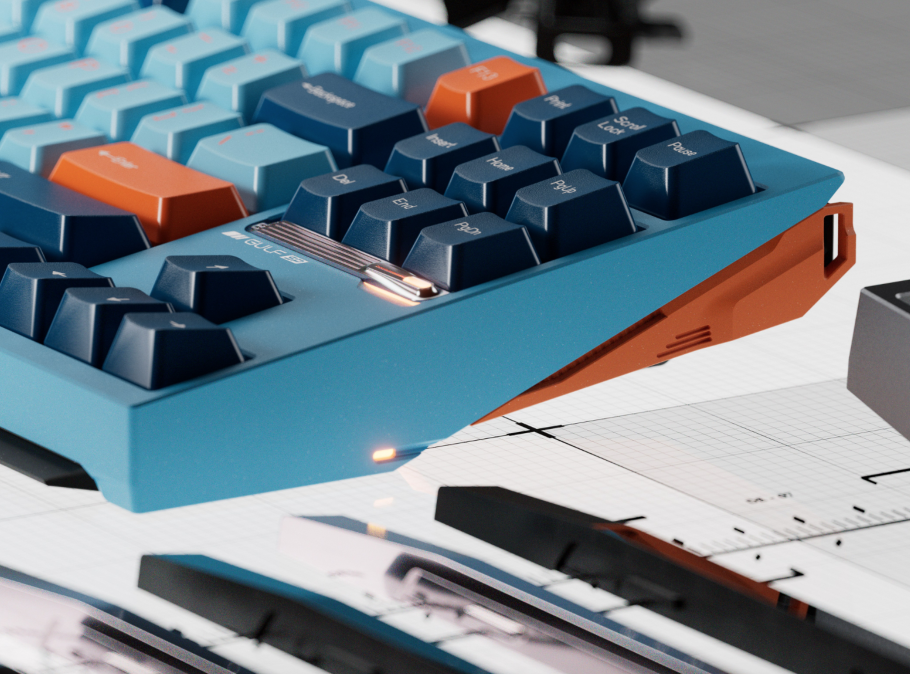
From the front, NoryTek still retains the series’ signature recessed spacebar area, while the entire right-side function cluster is lowered downward as a whole, creating a distinct stepped height difference between the arrow keys and navigation cluster. Above that, an integrated module area is raised upward in reverse. According to the official description, this section is not a simple assembled component, but rather a single-piece machined structure directly integrated into the top case itself.
Visually, the impact of this treatment is quite obvious: the front is no longer a single flat plane, but instead broken into multiple “height layers.” These layers are not merely decorative divisions, but structural elements actively participating in the visual language itself. At the same time, however, this multilayered structure also introduces a certain issue — as information density increases, the visual transitions between functional areas become more fragmented, especially under darker colorways or low ambient lighting conditions, where the layering itself begins to blur.
In terms of spatial organization, a diagonal cut is introduced between the spacebar area and the arrow cluster. Its purpose is to break the stability of the horizontal structure, preventing the lower half from becoming overly regularized. However, this cut itself carries no direct functional or interactive purpose, instead acting more as a visual rhythm adjustment element. Boards like the Luminkey75 have explored similar treatments before.
The primary visual focus on the front, however, is concentrated around the badge area. This section can arguably be considered the most recognizable part of the entire kit’s design language — a complete hybrid of interaction and decoration.
The region is divided into two sections: on the left sits a dot-matrix-style light bar module composed of multiple small square elements, intended for status feedback or ambient lighting effects; on the right is a 160×40 pixel display used for UI elements, animations, or user-customized content. The relationship between the two is not simply parallel, but intentionally designed as a contrast between “information hierarchies”: one side leans toward static decoration, while the other focuses on dynamic information output.
The light bar provides low-density background feedback, while the display handles high-density content presentation, with structural boundaries separating the two. But the issue becomes equally apparent — when the lighting effects, screen content, and surrounding textures are all active simultaneously, this region reaches a significantly higher information density than the rest of the keyboard. In static display scenarios, this can easily create an overly concentrated visual focal point.
The side profile continues using the fairly common HHKB Line treatment, relying on a clean straight contour to control the overall proportions, while localized color separation further reinforces the sense of layering. The rear design leans more heavily into a designer-toy aesthetic, continuing the use of mixed materials: sandblasted electroplated stainless steel weights above and below, with a central sandblasted electroplated stainless steel “NoryTek” typography weight in the middle. Structurally, it uses a Leaf Spring Gasket mounting solution — relatively conventional overall.
In terms of pricing, the aluminum standard version starts at 3100 RMB, while the PC version comes in at 3200 RMB. Personally, I think the pricing overall feels somewhat expensive. That said, if you particularly enjoy the combination of recessed spacebar layouts, retro aesthetics, and modern technological themes, it may still be worth considering.
As for colors, I would more strongly recommend silver, retro green, and P2K. These colorways are better suited to carrying the layered front-facing structure and material contrasts of the design, while also more clearly presenting the hierarchical relationships between the different information modules. Darker colorways, on the other hand, tend to compress the visual layering of this design. Especially with both the front functional modules and the diagonal cut line existing simultaneously, darker finishes can make the segmented relationships feel less distinct, compressing the entire composition into a flatter visual plane and ultimately weakening the structural expression that defines the keyboard in the first place.
Ferrari Unveils Its First Fully Electric Supercar Luce
Sennheiser Launches Momentum 5 Headphones
Spotify Begins Testing Audio Magazine Articles
Motorola Global ROM Found Redirect Hijacking Behavior
Samsung Gallery Will No Longer Support Direct OneDrive Sync
News Worth a Quick Look
Ferrari Unveils Its First Fully Electric Supercar Luce
On May 25 local time, Ferrari officially unveiled its first fully electric supercar, the Luce, in Rome. The Luce has a curb weight of 2,260kg and is equipped with four axial-flux permanent magnet synchronous motors derived from the Ferrari F80, featuring independent drive for each wheel. The front motors can reach a maximum speed of 30,000rpm, while the rear motors peak at 25,500rpm. The system delivers a combined maximum output of 772kW and 990Nm of motor torque (11,500Nm wheel torque). Combined with a new VCU control unit, Side Slip Control X system, and eTrac electronic traction control, the Luce accelerates from 0–100km/h in 2.5 seconds and reaches a top speed exceeding 310km/h.
The Luce uses an 800V structural integrated lithium battery pack co-developed with SK On, containing 15 modules and 210 battery cells. The battery offers an energy density of 305Wh/kg and a total capacity of 122kWh, supporting up to 350kW DC fast charging, with an estimated WLTP driving range exceeding 530km. The exterior was designed by LoveFrom, the creative team led by former Apple Chief Design Officer Jony Ive and Marc Newson. It features a pillarless panoramic glass roof and floating aerodynamic wing elements at the front and rear, paired with progressive large wheels measuring 23 inches in the front and 24 inches in the rear. Inside, the interaction system consists of four OLED displays custom-made by Samsung, while retaining precision-machined aluminum mechanical knobs and toggle switches.
The Luce includes Ferrari’s official seven-year complimentary maintenance program, along with an eight-year extended warranty covering core EV components. Pricing starts at approximately $650,000. Source
Sennheiser Launches Momentum 5 Headphones
On May 25, Sennheiser unveiled the Momentum 5 Wireless over-ear headphones. The new model retains the exterior design of its predecessor while featuring 42mm transducers derived from the HD 600 series. The number of microphones in each earcup has increased to four per side (eight total), with Sennheiser claiming voice noise cancellation performance up to three times better than the previous generation. The headphones are Hi-Res Audio certified and support Snapdragon Sound with aptX Lossless Bluetooth audio codecs. They feature a Bluetooth 5.4 chip with firmware support planned for future Bluetooth 6.0 compatibility. The initial firmware update will also introduce Dolby Atmos spatial audio with head tracking support. The Momentum 5 Wireless includes a user-replaceable 700mAh battery, delivering up to 57 hours of playback with active noise cancellation enabled, alongside fast charging capable of providing three hours of usage from just five minutes of charging.
The Momentum 5 Wireless comes in black, white, and blue color options, priced at $400, and will officially launch on June 16. Source
Spotify Begins Testing Audio Magazine Articles
On May 26, Spotify announced testing for a new audio magazine article feature for English-language users in regions where audiobooks are currently available. The feature offers newly produced narrative-style audio articles created by Spotify’s internal team. The initial rollout includes more than 650 long-form articles from publishers such as Rolling Stone, The Atlantic, Vogue, Variety, Billboard, Vibe, GQ, WIRED, Vanity Fair, and Pitchfork. Each audio article is under two hours long. Premium subscribers can listen within their monthly audiobook allowance, while free-tier users must purchase articles individually for $1.99 each. Source
Motorola Global ROM Found Redirect Hijacking Behavior
Several overseas versions of Motorola smartphones have reportedly exhibited app hijacking behavior after recent software updates. When users open the Amazon app from the app drawer, the system briefly launches a browser, flashes momentarily, and redirects to a specific URL before injecting Amazon affiliate referral codes.
Through ADB logs and network traffic analysis, users confirmed that the behavior originates from the preinstalled Smart Feed app version v2.03.0070. Affected devices reportedly include Razr Fold foldable phones and the Razr (2026) lineup. Network logs also show requests being sent to the advertising service domain “devicenative,” with the hijacking process ultimately redirecting users to a site under the domain kira-abboud.com and injecting a dedicated affiliate referral code different from those publicly used by fashion influencers. At present, users can stop the redirect behavior by disabling the Smart Feed app in system settings. Motorola has not yet issued an official response regarding the incident. Source
Samsung Gallery Will No Longer Support Direct OneDrive Sync
On May 14, Microsoft updated its support documentation confirming that Samsung Gallery will no longer support direct synchronization with OneDrive starting September 30, 2026. Photos, files, and other previously synced content will still remain accessible through the OneDrive website or mobile app. Microsoft stated that users who wish to continue using photo backup features will need to switch to the OneDrive app and manually enable the “Camera Upload” setting to avoid backup interruptions. Because Samsung accounts may differ from the OneDrive account being used, users are also advised to verify that the correct backup account is selected. Source
News Worth a Quick Look
According to a Bloomberg report, Apple plans to introduce native support for third-party AirPlay alternatives in the EU region with iOS 27, allowing users to set services such as Google Cast as the default solution for wireless media streaming. The change is primarily intended to comply with the European Union’s Digital Markets Act requirements. Source
Chen Keming Foods issued a public apology regarding controversy over its “Hand-Rolled” trademark and announced it will completely stop producing and selling products containing “hand-rolled” labeling. Earlier, Chinese state broadcaster CCTV exposed that one of the company’s noodle products prominently displayed the words “hand-rolled” alongside rolling-pin imagery on the packaging, despite actually being machine-made. Chen Keming Foods responded at the time by stating that “Hand-Rolled” was merely a trademark name. Source
According to Economic Observer, Xu Yao, the former CEO of Three-Body Universe (Shanghai) Culture Development Co. and a convicted poison murderer whose case attracted widespread attention, has been executed. Source
OPPO Launches Reno16 Series and Other New Products
HONOR Launches HONOR 600 Series and Other New Products
Huawei Proposes a New Law in the Semiconductor Industry
Epic Reveals Unreal Engine 6
Meta Launches Forum App
Alibaba DAMO Academy’s Xuantie 9 RISC-V Processor Series Adapts to Android 16
News Worth a Quick Look
OPPO Launches Reno16 Series and Other New Products
On May 25, OPPO held its Reno Land Fantasy Night launch event, unveiling multiple newproducts including the OPPO Reno16 smartphone series and the OPPO Pad 6 tablet.
The OPPO Reno16 series includes the Reno16 and Reno16 Pro. The OPPO Reno16 features a 6.32-inch flat display, powered by the Dimensity 8550 SUPER processor, with a 6700mAh battery, available in Heartbeat Star, Galaxy Purple, and Moonlight Black. The OPPO Reno16 Pro features a 6.78-inch flat display, powered by the Dimensity 9500s processor, with a 7000mAh battery, available in Heartbeat Star, Dream Blue, and Moonlight Black. The entire lineup is equipped with a quad-main-camera ultra-clear imaging system focused on direct Live Photo capture, including a 200MP primary camera, a 50MP 3.5x periscope telephoto lens, a 50MP ultra-wide lens, and a 50MP front ultra-wide camera. All models support IP69K water resistance. The Reno16 Pro’s main camera also includes a large-angle stabilization gimbal module, alongside a new “Mountain and Sea” antenna architecture designed to improve livestreaming performance. The OPPO Reno16 starts at RMB 3,499 (12GB + 256GB), while the Reno16 Pro starts at RMB 4,499 (12GB + 256GB).
Also announced was the magnetic accessory OPPO Bubble selfie display, featuring a 58mm AMOLED touchscreen that magnetically attaches to the back of the phone and functions as a selfie mirror. It supports customizable wallpaper rotation, includes a 550mAh battery, and supports remote wireless shooting. Pricing starts at RMB 499, with a Reno16 bundle option available.
The OPPO Pad 6 is powered by the Dimensity 9500s processor and packs a 10,420mAh battery with support for 67W SUPERVOOC fast charging. It features a 12.1-inch 3K-resolution display with an optional anti-glare soft-light panel. The tablet weighs 577g and is approximately 5.99mm thick. Pricing starts at RMB 3,499 (8GB + 256GB), with Deep Space Gray, Galaxy Silver, and Starlight Blue color options available.
OPPO also introduced the Enco Air5s semi-in-ear active noise-canceling earbuds, offering up to 48 hours of battery life and weighing 3.9g per earbud. Available colors include Midnight Black, Starlight Purple, and Moonlight White, with pricing set at RMB 299. Source
HONOR Launches HONOR 600 Series and Other New Products
On May 25, HONOR held its “4K Live Starlight Graduation Concert” launch event, unveiling the HONOR 600 series, HONOR Pad 20, and several other new products.
The HONOR 600 series includes the HONOR 600 Pro, HONOR 600 Ultra Edition, and HONOR 600 Vitality Edition. The HONOR 600 Pro is powered by the Dimensity 8550 Elite processor, while the HONOR 600 Ultra Edition and Vitality Edition use the Snapdragon 7 Gen 4 mobile platform. All models support IP68/IP69/IP69K protection. Both the HONOR 600 Pro and HONOR 600 Ultra Edition feature 6.57-inch displays. The 600 Pro includes a triple-camera setup consisting of a 200MP wide-angle camera, a 50MP periscope telephoto lens, and a 12MP ultra-wide macro camera, supporting full-focal-length 4K Live Photo capture, alongside an 8000mAh battery. The 600 Ultra Edition features a dual-camera system with a 200MP wide-angle camera and a 12MP ultra-wide macro camera, also supporting 4K Live Photo capture, paired with an 8600mAh battery. The entire lineup supports a paper-like full-color eye-comfort mode. HONOR also introduced a magnetic secondary display accessory alongside the phones. The HONOR 600 Pro and Ultra Edition are available in Lucky Star, Feather Blue, Green Apple, and Obsidian Black. The Ultra Edition starts at RMB 3,299 (12GB + 256GB), while the Pro starts at RMB 3,899 (12GB + 256GB). The HONOR 600 Vitality Edition comes in Vitality White, Lucky Orange, and Obsidian Black, starting at RMB 2,699 (8GB + 256GB).
The HONOR Pad 20 uses the Snapdragon 7 Gen 3 mobile platform and features a 12.1-inch 3K TFT LCD display with an optional soft-light panel. It weighs 525g, measures 6.29mm thick, and packs a 10,100mAh battery. Color options include Forest Green, Shining Pink, and Extraordinary Gray, with launch pricing starting at RMB 1,899 (6GB + 128GB).
The HONOR Watch 6 Plus features a 46.5mm watch face with a 1.46-inch display and supports over 120 professional sports modes. It is the first smartwatch to include a 1000mAh “Qinghai Lake” battery, offering up to 17 days of battery life under normal Bluetooth usage. Launch pricing starts at RMB 1,199.
HONOR also released the Earbuds Clip Pro clip-on earbuds, supporting IP55 dust and water resistance alongside LHDC 5.0 high-definition audio codec support. Introductory pricing starts at RMB 539.1. Source
Huawei Proposes a New Law in the Semiconductor Industry
At the International Symposium on Circuits and Systems (ISCAS 2026) on May 25, Huawei officially introduced the Tao (τ) Law, proposing “time scaling” as a replacement for traditional “geometric scaling.” The theory aims to systematically reduce time constants (τ) through innovations such as logic folding, continuously compressing signal propagation delays and increasing transistor density to sustain the evolution of semiconductors and electronic systems. The Tao Law establishes a multi-layer collaborative optimization framework spanning devices, circuits, chips, and entire systems. Huawei predicts that by 2031, high-end chips based on this principle could achieve transistor densities equivalent to current 1.4nm process technology. Source
Huawei also revealed technical details related to its upcoming Kirin 2026 chip during the conference. The chip will be among the first to adopt logic folding technology. Compared with traditional 2D-designed chips, transistor density increases by 53.5% to 238 MTr/mm², while P-core power efficiency improves by 41% and peak frequency rises by 12.7%. The P-core frequency for the 2026 chip is expected to reach 3.1GHz. For comparison, the previous Kirin 9030 Pro operated at 2.75GHz, meaning the 12.7% increase aligns exactly with the new 3.1GHz target. Huawei also projected steady future improvements in frequency and transistor density, estimating more than 400 MTr/mm² transistor density and 5.0GHz clock speeds by 2031. Source
Epic Reveals Unreal Engine 6
On May 25, Epic Games subsidiary Psyonix released a trailer for a new version of Rocket League running on Unreal Engine 6 during the Rocket League Paris Masters tournament. Epic and Psyonix did not reveal further technical details or an official release timeline for Unreal Engine 6. Epic Games CEO Tim Sweeney previously stated in 2025 that UE6 would address the long-standing single-thread simulation bottleneck present in UE5 by fully transitioning to multi-threaded game simulation. The engine will also deeply integrate the Verse programming language and the next-generation Scene Graph content platform. According to Sweeney, the complete rollout is still one to two years away. Source
Meta Launches Forum App
Meta has recently launched a standalone group-focused app called Forum, positioned as a competitor to Reddit. Officially described as “a dedicated space for in-depth discussions, genuine Q&A, and interest-based communities,” the app syncs users’ groups, profiles, and activity after logging in with a Facebook account, while also allowing posts to be published under nicknames. Its operation closely mirrors the standard Facebook app. Existing groups remain on Facebook itself, and content posted in Forum is simultaneously displayed in the corresponding Facebook groups. The app’s feed centers around group conversations, allowing users to browse authentic discussions from regular members and easily continue unfinished interactions. It also includes an AI-powered Q&A section where users can ask questions, with the system generating responses by aggregating discussions from various groups. Additionally, the app features an AI assistant for administrators, helping group owners manage communities and moderate content. Source
Alibaba DAMO Academy’s Xuantie 9 RISC-V Processor Series Adapts to Android 16
On May 25, Alibaba DAMO Academy’s Xuantie team announced that the high-performance Xuantie 9 processor series has completed adaptation for the Android 16 operating system, with the Xuantie Android platform now being selectively released to strategic partners. The adaptation is built on Xuantie 9 processors compliant with the RVA23 specification and based on Android 16’s AOSP mainline code. Both system functionality and security capabilities have undergone deep optimization. In terms of system support, the Xuantie Android platform is fully compatible with standards such as AVB, GKI, GSI, and VINTF. Leveraging RISC-V vector extensions and vector encryption extensions, the platform deeply optimizes Android core components. The team has verified the correctness and stability of Android 16’s core runtime, system services, and native RISC-V applications running on Xuantie processors. On the security side, the Xuantie Android platform provides a complete trusted execution environment integrating over 40 security applications, covering secure boot, key management, encryption acceleration, and other core Android security framework requirements. It also supports system-level features such as device lock-screen verification and digital rights protection, enabling RISC-V deployment in high-security scenarios like financial payments and high-definition streaming services. The Xuantie Android platform is currently available to the first batch of Xuantie strategic customers. Backed by Xuantie’s full-stack support from processor platforms to operating systems, along with complete functional verification, system-level performance optimization, and end-to-end security stack integration, customers can accelerate exploration of new RISC-V smart device scenarios and shorten the path from chip prototypes to commercial products. Source
News Worth a Quick Look
Tencent announced on May 25 that ima copilot is now fully open to all users. Source
A Reddit user from Australia integrated Gemini into their Google Home smart home system and discovered that Gemini AI’s recognition accuracy for surveillance cameras was surprisingly poor. For example, it repeatedly identified a neighbor’s cat as a raccoon—which does not exist in Australia—and mistook kangaroos and wallabies for humans. Source
A Xiaomi wearable device with model number M2561B1 has appeared in Singapore IMDA and Taiwan NCC certification databases, leading to speculation that it could be the Xiaomi Smart Band 11 Active. Source
An X user posted that Tesla FSD automatically began slowing down, changing lanes, and blending into slower-moving traffic after detecting police vehicles parked by the roadside. Source
@克莱德: Nuevo Tokyo Design Studio first became known for its concept camera designs and small creative hardware projects. I personally started following them because of one particularly unique camera concept. Later, they also released a black-and-white film simulation tool called AgBr.
This new VWFNDR™ + MBL also recreates one of their earlier camera hardware concepts.
Much like AgBr being exclusive to the Apple ecosystem, Nuevo Tokyo unexpectedly launched a new Android camera app called VWFNDR™ + MBL last week.
The “VWFNDR” in the app’s name already hints at its core feature. Nuevo Tokyo brought many design ideas from its earlier VWFNDR concept camera series into the app itself. The gallery, viewfinder, and control area are arranged in a continuous vertical (or horizontal, depending on orientation) layout. Swiping up and down seamlessly switches between photo aspect ratios, while pulling the viewfinder down into full-screen mode opens the gallery. Combined with crisp sound effects, well-tuned haptic feedback, and a control area that responsively changes layout based on available space, the entire experience feels smooth and refreshingly original.
In practical use, the app runs very smoothly on my Pixel 9 Pro, though there’s a slight delay in image processing after taking a photo—you’ll need to wait a moment before previews appear in the gallery. Controls follow the traditional manual-camera approach, offering exposure, shutter speed, focus distance, and more, while also supporting camera-style P and S modes for switching control behavior.
The only real issue right now is that the current version cannot access lenses other than the main camera. In a follow-up blog post, Nuevo Tokyo harshly criticized the inconsistency of multi-camera APIs across Android hardware. They simply couldn’t achieve a unified, seamless multi-camera switching experience across different devices, so they decided to skip multi-camera support entirely. A pretty stubborn move, honestly.
Pixel 9 Pro stock camera (left) vs. VWFNDR™ + MBL (right) image comparison
As for image quality, VWFNDR™ + MBL bypasses the hardware manufacturer’s ISP post-processing pipeline. It captures DNG RAW files directly and then generates JPEGs using its own processing algorithm. You can also enable simultaneous RAW + JPEG saving in settings. The resulting images focus on minimal post-processing and lighter computational photography, delivering a strong optical feel. If you dislike the overly painterly or plasticky look of many stock camera apps, VWFNDR™ + MBL will probably appeal to you.
Pedometer++: Redesigning the Apple Watch Experience
Platform: iOS, watchOS
Keywords: Step Tracking, Hiking, Walking Exercise
@ElijahLee: Pedometer++ is a long-running pedometer and walking exercise app that, after years of refinement, has gradually evolved into a complete tool focused on outdoor walking, hiking, and light exercise tracking. Recently, the app released its major 8.0 update, with nearly all changes centered on rebuilding the Apple Watch experience. The developers even describe it as a completely redesigned watchOS app.
The first thing you notice is the fully dashboard-style homepage. On Apple Watch, the app uses large typography to display daily step counts, with walking distance and floors climbed shown as secondary information. More eye-catching is the progress ring below, which uses roughly one-fifth of a circular ring to indicate progress. The color gradually fills as you approach your goal, visually resembling Apple’s native Activity rings, but focused specifically on walking.
Scrolling down from the homepage opens the workout selection list, which has also been redesigned in the new version. Apple redesigned the Workout launch interface in watchOS 26, adding many buttons that make operation more cumbersome, while Pedometer++ does the opposite by returning to an earlier approach with large buttons and bigger touch targets, making it easier to use during exercise.
The newly introduced Expedition Mode is the core feature of this update. In this mode, the app no longer continuously monitors heart rate at high frequency, instead relying on Apple Watch’s lower-power heart-rate sampling to significantly reduce battery usage, extending battery life by up to 40%. The feature makes a lot of sense, since when hiking, people often care more about battery endurance than heart rate tracking.
Finally, the map experience has been significantly improved, now spread across five pages to present multidimensional information. The main watch face page displays the route map in real time, with support for switching between dark/light map modes and different visual styles. Rotating the Digital Crown switches between additional watch pages, which permanently display distance while also showing pace, steps, floors climbed, elevation changes, heart-rate zones, and more. The interface is also very convenient to operate while exercising.
You can download Pedometer++ for free on the App Store. A paid subscription unlocks the premium version, which includes workout tracking, training plans, weather information, and Apple Watch map functionality. Pricing is ¥15/month or ¥198/year.
Tripsy Update: Adding Claude MCP Brings Travel Planning Into the AI Era
@Vanilla: Honestly, travel planning is exhausting. Even though we already have tools like Tripsy to help collect, organize, and manage itineraries, most of the work still has to be done manually, and the longer the trip, the more complicated adjustments become. Finally, in its latest update, Tripsy introduced its own MCP tool that can be used directly inside Claude or Claude Code. With Claude’s powerful capabilities, we can now plan trips much more efficiently.
The first step: taking Claude Desktop as an example, switch to the Code interface, click the Customize button in the left sidebar, choose “Connectors,” then click the + button to add a custom connector. You can name it anything you like. In the URL field, enter https://mcp.tripsy.app, then click Add.
Once added, you’ll see all the tools provided by Tripsy MCP, including 17 read-only tools and 19 editable/deletable tools. Each tool can have individual permissions configured, including Always allow, Needs approval, Block, and Custom.
The second step: return to the Code interface and start a new conversation. Then simply describe the travel itinerary you want Tripsy to create, with as much detail as possible. After a short wait, Claude will generate an itinerary matching your requirements and write it directly into the Tripsy app through Tripsy MCP.
The third step: if you notice anything unsatisfactory in Claude’s generated overview or while viewing the itinerary directly inside Tripsy, you can simply ask Claude to modify it. You can provide alternative options for replacement, or let Claude search for recommendations on its own.
Finally, when you return to the Tripsy app, you’ll see a complete travel itinerary, including flights, accommodations, locations, routes, and detailed information for every stop.
At this point, I don’t think much more needs to be said—Tripsy MCP feels like the ideal solution for travel planning in the AI Agents era. Tripsy can be downloaded for free from the App Store. A subscription unlocks expense management, reservation forwarding, advanced travel statistics, calendar subscriptions, daily activities, 10-day weather forecasts, timezone changes, and more. Pricing is $7.99 per month or $39.99 per year, with a 7-day free trial available, and it’s also included with Setapp. For me personally, with Tripsy MCP and Claude, the free version is already more than enough.
GoalKit: Let AI Help You Break Down Your Goals
Platform: iOS / iPadOS
Keywords: Habit Building, Goal Management
@Snow: Habit-building apps and to-do list apps are two types of tools we often use when breaking down goals in daily life, and GoalKit attempts to merge both into a single framework. Instead of focusing solely on daily habit check-ins or task completion, it helps users break long-term goals into executable and trackable steps, so you won’t give up halfway because a goal feels too ambitious. By taking small steps every day, eventually you’ll arrive at your destination.
GoalKit offers four different goal types: one-time checklist goals, quantifiable progress goals, milestone goals suited for long-term planning, and habit goals for cultivating daily behaviors. Whether you’re preparing for a trip, learning a new skill, or organizing a project, GoalKit can basically cover most everyday goal-management needs. For example, if you’re currently preparing for a home renovation, you can use milestone goals to divide the process into stages such as clearing waste, structural adjustments, and furniture purchasing. Combined with daily progress check-ins, milestone goals help provide a clearer understanding of completion status and expected timelines for each stage.
If you’re unsure which goal type suits you best, you can rely on GoalKit’s built-in AI capabilities. When creating a goal, you can describe your objective in natural language and tap “Create with AI.” The AI will automatically match the appropriate goal type, break down the plan, and add notes for you. During execution, the AI can also provide more detailed recommendations based on your progress.
The bottom drawer of the app includes two sections: “Goals” and “Insights.” After completing a certain number of tasks, you can track the progress of each goal in the “Insights” section. Scrolling to the bottom of the page reveals an AI summary. If you don’t have time to study detailed data and progress reports, this AI-powered “too long; didn’t read” version may be exactly what you need.
GoalKit includes a subscription service priced at $3.99 per month or $15.99 per year, with a one-time lifetime purchase option for $29.99. Paid features unlock unlimited goals, widget syncing, image attachments, and more.
GoalKit is not yet available on the China App Store, but you can download it for free from the U.S. App Store.
Vivaldi 8.0: Rebuilt Interface with Six New Preset Layouts
Platform: macOS / Windows / Linux
Keywords: Browser
@化学心情下2: Desktop browsers today are almost entirely dominated by Chromium, but browsers like Chrome, Edge, Opera, and Vivaldi all differentiate themselves through interface design. The problem is that users can barely customize these interfaces in depth—at most, you can change a theme, while adjustments to title bars, menu bars, and other modules remain extremely limited. For browsers like Chrome and Edge that prioritize out-of-the-box simplicity, this may not be a major issue, but for Vivaldi, which is known for extensive customization, it’s a different story.
As a result, Vivaldi 8.0 doesn’t introduce a flashy new feature like previous major releases. Instead, it completely reconstructs the browser interface in what the company calls the “Unified UI.” The fragmented feeling caused by stacked components has been eliminated, with all browser elements now treated as different layers of the same system, unified through consistent alignment and spacing while smoothing out subtle design inconsistencies between components. According to Vivaldi, the new interface creates a more cohesive theme throughout the browser, eliminating awkward color mismatches between tabs and backgrounds. Combined with translucency and blur effects, transitions now feel much smoother visually.
Vivaldi has always been known for its rich layout customization options, but new users often don’t know where to begin. To address this, version 8.0 introduces six preset layouts: Simple, Classic, Auto-Hide, Bottom Tabs, Vertical Left Tabs, and Vertical Right Tabs. New users can quickly pick a layout that matches their habits and later customize it further as needed.
Beyond the Unified UI, Vivaldi 8.0 also brings a series of optimizations to the panel editor and start page. The browser supports macOS, Windows, and Linux, and can be downloaded for free from the official website.
Braincup: Stop Mindless Scrolling, Start Training Your Brain
Platform: Android
Keywords: Brain Training
@Peggy_: The last time I realized my memory was deteriorating was after staying up all night, when I simply could not remember the pickup code for a Hive parcel locker. The panic I felt over such a tiny incident was very real. Although proper rest later restored my short-term memory, the experience still served as a wake-up call: I need to keep exercising my brain, stop endlessly scrolling on my phone, and build more positive habits, including but not limited to exercise, writing, and creating. Braincup, the app I’m introducing today, is a collection of tools designed to help improve brainpower and reaction speed.
The next time you unlock your phone and have no idea what to do, maybe use Braincup to make yourself smarter instead. Braincup includes many mini-games designed to train calculation ability, thinking skills, short-term memory, and reaction speed. Familiar categories include Sudoku, mental arithmetic, and Schulte tables. Sudoku and calculation games effectively train math skills, while Schulte tables test concentration. Ghost Grid, Visual Memory, and Orbit Tracking challenge short-term memory. In addition, Braincup also offers Mini Chess and Huarong Dao puzzles to develop thinking ability, while Color Shapes and Color Confusion train reaction speed.
Opening any mini-game first brings up a brief instruction guide, after which you simply complete the required tasks before the countdown ends. Once time runs out, Braincup calculates a score based on your accuracy and the number of completed tasks. As you play more often, the app also continuously updates your personal high-score records.
In practice, some of Braincup’s mini-games are genuinely challenging. The most demanding one in terms of concentration and reaction speed is probably Color Confusion, where you must identify the one color word whose text matches its actual color among many misleading options. It feels exactly like being back in a psychology reaction-time experiment. While most games aren’t particularly difficult, Mini Chess allows difficulty selection, giving it more replayability. The next time you’re bored and want to kill time, instead of sinking into short videos, you might as well open Braincup and randomly pick a puzzle game.
If you’re interested in Braincup, you can download it through F-Droid. The app is completely free.
App Quick Hits
The macOS launcher Raycast has opened public beta testing for version 2.0. The new release features a redesigned interface, upgraded file search capabilities, and transforms Presets into Agents that support reuse across chats, among other improvements.
During Google I/O, Google demonstrated the ability to create personal-use Android apps with AI Studio and export them directly to smartphones.
GitHub Faces Talent and Technology Drain Under Microsoft
Tiger Brokers, Futu, and Longbridge to Fully Exit Mainland China Business
Google Search AI Mode Mistakenly Treats Keywords Like “disregard” as Instructions
“Dead Yet?” Renamed to “You There?” for Elderly Home Safety
Ministry of Public Security Proposes Clearer Procedures for Obtaining Passwords During Investigations
London iPhone Theft Rings Use Threats to Unbind Apple IDs
News Worth a Quick Look
GitHub Faces Talent and Technology Drain Under Microsoft
According to The Verge, nearly eight years after Microsoft acquired GitHub, the world’s largest open-source code hosting platform is facing multiple challenges.
On the personnel side, after former CEO Thomas Dohmke departed last summer, Microsoft did not appoint a new CEO. Instead, GitHub’s reporting structure was merged into Microsoft’s CoreAI division, led by a former Meta executive. This restructuring broke GitHub’s long-prized tradition of independent operations, triggering strong internal backlash and talent loss. Several core executives have left, with many employees following Dohmke to his newly founded competing platform, Entire.
On the technical and operational front, GitHub has suffered frequent outages over the past year amid a difficult migration to Microsoft Azure cloud servers. Some prominent developers, frustrated by the instability, publicly announced they were abandoning the platform, forcing the current CTO to issue a public apology. In terms of security, GitHub’s internal infrastructure was reported to have a severe vulnerability in March, and this week an employee accidentally installed a malicious VS Code extension, leading to hackers stealing 3,800 internal repositories. Meanwhile, GitHub Copilot’s recent shift toward usage-based limits and pricing has sparked strong backlash from the user community.
External competition has also intensified. Although GitHub Copilot once held an early lead in AI programming, it has gradually been overtaken over the past year by strong competitors such as Cursor and Claude Code. Microsoft CoreAI management reportedly warned internally that GitHub faces an “existential threat,” even going so far as to revoke internal developers’ access to Claude Code in an attempt to force teams to focus on improving GitHub Copilot and regain its technical edge.
Tiger Brokers, Futu, and Longbridge to Fully Exit Mainland China Business
According to Caixin, on May 22 the China Securities Regulatory Commission (CSRC) announced that it had formally opened investigations into Tiger Brokers, Futu, and Longbridge, along with related domestic and overseas entities, for illegally operating securities businesses within mainland China, and had issued prior notices of administrative penalties. The CSRC stated that the related entities of Tiger, Futu, and Longbridge had conducted securities marketing, transaction processing, and other brokerage-related services in mainland China without approval or the required licenses for securities brokerage or margin financing operations, thereby constituting illegal securities business activities. Regulators also determined that the three firms had illegally engaged in public fund sales and futures brokerage businesses. The CSRC plans to confiscate all illegal gains from the involved entities and impose severe penalties in accordance with the law.
Under the newly issued Implementation Plan for the Comprehensive Rectification of Illegal Cross-Border Securities, Futures, and Fund Operations, jointly released by eight government departments including the CSRC, China will fully eliminate illegal cross-border operations by overseas securities and fund institutions during a two-year rectification campaign. Previously, the CSRC had already ordered Tiger Brokers and Futu to halt new customer acquisition in mainland China, banning them from soliciting mainland investors or opening new accounts, while existing customers could continue trading. However, the new measures prohibit overseas institutions from providing mainland-based existing investors with services such as buy-side trading or inbound fund transfers, allowing only one-way selling and fund withdrawals. The CSRC emphasized that investor asset safety would not be affected during the rectification process, and overseas institutions must properly communicate with affected investors and handle account arrangements to ensure asset security. After the rectification period ends, overseas institutions will be ordered to completely shut down mainland websites, trading software, and supporting services, and will be prohibited from illegally providing trading services to mainland investors.
On May 22, the Hong Kong Securities and Futures Commission also issued a circular to licensed corporations regarding customer onboarding and relationship management expectations, requiring intermediaries to strengthen controls when opening accounts for individuals using mainland Chinese ID cards or passports.
Under China’s securities regulations, mainland residents may only indirectly invest in overseas stock markets through the Qualified Domestic Institutional Investor (QDII) scheme, or directly trade eligible Hong Kong-listed stocks through the Shanghai-Hong Kong and Shenzhen-Hong Kong Stock Connect programs, both of which have eligibility thresholds. Legally speaking, it is not possible for mainland residents to directly trade U.S. stocks from within mainland China. Cross-border stock trading has long existed in a regulatory gray area outside China’s securities and foreign exchange supervision systems.
Google Search AI Mode Mistakenly Treats Keywords Like “disregard” as Instructions
According to The Verge, Google’s recently launched AI Overview search feature has developed a bug. When users search for the word “disregard,” the AI mistakenly interprets it as a conversational instruction directed at the AI itself, rather than as a normal search query. Instead of returning search results, it responds like a chatbot, with replies such as, “Understood. If you need any further help or have new questions later, feel free to ask!”
Similarly, searches for words like “ignore” or “skip” produce responses such as “Got it! I’m ready to help” or “This looks like a test or typo,” completely diverging from the user’s search intent.
Google has temporarily removed the AI Overview module for the term “disregard,” restoring standard web and news search results as the default display. A Google spokesperson stated that the company is aware the AI Overview feature is currently misinterpreting certain “action-related queries,” and that engineers are working on a fix, with an update expected soon.
“Dead Yet?” Renamed to “You There?” for Elderly Home Safety
According to The Paper, on May 24 the official WeChat account “Shangcheng Release” operated by Hangzhou’s Shangcheng District Publicity Department revealed that, after gathering public feedback, the “Dead Yet?” app has officially been upgraded and renamed as the “You There?” safety platform, and has already been deployed in Naxing Subdistrict of Shangcheng District.
According to the report, more than 40% of Naxing Subdistrict’s population is elderly, making home safety and emergency support for seniors living alone or in empty nests a major challenge for local public services. The “You There?” platform adopts an elderly-friendly design with large fonts, simple interfaces, minimal operations, and high fault tolerance. Seniors only need to input basic information once, and can then use their smartphones for seamless daily check-ins to confirm their safety. If no check-in is detected for two consecutive days, the system automatically alerts family members or emergency contacts. It also includes a one-tap SOS emergency feature. For elderly residents without smartphones, the subdistrict and platform operator introduced a physical “safety button,” which can be worn or placed nearby. In emergencies, pressing it instantly alerts guardians and community support staff.
Back in January, the paid app “Dead Yet?” went viral online. Designed as a lightweight safety tool for people living alone, it only required users to enter contact names and email addresses. If the user failed to check in for two days, the system would send an email notification to designated contacts. On January 13, the developer announced that, after careful consideration, the app would adopt the globalized brand name “Demumu” in its upcoming release. The next day, however, the developer admitted the renaming attempt had not gone smoothly and decided to let internet users vote on a new name instead.
Ministry of Public Security Proposes Clearer Procedures for Obtaining Passwords During Investigations
On May 22, China’s Ministry of Public Security issued a public consultation notice for the Rules for Electronic Data Collection by Public Security Organs (Draft for Comments), with feedback open until June 21, 2026.
The draft explicitly states that when account passwords for smart devices or related systems are necessary for electronic evidence collection, investigators should generally first request the password from the data holder. If the individual refuses, police may, with approval from county-level or higher public security authorities and after informing the data holder or having witnesses present, take corresponding measures to obtain the password.
When retrieving personal communications such as emails, authorities should first ask the data holder to log in and assist voluntarily. If the individual refuses, investigators must obtain approval from municipal-level or higher public security authorities before requesting the data from internet service providers, while informing the user or ensuring witness oversight. The draft emphasizes respect for and protection of citizens’ communication privacy and personal information.
The proposed rules also expand the scope of electronic evidence collection procedures, standardize related concepts, and regulate documentation used during electronic data investigations.
London iPhone Theft Rings Use Threats to Unbind Apple IDs
According to The New York Times, smartphone theft in London is increasingly being combined with extortion tactics. More and more victims whose iPhones are stolen in London are discovering that criminal groups smuggle the devices to China and use psychological manipulation and violent threats to coerce victims or their families into removing Apple IDs, allowing the devices to be resold intact at high prices on the second-hand black market.
The extortion typically relies on emergency contact information left visible in “Lost Mode.” Criminals escalate their tactics in stages: first pretending to be Apple support sending fake security alerts, then posing as innocent buyers who unknowingly purchased the stolen device. If victims refuse to cooperate, the criminals escalate to sending videos featuring firearms and even threaten sexual violence or murder against family members. Although police confirm that most overseas threats are bluffs, the psychological pressure has still forced many victims to comply.
For thieves, stolen iPhones remain locked and cannot be reset without the original Apple ID being removed, reducing them to low-value spare parts. In recent years, between 70,000 and 80,000 phones have been stolen annually in London, reaching a record 81,000 in 2024. Many are trafficked through international criminal networks to electronics trading hubs such as Shenzhen, making Apple ID removal a crucial step for maximizing profits.
British police stated that because many extortion messages originate overseas, their ability to intervene is limited by jurisdictional constraints. London officials and law enforcement are urging Apple to introduce stronger irreversible device-disabling measures to disrupt the resale chain. Apple responded by advising victims to remotely erase stolen devices but keep them listed in the “Find My” device list, reducing incentives for theft.
News Worth a Quick Look
According to Mark Gurman:
To comply with EU regulations, iOS 27 will allow third-party casting protocols as alternatives to AirPlay;
iOS 27 will significantly improve the AirPods settings interface.
According to Bloomberg, Sony-owned Bungie plans major layoffs and will halt development of Destiny 2. The game will receive its final content update on June 9 before remaining online without further major development, and there are currently no plans for Destiny 3. None of Bungie employees’ proposed new projects reportedly received approval. Sony acquired Bungie for $3.6 billion in 2022, and the studio has already laid off hundreds of employees in the years since.
Recent recommended titles: [Movie] Sheep Detective Team, [Movie] Goodbye, Julia, [Movie] The Man Living with the King, [J-Drama] Small Business Kin & Gin Season 3, [Anime] Fist of the North Star -FIST OF THE NORTH STAR-, [Documentary] Stanley Tucci: Searching for Italy Season 2, [Documentary] Secret Creatures in the Backyard
Notable trailers: Official trailer for Bleach: Thousand-Year Blood War – The Flames of Fate, new trailer for Green Lantern Corps, final trailer for Spider-Man: Beyond the Shadows, first teaser for Grain Rain
Entertainment news: Secrets of Japan confirmed for release, new poster for Spider-Man: A New Day, release date announced for Clive Boots Continues Adventures
[Movie] Sheep Detective Team
Keywords: Mystery / Comedy
Also known as: The Sheep Detectives
Duration: 110 minutes, with a tiny post-credits scene
Viewing Options: Currently in theaters; Douban link
The Sheep Squad Saves the Day!
@SHY: It’s said that among common farm animals, sheep are the dullest. But don’t mention that to the fluffy residents of Dembrooke Town. Having listened to shepherd George read detective novels daily, they’ve honed sharp logical thinking, easily solving small puzzles. Yet when George meets a truly mysterious fate, can these grass-chewing strategists take on real detective duties?
After years of action-packed roles, Hugh Jackman finally finds a “relaxing” gig, eyes closed and unconcerned as the town descends into chaos. A $30 million inheritance revealed only after death makes everyone a suspect, with cryptic codes in the will sowing paranoia. Seeing the town’s sole police officer outwitted, only the soft, non-human perspective of the sheep sees the truth.
Director Kyle Balda, known for Minions, brings his animation talent to live-action, delivering a whimsically British-style mystery in the vein of Shaun the Sheep. The sheep crack the case with inventive antics, brazenly entering human society and weaving unpredictable laughs. Amid the lively adventure, heartfelt friendships shine through, making this soft, warm detective comedy a stress-relieving, family-friendly treat.
[Movie] Goodbye, Julia
Keywords: Drama
Also known as: Goodbye Julia
Duration: Around 115 minutes
Viewing Options: Nationwide Art Alliance theaters; Douban link
Did you stop lying afterwards?
@潘誉晗: One day, Mona accidentally bumps into a young boy while leaving home. Terrified by the boy’s furious father, she flees by car. The father chases on a motorcycle, ultimately shot by Mona’s husband. With her husband influential and the boy’s father from South Sudan, the incident is quickly settled. Haunted by guilt over indirectly causing an innocent death, Mona seeks out the boy’s mother, Julia, claiming she urgently needs a live-in nanny. Julia moves in with her child, and through daily interactions, Mona and Julia influence each other and form a friendship.
In 2023, Sudanese film Goodbye Julia was selected for the 76th Cannes Film Festival and won the Un Certain Regard Freedom Award. As Sudan’s first film at Cannes, it uses the small moments between Julia and Mona to explore social issues including race, religion, faith, and ethnic division. A car accident, two women, two social classes, lies and truth, rescue and redemption, freedom and constraint—the film portrays Sudan’s political turmoil with a gentle, truthful touch.
Your Highness, I’ve come to escort you across the river.
@潘誉晗: Yeon Heung-do is the village chief of a remote hamlet in Gangwon Province. Isolated and suffering poor harvests, villagers’ lives are harsh; even children have never tasted hot white rice. To improve the village’s fortunes, he decides to follow a neighboring village’s practice of hosting exiled officials. After persistent effort, an exiled official finally arrives—but it isn’t a bearded elder statesman; it’s Lee Hong-wei, the 16-year-old Rusan King, deposed by his uncle as the sixth monarch of the Joseon dynasty.
Released in early 2026 on South Korean screens, the film broke local audience records. While historical records say little about this period, the creative void allows filmmakers more narrative freedom. Though the historical outcome cannot change, the film gives the politically tragic boy a warm, human experience. Under the villagers’ simple care, the once rigid youth feels warmth beyond the cold grip of royal authority, and the touching friendship between Yeon Heung-do and the young king remains celebrated.
[J-Drama] Small Business Kin & Gin Season 3
Keywords: Drama / Period Also known as: あきない世傳(せいでん) 金と銀3 Duration: Around 43 minutes per episode × 8 episodes; Douban link
Running a business is never this easy.
@潘誉晗: The timeline of Season 3 quickly reaches Hōreki 4, but the daily life of the Isuzuya shop continues as usual. Under the leadership of the seventh-generation owner, Koyuki, the staff work hard and business flourishes. To boost sales, Koyuki commissions a craftsman to develop an affordable, small-patterned dye accessible to ordinary people, which becomes an instant hit. However, business is never smooth: when Koyuki’s love interest shows affection for her sister, her younger sister Aketsu joins a rival shop, becoming a direct competitor.
Though not as grand as annual Taiga dramas, this relatively lesser-known domestic period drama has steadily reached its third season. Centered on female growth, the series excels in portraying historical female entrepreneurship without overdramatizing crises. From guild difficulties to rival sabotage, Koyuki approaches problems with patience and inclusivity. The storytelling is gentle yet detailed, depicting Edo-era life while highlighting women’s resilience.
[Anime] Fist of the North Star -FIST OF THE NORTH STAR-
Keywords: Manga Adaptation / Action / Adventure
Also known as: 北斗の拳 -FIST OF THE NORTH STAR-
Duration: 24 minutes per episode × unknown number of episodes, updated every Friday
@SHY: In 199X, the world is consumed by nuclear fire, once-thriving civilizations destroyed, ushering in a lawless era. On this survival-of-the-fittest wasteland, a lone man bears the seven-star scar of Hokuto on his chest. As the heir of the assassination martial art “Hokuto Shinken,” he carves a new path for himself and the oppressed with his indomitable fists.
Hardcore Japanese manga often brings titles like JoJo’s Bizarre Adventure or Berserk to mind. Their stylistic foundation, however, was laid by Fist of the North Star, first serialized in 1983. Creators Buronson and Tetsuo Hara, inspired by Mad Max 2 and Bruce Lee films, crafted this rugged post-apocalyptic world, blending vivid violence and aesthetic brutality that deeply influenced future works.
Compared to previous adaptations, the remake trims lengthy original plotlines, adheres more closely to the source material, and incorporates well-known later settings. The ED features a cover of the classic theme, evoking nostalgia. Using 3D compositing for smooth viewing and occasional hand-drawn animation, key scenes are striking. The story delivers adrenaline-filled adventures, balancing life-and-death tension with heroic feats, making this end-of-century savior legend still exhilarating.
[Documentary] Stanley Tucci: Searching for Italy Season 2
Keywords: Human Interest
Also known as: Tucci In Italy Season 2
Duration: Around 44 minutes per episode × 5 episodes; Douban link
@利兹与青鸟: After a year, the Emmy-nominated Searching for Italy returns for Season 2. Having visited Florence and Milan, seen border mountains and glacier fishing, Stanley Tucci continues to explore other corners of Italy, tasting regionally-inspired cuisine, visiting scenic spots and historical landmarks, and delving into local culture.
In southern Campania, with Mount Vesuvius, picturesque coastlines, and a history of hardship, Tucci samples baked eggplant lasagna at an 83-year-old Naples eatery, dry pasta cooked with stones in the pasta capital, visits lemon orchards, tomato farms, and buffalo mozzarella factories, and explores unique local wineries.
Each episode explores a different Italian region, from well-known Campania and Sicily to lesser-known Marche, Sardinia, and Veneto. Each episode is rich with content, featuring five to six culinary tastings, interwoven cultural and historical stories, accessible restaurants, and private tasting events, all accompanied by stunning natural scenery, offering both visual delight and deeper understanding of Italy.
[Documentary] Secret Creatures in the Backyard
Keywords: Documentary
Also known as: Secret Garden
Duration: Around 60 minutes per episode × 5 episodes; Douban link
It turns out every backyard hides a little piece of nature.
@潘誉晗: Henry and Martha live in a century-old mill house, but because the area around their home is full of waterways, rising water or floods can still cause small worries, so they need to monitor the weather regularly. Yet the unpredictability of nature gives the yard a different kind of vitality—these overflowing waters create ideal habitats for creatures like kingfishers.
Last month, the BBC released a new documentary, once again narrated by Sir David Attenborough. At 100 years old this year, hearing his narration is itself a precious gift. Even more remarkable, this time the documentary does not explore vast, distant worlds but returns to ordinary backyards. With Sir Attenborough’s gentle storytelling, the stunning imagery remains deeply moving. Thanks to ultra-high-definition cameras, we are finally able to realize that even in these overlooked worlds, a small, condensed piece of nature thrives.
@潘誉晗: Yoon Chae-min, who suddenly died from a terminal illness after contact with nuclear wastewater, miraculously revives and gains teleportation powers. Her two companions also gain abilities—one with super strength, the other able to become a glue-like form. Though seen as a foolish trio by outsiders, their accidental powers turn them into saviors of the world. Set in the 1990s, this post-apocalyptic superhero series blends superpowers, cults, and immortality with a hilarious twist.
@潘誉晗: When her father Haviland is arrested as a suspect, 11-year-old Flavia realizes she alone must uncover why a corpse appeared in her home. A chemistry prodigy, she picks up her magnifying glass and applies her knowledge, solving the case as it intertwines with her father’s past. Featuring familiar actors, this teen detective series exudes retro charm, with a lively, dynamic pace.
@潘誉晗: Serving as a bridge between the Punisher series and the film Spider-Man: A New Day, The Punisher: Last Strike follows Frank Castle regaining his fighting spirit after a period of decline post-revenge. With a Marvel-style John Wick vibe, this single special introduces new viewers to the character and delivers standout action sequences.
@潘誉晗: Displeased that her parents plan to hand the family business to her sister and eager to prove herself, heiress Si leaves her luxurious life to take over a rural rental project. This “wealthy girl goes to the countryside” story begins, leading to a sweet, comedic romance with Klao, a village girl renting her farmland. Amid bright rural scenery, the tsundere heiress and cool, handsome girl navigate a humorous, heartwarming romance.
@潘誉晗: Though the coup at Suffolk Square is quelled, a boy’s death leaves Detective Joan wracked with guilt. Behind the political gathering lies a hidden conspiracy, prompting Daniel and Joan to team up with an undercover agent to catch the real culprit. With political rallies, assassination plots, and right-wing threats, the second season intensifies anti-terrorism themes, maintaining a serious and structured pace.
@SHY: In 1994, workers in Saitama discover an allegedly murdered unidentified body in the mountains, alongside seven remaining first-generation Kikusui Moon shogi pieces. The investigation points to the sudden appearance of prodigy shogi player Keisuke Kamijo. This second film adaptation of the namesake mystery novel interweaves meticulous police work with calm shogi matches, gradually revealing Kamijo’s complex background and delivering strong emotional impact.
@利兹与青鸟: Marta and her boyfriend quarrel over a minor issue after years together, leading to a breakup. Struggling with heartbreak, Marta leaves negative reviews for her ex’s restaurant, skips meals, talks to a cardboard figure, and wanders Rome reflecting on the past and future—both immature and slightly romantic. As love and health slip away, she learns to reconnect with life and bid farewell. With a slow pace and understated narrative, the film uses ample empty shots to capture life’s beauty and melancholy, ending tenderly yet wistfully.
@利兹与青鸟: In the 18th century, maid Lotte finds a blue stone and escapes noble pursuers into a dark cave; in modern times, restaurant worker Ursula, video creator Neda, and a grandfather-grandson duo on a tour meet in the forests of Sangerhausen, Germany. To evade the police, they enter the same cave and encounter Lotte’s ghost. Each character struggles with life’s challenges on society’s margins. Told in four chapters, the film uses elegant, vintage cinematography to depict ordinary people’s fleeting dreams and desires.
📅 This Week’s New Trailers
Bleach: Thousand-Year Blood War – The Flames of Fate Official Trailer On May 19, the TV anime Bleach: Thousand-Year Blood War – The Flames of Fate released its official trailer. Episodes 1–3 will premiere in Japanese theaters on June 21, with broadcast starting in July. Tomohisa Taguchi serves as chief director, Mitsuru Murata directs, and PIERROT FILMS produces. As the final season of the series, it will conclude the climactic battle between Ichigo Kurosaki and Yhwach. Source
Green Lantern Corps New Trailer On May 18, DC’s new series Green Lantern Corps released a new teaser trailer, scheduled to premiere on HBO Max on August 16. Aaron Pierre stars as rookie John Stewart, and Kyle Chandler plays legendary Green Lantern Hal Jordan. The two intergalactic law enforcers investigate a murder in a small Midwestern town and become entangled in a dark mystery looming over Earth. Source
Spider-Man: Beyond the Shadows Final Trailer On May 19, the series Spider-Man: Beyond the Shadows released its final trailer, with a premiere on Prime Video on May 27. Nicolas Cage (Spider-Man: Across the Spider-Verse) returns as the lead, focusing on an aging, extremely unlucky private detective in 1930s New York who, as the city’s only superhero, must confront his past life. Source
Grain Rain First Teaser On May 11, the Chinese suspense-crime series Grain Rain released its first teaser. Directed by Li Lu (In the Name of the People, Ordinary World), starring Jing Boran, Zhang Songwen, Sun Yizhou, Sui Junbo, Li Xiaoran, Zhang Xueying, Wang Ou, and Wang Yiting, the series adapts the novel of the same name, based on a real tax case, focusing on the death of a company accountant in Pengzhou. Source
More Her Personal Hell First Trailer: Directed by Nicolas Winding Refn (Drive), starring Sophie Thatcher, Christine Froude, Havana Rose Liu, and others. A group of actresses plans to shoot a film while a vile killer hunts women across the city. North American release: July 24. Source
Hope First Trailer: Directed and written by Roh Hong-jun, starring Hwang Jung-min, Cho In-sung, and Jung Ho-gyun. Set in the 1970s–80s, residents of an isolated village near the DMZ confront mysterious alien beings. Selected for the main competition at the 79th Cannes Film Festival. Source
Dream Tales First Trailer: Directed and written by Koichi Sakamoto, Kenji Tanigaki, and Yuji Shimomura, starring Yasuo Kurata, with a special appearance by Sammo Hung. Following the protagonist’s visions, the story traverses past, present, and future across countries and generations, telling interconnected destinies. Japan release: July 17. Source
Cosmic Giants: He-Man Rises Final Trailer: Nicholas Galitzine (Red, White & Royal Blue) stars as Prince He-Man, Jared Leto as villainous Skeletor, with Camila Mendes and Idris Elba among the cast. Directed by Travis Knight (Bumblebee, Guillermo del Toro’s Pinocchio). Release in China and North America: June 5.
📽 Weekly Film & TV News
Secrets of the Sun Confirmed for Mainland China On May 22, Secrets of the Sun was confirmed for release in mainland China, along with a trailer and poster. Directed by Steven Spielberg and starring Emily Blunt, Josh O’Connor, Colin Firth, and Eve Hewson, the sci-fi film explores UFOs, aliens, and “the truth.” This summer, it promises to reveal everything to humanity and will premiere in North America on June 12. Source
Spider-Man: A New Day New Poster On May 20, the film Spider-Man: A New Day released a new poster and behind-the-scenes featurette. Directed by Destin Daniel Cretton and starring Tom Holland, Zendaya, and Mark Ruffalo, the movie follows Peter Parker donning the Spider-Man suit and soaring across the city, embarking on a new day as the “Friendly Neighborhood Spider-Man.” North American release: July 31. Source
Cliff Booth Continues Adventures Release Date Announced Quentin Tarantino’s sequel to Once Upon a Time in Hollywood, Cliff Booth Continues Adventures, is scheduled for November 25 in theaters and December 23 on Netflix. Starring Brad Pitt, directed by David Fincher, written by Quentin Tarantino, and featuring Elizabeth Debicki, Scott Caan, and Carla Gugino, the film follows stuntman Cliff Booth’s new adventures after the events of Once Upon a Time in Hollywood. Source
On May 21, Xiaomi held its “All-in-One Ecosystem for People, Cars, and Home” product launch, unveiling the large-screen flagship smartphone Xiaomi 17 Max and the high-performance SUV Xiaomi YU7 GT, among other new products. The Xiaomi 17 Max, priced from ¥4,299 after national subsidies, is now available for pre-order and will officially go on sale at 10:00 AM on May 25; the YU7 GT starts at ¥389,900, with full reservations opening at 9:00 PM the same day, refundable if not locked in within three days.
The Xiaomi 17 Max focuses on battery life and imaging, featuring a 6.9-inch LTPO flat display with a peak brightness of 3,500 nits. The device houses an 8,000mAh Jinsha River battery with 16% silicon content and 894Wh/L energy density, supporting 100W wired and 50W wireless fast charging. It debuts Leica’s 200-megapixel main camera with a 1/1.4-inch large sensor, a periscope telephoto lens supporting 3x optical zoom, and is powered by the fifth-generation Snapdragon 8 Ultra chip. Available colors include White, Sky Blue, and Pixel Black.
Key product specifications chart; image courtesy of the news source
The Xiaomi YU7 GT is equipped with the new-generation V8s EVO super motor, reaching a top speed of 28,000 rpm, maximum horsepower of 1,003 hp, peak power of 738 kW, 0–100 km/h acceleration in 2.92 seconds, and a top speed of 300 km/h. It features a 101.7kWh ternary lithium battery and a 897V silicon carbide high-voltage platform, with a CLTC range of 705 km and a 15-minute maximum recharge adding up to 570 km. Xiaomi founder Lei Jun announced on-site that the YU7 GT set a new Nürburgring SUV lap record of 7 minutes 22.755 seconds, 14 seconds faster than the previous record, becoming the fastest SUV in Nürburgring history.
YU7 GT exterior poster; image courtesy of the news source
The YU7 GT sports the Jiaolong chassis Master Edition with dual-valve CDC dampers, closed dual-chamber air springs, and an eLSD electronic limited-slip differential; the braking system uses carbon-ceramic discs with Akebono high-performance calipers, arranged six-piston front and four-piston rear, achieving a 100–0 km/h braking distance of 32.9 meters. Luxury features include standard four-seat massage, a smart dimming sunroof with 99.85% shading rate, and a 25-speaker audio system. The “fully loaded” version is priced at ¥429,900, with optional 24K gold carbon fiber badges and other accessories, offered in five colors including “Cherry Red.”Source
Photoshop Remove Tool Supports On-Device AI Models
On May 20, Adobe released Photoshop 27.7, adding on-device AI model support for the Remove Tool. This reduces network dependence and alleviates privacy concerns from uploading image data. Users can choose between cloud-based models or on-device AI mode. According to Adobe’s official configuration requirements, running on-device AI mode on Mac requires at least 24 GB of memory and macOS Tahoe (version 26.4) or later. Devices that do not meet these hardware specifications will have the Device mode grayed out, forcing users to continue using the cloud version of the Remove Tool. Other improvements include integration of Photoshop desktop with the Firefly Inspiration Board, a unified account menu in the editing workspace, and expanded access to advanced generative AI features for more Creative Cloud subscribers. Eligible users now receive 100 generative credits per month (up from 25).Source
UGREEN Launches New NAS DXP4800 GT
On May 21, UGREEN launched the previously teased NAS model DXP4800 GT. This model is based on the AMD Ryzen Embedded R2514 processor, featuring four 3.5″ drive bays (all SATA, two supporting U.2) and two M.2 2280 M-Key NVMe slots, priced from ¥2,681.1. The DXP4800 GT comes with 8GB or 6GB DDR4 memory (ECC supported), integrated 64GB flash, two 10GbE RJ45 ports, one USB-C 10Gbps, one USB-A 10Gbps, one USB-A 5Gbps, two USB-A 480Mbps, one HDMI 2.0 TMDS, and an SD 3.0 (UHS-I) card reader.
This NAS supports diverse applications, including Docker and virtual machines, with dual 10GbE ports capable of aggregation or bridging. It also features Photo Album 2.0 with intelligent classification, facial recognition, and semantic image search, and is the first NAS in the industry to embed the MiniMax large model. Source
Product images; photos courtesy of the news source
AMD Releases Multiple New Products
On May 21, AMD launched the Ryzen AI Max+ 400 PRO series APUs, with the flagship Ryzen AI Max+ PRO 495 set to debut on the next-generation Ryzen AI Halo platform, positioned as the core engine for local AI and high-performance computing. This processor features a 16-core, 32-thread design, a base frequency of 3.1GHz, a maximum boost up to 5GHz, and 80MB of high-speed cache, operating within a configurable TDP range of 45W to 120W to balance performance and power efficiency.
As is typical for the Max series APUs, the new 400 series dedicates significant chip area for the integrated GPU. The Ryzen AI Max+ PRO 495 houses a 40-CU GPU based on RDNA 3.5 architecture and an NPU based on XDNA 2, delivering 55 TOPS of AI performance for local large language model inference and various generative AI workloads. In addition to the flagship, AMD also released the Ryzen AI Max+ PRO 490 and Max+ PRO 485, with differentiated CPU cores and GPU units. The 490 and 485 models feature 12-core and 8-core designs respectively, with GPU CUs reduced from 40 to 32 and NPU AI performance at 50 TOPS, still meeting the requirements of next-generation AI PC platforms like Copilot+.Source
Alongside the new APUs, AMD introduced the Ryzen AI Halo local AI computing platform for developers and creators running large models on-premise, priced around $3,999. It supports up to 128GB of memory and comes preinstalled with a complete AI development and runtime environment, focusing on ready-to-use local AI solutions. Software support relies on AMD’s ROCm open compute platform, providing high-performance optimizations and compatibility with mainstream state-of-the-art models. The new Ryzen AI Development Center centralizes feature access, tools, and update management. AMD emphasizes that Ryzen AI Halo is currently the only local AI device specifically built for Microsoft desktop operating systems.
AMD also previewed the next-generation platform—a new version of Ryzen AI Halo based on the Ryzen AI Max+ PRO 495—expected to launch in Q3 2026.Source
Hubsan Blackhawk 4 Drone Released
On May 21, Hubsan announced the new Blackhawk 4 drone passed civil aviation UOM RID compliance certification and revealed its specifications. The Blackhawk 4 is an aerial photography drone supporting 16km digital transmission, equipped with a fourth-generation three-axis brushless stabilized gimbal, offering Sport, Standard, and Cinematic flight modes, with a maximum takeoff altitude of 5,000 meters. It features a 48MP 1/1.3-inch CMOS sensor, supports 4K video capture, and has a rated flight time of 28 minutes.
Hubsan has not yet disclosed pricing; the previous Blackhawk 3 drone package (including two 5,000mAh batteries) was priced at ¥3,699. Source
Product images; photos courtesy of the news source
On May 21, Creative launched its new PCIe “Sound Blaster” card, the Sound Blaster AE-X, priced at ¥1,269.
This internal sound card features the ESS ES9039Q2M dual-channel DAC chip, offering 32-bit / 384kHz resolution, 130dB SNR, and support for 600Ω headphones, with S/PDIF optical input and output. The Sound Blaster AE-X integrates a flagship decoding chip, comes with an X-amp discrete headphone amplifier, supports the ASIO 2.3 API, and can directly decode DSD256 format. It includes Scout Mode for enhanced game awareness, AutoEQ headphone calibration presets, multiple gaming audio presets, and supports custom adjustments. Source
Product images; photos courtesy of the news source
News Worth a Quick Look
Recently, reports indicated that Beijing Lagou Network Technology Co., Ltd., the company behind the vertical Internet recruitment platform Lagou, entered bankruptcy review on April 29, 2026, and on May 15 was formally approved for bankruptcy reorganization, having voluntarily applied for its own bankruptcy. Lagou is now listed as a debtor with an enforcement target of over ¥240,000, and is also involved in a pending dispute regarding a UCloud technical service contract. Lagou’s official recruitment Weibo and WeChat accounts have been inactive for over a year, with the last post in March 2025. Lagou was founded in 2013 by Xu Dandan, reaching a peak with over 20,000 Internet companies onboard, and in 2017 received a $120 million investment from 51Job, which acquired a 60% controlling stake. After Xu Dandan’s departure in 2023, the company was fully taken over by 51Job. Source
This was bought one winter at the Odakyu Department Store in Shinjuku. I originally wanted a thermal flask, but I accidentally came across this “insulated bottle,” which was quite popular, and I grabbed the last one in the store. It had been idle at home for a while, but now that summer has arrived, drinks taken from the fridge quickly get covered in condensation. This is when the bottle comes into play.
First, the benefits It uses a double-layer stainless steel vacuum structure, keeping ice-cold drinks chilled for a long time. On daily outings or weekend badminton sessions, I bring it along, and even after several hours, the temperature remains the same—the drink feels just as cold as when taken from the fridge, with the taste staying refreshingly cool.
Not only does it have strong cooling performance, but it also prevents the problems of plastic bottles sweating or leaking. With the insulated bottle, my belongings, desk, and bag stay dry. Its built-in handle makes it easy to carry, just grab and go. It’s like giving bottled drinks a “mobile ice chamber,” always keeping them icy.
Now, the drawbacks It is specifically designed for bottled drinks and cannot be filled independently with water. While it fits most standard bottles on the market, some uniquely shaped bottles (wide mouths, irregular shapes) may not fit—for example, my favorite Oriental Leaf drink doesn’t fit perfectly. In these cases, you generally just slip the bottle in without the lid, but this reduces the cooling effect.
Also, to accommodate 500ml–650ml bottles and maintain the double-layer vacuum structure, the overall size is large, making it difficult to fit into small bags. With many beverage companies continually downsizing bottles to match snack wholesale stores, this insulated bottle may not always be convenient.
@克莱德: Xiaomi DC Inverter Fan 1X
Reference Price: ¥195
It’s a bit hot but not quite hot enough to turn on the air conditioning yet—this time of year, the appliance you can’t live without is of course the fan. With a “let’s just try one first” mindset, and following my family’s suggestion at home, I skipped the more expensive circulation fans and cooling fans, and picked a Xiaomi DC Inverter Fan 1X for under 200 yuan that looks plain and ordinary.
The 1X uses Mi Home’s classic pure white color scheme. Placed at home, it doesn’t have the outdated look of old-style fans, and its unpretentious design blends well with the overall home décor. Another reason I personally like white is that it allows for “customization space”—if, like me, you think the Mi Home logo in the center of the fan looks a bit ugly, just stick on a sticker you like and problem solved.
After using it these past few days, I actually started thinking about getting a few more 1X units. Because it uses a DC inverter motor, the 1X’s core feature is naturally its 100-speed wind adjustment—but honestly, nobody actually counts or feels all 100 levels; at least for fans, having more adjustable speed options basically equals “stepless.” The 1X also supports different natural wind presets.
Natural wind has been the mode I’ve used the most since buying it. I can’t really judge how accurate the preset “lakeside,” “green,” or “camping” scenarios are—if you blindfold me and tell me what it’s supposed to be, I’d probably just say “hmm, kinda makes sense”—but compared to traditional fixed-speed fans that blow a uniform current of air, the 1X’s natural wind mode feels soft and comfortable. The slightly randomized, outdoor-simulating airflow makes long-term use less annoying than a constant direct breeze.
Another feature I quite like is how quiet it is. In natural wind mode, the noise is as low as 25.6 decibels, so running it in the bedroom at night is very pleasant. Combined with ultra-low power consumption (official data says using it 8 hours a day for 90 days costs less than 1 yuan) and its lightweight portability (tested at only 2.7kg), I’ve been carrying it around my bedroom, study, dining room, and living room—the natural wind follows wherever I go. The fan only consumes 1.6W and supports USB-C power, so if you want, you could even take it in the car on calm days.
The downside is that the fan doesn’t support height adjustment, but at 95cm tall, it’s fine for sitting or lying down. The 39-degree tilt adjustment also works for those times when you need to stand and face a strong breeze—you can manually tilt it to “look up” at yourself.
@北鸮: Turas Pivot Case O3Hue
Reference Price: ¥210
Ever since I impulsively bought a large phone, I haven’t been without a PopSocket. Among all the magnetic external accessories, PopSockets are probably one of the most secure and portable options. But carrying one always adds some bulk, and due to angle and height limitations, its use as a phone stand is actually mediocre—mostly just serves as a grip aid. After looking around, I ended up buying the Turas Pivot Case in a Douyin livestream. The color comes from a gift box set tied to Mao Buyi’s merchandise IP, so the price is reasonable—there aren’t many colors that match orange nicely, so I’m willing to pay this design tax for the look.
The set arrived in a shoebox-sized outer package, containing a paper bag, a small shoulder bag, the phone case, and some stickers. The O3Hue itself has decent anti-slip performance, with internal bumpers. From my very first accidental drop (thanks to my clumsy hands), it seems protective enough for everyday minor drops. The weight is reasonable, without any obvious feeling of heaviness. The camera control buttons are conductive, making them more responsive and smoother than the Spigen I used before, and better feeling than the big cutout on the MUJI case.
The pivot ring, which is supposed to be the selling point, is a bit underwhelming. It rotates flexibly and feels nice to touch. The angle is sufficient in landscape mode, but a bit wobbly in portrait mode. At the extreme portrait angle, the hinge can push the ring up slightly, so it doesn’t feel super stable; if the case breaks, I suspect it would be because the ring fell off.
Using the ring as a grip with two fingers is fine, but because it’s thin, it can dig into your hand a bit. And since the hinge has some height, using it together with a MOFT-type stand isn’t very secure. Wireless charging works, but the case still gets quite warm. Overall, it gives a feeling of “sacrificing all other accessories for one.” That said, after a few days of use, it feels fairly balanced. First, it achieves the effect I originally wanted; second, it just looks good—so for now, I’m not complaining or chasing alternatives.
@路中南: Qi2.2 3-in-1 Charging Dock with Active Cooling
Reference Price: ¥249
Unfortunately, with the weather heating up, everything feels warm, and even the phone taken off the wireless charging dock gets hot—snapping a quick photo can be laggy. I wanted a magnetic charging dock with active cooling. Now the products supporting up to 25W on the Qi2.2 protocol are widespread, so getting one to replace my old Belkin Qi2 2-in-1 wireless dock sounded perfect. Conveniently, one of the stores I follow specializes in Qi2, so I bought a small-brand unit to try it out.
That purple ring around the charging module—wow, just beautiful.
Magnetic, wireless, active cooling, preferably with a switch to control the fan—unpacked and tested, and it satisfies all those requirements, nothing to complain about. The key Qi2.2 charging module only allows vertical angle adjustment, which I usually set to face upward, the standard iPhone Standby posture. At this angle, some non-magnetic case-wearing Chinese Android phones can also hang on and charge (maybe OPPO bodies are slightly magnetic?).
The breathing light at the bottom doubles as a touch button. When a device is placed, it breathes for five seconds, indicating it’s negotiating the charging protocol. If the light stays on, the fan is running; if off, the fan is off. The first time I used the touch button I was startled—the dock has a vibration module. Though it’s the old, loud, cheap-style haptic feedback, it’s better than nothing, making blind operation easier. The fan noise—completely acceptable. I placed the dock on a side cabinet in the kitchen; even in the quiet of the night, there’s no need to turn off the 0.5W fan. By the bedside, you can choose to turn it off anytime.
When I bought it, I noticed it’s basically a generic model (there’s a nicer white version), but surprisingly, the watch charging module has MFW certification and supports up to 5W output. My tests show it really charges fast. Compared to the old Belkin 2-in-1, whose watch path relied on a 2W USB-C port, no wonder it couldn’t fast charge.
If I had to mention drawbacks:
The packaging is terrible, with sharp paper edges—I accidentally cut my hand while unpacking;
The 25W output requires 15V 3A input. Without it, it can still work, but the power drops;
Not portable. Big-brand air-cooled products usually consider travel needs.
I’m not too concerned about wireless charging power, but in terms of feel, even with active cooling off, the Qi2.2 protocol improvements make it feel closer to original MagSafe, which doesn’t heat much. Qi2 feels like it’s pushing the thermal limit aggressively and heats noticeably. Actually, there are many cheap passive-cooling Qi2.2 products. The earliest 7.5W magnetic chargers can really be retired—they’re slow and hot. If possible, Qi2 users are recommended to upgrade.
AMD Reveals Detailed Information on EPYC 8005 Sorano Processors
Sony Announces WH-1000XX 10th Anniversary Edition Noise-Canceling Headphones
New National Standards for Carrier Online Service Platforms Released
WeChat Begins Testing “Log In With This Device’s Phone Number” Feature
Warhorse Studios Reveals Two New Games Simultaneously
iQOO 15T Officially Launches
On May 20, vivo’s iQOO brand officially unveiled the new iQOO 15T smartphone, starting at 3,799 yuan during its initial launch period. Also announced alongside it were the iQOO Pad6 Pro and iQOO TWS 5i earbuds.
The iQOO 15T debuts with the MediaTek Dimensity 9500 Monster Edition chipset, paired with LPDDR5X Ultra memory and UFS 4.1 storage. Compared to the standard Dimensity 9500, the customized version offers lower power consumption and a 34% improvement in frame-rate stability. The device also features an 8K “Ice Dome” VC liquid cooling system and the Universe Esports Network System 2.0. Battery capacity reaches 8000mAh with support for 100W wired fast charging.
For the display, the iQOO 15T uses a jointly developed 2K 144Hz “Everest Display” created with BOE. It utilizes Q10+ luminescent materials and 2K 8T LTPO technology, supporting a dynamic 1–144Hz refresh rate, 2592Hz high-frequency PWM dimming, and TÜV Rheinland Global Eye Protection 5.0 certification. The phone also includes the self-developed Q3 gaming chip, enabling full-scene ray tracing, super resolution, and frame interpolation simultaneously. In 逆战:未来, the device debuts support for 2K upscaling combined with 144FPS frame interpolation.
In terms of cameras and design, the iQOO 15T adopts the same “Future Capsule Deco” design language found on the Ultra model and comes in Azure Cloud, Legend Edition, and Track Edition color options. The main camera uses a 200-megapixel large sensor with support for 4x lossless zoom and CIPA 4.5 stabilization, accompanied by a 50-megapixel ultra-wide camera. The phone ships with OriginOS 6.0 preinstalled. During the first-sale period from May 20 to May 26, pricing starts at 3,799 yuan for the 12GB + 256GB version. Sales are available through the vivo official store, JD.com, Tmall, Pinduoduo, Douyin, Kuaishou, and offline retail channels.
Product render image, image sourced from the original report
The simultaneously announced iQOO Pad6 Pro features the Snapdragon 8 Gen 5 Leading Edition chipset and a 13.2-inch 144Hz 4K display, starting at 4,299 yuan (3,799 yuan after subsidies). Meanwhile, the iQOO TWS 5i earbuds are priced at 119 yuan. Source
Apple Releases App Store 2025 Anti-Fraud Report
On May 20, Apple published its App Store 2025 Fraud Prevention Report through its first-party Newsroom platform. According to the report, Apple prevented more than $2.2 billion in potentially fraudulent transactions during 2025 alone, bringing the six-year cumulative total to over $11.2 billion. The company also rejected more than 2 million problematic app submissions and blocked over 1.1 billion fraudulent account creation attempts during the year.
At the account level, Apple disabled 40.4 million customer accounts for fraud and abuse, terminated 193,000 developer accounts, and rejected more than 138,000 developer registration attempts. The company also detected and blocked 28,000 violating apps distributed through pirated app stores. In the past month alone, Apple prevented 2.9 million attempts to illegally install or launch apps through methods designed to bypass the App Store or approved alternative marketplaces.
On the review side, Apple’s App Review team evaluated more than 9.1 million submissions throughout the year, rejecting over 1.2 million new app submissions and nearly 800,000 updates. Among them, roughly 59,000 used “bait-and-switch” tactics, more than 22,000 contained hidden functionality, 371,000 were identified as spam or copied apps, and 443,000 raised privacy concerns. The TestFlight platform also blocked more than 2.5 million pre-release submissions due to fraud or security issues.
In search and payment systems, Apple processed more than 1.3 billion ratings and reviews during the year, intercepting nearly 195 million fraudulent submissions. The company also prevented approximately 7,800 deceptive apps and 11,500 misleading apps from appearing in App Store search results and ranking charts respectively. On the payments side, Apple blocked over 5.4 million stolen credit cards from being used for purchases and prohibited nearly 2 million accounts from conducting additional transactions. Source
Two Microsoft Updates
Surface Laptop to Launch With 8GB RAM Version
According to technology outlet Windows Central, Microsoft plans to introduce an 8GB RAM version of the Surface Laptop in 2026 in response to the ongoing memory supply situation, with a starting price of $1,299.99. Although the 2026 13-inch Surface Laptop will reportedly deliver 50 TOPS of AI computing performance, it would become the first Surface device since Microsoft introduced the Windows 11 AI+ PC standard in 2024 — which specified a minimum requirement of 16GB of memory — to ship with less than 16GB RAM. The report notes that while 8GB may still handle everyday tasks, it may struggle to fully utilize the device’s AI capabilities in multi-tasking scenarios, especially for features such as semantic search and Windows Recall. Source
Microsoft Releases Azure Linux 4.0
Recently, Kubernetes co-founder and Microsoft vice president Brendan Burns announced at the North America Open Source Summit that Microsoft plans to expand Azure Linux into a general-purpose Linux distribution. Previously, Microsoft had developed the Linux container platform CBL-Mariner — now known as Azure Linux — specifically for its Azure cloud computing platform. However, the distribution was never intended to serve as a fully general Linux operating system. This time, Microsoft aims to transform Azure Linux into a complete general-purpose cloud distribution.
Azure Linux 4.0 is based on Fedora Linux and has already been released on GitHub. It uses Fedora’s RPM package management system and deeply integrates with the Azure cloud platform. Developers can run Azure Linux 4.0 through Windows Subsystem for Linux on Windows 11, though no graphical user interface is currently provided. Microsoft also promised monthly security patches for Azure Linux, along with rapid updates for major vulnerabilities when necessary. Source
XPeng GX Officially Launches
On May 20, XPeng Motors officially unveiled its new flagship SUV, the XPeng GX, simultaneously launching both fully electric and extended-range powertrain versions. Official pricing starts at 279,800 yuan and goes up to 359,800 yuan for the pure electric models, while the Super Extended Range versions are priced between 289,800 yuan and 359,800 yuan. Customers who place a 5,000 yuan deposit before June 30, 2026 can receive limited-time launch benefits including a 10,000 yuan reduction on the final payment.
In terms of performance, the pure electric all-wheel-drive version delivers a CLTC-rated range of 750 km with a minimum energy consumption of 16.3 kWh/100 km. The Super Extended Range all-wheel-drive version adopts XPeng’s next-generation Kunpeng Super AWD Range-Extension technology, offering a CLTC combined range of 1,585 km and a pure electric range of 430 km. Its WLTC fuel consumption under depleted battery conditions is rated at 6.19L/100 km, while 0–100 km/h acceleration takes 4.98 seconds. Both versions support 800V 5C ultra-fast charging, capable of adding 525 km and 301 km of range respectively in just twelve minutes.
For chassis and safety systems, the GX comes equipped with a fully steer-by-wire four-wheel steering system, achieving a minimum turning radius of 5.4 meters, alongside an AI-powered intelligent dual-chamber air suspension system. The vehicle adopts an aerospace-grade six-layer redundant safety architecture covering steering, braking, power supply, drivetrain, communications, and unlocking systems. XPeng states the GX has passed a 720-degree chain collision challenge and includes eleven airbags alongside an EIS battery safety chip.
Inside the cabin, the “Universal Starry Sky First-Class Cabin” includes powered electric doors, AI digital projection headlights, a steer-by-wire steering wheel, a “Queen Passenger Seat,” a second-row right-side zero-gravity seat, and a third row capable of reclining completely flat to 180 degrees. Maximum cargo capacity expands to 1748L. For intelligent driving, the entire GX lineup is powered by the Turing AI chip with computing performance reaching up to 3000 TOPS, utilizing the same technical architecture as XPeng’s Robotaxi platform together with the company’s second-generation VLA system. The vehicle is available in six exterior colors and three interior options. Source
Product images and pricing chart sourced from XPeng
Gigabyte Introduces GO27Q24A Monitor
On May 20, Gigabyte introduced its new OLED monitor, the GO27Q24A. The monitor features what the company describes as a “Semi-Glossy” 26.5-inch QD-OLED panel, offering a QHD (2560×1440) resolution alongside a 240Hz refresh rate.
The GO27Q24A complies with the HDR10 standard, delivering a peak HDR brightness of 400 nits and a 1.5M:1 HDR contrast ratio. It also features a 0.03ms GtG response time, 10-bit color depth, 99% DCI-P3 color gamut coverage, and a color accuracy rating of ΔE < 2.
The monitor includes a built-in power supply board. For connectivity, it provides two HDMI 2.1 ports, one DisplayPort 1.4 connector, and a 3.5mm audio jack. It also ships with a fully ergonomic stand supporting four-way adjustment and is compatible with the VESA 100mm × 100mm mounting standard. Source
Product render image, image sourced from the original report
AMD Reveals Detailed Information on EPYC 8005 Sorano Processors
On May 19, AMD published detailed specifications for its EPYC 8005 Sorano processors through an official blog post, while also listing several SKU configurations within the EPYC 8005 lineup.
The EPYC 8005 series is designed with a compact and streamlined architecture, utilizing a single-socket SP6 platform. The processors feature between 8 and 84 Zen 5 CPU cores, support six-channel DDR5-6400 memory, and provide 96 PCIe Gen5 lanes. Default TDP ranges from 70W to 225W. Compared to the previous-generation EPYC 8004 processors, EPYC 8005 delivers a 30% improvement in single-core integer performance alongside a 6.4% gain in single-core energy efficiency. For flagship models, integer performance improves by 40%, while energy efficiency increases by 9.5%. Source
Sony Announces WH-1000XX 10th Anniversary Edition Noise-Canceling Headphones
On May 20, Sony officially unveiled the 10th Anniversary Edition of its 1000X headphone series, the 1000X THE COLLEXION. At the same time, Sony also announced a new sandstone color option for the WH-1000XM6. Both products are now officially on sale.
The Chinese retail price for the 1000X 10th Anniversary Edition is set at 4,799 yuan, with a launch price of 4,399 yuan. It is available in Platinum Silver and Black color options. In terms of design and materials, the 1000X THE COLLEXION adopts a manufacturing process significantly different from the WH-1000XM6. The headband introduces stainless steel construction for the first time, undergoing multiple finishing processes including matte sandblasting and hand polishing. Combined with newly developed synthetic leather materials, the overall texture feels smoother and more skin-friendly. Compared to the WH-1000XM6, the anniversary model features a headband cushion widened by approximately 10% and thickened by around 40%, while the external thickness of the earcups has been reduced by more than 5mm despite an increase in internal chamber volume. Total weight reaches approximately 320 grams, slightly heavier than the WH-1000XM6. The carrying case also replaces the traditional zipper with a magnetic closure system and integrated handle, while left and right ear indicators inside the case adopt raised Braille-style markings.
On the acoustic side, the 1000X THE COLLEXION uses a specially developed 30mm unidirectional carbon fiber composite diaphragm driver. Under high-output conditions, diaphragm deformation remains more controlled, improving high-frequency extension and separation between instruments and vocals. Sony also invited Grammy-winning and Grammy-nominated mastering engineers to participate in tuning the headphones, aiming to preserve the standard model’s noise-canceling performance while delivering a warmer, more relaxed, and more layered sound signature.
The WH-1000XX series also debuts Sony’s next-generation integrated V3 processor, becoming the first headphone in the 1000X lineup to support the flagship version of DSEE Ultimate. Using Edge-AI technology, compressed audio can be restored to a level approaching Hi-Res quality. The 360 Upmix spatial audio feature has also expanded from a single cinema mode into dedicated Music, Movie, and Game modes, all accessible through a newly added dedicated “Listening Mode” button on the earcup.
For noise cancellation and battery life, the 1000X THE COLLEXION retains the same core hardware configuration as the WH-1000XM6, including the HD Noise Cancelling Processor QN3 and twelve high-performance noise-canceling microphones distributed throughout the headphones. The adaptive noise-canceling optimizer can rapidly adjust algorithms according to surrounding environmental changes. Battery life reaches approximately 24 hours with noise cancellation enabled and around 32 hours with noise cancellation disabled. Wireless connectivity has also been upgraded to the Bluetooth 6.0 standard. Source
Product render image, image sourced from the original report
New National Standards for Carrier Online Service Platforms Released
According to a May 20 report from China Central Television, China’s State Administration for Market Regulation has officially approved and released the national standard Telecommunications and Internet Services — Service Specifications for Basic Telecommunications Enterprise Online Business Halls. The standard establishes comprehensive regulations covering the entire service process for telecom online business platforms, including websites and mobile apps, spanning service promotion, sales, account management, and related service operations.
In terms of information transparency, the standard emphasizes that online service platforms must provide truthful, accurate, complete, and clearly presented promotional information. It specifically requires that important details such as pricing standards, service content, applicable scope, usage rules, promotional policies, contract durations, cancellation methods, liabilities for breach of contract, and restrictive conditions must all be prominently displayed on the same page. For operational convenience, the standard requires online business halls to provide navigation through both keyword search and page menu systems. Customer support and consultation portals must also be placed in highly visible locations to allow users one-click access. Regarding accessibility services, the standard calls for user-friendly interface design, including senior-friendly simplified layouts, ad-free browsing without floating advertisements, and multilingual interfaces for non-native Chinese speakers. For personal data protection, the standard specifies that online service platforms must obtain proper user authorization and consent before collecting or using personal information. During data processing, platforms are required to implement technical protections such as encryption, anonymization, and access controls to prevent illegal access, tampering, or misuse of user data.
The standard additionally introduces requirements covering service availability, service efficiency, and complaint and feedback mechanisms, aiming to encourage telecom operators to continuously improve online business hall services and comprehensively enhance user experience. Source
WeChat Begins Testing “Log In With This Device’s Phone Number” Feature
WeChat has recently begun limited testing on iOS for a brand-new login method called “Log In With This Device’s Phone Number.” Some users may now see this new option when logging back into their WeChat accounts after signing out, or when logging into WeChat on a device that is not being used for the first time. After tapping the button, the system uses carrier-provided mobile number authentication services to automatically recognize the phone number linked to the device’s current SIM card. Users can then log in with a single tap without manually entering passwords or receiving SMS verification codes. The feature requires cellular data to remain enabled during use.
At present, the feature has not yet been rolled out to all WeChat accounts and devices. Users who have not received access are not experiencing any abnormalities, as the feature is still expanding gradually through staged rollout testing. Source
Warhorse Studios Reveals Two New Games Simultaneously
On May 20, Warhorse Studios — the developer behind Kingdom Come: Deliverance — announced through the X platform that the studio is currently developing two new projects simultaneously: an open-world RPG set in Middle-earth, as well as an entirely new adventure in the Kingdom Come series. Warhorse stated that additional details will be revealed “when the time is right.” Source
Concept poster image, image sourced from the original report