Welcome to this episode of SSPAI Review. You can use the table of contents to quickly jump to the sections you’re interested in. If you’ve discovered other apps worth checking out, or topics you’d like us to cover, feel free to join the discussion in the comments.
Beam Browser: A Dedicated Browser Built for iPad
Platform: iPadOS
Keywords: Browser
@ElijahLee: Beam Browser is a brand-new browser app designed specifically for iPadOS. It aims to transform the iPad browser into a productivity tool, featuring a sidebar layout, workspaces, AI support, and deep integration with iPad’s touch interactions and keyboard ecosystem.
In Beam Browser, webpages are arranged vertically in a sidebar. Compared to Safari’s top tab layout, the sidebar better suits large horizontal screens and allows multiple tab titles to be visible at once, making it far more efficient than traditional horizontal tabs. The sidebar also supports auto-hide for a more immersive experience, and can be easily summoned with a swipe gesture. Functionally, it includes advanced features such as pinning tabs, drag-and-drop sorting, and nested folders.
Beam Browser also introduces a Space (workspace) feature within the sidebar, somewhat similar to Arc. Users can create dedicated workspaces for different scenarios such as work or personal browsing. Each workspace operates as an independent environment with its own tabs, history, and cache. The app offers a wide selection of icons and allows custom colors to help differentiate between spaces.
The app includes a Command Bar, accessible via the shortcut Command – T. Similar to Spotlight, it allows users to search the web, switch spaces, invoke AI, or execute specific actions directly. This is supported by robust keyboard and shortcut integration—Beam Browser’s shortcuts closely mirror those of macOS, making actions like opening/closing tabs, searching, and refreshing feel familiar to Safari users. It also introduces new commands, such as using the “@” symbol to quickly search across engines like Google or DuckDuckGo.
Beam Intelligence can be activated with Command – J. Built on Apple Intelligence, it enables users to interact with webpages through AI, offering features such as summarizing content, analyzing key points, explaining concepts, and extracting information. Users can also switch to third-party large language models, including Claude, Google, and OpenAI.
In addition, the app includes practical features such as built-in ad blocking, local data storage, webpage hover previews, iCloud sync, forced dark mode, reading mode, and webpage translation. Overall, Beam Browser delivers a powerful and thoughtfully designed browsing experience tailored for iPad. It is available on the App Store, priced at 28 RMB.
SnapSafe: A Spy-Level Privacy Camera App
Platform: Android
Keywords: Camera, Privacy
@大大大K: There are always a few photos on your phone that need extra protection—ID photos, private life moments, or even screenshots that could impact your work. If these are stored normally in your system gallery, a careless tap or a malicious app could expose them, leading to awkward or even serious consequences. SnapSafe, an open-source encrypted camera app, provides robust protection across every stage—from capture/import to storage and sharing.
Note: SnapSafe disables screenshots. The images shown below are sourced from F-Droid and may differ from the latest version.
For any privacy-focused app, the most important question is whether it introduces any risk of data leakage itself. SnapSafe eliminates this concern at the root by completely bypassing network permissions at the system level. This means no telemetry, no background uploads—in short, it never sends data externally under any circumstances. Additionally, SnapSafe blocks Android’s system backup from accessing its data, so even if you enable Google’s automatic backup, photos stored in SnapSafe will never be uploaded to the cloud in any form.
SnapSafe allows you to take photos and videos directly, as well as import from your existing gallery. All captured or imported content is encrypted and stored داخل the app’s own isolated storage, completely separate from the system gallery. When sharing images, SnapSafe automatically strips EXIF metadata such as device information and timestamps, and can randomize file names to prevent reverse identification. In the app settings, you can also adjust how location data is handled during sharing—choosing between precise location, approximate location, or no location data at all, offering flexible control.
Another standout feature is automatic face detection and blurring during sharing. Officially, this is meant to prevent identity tracing through facial recognition. In practice, it can also double as a convenient image editing tool, especially since many of us have already shared facial photos elsewhere.
Access to SnapSafe requires a separate password. Notably, it also includes a feature called a “duress password,” similar to those found in some smart locks. By entering a predefined special PIN, the app will silently delete all stored photos in the background, while the interface appears unchanged. You can also mark certain “decoy photos” in advance, which will remain after deletion to create a more convincing illusion. That said, scenarios requiring such a feature are likely quite extreme—but the concept itself is undeniably clever.
SnapSafe is open-source and free. If you’re looking for a secure way to store photos and videos with peace of mind, you can download it from GitHub or F-Droid and give it a try.
Comet for iOS: AI Browsers Reach Mobile—Even More Important Than Desktop
Platform: iOS / iPadOS
Keywords: Browser
@Vanilla: In my view, AI browsers have greater potential on mobile than on desktop, for a simple reason: desktop environments offer higher operational efficiency—we can quickly achieve our goals using a mouse and keyboard. On mobile, however, we seek simpler ways to accomplish similar results, relying on touchscreens and voice input to approach desktop-level productivity.
It has to be said that while Perplexity’s AI models may not be the most eye-catching, its product direction and execution quality are excellent, showing a strong understanding of user needs. The newly released Comet for iOS follows the same philosophy. In terms of functionality, the iOS version of Comet largely mirrors its desktop counterpart—so let’s take a closer look.
Unsurprisingly, Perplexity has brought its core AI Assistant to Comet for iOS. When browsing any webpage, you can tap the assistant button at the bottom of the tab to activate it. The AI assistant understands the content of the current page and can answer questions, generate summaries, or extract key information based on your queries.
My favorite feature of Comet for iOS is its voice mode. When interacting with the AI assistant, you can switch to voice input, eliminating the inefficiency of typing on a touchscreen and enabling faster, more natural information exchange.
Comet also recognizes that users don’t always need AI-generated results when searching. On mobile, it introduces a hybrid search mechanism.
When you search for simple, straightforward queries, Comet directly uses Google Search to display results. For more complex queries, it switches to Perplexity’s AI search engine for deeper research—scanning multiple sources, extracting useful information, and generating cited summaries to provide more comprehensive answers. Within the deep research view, you can also switch to source and image tabs to explore additional relevant content.
Compared to the desktop version, Comet for iOS lacks browser extension support, which naturally limits its extensibility. Additionally, all browsers on iOS are required to use the WebKit engine, which differs from the Chromium engine used on desktop and may result in performance differences—something to be expected.
Comet for iOS is available for free on the App Store (in select regions). Pro users can unlock models such as Claude Sonnet 4.6, GPT-5.4, and Gemini 3.1 Pro, while Max users gain additional access to Claude Opus 4.6.
Readwise CLI: Manage Your Read-Later Content via the Command Line
Platform: Windows / macOS
Keywords: Read-it-later, AI, CLI
@化学心情下2: With the recent rise of AI agents, using the CLI (command-line interface) to operate various apps through AI has gradually become a hot topic. The long-standing read-it-later tool Readwise has recently released its own CLI utility, allowing users to search their library, save URLs to Reader, and perform a range of actions directly from the command line—or even let AI handle these tasks for you.
The installation process is quite simple. First, make sure you have a Readwise account. Then, in your terminal, run: npm install -g @readwise/cli to install it. After that, enter readwise login to complete the authorization process. When you type readwise again and see the following TUI interface, it means the installation was successful.
Although the official documentation provides many CLI examples, the TUI interface makes it easy to operate step by step. For example, to search saved documents, use the arrow keys to select “Search Documents,” then enter your keyword directly in the interface and press Enter. The tool will search your inbox and return the most relevant entries, which you can open by pressing Enter. During search, you can also press the Tab key to add filters such as document ID, tags, or URLs, helping you locate specific content more precisely.
One of the most interesting features in the CLI is saving articles via URL. Select “Create Document” using the arrow keys, then press Tab to choose options. For example, if you want to add a URL to your Reader inbox, select “url,” paste the link, and press Enter to complete the process.
Once finished, the CLI will return a document ID and its corresponding link, indicating that the article has been successfully added. You can click the link below to view the processed content.
Similarly, through the CLI, you can list documents in your inbox and view your highlights. To list inbox items, choose “List Documents,” press Tab to select “location,” then choose “new.” After confirming, you’ll see your inbox articles sorted by the order they were added.
To view highlights, return to the main menu and select “List Highlights.” You can press Tab to apply filters or simply press Enter to display all highlights.
Beyond these commonly used features, there are many other practical functions not covered here due to space constraints. After installing Readwise CLI, you can explore them yourself. You can even use official Skills to let tools like Claude Code assist with summarizing content or recommending reading materials. If you’re using the Claude desktop app or other AI tools, you can also install MCP services to connect them with your Readwise account.
Momentum: Capture One Photo a Day to Record Life’s Small Moments
Platform: Android
Keywords: Daily journaling
@Peggy_: Everyone has their own way of documenting life—some like to share everything in real time on social media, while others prefer quietly writing in a journal. No matter the method, the act of recording itself carries meaning, helping us push back against the seemingly repetitive nature of everyday life.
You’ve probably seen people online documenting changes by taking one photo every day. With long-term consistency, time itself becomes a sculptor, shaping something meaningful. The app Momentum is designed to help you capture these subtle daily changes—whether of yourself or the world around you.
Taking the growth of a plant as an example, you first create a new project in Momentum, adding a name and description. Once the setup is complete, you can enter the project interface, tap on the current date, and select the image you want to record. It’s worth noting that Momentum doesn’t take photos itself—it organizes images already stored on your device, so you don’t need to worry about it consuming additional storage space.
After adding a photo, you can write a description or mark meaningful images as favorites. If you’re worried about forgetting, you can also set reminders within each project to help maintain consistency. Momentum will notify you based on your chosen interval—for example, you can set a reminder every 48 hours.
As your collection grows (five photos or more), you can use the app’s “Create Montage” feature to turn your images into a fast-playing video. Playback settings can be adjusted afterward. If you’re documenting a person, you can also use the built-in face recognition feature to identify specific faces and apply additional settings, ensuring smoother and more consistent results in the generated video.
If you’re interested in Momentum, you can download it from the Play Store. The app itself is free, with additional features available via subscription—$0.99 per month or a one-time purchase of $3.49.
Recordly: A “Combo” Approach to Screen Recording
Platform: macOS / Windows / Linux
Keywords: Screen recording
@Snow: Screen recording is both simple and complex. It’s simple because almost any third-party app—or even built-in system tools—can start recording with a single click. But it becomes complicated when you want to create tutorials or product demos. Recording is just the beginning—you still need to spend significant time on post-production: syncing voiceovers, zooming into key areas, refining mouse movements, adding click animations… Often, this requires juggling multiple apps across a heavy workflow. What Recordly aims to solve is exactly this—offering a “combo” solution that simplifies the entire process within a single app.
Getting started with Recordly is straightforward. On macOS, for example, its workflow is quite similar to QuickTime. After launching, a floating toolbar appears, where you can choose to record the full screen or a specific app window, adjust audio input, camera sources, and countdown delay. Once everything is set, click the red record button to begin. During recording, Recordly captures mouse movements and interactions, and automatically adds mouse trails, click animations, and Screen Studio–like auto-zoom effects in the project file, ensuring that key interactions always stay in focus.
After recording, Recordly provides a lightweight editor with a timeline and preview window for more detailed adjustments. It supports basic editing tasks such as trimming, speed adjustments, and aspect ratio changes. Its interaction logic differs slightly from traditional video editors—when you apply trimming or speed changes, colored segments appear on the timeline to indicate the affected areas. Additionally, Recordly allows you to adjust global zoom levels, add annotations, and include background music.
By clicking the three buttons on the left side of the preview window, you can switch between different editing panels. From top to bottom, these correspond to visual effects, mouse cursor settings, and camera controls—three key elements for presentations. In visual effects, you can adjust background, frame borders, cropping, and motion blur for zoom transitions. In the cursor panel, you can toggle visibility, adjust cursor size, smooth movement, and customize click animations.
If you recorded webcam footage alongside your screen, Recordly places it by default in a floating window at the bottom-right corner of the video, automatically scaling it based on the content. You can adjust its visibility, position, size, and shadow intensity in the camera panel. Even if you didn’t record webcam footage initially, you can link it to your screen recording here afterward.
Once editing is complete, Recordly allows you to export files in multiple resolutions as MP4 or GIF, depending on your needs. One drawback is the lack of subtitle support—if you need captions for presentations, you may have to rely on AI tools or other editing software.
Recordly still has quite a few bugs. For example, I encountered issues where it couldn’t use AirPods for audio recording, and enabling the webcam sometimes caused interaction glitches during recording. However, considering that it is open-source and completely free, I’m still happy to use it for relatively simple projects. Recordly currently supports Windows, macOS, and Linux—you can download it from the official website or its GitHub page.
App Updates
Apple acquires MotionVFX, a well-known marketplace for video editing plugins.
According to reports, Apple had previously considered acquiring Lux, the developer behind the popular iOS camera app Halide. After negotiations fell through, one of Lux’s co-founders, Sebastian, announced that he had joined Apple’s design team. Recently, Lux’s other co-founder, Sandofsky, alleged that Sebastian provided Apple with Lux’s confidential materials and source code, and is preparing to file a personal lawsuit against him. Source
Microsoft promises multiple improvements to Windows 11
Android may require a “cooling-off” day before installing apps from outside official stores
Halide CEO accuses former co-founder poached by Apple
U.S. tech companies see rising competition in “token farming”
Meta’s metaverse plans move toward an end
Preprint platform arXiv to operate independently from Cornell University
News Worth a Quick Look
Microsoft promises multiple improvements to Windows 11
On March 20, Pavan Davuluri, Executive Vice President of Microsoft’s Windows and Devices division, announced that Windows 11 will receive major quality upgrades. The promised measures include—
The taskbar will once again support docking at the top, left, or right of the screen;
AI integration will be more restrained, with unnecessary Copilot shortcuts removed from core apps such as Screenshot, Photos, Widgets, and Notepad;
Users will be able to skip updates during initial setup on new devices, and in daily use can choose to shut down or restart without installing updates;
Core Windows experience components, including the Start menu, will be migrated to the WinUI3 framework to reduce interaction latency, with a focus on improving File Explorer launch and search performance;
The Widgets panel will adopt a quieter, less intrusive default design;
Stability improvements will be made to Windows Subsystem for Linux (WSL), Windows Hello biometric authentication, and peripheral connectivity.
As background, Windows 11 has recently pushed AI features heavily across its interface while also facing frequent stability issues, leading to user complaints. These optimizations will be rolled out for testing to Windows Insider Program members between March and April this year.
Android may require a “cooling-off” day before installing apps from outside official stores
On March 19, Google unveiled a new proposal targeting Android app “sideloading” (installing apps from non-official stores), which includes a so-called mandatory 24-hour cooling-off period.
According to the developer identity verification policy announced by Google last August, developers will be required to submit real names and identity verification documents to the platform. This mandatory verification will first be implemented in countries such as Brazil and Singapore starting this September, with a global rollout planned for 2027. The new sideloading process, including the cooling-off period, will be made available earlier in August as an optional setting for advanced users. The high threshold has drawn widespread criticism, and Google later promised in November to continue allowing sideloading for power users.
Under the newly outlined process, users who wish to enable sideloading must first activate Developer Mode, confirm they are not being coerced, reboot their device, and then wait 24 hours before verifying their identity via fingerprint or facial recognition. Once completed, users can choose to enable sideloading for either 7 days or indefinitely. Google states that the reboot step is intended to interrupt potential scammer activities such as ongoing calls or remote screen monitoring, while the cooling-off period is designed to break the sense of urgency often exploited by fraudsters, giving users time to think more carefully.
Halide CEO accuses former co-founder poached by Apple
According to The Information, after failing to acquire the developer behind the well-known photography app Halide, Apple instead recruited one of the startup’s co-founders. The move has since triggered a fierce legal dispute within the original team, with both sides accusing each other of misappropriating funds and stealing trade secrets.
The lawsuit was filed by Ben Sandofsky, CEO of Halide’s parent company Lux Optics, in the Superior Court of Santa Cruz County, California. He alleges that former co-founder and designer Sebastian de With misappropriated over $150,000 of company funds for personal expenses since 2022, and, after joining Apple, disclosed confidential materials and source code to the company. De With was dismissed in December last year following these allegations and officially joined Apple’s design team in January this year. In response, de With’s legal counsel strongly denied any intellectual property theft and counter-accused Sandofsky of financial misconduct, claiming the lawsuit is retaliation for de With’s request to review company financial records.
The dispute stems from acquisition talks between Apple and Lux Optics last summer. Apple had initially hoped to strengthen its native iOS camera app through the acquisition, explicitly stating that Lux’s intellectual property was a key consideration. However, the Lux team believed that future app updates could secure a better valuation, leading to the collapse of negotiations. Just two months later, Apple began recruiting de With independently. Apple is not named as a defendant in the case.
Sources indicate that upgrading the native camera app is currently a top priority within Apple. To enable the upcoming iPhone 18 Pro to rival professional-grade cameras in certain advanced features, Apple is actively seeking to absorb both the underlying technical expertise and design talent from specialized imaging apps.
U.S. tech companies see rising competition in “token farming”
According toThe New York Times, major Silicon Valley companies such as Meta, Shopify, and OpenAI have recently begun incorporating AI usage into employee performance evaluations, sparking an internal competition among programmers dubbed “token farming” (or “Tokenmaxxing”). In an effort to demonstrate productivity to management, some employees are aggressively invoking AI tools, with individual usage reportedly exceeding $150,000 worth of compute in a single month. One OpenAI engineer processed as many as 210 billion tokens in just one week—equivalent to roughly 33 full Wikipedia texts.
Traditional prompt-and-response usage of AI is unlikely to reach such scale. Instead, employees are primarily relying on the rising class of agentic programming tools. These systems can operate autonomously around the clock without human supervision, spawning multiple sub-agents to handle tasks in parallel—continuing to consume vast amounts of compute even while the user sleeps.
According to reports, generous token budgets have effectively become a new form of employee perk, akin to free lunches. To encourage adoption of new technologies, companies have introduced internal leaderboards tracking AI consumption and even reward top users. This incentive structure has also given rise to opportunistic behavior.
Industry observers note that behind this frenzy of compute consumption lies a growing sense of “token anxiety” among white-collar workers. As AI becomes increasingly capable of independently writing code, programmers face the looming threat of replacement. To avoid falling behind in the wave of automation, employees are treating the operation of large-scale AI agent systems as a form of career self-defense—signaling to management that they are keeping pace with cutting-edge technology, even as the actual quality of code output takes a back seat.
Meta’s metaverse plans move toward an end
According to The New York Times, Meta has effectively brought an end to Mark Zuckerberg’s virtual reality (VR)-based metaverse vision. Last week, Meta announced that starting June 15, users will no longer be able to access its “metaverse social app” Horizon Worlds via VR headsets. Although Meta later clarified that it will continue to support some existing VR experiences within the app, it made clear that no new applications will be added.
Behind this retreat is a comprehensive shift of resources toward AI. The division responsible for metaverse projects has laid off around 10% of its staff in recent months. At the latest developer conference, Zuckerberg mentioned the “metaverse” only twice, compared to 23 mentions of “AI.” He is now betting on “superintelligence,” with Meta expected to invest at least $115 billion this year, primarily in AI development and large-scale data center infrastructure. Meanwhile, the company’s hardware focus has shifted to AR smart glasses equipped with built-in AI assistants.
Meta acquired VR headset company Oculus in 2014 for $2 billion, rebranded itself as Meta in 2021, and has accumulated approximately $80 billion in losses on its metaverse initiative. During the pandemic, the demand for remote work and contactless social interaction briefly propelled the metaverse concept into the spotlight. However, Meta’s virtual world repeatedly ran into technical limitations, with its crude floating avatars becoming a frequent subject of online ridicule. Additionally, the high cost of hardware has hindered broader adoption. Even Apple’s Vision Pro has yet to break into the mass consumer market, and VR has not replaced smartphones as the next computing platform.
Preprint platform arXiv to operate independently from Cornell University
According to Science, the globally renowned preprint platform arXiv has announced that it will officially separate from Cornell University on July 1 and become an independent nonprofit organization. The move aims to broaden funding channels in response to the surge in paper submissions in recent years and to invest resources in combating “AI slop.” arXiv allows scientists to share research findings quickly and freely before formal peer review, serving as a foundational platform for scholarly communication in fields such as physics, computer science, and mathematics.
Since its founding in 1991, the platform has grown rapidly, with the recent AI boom significantly accelerating submission volumes—expected to exceed 300,000 papers this year. To cope, the arXiv team has expanded to 27 members, driving its annual operating costs to $6.7 million and resulting in deficits over the past two years. Cornell officials stated that spinning off into an independent entity would alleviate concerns among potential donors about funds being controlled by the university, enabling arXiv to more directly attract financial support from libraries, research institutions, and foundations worldwide.
In response to the transition, some researchers have expressed concerns on social media, including criticism of the proposed CEO salary of up to $300,000 and worries about whether the platform might eventually be acquired by a commercial entity. Management responded that arXiv will maintain its successful nonprofit model, with no noticeable changes for users in the short term, and no immediate increase in institutional membership fees. Cornell University, the Simons Foundation, and others have already secured initial funding to ensure the new organization begins operations without a deficit.
Last year, bioRxiv and medRxiv—preprint platforms in biology and medicine inspired by arXiv—also separated from their academic hosts for similar reasons. As arXiv founder Paul Ginsparg has noted, while universities offer many advantages, historical experience suggests they are not well-suited to provide long-term, comprehensive support for global research infrastructure of this kind.
News Worth a Quick Look
According to PBX SCIENCE, Ubuntu 26.04 LTS, set to be released on April 23, will break a 46-year Linux tradition: when users enter their password with the sudo command, the terminal will display asterisks (*) to indicate input, instead of remaining blank. Since its introduction in 1980, sudo has provided no visual feedback during password entry, originally to prevent observers from inferring password length. In this update, Ubuntu adopts sudo-rs, a Rust-based reimplementation of sudo focused on security. The development team argues that modern graphical login interfaces already display password placeholders, making the terminal’s invisible input offer minimal security benefits, while often confusing newcomers into thinking the terminal has frozen or their keyboard is unresponsive.
According to The Wall Street Journal, OpenAI plans to integrate ChatGPT, Codex, and the Atlas browser into a single desktop “super app.” The move aims to streamline user experience, consolidate internal engineering resources, and refocus strategy on enterprise clients and developers. In an internal memo, OpenAI’s Head of Applications, Fidji Simo, noted that the team’s efforts are currently too fragmented, slowing development and making quality harder to maintain. The new app will emphasize AI agent capabilities. The existing ChatGPT mobile app will remain unchanged.
According to The Verge, Google is testing AI-generated rewrites of webpage titles in search results. The outlet found that titles of multiple articles were replaced with AI-generated versions without any indication of modification. A Google spokesperson confirmed this is a “limited” experiment using generative AI, intended to better match user intent and improve engagement. However, Google stated that if the feature is officially launched, it will not rely on generative models—without explaining how titles would then be rewritten. Google has previously adopted a similar approach in its Discovery feed.
According to Reuters, more than a decade after the failure of the Fire Phone, Amazon is planning a return to the smartphone market under the codename “Transformer.” The company aims to create a mobile device deeply integrated with AI and the Alexa voice assistant, focusing on AI-native features. Amazon is exploring multiple design directions, including minimalist “dumbphone”-style devices inspired by the Light Phone.
On March 21, the co-founder and COO of the AI coding app Cursor confirmed that its new model, Composer-2, is fine-tuned from Moonshot AI’s Kimi K2.5 model. Cursor released Composer-2 on March 19, claiming performance between OpenAI GPT-5.4 (high) and Anthropic Claude Opus 4.6 (high) at a lower cost. However, developers noticed the model ID in code as “Kimi-k2p5,” leading to speculation that Composer-2 was essentially a reinforced-learning version of K2.5. Cursor acknowledged that failing to mention Kimi as the base model in its launch blog was an oversight and said it would correct this in future releases. Kimi responded that Cursor accesses K2.5 via the FireworksAI inference and deployment platform under a licensed commercial partnership, and welcomed its integration into the broader open model ecosystem.
On March 21, China’s Cyberspace Administration stated that current standards for labeling short video content across platforms are inconsistent. Some videos involving fictional narratives, staged marketing, or AI-generated content lack proper labeling, misleading the public, disrupting social order, and polluting the online ecosystem. In response, regulators plan to standardize content labeling: first, by defining required label categories; second, by making labeling a mandatory step before publishing; and third, by retroactively reviewing and labeling existing content in phases. Authorities will soon issue detailed requirements and timelines, implement nationwide enforcement, and conduct inspections—penalizing accounts and platforms that fail to comply, with public disclosure of violations.
On March 22, Tencent announced the launch of a new tool called ClawBot, officially integrating OpenClaw into WeChat. Once added, ClawBot will appear in users’ contact lists like a regular contact. Earlier this month, Tencent also introduced QClaw for individual users, Lighthouse for developers, and WorkBuddy for enterprise services.
Ten years ago, I got my first iPhone. Since then, every upgrade has also been an iPhone. So for the past decade, all my photos have been stored on my phone and in iCloud, always ready to revisit.
Among them is a sizable collection of photos of the Summer Palace.
I’ve lived in Haidian since my university days. After graduating, every company I’ve worked for has also been in Haidian, and every place I’ve rented has been there too. What’s even more interesting is that all these locations lie along a north-south road, no more than 3 kilometers apart at their furthest. The Summer Palace sits roughly 5 kilometers from my usual range of activity—about a 12-minute drive or a 25-minute bike ride.
By Beijing standards, it can practically be considered the park next door to home (or the office).
Search “Summer Palace,” and the system returns 1,988 photos
Thanks to the convenient access and my inexplicable fondness for the place, I’ve visited the Summer Palace on and off over the years. On days I get off work early, I’ll go catch the sunset; when the weather is especially nice, I’ll take a lunchtime stroll; on snowy days, I’ll go admire the winter scenery; on days I play hooky, I’ll go relax… Each time I visit, I casually snap a few photos. Over time, they’ve accumulated into a large album.
It’s worth noting that I’m not a professional photographer. All photos are straight out of the iPhone camera (across iPhone 6s/8/12/16), with no color grading or post-processing. Through these casual snapshots from an ordinary visitor, I hope to give you a glimpse of the true beauty of the Summer Palace—though in reality, it’s even more stunning than the photos suggest.
Basic Information
The Summer Palace is a 5A-rated scenic attraction and is crowded year-round. Weekends, school holidays, and major public holidays such as National Day and Spring Festival are especially busy.
Admission Tickets
From April 1 to October 31 is peak season, with opening hours from 06:00 to 20:00 (last entry at 19:00). The main gate ticket costs 30 RMB (excluding additional attractions such as the Tower of Buddhist Incense and Suzhou Street). From November 1 to March 31 is off-season, with opening hours from 06:30 to 19:00 (last entry at 18:00), and tickets cost 20 RMB. Tickets can be purchased via the mini program “Summer Palace Official Online Ticketing,” and there are also ticket counters at the entrance.
Electronic park pass interface—this year’s cover features the Summer Palace
For visitors based in Beijing or those planning multiple visits, the Beijing Park Annual Pass is also a great option. For just 100 RMB per year, it grants multiple entries to the main gates of major attractions such as the Summer Palace, Temple of Heaven, Jingshan Park, and the Botanical Garden. This is something I buy every year. It used to be a physical card, but now it’s a digital QR code within the “Beijing Yikatong” app, making entry very convenient.
Entrances and Exits
The Summer Palace has multiple entrances. The most popular and convenient ones include Beigongmen (North Palace Gate), directly accessible via Subway Line 4, close to Suzhou Street, the Tower of Buddhist Incense, the Long Corridor, and the Marble Boat. There are also Donggongmen (East Palace Gate) and the New Palace Gate on the eastern side, accessible by bus (routes 332, 584, 374, 74, etc.). These are near the main scenic areas and Kunming Lake; entering through the New Palace Gate, you’ll immediately see the famous Seventeen-Arch Bridge and the Bronze Ox—perfect photo spots. Entering through any of these gates allows you to cover all major attractions within a relatively short distance.
Summer Palace sightseeing route (online image)
If you’re a frequent visitor or want to avoid crowds, you can choose the Ruyi Gate in the southeast or the West Gate in the southwest (accessible via the Xijiao Line). These are slightly removed from the main scenic areas but are excellent for leisurely walks and appreciating the beauty of imperial gardens. If you’re specifically heading to the Jade Belt Bridge, entering from the West Gate and heading north along smaller paths is a convenient option.
As for me, I usually enter through the New Palace Gate and head toward Ruyi Gate, walking 2–3 kilometers along the southeastern side of Kunming Lake before exiting through the West Gate. This route is never too crowded, offers a reasonable walking distance, and features beautiful scenery. If needed, you can also exit at any point along the way—it’s very convenient.
Best Time to Visit
Finally, a note on timing. The Summer Palace is busy year-round, and each season offers its own charm. If you had to pick a quieter time, the coldest weekdays in winter (when temperatures are below freezing) tend to have fewer visitors. Dress warmly, and you’ll enjoy a peaceful daytime experience. During the pandemic, I often took walks there, witnessing many tranquil and breathtaking everyday scenes—memories that remain vivid.
Within a single day, early mornings and evenings are undoubtedly the best. I’m not much of a morning person and have never entered at dawn, but older family members say that around 6–7 a.m., before the crowds arrive, the park is incredibly quiet and pleasant— their favorite time to visit. Personally, I recommend arriving just before the last entry time—before 6 p.m. in the off-season or before 7 p.m. in peak season. On one hand, for those of us who finish work late, as long as you make it in before closing, you can still enjoy a full hour before the park shuts, with most tourists already gone—leaving only locals and a few dedicated photographers. On the other hand, this is often when the sunset and evening scenery are at their most beautiful—the very reason I keep coming back.
Next, I’ll use simple, straight-out-of-camera phone photos to showcase some lesser-seen views of the Summer Palace.
Afterglow at Sunset
Southerners who have long lived in northern China may share the same feeling as I do: the blue of the northern sky is something rarely seen in the south. Especially on clear days with clouds, the sunset in the evening is absolutely worth watching.
Coupled with Beijing’s rainy summers, in July and August the sky often suddenly darkens in the afternoon, followed by an unexpected downpour. If the skies clear up by evening, that day’s sunset will almost certainly dominate everyone’s social feed. Whenever such weather appears, I prepare in advance—finish my work early and head to the Summer Palace to catch the sunset.
The first sunset photo of the Summer Palace in my phone is a very classic scene:
Taken on: October 27, 2015, 17:00
Three minutes later, on the Seventeen-Arch Bridge:
Taken on: October 27, 2015, 17:03
At 17:09 that day, the sun had dipped behind the Western Hills, leaving only colorful clouds across the sky:
Taken on: October 27, 2015, 17:09
Sometimes, after the sun sets, the sky darkens quickly; other times, once the sun fully disappears below the horizon, the western sky bursts into vivid red clouds, as if the entire world has been softly painted over—utterly dreamlike. A few days ago, I went to the Summer Palace again. The daytime weather was mediocre, so I didn’t expect much. I rushed there after work and managed to enter just before closing, at first only seeing a rather “ordinary” sunset:
Taken on: March 9, 2026, 17:55
The weather forecast showed sunset at 18:15 that day. Right on cue, as the sun slipped behind the hills, red clouds illuminated the sky, and a few girls beside me couldn’t help but exclaim in awe:
Taken on: March 9, 2026, 18:15
Soon the sky deepened in color, the warm red glow bringing a sense of calm and comfort. I couldn’t help but think: what a beautiful day.
Taken on: March 9, 2026, 18:21
My album contains many such “Magic Time” moments—each one a joy to revisit. Here are a few more particularly stunning examples. On this day, the clouds stole the show—what shape do you think they resemble?
Taken on: May 2, 2018, 19:10
On this day, the sunset glow was incredibly saturated. If the photo already looks like this, I must have been completely immersed in it at the time—especially during the pandemic:
Taken on: August 31, 2020, 18:51
My album also preserves some full sequences, capturing the entire progression of a sunset:
Taken on: May 29, 2019, 19:16–19:37
Of course, not every visit to the Summer Palace brings such beautiful scenes. One particularly memorable time was a weekend evening in late spring. I entered the park just before 6 p.m. The sky was thick with clouds. Although sunlight broke through gaps in the clouds, forming cone-shaped beams, I still felt a bit disappointed, thinking there would be no good sunset that day.
Taken on: May 26, 2019, 18:00
But just as I was about to leave, within a matter of minutes, the sunlight suddenly pierced through the clouds and shone onto the Tower of Buddhist Incense, giving me renewed hope.
Taken on: May 26, 2019, 18:05
For nearly an hour afterward, the clouds gathered and dispersed unpredictably—sometimes revealing the sunset, sometimes hiding it. My mood rose and fell along with it. Finally, at the moment of sunset, the long wait paid off with a breathtaking view.
Taken on: May 26, 2019, 18:58
Of course, I was never alone. At every sunset moment, there was always a group of elderly photographers beside me, equipped with long lenses and professional gear, quietly watching the same sunset together.
Taken on: the evening of May 26, 2019
Blue Hour Night
In terms of quantity, sunsets are what I’ve photographed the most. But in terms of preference, I’m even more drawn to what comes after—the gradual darkening of the sky, as the Summer Palace slowly fades into the night.
Let’s start with an overall impression: this set of photos directly follows the sunset series above. At 19:37 that day, the overall tone of the sky shifted abruptly from red-orange to a pale blue. Apart from the direction of the sunset, the rest of the scene resembled an ink wash painting (see the middle image in the first row): the sky, mountain silhouettes, and water surface all shared a deep blue palette, differing only in intensity.
Taken on: May 29, 2019, 19:37–19:48
As blue hour sets in, the surface of Kunming Lake appears even more tranquil than during the day. Perhaps it’s because the distant mountains, clouds, and pagodas all turn into silhouettes, creating a stronger sense of calm.
Taken on: May 27, 2020, 19:49
At this time, there are very few visitors left in the park. The occasional passerby is quietly admiring or photographing the scenery—hardly anyone speaks loudly or laughs, adding another layer of stillness to the atmosphere.
Taken on: September 15, 2018, 18:42
Before closing, the park repeatedly plays soft background music and announcements. The lingering melodies, paired with scenery that is almost fading into darkness, create an unreal, dreamlike feeling.
Taken on: September 15, 2018, 19:08
Recently, I noticed that after night falls, various structures within the Summer Palace—including the arches of the Seventeen-Arch Bridge—are illuminated. The lights reflect off the dim lake, creating a subtle harmony. I can’t quite remember when this change began. While it has softened the once profound sense of quiet mystery, it has also introduced a different kind of charm.
This photo was taken from the south side of the Seventeen-Arch Bridge looking north, with the illuminated Tower of Buddhist Incense in the distance:
Taken on: March 9, 2026, 18:37
Ten minutes later, taken from the north side of the bridge looking south. As the sky darkens further, the lights shimmer across Kunming Lake, appearing both dignified and dazzling—evoking Van Gogh’s Starry Night series:
Taken on: March 9, 2026, 18:47Van Gogh, Starry Night Over the Rhône
Once, I stayed until it was completely dark before leaving the park (still within official opening hours). When all human voices had faded, leaving only the sound of water and my own footsteps, I felt a slight sense of unease—but even more so, a deep reverence for nature, as if I had fully become part of it in that moment.
If you’re interested, try visiting during peak season when the park closes at 8 p.m. In September or October, pick a day when sunset comes relatively early, and linger a little longer in the Summer Palace. Experiencing it under moonlight will surely leave a lasting impression. Overall, the park is quite safe, but it’s still best to stay alert—and ideally, go with a companion.
Winter Scenes
As mentioned earlier, winter is the off-season for the Summer Palace. Combined with Beijing’s strong winds and low temperatures, visitor numbers drop significantly during the coldest days. Compared to spring, summer, and autumn, I actually prefer visiting the Summer Palace on clear winter days during the daytime—and over the years, I’ve captured quite a few beautiful scenes.
This photo captures a perfectly ordinary winter noon—entering from the West Gate and walking toward the Jade Belt Bridge, facing the Western Hills. This route is less crowded and the scenery is relatively understated, making it ideal for casual strolls. Just remember to wear a hat, or your head will freeze numb.
Taken on: December 23, 2025, 12:43
In recent years, Beijing’s air quality has improved noticeably. In earlier times, winter smog was severe, so I especially cherished the rare days of good weather. Whenever the weather looked promising, even during a short lunch break—and even if it meant skipping a meal—I would come to the Summer Palace for a quick walk and some time with nature. This habit has continued to this day, and I suppose it’s a bit of a “luxury complaint.”
Some photos are special not because of the scenery, but because of the moment and state of mind when they were taken. For example, when I took this photo, the entire country was at one of the strictest stages of pandemic control, right on the brink of reopening. I was overwhelmed by constant streams of negative news online, leaving me mentally exhausted. Then I had an idea—since I couldn’t go to the office anyway, why not come to the Summer Palace instead? This image was taken at the same location and angle as the previous one, except the lake hadn’t frozen yet. You can faintly see a black swan on the left. Watching these carefree creatures play in the water brought me a sense of relief.
Taken on: December 9, 2022, 09:03
In winter, sunsets in Beijing come very early. By the time I leave work, it’s often already pitch dark—another day gone in a blur. This photo left a deep impression on me: it was taken on the last day of 2021, a Friday afternoon. That day, I had no motivation to work, feeling like I had wasted yet another year. At the very least, I wanted to do something meaningful before it ended—leave behind a memorable closing moment. So I skipped work and went to the Summer Palace. To my surprise, the sunset that day was exceptionally beautiful, the sky glowing with a warm orange hue, as if the whole world was gently embracing me. I love that sunset dearly—it gave 2021, a rather heavy year, a precious moment of beauty.
Taken on: December 31, 2021, 16:49
Every winter, once the ice reaches a certain thickness, the park allows visitors onto designated areas of Kunming Lake. The ticket prices are a bit steep though. This winter, the current rates are: simple ice sleds (wooden boards requiring both hands and feet to move) at 50 RMB with no time limit, and ice bicycles (similar to children’s four-wheeled bikes) at 100 RMB with no time limit. I’m not very athletic, and despite living in Beijing for years, I’ve never ventured onto the ice—I’m afraid of falling.
The final set of photos holds a particularly important place in my album.
Taken on: December 7, 2020, noonTaken on: December 7, 2020, 13:17
The sky that day was unbelievably blue. I compared it with other photos taken before and after—there’s absolutely no color adjustment. The location was near the North Palace Gate, at the rarely visited Back Lake of the Summer Palace. Even though the trees were mostly bare, the sky was a vivid blue, and the water was crystal clear. Whenever I show these photos to friends, some think they were taken in Jiuzhaigou, others in Xinjiang (I haven’t been to either, so I can’t say how similar they are), but no one believes they were taken in Beijing—let alone in the middle of winter.
Since then, I’ve revisited the Back Lake many times in winter, but I’ve never seen the same light and scenery again. It truly was a fleeting moment, and I’m incredibly grateful to have captured it, allowing me to revisit it again and again.
Conclusion
As mentioned above, once you’ve lived in Beijing long enough, no matter the season, there will always be days when the weather feels almost unreal in its perfection. For people like me, stuck in the pressures of big-city life, these moments offer a rare chance to breathe. That’s why I keep returning to the Summer Palace—wandering, taking photos, and simply being.
Over the past decade, many of the Summer Palace photos in my album are quite similar or repetitive. They take up a significant amount of storage space, even pushing me to upgrade my iCloud plan just to keep them accessible. My family often complains that I never clean up my photo library, that there’s too much clutter—but deep down, I simply can’t bring myself to delete any of them. To me, these captured moments are my real life. In between work hours, or after finally finishing a long day, these scenes and the experiences they bring have healed me, giving me the strength to return to the endless routine of daily work with renewed energy.
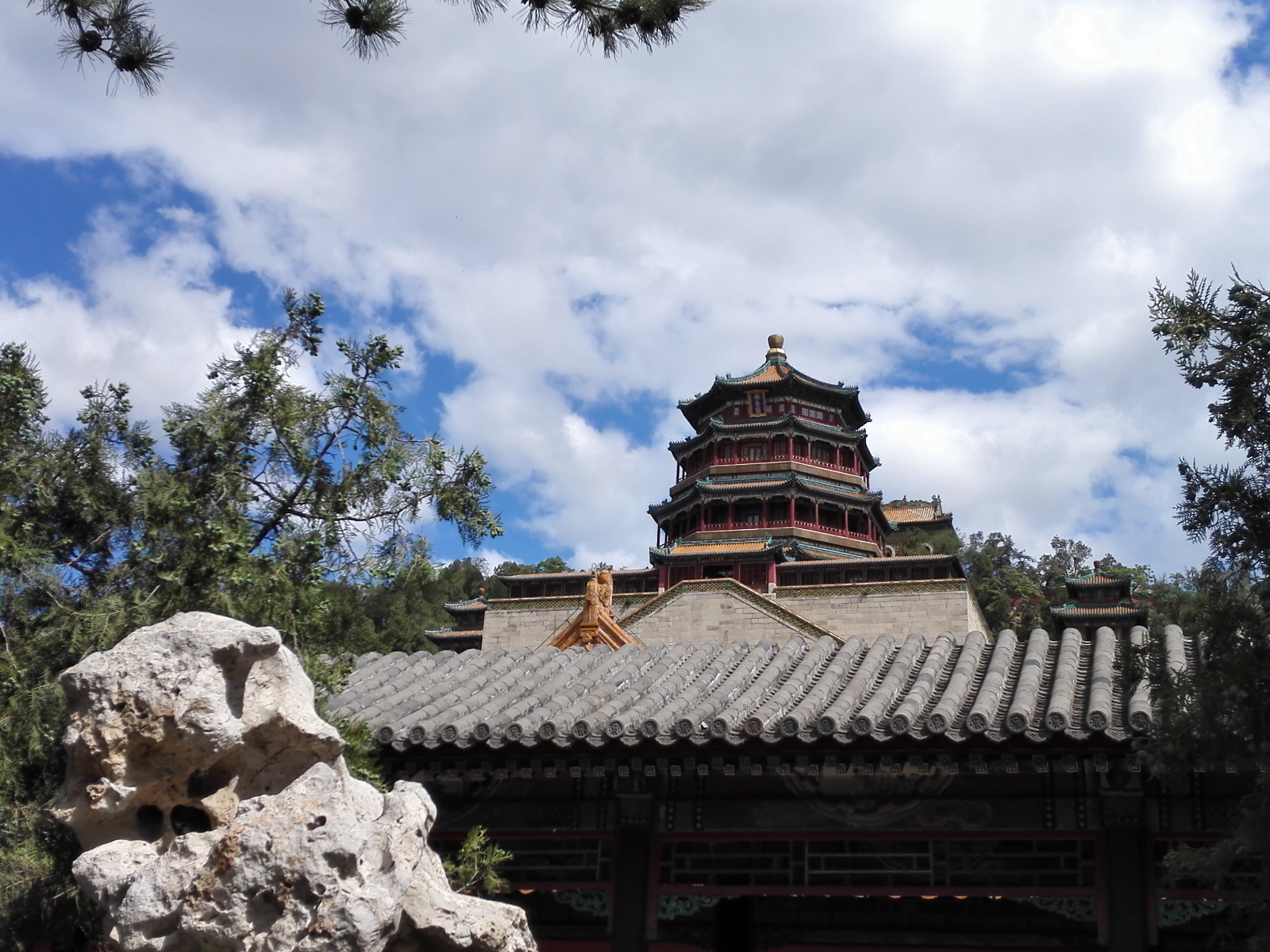
One last note: many people might notice that I haven’t shown the classic “Summer Palace icons” like the Tower of Buddhist Incense, the Long Corridor, or the Marble Boat. I do have plenty of those in my album. But what I wanted to share more is the Summer Palace as a place of everyday leisure—a park near home that has accompanied me for over a decade—rather than a distant, prestigious 5A tourist attraction.
Thank you for reading. If any photo has moved you, feel free to download it—I would be honored. And if you have a park near your home or workplace that you often visit, don’t hesitate to take photos. Over time, you too may build an entire album filled with beautiful moments.
Recent recommendations: [Film] Beaver Transformation Project, [US Series] Madison Valley Season 1, [K-Drama] Power at the Peak, [HK Drama] Goddess of Justice, [UK Series] Free Activity Time, [UK Series] The Other Bennett Sisters, [US Series] Imperfect Women, [K-Drama] Still Shining, [J-Drama] The Devil’s Handball Song, [Canada] Blue Sky Companions, [Animation] Steel Ball Run: JoJo’s Bizarre Adventure 1st STAGE, [Animation] Chicken Fighter
Highlights from recent trailers: Sekiro: Never Surrender new trailer, Dune 3 first trailer, Spider-Man: Brand New Day first trailer, Mortal Kombat 2 confirmed release date in mainland China
Latest film & TV news: Sunshine Girls Choir set for mainland release on April 4, Emotional Value confirmed for import, The Spy release poster unveiled, Bitter Star Journey poster released
@SHY: For Mabel, a suburban pond is her emotional sanctuary—until Mayor Jerry’s highway plan threatens to wipe it out. To stop the construction, she tries to lure back the beavers that once lived there as protected animals. But due to Professor Sam’s invention, her consciousness is transferred into a mechanical beaver, allowing her to infiltrate the animal world from a first-person perspective.
After watching the trailer and reading the synopsis, you might feel like you’ve already pieced together the entire plot. While the beginning and ending may be fairly predictable, the “filling” in the middle is likely to surprise most viewers. Directed by Daniel Chong, the creator of We Bare Bears, the film takes a familiar premise and lets its imagination run wild, delivering unexpected twists and cleverly crafted humor. Backed by Pixar’s unquestionable technical prowess, the animals’ fluffy textures are rendered to perfection, wrapping the entire film in an irresistibly cute atmosphere.
Though centered on the seemingly overused theme of environmental protection, the film avoids empty preaching and instead makes meaningful progress within its scope. Character developments are well-motivated, grounded in a belief in the inherent goodness of human nature. Immersed in nature, it invites viewers to let go of their worries and imagine coexistence across species—echoing, in a tongue-in-cheek way, an alternative possibility to Avatar. Brimming with childlike charm, the film captures the spirit of classic Pixar, and its strong word of mouth and box office performance come as no surprise.
[US Series] Madison Valley Season 1
Keywords: Drama / Western
Also known as: The Madison Season 1
Runtime: ~45 minutes per episode (60 minutes for the premiere) × 10 episodes; Douban link
How do you move on from the grief of loss?
@潘誉晗: Before receiving the call about her husband Preston’s fatal plane crash, Stacey had never imagined losing him. Now 65, she had met him at 19, and they built a life together—working hard, raising two beautiful daughters, and enjoying a happy, affluent life in Manhattan. To handle the aftermath, she brings her family to Madison Valley in Montana, Preston’s long-cherished hometown—a place neither she nor her children had ever visited before.
The vast plains and crystal-clear streams present a breathtaking landscape entirely unfamiliar to Stacey, who grew up in New York City. Like the proverbial “city mouse,” she has long enjoyed the conveniences of urban life, but in doing so has overlooked the grounding power of the land.
In this gentle new take, Taylor Sheridan restrains the usual intensity of the Yellowstone universe. There are no land grabs, power struggles, or graphic violence—only a family trying to come to terms with sudden loss. The storytelling is delicate and steady, like the quiet river flowing past Preston’s beloved cabin. Simply watching it unfold brings a deep sense of emotional fullness.
In the struggle for power, you either end up battered—or completely destroyed.
@利兹与青鸟: Bang Tae-seop’s father, once a union representative, took his own life after being imprisoned due to a bribery scandal involving a prosecutor. Driven by a desire for revenge, Tae-seop becomes a prosecutor himself, but his humble background limits his career advancement, no matter how hard he tries to break into elite circles. After marrying top actress Chu Sang-ah, he begins to find the key to that exclusive world—and even develops ambitions of rising to the pinnacle of Korean politics. Using evidence of sexual bribery as leverage, he partners with conglomerate heir Kwon Jong-wook. Meanwhile, Chu Sang-ah has already fallen from grace: not only is she being threatened by Lee Ryang-mi, the conglomerate’s powerful second-in-command, but a rising male star in her company is also dragged into the web of power-for-sex deals. With both Tae-seop and Sang-ah holding secrets in Lee’s hands, how can this high-stakes game possibly be won?
Although only two episodes were released in its first week, the series is dense with information, featuring a large cast and intricate relationships. Politics, capital, and the entertainment industry intertwine into an inescapable web. Beyond power struggles, it incorporates espionage and surveillance, making for a richly layered narrative. The muted color palette reinforces a somber, weighty tone. The cast is striking, with performances well-matched to their roles—Cha Joo-young, following The Glory, once again delivers a compelling portrayal of the villainous Lee Ryang-mi: powerful, unhinged, and commanding. The characters abandon their humanity for power or vengeance, only to find themselves with no way out, sinking ever deeper.
Should the age of a criminal be considered in upholding the integrity of the law?
@潘誉晗: The trial of a seven-year-old boy’s fatal fall leads Judge Yan Huizhi to reexamine her career. Dissatisfied with the verdict, the boy’s mother confronts the juvenile suspect with a knife, demanding a confession—only to be shot dead by special police. Realizing that juvenile crime can no longer be ignored, Huizhi gives up a promotion opportunity and voluntarily applies to preside over the juvenile court: “If parents fail to teach, the court will.” Through this, she hopes to uphold justice while preventing young offenders from sinking deeper into the abyss of crime.
Adapted from the Korean drama Juvenile Justice, the series focuses on crimes committed by minors. As a hotly debated topic today, it not only achieves solid localization but also boldly and sharply addresses many pressing issues: PUA, school bullying, sexual abuse by trusted teachers… One harrowing case follows another, making for a deeply unsettling viewing experience. While maintaining a tight narrative pace and delivering compelling courtroom drama, the series also probes the root causes of juvenile crime—family neglect, distorted personalities—issues that urgently demand public attention. The courtroom scenes are particularly well-executed.
[UK Series] Waiting for the Out
Keywords: Drama
Also known as: Waiting for the Out
Runtime: ~45 minutes per episode × 6 episodes; Douban link
My father, my uncle, and my brother—they’ve all been in prison.
@潘誉晗: Philosophy teacher Dan takes on a new job, entering a prison to teach inmates. He hopes that through his lessons, they might learn to think philosophically. What he doesn’t expect is that the job will instead lead him to rediscover himself.
Unlike typical prison dramas, Waiting for the Out presents a very different portrayal of prison life. There are no vicious criminals or irredeemable villains—these inmates show up to Dan’s class on time, like well-behaved students. Dan himself is an intriguing protagonist: he suffers from OCD and constant anxiety, repeatedly checking photos on his phone to confirm he has turned off the gas at home. He once had a respectable job, making his decision to teach in prison puzzling. Yet his father, uncle, and brother have all served time—an invisible thread that seems to have led him here as well.
Each episode revolves around a philosophical topic, with discussions that are sincere and thought-provoking. As the series unfolds, we see Dan gradually come to terms with his own fragility and family history, finding himself anew. At the same time, in these prisoners—often scorned by society—we glimpse both sorrow and humanity.
[UK Series] The Other Bennet Sister
Keywords: Drama
Also known as: The Other Bennet Sister
Runtime: ~30 minutes per episode × 10 episodes; Douban link
Even an ordinary bird can soar across the sky.
@利兹与青鸟: As a spin-off of Pride and Prejudice, this series is adapted from the novel of the same name and centers on Mary Bennet, the third daughter of the Bennet family. Compared to her sisters, Mary is unremarkable—seen by her mother as awkward, out of place, a bespectacled and unpopular bookworm. The story begins when Mr. Bingley purchases the estate. As her sisters marry one by one, books fail to provide answers for Mary’s life, and she resigns herself to a future of staying with her mother. However, her mother sends her to her uncle’s home to work temporarily as a governess. Arriving in London, Mary begins a new chapter in her life.
From the five episodes released so far, the series stands out in both pacing and production quality. It addresses the original novel’s slower narrative progression while introducing fresh developments in each episode. Mary’s life in London is far from smooth—one challenge after another pushes her to grow. The cinematography is beautiful, ranging from pastoral, oil-painting-like landscapes to elegant and classical ballroom scenes. The characters’ inner monologues are delicately portrayed, revealing the constraints faced by women of that era, while the dialogue retains the literary charm of the original work. Freed from her mother’s constant criticism and supported by a kind aunt and accepting friends, Mary gradually discovers her strengths—and in doing so, inspires viewers with a renewed sense of enthusiasm for life.
[US Series] Imperfect Women
Keywords: Thriller
Also known as: Imperfect Women
Runtime: ~45 minutes per episode × 8 episodes; Douban link
Is there still such a thing as trustworthy friendship in this world?
@潘誉晗: Late at night, Erin receives a call from Robert, the husband of her friend Nancy. He says he wants to report Nancy missing immediately. Hearing this, Erin is forced to reveal Nancy’s affair. She then rushes to Robert’s home to comfort him—only for the police to arrive and inform them that Nancy’s body has been found.
Adapted from a novel, the series revolves around the death of a woman. On social media, Nancy’s daily posts paint a picture of a glamorous life as a wealthy wife. Her husband, from an old-money family, dotes on her; her daughter shares a close bond with her; and she is surrounded by two close friends, Mary and Erin. Yet it is precisely this death that exposes the illusion beneath the trio’s seemingly perfect friendship. Nancy’s affair was known only to Erin; Nancy’s unease about Erin’s relationship with her husband was confided only to Mary. They claimed to share everything—but once privacy and love come into play, everything begins to change.
With a murder at its core, the series carries a strong sense of texture, using visuals and music to build an effective atmosphere of suspense. Its probing exploration of female friendship is both poignant and thought-provoking.
@潘誉晗: A car accident robs 19-year-old Yeon Tae-ri of his parents. Forced to take on the role of an elder brother, he sets aside his youthful impulsiveness and transfers to a rural town with his injured younger sibling. That summer, he meets Mo Eun-ah. Living alone with her father, Eun-ah carries her own hidden wounds. Bound by shared burdens, the two young hearts quickly draw close—but at the age of 20, their passionate love comes to an abrupt end. Ten years later, fate brings them together again. As long-silent feelings begin to stir once more, can they find their way back to each other?
Both timelines portrayed in the series are deeply moving. At 19, Tae-ri and Eun-ah are two youths in the prime of their lives—wounded yet pretending to be strong, finding solace and healing in each other. But loving too early means that dreams and the future force them apart. At 30, they are more mature, burdened with greater concerns—yet capable of loving more deeply.
There are no melodramatic twists or manufactured sweetness—only choices shaped by circumstance. Their intimacy comes naturally, born of genuine love. This story of reunion feels as fresh and gentle as the air after rain.
[J-Drama] The Devil’s Handball Song
Keywords: Drama / Mystery / Crime
Also known as: 悪魔の手毬唄
Runtime: ~90 minutes per episode × 2 episodes; Douban link
Every note of the nursery rhyme carries the weight of old sins.
@Sholmes: Detective Kosuke Kindaichi arrives at Onikubi Village in Okayama Prefecture, staying at the local hot spring inn “Kame-no-Yu.” The village is abuzz with celebration as Chieko, a popular singer originally from the area, returns home in triumph. But the festive mood is short-lived. Soon after her return, several of her childhood friends—young women from the village—are murdered one after another. What makes the case especially eerie is that each body is found adorned with peculiar decorations, each corresponding exactly to the lyrics of an old folk rhyme passed down through generations in the village—The Devil’s Handball Song.
The mountainous landscape of Onikubi Village and the wooden corridors of the hot spring inn form a somber yet beautiful backdrop. The female characters are not merely victims; each carries her own secrets and past, becoming active forces that drive the tragedy forward. By delving deeply into the psychology of its characters, the script moves beyond the simple question of “who is the killer” and instead asks, “what creates a killer.” Unlike the more free-spirited portrayal by Koji Ishizaka, Hidetaka Yoshioka’s Kindaichi exudes a quiet, almost melancholic warmth. He is not a detached puzzle-solver, but rather a compassionate observer of human tragedy—an interpretation that closely aligns with the fatalistic tone of the original work. The pacing is restrained: the first part focuses on building suspense, while the latter gathers all narrative threads, leading to a bittersweet truth.
[Canada] Blue Skies
Keywords: Drama
Also known as: Blue Skies
Runtime: ~45 minutes per episode × 8 episodes; Douban link
Our furry companions will always be humanity’s best partners~
@潘誉晗: After retiring from the military, Jodie returns to her hometown and becomes a ranger investigator at Crystal Ridge National Park. The park is vast and home to many wild animals, so the job is typically done in pairs. However, on her final day before discharge, Jodie nearly caused a teammate’s death due to her own mistake, leaving her with deep psychological scars. As a result, she insists on working alone after becoming a ranger. On the very day her new supervisor arrives and requires her to find a partner, she unexpectedly discovers an intelligent stray dog in the park. She names him Blue, and from that moment on, they become the perfect team.
Set against the backdrop of a national park, the series naturally benefits from breathtaking scenery, offering a visually soothing viewing experience. Amid such beauty, the close bond and seamless cooperation between Blue and Jodie add an extra layer of warmth and healing. The narrative is well-structured, and through the protagonist’s profession, viewers gain insight into the work of ranger investigators. Searching for missing hikers involves more than just basic tasks like area sweeps and drone surveillance—it also includes rappelling into valleys and exploring caves. The daily life of a ranger investigator is anything but easy.
True failure belongs to those who forget the spirit of exploration and never dare to challenge adversity.
@SHY: In 1890, the 6,000-kilometer STEEL BALL RUN race kicks off across the United States. From San Diego to New York, contestants ride horseback across North America, competing for a grand prize of 50 million dollars. After encountering the mysterious Gyro Zeppeli, former prodigy jockey Johnny Joestar—now paralyzed from the waist down—enters the race, setting the stage for a bizarre adventure.
As the beginning of JOJO’s new universe, Steel Ball Run synthesizes elements and characters from earlier parts, standing not only as a culmination of the series but also widely regarded as one of the greatest manga of all time. Hirohiko Araki transcends the conventions of traditional shonen manga, crafting vivid, fully realized characters while continuing to celebrate the courage of humanity. The entanglement of dark intentions and golden spirit elevates the protagonists’ journeys of redemption and growth, telling the story of a man abandoned by fate who rises again.
Animating horses is notoriously difficult in hand-drawn animation—let alone the grand spectacle of thousands galloping across the plains. While many fans tempered their expectations, David Production delivered a reverse “PV deception,” with the final product showing a clear improvement over the initial trailer. Clever direction compensates for production limitations, concentrating resources on the exhilarating horseback battles in the latter half. The climactic finish line sequence fully ignites the audience’s emotions—guaranteed to get your blood pumping. This long journey is one worth witnessing.
[Animation] Rooster Fighter
Keywords: Manga adaptation / Fantasy / Action / Comedy
Also known as: ニワトリ・ファイター / Rooster Fighter
Runtime: 24 minutes per episode × number of episodes unknown, updated weekly on Sundays
@SHY: On that day, humanity recalled the terror of being dominated—and the humiliation of being confined in cages. As monstrous “oni-beasts” trample cities at will, a furious rooster rises to stand against them. Named Keiji, he roams the land in search of the demon that killed his sister. Along the way, he forms strong bonds with companions such as Piyoko, a chick bearing the tattoo of “justice and loyalty,” and Elizabeth, a talented and beautiful hen, joining forces to overturn a seemingly hopeless future.
Adapted from one of the new-generation meme manga sensations—nicknamed “our ruthless chicken bro, a man of few words”—the original work went viral across the internet early in its serialization. The anime fully embraces the language of short-form video clips: episode one is packed with rapid-fire references, from three-dimensional chicken-powered devices to “semi-circular physics,” unleashing absurd ultimate moves with clucks and crows, capped off with a punchy финisher—every frame feels like a highlight moment. Keiji, with grand ambitions, delivers sharp, hilarious lines that keep audiences laughing.
Following last year’s work on “Hen Gear,” animation studio Sanzigen proves equally adept at bringing roosters to life. The bold, thick-lined modeling gives the characters a strong physical presence. While the story largely follows familiar shonen tropes, replacing the protagonist with a rooster makes everything delightfully absurd. Scripted by blockbuster veteran Hiroshi Seko, the series playfully subverts those very tropes. Watch as Keiji sharpens his feathers, lets out a mighty crow, and slays demons—reminding us that when the rooster crows, the world awakens. Truly, chicken bro is something else.
@SHY: Marty Mauser, a young clerk working in a shoe store, possesses extraordinary table tennis talent. In his pursuit of a chance to prove himself, he is willing to pay any price. Can this unmatched obsession lead him to success? Although it awkwardly went 0-for-9 at the Oscars, the sheer number of nominations proves the film’s strengths. Director Josh Safdie crafts an extremely self-serving, almost manic character through unconventional editing and storytelling, while Timothée Chalamet delivers what may be a career-best performance, bringing the character’s magnetic presence to the big screen—even if you don’t agree with his actions, it’s hard not to be drawn in.
@SHY: Will, a small-statured goat with dreams of becoming a superstar, makes his way into the team of his dreams through talent, hard work, and a bit of luck. But in a sport dominated by fierce beasts, things are far from simple. Produced and voiced by Stephen Curry, this GOAT-themed film draws inspiration from real-life stories and is packed with countless Easter eggs. Fresh off an Oscar win, Sony Animation continues the distinctive visual style seen in Spider-Verse and The Mitchells vs. the Machines, delivering an outstanding audiovisual experience. While the script leans toward familiar territory, the underdog comeback story on the court remains genuinely moving.
@利兹与青鸟: Adapted from the novel of the same name, the story is set in the early 20th century. Emma Hart, a hardworking, sharp-minded, and determined maid from a poor background, seizes opportunities during World War I and gradually builds her own business empire through sheer effort. While it may sound like a typical “strong female lead” success story—with elements of love, betrayal, and family intrigue that make it dramatic and legendary—Emma is portrayed as a fully realized character with both strengths and flaws, making her compelling to watch. However, the ending may test viewers’ patience and emotions—perhaps a reflection of life’s bittersweet reality.
@潘誉晗: Saint Marie is always bathed in sunshine—unfortunately, it’s also a place where crime frequently occurs. Thankfully, the detectives at the local police station are reliable, working in sync and dividing tasks efficiently. Though they occasionally hit dead ends, they always manage to solve the case in the end. Over the years, this long-running series has seen a rotating cast of lead detectives; this time, the newcomer is transferred from Brazil. Yet the commissioner and mayor remain constant, as do the Caribbean scenery and the triumph of justice.
@潘誉晗: Seo Mirae gains access to a beta version of an otome game called “Boyfriend Subscription.” Within the game, she can choose from 900 high-quality male characters to romance. To better fulfill her role as a romance manga editor, Mirae enters the game—and unexpectedly rekindles her long-dormant feelings, rediscovering her desire for love. This urban romantic comedy, built around elements like otome games and manga, offers a fresh premise and a brisk, lighthearted pace.
@利兹与青鸟: Shin Yi-rang, struggling in her career, opens a law firm inside a former shaman’s studio steeped in folk traditions. Unexpectedly, she gains the ability to communicate with spirits—and even be possessed by them—using these powers to seek justice for the dead. Blending supernatural elements with episodic investigative cases, the series features socially grounded stories that highlight human warmth, yet maintains an overall light and comedic tone. Yoo Yeon-seok’s performance, especially in possession scenes, is both exhilarating and entertaining, making it a perfect casual watch.
On March 17, the animated film Sekiro: Never Surrender released a new trailer. The film is set to premiere in Japan in 2026 and will be available on Crunchyroll. Adapted from the game Sekiro: Shadows Die Twice, it is directed by Kenichi Tsunama, written by Takuya Sato, with Takashi Mukoda serving as action animation director, music composed by Tatsuya Kato, and produced by Qzil.la. The theme song is “Blu” by Ryuichi Sakamoto. Source
On March 18, the first trailer for Dune 3 was released. The film is scheduled to premiere in North America on December 18. Directed by Denis Villeneuve and starring Timothée Chalamet, Zendaya, Rebecca Ferguson, Robert Pattinson, Florence Pugh, Anya Taylor-Joy, Jason Momoa, and Javier Bardem, the film brings together new enemies and old allies as it builds toward an epic conclusion. Source
On March 18, the first trailer for Spider-Man: Brand New Day was released. The film will debut in North America on July 31. Directed by Destin Daniel Cretton and starring Tom Holland, Zendaya, and Mark Ruffalo, the story follows Peter Parker after he has been forgotten by the world—his loved ones now strangers. As new threats emerge, can Spider-Man, fighting alone, rise again? Source
On March 16, the action film Mortal Kombat 2 was officially scheduled for release in mainland China on May 8, alongside a new poster and trailer. Directed once again by Simon McQuoid, the film stars Karl Urban (Johnny Cage), Adeline Rudolph (Kitana), Jessica McNamee (Sonya Blade), Josh Lawson (Kano), and Ludi Lin (Liu Kang).
More
Animation Film Chiikawa: The Secret of Mermaid Island – Teaser Trailer: Directed by Kei Oikawa and produced by Cygames Pictures, the film is adapted from a story originally posted on X by creator Nagano in 2023. After receiving a special invitation, the adorable characters set off for a training camp on a mysterious island. The film will be released in Japan on July 24. Source
Film Wild Horse Nine – First Trailer: Directed and written by Martin McDonagh (Three Billboards Outside Ebbing, Missouri), and starring John Malkovich and Sam Rockwell, the story follows two CIA agents with vastly different personalities, Chris and Lee, who are sent to Easter Island. There, they must carry out a mission that tests their trust and loyalty. The film will premiere in North America on November 6. Source
Film Jack Ryan: Ghost War – First Trailer: Directed by Andrew Bernstein and starring John Krasinski, Sienna Miller, McKenna Grace, and Khalid Abdalla, the film sees Jack reunite with veteran CIA agent Mike and former CIA director James. Drawing on their extensive experience, they face off against a formidable enemy. It will premiere on Prime Video on May 20. Source
📽 Weekly Film & TV News
Sunshine Girls Choir set for mainland release on April 4 On March 19, Sunshine Girls Choir, the highest-grossing Chinese-language film in Taiwan box office history, was officially scheduled for mainland China release on April 4, alongside a trailer and poster. Directed by Hsiao-Chien Lin and starring Ivy Chen and Judy Ongg, the story follows Li Huizhen, who, in order to leave behind beautiful memories for her soon-to-depart daughter, decides to form a choir. Through rehearsals and shared moments, these imperfect women gradually heal one another. Source
Sentimental Value confirmed for import On March 15, the film Sentimental Value was confirmed for import and will be released soon. The film won Best International Feature at the 98th Academy Awards and is directed by Joachim Trier (The Worst Person in the World), starring Renate Reinsve, Stellan Skarsgård, Inga Ibsdotter Lilleaas, and Elle Fanning. It was previously recommended in What to Watch This Week (260206 edition).
The Informant release poster unveiled On March 16, The Informant officially announced its release date, unveiling a poster and trailer. The film will be released nationwide on March 27. It won Best Foreign Language Film and Best Actor at the Golden Globes and received a nomination for Best Picture at the 98th Academy Awards. Directed by Kleber Mendonça Filho and starring Wagner Moura, the story follows an ordinary professor who goes into hiding to escape persecution, using an individual’s fate to reflect broader historical memory.
Bitter Star Journey releases new poster On March 16, the dark comedy Bitter Star Journey, directed by Jonah Hill and co-starring Keanu Reeves, Cameron Diaz, and Matt Bomer, released a new poster. The film will premiere on Apple TV on April 10. The cast also includes Martin Scorsese, Susan Lucci, Laverne Cox, David Spade, Atsuko Okatsuka, Roy Wood Jr., Kaia Gerber, and Ivy Wolk.
Xinjiang has become incredibly popular—everyone wants to go. But after visiting, I realized it is still underestimated.
The fiery sunset clouds over Sayram Lake
During the recent off-season, I spent 24 days traveling solo across Xinjiang, moving between both northern and southern regions. I visited Urumqi, Turpan, Fuyun, Altay, Shache, Kashgar, Tashkurgan, Aksu, Yining, Bole, and more. I rode the snowfield train to Koktokay, passed herds of camels, cattle, sheep, and horses scattered across the winter wilderness, witnessed the golden sunset glow over Bogda Peak, saw horses treading through snow-laden pine forests in the Tianshan Mountains, yaks slowly crossing the frozen Baisha Lake, the silent “Father of Ice Mountains” on the Pamir Plateau, pigeons and timeworn high-platform dwellings, the Karakoram Mountains sealing the road like a wall at the edge of the world, mandarin ducks shaking water off their feathers in the wetlands of Ili at dusk, fiery clouds reflecting red across snow mountains and dissolving into the tears of Sayram Lake, and wild ibex wandering at 3,300 meters, grazing on moss in the mountain winds…
Snowfields, grasslands, mountains, glaciers, lakes, hills, wetlands, volcanoes, canyons, forests, deserts, oases… To contain such a rich diversity of landscapes within a single province feels almost unbelievable. Nature’s craftsmanship here is vast and intricate, making Xinjiang astonishingly rich in travel possibilities. Its multicultural blend also gives cities a distinctive, almost exotic atmosphere. Over these 24 days of travel, every place overwhelmed my senses—from landscapes to people to all living things—expanding my understanding of what travel can be.
My map after completing the journey
I am not a trekking expert, nor a cultural scholar, so I cannot share the most extreme scenery or lost relics of Xinjiang. But I am a traveler—someone good at saving money and traveling on a budget. Contrary to the growing perception that Xinjiang is becoming increasingly expensive, my nearly month-long, free-spirited journey made me realize that Xinjiang is actually an ideal destination for budget travel during the off-season—a place to truly relax both body and mind. It’s genuinely affordable.
Sayram Lake
Expenses
Talk is cheap—let’s look at the actual bill. From flights to accommodation, food, transportation, and various miscellaneous costs, my total spending over these 24 days was under RMB 8,000 (see detailed breakdown below). This is not the typical “per capita” calculation often used in headlines (where accommodation costs are shared), nor is it a hardcore, ultra-frugal trip. I did not deliberately lower my travel standards or resort to energy-draining ways of saving money, such as long hours on hard-seat trains or staying in low-quality hostel beds with unpleasant conditions. My trip included high-speed rail business class, occasional stays at Hilton hotels, and experiences like horseback riding and ski resort visits. In other words, I traveled comfortably and freely the entire time—not cutting costs deliberately, but also not planning everything far in advance, simply going with the flow. It’s worth noting that affordability, comfort, and flexibility form an almost impossible triangle in travel—especially in a place like Xinjiang, where prices are often assumed to rival those of major cities like Beijing, Shanghai, and Guangzhou.
The expense record is quite long and shown across multiple images; it was manually tracked without missing a single entry
One thing to clarify: my return flight out of Xinjiang happened to be reimbursed due to a photography-related invitation. However, even without reimbursement, using a flight pass like China Eastern’s “Fly Freely” would have only added around RMB 269.
Earlier, I shared both my expenses and travel photos with a European friend, who remarked, “Do you know how expensive a similar experience would be in Europe?” That was when it struck me—this might actually be the best time for domestic travel. Since the pandemic, prices have risen globally, yet within China, costs have been decreasing. Factors such as the real estate slowdown, economic adjustments, and the country’s strong push to develop western regions have led to airline subsidies, discounted newly opened chain hotels, and increasingly affordable travel and accommodation. Meanwhile, infrastructure continues to improve rapidly—from the upgrade of Diwopu Airport to Tianshan Airport, to new energy facilities and rapidly developing cities—enhancing the overall travel experience. This combination is rare on a global scale and likely won’t last forever. It feels like a unique dividend of this era.
A frozen lake surface
Of course, taking advantage of this “dividend” requires some strategy. Based on the expenses and this journey, let’s talk about how to travel Xinjiang comfortably on a budget.
Flights: Off-Season, Flight Passes, and Flexible Deals
Flights are the first hurdle for most people. Many have searched for peak-season ticket prices to Xinjiang after being inspired by viral travel videos, only to label it as an expensive destination. And it’s true—if you book last minute during peak season, flying to Xinjiang can be extremely costly. However, I used a Hainan Airlines “Fly Freely” pass during the off-season. The pass itself costs RMB 666, and each flight has a fixed cost of RMB 199 plus airport taxes and fuel surcharges. These flight pass products have been widely known since the pandemic, but availability depends on routes and seat inventory. This year, with the economy still sluggish, airlines such as Hainan Airlines, China Southern, Sichuan Airlines, Spring Airlines, China Express, and Loong Air continue to offer similar products. However, each airline has different rules and usage methods, which can be quite complex. For example, with the Hainan Airlines pass I used, I flew from Luoyang to Urumqi. Each flight has limited seat availability, requiring reservations several days in advance, and all eligible flights are red-eye flights—meaning you may occasionally lose a night’s accommodation. Different airlines have varying route networks and operational strategies, so I won’t go into detail here. Instead, I recommend following specialized bloggers and information sources such as Feifei Travel (WeChat), Feifei (mini program for checking routes), “This Is Not Excessive” (Xiaohongshu), Travel Radar Assistant (WeChat), and Stan Cheap Flights (WeChat).
As a side note, for Xinjiang-specific flight passes, Chengdu Airlines and China Express operate many regional routes and offer dedicated Xinjiang passes, such as Chengdu Airlines’ “Xinjiang Unlimited Fly” starting from RMB 150. These are limited to flights within Xinjiang and are very cost-effective, though they require booking several days in advance. They are ideal for experienced travelers planning in-depth trips. I originally purchased one of these for this journey, but due to platform issues I couldn’t use it—otherwise I would have saved even more.
A small aircraft at Altay Airport
Flight passes come with complex rules and are better suited for experienced users. Beginners or those simply planning a Xinjiang trip can consider multi-flight passes. These are sold through various channels, including OTA platforms, airline livestreams on Douyin or Xiaohongshu, as well as airline apps and mini programs. Sales periods are irregular, so it’s best to follow the information sources mentioned earlier. Although all are “multi-flight passes,” their rules vary significantly by airline, so be sure to read the details carefully (or search for user experiences—I often do this myself).
Finally, and just as importantly, there are discounted flight tickets. Flights and hotels are opportunity-based products, with prices fluctuating over time. By using OTA price-checking tools and planning ahead, you can sometimes find deals comparable to flight passes or multi-flight packages, while saving effort. Based on my experience, Ctrip offers the most intuitive discount flight search function. In “Home – Flights – Special Deals,” you can search across a large database ranging from cities to provinces to entire countries, with calendar-based pricing tools. For example, using Ctrip, the cheapest flight in December was a China Express flight (G52885) from Hohhot to Erenhot on December 20, costing only RMB 170 including taxes and fees.
Although I often use Ctrip for price comparisons, I usually book flights through Fliggy. Thanks to the 88VIP membership and Fliggy’s partnerships with Marriott and Hilton, I prefer booking there to accumulate membership benefits. This is mainly because I don’t participate in airline loyalty programs—otherwise booking directly through airlines might be more reasonable. Hotel memberships, airline memberships, and OTA platform memberships all offer different benefits, so choosing the right platform based on your status is key. For example, I don’t have airline status, but I am an F5 member on Fliggy. By booking through Fliggy, I can redeem points for airport lounge access and fast-track security, which helps me rest and recover during travel transitions. Overall, making good use of membership perks is an effective way to recharge during a trip and avoid exhausting yourself with overly intense travel schedules.
First Stop: Urumqi
For this trip to Xinjiang, I made no prior itinerary plans, so my first destination was the typical beginner-friendly choice: Urumqi.
As the capital of Xinjiang and a major hub in Northwest China, Urumqi naturally offers the densest network of inbound and outbound flights. Benefiting from the “Belt and Road” initiative, Urumqi Tianshan International Airport has undergone continuous upgrades in recent years—not only changing its name (officially renamed from Diwopu International Airport in March 2025), but also expanding to Terminal 4 (with T1–T3 under renovation). Its annual passenger capacity has grown from the originally designed 35 million to 63 million. The airport facilities are highly advanced, with comprehensive routes that make it convenient to travel across the entire region.
A glimpse reveals the whole picture—Tianshan Airport is a microcosm of Xinjiang’s overall development. Throughout my 20+ day journey, I often felt that Xinjiang today resembles coastal cities in Southeast China before the pandemic, or even around 2008—a sense of economic upward momentum. Urumqi is filled with newly constructed high-rises, giving me a feeling surprisingly similar to Shenzhen. This is also reflected in the data: Urumqi’s urbanization rate has reached an astonishing 97%, second only to Shenzhen’s 98.5% nationwide, and far exceeding Guangzhou’s 86.5% in third place.
A rapidly rising cityscape
As a result, Urumqi shares similarities with Shenzhen: well-planned urban design and developed infrastructure, but relatively limited travel attractions and (comparatively) less remarkable food. The logic is simple—Shenzhen also has beautiful coastlines and a rich mix of Cantonese cuisine, yet high living costs and rapid urbanization often compress local culture and culinary diversity. Starting your Xinjiang trip in Urumqi is like starting a Guangdong trip in Shenzhen. Out of curiosity, I stayed in Urumqi for a few extra days, but in hindsight, it wasn’t necessary. Despite frequent recommendations online, my advice is to treat it as a transit point and move on as soon as possible.
My first plate of pilaf in Xinjiang
If you do want to explore Urumqi briefly, places like Hequan Second Street, the Grand Bazaar, and Consulate Lane do offer ethnic charm, but they are not particularly unique within the broader context of Xinjiang and can be skipped if time is limited. Three more worthwhile options are Hongshan Park, Yama Mountain, and Shagou. Hongshan Park is the most accessible choice, offering excellent viewpoints for sunset over the mountains and cityscapes.
View of Bogda Peak from Hongshan Park
Bogda Peak, meaning “God of Mountains” in Mongolian, stands at 5,445 meters and is considered a sacred mountain. For many visitors, it is the first major peak they see in Xinjiang. While it wasn’t the tallest mountain I encountered on this trip, it carried a profound sense of presence. At sunset, as golden light falls upon it, the towering mountain overlooks the city skyline, and the Tianshan range stands like a crowned deity—enduring through time, silently demonstrating the unimaginable forces of nature.
Hongshan Park is easily accessible by taxi, making it a convenient viewing spot. If you’re looking for a higher vantage point, Yama Mountain is a better choice. At 1,391 meters, it is the highest point within Urumqi city, though still lower than Mount Tai’s 1,545 meters. However, it is much easier to climb—thanks to its higher starting elevation, shorter route, and gentle slopes. With a good path and decent fitness, you can reach the summit in just over half an hour. There are even shortcuts that can be found on Xiaohongshu. Locals call it “Monster Mountain.” I didn’t feel much on the way up while chasing the sunset, but descending after dark was a different story—bare trees, strange rocks, winding paths, and complete darkness made it genuinely unsettling. Thankfully, I had a bright photography flashlight; otherwise, walking down alone would have been quite intimidating.
Shagou in the southern part of Urumqi County deserves special mention. I went there for horseback riding, which is often described online as a hidden gem activity in Urumqi. To give the conclusion upfront: the experience is unique and affordable, but I don’t recommend it due to safety concerns. The area is underdeveloped, and horseback rides typically come with a teenage local guide (one-to-many, paid, with limited Mandarin communication), and no protective measures. Local herders have lived here for generations, mastering horseback riding from a young age—some, like the Kyrgyz guide I met, even train eagles. The horses, however, can be unpredictable. Mine suddenly sprinted at full speed at one point, ignoring commands, until I managed to pull the reins tightly and the guide caught up to regain control. Others seemed to have calmer horses, but if you try this, be sure to ask for a gentle one.
Shagou is located in Urumqi County, about 1 to 1.5 hours by car. There is a shuttle bus from the parking lot of Friendly City Outlets, costing RMB 20 per person, with stops along the way. It’s best to go in the morning, and get the driver’s contact information for the return trip. Drivers in Xinjiang often coordinate rides through internal networks, which I also experienced in Altay, Sayram Lake, and Shache—you may not return with the same driver, but they’ll arrange transport as long as you confirm your timing. Many herders offer horseback riding services; you can book online or ask drivers for recommendations. Prices generally start at RMB 60 per hour, depending on the horse. In more developed scenic areas in northern Xinjiang, horseback riding is more expensive but safer, with one-on-one guides, helmets, and insurance. Even then, accidents do happen. In contrast, riding in Shagou feels raw and untamed—no protective gear, minimal instruction, and risks that local herders seem unconcerned about. While I admire their carefree confidence, I must caution those unfamiliar with such environments: if you lack experience, avoid it; if you lack physical strength, don’t even consider it. Riding is physically demanding—your thighs will endure intense friction, so be prepared. Avoid carrying handheld camera equipment; instead, use a chest-mounted action camera for first-person footage. You can take photos with your phone during breaks. Secure your pockets or travel light. Bags can be left in the herders’ yurts, guarded by large dogs capable of fending off wolves. Never stand behind a horse, and if you bring a drone, operate it far away from horses to avoid disturbing them.
Despite all these warnings, galloping across the Tianshan Mountains still feels exhilarating. When the horse runs, it feels like flying, and the snow becomes clouds. All worries fall behind you, and the distance ahead becomes your destination.
Altay · Fuyun
After horseback riding, my body ached for several days, so I decided to leave Urumqi and head to northern Xinjiang. The cheapest flight option required a transfer via Turpan to Fuyun. I took a hard-seat train for RMB 24.5 to Turpan, where the overheated carriage left me feeling dizzy. Cheap as it was, the journey was still quite long—distances between cities in Xinjiang are immense. I didn’t explore Turpan at all, instead staying in a small hotel without an elevator near the station, waiting for my flight. Skipping Turpan was one of my few regrets during the trip—the station is right next to the airport but far from the city center, so if you follow a similar route, planning is essential. But what came next made up for it: the flight from Turpan to Fuyun cost only RMB 119. Most airports in Xinjiang are quite small, without jet bridges—you simply walk to board the plane. The aircraft was a Bombardier CRJ900 operated by China Express. It’s an interesting plane—Bombardier jets are often used as private aircraft, so it felt small and somewhat cramped. I’ve heard these flights often operate from dawn till dusk with rotating crews, almost like airborne buses. I recommend choosing a window seat near the front. If you happen to take off on a clear day after snowfall, you’ll feel exactly what I did.
This was, without a doubt, the best RMB 119 I’ve ever spent.
Flying from south to north, we crossed the Tianshan Mountains. From cruising altitude, looking down at Bogda Peak was a breathtaking, almost tear-inducing experience. There was even a hint of guilt in those tears—what right did I have to view such a sacred mountain from a godlike perspective?
Flying over the Tianshan
Lin Zexu once wrote at the foot of the mountains, “I smile with the spirit of the mountains.” Li Bai imagined the frontier: “The bright moon rises from the Tianshan, among vast seas of clouds.” Cen Shen wrote, “Snow clouds never part over the Tianshan, peaks upon peaks stand towering in white.” And I, in the sky, was left speechless—lost in awe. Without the words of poets or heroes, how could an ordinary person ever describe such an eternal mountain?
Fuyun is a county under Altay Prefecture. The writer Li Juan, author of My Altay, is from here. The famous Koktokay lies nearby. In winter, everything here is covered in endless white. Koktokay is home to a ski resort, and recently even made headlines for a rare snow leopard sighting. Snow leopards are incredibly elusive—many researchers spend their entire lives without seeing one in the wild. That alone tells you how pristine and untamed the environment is.
Melting ice flows swiftly through the rivers
There is no public transportation from the airport to Fuyun County—taxis cost around RMB 100, or RMB 80 if you bargain. Ride-hailing services are rare; taxis are the main option. Fuyun feels somewhat like Northeast China: low prices, generous food portions, and warm, straightforward people. I stayed at what might be the cheapest Hilton DoubleTree in the world. As a member—and likely one of very few here—I was upgraded to a spacious suite for just over RMB 200. The room even had a tea table and a mahjong table, and the bathroom was so large it included a sofa.
A sofa in the bathroom—something I’d never seen before
From my room, I could see snow-covered mountains in the distance. Fuyun is surrounded by mountains on all sides, with icy rivers flowing swiftly through the landscape. People move carefully but with quiet determination. The sky is white, the mountains are white, and even the half-frozen rivers gleam with brightness. Only the town itself carries a hint of color, as people go about their daily lives. Imagine a campfire burning across a snowfield—that flicker of warmth is Fuyun.
Fuyun straight out of an iPhone shot
My days in Fuyun were wonderfully unhurried. Walking along the streets, footprints sank deep into the snow, while tiny snowflakes settled into my hair. Meatball soup was rich and warming; lamb and naan were so hearty they felt overwhelming; pilaf with a couple of thin-skinned dumplings, and oil-slicked stir-fried noodles often left me in a blissful carb haze.
Days of indulgence in Fuyun
Li Juan once described Fuyun like this: “Fuyun County is as quiet as the end of the world, with only four streets crossing in a grid, and filled entirely with trees. Whenever I walked between school and home along that straight, silent, tree-lined road, dense canopies intertwined above, forming a shaded corridor. The world before me felt endlessly deep and ancient, a mystery that still lingers in my heart to this day.”
Altay
From Fuyun to Altay city, you should definitely take the train. However, the hard-seat carriages can be quite crowded. I recommend booking a sleeper instead—it’s much less crowded and not significantly more expensive. The carriage between the hard seats and sleepers is locked.
You can take a bus from Fuyun to the train station for just RMB 5
The scenery on this train is unlike anything I’ve ever seen—a true snowfield train. Along the way, you’ll see camels, herds of horses and cattle, and scattered yurts. It feels like… the planet with potential for life that Matt Damon sends coordinates to in Interstellar. Everything looks like it could sustain life.
The snowfield train
Compared to the small-town feel of Fuyun, Altay city is much larger, more commercialized, and very popular. In Fuyun, I didn’t visit Koktokay; in Altay, I didn’t go to Hemu—looking back, that’s a bit of a regret. At the time, however, continuous snowfall made travel difficult, and those places are quite commercialized. Many local herders have already sold their land to outsiders and moved into the city. Wooden houses converted from cattle sheds in Hemu can sell for several thousand RMB per night during New Year’s Eve. I visited in November, typically considered the off-season, but it was just before Altay’s peak winter season—the ski resorts had just opened, and hotel prices were already rising. Reports say that during peak snow season last year, rooms were nearly impossible to book. With a limited budget, I didn’t dare venture to places like Baihaba or Hemu. Ski enthusiasts have strong spending power and a certain vitality—you can almost sense their polished, middle-class presence even at breakfast in the hotel. It’s the scent of urban life, higher education, and high income, mixed with a hint of snow and wilderness.
Altay city
Prices in Altay are not low. A local specialty—black mushrooms—has a distinct umami flavor. A bowl of black mushroom meatball soup in a small roadside restaurant costs RMB 38. I also ordered a simple tomato-and-egg rice dish at a tiny family-run eatery for RMB 20. The owners were warm and friendly, but the prices reflect the influx of wealthier visitors—Altay feels almost “Shanghai-ized.”
Prices at a small local eatery
Cats in northern Xinjiang are very affectionate. Living in the snow, they take any chance for food they can get. The cats I met in Altay would come right up to you if you crouched down, trotting over and rubbing against your legs—thin but agile, and friendly to people. Later, in Kashgar, the cats I encountered were plump and seemed less attentive, completely ignoring me while busy fighting with other cats.
Cats in northern Xinjiang approach me, while cats in southern Xinjiang turn their backs on me
Jiangjun Mountain Ski Resort is located within Altay city and is likely a great spot for sightseeing. When I traveled to northern Xinjiang, there was a promotion offering free skiing with flight tickets, but I didn’t fully understand the terms and missed it. After that, I lost motivation to visit Jiangjun Mountain—telling myself that everything happens for the best.
Shache
If Fuyun County was my unexpected delight in northern Xinjiang, then Shache was its southern counterpart. The ancient Kingdom of Shache was one of the Western Regions states—Zhang Qian passed through here, Ban Chao came here, and Xuanzang also visited on his westward journey. Within the old city of Shache, there is even a historical site known as the “Xuanzang Lecture Platform.” It is often said that northern Xinjiang is about landscapes, while southern Xinjiang is about culture—and Shache, a city with over a thousand years of history, proves this well. Modernization in eastern cities tends to be rapid and thorough, often loosening the connection between long-standing traditions and contemporary culture. But from Shache across southern Xinjiang, culture is deeply embedded in everyday life. The poetry engraved on royal tombs, the bargaining gestures hidden in sleeves at livestock bazaars, the old shops tucked deep within Kazanqi—culture here is not confined to museums, but lives in the streets and daily routines.
Airports in Xinjiang are all quite small
I wandered deeper into Kazanqi and came across a market. At a stall steaming lamb, I bought RMB 20 worth of meat priced at RMB 30 per jin—it was incredibly satisfying. From an elderly woman, with whom communication was not very smooth, I bought a bottle of fresh milk for RMB 3. From another old lady selling fruit, I bought fresh grapes that tasted like raisins—I picked quite a lot, but she only charged RMB 2. Feeling it was too cheap, I added more fruit, but she refused to take more money. I transferred RMB 4 anyway, and upon seeing it, she immediately grabbed another handful of grapes and gave them to me…
Good fortune in Shache
Shache is known as the “home of almonds,” the largest almond-producing region in China. I didn’t buy almonds themselves, but I did try almond ice cream—and it was truly outstanding. The rich combination of milk and nutty flavor surpassed even pilaf and lamb skewers, becoming my number one most memorable food in Xinjiang.
Kashgar
I took a train from Shache to Kashgar. The ride itself was quite interesting—the station was packed with people, and I seemed to be the only Han Chinese there.
Kashgar Prefecture has a slightly larger permanent population than Ili, making it the most populous region in Xinjiang. Traveling from northern to southern Xinjiang, the climate changes noticeably, and the architectural styles become distinctly different—you can clearly feel the vibrant, lived-in atmosphere of southern Xinjiang. In Kashgar Old City, pigeon keepers release flocks of pigeons in circles, which looks especially beautiful under the setting sun. The most recommended viewing spot online is the observation deck of the Licheng Hotel in the old city. Even the cheapest windowless rooms there cost over RMB 300 during peak season, but when I visited, an executive room with a view was only a bit over RMB 200, so I booked a night. Compared to the observation deck, the view wasn’t much different.
The view from my room window
The pigeons in Kashgar are unlike those elsewhere—I can’t quite identify their breed. I came across a few in the Gaotai residential area, waddling along the streets like penguins.
You little pigeon
This is one of the cities in China—besides Zhongshan—that loves pigeon dishes the most. Just outside the east gate of the old city, there’s an entire row of pigeon restaurants. From grilled pigeon to pigeon soup, there’s a wide variety, and the flavors are excellent. Unlike the Cantonese style of roast pigeon that retains juiciness, here they are grilled quite dry, yet still richly flavorful.
Pigeon soup and grilled pigeon
Kashgar also has a strong football culture. In People’s Park, I came across a live broadcast of the Kashgar Cup football tournament opening. Many men, women, children, and even kids playing with footballs gathered in front of a large outdoor screen to watch the entire match. The students here seem to have lighter academic pressure, leaving them more time to play sports and stay active—which is genuinely refreshing to see.
Kashgar offers more than just culture. It lies near the Kunlun and Karakoram mountain ranges—places where myths are born and the earth itself seems to shift. “Brilliant as the cosmos, rising above Kunlun.” Nearly all of the world’s mountains above 7,000 meters are concentrated around the Qinghai-Tibet Plateau and the Pamir Plateau, and Kashgar sits right among them. K2, the world’s second-highest peak, is here, along with Mustagh Ata—the “Father of Ice Mountains”—the pearl of the Pamir Plateau, Baisha Lake, the crimson Red Mountain, and Oytagh Glacier Park…
I joined an off-season day tour booked through Ctrip, costing only RMB 131. From morning to evening, we traveled in a small minibus with few passengers, while the driver covered more than 400 kilometers round trip. A border permit is required along the way, and it’s recommended to carry a small oxygen canister just in case—they cost only a dozen yuan. At Baisha Lake, you can also ride yaks at a reasonable price.
Photos taken with the consent of both the “uncle” and the yak
If you visit here, definitely bring a drone—preferably with extra batteries and a power bank for charging. One word: incredible flying experience.
Mavic 4 Pro: Never flown in Xinjiang? Then you’ve missed out.
Ili
Heading north from Kashgar with connecting flights, I arrived in Ili. Ili is often called the “Jiangnan beyond the Great Wall,” and for good reason. Here I experienced the most humid climate in all of Xinjiang—my room didn’t even need a humidifier, and I never had nosebleeds. The region is rich in waterways and wetlands, with an exceptionally favorable ecological environment. It serves as a major grain-producing area in western China and has long been a core region of the Western Regions. Historically, Sun Yat-sen once described it as “Ili as the key to governing a continent,” almost like an Asian capital.
Lush grasslands and even mandarin ducks
The development of Yining feels steady and grounded—much like Jiangnan, which has been prosperous for centuries, Yining carries a similar sense of being “old money” within Xinjiang. Compared to the rapid expansion of Urumqi, the sudden popularity of Altay, and the dense population of Kashgar, Yining’s commercial development feels more rational and measured. Areas like Qixing Street and Kazanqi are quite commercialized, lacking some of the raw simplicity found in Shache’s Kazanqi, but they haven’t lost their essence in pursuit of profit. Their reputation matches their substance, making them well worth a visit.
The night sky captured straight from a phone
My original plan was to travel from Yining to Khorgos, then take an eight-hour bus to visa-free Almaty in Kazakhstan to see Soviet-era architecture. Unfortunately, due to time constraints, I couldn’t make it. If you plan to go, I’d recommend attending an opera in Almaty—the city has a rich cultural atmosphere. You can check available performances and purchase tickets on this website.
website
Sayram Lake
I gave up on Almaty, but Sayram Lake was not something I could miss.
When the scenery is this beautiful, technique doesn’t matter—just shoot straight from your phone
From Yining’s Ili Prefecture Bus Station, a bus to Sayram Lake costs only RMB 49. It’s best to go early in the morning. Sayram Lake is a designated drone flight zone, where drones can fly up to 1,000 meters. Check whether your device supports this and enable the altitude limit in the settings. Before takeoff, you need to register your drone at the scenic area.
There are two main ways to explore the lake: self-driving or taking the shuttle bus. I chose the shuttle. During peak season, the shuttle operates like a hop-on, hop-off bus. In the off-season, however, passengers follow a fixed schedule—the driver drops you at scenic spots and asks you to return within a set time. The downside is that drivers finish work early. We thought we would miss the sunset, and the driver, seeing the weather worsen, encouraged us to leave earlier. But just after exiting the gate, we were greeted by an intense, fiery sunset. With barely any battery left after a full day, I risked flying my drone to capture the scene—one of the most stunning sunsets I’ve ever witnessed.
Left: view from outside the gate; Right: drone perspective
When taking the shuttle, sit in the front row on the right side. The route circles the lake clockwise, making this the absolute best seat—like the emperor’s seat.
A perfect viewing spot
I recommend staying overnight near the east gate. Ever since Sayram Lake became popular through viral content, it has become one of the most commercialized destinations in Xinjiang. The east gate area has developed rapidly, with hotels and guesthouses opening one after another. However, food options are expensive and fairly average. It’s also worth noting that, throughout my Xinjiang trip, Sayram Lake was the only place where the majority of visitors were Han Chinese, with a very high tourist density.
The ski resort
If you can wake up early the next morning, go watch the sunrise. Ask your driver about the early shuttle schedule—they usually have internal arrangements. I took a free shuttle to the Sayram Lake ski resort. It’s less famous than resorts like Hemu, Jiangjun Mountain, or Koktokay, but it boasts the longest ski lift in Asia. I bought a sightseeing ticket and enjoyed a long cable car ride. The view from the top was stunning, and in the distance, I spotted horned wild ibex.
View from the top of the ski resort
Leaving Sayram Lake, I took a car to Bole, again arranged through a driver. From Bole back to Urumqi, I managed to book a business-class high-speed train seat. If Sayram Lake is your main destination, you can try booking business class from Urumqi to Bole instead. The journey takes about four and a half hours, with fishbone-style seats—one of the best-value business-class experiences in China. Meals used to be included, but since new regulations last May, they are no longer provided. Still, if you can get a ticket, it’s absolutely worth it—you can lie flat and sleep the entire journey.
An incredibly cost-effective business-class seat
Tips
That’s my journey through Xinjiang. Here are a few practical tips for budget travel worth taking advantage of: for the first and last nights of your trip, look for hotels that offer airport transfers—it saves both time and money; many airports in Xinjiang provide overnight transit benefits—for example, Urumqi offers transit perks such as sleep pods and free meals. You can check the details based on your flight itinerary. For accommodation, I found that Jinjiang hotels have a strong presence in Xinjiang, and with an 88VIP membership you can get Gold status, which includes complimentary breakfast. When booking hotels, compare prices across platforms—sometimes Fliggy’s “special deals” section offers surprisingly good prices, while Jinjiang’s own platform allows you to use points to offset costs. I’ve stayed in rooms costing just over RMB 70 per night, and they were all quite decent.
A room costing just over RMB 70 per night
Everyone should visit Xinjiang at least once in their lifetime—ideally more than once. Snow-capped mountains and the sea, one in the west and one in the east, feel like two forms of redemption destined for those who live in China, quietly waiting for you to arrive. We are used to structured cities governed by rules, but when you witness vast landscapes that exist beyond human control, you begin to realize how immense the world is and how small we are within it. All hardships and struggles feel fleeting. Xinjiang is vast enough to hold everything. It is a place without noise, without explanations. There, simply breathing is enough. Camels will not spare you a glance, horses only neigh. Snow falls, flowers bloom, mountains stand still, lakes remain blue, and the universe carries on.
Sina Cloud announces permanent shutdown on September 16
ASUS launches ExpertCenter PN55 mini PC
LG introduces two ultrawide monitors
News Worth a Quick Look
Xiaomi launches multiple new products
On March 19, Xiaomi unveiled the new-generation SU7, the latest Xiaomi Laptop Pro 14, and the Xiaomi Watch S5.
The new-generation SU7, as the first major facelift of the model, brings comprehensive upgrades in design, performance, intelligence, and safety. It introduces new color options and premium configurations, and is equipped with an upgraded V6s Plus motor and a silicon carbide high-voltage platform. The Max version accelerates from 0 to 100 km/h in 3.08 seconds, reaches a top speed of 265 km/h, and offers a maximum CLTC range of 902 km. The vehicle also comes standard with LiDAR, NVIDIA Thor chip, and Xiaomi HAD advanced driver assistance system, supporting large-model-driven intelligent driving capabilities. Pricing across the lineup has increased by RMB 4,000 compared to the previous generation, with a starting price of RMB 219,900.
The Xiaomi Laptop Pro 14, released alongside, focuses on a balance of portability and high performance. It weighs approximately 1.08 kg, can be configured with up to an Intel Core Ultra X7 358H processor, features a 3.1K OLED touchscreen, and offers up to around 19.8 hours of battery life, starting at RMB 8,499. The Xiaomi Watch S5 is positioned as a long-battery-life sports smartwatch, featuring a stainless steel body and AMOLED display, supporting dual-frequency GNSS, health tracking, and up to 21 days of battery life. It also integrates deeply with Xiaomi vehicles, with a starting price of RMB 1,199. Source
MiniMax releases MiniMax-M2.7 model
On March 18, MiniMax announced the launch of its flagship agent model, MiniMax-M2.7. The model focuses on enabling recursive self-iteration. According to MiniMax, it “builds an autonomous evolving Agent Harness system that allows the model to deeply participate in its own training, optimization, and reinforcement learning processes.”
Test results show that the model performs strongly in engineering development and professional productivity tasks. For example, it achieved 56.22% on the SWE-Pro benchmark, 55.6% on VIBE-Pro, and 57.0% on Terminal Bench 2.
In terms of specifications, MiniMax-M2.7 supports up to a 204.8K context window, making it suitable for handling large codebases and long-chain conversational tasks. The standard version delivers output speeds of 60 tokens per second, while the highspeed version increases output to 100 tokens per second without compromising performance.
In pricing, MiniMax-M2.7 costs RMB 2.1 per million input tokens, RMB 8.4 per million output tokens, RMB 0.42 per million cached reads, and RMB 2.625 per million cached writes. The MiniMax-M2.7-highspeed version is priced at RMB 4.2 per million input tokens, RMB 16.8 per million output tokens, with the same caching costs as the standard version. Source
Google Stitch introduces “vibe design” concept
On March 18, Google announced an update to its UI design tool Stitch, introducing a new design philosophy called “vibe design.” The update includes a redesigned user interface and adds a native AI-powered infinite canvas that supports multiple context types such as images, text, and code, providing greater flexibility from early ideation to final prototyping.
AI can not only generate new pages by “interviewing” users but also offer real-time design evaluations and adjust outputs dynamically based on prompts such as “give me three menu options” or “show this screen in different color palettes.” Google stated that with the addition of the Design Agent and Agent Manager, the system can analyze the entire project lifecycle, perform logical reasoning, and track multiple parallel creative workflows. Users can also assign specific tasks directly on the canvas to collaboratively tackle more complex design challenges.
Additionally, Stitch now supports one-click extraction of design systems from any URL. To improve cross-platform compatibility, it introduces a DESIGN.md format for agents, enabling users to synchronize design rules and commonly used tools, and to import, export, or reuse designs across different Stitch projects.
Google also emphasized that developers can now integrate external AI tools such as Cursor, Antigravity, or Gemini CLI into their projects via the Stitch MCP server and SDK, further expanding Stitch’s application scenarios. Source
Philips unveils new Moving Sound series
On March 18, Philips officially introduced the new Moving Sound series. The lineup adopts high-saturation color schemes popular in the 1980s, giving it a distinctly retro design style.
The series includes two wireless speakers, both supporting Bluetooth 5.5 and Auracast, featuring IP67 protection and up to approximately 24 hours of battery life. They are equipped with neon-colored buttons and multi-color LED lighting effects. Both models feature color displays that simulate cassette tape animations while showing playback information. The Tube model delivers 140W output, equipped with dual woofers, dual tweeters, and passive radiators, emphasizing bass performance. The Roller model offers 60W output, with a smaller form factor focused on portability.
The lineup also includes two headphone products. The Ringo Duo is a lightweight over-ear headphone inspired by classic Walkman-style designs, featuring a metal headband and supporting both Bluetooth and USB-C connections, with up to 26 hours of battery life. The Buds true wireless earbuds feature a six-microphone system for active noise cancellation and call pickup. With ANC turned off, they offer up to 42 hours of battery life with the charging case. The case is relatively large and includes a display capable of showing animations. Source
Sina Cloud announces permanent shutdown on September 16
On March 16, Sina Cloud announced on its official website that, due to business adjustments, the platform will be shut down at 24:00 on September 16, 2026, with all services permanently terminated. According to the announcement, from now until September 16, 2026, Sina Cloud will stop new user registrations, new service activations, and cloud credit top-ups. During this period, any remaining cloud credits and points in user accounts can still be used normally.
For users with active services, the company advises completing service migration, data export, backup, and account cleanup before September 16, 2026. After that date, all platform services will cease, and users must make the necessary preparations in advance. Source
ASUS launches ExpertCenter PN55 mini PC
On March 18, ASUS officially introduced the ExpertCenter PN55 mini PC. The device is powered by AMD’s Gorgon Point processors, offering multiple configurations ranging from consumer-grade Ryzen AI 5 430 to Ryzen AI 9 HX 470, as well as business-oriented Ryzen AI 7 PRO 450 and Ryzen AI 5 PRO 440 options.
The PN55 measures 130 × 130 × 34 mm and weighs just 530 grams. Internally, it provides two DDR5-5600 SO-DIMM memory slots, two M.2 2280 PCIe Gen4 ×4 NVMe SSD slots, and includes a wireless network card.
In terms of external I/O, the front panel includes two USB-A ports, one USB-C port (all supporting 10 Gbps), and a 3.5 mm combo audio jack. The rear panel features one full-function USB-C (40 Gbps), one USB-A (10 Gbps), one USB-A (480 Mbps), one HDMI 2.1 FRL, two DisplayPort 1.4 ports, and two 2.5 GbE RJ45 Ethernet ports.
Additionally, the side of the device includes a Kensington lock slot, while the top integrates a Windows Hello fingerprint sensor. Source
LG introduces two ultrawide monitors
On March 18, LG introduced two new monitors: the 34U640B-B and 34U620B-B. Both models feature 34-inch 1800R curved VA panels with a UWQHD resolution of 3440 × 1440 and a 144 Hz refresh rate.
Both displays offer a 5 ms response time, 300 nits brightness, a 4000:1 contrast ratio, and cover 99% of the sRGB color gamut. They also support HDR10, variable refresh rate (VRR), and adaptive sync technology. Additionally, both monitors include low blue light and flicker-free eye-care features, with stands that support height adjustment and tilt.
The main difference lies in connectivity. In addition to the two HDMI ports and one DisplayPort found on the 34U620B-B, the 34U640B-B also includes a full-function USB-C port with 65W Power Delivery and two USB-A 5 Gbps ports. Source
News Worth a Quick Look
Brazil’s antitrust regulator CADE has intensified its investigation into Apple’s restrictions on iPhone NFC functionality and has issued a formal notice requiring the company to provide details on its fee structure, technical requirements, and developer agreements. Apple has been asked to respond by March 30. Previously, Brazil’s central bank and banking associations filed complaints alleging that Apple’s limitations on third-party access to iPhone NFC may constitute unfair competition. Apple has argued that its market share in Brazil’s smartphone market is only around 10%, and stated that it has opened NFC access to third parties since 2024, maintaining that its service fees do not violate local laws. The company also emphasized that Brazil’s payments market remains highly competitive and that Apple Pay does not exclude competitors. However, regulators have not accepted this explanation. The investigation also involves Brazil’s mainstream payment system PIX, with Apple’s refusal to support its contactless payment protocol becoming a key point of controversy. Source
XPeng P7 introduces Max version and three new color options
Xiaomi releases MiMo-V2-Pro model
Midjourney unveils V8 model
Firefox to introduce mascot “Kit”
FIFA partners with YouTube for World Cup content
Horizon Worlds to discontinue VR version
Tencent launches QClaw
On March 18, Tencent announced the public beta launch of QClaw, alongside a new version update that upgrades the WeChat entry into a mini program, enabling users to upload or receive files from their computers. A new “Inspiration Square” has also been introduced, featuring preset common tasks and skills, allowing users to execute actions with one click without writing commands.
QClaw is a local AI agent one-click launch package developed by Tencent PC Manager team, based on the OpenClaw framework. Its core highlight is the integration of both WeChat and QQ entry points, allowing users to remotely control their local computers by simply sending natural language commands within chat windows—without needing to open a dedicated client. It supports tasks such as file processing, data analysis, and browser automation.
The platform supports both Windows and macOS, integrates mainstream Chinese large models including Kimi, MiniMax, GLM, and DeepSeek, and connects to the ClawHub skill ecosystem, offering more than 5,000 predefined skills. Source
XPeng P7 introduces Max version and three new color options
On March 18, XPeng Motors held a product launch event, announcing three new exterior color options for the P7 series—Stellar Red, Midnight Black, and Nebula White—bringing the total number of available colors to ten. At the same time, the P7 Max version was introduced, offering three configurations: 702 Max, 820 Max, and 750 AWD Max, with prices ranging from RMB 203,800 to RMB 243,800.
The new model offers an intelligent upgrade package, allowing users to choose different configurations of Turing AI chips as well as second-generation VLA and VLM models. Two new interior color options—Gravity Red and Lava Gray—have also been added, along with “Stellar Knight” and “Dark Knight” styling packages. Source
Key product specifications chart; image courtesy of the news source
Xiaomi releases MiMo-V2-Pro model
On March 19, Xiaomi unveiled its flagship foundation model for agent scenarios, Xiaomi MiMo-V2-Pro. According to the company, the model has over 1 trillion total parameters, with 42 billion activated parameters, and adopts a hybrid attention architecture. It supports up to 1 million tokens of context and is designed for high-intensity agent workflows, long-horizon planning, and complex tool usage in real-world scenarios.
Xiaomi stated that MiMo-V2-Pro ranks eighth globally and second in China on the Artificial Analysis leaderboard. It has demonstrated end-to-end task execution capabilities in agent frameworks such as OpenClaw and Claude Code, capable of completing complex workflows and precise tool calls without human intervention. The company claims its overall performance surpasses Claude Sonnet 4.6 and approaches Opus 4.6, while its API pricing is only about one-fifth of the latter.
In terms of capabilities, MiMo-V2-Pro continues the Hybrid Attention mechanism of its predecessor, increasing the ratio from 5:1 to 7:1, scaling up parameters while maintaining inference efficiency. Through expanded compute during post-training across broader agent tasks, the model extends beyond dialogue and code generation into full task execution. Xiaomi also revealed that the anonymous model previously released on OpenRouter under the name Hunter Alpha was an early internal test version of MiMo-V2-Pro.
MiMo-V2-Pro is now available via API, priced at $1 per million input tokens and $3 per million output tokens for contexts up to 256K, and $2 input / $6 output for contexts up to 1M tokens. The model has also been integrated into MiMo Studio, WPS Lingxi, Xiaomi Browser, and the mobile agent product miclaw. Source
Midjourney unveils V8 model
On March 18, the Midjourney team opened early access to the V8 model in its user community, inviting users to test the model and provide feedback. According to Midjourney, V8 shows significant improvements in understanding complex prompts, delivers better image detail and overall consistency, and further enhances text rendering capabilities. Generation speed has also increased by approximately five times compared to previous versions.
Alongside the V8 release, Midjourney has upgraded its web interface, introducing a more natural conversational creation workflow, a new Grid Mode for easier viewing of image sets, and a redesigned sidebar for parameter controls to reduce visual clutter. In terms of features, V8 supports multiple aspect ratios at launch, as well as parameters such as –chaos, –weird, –exp, and –raw, while remaining compatible with V7 personalization settings, mood boards, and style references.
The new version also introduces a native 2K output mode (–hd) and a –q 4 mode to improve visual consistency. Midjourney noted that Relax mode is not yet supported and is currently awaiting new server clusters. At present, tasks using –hd, –q 4, style references, and mood boards render at approximately one-quarter the speed of standard tasks and are billed at four times the cost.
Midjourney emphasized that V8 is a brand-new model with its own strengths and limitations, and may require different prompting techniques. Users are encouraged to use longer and more specific prompts, combined with personalization, style references, and mood boards to fully leverage V8’s capabilities, while also using the web-based rating system to help improve the model. Source
Firefox to introduce mascot “Kit”
On March 17, Mozilla announced that Firefox will retire its iconic “fox wrapped around the globe” logo, which has been associated with the browser for over 20 years, and introduce a new mascot named Kit.
Illustration of Kit, image from source
In its blog post, Mozilla stated that the internet has entered a new era, and users need a new guide that conveys warmth and familiarity. Kit is designed to fill this role as a unified global identity. Conceptually, Kit is defined as a pure representation of Firefox—it is neither the traditional fox nor a Himalayan red panda. The character was created through a collaboration between Mozilla, creative agency JKR, and illustrator Marco Palmieri.
Kit will appear in Firefox’s onboarding experience, feature announcement pop-ups, and settings confirmation screens, and will also be used across Firefox’s website, blog, and social media platforms.
Mozilla also clarified that Kit was entirely handcrafted by human designers through hundreds of detailed refinements—such as tail movement, textures, and gradients—and is not generated by AI. Users are advised not to mistake it for a chatbot or AI assistant. Source
FIFA partners with YouTube for World Cup content
On March 18, YouTube announced a partnership with the Fédération Internationale de Football Association (FIFA), under which YouTube will serve as an official content partner platform for the 2026 World Cup. During the tournament, YouTube will provide match highlights, archival footage, and a dedicated creator program for global content creators.
According to current arrangements, rights-holding broadcasters will be allowed to livestream the first 10 minutes of each match on their YouTube channels, and may also publish selected full matches, extended highlights, behind-the-scenes footage, short-form videos, and on-demand content. FIFA will also open access to portions of its historical World Cup archives, including classic matches and iconic moments.
The collaboration will also include a global YouTube creator program, granting selected creators access to exclusive interviews and behind-the-scenes content during the tournament. The 2026 World Cup is scheduled to take place from June 11 to July 19 across the United States, Canada, and Mexico, featuring an expanded format of 48 teams and a total of 104 matches. Source
Horizon Worlds to discontinue VR version
On March 18, Meta confirmed that its metaverse platform Horizon Worlds will gradually phase out support for VR devices, with the VR version set to be discontinued and removed from the Quest Store on June 15.
According to Meta’s current timeline, starting March 31, the Quest Store will no longer display user-created Horizon Worlds environments and events, and users will be unable to access multiple in-world locations—including Horizon Central, Events Arena, Kaiju, and Bobber Bay—via VR headsets. By June 15, the Horizon Worlds app will be completely removed from Quest devices, after which users will only be able to access the platform in 2D mode via the Meta Horizon app on iOS or Android.
At the same time, the recently introduced Hyperscape Capture testing feature will also be discontinued. Meta stated that while users will still be able to capture and view Hyperscape content in the future, social features such as sharing, invitations, and multiplayer experiences will no longer be supported. Source
Beats and Nike release co-branded Powerbeats Pro 2
OpenAI releases GPT-5.4 mini and nano models
Nintendo Switch rolls out handheld enhancement mode update
Nikon announces recall of certain Z5II full-frame mirrorless cameras
Spotify Windows version adds exclusive mode and lossless audio support
Kagi launches Small Web mobile app and browser extension
News Worth a Quick Look
OPPO unveils Find N6
On March 17, OPPO introduced its foldable flagship, the OPPO Find N6. The device is powered by the Snapdragon 8 Gen 5 Elite mobile platform and features an 8.12-inch inner display alongside an outer display with ultra-narrow bezels. Both screens support 1-nit eye-care brightness and a global peak brightness of 1800 nits. It adopts a titanium alloy “Sky Dome” hinge and “Sky Dome” memory glass, passing TÜV Rheinland’s 600,000-fold durability test, delivering a virtually crease-free experience both out of the box and after prolonged use. It is equipped with a 6000mAh “Glacier” battery, supporting 80W wired and 50W wireless fast charging. For imaging, it features a Hasselblad-tuned 200MP quad-camera system, including a 70mm portrait periscope telephoto lens and a Danxia color reproduction lens. The device also supports IP56/IP58/IP59 water resistance and includes a “Shanhai” communication enhancement chip with support for 66 frequency bands.
The OPPO Find N6 is available in Gold Orange, Raw Titanium, and Deep Black. Pricing starts at RMB 9,999 for the 12GB + 256GB version, RMB 10,999 for 16GB + 512GB, and RMB 11,999 for 16GB + 1TB. It will officially go on sale globally starting March 20. Source
GAC and Huawei jointly launch “Qijing” GT7
On March 17, Huawei Qiankun and GAC Group unveiled a jointly developed high-end intelligent vehicle brand, AISTALAND, in Guangzhou, and introduced its first model, the AISTALAND GT7. The GT7 measures 5050 × 1980 × 1470 mm with a 3000 mm wheelbase, featuring a 21.5° “shooting brake angle” and a 51.2% wheel-to-body ratio. It comes equipped with 275 mm wide tires, frameless side mirrors, and semi-hidden door handles. In terms of hardware, it features Huawei’s 896-line dual-path image-grade LiDAR, a triple-motor system, and CATL’s 800V/6C Qilin battery. It also integrates Huawei Qiankun Intelligent Driving ADS, the HUAWEI XMC digital chassis engine, an 88-inch HUAWEI XHUD, and a triple-layer silver PDLC smart dimming panoramic roof.
The AISTALAND GT7 is now open for pre-orders with a refundable deposit of RMB 999, with official launch and deliveries planned within 2026. Source
Beats and Nike release co-branded Powerbeats Pro 2
On March 17, Beats and Nike jointly announced their first co-branded hardware product, the Nike Special Edition Powerbeats Pro 2. This version features a fluorescent yellow colorway and marks the first time both brands share visible logos, with the Nike Swoosh on the right earbud and the Beats logo on the left. It also comes with a matte black charging case accented with fluorescent yellow speckles, with a Nike slogan engraved inside the lid.
Powerbeats Pro 2 supports adaptive active noise cancellation and transparency mode, and includes built-in heart rate monitoring for workouts, which can sync with fitness apps. It offers IPX4 sweat and water resistance and features a secure ear-hook design, with up to 45 hours of total battery life including the charging case. The Nike Special Edition Powerbeats Pro 2 will officially go on sale on Friday, March 20, priced at RMB 2,099, available via Apple.com and the Apple Store at Shanghai iapm. Source
OpenAI releases GPT-5.4 mini and nano models
On March 17, OpenAI announced two smaller models in the GPT-5.4 series: GPT-5.4 mini and GPT-5.4 nano. GPT-5.4 mini delivers more than 2× the speed of GPT-5 mini and demonstrates performance close to the full GPT-5.4 model in benchmarks such as SWE-Bench Pro and OSWorld-Verified, with particular improvements in coding, multimodal understanding, and computer-use capabilities. GPT-5.4 nano, as the smallest and most cost-effective model in the lineup, is designed for tasks such as data classification, extraction, and simple sub-agent workflows.
Both models offer a 400K context window. GPT-5.4 mini is priced at $0.75 per million input tokens and $4.50 per million output tokens via API. GPT-5.4 nano is available only via API, priced at $0.20 per million input tokens and $1.25 per million output tokens. GPT-5.4 mini is now available across the API, Codex, and ChatGPT (for Free and Go users). Source
Nintendo Switch rolls out handheld enhancement mode update
On March 17, Nintendo released system firmware version 22.0.0 for Switch and Switch 2 consoles. The update introduces a “Handheld Mode Enhancement” feature, which can be enabled under “Settings – System – Software Operation Mode.” Once enabled, software in handheld mode can run with performance equivalent to TV mode. The update also refines social and management features, adding private friend notes that can be edited on both the console and mobile app (version 3.3.0 or later), and allowing invitations to friends who have not completed initial setup to join game chats. Parental controls have been upgraded as well—when entering a PIN on the console, linked apps (version 2.4.0 or later) will receive real-time notifications. In terms of interface details, the HOME menu’s virtual game card loading animation has been redesigned; full-screen video playback in eShop and game news now supports 10-second skip forward/back using ZL/ZR buttons; edited album content is now included in automatic uploads; and airplane mode can retain Bluetooth, Wi-Fi, and NFC settings. Accessibility features have also been expanded with multi-language text-to-speech support, though Chinese is not yet supported. Source
Nikon announces recall of certain Z5II full-frame mirrorless cameras
On March 17, Nikon announced a recall of certain Z5II full-frame mirrorless cameras. The recall is due to specific components in a small number of units that may, in rare cases, affect normal operation. Nikon has identified the affected serial number ranges, and users can check eligibility on the official website by entering their camera’s serial number. Nikon will provide free repairs for affected units and cover round-trip shipping costs, regardless of warranty status. Users can contact Nikon customer support or authorized service centers before sending in their devices. Additionally, some Z6III and ZR cameras purchased outside mainland China are also included in the recall. Source
Spotify Windows version adds exclusive mode and lossless audio support
On March 17, Spotify announced the rollout of “Exclusive Mode” for Premium users on its Windows desktop client. Combined with the newly introduced Lossless audio tier, the feature enables “bit-perfect” output at up to 24-bit/44.1 kHz FLAC quality. When enabled, Spotify takes full control of the system’s audio processing, bypassing the Windows mixer’s resampling and volume adjustments, and delivers the original audio stream directly to an external DAC or audio interface. While in Exclusive Mode, other applications cannot output sound through the same device. The feature does not support video, podcasts, or Canvas clips, and automatic mixing and crossfade are disabled when activated. Users can enable the feature under “Settings – Playback,” selecting a compatible output device and turning on “Normalize Volume” to maintain maximum output. The feature is currently available only on Windows, with a macOS version expected in the future. Source
Kagi launches Small Web mobile app and browser extension
On March 17, search engine Kagi announced the release of the Small Web mobile app and browser extension for iOS and Android. Small Web aims to bring human-created, non-commercial content—such as personal blogs, web comics, and independent videos—to mobile platforms. The initiative originated from Kagi’s 2023 project of the same name and now indexes over 30,000 such sites. The new app and extension support filtering results by categories such as videos, code repositories, and comics, and offer features like random discovery, distraction-free reading mode, and bookmarking.
Although some users on Hacker News have pointed out that its filtering criteria—such as requiring an actively updated RSS feed—may exclude certain single-purpose or experimental websites, Kagi maintains that the project is intended to counter the growing impact of AI-generated content on the web ecosystem. Users can currently submit suggestions for human-created sites via its GitHub page. Source
News Worth a Quick Look
On March 16, Dell announced the reinstatement of its Pro Precision workstation product line, reversing its previous rebranding under the Dell Pro Max lineup. The series includes both desktop and mobile models. The flagship tower workstation, Pro Precision 9 T6, features 15 PCIe slots and supports up to two 600W or five 300W NVIDIA RTX PRO Blackwell professional GPUs. The Pro Precision mobile workstations are available in 14-inch and 16-inch configurations. Source
On March 17, Apple officially released its first “Background Security Update,” delivering lightweight security patches for Safari, the WebKit framework stack, and other system libraries. The update supports iOS 26.1, iPadOS 26.1, and macOS 26.1, and is designed to address WebKit-related vulnerabilities. Background Security Updates can be downloaded automatically, but require a device restart to complete installation, which takes about one minute. Users can view update details under “Settings – Privacy & Security.” Source
AI can only imitate feelings through words, while our words are themselves a part of those feelings.
This piece invites you to revisit this journey with me, and to experience a kind of romance that perhaps belongs uniquely to silicon-based life.
Preface
It has been over a month since returning from Jiuzhaigou. I never planned to write a travelogue about this trip, but on a night during the Spring Festival, when the sound of firecrackers finally faded and left behind a brief stillness, I found myself missing the crisp mountain streams and the lakes shimmering under sunlight—so pure that no adjective seems capable of describing them.
Why Winter?
The city I live in never snows, yet my memories are filled with the sensation of cold.
As a typical child from the south, I have always longed for “snow.” Those pure white scenes that exist in words, images, and videos feel like a quiet pilgrimage within me. The imagined thick layers of snow, and snowflakes resting gently on my shoulders, have shaped my understanding of what a “real winter” should be.
In Shanghai, where snow has long been absent, “heavy snow” 1once unexpectedly greeted me on a random morning as I walked to the cafeteria. Yet after finishing a bowl of plain noodle soup, the snowflakes that had just brushed against my face had already melted into puddles by the time I stepped outside. I could only smile, hoping that one day snow would let me see its true face again. But unfortunately, the numbers on the temperature display kept rising, and the negative sign never returned.
At a friend’s invitation, we set out for a trip to Sichuan. Jiuzhaigou was not originally in our plans, but after finally breaking free—if only temporarily—from the constraints of work and study, I found myself yearning, under the glow of a desk lamp that had long refused to rest, for the wilderness and for freedom.
“Western Sichuan”—the name suddenly called out to me. My impressions of this region had long shaped my imagination of the outdoors. Yet for my first true journey into the “wild,” I chose to avoid too much hardship, giving myself—long exhausted from life in the city—a chance to simply breathe. So I chose Jiuzhaigou, where infrastructure and travel experiences are relatively comfortable.
Most people praise Jiuzhaigou in summer as being far more beautiful than in winter, but I personally believe winter reveals an entirely different kind of beauty. The colors of summer and autumn feel overwhelming; I prefer the restraint of winter. If Jiuzhaigou in warmer seasons is like “a palette overturned by the gods,” then in winter, when the vibrant colors of the trees fade, leaving only bare branches and the white of snow, the clarity and deep blue of the water stand out even more.
Of course, there is also one very practical reason—winter is the off-season for tourism in Jiuzhaigou. Lower prices and fewer crowds significantly enhance the travel experience, making it all the more appealing.
Preparation
Packing Considering the long and potentially tiring journey, we stored our suitcases at a hotel in Chengdu and traveled with only two backpacks to reduce unnecessary burden.
We carried the following items:
Clothing;
Hand warmers (in case we didn’t bring enough layers—this proved to be a wise decision);
Phones;
Apple Watch (its blood oxygen monitoring is quite useful at high altitudes);
ID documents;
Camera + lenses (Sony a6700 + Sigma 56mm f1.4 + Sony 18–135mm);
Power bank + cables;
Tripod (extremely helpful for video recording and long exposures);
The only regret was not bringing an ND filter, which made certain long-exposure shots impossible.
After a full day of travel, the backpacks containing all of the above items felt hardly burdensome.
It’s worth noting that the area around Jiuzhaigou is quite modernized, with many supermarkets, convenience stores, and even food delivery services available (some operating 24 hours). Most essentials can be purchased at normal prices, so it’s recommended not to overpack unnecessary items, which can significantly lighten your journey.
Transportation The typical route for getting from downtown Chengdu to the Jiuzhaigou scenic area follows this pattern:
Take a high-speed train from Chengdu West Railway Station or Chengdu East Railway Station to Huanglong Jiuzhai Station or Songpan Station;
Then reserve a shuttle bus via the official mini-program, boarding directly outside the train station to head up the mountain (there are multiple stops along the way, so if you plan to stay overnight, you can choose the closest stop to your hotel).
The return trip to Chengdu follows the same process. (One thing to note is that the return shuttle departs from Guoda Parking Lot, which is about 1.5 km from the park entrance. Be sure to leave enough time for this segment, or you may miss your bus—we nearly missed ours after heading to the wrong location.)
Hotels near the scenic area usually provide shuttle services to the entrance. If you choose to take a taxi, one is typically available within a minute, so transportation within the area is not something you need to worry about too much.
Tickets There are three types of tickets you’ll need to book for the entire trip:
High-speed train tickets from Chengdu to Huanglong Jiuzhai or Songpan;
Shuttle bus tickets from the train station to the scenic area;
Entrance tickets to the scenic area.
The shuttle bus requires scanning a QR code for boarding, while entry to the scenic area is done by scanning your ID. It’s recommended to plan your itinerary in advance and book tickets accordingly.
Route Planning
Jiuzhaigou Topographic Map
The Jiuzhaigou scenic area is laid out in a “Y” shape, with Nuorilang Central Station as the hub, dividing the park into left and right routes. Since shuttle buses dynamically assign routes based on visitor flow, you won’t know which route you’ll be assigned before boarding2. However, regardless of which route you take first, after finishing it, you’ll return to Nuorilang Central Station and transfer to the other route.
It’s worth noting that winter is the off-season in Jiuzhaigou, so two stops on the right route—Primitive Forest and Swan Lake—are closed to visitors, with Arrow Bamboo Lake serving as the final stop on that side.
Jiuzhaigou Route Map
Because the routes within Jiuzhaigou are relatively fixed, our main goal was to “see as much of the scenery as possible in one day” while maintaining a comfortable pace. After reviewing various guides, we developed a general strategy: skip lakes and waterfalls that are too similar, spend more time at the most scenic spots, and combine walking with shuttle buses to both save time and enjoy a more leisurely exploration experience.
Departure
Instead of rushing to depart early in the morning and heading straight to Jiuzhaigou, we chose to settle in for a night first and begin the next day’s journey at a more relaxed pace. After spending half a day exploring Chengdu, we arrived at Chengdu West Railway Station in the afternoon. Since there were no later trains to Huanglong Jiuzhai Station, we chose to take a train to Songpan Station instead. (Although Songpan is farther from the scenic area, shuttle buses can still take you directly there.)
Although it was a high-speed train, its green exterior paired with yellow signage gave off a nostalgic vibe. Coincidentally, the passenger in front of me was wearing a red beanie, adding a unique texture to the scene.
Train from Chengdu West to Songpan
After about two and a half hours of travel, we arrived at Songpan Station, where night had already fallen. As soon as we exited the station, we saw signs for the shuttle buses. After confirming the license plate and scanning our tickets with the driver, we boarded the bus heading up into the mountains.
Sitting by the window, accompanied by the hum of the engine and the whisper of warm air, the song “The Mystery of Arrival” by Zheng Xing happened to be playing in my headphones:
There are several turns on the road up the mountain, and enduring the long winter night is easier than imagined.
As the bus wound along the mountain road, my fingers resting lightly against the window could already feel the growing chill. The outside world gradually became enveloped in fog.
After more than two hours in the darkness, we passed through a stretch of brightly lit road again, signaling that we were close to our destination. The stream along the roadside was covered in large patches of ice, with frost lingering along its edges. Suddenly, the cabin lights came on, the bus came to a stop—we had arrived at our hotel for the night.
After a brief rest, we ordered some hand warmers and a bottle of oxygen via delivery (which we didn’t end up using and took home as a souvenir), then washed up and went to bed, waiting for the next day’s sunlight to wake us. (Well, mostly relying on the alarm.)
Our sleep quality was better than expected, and none of the altitude-related symptoms we had worried about occurred.
At 7:00 in the morning, the wind still carried the lingering chill of the night. After packing our gear and having a simple breakfast at the hotel, we took a shuttle bus to the entrance of the scenic area. Jiuzhaigou opens at 8:30 during the off-season. Although it was technically the off-season, the endless crowd ahead and the “9,000 visitors” displayed on the screen made it clear that Jiuzhaigou remains highly popular.
The crowd moved slowly, step by step, until we finally reached the entrance. Watching groups of passengers being taken away by bus after bus, we eventually boarded one ourselves.
Fortunately, I got a window seat. I had hoped to preview the scenery outside, but the window was still covered with water stains, casting a hazy veil over everything. Perhaps it was better this way—to save the surprise for the moment I would truly face it.
Halfway through the ride, an announcement came over the speaker, informing us that our route would be the “right line,” with Arrow Bamboo Lake as the final stop.
Lakes: Crystals Embedded Among the Mountains
I think that when facing the real scenery of Jiuzhaigou, any words feel pale. I could only instinctively press the shutter again and again, trying to recreate even one-thousandth of the visual impact.
“The final stop of the right route in the off-season—Arrow Bamboo Lake has arrived. Please disembark in an orderly manner.”
The announcement from the shuttle echoed through the bus as we followed the crowd and got off. The first thing that met us was a slightly cold yet incredibly pure breath of air—then, the view before our eyes.
I had seen the waters and skies of western Sichuan countless times through photos and videos, but when I truly stood there for the first time, I was still deeply shaken. On the mirror-like surface of the water, small ripples scattered gently, blending colors together. I knew they were blue and green, yet I had never seen blue and green like this—these were not colors that could ever be artificially created.
Arrow Bamboo Lake
Surrounded by layers of mountains, the waterfalls of Jiuzhaigou do not win with grandeur, but rather with delicate beauty, quietly embellishing the lakes. Walking downhill from Arrow Bamboo Lake, the petite Arrow Bamboo Lake Waterfall soon appeared before us.
The sub-zero temperature was not enough to freeze the flowing water; the silky stream still cascaded gently, with traces of snow lingering nearby.
Arrow Bamboo Lake Waterfall
Following the boardwalk further, we arrived at Panda Lake. As mentioned on the shuttle broadcast earlier, part of the lake’s name comes from how, in winter, the surface freezes in patches rather than forming a continuous sheet, creating a black-and-white pattern reminiscent of a panda.
Panda Lake
A short walk later brought us to a shuttle stop. After boarding, within minutes we arrived at Five Flower Lake.
This is one of the most iconic spots in Jiuzhaigou, embodying nearly all the beauty of its lakes. Many widely circulated promotional images originate here, so we deliberately allocated the most time to explore it.
As the sunlight stretched further across the sky, the chill in the mountains gradually faded. Approaching noon, the sun finally crossed the ridgeline, illuminating Five Flower Lake with remarkable clarity. The lake is vast, and every angle reveals a different color.
When we first arrived, the water appeared as a clear yet deep blue, carrying a metallic coolness. When the wind stopped, the surface looked like a single solid piece of resin, sealing in the fallen logs beneath.
Five Flower Lake
Walking deeper along the boardwalk, as the viewing angle and water depth changed, the colors before us began to flow.
Five Flower Lake
The deep blue gradually lightened and brightened. By the midpoint, the water had transformed into shades of turquoise and peacock green.
Sunlight refracted through the ripples into countless shimmering points of light, flickering among the submerged branches, giving off a diamond-like brilliance.
The surface of Five Flower Lake shimmered like starlight
Continuing down the path, the previously still water gained movement, flowing over calcified terraces toward Pearl Shoal Waterfall.
Unfortunately, in winter much of the waterfall had frozen, and we missed the continuous pearl-like cascades. Many icicles hung along the cliffs, while thin streams of water still traced across the ice, producing a soft, crisp sound.
Pearl Shoal Waterfall
After leaving Pearl Shoal Waterfall, we took a shuttle directly to Nuorilang Central Station to transfer to the left route.
The journey to Long Lake is the longest stretch within the park. As the bus climbed along winding mountain roads, the altitude gradually increased, and the presence of snow grew stronger. Upon arrival, the air felt noticeably thinner.
Stepping off the bus, we were met with a grand, sweeping scene. The scale of Long Lake once again left me in awe. Compared to other lakes, it could truly be described as vast—its frozen surface stretching across multiple mountains.
As the highest-altitude lake in Jiuzhaigou, Long Lake in winter becomes an expanse of white, losing the fluidity of water and transforming into a heavy stillness.
Frozen Long Lake in winter
Beside the stairs descending from Long Lake stood rows of prayer flags, fluttering in the sunlight and gentle wind. The five-colored flags symbolize nature and carry blessings and good fortune.
Prayer flags beside Long Lake
After spending some time at Long Lake, we boarded a shuttle downhill toward Rhino Lake. The trees along Rhino Lake had shed their leaves, leaving only bare branches reflected in the water’s surface, swaying gently. The clarity of the water and the trees together evoked a sense of quiet Zen.
Reflections of trees in Rhino Lake
Walking further down the path, we arrived at Shuzheng Waterfall. It made up for what we had missed at Pearl Shoal—the water here remained forceful, lively, and abundant. Just standing nearby, I could feel the spray hitting my body. Within less than a minute, my camera was already covered in fine droplets.
Compared to the stillness of the upstream lakes, the liveliness here told a different story, making one feel that the valley itself was alive.
Shuzheng Waterfall
After leaving Shuzheng Waterfall, it was around 4:30 PM. To ensure we wouldn’t miss our return transport, we had to head straight down toward the exit by shuttle. Along the way, we inevitably missed some lakes we had hoped to see, such as Sparkling Lake and Reed Lake.
Through the bus window, the golden reeds of Reed Lake flashed by, like a ribbon left behind in the mountains.
As the altitude decreased, the light gradually dimmed. Only the hum of the engine remained, carrying with it both the satisfaction of having witnessed such beauty and a faint sense of regret, as we slowly made our way toward the exit.
An Unexpected Highlight on the Return Trip: Yak Meat Hotpot
This part is entirely an unexpected story. After a full day of sightseeing, we boarded the return bus. But halfway through the journey, I suddenly felt unwell. There were no stops along the way, so I had no choice but to endure it on the bus.
After more than two hours of discomfort, the bus finally approached a stop near Songzhou Ancient Town. Our original plan was to head straight to the high-speed railway station, but given the situation, we decided to get off.
After taking a short rest, it happened to be dinner time. Since we had already gotten off, we decided to go with the flow and try some local food. After checking the train schedule, we realized we still had enough time for a meal, so I found the highest-rated yak meat hotpot restaurant nearby on Dianping.
The total cost for two people was 120 RMB, including the soup base, yak meat, yak tripe, yak bones, as well as some vegetables and noodles. The portion of meat was generous—eating just the meat alone was enough to fill us up. Every time we thought we had finished, we somehow managed to fish out more pieces.
Yak meat has a distinct aroma unlike any other type of beef. It carries a rich, full-bodied fat fragrance, and when paired with the fresh, slightly sweet mushroom broth, its unique milky flavor stands out—intense yet not greasy. At the same time, the meat was extremely fresh, perhaps a benefit of being close to its place of origin.
Because we had to catch the train, we barely paused during the less-than-40-minute meal. If we had more time, I’m sure we would have ordered two more plates of meat, even if it meant eating beyond fullness. Back in the city, I still find myself missing that taste, yet I can’t seem to find anything as authentic or as cost-effective. Some foods can truly only be experienced in a specific place.
I only managed to take one quick photo
It’s also worth mentioning that it’s best to avoid trying so-called “yak meat” at restaurants around the Jiuzhaigou scenic area. On our first night, after nearly six hours of continuous travel, we arrived at the hotel around 11:30 PM. Hungry and having skipped dinner, we noticed a restaurant next to the hotel still open and rushed in. But when we looked up at the menu on the wall, we were surprised. A friend had previously told us that “yak meat in Jiuzhaigou is cheap and delicious,” but when a small pot of yak meat soup priced at 128 RMB was served, it contained only a thin layer of sliced beef—roughly the amount you’d find in three bowls of Lanzhou noodles—floating on the surface.
The next day, while passing by a row of restaurants near the scenic area, we heard a local driver say: “There are no yak herds around the scenic area. It’s either fake or overpriced. The authentic stuff—you have to go down the mountain for it.”
Fortunately, we managed to taste what the driver called “authentic yak meat” before heading back.
On Facilities
After a full day of exploring, I want to focus on the experience of Jiuzhaigou as a “developed scenic area.”
This section specifically refers to facilities within the Jiuzhaigou scenic area.
It can be said that Jiuzhaigou’s overall infrastructure ranks among the best of any scenic area I’ve visited. Efficient management ensures that visitor flow remains smooth—despite the large number of tourists, there is almost no sense of congestion. Staff are also stationed throughout the park to provide assistance at various points.
Aside from the more concentrated commercial area at Nuorilang Central Station, Jiuzhaigou successfully avoids the over-commercialization seen in many domestic scenic spots. While necessary infrastructure and services are in place, the natural beauty is preserved as much as possible. There are still some commercial photography services at popular spots, but they are limited in scale and have minimal impact—especially during the off-season, when the experience is noticeably better.
Shuttle Buses The highly efficient shuttle bus system is central to maintaining a good visitor experience. Buses run at extremely high frequency—almost one every 30 seconds—so waiting times are minimal. Even if one bus is full, the next arrives quickly.
Restrooms Restrooms are widely available throughout the scenic area, with facilities located near nearly every attraction. Each restroom also has a sufficient number of stalls, so there’s little concern about accessibility during your visit. Cleanliness is well maintained, and hot water for handwashing is thoughtfully provided.
Dining All dining options within Jiuzhaigou are concentrated at Nuorilang Central Station. There are many vendors, including some chain restaurants. Prices are typical for a scenic area, with simple meals costing around 30–80 RMB per person, though the quality of chain brands may be slightly lower. If your goal is simply to have a quick meal, dining at the station is convenient, but I would recommend bringing some ready-to-eat food instead. There are also plenty of free seating areas available.
A standard scenic-area food street
Farewell
After returning from western Sichuan to the city, the memories of that day still linger vividly in my mind. Even now, photos of Jiuzhaigou remain my desktop wallpaper.
Beautiful, almost like an official landscape wallpaper
After dragging it out across several nights, I finally pieced together these scattered fragments into a complete piece of writing—almost like revisiting the place once again in my mind.
Standing beneath towering mountains, “grandeur” is the most instinctive feeling that comes to mind.
I chose a photo taken beneath the mountains of Long Lake as the back cover of my self-made 2026 calendar, printed with the words “See you in 2027.” I hope this journey to Jiuzhaigou becomes a starting point. In the new year, I want to continue stepping into the wilderness—to feel, to begin again in the wind.
For people in Shanghai, this certainly qualifies as a “heavy snowfall”; after all, it’s rare for snow to settle on the ground in Shanghai, even if it’s just a thin layer. ↩︎
During the off-season, the shuttle bus will inform passengers of the route; if you need to change routes, you can get off at the Nuorilang Central Station to transfer. During the peak season, the shuttle bus will not stop to allow for transfers. ↩︎
Welcome to this episode of SSPAI Review. You can use the table of contents to quickly jump to the sections you’re interested in. If you’ve discovered other apps worth checking out, or topics you’d like us to cover, feel free to join the discussion in the comments.
Stuff: A To-Do App with Smart Input Support
Platform: iOS, iPadOS
Keywords: to-do, todo
@ElijahLee: Stuff is a newly released to-do app for iOS. It is lightweight yet feature-rich, focusing on natural language input, task relationships, automation, and tag-based organization. It offers core task management features while incorporating a range of intelligent input and automation capabilities.
First, Stuff features a very clean interface, closely resembling the minimalist style of Things—so much so that it might be mistaken for a redesigned version of Things. On the home screen, there are two large skeuomorphic inboxes at the top: Inbox and Today. Below them are Collections, which automatically organize tasks into Future, Upcoming, and Log based on deadlines. Finally, the app includes a three-layer GTD framework. Overall, the interface is highly appealing.
Stuff organizes tasks into a three-layer structure: Spaces, Lists, and Tasks. Users can create categories such as work, personal, or family within Spaces, then create multiple Lists under each Space, and add specific Tasks within those Lists. Tasks support adding planned dates, due dates, recurrence, task dependencies, tags, and collaborators.
Stuff introduces several innovations in task input. The first is natural language input—for example, typing “Remind baby to take a bath on Friday” allows the app to automatically recognize dates and tags, which can be confirmed with a tap. The second is Listen Mode, where users can speak tasks directly and have them converted into a task list. However, this feature relies on Apple Intelligence and is currently unavailable in mainland China. The third is Scan Mode, which supports photographing handwritten task lists and automatically converting them into tasks.
Another highlight of Stuff is task dependency support. Adding a prerequisite task B to task A means that B must be completed before A can be finished. This feature is relatively rare among to-do apps. In terms of iOS integration, the app supports widgets, Siri, Shortcuts, Spotlight search, and integration with Apple Calendar and Reminders, achieving system-level automation and functionality.
Stuff is available for free on the App Store. The app is currently only available in English and has not yet been localized into Chinese. Most features are free to use, while purchasing Extra Stuff unlocks advanced features such as archived lists, templates, and support for up to 25 collaborators. Pricing is RMB 22 per month, RMB 198 per year, or RMB 798 for a lifetime purchase, with a 7-day free trial available.
Craft Agent: A Document-Centric AI Agent Client
Platform: macOS / Windows / Linux
Keywords: AI Agent
@Vanilla: “The era of AI Agents has arrived”—this is now widely accepted. But one question hasn’t been seriously answered yet: what should an Agent actually look like? A terminal (Coding CLI)? A chat interface (Chatbot)? Or a workflow canvas (Canvas)? Craft Agent offers a completely different answer—and packages that answer into an open-source desktop application.
When I first heard that Craft had built an AI Agent app, my initial assumption was that it would be a product competing with Notion AI Agent. However, the Craft team surprised me this time. It can be said that Craft Agent has almost nothing to do with the Craft app itself. Instead, it is a desktop-level GUI designed specifically for AI Agents with a document-centric approach. In other words, if you’ve used Codex’s desktop app, you can understand its positioning—it brings together AI Agents, Skills, MCP, and more, but presents everything in the form of “documents/sessions,” making them readable, manageable, and traceable.
According to the official GitHub repository, Craft Agent is built on the Claude Agent SDK and Pi SDK. It supports multiple ways of accessing LLMs, including Claude subscriptions, ChatGPT subscriptions, GitHub Copilot subscriptions, API keys, and local models (Ollama). The application is open-source under the Apache 2.0 license, allowing for self-hosting and secondary development.
At this point, you may realize that Craft Agent is essentially a third-party GUI client for today’s popular Coding CLI tools, targeting users who prefer not to operate Claude Code, Codex, Gemini CLI, Opencode, and other TUI-based tools in a terminal. Next, let’s take a look at its core features.
Document-Centric Management
In Craft Agent, sessions are managed as documents. They can be labeled by status—such as backlog, todo, needs review, done, or cancelled—and also tagged with labels based on content. You can flag, archive, and organize these sessions easily. Under this document-centric approach, all sessions can be managed, searched, and reused in a highly intuitive and efficient way, often providing a better experience than TUI-based agents in terminal apps.
Within each session, you can easily switch between operation modes (explore, ask to edit, execute) and update task statuses directly. One of my favorite aspects is Craft Agent’s Markdown rendering. The app presents outputs as rich text, displaying mixed content elegantly and cleanly, perfectly aligning with Craft’s product aesthetic.
When you need to export a session, you can share the entire session as an online document via a link, or copy content as rich text or raw Markdown from within it.
Extension Management
When using AI Agents, it’s inevitable to rely on various Skills, APIs, and MCPs. In TUI environments, these configurations are stored as local files and accessed via commands. In the Codex app, they are managed through a settings interface. In Craft Agent, however, you can directly manage, view, and add Sources (including APIs, MCPs, and local folders) and Skills from the sidebar. These configurations are still stored locally, making them easy to sync and back up.
Automation Management
A standout feature of OpenClaw is its Cron task capability, allowing AI Agents to run tasks automatically at scheduled times and return results. Craft Agent also makes it easy to create automated tasks, supporting three trigger types: Scheduled, Event-Based, and Agentic. I created a simple diagram in Craft Agent to illustrate how these three automation types work and differ from each other.
After using it for a while, I believe Craft Agent is an excellent AI Agent client. Compared to TUI interfaces, it is better suited for most users—especially as a primary tool—because it enables intuitive and efficient management of sessions, extensions, and automation tasks. If there’s one drawback, it’s that Craft Agent is currently desktop-only. If mobile support and remote operation capabilities are added, it could have an even broader future.
Craft Agent is available for download on its official website, supporting macOS, Windows, and Linux. You can also install it directly via terminal using curl -fsSL https://agents.craft.do/install-app.sh | bash or irm https://agents.craft.do/install-app.ps1 | iex.
Lux Alarm: Start Your Day by Embracing Light
Platform: Android
Keywords: alarm
@Peggy_: Many popular science articles have pointed out the importance of getting sufficient light exposure in the morning to boost alertness and energy. However, for those who struggle to wake up, even knowing that immediate light exposure is beneficial doesn’t help—because getting out of bed is already difficult enough. This creates a vicious cycle: “not having enough energy to do small things that improve morning energy,” especially when most alarm apps encourage us to “snooze for a bit.”
Today’s Lux Alarm takes a different approach by making light exposure the condition for stopping the alarm. Want to comfortably turn off the alarm and go back to sleep? Not happening—you must receive sufficient light before the alarm can be dismissed.
Illuminance is the physical quantity used to measure the intensity of light. Simply put, it reflects how “bright” a surface is when illuminated. Its international unit is lux (symbol: lx).
In terms of setting and adding alarms, Lux Alarm is no different from the system’s built-in alarm app. You simply choose the time you want to wake up, select the desired days, and optionally customize the alarm sound.
In the settings interface, Lux Alarm displays the real-time illuminance of your current environment. Since illuminance is not a commonly understood concept for most people, seeing real-time values helps you better understand how to configure the app. For example, in my office environment, the illuminance at my desk is around 300 lux, but when I step outside, it jumps to over 11,000 lux. This means that if you set the condition to turn off the alarm at 10,000 lux, you would need to open the curtains and bring your phone near a window on a relatively sunny morning.
With this understanding, the next step is to set a reasonable threshold for dismissing the alarm. As a result, when the alarm goes off in a dark bedroom, the alarm screen will not provide any “snooze” or “dismiss” options—you must get out of bed and expose your phone to sufficient light before the option to turn off the alarm appears.
If you’re determined to become someone who wakes up early, Lux Alarm is worth a try. It not only reliably wakes you up but also encourages you to get some sunlight. You can download Lux Alarm via F-Droid—it is open source and completely free to use.
LocalMusic: A Free AI Music Creation Tool
Platform: macOS
Keywords: music, AI
@化学心情下2: Today’s featured app, LocalMusic AI, is a music creation tool built on the recently popular open-source music model ACR-Step 1.5 and Apple’s MLX framework. It’s especially suitable for users without much background in music theory. After installation, the app will automatically download the required local models for you to use. You can also switch to cloud-based model services if needed. Once the environment is set up, you can start “creating music.”
Click the Create option at the top of the left sidebar to open the creation template. You can name your music, describe what kind of music you want to generate in the Prompt field, and select style tags under Style. If you need lyrics, you can fill them in under Lyrics following the provided format. You can also upload reference audio in Persona or choose predefined styles to help generate music with a similar feel.
On the right-side Controls panel, you can adjust parameters such as Steps, duration, tempo, key, and time signature. For beginners unfamiliar with music theory, these settings might be difficult to customize, so it’s recommended to start with default values and adjust later if needed. Once everything is set, click Generate and wait for the music to be created. The generated tracks will appear in the Previous section below, where you can preview them by clicking play.
The generated music can also be further processed and edited. For example, by clicking Stem Separation, you can split a track with vocals into separate vocal and instrumental tracks, making it easier to refine using professional audio editing software.
Clicking Audio Editor allows you to perform basic edits on the generated music, such as slicing clips, adjusting EQ, and modifying waveforms. The Video Generator feature lets you create a simple music video using templates, where you can add visual effects and enhancements before exporting and sharing to platforms like YouTube.
Overall, LocalMusic AI offers a free, local-first “text-to-music” experience. Even if you have little to no knowledge of music theory, creating a listenable piece of music is no longer out of reach.
You can download the app for free from the Mac App Store. It requires macOS 15.0 or later, an Apple Silicon processor, and at least 16GB of memory.
iMazing 3.5: Adds iOS Screen Recording and New Developer Tools
Platform: macOS / Windows
Keywords: iOS management
@Snow: Two weeks ago, the data management app iMazing released version 3.5. This update expands across UI design, data management, and productivity tools, further showcasing iMazing’s evolution toward a more professional, developer-oriented tool.
After updating to version 3.5, you can easily find a “collapse” icon at the bottom right of the left sidebar. Clicking it compresses the device panel—previously occupying a large portion of the interface—into a slim strip, giving the main window more space. Within this area, you can take advantage of enhanced search functionality. Version 3.5 supports searching files and folders across connected iOS devices and local backup data. If you don’t know the exact path or file name, you can use wildcard (*) matching to perform partial searches, making it easier to quickly locate the files you need.
Message management has always been one of iMazing’s core features, and this update further enhances it. The new version supports displaying quoted messages in Messages and WhatsApp, adds detailed timestamps for sending, receiving, editing, deleting, and read status, and allows users to filter messages in conversations by participant or service type. Export capabilities have also been improved, with better formatting and data completeness in formats such as PDF and CSV.
If you’re a macOS user, this update enables iOS screen recording via a wired connection. By connecting your macOS device to an iPhone or iPad, you can access screen recording in “Tools – General – Screen Recording,” capturing footage in H.264 format. With a wired connection, enabling “Tools – Advanced – Enable IDAM” also allows your iPhone or iPad to function as an audio input device for your desktop.
For advanced users and developers, this update introduces a range of lower-level device tools, including a device console, battery diagnostics export, pairing record export, and network and Bluetooth packet capture. When Developer Mode is enabled, it also supports features like simulated geolocation, making it more convenient for debugging and data analysis.
Some features in this update, such as file search and simulated geolocation, are only available in the paid version of iMazing. You can visit the official website to learn more about different pricing tiers and their corresponding features.
App Updates
Moment Pro Camera (iOS): Updated with support for Profile presets, allowing users to save various shooting parameters into different presets for quick one-tap access in suitable scenarios.
Apple announced that starting March 16, it will reduce App Store commission rates in mainland China. The standard commission for in-app purchases and paid apps will drop from 30% to 25%, while the Small Business Program renewal rate will decrease from 15% to 12%.
Google announced that, in order to resolve its antitrust dispute with Epic and respond to regulatory pressure, it will adjust Play Store fees and distribution policies starting March 2026. The standard service fee for most in-app purchases will be reduced to 20%, subscription fees will drop to as low as 10%, and an additional 5% fee will apply when using Google’s billing system. At the same time, Google will open up more standardized access for third-party app stores and external distribution channels.