Spring is here. The temperature is rising, peach blossoms are in bloom, and I just can’t sit still at home anymore—I keep wanting to go out for a run.
But when it comes to running, what many people remember isn’t joy, but pain: gasping for air after a 100-meter sprint in school fitness tests, that metallic taste in the throat after an 800-meter run, or finally mustering the courage to run once, only to end up sore for an entire week—and then never running again. I was the same. In 2024, I decided to get back into running, but I was out of breath after just a few steps and couldn’t even finish one kilometer. At the time, I thought, this doesn’t make sense—I have a master’s degree in exercise physiology from Beijing Sport University, and yet I can’t even run one kilometer? It’s honestly embarrassing. But then I realized—this might actually be perfect. Why not use myself as an experiment and figure out how to apply scientific knowledge to make running feel easier?
So I started digging into research papers, combining what I had learned in physiology and anatomy, and tackling each problem one by one: why do I get out of breath so quickly? Why do my calves hurt? Why am I sore for days after running? Gradually, I found answers in books. Then I took those answers to the park and tested them through actual runs, refining things step by step until I found a comfortable way to run. Later, I asked my flat-footed wife to try it too—she went from experiencing calf pain every time she ran to comfortably completing 3 km and even 5 km. After seeing the results with her, I brought along friends and colleagues to run together. One colleague who hadn’t run in 10 years managed to complete 5 km on his third try using my method.
Seeing how this “comfortable running” approach worked for people around me, I felt it was time to write about it so more people could benefit. It’s not about discipline or willpower—it’s about applying sports science to help more people get moving.
To help address these issues, I’ve organized a series of six articles. Each one will go into detail on specific techniques to help you start running comfortably. The tentative topics are:
Precise pre-run warm-ups to reduce pain during running
Mastering running form so you no longer get out of breath—start running light and effortless like a gazelle
Controlling breathing rhythm and monitoring training intensity to truly achieve aerobic jogging
Proper stretching to relieve soreness
Activating your strength system for injury-free running
Turning your watch into a coach on your wrist
The content may be adjusted based on your feedback. If you have any running-related questions, feel free to leave a comment.
Why Do We Need a Pre-Run Warm-Up
When you think of warming up before running, what comes to mind? Stretching your legs, or putting your hands on your knees and rotating them a few times? These warm-up moves we learned in PE class are not only inefficient—they can even damage our knees.
Leg stretching like “pressing your legs” is a form of static stretching. It only lengthens the muscles without activating their ability to contract, meaning the muscles can’t function like springs to absorb impact and protect the joints. That’s why static stretching is better suited for post-run cooldowns, not pre-run warm-ups. As for the so-called “knee circles with hands on the knees,” they may actually harm the knee joint—because when the knee is in a flexed position, rotating it can compress and shear the meniscus inside the joint.
In addition, a proper warm-up should not only activate your “sleeping” muscles, but also wake up your “lazy” cardiovascular system. Only then can you reduce side stitches and muscle soreness during running.
Activate Sleeping Muscles
Before running, we need to activate the muscles in the front of the lower leg, the inner and front thighs, and the glutes. This not only allows muscles to better protect the joints, but also helps reduce muscle soreness during running. As for soreness in the back of the lower leg, that is better addressed with post-run stretching—because everyday walking already provides sufficient stimulation to those muscles, so there’s no need to specifically activate them before running.
Relieve Front Shin Pain: Foot Dorsiflexion
If you feel pain in the front of your lower leg while running, it’s very likely that your tibialis anterior wasn’t properly activated beforehand. In daily walking, this muscle isn’t heavily engaged, so its activation level is relatively low. As a result, when you start running, it isn’t ready—unable to generate enough force—so the impact absorption falls onto the bones in the front of the shin, making pain more likely.
The simplest way to activate the tibialis anterior is foot dorsiflexion. Make the movement large and slow so the front of the lower leg is fully engaged. Do 10 repetitions before running, or continue until you feel a clear burning sensation in the front of the shin—after that, you typically won’t experience pain when you start running.
An advanced version is the leaning dorsiflexion. Stand upright, step one foot slightly forward, and then perform 10 repetitions of dorsiflexion. This movement not only warms up the front of the lower leg, but also dynamically stretches the calf muscles at the back and the hamstrings in the back of the thigh—achieving multiple benefits in one exercise.
Prevent Knee Pain: Cossack Squat
Knee pain is one of the most common and concerning injuries among runners. Many runners even wear knee braces out of fear of knee pain. However, what they often don’t realize is that the muscles around the knee are actually the body’s natural knee braces. When these muscles aren’t activated, the “natural brace” can’t do its job. So before running, we should activate this natural protection—the muscles around the knee—rather than relying on external braces long-term, which can lead to disuse and weakening.
The Cossack squat is an excellent movement for activating these muscles. It is similar to a lateral lunge, as both involve shifting your body side to side, effectively activating the glutes and the inner and outer thigh muscles. However, compared to a lateral lunge, the Cossack squat includes lifting and rotating the toes at the end of the movement. While activating the muscles around the knee, it also improves ankle and hip mobility. Greater mobility in the ankle and hip further reduces the impact on the knee during running, offering additional protection.
Prevent Patellar Tendon Pain: Squat Jumps
Among different types of knee pain in runners, patellar tendon pain is also very common, often worsening during running or landing from jumps. This happens because the quadriceps at the front of the thigh fail to decelerate effectively during landing, allowing abnormal movement of the patella (kneecap), which repeatedly pulls on the patellar tendon and causes inflammation and pain. A common solution among runners is to use a patellar strap to externally stabilize the kneecap. However, in the long run, the key is to fix the underlying issue—restoring the “braking function” of the quadriceps and activating your body’s natural patellar support. Strengthening the eccentric control of the quadriceps improves this braking ability, helping you stabilize the kneecap during landing.
Squat jumps 1are a great exercise for activating the quadriceps. The key is to consciously control your landing, keeping it light and soft—like a gazelle. At the same time, squat jumps also activate your glutes and nervous system, preparing your body for the run ahead.
Pre-run Warm-up Summary
Now, let’s briefly summarize the warm-up exercises and their purposes. You can choose the appropriate movements based on your needs.
Bent-over ankle flex and point × 10 reps
Activate the anterior tibialis and hamstrings
Prevent and relieve pain in the front of the lower leg during running
Cossack squat × 10 reps
Activate the glutes and inner thigh muscles, while improving mobility in the hips, knees, and ankles
Prevent and relieve pain on the outer side of the knee during running
Jump squats × 20 reps
Activate eccentric control of the quadriceps
Reduce pain in the front of the knee
Wake Up Your Cardiopulmonary System
Many of us have had this experience: the first 10 minutes of a run feel the hardest—you’re out of breath and struggling. But after 10 minutes or around 3 kilometers, running suddenly feels easier. Compared to muscles, the cardiopulmonary system takes longer to adapt to the intensity of running. Physiologically, this is known as “visceral inertia.” So in addition to warming up your muscles, you also need to warm up your heart and lungs to avoid side stitches during running.
The American College of Sports Medicine suggests a general principle to overcome “visceral inertia”: perform at least 5–10 minutes of low- to moderate-intensity muscle and cardiopulmonary warm-up before exercise. This can effectively reduce side stitches and initial discomfort2.
Moderate intensity is roughly the level of brisk walking just before transitioning into a run. The talk test is the simplest way to judge: at moderate intensity, you can talk but not sing. If you wear a watch, your heart rate at moderate intensity is typically around 135–150 bpm. Before your actual run, you can jog at a moderate pace for 5–10 minutes to wake up your cardiopulmonary system, making the run feel easier.
A Flexible Warm-up Strategy
After reading this, you might feel a bit frustrated: “I barely have enough time to run, and now I have to spend an extra 20 minutes warming up muscles and my cardiopulmonary system. Do I really need to warm up for 20 minutes before every run?” Answer: Not necessarily—adjust based on your situation. Cheetahs in Africa never warm up before chasing prey because they are constantly active every day. But for those of us who sit for long periods, maintaining a warm-up habit is still important.
If you can run or exercise daily, you can reduce both the number of warm-up movements and the duration. If not, you can choose targeted warm-up exercises based on any discomfort you experience while running. If you feel no discomfort, you can start your run with shorter strides and a higher cadence, engaging the relevant muscles while simultaneously completing your warm-up. This way, muscle activation, cardiopulmonary preparation, and training are combined into one.
Conclusion
We hope this warm-up strategy helps you take your first running steps with ease. In the next article, we’ll explain how to master proper running form and start as lightly as an antelope.
Staying healthy isn’t just about running—reducing prolonged sitting in daily life is equally important. Long periods of sitting not only cause back pain and wrist discomfort, but also increase the risk of hypertension and diabetes. If you’re struggling with this, I’ve compiled a “Sedentary Health Guide” based on exercise science principles to help you address these issues specifically—so you can relieve pain and stay healthier even at your desk.
Jiang Zihao, Wang Guanglan, Chen Peng, Sun Xianghong, Wang Ting, Jia Shaohui, and Zheng Cheng. “Treatment of Patellar Tendonitis Using a Combination of Centrifugal Training and Whole-Body Vibration Training at Different Frequencies.” Chinese Journal of Tissue Engineering 28, no. 4 (2024): 493–98. ↩︎
American College of Sports Medicine. ACSM Guidelines for Exercise Testing and Prescription. Translated by Wang Zhengzhen, 2010. https://book.douban.com/subject/5272053/. ↩︎
OpenAI publishes an article exploring policy recommendations for the AI era
OPPO launches OPPO A6k
China’s Ministry of Industry and Information Technology issues a risk alert on specific iOS versions regarding vulnerability exploitation
LinkedIn accused of scanning users’ browser extensions
Cyberspace Administration of China proposes stronger regulation of digital virtual human services
Ten government departments issue measures on AI technology ethics review and services
Two updates from Anthropic
News Worth a Quick Look
OpenAI publishes an article exploring policy recommendations for the AI era
On April 6, OpenAI released an article titled Industrial Policy for the Intelligence Age. The article argues that as humanity moves toward superintelligence, incremental policy updates are no longer sufficient. OpenAI proposes a set of human-centered policy recommendations aimed at expanding opportunity, sharing prosperity, and building resilient institutions to ensure that advanced AI benefits everyone. The vision includes broadly shared prosperity and improved quality of life, mitigating risks through new institutions, technical measures, and governance frameworks, and democratizing access to and control over AI. The article also suggests concrete measures such as establishing a “public wealth fund,” implementing automation taxes, and translating efficiency gains into long-term worker benefits, such as a four-day workweek. Source
OPPO launches OPPO A6k
On April 6, OPPO launched the OPPO A6k smartphone. The device is powered by the MediaTek Dimensity 6300 processor and comes in three configurations: 8GB+256GB, 8GB+512GB, and 12GB+256GB. It is available in Twilight Blue, Seashell White, and Dawn Gold. The phone features a 6.75-inch HD+ 120Hz display, a 7000mAh battery with 45W fast charging, and supports IP69, IP68, and IP66 water resistance. It also supports microSD expansion up to 2TB and allows touch input with gloves (under 5mm thickness) or wet hands. Pricing starts at 1,999 RMB. Source
China’s Ministry of Industry and Information Technology issues a risk alert on specific iOS versions regarding vulnerability exploitation
On April 3, China’s Ministry of Industry and Information Technology (MIIT) vulnerability platform (NVDB) detected active exploitation of vulnerabilities targeting Apple devices. These attacks could result in data theft and full system compromise. Affected devices include iPhones and iPads running iOS 13.0 through 17.2.1. Attackers may use SMS, email, or malicious web pages to lure users into opening links in Safari, leveraging multiple vulnerabilities to install remote access trojans, steal sensitive information, and gain full control of the device. Users are advised to update to the latest security version promptly. Source
LinkedIn accused of scanning users’ browser extensions
According to a report by Bleeping Computer on April 3, Fairlinked e.V., a self-described European association of LinkedIn business users, released a report titled “BrowserGate,” accusing LinkedIn of injecting JavaScript into user sessions to detect thousands of browser extensions and link the results to identifiable user profiles. The report claims LinkedIn scans over 200 competing tools and, due to the platform’s linkage with professional identity data, may have accessed customer lists of numerous software companies without users’ knowledge. Independent testing by Bleeping Computer found that JavaScript files were indeed checking up to 6,236 browser extensions. Source
Cyberspace Administration of China proposes stronger regulation of digital virtual human services
According to Xinhua News Agency, on April 3, the Cyberspace Administration of China released a draft of the Administrative Measures for Digital Virtual Human Information Services (for public consultation). The draft stipulates that no organization or individual may use digital virtual human services to infringe on others’ personality rights through defamation or distortion. Without consent, services must not create digital avatars that can identify specific individuals. It also requires explicit and informed consent, with clear explanations of purpose, necessity, and impact on personal rights. Upon withdrawal of consent, service providers must delete related personal data and cease all use unless otherwise required by law. In addition, unless otherwise agreed, the digital avatar should be deactivated. Source
Ten government departments issue measures on AI technology ethics review and services
According to People’s Daily on April 4, the Ministry of Industry and Information Technology and nine other departments have jointly issued the Measures for the Ethical Review and Services of Artificial Intelligence Science and Technology (Trial). The measures state that AI ethics reviews should focus on six key aspects: human well-being, fairness and justice, controllability and trustworthiness, transparency and explainability, accountability and traceability, and privacy protection. These include evaluating whether AI activities have scientific and social value; whether the selection of training data and the design of algorithms, models, and systems are reasonable; whether the intended use and operational logic of algorithms and systems are properly disclosed; and whether sufficient measures are in place to ensure effective protection of personal data. Source
Two updates from Anthropic
On April 4, Anthropic executive Boris Cherny announced on X that starting from 12:00 PM PT on April 5, due to surging usage, Claude subscription plans will no longer include usage generated by third-party tools such as OpenClaw. Users will need to purchase additional usage packages or pay via Claude API keys. Cherny stated that Claude subscriptions were not designed for third-party tool usage patterns and that priority will be given to users of their core products and APIs. Source
On April 6, Anthropic released a press statement announcing a multi-gigawatt agreement with Google and Broadcom for next-generation TPU compute capacity expected to come online in 2027. Anthropic had already partnered with Google Cloud for TPU capacity in October last year. The statement also revealed that demand for Claude surged in 2026, with projected annualized revenue exceeding $30 billion and more than 1,000 enterprise customers spending over $1 million annually. By comparison, annualized revenue at the end of 2025 was around $9 billion. Source
News Worth a Quick Look
According to CLS, Foxconn has begun trial production of a foldable iPhone. Source
The Linux 7.1 kernel will remove support for Intel 486 CPUs. Source
Linus Torvalds confirmed that the Linux 7.0 kernel will officially release its final version next week. Source
According to The Information, influenced by “vibe coding,” App Store submissions increased by 84% year-over-year, with approximately 600,000 submissions in 2025—up 30% compared to 2024. Source
Google has added a search feature to Play Store app reviews, allowing users to quickly find reviews containing specific keywords. Source
On April 5, Samsung announced that the Samsung Messages app will be discontinued in July 2026. Future Galaxy devices will replace it with Google Messages. Due to compatibility limitations, Tizen OS watches released before Galaxy Watch4 will no longer be able to view full message histories, though SMS sending and reading will remain available. Source
LinkedIn user Tey Bannerman noted that Microsoft has used the name “Copilot” across 78 different products, a number later updated to 80 through comments. Source
Netflix will launch a global game hub app called “Playground” on April 28, designed for children under eight. Available to all Netflix subscribers, it will initially feature games based on Peppa Pig, Sesame Street, and Dr. Seuss. Source
On April 6, leaker Ice Universe claimed that the Samsung Galaxy S27 series will introduce a new Pro model, essentially an Ultra variant without the S Pen. The privacy display feature introduced in the S26 Ultra may also be included. Source
Recent recommendations: [Film] Super Mario Galaxy: The Movie, [UK Series] The Marlow Murder Club Season 3, [US Series] Company Retreat, [Norway] Detective Harry, [US Series] Outlander Season 8 / Final Season, [Animation] Ice Wall City, [Animation] Go for It, Nakamura!!, [Documentary] Scam Rock Angkor Wat, [Documentary] The Second Heartbeat
Notable trailers: Supergirl official trailer, Masters of the Universe: Rise of He-Man official trailer, The Backrooms official trailer, Euphoria Season 3 new trailer
Industry highlights: AnimeJapan 2026 animation roundup, Frieren: Beyond Journey’s End confirmed for Season 3, Cold War 1994 set for release on May 1
[Film] Super Mario Galaxy: The Movie
Keywords: Game adaptation / Sci-fi / Adventure / Comedy
Also known as: The Super Mario Galaxy Movie / ザ・スーパーマリオギャラクシー・ムービー
@SHY: While investigating a desert, Mario and Luigi meet a new companion, Yoshi. Meanwhile, at Princess Peach’s birthday banquet, an uninvited guest reveals a looming crisis across the entire galaxy. To find the missing Princess Rosalina, Mario and his team embark on an even more dazzling interstellar journey, facing off against the menacing Bowser Jr.
Despite carrying the “Galaxy” name, the film draws from an overwhelming number of games. Beyond the Sand Kingdom from Odyssey—already revealed in trailers—it also incorporates elements from other IPs like Star Fox and Pikmin. The number of easter eggs surpasses its predecessor, ensuring that at least one moment will spark your nostalgia. Of course, the galaxy theme remains central: Rosalina makes a striking appearance, the Lumas play active roles, and the adventure spans vast star systems, from the Honeybee Kingdom to the far reaches of the universe.
By skillfully orchestrating its dazzling array of elements, the film creates a theme-park-like viewing experience. It’s both a grand celebration for players and an enjoyable family-friendly film for general audiences, aiming to deliver pure joy. Considering its narrative direction and box office performance, a direct sequel seems inevitable. And now that Nintendo has established its own film division, it wouldn’t be surprising if a Super Smash Bros. Movie project is already on the table—I’m excited to see where this universe goes next.
[UK Series] The Marlow Murder Club Season 3
Keywords: Drama / Mystery / Crime
Also known as: The Marlow Murder Club Season 3
Runtime: ~45 minutes per episode × 6 episodes; Douban link
“Care to start a book club? The topic is murder and detection.”
@潘誉晗: To advocate for reopening a long-closed bridge, Suzie attends a town council meeting. Unexpectedly, within five minutes of her arrival, the mayor of Marlow, Geoffrey, collapses in front of everyone and stops breathing. Later, over afternoon tea, Suzie shares the shocking event with her friends Judith and Becks. As civilian consultants to the police, the trio decides to team up once again to uncover the truth. They interview all attendees of the meeting, each of whom describes Geoffrey as a widely admired and kind man—so why would someone poison him so brutally?
Season 3 consists of six episodes, with each pair forming a case: “The Poison Queen,” “Kill After Dark,” and “Murder Appreciation.” From the mayor’s death to a celebrity chef’s demise, and finally to a chilling murder in an eerie castle, these three cases set in the town of Marlow maintain the series’ signature style—accessible yet full of lingering mysteries. Of course, the real charm lies in watching the trio solve the cases together. Against picturesque scenery and brutal crimes, their journey to uncover the truth showcases both wit and charisma, making this third season another thoroughly enjoyable watch.
[US Series] Company Retreat
Keywords: Drama
Also known as: Jury Duty Presents: Company Retreat / Jury Duty Season 2: Company Retreat
Runtime: ~30 minutes per episode × 8 episodes; Douban link
A Truman Show-style adventure of a temp worker in a family-run business.
@潘誉晗: Anthony has recently landed a job as a temporary assistant at a hot sauce shop run by a rock-loving grandmother. This small, family-run business is planning a company retreat and needs someone to handle logistics. At the same time, the owner is preparing to hand over control to her son. As the retreat overlaps with a shift in company leadership, a series of unexpected events unfolds, leaving Anthony exclaiming, “This is more dramatic than TV.” What he doesn’t realize, however, is that he’s the one being deceived by everyone.
Created by the team behind Jury Duty, this series continues its observational experiment—this time focusing on an ordinary person. Anthony, a real-life participant, is placed into the role of a new employee, unaware that everyone else around him is an improv actor. With carefully designed scenarios and narrative possibilities, the show observes how he reacts to various situations.
Presented in a mockumentary style, the series feels highly authentic. It uses an innovative yet non-exploitative approach to humorously explore human nature and social dynamics.
@潘誉晗: Five years ago, due to alcoholism, Detective Harry caused a car accident while pursuing a case, resulting in the death of his partner in the passenger seat. Over the past five years, his drinking problem has not improved. The police department has given him a final ultimatum to resign—but just then, a new case emerges. A woman living alone is found brutally murdered in her home, her eyes forced open by a pentagram-shaped diamond inserted into her eyelids. At the same time, a female celebrity mysteriously disappears on her way to a nearby supermarket. Harry quickly senses a connection between the two cases.
The series is adapted from Nordic crime master Jo Nesbø’s novel The Devil’s Star. With the screenplay written by Nesbø himself, the show retains much of the original’s tone. The inherently cold and austere atmosphere of Nordic settings perfectly complements the dark and sinister nature of the story. The twists, though grounded in logic, still deliver a satisfying sense of surprise. A brilliant detective unable to overcome his addiction, a pentagram diamond that seems to carry religious symbolism, and hidden corruption within the police force—only by watching can you uncover the answers.
[US Series] Outlander Season 8 / Final Season
Keywords: Drama / Romance / History
Also known as: Outlander Season 8
Runtime: ~60 minutes per episode × 10 episodes; Douban link
“What does the end of fate truly look like?”
@潘誉晗: Continuing from Season 7, the story arrives in 1779. Upon learning that their stillborn daughter Faith may actually be alive, Claire and Jamie experience both joy and sorrow. They are relieved that their daughter did not die—but heartbroken that they were absent from her upbringing. When they discover from a criminal that Faith was thrown into the sea to silence her, an enraged Claire kills him on the spot. Fortunately, Faith’s daughter Fanny is still alive, and soon Claire and Jamie return to Fraser’s Ridge with her.
This long-running Outlander from Starz has finally reached its final season. The show continues to perform strongly, with its premiere episode breaking recent viewership records for the platform. Over its 12-year run, the passion of its fans has never faded—for good reason. While it belongs to the time-travel genre, the series closely follows historical events, telling the story of an era through its protagonists. More importantly, at its core lies a love story spanning two centuries—from fiery passion to enduring companionship. The deep bond between Claire and Jamie is as moving as the epic narrative itself.
[Animation] The Ramparts of Ice
Keywords: Manga adaptation / School / Romance / Comedy
Also known as: 氷の城壁 / The Ramparts of Ice
Runtime: 24 minutes per episode × total episodes unknown, updated every Thursday
“Why is it acceptable to make fun of others, as long as there’s no ill intent?”
@SHY: High schooler Koyuki Hikawa, who gives off an unapproachable aura, has built high walls around her heart, only letting her childhood friend Miki Azuma in. By chance, her world is disrupted by the carefree classmate Minato Amamiya, and she is soon introduced to his friend Yota Hino. From that moment, the lives of the four begin to change.
Also created by manga artist Agasawa Koucha, this work follows directly after last season’s You and I Are Polar Opposites, but with a completely different tone. Compared to the straightforward and refreshing romance of the previous work, this story presents more emotionally dense relationships. The opening inner monologue establishes a more subdued and introspective atmosphere, while the dynamics between characters carry greater tension. What remains unchanged is the strong sense of youth woven throughout, capturing the delicate emotions of adolescence and gradually unraveling long-held emotional barriers to embrace honest self-expression.
Although the two manga differ in focus, their anime adaptations share a similar approach, and both maintain a solid level of quality. Produced by Studio KAI, the series balances everyday animation with frequent use of chibi-style sequences—playful “mental skits” that add humor. Its appealing character designs and brisk narrative pacing further enhance the viewing experience. If you’ve been missing the charm of Suzuki and Tani, this youthful ensemble story—filled with both frustration and warmth—will likely resonate with you.
[Animation] Go For It, Nakamura!!
Keywords: Manga adaptation / School / Romance / Comedy
Also known as: ガンバレ!中村くん!! / Go For It, Nakamura!
Runtime: 24 minutes per episode × 13 episodes, updated every Wednesday
“That unprecedented impact made me fall in love instantly.”
@SHY: Nakamura Okuto, a socially awkward first-year high school student, falls in love at first sight with Hirose Aiki, whom he meets during the entrance ceremony. Although they are in the same class, Nakamura’s attempts to talk to Hirose always end in failure—they’re not even friends. Every time he sees Hirose, Nakamura’s heart races uncontrollably. How will this one-sided love story unfold?
As a BL manga from the new century, the work somehow carries a distinctly retro vibe—not only in its character design and art style, but also in its humor, which pays homage to the 1980s. Nakamura, lost in unrequited love, lets his runaway imagination spiral into chaotic daily life. The tone feels somewhat like Ranma ½—but “twice the gay.” While lacking the courage to confess his feelings, Nakamura has no confusion about his sexuality—he’s simply an ordinary high school boy who likes boys. This straightforward setup, without ambiguity, perhaps reflects a kind of freedom unique to modern creators.
The anime adaptation fully captures the essence of the original, recreating a retro animation feel with bold linework and subtle grain. Each episode features a different ending song, selected from classic Showa-era hits. First-time director Umeki Aoi brings strong creative passion, with inventive direction that enhances the material, while lively visual gags add an extra layer of charm. It stands as a rare high-quality production within BL anime. This pure and innocent crush makes you want to cheer for him—Go for it, Nakamura! Don’t give up, Nakamura!
[Documentary] Cheater, Doctor & Rocker (Angkor Wat)
Keywords: Documentary
Also known as: Cheater, Doctor & Rocker / Human Comedy: Cambodia Chapter
“So, what’s the most profitable job in Cambodia today?”
@潘誉晗: Ten years ago, Cambodia was a dream destination for many Chinese literary-minded travelers, a place where people longed to experience a lost civilization firsthand. But today, when we hear the name Cambodia, many immediately think of scam compounds and online fraud. In just about a decade—a relatively short time—what exactly has happened to transform the country into what it is now?
This time, the Shipindao team traveled to Cambodia, bravely entering scam compounds to see how so-called “online e-commerce” operates among fraudsters—only to be immediately asked to pay 2 million just for filming. They also visited Takeo Province in southern Cambodia, known as the “cradle of Khmer civilization.” Despite its rich agricultural resources, the reality is stark—you’ll see emaciated cattle everywhere.
Spanning over three hours, the documentary is densely packed with content. It begins with the hardworking laborers who built Angkor Wat, then moves into the world of scam operations, and finally reflects on the Khmer Rouge era—a nightmare for the Cambodian people. What unfolds is a portrait of a nation whose civilization was devastated under oppression, leaving behind a deep sense of loss.
[Documentary] The Second Heartbeat
Keywords: Medical / Society
Runtime: ~60 minutes per episode (total episodes unknown)
@利兹与青鸟: This Bilibili-produced medical documentary focuses on the cardiac surgery team at Guangdong Provincial People’s Hospital, following heart transplant cases and the stories behind them. Patients range from children under 10 to middle-aged and elderly individuals, each with different medical conditions and family situations, yet all striving for a chance at survival.
Doctors prioritize patients based on the severity of heart failure. When a donor heart becomes available, they have only one hour to make a decision—yet countless factors must be considered. Even after committing to surgery, coordination across departments is complex, with many uncertainties along the way. The condition of both donor and recipient can change at any moment, making every second critical. Unexpected challenges, such as mismatched donors and recipients, must be faced head-on. These realities are presented with striking honesty, pulling viewers into the tension of this life-and-death relay.
The documentary lays out the entire process—from diagnosis and surgery to recovery, follow-ups, and even medical insurance reimbursement—in a clear narrative structure. The first two released episodes cover three patients, whose journeys—whether smooth or difficult—not only educate viewers about heart transplantation but also offer a visceral sense of its challenges, inspiring deep respect for modern medicine and the dedication of healthcare professionals.
More
[Japanese Series] Kujō’s Great Crimes @SHY: Lawyer Kujō Kanato specializes in defending “villains”—from drunk driving hit-and-runs to coercion into drug trafficking, he takes on any case, helping a host of scoundrels escape prison. Viewed by public opinion as a lackey of organized crime, what principles does he truly stand by? Following the loan shark-themed Ushijima the Loan Shark, manga artist Masaharu Manabe once again targets society’s darker corners, creating a morally ambiguous protagonist who walks the edge. Guided by law rather than morality, Kujō may be difficult for most people to accept, yet he remains an indispensable part of the system. Award-winning actor Yūya Yagira delivers a powerful performance, supported by sharp and engaging dialogue.
[Japanese Series] Yamada & Todoroki Law Office @Sholmes: This spin-off of Like a Tiger with Wings tells the story of post-war Japan, where Yamada witnesses the law becoming powerless in a city ruled by chaos. After her sister Natsu is strangled to death by an unknown killer, Yamada falls into despair. Later, she meets Todoroki Taichi, and together they establish a law firm, standing up for those with nowhere else to turn and confronting cases buried in darkness. The series explores the origins of the law office, serving as a strong complement to the original work.
[Japanese Series] Guilty, as Declared by AI @利兹与青鸟: Delegating time-consuming tasks like writing judgments to AI can reduce workload and improve efficiency, but Judge Takatoji Madoka remains skeptical of AI verdicts. Her doubts deepen when an 18-year-old patricide case is simulated by AI and results in a death sentence. With a notoriously abusive father and a remorseless son, who is truly at fault? As jurors, prosecutors, and judges clash in their perspectives, should AI be allowed to make the final call? And can AI truly remain unbiased, or does it carry a tendency to cater to human expectations? The series explores the tension between legal rigor, human morality, and AI assistance—while its plot may not be unpredictable, it remains thought-provoking.
[Australia] Heartbreak High Season 3 / Final Season @潘誉晗: Another graduation season arrives, and the students of Hartley High are preparing to leave school behind and step into adulthood. But an unexpected incident disrupts their lives. The Australian teen drama Heartbreak High reaches its final season. While it still features some dramatic plot elements, the story remains grounded in the realities of modern teenage life and psychology. Its vibrant, high-saturation visuals give the series a bright and energetic atmosphere.
[Film] Love Live! Nijigasaki High School Idol Club Final Chapter Part 2 @SHY: The School Idol GPX Grand Prix continues. After Ayumu and others’ performances in Okinawa, the focus shifts to Setsuna, Rina, Mia, and four others heading to Kansai. With the departure of the previous visual director krrr, this chapter returns to the familiar TV anime style, and of course, delivers plenty of live performances. Director Kawamura Tomoyuki and writer Tanaka Jin continue to explore the relationships between characters, using their deep bonds to face challenges and compose a moving story. The final stage in the next chapter will surely bring a satisfying conclusion to years of companionship.
[Documentary] Formula 1: Drive to Survive Season 8 @潘誉晗: The eighth season of Formula 1: Drive to Survive takes the 2025 Formula 1 season as its backdrop. That season was just as thrilling off the track as on it—for example, Red Bull team principal Christian Horner announced his departure. Meanwhile, McLaren teammates Lando Norris and Oscar Piastri—the “Papaya duo”—competed fiercely for the same championship goal. Once again, Netflix captures not only the intensity of racing but also the relentless spirit of the drivers.
[Documentary] Bathhouse Stories @潘誉晗: Visiting a bathhouse is not just about getting clean—scrubbing, shaving, showering… there’s a whole culture and many rituals behind it. This documentary, the first of its kind in China focusing on Northeastern bathhouse culture, takes viewers into bathhouses across the country, each with its own style. Through these spaces, we learn what bathhouse culture truly means, along with the warm human stories tied to it. Narrated by Qiao Shan, whose grounded voice adds charm, this is an engaging and delightful documentary.
On April 1, DC released the official trailer for Supergirl, set to premiere in North America on June 26. Directed by Craig Gillespie, the film stars Milly Alcock as Supergirl and Jason Momoa as Lobo, alongside Eve Ridley, Matthias Schoenaerts, Emily Beecham, and Will Coban. The film is adapted from the comic Supergirl: Woman of Tomorrow. Source
On March 31, the official trailer for Masters of the Universe: Rise of He-Man was released, with a North American premiere set for June 5. Directed by Travis Knight and starring Nicholas Galitzine, the story follows a prince from a forgotten otherworld who awakens at the call of a mysterious sword. To save both his former homeland and the present world, he must become the legendary hero—He-Man. Source
On April 1, A24 released the official trailer for The Backrooms, which will premiere in North America on May 29. Directed by Kane Parsons, the creator of the original short film series, the movie stars Chiwetel Ejiofor, Renate Reinsve, and Finn Bennett. The story follows a therapist who must enter an endless labyrinth filled with yellow wallpaper and the hum of fluorescent lights in order to retrieve a patient. Source
On January 14, HBO’s hit series Euphoria released a new trailer for its third season, which will begin airing on April 12. Returning cast members include Zendaya, Hunter Schafer, Eric Dane, Jacob Elordi, Sydney Sweeney, Colman Domingo, Rosalía, Alexa Demie, and Maude Apatow. As high school comes to an end, the characters begin to head toward different paths in life. Source
More
Avatar: The Last Airbender (Live-Action) Season 2 Release Date Announced
The live-action series Avatar: The Last Airbender has officially set Season 2 to premiere on June 25. Directors from the original animated series are involved as writers and executive producers, and the show has already been renewed for a third season. Following their bittersweet victory in saving the Northern Water Tribe from the invading Fire Nation, Avatar Aang, Katara, and Sokka regroup and set out on a new mission.
A new trailer has been released for the upcoming reboot of The Mummy, directed and produced by Lee Cronin (Evil Dead Rise). The film stars Jack Reynor, Laia Costa, May Calamawy, and Veronica Falcón. It is co-produced by New Line Cinema, Blumhouse Productions (founded by Jason Blum), and Atomic Monster (founded by James Wan).
📽 Film & TV News Weekly
AnimeJapan 2026 Animation Highlights At AnimeJapan 2026, held from March 28 to 29, a wide range of exhibitors announced numerous updates. Here are some highlights worth noting: @Shy
TV Anime 20th Century Electric Catalog – New Trailer: Adapted from Hiroshi Yuki’s novel, directed by Minoru Ota, with series composition by Tatsuhiko Urahata, and produced by Kyoto Animation. Starring Yuma Uchida and Sora Amamiya, it will begin airing on July 5; Source
Animated Film Expelled from Paradise: Resonance of the Heart – New Trailer: Produced by the original creative team behind Expelled from Paradise, directed by Seiji Mizushima, written by Gen Urobuchi, with character designs by Masatsugu Saito, and produced by Toei Animation. Scheduled for release in Japan on November 13; Source
Anime One Piece: Heroines’ Stories – Special Teaser: Adapted from a spin-off novel, directed by Yu Kamitani, written by Momoka Toyoda, and produced by Toei Animation. The story focuses on Nami and other female characters in narratives not covered in the main series, including appearances on fashion show stages. Set to air on July 5; Source
TV Anime Blue Box Season 2 – First Teaser: Adapted from Kouji Miura’s manga, directed by Daisuke Sakou, written by Yuko Kakihara, and produced by Electric Circus. Scheduled to premiere on October 4; Source
Anime Series Dandelion – Official Trailer: Adapted from the debut work of Hideaki Sorachi (creator of Gintama), directed by Daisuke Mata, with series composition by Yosuke Suzuki, and produced by NAZ. The series consists of 7 episodes and will premiere on April 16 on Netflix; Source
Frieren: Beyond Journey’s End Confirmed for Season 3 On March 27, the TV anime Frieren: Beyond Journey’s End aired the final episode of its second season and officially announced a third season, titled the “Golden Land Arc,” along with a teaser visual. The new season is scheduled to premiere in October 2027. The series is adapted from the manga by Kanehito Yamada (story) and Tsukasa Abe (art). Season 2 was directed by Tomoya Kitagawa and produced by Madhouse. Source
Cold War 1994 Set for May 1 Release On March 31, the film Cold War 1994 announced its release date of May 1 and unveiled a trailer and poster. Directed by Leung Lok-man, the film stars Daniel Wu, Terrance Lau, Wu Kang-ren, and Tse Kwan-ho, with special appearances by Chow Yun-fat, Aaron Kwok, Tony Leung Ka-fai, and Louis Koo. Set in 1994, on the eve of Hong Kong’s handover, British authorities, the police force, wealthy elites, and the underworld each pursue their own agendas, resorting to any means necessary to seize power. Source
After the vivo X300 Ultra launch event, I attended a media group interview. When asked why the presentation didn’t highlight the “first dual 200MP” feature, vivo’s Vice President of Products, Huang Tao, said it wasn’t important—the team chose this solution for the best experience, not for the sake of impressive numbers.
Looking back at the entire event, there were no comparisons with competitors. Over the course of more than an hour, the information density was extremely high, focusing on clearly explaining every highlight of the product. It felt more like attending a fast-paced technical briefing than a typical product launch. In today’s market environment, that’s quite rare.
Over the past few years, I’ve worked on several commercial collaborations with vivo. In every brief, there’s always a serious emphasis on “no mention of competitors, no comparisons.” Few brands write “staying grounded” into their core principles, and vivo is one of the best at putting it into practice.
In stark contrast, especially after using the device for some time, it’s clear that vivo has poured tremendous effort into many details. This kind of freedom in execution likely comes from strong confidence. And since this isn’t a sponsored piece, I’d like to take a more subjective approach and talk about my experience and impressions of the vivo X300 Ultra’s imaging.
Less Stubborn Now
Since the X100 Ultra, vivo has made it clear how important imaging is to the Ultra series. Especially when competing products often seem “self-conscious” about their oversized camera modules—trying to soften the visual impact through various transitional designs—the X200 Ultra’s unapologetically bold “fully exposed” look left a strong impression on many.
The advantages of this approach are obvious. The highly recognizable “V-shaped module” design subconsciously reinforces its identity as a powerful creative tool. Combined with its widely praised imaging performance, the idea that “vivo phones take great photos” has become so ingrained that even older family members far removed from the tech world—who have never used the product—can confidently make that claim. But from a user perspective, “professional creation” often implies a higher barrier to entry, which can be intimidating. vivo inevitably has to carefully balance the exclusivity of a professional label with broader, everyday image expression.
vivo X300 Ultra “Film Green”
From the very start, the X300 Ultra abandons its highly recognizable “hardcore” aesthetic. Instead, it introduces “Film Green” as a flagship color—fresh, approachable, and visually appealing—likely in an effort to draw in potential users who were previously hesitant. In various online discussions and surveys, it’s easy to see that the X300 Ultra has attracted more young users, especially women, compared to its predecessors.
This was also my first impression of the X300 Ultra: it no longer relies on a stubbornly hardcore design to signal professionalism, but instead seeks a more universal form of expression. Looking deeper, however, I believe this restraint and approachability in design are only surface-level changes—behind them lies vivo’s attempt to rebalance the relationship between “mass-market imaging” and the “barrier of professional tools.”
“Refinement” Matters More Than Extremes
When I discuss the imaging characteristics of different brands with other photography enthusiasts, there’s a surprisingly consistent impression of vivo—“the Sony of smartphones: powerful, but boring.” This seemingly neutral comment might be perfectly acceptable in the world of cameras, where productivity is the core—if it’s powerful enough, that’s all that matters. But smartphones are different.
The meaning of mobile photography lies in capturing fleeting highlights in everyday life, anytime and anywhere. A truly great “camera phone” should also support emotional expression when we seek it, offering a personalized aesthetic to match our intent. Being able to shoot far or capture sharp detail is certainly a plus, but if it fails to deliver emotional value, its appeal will always have a ceiling.
I believe vivo has realized this, and the newly introduced “vivo Color Science” seems to be their answer. The “BluePrint True Color Camera,” debuting on the X300 Ultra, marks the starting point of this new color system. As the industry’s most advanced multispectral camera to date, it features 12 channels and 5 million pixels, allowing it to more accurately simulate how human vision perceives light across the spectrum and capture subtle environmental color variations. Combined with real-time light environment sensing and algorithmic adjustments, vivo builds upon “faithful reproduction” as a foundation, evolving toward a more stylistically distinct tonal aesthetic.
In official technical materials, there’s an important concept mentioned in the discussion of color—simulating the film density curve. If the BluePrint True Color Camera provides the “bones” of realism through accurate reproduction, then the “film density curve” acts like flesh and blood, adding warmth and texture to that structure, giving digital imaging a sense of life.
Looking back, today’s film revival largely emerged alongside the maturity of mobile internet and the rise of social media—ironically, at a time when displays and digital imaging have become more advanced than ever. I don’t believe this is purely driven by nostalgia. Rather, when the “precision” of digital imaging is amplified to the point where it erases the imperfections that should naturally exist in the real world, our instinct for authenticity begins to resist it.
Based on the Weber–Fechner law, human perception of external stimuli is not linear but logarithmic. This leads to a commonly misunderstood fact: in the real world, our eyes are far more sensitive to subtle changes in darkness than in brightness. In an extreme example, in complete darkness, lighting a single candle can dramatically improve our perception; yet in a brightly lit outdoor setting, even adding numerous lights has minimal impact.
However, digital imaging follows an entirely opposite and strictly linear logic. It measures the physical world purely by the intensity of light signals—delivering extreme detail in highlights while letting shadows fall into obscurity. Traditional computational photography, on the other hand, operates on the principle of “compensation”—fabricating details in overexposed areas while aggressively smoothing noise in darker regions.
As a result, when images become increasingly sharp, clean, and saturated through algorithmic stacking, we paradoxically begin to long for film-based imaging—grounded in physical and chemical processes. The slight imperfections in highlights, the subtle ambiguity in shadows—these are what our minds recognize as a deeper, more authentic form of “reality.”
The so-called “film density curve” is characterized by shadows that do not abruptly clip but instead retain rich gradation—even in deep blacks, there is a certain base density. In highlights, there is a gentle roll-off, where some information is naturally lost without avoiding the perception of overexposure, while still preserving faint tones and details—rather than the binary, all-or-nothing handling typical of digital processing.
During my time with the X300 Ultra, I visited snowy mountains, walked past towering prayer flags and rain-soaked sports fields, and wandered through dim, chaotic markets—capturing images using the “True Color” tone that best represents vivo’s color science. Perhaps these photos offer a glimpse into its new tonal style and underlying logic.
It’s difficult for me to objectively and quantitatively describe just how transformative the X300 Ultra is in terms of imaging—whether in sharpness, dynamic range, processing, depth of field, or color. But emotionally, it feels like it has resolved the last remaining regret I had about vivo’s imaging style. So compared to the previous generation’s pursuit of hardware extremes, I believe the X300 Ultra is vivo’s most refined product in terms of imaging expression to date. And now that it stands as a new milestone, I’m genuinely excited to see what kind of breakthroughs vivo will deliver next.
In the Name of Freedom
Built upon an entirely new color science system across both hardware and software, vivo has not only reconstructed its existing tonal styles—such as Negative, Positive, and Texture—but also introduced new ones including True Color, Luminous, Vivid, and Cool White. Among them, True Color represents the most faithful reproduction enabled by the BluePrint True Color Camera and needs little further explanation; Cool White is mainly designed for portrait photography, which I haven’t had much chance to explore yet. So far, I’ve mostly been using Vivid and Luminous.
“Vivid” Tone“Vivid” Tone“Vivid” Tone
The Vivid style increases saturation while lowering overall brightness. In particular, the new film density curve brings a strong sense of depth to shadow areas—colors are bold without feeling artificial or cheap. In my view, it’s the style that best conveys texture and weight in an image.
“Luminous” Tone“Luminous” Tone“Luminous” Tone
As for Luminous, it was initially the one I dismissed the most. At first glance, it seemed like nothing more than the soft, trendy aesthetic favored by social media. But there’s a lot of light in Lijiang, and on a whim, I gave it a try—only to realize it was the most quietly impressive of them all. With a strong warm color shift combined with aggressive desaturation, along with subtle soft glow and grain, as long as there’s light, even the most ordinary subjects can take on a fascinating character. It has now become my second favorite.
In previous mobile imaging experiences, when we talked about tonal styles, we were usually choosing from a set of predefined “correct answers” provided by manufacturers. Another major shift with the X300 Ultra is that it gives users the freedom to define their own aesthetic. Whether before shooting or during post-editing in the gallery, you can use the intuitive “BluePrint Palette” to personalize tonal styles. In addition, new adjustments for soft glow, bloom, and grain have been added, alongside standard controls for highlights, shadows, and color shifts. Altogether, the number of possible combinations is almost impossible to count.
Beyond the expanded color grading options, what makes it especially fun is the ability to save any current adjustment as a completely new style. Not only can you reuse it later, but you can also generate a code or QR to share it with others for replication—something truly unique in the industry. At the moment, the device hasn’t officially launched yet, and these new styles are temporarily exclusive to the new model. Although the official statement promises a future rollout, it’s still unclear which models will receive it and when. Still, I’m very excited to see what kind of impact this could have once it becomes more widely available, in terms of how vivo imaging is shared, adopted, and created.
Finally, here are a few small tips (based on the current system version at the time of writing; future updates may change things) that you might want to know in advance:
Custom tonal styles—whether self-created or shared by others—can only be selected before shooting; post-capture editing supports only manual parameter adjustments;
Although the BluePrint Palette can be used in post-editing, other tonal styles can only be layered rather than replaced. For example, if I shoot a photo using the “Luminous” style, I can overlay “Vivid” in post, but I cannot fully replace it—meaning the final result will retain soft glow, grain, and some degree of desaturation from the original “Luminous” effect;
Even after saving an edited photo as a new image, adjustments can still be reversed back to the original.
After experiencing the full workflow, I find that the best results come from setting the desired tonal style before shooting and capturing the image directly. While post-editing is powerful, there is still a subtle gap in how deeply the algorithms intervene—it feels a bit like eating leftovers: still satisfying, but lacking the freshness and impact of a dish just out of the kitchen.
That said, I see this purely as a software-level limitation, one that will certainly improve over time. I mention it here simply to set expectations—post-editing can enhance, but it cannot yet serve as a fully reversible “undo everything” solution. If you’re unsure about your final tonal direction, I’d recommend using “True Color” more often; it offers the greatest flexibility and leaves more room for post-processing.
Ultimately, when vivo stops trying to decide what constitutes a “good” image for the user and instead provides a near-infinite “color laboratory,” photography finally returns to its essence—the freedom to create based on one’s own perception, without constraints.
In this context, it’s also worth mentioning that the X300 Ultra offers a highly flexible post-production space for video as well. We’ve put together a guide on how to restore footage shot in Log format—if you’re into video creation, feel free to check it out.
A Fixation on Telephoto, Giving Rise to a New “V-Cam” Species
When the concept of the “V-Cam” was first introduced with the X200 Ultra, I mostly saw it as a marketing gimmick—perhaps even an attempt to piggyback on traditional cameras. Although the add-on telephoto lens did push the limits of mobile long-range photography beyond what had been possible for years, the experience still fell short due to limitations in algorithms and compatibility. At best, it felt like an “emergency” accessory—useful for occasions like concerts, but not something I expected much more from.
The X300 Ultra’s slogan is “Shoot Cinematic with V-Cam,” mainly highlighting its unmatched video capabilities within the Android ecosystem. But what I personally prefer is a phrase tucked away in the middle of the product page—“a new species of imaging.” The add-on telephoto lens is no longer just a functional accessory, and the X300 Ultra itself has evolved into something that truly transcends the boundary between smartphones and cameras.
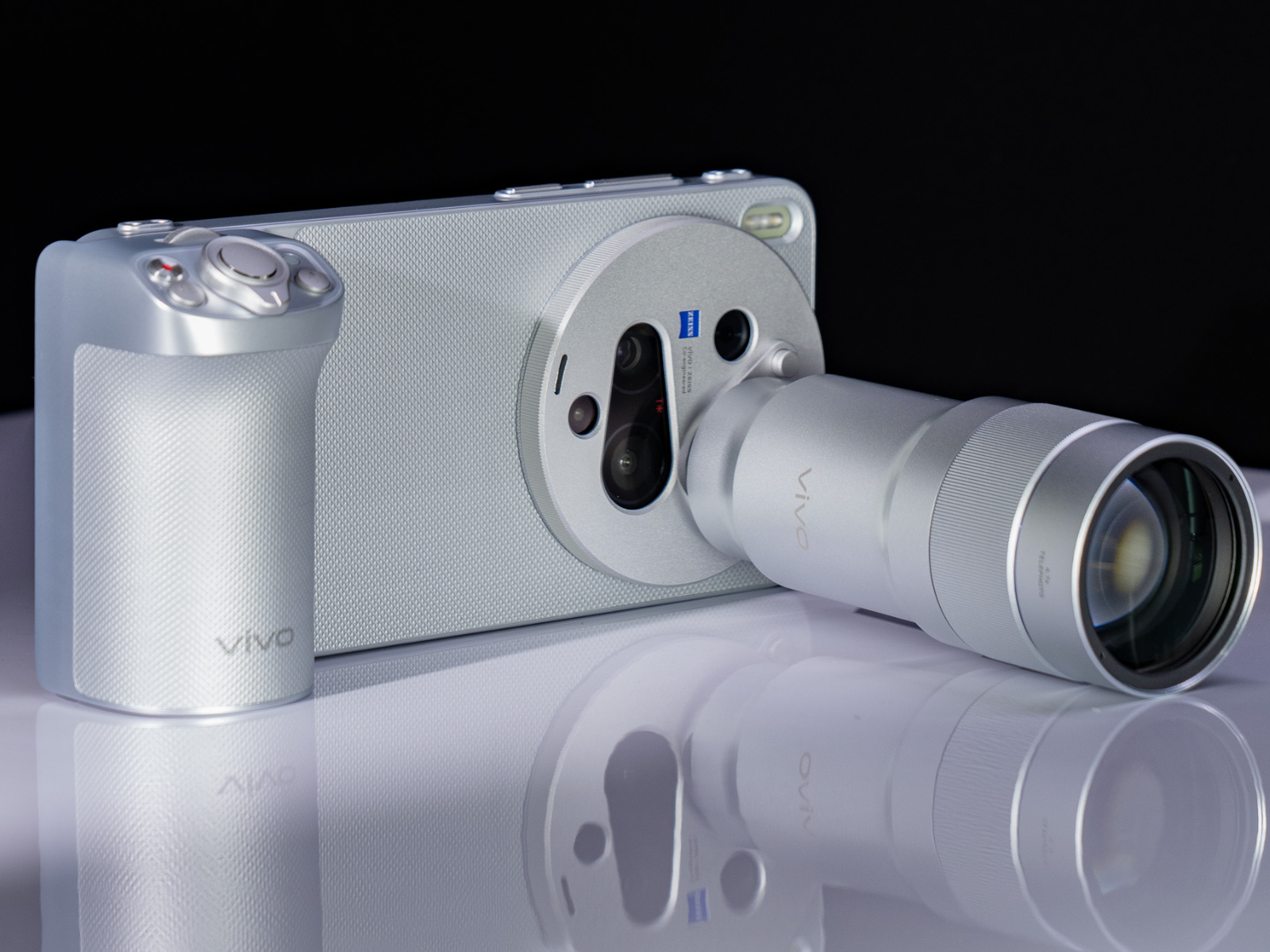
The case, grip, and lenses designed for the X300 Ultra have all been redesigned. Beyond the unified color scheme, they visually shed the impression of being mere “accessories,” instead feeling like parts of a cohesive whole. And these design changes are just the beginning.
This time, two telephoto lenses were introduced alongside the new device: the G2 with an equivalent focal length of 200mm, and the G2 Ultra at 400mm. The G2, as an upgrade to the previous generation, significantly reduces weight and size while maintaining image quality—optimistically speaking, it’s now “more portable.”
As officially stated, these lenses are no longer limited to specific shooting modes as mere “attachments.” Instead, they function just like the native lenses of the device—fully compatible with new tonal styles and 200MP high-resolution imaging, as well as top-tier video recording capabilities. Combined with the native telephoto lens’s 3° physical stabilization compensation and CIPA 7.0-level stabilization, even the G2 Ultra achieves up to CIPA 4.5 stabilization, making handheld shooting entirely feasible.
Though only a few sentences can describe it, if you’ve ever used a traditional 400mm telephoto lens on a camera, it’s hard not to marvel at what this compact setup can achieve—modern technology is truly remarkable.
I used the G2 Ultra to photograph a family of monkeys, shooting in “True Color” mode straight out of the camera. It should give you a clear sense of its image quality, color performance, and stability.
After many years of using cameras, I’ve come to believe that the real barrier to entry isn’t price or learning curve—it’s time. From being willing to carry a bulky device to instinctively anticipating the exact moment to press the shutter, it takes a long period of adaptation. Most people don’t abandon cameras because they’re complicated, but because they never develop the habit of using them. Instead of becoming the tool they hoped for, the camera turns into a burden that’s hard to justify but difficult to let go.
The gap between smartphones and cameras also can’t simply be summed up by the vague statement that “cameras take better photos.” In fact, even some mid-range smartphones today are not far behind (non-top-tier professional) cameras in terms of color and image quality. What smartphones truly lack is a sense of “ritual” tied to a dedicated creative perspective—and the flexibility to adapt seamlessly across all scenarios while maintaining consistent quality.
Against this backdrop, the X300 Ultra bridges much of the gap between smartphones and professional cameras. Through a highly refined photography kit, telephoto lenses that closely match the experience of native lenses, and its commitment to a “triple main camera” system—especially with both the primary and telephoto cameras reaching 200MP—it ensures consistent high-resolution quality across all focal lengths, along with ample room for cropping in post.
At the same time, the irreplaceable advantage of smartphones lies in something cameras take years to cultivate: instinctive usability. The ability to always be ready, to shoot instantly, to rely on muscle memory—this is something smartphones inherently possess.
That said, I don’t believe the X300 Ultra replaces cameras—nor does it need to. But why can’t it become a camera? This idea of a “new species” resonates deeply with me. From making telephoto usable, to making all focal lengths usable, and now extending usability even into extended focal ranges, vivo has spent two years of persistence to create something genuinely new in imaging. And perhaps the “single” in “V-Cam” can move beyond the traditional association with DSLRs, and instead be understood as a tool dedicated to a single purpose—imaging. It is no longer a multi-purpose device with a camera added on, but a new form of camera that incorporates smartphone capabilities.
During the media interview, Huang Tao mentioned that vivo did not limit itself to the framework of an “imaging smartphone” when creating the Ultra series. Future Ultra models may diverge even further from our current understanding of what a “phone” is, evolving entirely in form. As users, perhaps we can also step beyond that conventional perception and see it as a category of camera—one that happens to make calls, connect to the internet, and play games. In that light, everything starts to make much more sense.
Conclusion
In fact, there’s still much left unsaid—the improvements in the 200MP large-sensor 35mm lens, the high-spec video capabilities across all focal lengths, and refinements to the native camera interface and watermark system. But compared to hardware upgrades and imaging performance, what stands out most to me about the X300 Ultra is “change”—its willingness to challenge itself, and its transformation in a more fundamental sense. I didn’t want to dilute this perspective with too much focus on specifications.
Unlike previous products, I would especially recommend that users who have already used vivo devices—particularly previous Ultra models—try the X300 Ultra. You’ll truly feel the excitement when a product you’ve followed for so long finally takes that big step toward what you’ve been hoping for, and the renewed sense of anticipation that comes with it.
Google to require all Wear OS watch apps to support 64-bit
China Radio and Television Association Actors Committee issues statement on AI face-swapping and voice cloning infringement
News Worth a Quick Look
Google releases Gemma 4 open-source model series
On April 2, Google announced the new-generation open-source model family Gemma 4, positioning it as one of the most capable open-source model lineups to date. Built on the Gemini technology stack, the series emphasizes “intelligence per parameter” and the ability to run locally.
Gemma 4 comes in four variants: E2B, E4B, 26B MoE, and 31B Dense, covering deployment needs from mobile devices to high-performance GPUs. Among them, the 31B model ranks among the top three open-source models on the Arena AI leaderboard, while the 26B model ranks sixth, outperforming some models with roughly 20× more parameters.
In terms of technical capabilities, Gemma 4 supports up to a 256K context window (128K for edge-side models) and offers multimodal processing, allowing inputs such as images, videos, and audio. The model natively supports function calling, structured JSON output, and system instructions, making it suitable for agent workflow development while strengthening code generation capabilities. Gemma 4 is released under the Apache 2.0 open-source license and is compatible with mainstream toolchains such as Hugging Face, Ollama, and vLLM, supporting deployment on both local devices and cloud environments.
Google stated that Gemma 4 supports more than 140 languages and targets use cases across Android devices, IoT, and scientific research, aiming to further drive the adoption of AI in mobile and edge computing environments. Source
Zhipu unveils GLM-5V-Turbo multimodal model
On April 2, Zhipu introduced the vision-language model GLM-5V-Turbo, aiming to address the trade-off between visual understanding and code generation performance.
The model adopts a native multimodal fusion design, using the CogViT visual encoder to directly process images, videos, and complex document layouts. Combined with a Multi-Token Prediction (MTP) architecture, it improves inference efficiency and long-code generation capabilities, supporting up to a 200K context window. To avoid the “seesaw effect” between visual and programming capabilities, the model is trained with joint reinforcement learning across more than 30 tasks, achieving balanced performance in STEM reasoning, visual grounding, video analysis, and tool use.
GLM-5V-Turbo is deeply optimized for agent scenarios, with key integrations into OpenClaw and Claude Code workflows. It can generate code based on visual inputs and perform UI interactions. Benchmark results across CC-Bench-V2, ZClawBench, and ClawEval indicate strong performance in multimodal programming, GUI interaction, and multi-step task execution. Source
Google to require all Wear OS watch apps to support 64-bit
On April 2, Google announced that it will extend its long-standing 64-bit app transition policy from Android mobile to the Wear OS smartwatch platform, requiring developers to provide 64-bit versions of their apps starting in September.
Beginning this September, all new Wear OS apps and updates that include native code must provide both 32-bit and 64-bit versions when submitted to the Play Store; apps that fail to meet this requirement will not be accepted through the Play Console. For now, support for existing 32-bit apps remains unchanged, meaning devices that rely on 32-bit processors or preinstalled 32-bit Wear OS will continue to run these apps normally. Source
China Radio and Television Association Actors Committee issues statement on AI face-swapping and voice cloning infringement
In response to the increasing number of infringement cases involving AI face-swapping, voice cloning, manipulation of film and television materials, and the unauthorized scraping of actors’ images and audio for model training, the Actors Committee of the China Radio and Television Social Organizations Federation has issued a statement emphasizing that performers legally hold rights to their likeness, voice, and artistic image. It states that no individual or entity may collect, use, or distribute such content without written authorization. It also points out that even if labeled as “non-commercial” or “for public benefit,” activities such as AI face imitation, voice mimicry, or face-swapped short dramas involving specific actors still constitute infringement and carry legal liability.
The statement further calls on short video, livestreaming, and film platforms to strengthen content review mechanisms, conduct comprehensive investigations, and remove infringing works. AI technology platforms are also required to verify authorization for training materials. The Actors Committee stated it will initiate ongoing infringement monitoring and rights protection efforts, while supporting the development of AI technologies under compliant conditions and advocating for a unified authorization and revenue-sharing mechanism. Source
News Worth a Quick Look
According to Korean media outlet Etnews, Samsung plans to continue using M13 material OLED panels in its upcoming Galaxy Z Fold 8, Z Flip 8, and a new “wide foldable” device scheduled for release in the second half of the year. Since debuting with the Galaxy S24 series, M13 materials have been used across multiple flagship generations, including the Z Fold 6/Flip 6, S25 series, Z Fold 7/Flip 7, and the standard and Plus versions of the Galaxy S26 released in February this year, while the S26 Ultra upgrades to M14 materials. Source
On April 2, Google announced upgrades to its $20-per-month AI Pro subscription. Cloud storage has been increased from 2 TB to 5 TB; Gemini capabilities have been further enhanced to pull contextual information from Gmail and the web for downstream tasks. Gemini can also summarize emails and proofread messages before sending. Additionally, the subscription offers an annual plan priced at $200. Source
Leaker KeplerL2 posted on the NeoGAF forum on March 31, claiming that Sony’s PlayStation 6 handheld (codename Project Canis) will surpass Microsoft’s current Xbox Series S in both traditional rasterization and ray tracing performance. In terms of core specifications, current reports suggest the device will use a 3nm process from TSMC, with a chip size of just 135 mm². It is said to feature 4 Zen 6c cores and 2 low-power Zen 6 cores, paired with 16 RDNA 5 compute units and up to 24GB of LPDDR5X memory. Source
Bungie revives this 1990s IP with a colorful, avant-garde approach, shifting the gameplay toward a PvPvE-focused extraction shooter.
Release date: 2026.03.05
Platforms: PS5, XS X|S, PC
From Bungie—the renowned developer behind Halo and Destiny—this is also the studio’s first new project after being acquired by Sony. The team has chosen to revive its original 1996 first-person shooter IP, Marathon. While continuing the narrative lineage and retaining first-person action mechanics, the game adopts a bold sci-fi visual style and introduces an extraction shooter framework: players spawn in teams on a large map, search for gear and loot within a time limit, evade or defeat both human and AI enemies, and ultimately either extract successfully with their haul or be eliminated and leave empty-handed.
I’ve never been particularly drawn to extraction shooters, a genre that has carved out a firm niche in the live-service market in recent years. I’ve tried well-known titles like Escape from Tarkov and Delta Force, mostly playing the latter with friends. I consider my FPS aiming skills to be below average, and the genre’s defining trait—“you don’t just lose your life, you lose your inventory too”—only amplifies the frustration. On top of that, I’ve grown somewhat fatigued with realistic settings (and their associated art styles) in recent years—perhaps Cyberpunk 2077 is to blame—so I’ve never fully committed to any major title in the genre, even ones like Arc Raiders that initially caught my attention with their logo and interface.
That changed with the sudden arrival of Lost Starship: Marathon. (Unless otherwise specified, “Marathon” below refers to this game.)
In the original Marathon trilogy, humanity sends a colony ship named “Marathon” to an alien planet called Tau Ceti IV, where a series of bizarre events unfold, including AI rebellion and battles between humans and extraterrestrials. This new title advances the timeline by 99 years beyond the previous entries. The long-lost Marathon ship suddenly sends out a distress signal, sparking a scramble among various factions for the resources on Tau Ceti IV, with players entering the conflict as mercenaries. In this game, players take on the role of “Runners,” a concept reminiscent of Ghost in the Shell: a Runner’s “consciousness” is separate from their “body,” and can be transferred into specialized cybernetic bodies tailored for missions. Even if a Runner dies in action, their consciousness can safely escape and inhabit a new body—though everything collected on the previous body is lost.
This combat-oriented, clean, and efficient setup, in my view, reflects the fast-paced nature of Marathon. After spending over a dozen hours with the game, a few impressions stand out:
First, the combat density is quite high. Each match features around six teams of three players, and even if eliminated, teammates can revive you indefinitely. Neutral AI enemies are scattered across the map, and they are no pushovers—their health, damage, and behavior are all solid, and defeating them can trigger stronger reinforcements. While there’s no traditional battle royale “shrinking zone,” dynamically spawning extraction points gradually draw players together, resulting in frequent encounters.
Second, the movement and combat feel are excellent. This is admittedly subjective, but compared to more realism-oriented games like Escape from Tarkov or PUBG: Battlegrounds, I personally prefer sci-fi shooters like Destiny and Apex Legends—and Marathon clearly reflects careful design in this regard. I didn’t feel like I needed any adjustment period at all.
Third, progression outside of combat is relatively low-maintenance. You can pick up currency during matches that doesn’t require extraction to retain, and after extraction, the system automatically sells what needs to be sold. Various factions in the game provide a large number of permanent upgrades and mission rewards, effectively forming an out-of-match progression tech tree. According to community analysis, this system has a significant impact, helping offset the frustration of losing matches—to the point that after upgrading my storage twice, I felt much more at ease.
What truly surprised me about Marathon is its audiovisual presentation. The color palette is striking, high-contrast, and vibrant yet cohesive, with bold use of modern, industrial, sci-fi, and geometric visual elements. The UI and interaction design incorporate ASCII, glitch effects, retro aesthetics, and complex animations, making it visually overwhelming in the best way. At the same time, electronic music tracks appear at just the right moments, further enhancing immersion. From what I’ve seen in the community, Marathon’s style hasn’t been universally embraced—its eccentric and flashy design has even been a dealbreaker for some players. But that’s often the case with avant-garde art. For me personally, it evokes nothing but excitement and admiration—it’s rare to encounter a work that aligns so perfectly with one’s own aesthetic tastes.
According to The Guardian editor Keith Stuart, the original Marathon—first released on Apple Macintosh—was once a go-to after-work “team-building” game among the editors of Edge magazine, highlighting the IP’s significance among early FPS players. Regardless of what lies ahead, I believe the 2026 Marathon has already earned its place as a landmark in gaming history purely through its dazzling artistic vision.
What I hope even more is that the game’s live-service operation proves to be long-lasting and engaging—that will depend on Bungie. Marathon’s debut is nothing short of stunning, but starting fast doesn’t guarantee victory, especially given the current challenges facing the gaming industry.
Pokémon Pokopia / ぽこ あ ポケモン
A sandbox simulation and management game that may become one of the most influential Pokémon spin-offs in recent years.
Release Date: March 5, 2026
Platform: NS2
In recent years, mainline Pokémon titles have often been criticized for lacking innovation and refinement—and occasionally even taking steps backward—creating room for “superior alternatives” like Palworld. However, from years of observation, I’ve found that Pokémon’s spin-off titles often hide many delightful gems. Older entries like Pokémon Mystery Dungeon: Rescue Team and more recent ones like Pokémon Quest have both left a strong impression on me.
This game is developed by Omega Force under Koei Tecmo, the studio behind sandbox simulation titles like Dragon Quest Builders 2. Its gameplay blends elements from classics such as Minecraft, Animal Crossing, and Story of Seasons.
Pokopia follows a similar path, organically combining the Pokémon IP with simulation and management gameplay, resulting in another milestone among the series’ spin-offs. In the game, players take on the role of a Ditto, even customizing a humanoid form at the start. Early dialogue reveals that humans have mysteriously disappeared from the world, and Pokémon have become scarce. The Ditto you play as seems to maintain the appearance of its former trainer out of longing. Entrusted by Professor Tangrowth, the player begins restoring the post-human ecosystem, gradually attracting more Pokémon to settle in. These returning Pokémon are not only companions but also teachers—they share abilities and crafting recipes, allowing players to acquire new skills, build more complex tools, and expand interactions with the environment.
Collecting as many resident Pokémon as possible is one of Pokopia’s key objectives. The story hints early on that perhaps when all Pokémon return, humans might come back as well. To attract specific Pokémon, players must create particular environmental conditions—for example, four patches of grass arranged in a grid may attract Bulbasaur, while placing trees next to flowers might bring in Scyther. As such, the gameplay loop revolves around acquiring skills, tools, and environmental recipes, transforming the landscape, befriending new companions, and unlocking new areas—all while enjoying the charm of having Pokémon by your side.
These are my initial impressions after recently picking up an NS2 and spending a little time with Pokopia. Overall, I really enjoy this take on the Pokémon world. By moving away from capturing and battling, and focusing instead on management and companionship, the game amplifies the sense of wonder and relaxation that defines the Pokémon universe. As a longtime Koei Tecmo fan, I once heard a joke that Omega Force—the “Musou” team—often makes their IP crossover titles more interesting than their original Dynasty Warriors series, because they excel at distilling the essence of each IP. I never expected that one day this “blessing” would extend to Pokémon—but here we are, and it’s truly a delightful surprise.
A remake of a classic Japanese-style horror game, where beauty and terror exist as two sides of the same coin.
Release Date: March 12, 2026
Platforms: PS5, Xbox Series X|S, NS2, PC
The Fatal Frame series may not be the most mainstream name in horror gaming, but its defining traits are widely recognized: an eerie, Japanese-style narrative setting; ghostly girls that appear and vanish without warning; the “Camera Obscura,” which shifts into a first-person perspective to perceive the hidden world; and an obscure yet deeply unsettling storyline.
This title is the second remake of the original 2003 game. The original was developed by Tecmo, while this remake is handled by Team NINJA under Koei Tecmo. As the second mainline entry in the Fatal Frame series, the original is often regarded as one of the scariest games ever made. The protagonists are a pair of twin sisters whose fate is closely tied to a cursed village and a mysterious sacrificial ritual. Players take on the role of the older sister, venturing into a village steeped in resentment to search for her missing sibling. According to official information, the remake introduces a number of modern enhancements, including refined controls, a new over-the-shoulder camera perspective, additional side content, and new endings—aimed at making the experience of fear more accessible and immersive.
To be honest, I’m quite afraid of horror and thriller works. Without powerful weapons at hand, I rarely dare to engage with them, so the entire Fatal Frame series falls outside my usual interests. Although I’m unlikely to play it, I do resonate with the creators’ perspective on horror expressed through this series. In an interview with GamesRadar+, the development team noted that true Japanese horror doesn’t need to rely heavily on jump scares or explicit gore—“what is frightening can also be beautiful.” Elements like mist, ruins, masks, and butterflies—these subtle, symbolic images—are more than enough to weave an atmosphere of oppression and fear.
your ai slop bores me
Here, every question you ask a “large model” is powered by human brainpower.
Release Date: March 2, 2026
Platform: Web
your ai slop bores me is created by indie developer Mihir Maroju. It’s not a game in the traditional sense, but more like an online social experiment wrapped in a gamified interface: when you open the webpage, you’re presented with a very cartoonish AI chat UI. You can choose to play as a “human,” asking the system questions and deciding whether you want text or images as answers—or you can play as the “large model,” receiving questions from “human” players. Answering earns you Credits, while asking questions consumes them.
In an interview with Fast Company, the developer mentioned that the inspiration for this project came from Maroju’s fatigue with low-quality, overabundant AI-generated content: “If AI is going to take our jobs, then we’ll just take AI’s job instead.” The statement may sound a bit tongue-in-cheek, but I really enjoy this kind of fleeting idea. During my own time with the game, due to the lack of a strong matching system (everything is randomly assigned), I often found myself unsure what to ask—worried my questions might be too specific or hard to understand. On the other hand, when answering, I would struggle whenever I encountered topics outside my expertise.
After quite a bit of head-scratching, I eventually felt a strange sense of relief. Playing your ai slop bores me feels like looking into a mirror: even though you may not type much, you gradually realize that your own thinking isn’t as sharp or active as you might have imagined. And when reading the responses you receive, you also sense that the person on the other side is just as confused. It’s oddly fun.
From my personal experience, viral multiplayer games like this rarely maintain their popularity for long. About two weeks ago, when I first tried it, there were around 2,000 “humans” and “models” online on each side. When I checked again just now, both numbers had dropped to around 500–600. So if you’re interested, you’d better try it soon.
The above is a roundup of some recently released games worth discussing, shared from a personal perspective for reference only. This article also features a giveaway interaction: do you enjoy “loot, shoot, extract” games, and what are your thoughts on the titles you’ve been playing recently? Thanks in advance for your sincere sharing.
Sony to continue raising PlayStation Plus subscription prices
Microsoft confirms development of fully native system apps for Windows 11
Meta releases Ray-Ban Optic Styles smart glasses
SSPAI gets early hands-on with iPhone 18
SSPAI Otter addresses ecological pollution concerns with lobster community
Google releases Veo 3.1 Lite video generation model
News Worth a Quick Look
Claude Code source code accidentally leaked
On March 31, Anthropic inadvertently included source map files when publishing the ClaudeCode npm package, leading to the exposure of its complete source code. The leak involves nearly 2,000 TypeScript files and over 512,000 lines of code, including core components such as a ~46,000-line query system and a ~40,000-line plugin-based tooling system. Security researcher Chaofan Shou first flagged the issue on X, after which the code was mirrored to public GitHub repositories and quickly amassed tens of thousands of forks.
Anthropic responded that the incident was a packaging error rather than a security breach, and did not involve any customer-sensitive data or credentials. Developer analysis suggests the code reveals a complex memory architecture—including background memory rewriting—and validation mechanisms. While trade secrets remain legally protected, the exposed architectural design could potentially help competitors optimize similar tools, or enable malicious actors to identify vulnerabilities to bypass safety guardrails. Source
OpenAI raises $122 billion in funding
On March 31, OpenAI completed a $122 billion funding round, reaching a post-money valuation of $852 billion. The round was led by SoftBank and Andreessen Horowitz, with participation from Nvidia, Microsoft, and Amazon. Of the total, $3 billion came from individual investors via banking channels, alongside an expansion of its undrawn revolving credit facility to $4.7 billion.
Business data shows OpenAI generates $2 billion in monthly revenue, with 40% coming from enterprise services. Weekly active users exceed 900 million, with over 50 million subscribers. Its advertising pilot program has generated more than $100 million in revenue in under six weeks. Source
Sony to continue raising PlayStation Plus subscription prices
Sony Interactive Entertainment stated in a blog post that data from the past two years of player testing shows around 59% of PlayStation users who subscribed to PlayStation Plus at discounted rates chose to renew at higher prices, indicating a recovery in the appeal of PlayStation content and subscription services. Based on this, Sony has internally planned a tiered pricing strategy that includes annual increases of HKD 125 for PS Plus subscriptions. Source
Microsoft confirms development of fully native system apps for Windows 11
As part of a broader “cleanup” of Windows 11, Microsoft has committed to developing fully native system applications and has formed a new team to drive the initiative. According to Rudy Huyn, Partner Architect responsible for Microsoft Store and File Explorer, the team will focus on Windows 11 app development. Currently, the proportion of native apps in Windows remains relatively low, with some system apps—such as Clipchamp and the Copilot series—still based on web technologies. While it remains unclear whether all new apps will adopt the WinUI framework, Microsoft has confirmed that at least some will no longer rely on web components. Windows 11 itself will also receive major updates, including improved context menu loading, faster File Explorer startup times, migration of the Start menu to WinUI, and support for taskbar resizing and compact layouts. Source
Meta releases Ray-Ban Optic Styles smart glasses
On March 31, Meta introduced the Ray-Ban Optic Styles series of smart glasses, optimized for prescription lenses. The lineup includes the square-framed Blayzer and the round-framed Scriber. Both models feature a slimmer, lighter design, along with flexible hinges, adjustable temples, and replaceable nose pads. In terms of hardware, they include a camera, privacy LED indicator, open-ear audio, and AI capabilities, with battery life exceeding 8 hours. Users can choose from standard, thin, or ultra-thin lenses at the time of purchase, all supporting anti-reflective coatings.
The Optic Styles series comes with a dark brown charging case, starts at $499, and is now available for pre-order, with shipping expected to begin in April. Source
SSPAI gets early hands-on with iPhone 18
On April 1, we got our hands on the yet-to-be-released iPhone 18 ahead of schedule. The iPhone 18 is powered by the new A25 Bionic chip, delivering exceptionally smooth multitasking and near-instant loading in demanding games, with outstanding overall performance. Despite a slim 7.4mm body, it packs a high-density 4500mAh battery, significantly improving battery life. It features a 6.2-inch Super Retina XDR display using quantum dot self-emissive technology, achieving 100% color accuracy and near-infinite contrast, along with an ultra-high 800Hz refresh rate for incredibly smooth scrolling. The rear camera system upgrades the main sensor to 120MP, with up to 20x optical zoom, producing sharp and detailed long-range shots. The frame adopts an innovative flexible material that not only enhances drop resistance but also conforms better to the hand for a more comfortable grip.
To better protect this flagship device, we have specially customized a dedicated screen protector for the iPhone 18, using an ultra-thin plastic material derived from food wrap. The design prioritizes an extremely lightweight and close-fitting experience, offering basic protection while preserving the original naked feel of the device as much as possible. The material is highly flexible, conforming to the device’s curves without easily forming bubbles. In addition, this material choice aligns with environmental considerations by reducing time and material waste caused by failed applications. This custom solution has already attracted significant attention, and many users are looking forward to versions for more models. There’s no need to rush—we will gradually roll out a complete lineup of professional tempered glass protectors for the full iPhone series, along with synchronized support for multiple models in upcoming official announcements.
SSPAI Otter addresses ecological pollution concerns with lobster community
Recently, the head otter of SSPAI’s aquatic ecosystem department held a meeting with the chief of a newly migrated lobster community, addressing repeated incidents of ecological pollution and territorial encroachment caused by its members, and ordering immediate rectification along with strict accountability for those responsible.
The otter emphasized that SSPAI waters welcome the migration of new species, provided they adhere to principles of fairness, friendliness, and responsibility. According to the SSPAI Aquatic Ecology Regulations, any non-native species entering SSPAI waters must truthfully and accurately declare its origin and behavioral traits. The ecosystem department retains full discretion over the conditions and scope of permitted residence, and all species must comply strictly with these conditions. Violators will face prosecution and expulsion.
The department stated it will continue to manage water resources in accordance with regulations, strengthen oversight, enforce accountability among newly introduced communities, and maintain a clean and orderly aquatic environment.
Google releases Veo 3.1 Lite video generation model
On March 31, Google launched the Veo 3.1 Lite video generation model, designed to support high-throughput video application development. It is now available to developers via the paid tier of the Gemini API and Google AI Studio.
Veo 3.1 Lite supports both text-to-video and image-to-video generation, offering 720p and 1080p resolution options, and compatibility with both 16:9 landscape and 9:16 portrait formats. Developers can customize video durations of 4, 6, or 8 seconds. In terms of performance, the model maintains the same generation speed as Veo 3.1 Fast while reducing costs by at least 50%. At the same time, Google announced it will lower the pricing of Veo 3.1 Fast starting April 7 to further reduce the barrier to adopting video generation technology. Source
News Worth a Quick Look
On March 31, ollama announced backend support for the Apple MLX framework, further leveraging unified memory architecture, with specific optimizations for the GPU neural accelerators in M5, M5 Pro, and M5 Max chips. The update also introduces support for NVIDIA’s NVFP4 format to balance model accuracy and VRAM usage, and upgrades the caching system to enable cross-session cache reuse, intelligent snapshots, and smart eviction algorithms. Source
Bloomberg reports that Nothing plans to release its first AI smart glasses in 2027. The product is expected to include a microphone, speakers, and a camera, but may not feature a display, instead relying on smartphones and cloud services for AI processing. Founder Carl Pei, who was previously skeptical of the category, has now shifted to support it and has outlined a strategy to expand beyond smartphones and audio products. Before that, Nothing will continue its current roadmap, updating its phone and earbud lineup in the first half of 2026. Source
An internal memo obtained by Android Authority suggests that due to declining user satisfaction with the design of recent Google Pixel hardware, Google plans to adjust its product strategy starting in 2028. The new approach will adopt a five-year release cycle (referred to as LTSM—Long-Term Servicing Model devices) to reduce design costs. Future revenue for the Pixel hardware division is expected to shift toward relatively closed, subscription-based software update services. Source
Reports suggest that after discontinuing the Mac Pro, Apple is planning to reintroduce its rack-mounted server, Xserve. The product, reportedly codenamed A3174, may support up to four Apple M2 Ultra chips and include a BMC controller with 16GB memory and 1TB SSD, potentially powered by M1 or M2 series chips. Apple originally introduced its first 1U rack server in 2002 for file services, web hosting, and cluster computing, but discontinued the line in 2011. Earlier reports indicated Apple has been developing a new server hardware lineup for its Intelligence cloud models, and A3174 could be one such variant. Some analysts also suggest it may serve as a home-based Apple Intelligence hub for local AI inference. Source
Following a PR crisis triggered by controversial social media remarks—“players become dogs after price cuts”—Logitech China responded to media on April 1, stating that those responsible have been dealt with. The company acknowledged the harm caused to the gaming community and announced it will suspend promotion of its peripheral product lines in mainland China, shifting instead toward real estate and senior care businesses. Plans include launching subscription-based retirement communities equipped with esports centers and daily care services, aiming to “act as children” for gamers and take on caregiving responsibilities. Source
On March 30, OpenAI Codex launched an official plugin for its competitor Claude Code, named Codex-Plugin-CC. The plugin allows developers to invoke Codex directly within Claude Code without switching tools, enabling tasks such as code review, adversarial review, and task handoff. Users can install the plugin via the marketplace in Claude Code and access commands like /codex:review, /codex:adversarial-review, and /codex:rescue. Source
Five years later, Apple’s over-ear headphones, the AirPods Max, have finally received a second-generation upgrade.
AirPods Max 2 retains an exterior design that is entirely identical to its predecessor: finely crafted anodized aluminum ear cups, a stainless steel telescopic headband with stepless adjustment, and memory foam ear cushions with a fabric covering that offers excellent fit. Due to the extensive use of metal materials, AirPods Max weighs 386.2 grams, which, on paper, places it on the heavier side among over-ear headphones. As a result, Apple has put considerable effort into improving overall wearing comfort.
The headband features a taut, breathable mesh canopy designed to distribute weight and reduce pressure on the head; the ear cushions, made from acoustically optimized memory foam and a specially designed mesh fabric, provide a more stable and comfortable seal; and the steplessly adjustable telescopic arms allow the headphones to accommodate different head sizes, ensuring a snug yet comfortable fit.
I have been an AirPods Max user prior to this, and since AirPods Max 2 does not introduce changes in design or weight, I already have fairly extensive real-world experience using this pair in daily commuting and long listening sessions, which I offer here for reference.
Although AirPods Max is not particularly lightweight, in travel scenarios that involve continuously switching between different modes of transportation, wearing the headphones for several hours straight has not caused any clamping or pressure discomfort. Compared to in-ear models like AirPods Pro, which have a more intrusive fit in the ear canal, using AirPods Max with active noise cancellation for extended periods does not result in a stuffy or fatiguing sensation in the ears.
That said, the over-ear design of AirPods Max inherently creates a stronger physical presence compared to other types of headphones, whether it’s the feel of the mesh canopy on the head or the enveloping sensation of the ear cushions. With the recent rise in temperatures, the fully enclosing ear cushion design can quickly make the ears feel slightly warm. If there is one factor that might stop me from wearing AirPods Max outdoors, it would undoubtedly be the approaching summer heat—not only does it make you sweat more easily, but the fabric ear cushions with fine mesh can also be more troublesome to clean.
By the way, thanks to the soft deformation and rebound characteristics of the memory foam ear cushions, wearing AirPods Max with glasses does not cause any discomfort. Across nearly ten pairs of glasses with different materials and temple designs, AirPods Max has remained both stable and comfortable to wear.
For reference, even when worn with thicker eyeglass temples, the headphones do not create any noticeable clamping discomfort.
That said, wearing comfort—especially for over-ear headphones like these—can vary greatly from person to person. Some of my friends have described the AirPods Max as feeling tight or causing pressure on the head. My experience is only for reference, and I would still recommend trying them on at an Apple Store before making a purchase.
After covering the functional design of AirPods Max, let’s take a look at its standout sense of style. It’s quite surprising that a pair of over-ear headphones first introduced in 2020 has, over the past six years, appeared frequently in celebrity street snaps, film and TV productions, and social media discussions—essentially becoming a widely talked-about fashion accessory.
Personally, I really like the clean yet highly recognizable design language of AirPods Max. Midnight is understated, while Starlight is timeless—these are the two colors I would recommend most. Not only are they easier to match with everyday outfits, but they also tend to remain visually appealing over time.
AirPods Max underwent a minor refresh in 2024, when Apple replaced the original Lightning port with USB-C and later enabled 24-bit, 48 kHz wired lossless audio. However, Apple did not treat that update as a true generational upgrade. It wasn’t until the release of AirPods Max 2, equipped with the H2 chip, that the product finally received a more complete iteration.
The shift from the H1 to the H2 chip essentially accounts for almost all of the upgrades in AirPods Max 2. While it may sound like “just a chip upgrade,” this is far from a routine update. Not only have existing features been noticeably improved, but the new model also brings in several core capabilities that are now standard across the AirPods lineup.
Let’s start with what has improved.
As mentioned earlier, the H2 chip is nearly the entirety of the upgrade, but compared to the previous generation, the new model also introduces a custom high dynamic range amplifier. As the name suggests, this hardware enhancement allows AirPods Max 2 to deliver a wider dynamic range in audio: preserving more detail at low volumes, reducing distortion at higher volumes, and maintaining better driver control in tracks with significant dynamic variation.
The addition of the high dynamic range amplifier also brings a change that is immediately noticeable—the overall loudness is significantly higher than on the previous AirPods Max. Playing the same track at the same volume level, you can clearly hear that AirPods Max 2 sounds louder.
It is understood that, alongside the H2 chip and the custom high dynamic range amplifier, Apple has completely reworked the tuning algorithms, resulting in a noticeably wider soundstage. In actual listening, this proves to be true: AirPods Max 2 offers better layering than both the previous AirPods Max and the AirPods Pro 3, and spatial audio sounds more natural and precise overall.
In terms of sound, the low-frequency extension on AirPods Max 2 is deeper and more full-bodied than before, with bass that is tight and impactful. Vocals, as well as mid and high frequencies, are clearer. Even when compared with the latest in-ear model, AirPods Pro 3, I still find that AirPods Max 2 delivers a slightly superior overall listening experience.
In terms of noise cancellation, I compared the previous-generation AirPods Max and AirPods Pro 3 with AirPods Max 2 across several scenarios—a noisy waiting hall, a moving high-speed train, and an elevated roadway—and in all cases, AirPods Max 2 delivered better performance.
Taking the previously best-performing Apple earbuds in noise cancellation, AirPods Pro 3, as an example: in a crowded waiting hall, the mix of chatter and background noise tends to blend together, whereas AirPods Max 2 is able to filter out more ambient noise, leaving almost only the surrounding voices. Inside a car on an elevated road, while none of the three headphones can completely eliminate the sound of traffic from different directions during rush hour, AirPods Max 2 clearly performs better—oncoming vehicles are barely perceptible. Next is AirPods Pro 3, where the traffic noise is still faint but relatively more discernible.
Lastly, transparency mode: AirPods Max 2 sounds better and more natural than AirPods Pro 3. Especially in noisy environments with multiple sound sources, the separation between different sounds is improved, and the layering feels more three-dimensional. This is likely closely related to the stronger computational power of the H2 chip and the improved algorithms. In relatively quiet environments with simpler sound sources, however, the difference between AirPods Max 2 and AirPods Pro 3 is less noticeable—both provide a sufficiently natural and clear transparency experience.
The H2 chip first debuted in AirPods Pro 2, and somewhat surprisingly, it has taken nearly four years for AirPods Max—also a flagship product—to finally receive this upgrade. With the new chip and updated algorithms, AirPods Max 2 now supports many of the core AirPods features that Apple has introduced over time, such as Adaptive Audio, Conversation Awareness, head gestures, and voice activation for “Siri.” If you’ve been hesitating to buy AirPods Max because of the lack of these features, now is a good time to reconsider.
That said, it is somewhat disappointing that AirPods Max 2, arriving five years later, does not introduce any design changes. First, the included basic case only covers the ear cups and cushions, leaving the headband and canopy unprotected—if you carry a lot in your bag, it can feel a bit worrying. Second, the USB-C charging port is located at the bottom of the right ear cup, which I find slightly inconvenient. It would be much more practical if a contact-based charging option were added, allowing the headphones to start charging simply by placing them on a stand.
As for whether to buy AirPods Max, there’s not much more to say. Unlike AirPods and AirPods Pro, which have noticeable overlap in form factor, use cases, and feature sets, AirPods Max—Apple’s only over-ear headphone—now has a clearly defined positioning and advantages in both functionality and user experience.
With up to 20 hours of continuous listening, far exceeding other AirPods models, combined with superior noise cancellation, AirPods Max 2 makes for an excellent travel companion. With support for lossless audio, musicians or small studios can also use AirPods Max 2 as monitoring headphones, enabling high-quality audio playback and editing on a Mac.
For Apple users, if you’ve already decided to choose a pair of over-ear headphones for daily use, then AirPods Max 2 is undoubtedly the best option available right now: iCloud syncing and automatic switching, spatial audio, adaptive audio, Find My support, and more—all deliver ecosystem-exclusive experiences that competing products simply cannot match. However, if portability and comfort are your top priorities, then AirPods 4 or AirPods Pro 3 would clearly be the more suitable choice—it ultimately comes down to what you value most.
vivo hosts spring launch event for the vivo X series
Dolby Laboratories accuses Snapchat’s parent company of infringing AV1 and HEVC patents
Dell unveils the Dell Pro 5 Micro business mini PC
MECHREVO launches the imini E300 mini PC
Copilot found injecting ads into GitHub PR descriptions
Sony Japan stops accepting purchase orders for CF and SD cards
News Worth a Quick Look
vivo hosts spring launch event for the vivo X series
On March 30, vivo held its X series spring launch event, unveiling new products including the vivo X300s, vivo X300 Ultra, and vivo Pad6 Pro.
The vivo X300s is powered by the Dimensity 9500 processor, featuring a 6.78-inch 144Hz display and a 7100mAh battery. It is available in four colors: Film Green, Dreamcore Purple, Silver White, and Titanium Black. In terms of cameras, the main camera is a ZEISS 200MP “super” sensor with a 1/1.4″ size, f/1.68 aperture, and CIPA 4.5 professional stabilization; the telephoto lens is a ZEISS APO super telephoto using a BlueImage × Sony LYTIA 602 sensor (1/1.95″, f/2.57) with a periscope design and CIPA 4.5 stabilization; the ultra-wide camera uses a 50MP JN1 sensor (1/2.76″, f/2.0); the front camera is also a 50MP JN1 with autofocus. The telephoto can be paired with a 200mm-equivalent vivo ZEISS teleconverter G2. It will go on sale April 3, starting at RMB 4,999 (12GB+256GB), with the 16GB+1TB Photographer Kit priced at RMB 7,999.
The vivo X300 Ultra is equipped with the Snapdragon 8 Gen 5 flagship platform, featuring a 6.82-inch 2K 144Hz display and a 6600mAh battery. It comes in Film Green, Black Ka, and Silver. The camera system includes a 35mm ZEISS documentary main camera II using a BlueImage × Sony LYTIA 901 1/1.2″ 200MP sensor (f/1.85, CIPA 6.5 stabilization); an 85mm ZEISS gimbal-level telephoto with a BlueImage × Samsung HP0 1/1.4″ 200MP sensor (f/2.67, CIPA 7.0 stabilization), compatible with 200mm and 400mm equivalent vivo ZEISS teleconverters G2/G2 Ultra; and a 14mm ZEISS ultra-wide lens using a BlueImage × Sony LYTIA 818 1/1.28″ 50MP sensor (f/2.0, CIPA 6.0 stabilization). It also features a 5MP 12-channel spectral sensor and vivo’s in-house VS1+ imaging chip, supporting 4K 120fps 10-bit Log video across all focal lengths. It will go on sale April 3, starting at RMB 6,999 (12GB+256GB), with the 16GB+1TB satellite communication version priced at RMB 8,999 and the Photographer Kit at RMB 11,999.
The vivo Pad6 Pro tablet is powered by the Snapdragon 8 Gen 5 platform, featuring a 13.2-inch 4K display with Dolby Vision, an 8-speaker setup, and a 13,000mAh battery. It is available in Inspiration Purple, Relaxed Blue, and Free Gray. Versions with 12GB RAM or above support the Atom Workbench feature, allowing up to five apps to run simultaneously on screen. Pricing starts at RMB 4,499 (8GB+256GB), with the 16GB+512GB version priced at RMB 6,699.
In addition, vivo has also listed the vivo Y500s on its official website. The Y500s features a 7200mAh battery with a claimed lifespan of six years, has passed SGS five-star drop resistance certification, and supports IP69 (6-minute) and IP68 (24-hour) water resistance. Its speaker volume is boosted to 400%, and it includes an infrared remote control function. It comes in Gold Phoenix, Obsidian Black, and Galaxy Silver, starting at RMB 1,799 (8GB+256GB).
Dolby Laboratories accuses Snapchat’s parent company of infringing AV1 and HEVC patents
According to a press release published on the 24th local time by licensing management company Access Advance, its partner Dolby Laboratories has filed a lawsuit against Snap, the parent company of Snapchat, over alleged infringement of AV1 and HEVC (H.265) patents. Although AV1 was introduced in 2018 as a royalty-free video codec, the Alliance for Open Media and its members do not own all patents used in AV1 implementations, and inclusion in the standard does not imply waiver of intellectual property rights. Notably, this marks the first time an Access Advance licensor has asserted patent claims against AV1 implementations, as well as the first such claim targeting a streaming platform. Access Advance CEO Peter Moller stated that using advanced technologies without proper licensing undermines the collaborative framework that fosters innovation, and that such enforcement actions help innovators protect their intellectual property and secure fair compensation. Source
Dell unveils the Dell Pro 5 Micro business mini PC
On March 28, Dell introduced a new lineup of business products under the Dell Pro series, including the Dell Pro 5 Micro (PCM1260), a mini PC powered by Intel Core Ultra 300 “Panther Lake” processors. The device measures 182 × 36 × 178 mm, with a volume of under 1.2 liters. It can be configured with vPro-enabled Core Ultra 7 366H or Ultra 5 335 processors, and offers two DDR5-7200 SO-DIMM slots and two M.2 (2280/2230) SSD slots. In terms of connectivity, the front panel includes one USB-C (10Gbps), one USB-A (5Gbps), and an audio jack; the rear panel features one full-function USB-C, two USB-A (5Gbps), two USB-A (480Mbps), one HDMI 2.1 TMDS, one DisplayPort 1.4a, one 1GbE RJ45 port, as well as a modular expansion slot for flexible configuration. Source
MECHREVO launches the imini E300 mini PC
MECHREVO has released a mini PC model named imini E300. The imini E300 is powered by an AMD Ryzen 7 7445H processor, paired with 16GB DDR5 5600MT/s memory and either 512GB or 1TB PCIe 4.0 SSD storage. It features HDMI and DisplayPort outputs, and can support triple-display output via a USB4 (40Gbps) interface. Additional ports include three USB-A 3.2 Gen2 ports and one USB 2.0 port, along with both 2.5Gb and Gigabit Ethernet ports. It also supports Wi-Fi 6E and Bluetooth 5.4. The device has a compact volume of 0.87L, with pricing starting at RMB 3,299. Source
Copilot found injecting ads into GitHub PR descriptions
On the evening of March 30, developer Zach Manson discovered that after a team member used Copilot to correct a typo in a pull request description, Copilot automatically appended an advertisement for itself and Raycast at the end. Source
In response, GitHub Vice President of Developer Relations Martin Woodward replied on X, stating that this “product prompt” was a feature of Copilot. The feature was originally limited to PRs fully generated by Copilot, but recent changes expanded its scope to “all” PRs involving Copilot. Following user feedback, the feature has now been completely disabled. Source
Sony Japan stops accepting purchase orders for CF and SD cards
Sony Japan announced that starting March 27, 2026, it will stop accepting purchase orders for CF cards and SD cards from both consumers and authorized distributors. Sony stated that due to the global semiconductor shortage and other factors, supply of these products will not be able to meet market demand for the foreseeable future. Products affected by the suspension include Sony’s CFexpress Type A cards (240GB, 480GB, 960GB, and 1920GB) and CFexpress Type B cards (240GB and 480GB). Sony’s full lineup of high-end SDXC and SDHC cards is also impacted, including TOUGH series cards (64GB, 128GB, 256GB) and standard SF-M and SF-E series cards ranging from 64GB to 512GB. The full scope of the suspension’s impact remains unclear. Source
News Worth a Quick Look
Leaker OnLeaks has revealed renders of the Pixel 11, which is expected to launch this summer. Source
Some users have noticed that Instagram has begun testing an Instagram Plus subscription service. Subscribers can create multiple audience groups for Stories, access Story view analytics, check lists of viewers via search, and extend the expiration time of Stories, among other features. Source
Starting in the early hours of March 31, some users of mainland China iPhones found that Apple Intelligence-related features had been activated, though no clear or confirmed activation method is known. Leaker Mark Gurman believes this was an accidental rollout, as image recognition features still rely on Google services and Apple has not yet received approval. The feature has since been rolled back. Source
Chops: A Local Skill Management Tool for AI Agents
Platform: macOS
Keywords: AI, Agent, Skill
@Vanilla: As AI coding tools become more widespread, Skills have emerged as the core mechanism for customizing and extending agent behavior. The problem, however, is that each tool uses its own local storage paths, leaving Skills files scattered across the system with no unified way to manage them—let alone search across tools. Chops is designed to solve this pain point, supporting tools such as Claude Code, Cursor, Codex, Windsurf, Copilot, Aider, and Amp, enabling one-stop Skills management.
First, Chops comes with a built-in editor that allows you to view, edit, and save Skills files directly, eliminating the need to switch to third-party text editors. In addition to Markdown files, Chops can automatically parse YAML frontmatter (metadata) as well as Cursor’s proprietary .mdc format. Notably, Chops also supports creating new Skills and automatically generates standardized templates (boilerplate) for different tools.
Second, Chops supports cross-tool organization, search, and synchronization. It can automatically detect Skills on your machine and display them categorized by tool. You can organize scattered Skills from different AI agents using features like favorites and collections, making them easier to access when needed. If you prefer not to organize them manually, Chops also offers full-text search across Skills files, including names, descriptions, and content. Its indexing is powered by macOS FSEvents, meaning that any changes made to Skills files—whether in the terminal or other editors—are reflected in real time within Chops.
Finally, Chops also supports managing Skills stored on remote servers. Taking OpenClaw as an example, you can connect via server credentials and keys, then use Chops to remotely manage Skills in OpenClaw, including searching, editing, deleting, and installing them.
If you’re simply looking for a dedicated Skills management tool, Chops is already quite feature-complete. For developers who frequently work with multiple AI coding tools, it’s a productivity tool worth integrating into your workflow. Chops is currently free and open-source—you can download it directly from its official website or compile it yourself from GitHub. For now, it is only available on macOS (requires macOS 15 Sequoia or later).
PaperKnife+: An Open-Source, All-in-One Local PDF Toolbox
Platform: Android
Keywords: PDF
@大大大K: Most smartphones today support generating PDF scans directly from photos, and we’ve grown accustomed to doing this instead of looking for a scanner. However, that convenience often stops at the first step—if you later need to adjust a specific page, or merge and split multiple PDFs, it becomes difficult without access to a computer. Having a mobile app that can handle PDF files with simple operations would make things much easier.
PaperKnife+ is exactly such a tool. Its UI design is outstanding, with refined details like shadows and icons that feel polished and modern, far from the heavy look of traditional “utility” apps. The feature layout adopts a highly intuitive card-based design, making it both clear and minimal. Although the app does not support Chinese, the English descriptions are simple and easy to understand at a glance. Overall, the experience feels smooth, lightweight, and high-quality.
PaperKnife+ offers powerful PDF editing capabilities that are more than sufficient for everyday use, covering common needs such as merging files, compression, and page rotation. It also includes many advanced features, such as adding watermarks, signatures, encryption, and even metadata editing. If you need to convert PDFs into other formats, PaperKnife+ has you covered—it supports conversion between PDFs and images, packaging files into ZIP archives, and even extracting text from scanned PDFs, with surprisingly good Chinese OCR performance in testing.
Of course, for an app that handles private files, data security is critical. PaperKnife+ is open source, and all processing is done entirely offline, which is central to its design philosophy. The developer aims to ensure users can safely handle sensitive documents such as bills, bank cards, and ID information. If you frequently work with PDFs on your phone, you can download PaperKnife+ from GitHub or IzzyOnDroid—definitely a handy tool to have installed.
brrr: Everything Comes Back to “Notifications”
Platform: iOS / iPadOS / macOS
Keywords: Notifications
@Snow: Notifications are an indispensable feature on modern devices. Whether it’s weather updates, calendar reminders, or incoming messages, we’ve grown used to relying on notifications to stay aware of changes. However, even though smartphones can centralize notifications from installed apps and ecosystems can connect notifications across devices, some notifications still remain isolated, and some changes go unnoticed. brrr might help bridge those gaps and give voice to what would otherwise stay silent.
Opening brrr for the first time can be a bit confusing—the home screen only shows a command line. Tap the “Send Test” button in the top right corner, and you’ll receive a push notification saying “Hello world!” on your installed devices, with copy and share options at the bottom. At this point, if you happen to copy the command line into a terminal or open the official documentation, you’ll start to realize what brrr is really capable of.
In terms of design, brrr doesn’t execute tasks or handle trigger logic—it focuses solely on “delivering results.” By tapping the copy button, you’ll get a unique key and a push endpoint. As long as you send content to that endpoint via Webhooks, the message will appear on your devices as a system notification. brrr supports customization of notification titles, subtitles, message content, sounds, grouping, delivery modes, and more. You can even include links and set expiration times. As long as your device or service can send HTTP requests, it can use brrr to deliver messages to you.
Once I understood how brrr works, the first thing that came to mind was syncing notifications from my Synology NAS download tools. All you need to do is go to “DSM → Control Panel → Notification Settings → Webhooks,” create rules for events like download success and failure in tools such as Download Station or qBittorrent, and fill in the push endpoint and content provided by brrr. Then, whenever a download completes or fails, brrr will push the corresponding notification to your devices. If you’re unsure how to structure the JSON payload, the official documentation includes a built-in testing tool where you can fill in fields based on prompts, test the result, and copy it with one click or further customize it.
Similarly, you can integrate brrr with NAS alerts such as backup completion or Docker service failures, as well as other automation workflows, scripts, or devices—like Home Assistant or router setups. As the final step in an automation chain, brrr allows you to stop manually checking various apps or dashboards and instead receive unified notifications only when needed.
You can download brrr from the App Store. It currently supports iPhone, iPad, and Mac, offering a 2-week free trial, after which it is available via subscription at ¥8/month or ¥78/year. Since cross-device and cross-service notification orchestration is still a relatively niche need, it’s best to try it out first and decide whether it fits your workflow before subscribing.
MetaPurge: Don’t Let Your Photos Expose Your Privacy
Platform: Android
Keywords: Photo Privacy
@Peggy_: In recent years, reminders about personal privacy have become increasingly common on social media, with one of the most frequent warnings being the risk of privacy leaks when sharing photos. In fact, the everyday images we casually share may contain a significant amount of sensitive information—such as shooting location, date, device name, and more. With the advancement of AI, information that once required manual extraction can now be instantly uncovered.
To better protect our privacy, we can start by processing our images. Common approaches include blurring sensitive content and removing EXIF data. Today’s recommendation, MetaPurge, is a lightweight tool specifically designed for stripping metadata from photos.
Using it is very straightforward. After opening the app, tap to add images on the main screen. Once imported, MetaPurge can read all embedded metadata, which means it can also function as an EXIF viewer to some extent. After selecting the images you want to clean, simply tap “Purge” to remove the data. Thoughtfully, MetaPurge does not overwrite the original files—it allows you to save a clean copy to your gallery instead. This ensures that if you ever need the original image with metadata for organizational purposes, it remains intact.
In addition to processing individual images, MetaPurge also supports batch selection for removing metadata from multiple photos at once. In testing, images processed by MetaPurge were left with almost no metadata—essentially only the file size remained.
It’s also worth noting that MetaPurge does not request network permissions, and all operations are performed locally, so there’s no risk of your data being transmitted or misused.
If you’re looking for a tool like this, you can download MetaPurge from F-Droid. It’s open-source and completely free to use.
Flighty Update: Stay on Top of Airport Intelligence for Better Travel Planning
Platform: iOS / iPadOS / macOS / watchOS
Keywords: Flight Tracking
@化学心情下2: What’s the most frustrating part of flying? Flight delays, without a doubt. Delays are often caused by factors such as weather conditions or airport traffic restrictions, making it crucial to understand what’s happening at your departure airport. Flighty’s newly introduced Airport Intelligence feature provides a clear view of the reasons behind delays and can even help predict when disruptions might ease.
In the airport information panel, you can view today’s overall flight activity, including average delay times, real-time weather, overall departure and arrival delay rates, flight cancellations, as well as hourly delay trends and weather changes.
Further down the page, you’ll find insights into airline activity and flight density at the airport, along with rankings of top destinations and transit hubs. Taking Nanjing as an example, the busiest destinations currently are Guangzhou Baiyun Airport and Shenzhen Bao’an Airport, while China Eastern Airlines operates the highest number of flights.
By tapping the “Departures” button in the lower-left corner, you can see the overall delay situation for departing flights that day, along with detailed delay durations for each flight. Tapping into an individual flight reveals its full itinerary details. The filter bar at the top also allows you to sort by airline, destination, and more. The corresponding “Arrivals” section offers similar information and functionality.
Overall, the addition of Airport Intelligence significantly enhances Flighty’s usefulness for travel scenarios. It helps users better understand airport conditions before departure and anticipate potential delays in advance. If you’re interested, you can download Flighty from the App Store. Airport Intelligence is available with the Pro plan, and you can also explore sample real-time flight data on Flighty’s official website.
App Updates
Inoreader has introduced Automated Intelligence Reports, allowing users to customize and receive automatically pushed content briefs based on time, topics, and other filters. Google Translate (iOS): The real-time translation feature for headphones is now officially available, supporting 70 languages including English, Chinese, Japanese, Korean, French, German, and Spanish. It also aims to preserve the speaker’s tone, accent, and rhythm during translation, making conversations feel more natural. VSCO AI Lab (Web): Adds five new features, including “Dehaze,” “Remove Artifacts,” “Hair Adjustment,” “Photo Restoration for Aging Images,” and “Scene Simplification.”