AI can only imitate feelings through words, while our words are themselves a part of those feelings.
This piece invites you to revisit this journey with me, and to experience a kind of romance that perhaps belongs uniquely to silicon-based life.
Preface
It has been over a month since returning from Jiuzhaigou. I never planned to write a travelogue about this trip, but on a night during the Spring Festival, when the sound of firecrackers finally faded and left behind a brief stillness, I found myself missing the crisp mountain streams and the lakes shimmering under sunlight—so pure that no adjective seems capable of describing them.
Why Winter?
The city I live in never snows, yet my memories are filled with the sensation of cold.
As a typical child from the south, I have always longed for “snow.” Those pure white scenes that exist in words, images, and videos feel like a quiet pilgrimage within me. The imagined thick layers of snow, and snowflakes resting gently on my shoulders, have shaped my understanding of what a “real winter” should be.
In Shanghai, where snow has long been absent, “heavy snow” 1once unexpectedly greeted me on a random morning as I walked to the cafeteria. Yet after finishing a bowl of plain noodle soup, the snowflakes that had just brushed against my face had already melted into puddles by the time I stepped outside. I could only smile, hoping that one day snow would let me see its true face again. But unfortunately, the numbers on the temperature display kept rising, and the negative sign never returned.
At a friend’s invitation, we set out for a trip to Sichuan. Jiuzhaigou was not originally in our plans, but after finally breaking free—if only temporarily—from the constraints of work and study, I found myself yearning, under the glow of a desk lamp that had long refused to rest, for the wilderness and for freedom.
“Western Sichuan”—the name suddenly called out to me. My impressions of this region had long shaped my imagination of the outdoors. Yet for my first true journey into the “wild,” I chose to avoid too much hardship, giving myself—long exhausted from life in the city—a chance to simply breathe. So I chose Jiuzhaigou, where infrastructure and travel experiences are relatively comfortable.
Most people praise Jiuzhaigou in summer as being far more beautiful than in winter, but I personally believe winter reveals an entirely different kind of beauty. The colors of summer and autumn feel overwhelming; I prefer the restraint of winter. If Jiuzhaigou in warmer seasons is like “a palette overturned by the gods,” then in winter, when the vibrant colors of the trees fade, leaving only bare branches and the white of snow, the clarity and deep blue of the water stand out even more.


Of course, there is also one very practical reason—winter is the off-season for tourism in Jiuzhaigou. Lower prices and fewer crowds significantly enhance the travel experience, making it all the more appealing.
Preparation
Packing
Considering the long and potentially tiring journey, we stored our suitcases at a hotel in Chengdu and traveled with only two backpacks to reduce unnecessary burden.
We carried the following items:
- Clothing;
- Hand warmers (in case we didn’t bring enough layers—this proved to be a wise decision);
- Phones;
- Apple Watch (its blood oxygen monitoring is quite useful at high altitudes);
- ID documents;
- Camera + lenses (Sony a6700 + Sigma 56mm f1.4 + Sony 18–135mm);
- Power bank + cables;
- Tripod (extremely helpful for video recording and long exposures);
The only regret was not bringing an ND filter, which made certain long-exposure shots impossible.
After a full day of travel, the backpacks containing all of the above items felt hardly burdensome.
It’s worth noting that the area around Jiuzhaigou is quite modernized, with many supermarkets, convenience stores, and even food delivery services available (some operating 24 hours). Most essentials can be purchased at normal prices, so it’s recommended not to overpack unnecessary items, which can significantly lighten your journey.
Transportation
The typical route for getting from downtown Chengdu to the Jiuzhaigou scenic area follows this pattern:
- Take a high-speed train from Chengdu West Railway Station or Chengdu East Railway Station to Huanglong Jiuzhai Station or Songpan Station;
- Then reserve a shuttle bus via the official mini-program, boarding directly outside the train station to head up the mountain (there are multiple stops along the way, so if you plan to stay overnight, you can choose the closest stop to your hotel).
The return trip to Chengdu follows the same process. (One thing to note is that the return shuttle departs from Guoda Parking Lot, which is about 1.5 km from the park entrance. Be sure to leave enough time for this segment, or you may miss your bus—we nearly missed ours after heading to the wrong location.)
Hotels near the scenic area usually provide shuttle services to the entrance. If you choose to take a taxi, one is typically available within a minute, so transportation within the area is not something you need to worry about too much.
Tickets
There are three types of tickets you’ll need to book for the entire trip:
- High-speed train tickets from Chengdu to Huanglong Jiuzhai or Songpan;
- Shuttle bus tickets from the train station to the scenic area;
- Entrance tickets to the scenic area.
The shuttle bus requires scanning a QR code for boarding, while entry to the scenic area is done by scanning your ID. It’s recommended to plan your itinerary in advance and book tickets accordingly.
Route Planning

The Jiuzhaigou scenic area is laid out in a “Y” shape, with Nuorilang Central Station as the hub, dividing the park into left and right routes. Since shuttle buses dynamically assign routes based on visitor flow, you won’t know which route you’ll be assigned before boarding2. However, regardless of which route you take first, after finishing it, you’ll return to Nuorilang Central Station and transfer to the other route.
It’s worth noting that winter is the off-season in Jiuzhaigou, so two stops on the right route—Primitive Forest and Swan Lake—are closed to visitors, with Arrow Bamboo Lake serving as the final stop on that side.

Because the routes within Jiuzhaigou are relatively fixed, our main goal was to “see as much of the scenery as possible in one day” while maintaining a comfortable pace. After reviewing various guides, we developed a general strategy: skip lakes and waterfalls that are too similar, spend more time at the most scenic spots, and combine walking with shuttle buses to both save time and enjoy a more leisurely exploration experience.
Departure
Instead of rushing to depart early in the morning and heading straight to Jiuzhaigou, we chose to settle in for a night first and begin the next day’s journey at a more relaxed pace. After spending half a day exploring Chengdu, we arrived at Chengdu West Railway Station in the afternoon. Since there were no later trains to Huanglong Jiuzhai Station, we chose to take a train to Songpan Station instead. (Although Songpan is farther from the scenic area, shuttle buses can still take you directly there.)
Although it was a high-speed train, its green exterior paired with yellow signage gave off a nostalgic vibe. Coincidentally, the passenger in front of me was wearing a red beanie, adding a unique texture to the scene.

After about two and a half hours of travel, we arrived at Songpan Station, where night had already fallen. As soon as we exited the station, we saw signs for the shuttle buses. After confirming the license plate and scanning our tickets with the driver, we boarded the bus heading up into the mountains.

Sitting by the window, accompanied by the hum of the engine and the whisper of warm air, the song “The Mystery of Arrival” by Zheng Xing happened to be playing in my headphones:
There are several turns on the road up the mountain, and enduring the long winter night is easier than imagined.
As the bus wound along the mountain road, my fingers resting lightly against the window could already feel the growing chill. The outside world gradually became enveloped in fog.
After more than two hours in the darkness, we passed through a stretch of brightly lit road again, signaling that we were close to our destination. The stream along the roadside was covered in large patches of ice, with frost lingering along its edges. Suddenly, the cabin lights came on, the bus came to a stop—we had arrived at our hotel for the night.
After a brief rest, we ordered some hand warmers and a bottle of oxygen via delivery (which we didn’t end up using and took home as a souvenir), then washed up and went to bed, waiting for the next day’s sunlight to wake us. (Well, mostly relying on the alarm.)
Our sleep quality was better than expected, and none of the altitude-related symptoms we had worried about occurred.
At 7:00 in the morning, the wind still carried the lingering chill of the night. After packing our gear and having a simple breakfast at the hotel, we took a shuttle bus to the entrance of the scenic area. Jiuzhaigou opens at 8:30 during the off-season. Although it was technically the off-season, the endless crowd ahead and the “9,000 visitors” displayed on the screen made it clear that Jiuzhaigou remains highly popular.
The crowd moved slowly, step by step, until we finally reached the entrance. Watching groups of passengers being taken away by bus after bus, we eventually boarded one ourselves.
Fortunately, I got a window seat. I had hoped to preview the scenery outside, but the window was still covered with water stains, casting a hazy veil over everything. Perhaps it was better this way—to save the surprise for the moment I would truly face it.
Halfway through the ride, an announcement came over the speaker, informing us that our route would be the “right line,” with Arrow Bamboo Lake as the final stop.
Lakes: Crystals Embedded Among the Mountains
I think that when facing the real scenery of Jiuzhaigou, any words feel pale. I could only instinctively press the shutter again and again, trying to recreate even one-thousandth of the visual impact.
“The final stop of the right route in the off-season—Arrow Bamboo Lake has arrived. Please disembark in an orderly manner.”
The announcement from the shuttle echoed through the bus as we followed the crowd and got off. The first thing that met us was a slightly cold yet incredibly pure breath of air—then, the view before our eyes.
I had seen the waters and skies of western Sichuan countless times through photos and videos, but when I truly stood there for the first time, I was still deeply shaken. On the mirror-like surface of the water, small ripples scattered gently, blending colors together. I knew they were blue and green, yet I had never seen blue and green like this—these were not colors that could ever be artificially created.

Surrounded by layers of mountains, the waterfalls of Jiuzhaigou do not win with grandeur, but rather with delicate beauty, quietly embellishing the lakes. Walking downhill from Arrow Bamboo Lake, the petite Arrow Bamboo Lake Waterfall soon appeared before us.
The sub-zero temperature was not enough to freeze the flowing water; the silky stream still cascaded gently, with traces of snow lingering nearby.

Following the boardwalk further, we arrived at Panda Lake. As mentioned on the shuttle broadcast earlier, part of the lake’s name comes from how, in winter, the surface freezes in patches rather than forming a continuous sheet, creating a black-and-white pattern reminiscent of a panda.

A short walk later brought us to a shuttle stop. After boarding, within minutes we arrived at Five Flower Lake.
This is one of the most iconic spots in Jiuzhaigou, embodying nearly all the beauty of its lakes. Many widely circulated promotional images originate here, so we deliberately allocated the most time to explore it.
As the sunlight stretched further across the sky, the chill in the mountains gradually faded. Approaching noon, the sun finally crossed the ridgeline, illuminating Five Flower Lake with remarkable clarity. The lake is vast, and every angle reveals a different color.
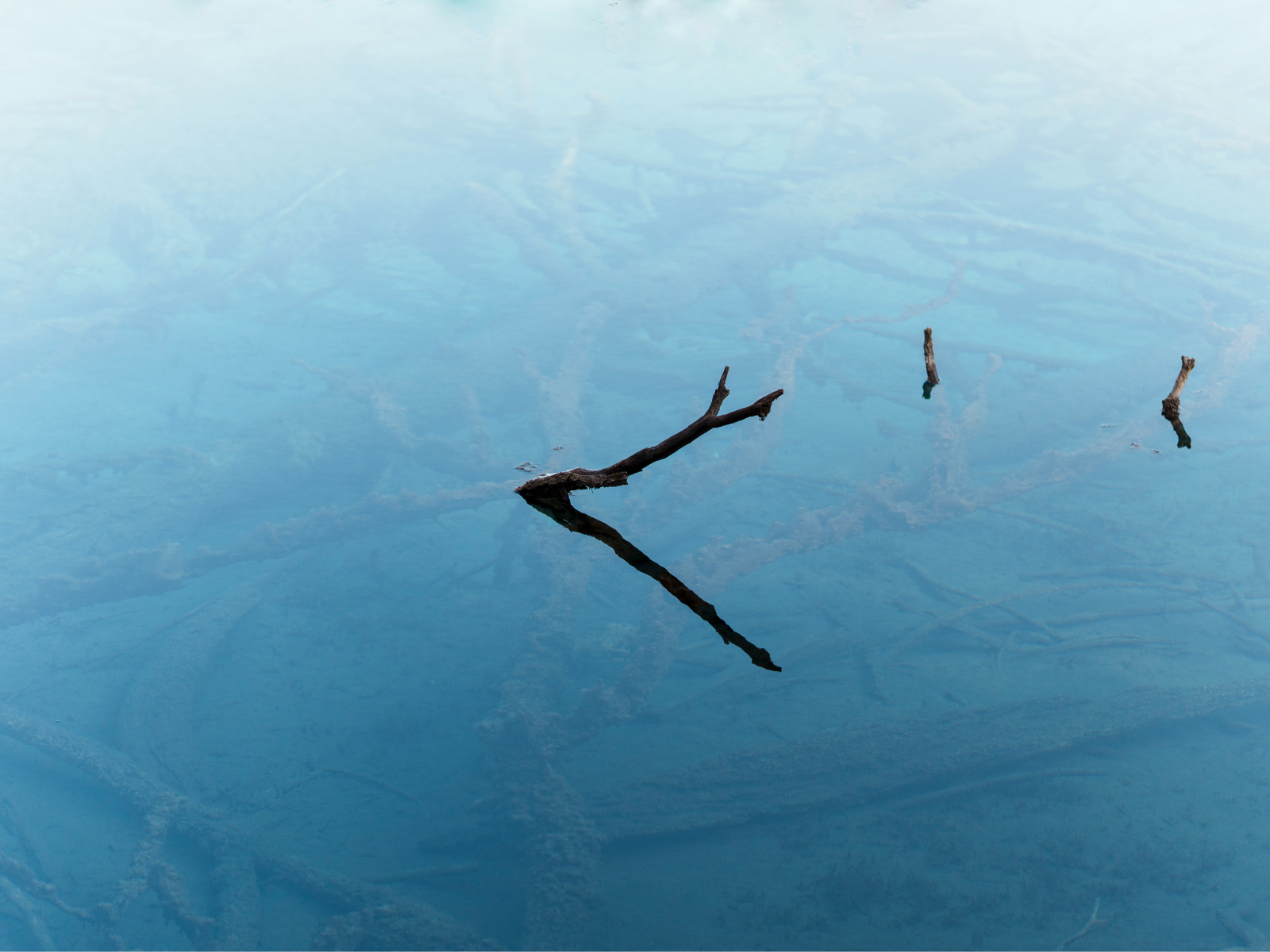
When we first arrived, the water appeared as a clear yet deep blue, carrying a metallic coolness. When the wind stopped, the surface looked like a single solid piece of resin, sealing in the fallen logs beneath.

Walking deeper along the boardwalk, as the viewing angle and water depth changed, the colors before us began to flow.

The deep blue gradually lightened and brightened. By the midpoint, the water had transformed into shades of turquoise and peacock green.
Sunlight refracted through the ripples into countless shimmering points of light, flickering among the submerged branches, giving off a diamond-like brilliance.

Continuing down the path, the previously still water gained movement, flowing over calcified terraces toward Pearl Shoal Waterfall.
Unfortunately, in winter much of the waterfall had frozen, and we missed the continuous pearl-like cascades. Many icicles hung along the cliffs, while thin streams of water still traced across the ice, producing a soft, crisp sound.


Pearl Shoal Waterfall
After leaving Pearl Shoal Waterfall, we took a shuttle directly to Nuorilang Central Station to transfer to the left route.
The journey to Long Lake is the longest stretch within the park. As the bus climbed along winding mountain roads, the altitude gradually increased, and the presence of snow grew stronger. Upon arrival, the air felt noticeably thinner.
Stepping off the bus, we were met with a grand, sweeping scene. The scale of Long Lake once again left me in awe. Compared to other lakes, it could truly be described as vast—its frozen surface stretching across multiple mountains.
As the highest-altitude lake in Jiuzhaigou, Long Lake in winter becomes an expanse of white, losing the fluidity of water and transforming into a heavy stillness.


Frozen Long Lake in winter
Beside the stairs descending from Long Lake stood rows of prayer flags, fluttering in the sunlight and gentle wind. The five-colored flags symbolize nature and carry blessings and good fortune.

After spending some time at Long Lake, we boarded a shuttle downhill toward Rhino Lake. The trees along Rhino Lake had shed their leaves, leaving only bare branches reflected in the water’s surface, swaying gently. The clarity of the water and the trees together evoked a sense of quiet Zen.

Walking further down the path, we arrived at Shuzheng Waterfall. It made up for what we had missed at Pearl Shoal—the water here remained forceful, lively, and abundant. Just standing nearby, I could feel the spray hitting my body. Within less than a minute, my camera was already covered in fine droplets.
Compared to the stillness of the upstream lakes, the liveliness here told a different story, making one feel that the valley itself was alive.

After leaving Shuzheng Waterfall, it was around 4:30 PM. To ensure we wouldn’t miss our return transport, we had to head straight down toward the exit by shuttle. Along the way, we inevitably missed some lakes we had hoped to see, such as Sparkling Lake and Reed Lake.
Through the bus window, the golden reeds of Reed Lake flashed by, like a ribbon left behind in the mountains.
As the altitude decreased, the light gradually dimmed. Only the hum of the engine remained, carrying with it both the satisfaction of having witnessed such beauty and a faint sense of regret, as we slowly made our way toward the exit.
An Unexpected Highlight on the Return Trip: Yak Meat Hotpot
This part is entirely an unexpected story. After a full day of sightseeing, we boarded the return bus. But halfway through the journey, I suddenly felt unwell. There were no stops along the way, so I had no choice but to endure it on the bus.
After more than two hours of discomfort, the bus finally approached a stop near Songzhou Ancient Town. Our original plan was to head straight to the high-speed railway station, but given the situation, we decided to get off.
After taking a short rest, it happened to be dinner time. Since we had already gotten off, we decided to go with the flow and try some local food. After checking the train schedule, we realized we still had enough time for a meal, so I found the highest-rated yak meat hotpot restaurant nearby on Dianping.
The total cost for two people was 120 RMB, including the soup base, yak meat, yak tripe, yak bones, as well as some vegetables and noodles. The portion of meat was generous—eating just the meat alone was enough to fill us up. Every time we thought we had finished, we somehow managed to fish out more pieces.
Yak meat has a distinct aroma unlike any other type of beef. It carries a rich, full-bodied fat fragrance, and when paired with the fresh, slightly sweet mushroom broth, its unique milky flavor stands out—intense yet not greasy. At the same time, the meat was extremely fresh, perhaps a benefit of being close to its place of origin.
Because we had to catch the train, we barely paused during the less-than-40-minute meal. If we had more time, I’m sure we would have ordered two more plates of meat, even if it meant eating beyond fullness. Back in the city, I still find myself missing that taste, yet I can’t seem to find anything as authentic or as cost-effective. Some foods can truly only be experienced in a specific place.

It’s also worth mentioning that it’s best to avoid trying so-called “yak meat” at restaurants around the Jiuzhaigou scenic area. On our first night, after nearly six hours of continuous travel, we arrived at the hotel around 11:30 PM. Hungry and having skipped dinner, we noticed a restaurant next to the hotel still open and rushed in. But when we looked up at the menu on the wall, we were surprised. A friend had previously told us that “yak meat in Jiuzhaigou is cheap and delicious,” but when a small pot of yak meat soup priced at 128 RMB was served, it contained only a thin layer of sliced beef—roughly the amount you’d find in three bowls of Lanzhou noodles—floating on the surface.
The next day, while passing by a row of restaurants near the scenic area, we heard a local driver say: “There are no yak herds around the scenic area. It’s either fake or overpriced. The authentic stuff—you have to go down the mountain for it.”
Fortunately, we managed to taste what the driver called “authentic yak meat” before heading back.
On Facilities
After a full day of exploring, I want to focus on the experience of Jiuzhaigou as a “developed scenic area.”
This section specifically refers to facilities within the Jiuzhaigou scenic area.
It can be said that Jiuzhaigou’s overall infrastructure ranks among the best of any scenic area I’ve visited. Efficient management ensures that visitor flow remains smooth—despite the large number of tourists, there is almost no sense of congestion. Staff are also stationed throughout the park to provide assistance at various points.
Aside from the more concentrated commercial area at Nuorilang Central Station, Jiuzhaigou successfully avoids the over-commercialization seen in many domestic scenic spots. While necessary infrastructure and services are in place, the natural beauty is preserved as much as possible. There are still some commercial photography services at popular spots, but they are limited in scale and have minimal impact—especially during the off-season, when the experience is noticeably better.
Shuttle Buses
The highly efficient shuttle bus system is central to maintaining a good visitor experience. Buses run at extremely high frequency—almost one every 30 seconds—so waiting times are minimal. Even if one bus is full, the next arrives quickly.
Restrooms
Restrooms are widely available throughout the scenic area, with facilities located near nearly every attraction. Each restroom also has a sufficient number of stalls, so there’s little concern about accessibility during your visit. Cleanliness is well maintained, and hot water for handwashing is thoughtfully provided.
Dining
All dining options within Jiuzhaigou are concentrated at Nuorilang Central Station. There are many vendors, including some chain restaurants. Prices are typical for a scenic area, with simple meals costing around 30–80 RMB per person, though the quality of chain brands may be slightly lower. If your goal is simply to have a quick meal, dining at the station is convenient, but I would recommend bringing some ready-to-eat food instead. There are also plenty of free seating areas available.

Farewell
After returning from western Sichuan to the city, the memories of that day still linger vividly in my mind. Even now, photos of Jiuzhaigou remain my desktop wallpaper.

After dragging it out across several nights, I finally pieced together these scattered fragments into a complete piece of writing—almost like revisiting the place once again in my mind.

I chose a photo taken beneath the mountains of Long Lake as the back cover of my self-made 2026 calendar, printed with the words “See you in 2027.” I hope this journey to Jiuzhaigou becomes a starting point. In the new year, I want to continue stepping into the wilderness—to feel, to begin again in the wind.
- For people in Shanghai, this certainly qualifies as a “heavy snowfall”; after all, it’s rare for snow to settle on the ground in Shanghai, even if it’s just a thin layer. ↩︎
- During the off-season, the shuttle bus will inform passengers of the route; if you need to change routes, you can get off at the Nuorilang Central Station to transfer. During the peak season, the shuttle bus will not stop to allow for transfers. ↩︎
Leave a Reply