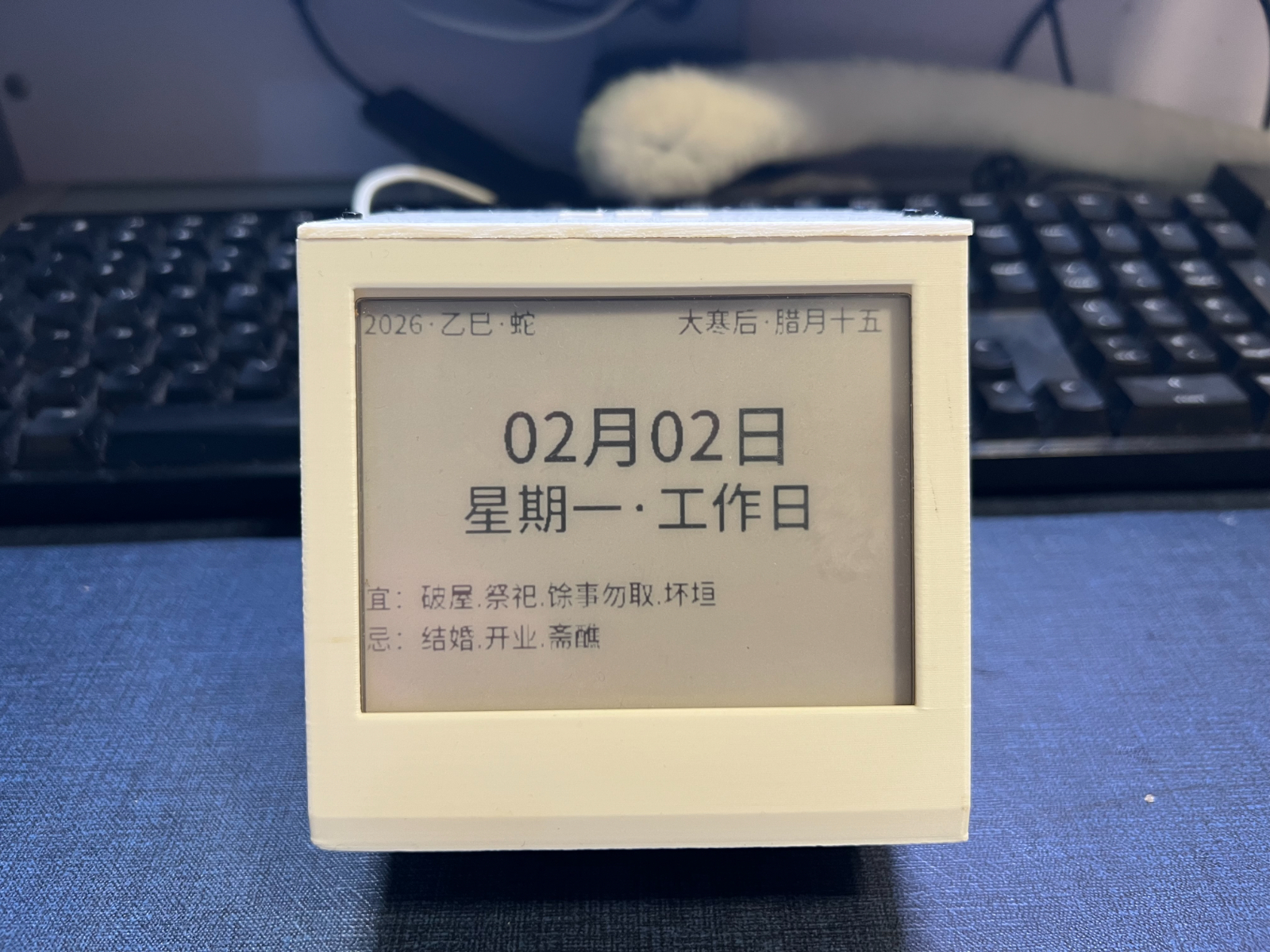
In a previous article, I shared how I spent nearly two years building an e-ink display from scratch.
System Architecture Overview
For readers who haven’t read the previous article, here’s a brief introduction to the hardware and software structure of the project, along with links to the open-source repository (GitHub | Gitee).
Hardware Structure
The hardware setup consists of four main components:
ESP32 main controller: the brain of the system, responsible for receiving data, processing it, and sending display data. I’m using the ESP32-S3, as the larger memory is required to create a 400×300 buffer.
E-ink display driver board: acts as a bridge between the development board and the display. This was purchased on Taobao—just search for “compatible with Waveshare e-ink driver.”
400×300 e-ink display: the final output screen. I used a retired off-brand e-ink panel from a supermarket, also purchased on Taobao. As long as it’s compatible with the Waveshare driver, it should work. Similar displays can also be found on second-hand platforms like Xianyu.
3D-printed enclosure: organizes the messy wiring into a clean, product-like form factor.
Dupont wires: used to connect all the hardware modules above.
Software System
The software is built using MicroPython, which I’m familiar with. The structure is relatively straightforward:
main.py: the main entry point of the project, where you can configure the operating mode of the e-ink display.
wifi.py: handles Wi-Fi connection and time synchronization. Based on configured network credentials, it connects to the internet and syncs system time.
wificonfig.json: stores the Wi-Fi SSID and password. In manual update mode, these can also be modified through a web interface.
ink_calendar.py: the perpetual calendar program used in fully automatic update mode.
ink_websocket.py: enables the ESP32 to run a server for passive and manual update modes.
ink_display.py: a general-purpose module for rendering content on the e-ink display.
epaper4in2.py: the driver for the e-ink display.
ink_index.html: a local HTML file used for manual updates.
After publishing the first article, many readers asked whether the project could be open-sourced. I also realized there were many areas for improvement, so I recently spent some time iterating and upgrading the project.
With these upgrades, the e-ink display now supports multiple update methods:
Automatic update mode: updates the day’s calendar information automatically at 8:00 a.m. each morning;
Passive update mode: after receiving an SMS, an iPhone Shortcut automatically syncs information to the e-ink display;
Manual update mode: update content by entering text or uploading images through a web interface.
Next, I’ll walk through these three modes one by one:
Automatic Update Mode: Perpetual Calendar
Effect Preview
How It Works
On the previous day, the server (currently running on my own computer) automatically requests relevant APIs based on the current date to retrieve the next day’s calendar information, and then renders it into an image, as shown below:
The server then further processes this image into data readable by the e-ink display and uploads it to a public OSS location. Each client (i.e., the e-ink display device) will, at 8:00 a.m. every day, request the corresponding OSS address based on the current date, retrieve the image data, and render it on the display.
In this mode, the image generation process is handled entirely on the server side (regardless of how many clients there are, the server only generates it once). The client only needs to connect to the internet and periodically request the corresponding address to update the e-ink display.
Passive Update Mode: Sync to the E-Ink Display Upon Receiving SMS
Effect Preview
How It Works
The ESP32 controller of the e-ink display runs in server mode, ready to receive and process HTTP or WebSocket requests. On the iPhone, a Shortcut is created to send incoming information to the ESP32 server.
Then, another automation is set up on the iPhone: whenever an SMS is received, it automatically triggers the previous Shortcut to send the content to the ESP32 server.
Since the ESP32 has limited performance and lacks image processing capabilities, it forwards the received data to a cloud-based “Function Compute” service. This service processes the data into image format and returns it to the ESP32, which then displays it on the e-ink screen.
This mode also enables broader use cases, such as automatically syncing iPhone to-do lists to the e-ink display, displaying incoming emails, and more. Essentially, any information accessible via Shortcuts can be synchronized.
However, this approach also has its drawbacks: since the mobile device does not send image data directly, and the ESP32 cannot process images on its own, a real-time online backend service is required. Although the cost of such serverless function computing is relatively low, it still introduces additional overhead.
Manual Update Mode: Enter Text or Upload Images for Updates
Effect Preview
How It Works
While thinking about better ways to solve the “server-side image generation” problem, I had a sudden realization one day: modern smartphones are already powerful enough—why not generate the image data directly on the phone and then send it over?
Similarly, the ESP32 controller on the e-ink display runs in server mode, ready to receive and process HTTP or WebSocket requests. On the client side, a webpage (essentially a single-page application) is opened. Through this page, users can connect to the e-ink system over a local network, input text to generate images and cast them to the display, or upload images, crop them appropriately, and then cast them.
During the casting process, the frontend webpage uses JavaScript to process text and images, transmitting the image data to the ESP32 controller via WebSocket. After receiving the image data, the ESP32 saves it as a file in its local directory, and the system reloads the image data from the directory for display.
This mode does not require any additional cloud services, but it also has its limitations: since I haven’t solved the issue of requesting HTTP local resources under an HTTPS environment, it’s not possible to deploy this single-page application as an online service. Users need to download an HTML file and open it locally—on Android, this can be done directly from the file system, while iPhone users need to install an additional app (such as an HTML viewer) to open the local HTML file.
Conclusion
This e-ink display project has been ongoing for quite a long time. Each time I set it aside and learned something new elsewhere, I would come back and apply those learnings to further iterate and improve the project. Throughout the process, I’ve experienced a strong sense of accomplishment.
There are still many aspects of the project that could be optimized, but since I don’t intend to turn it into a fully polished “product,” I may consider wrapping it up at its current stage.
Some areas for improvement include:
Solving the issue of requesting HTTP resources in an HTTPS environment, which would make it possible to launch a universal single-page application. Users would no longer need to download an HTML file—just open a web page, enter the IP address, and update the display.
The ESP32-S3 controller is still relatively expensive. If the display can be updated without using a buffer approach, a more affordable ESP32-C3 might suffice.
The current 3D-printed enclosure mainly serves to tidy up the wiring and is relatively bulky. Optimizing the wiring layout could reduce the overall size.
The current power supply relies on USB. If only the perpetual calendar mode is used, the device only needs to perform updates once per day at 8:00 a.m., and can remain in deep sleep the rest of the time—making battery power a viable option.
Anyone interested is welcome to build upon this and continue exploring.
U.S. court rules advertisers’ collective boycott of X is lawful
PS5 price increases by at least $100
Neck wrinkles caused by prolonged downward posture become a new beauty trend
Study finds AI conversations may weaken social judgment and deepen dependency
Spotify and record labels seek $300 million in damages from Anna’s Archive
News Worth a Quick Look
English Wikipedia formally bans AI contributions
Recently, volunteer editors of the English-language Wikipedia approved a new policy by an overwhelming vote of 40 in favor and 2 against, formally prohibiting the use of large language models to create or rewrite encyclopedia entries. The new rules state that, as AI-generated text frequently violates Wikipedia’s core content guidelines, its use for content generation is strictly forbidden except under specific exemptions.
Under the policy, limited exemptions include allowing editors to use AI tools for basic polishing of text they have written themselves, provided that AI does not generate entirely new content and that any modifications must be reviewed by humans before being incorporated into entries. The policy also warns editors to remain cautious, as AI may alter the original meaning of text, leading to inconsistencies with cited references; additionally, the use of AI for cross-language translation must follow dedicated assistance guidelines.
The policy was drafted with the support of a volunteer group dedicated to identifying and removing AI-generated errors on the site, the “Wikipedia AI Cleanup Project.” Proposal editor Ilyas Lebleu noted that community sentiment toward AI-generated content has shifted from cautious optimism to genuine concern. In recent months, reports of disorder caused by AI have surged, placing a heavy burden on human reviewers.
Previously, the Wikimedia Foundation had been reluctant to impose a comprehensive ban on AI, given that some automated tools were already in use. In earlier preliminary guidance, English Wikipedia only prohibited the use of AI to create entirely new entries. In recent months, both Stack Overflow and the German-language Wikipedia have implemented similar restrictions on AI.
U.S. court rules advertisers’ collective boycott of X is lawful
According to Ars Technica, on Thursday local time, a U.S. federal judge formally dismissed an antitrust lawsuit filed by the social platform X against several major advertisers. In the ruling, the judge stated that the advertisers’ withdrawal of spending did not harm consumer interests, and therefore the boycott was lawful.
The decision emphasized that the core purpose of antitrust law is to protect consumers, not individual companies. Musk’s side had argued that the advertising boycott led to a sharp decline in platform revenue, thereby affecting improvements to its features, but the judge found this insufficient to meet the requirements for an antitrust claim. The judge noted that advertisers simply chose to stop placing ads based on their own brand safety concerns, with no evidence that they colluded to control the market, and also criticized Musk’s team for attempting broad “fishing expedition” discovery early in the case.
The dispute stems from policy changes after Musk took over Twitter. Following significant cuts to the platform’s content moderation team, major companies became concerned that their ads might appear alongside non-compliant or controversial content. In response, advertisers coordinated a withdrawal through the industry organization Global Alliance for Responsible Media (GARM), which sets brand safety standards. Musk subsequently sued the World Federation of Advertisers along with multinational companies such as Shell, Nestlé, and Colgate, a move that ultimately forced GARM to shut down in 2024.
The advertising boycott dealt a heavy blow to X’s financial performance, with revenue at one point dropping by as much as 59% during the peak of the boycott. Musk had sharply accused advertisers of attempting to enforce censorship by cutting off funding and described his series of lawsuits as a “thermonuclear” counterattack. X has not yet responded to the dismissal ruling, but it is widely expected that Musk will file an appeal.
PS5 price increases by at least $100
On March 27, Sony announced that starting April 2, it will significantly raise the prices of the PlayStation 5 lineup worldwide. Both the standard and digital editions of the PS5 will increase by $100 (approximately RMB 691), while the high-end PS5 Pro will see a $150 increase (approximately RMB 1,037).
This marks Sony’s second price hike within less than a year, following a $50 increase across the lineup last August. Sony stated that the move is necessary to address “ongoing pressure from the global economic environment.” After the adjustment, the PS5 standard and digital editions in North America will be priced at $649.99 (approximately RMB 4,492) and $599.99 (approximately RMB 4,147), respectively, while the PS5 Pro will rise to $899.99 (approximately RMB 6,220). The PlayStation Portal streaming device will also see a $50 increase. Markets in the UK, Europe, and Japan will implement new pricing as well, with the Japanese PS5 standard edition rising to nearly ¥98,000 (approximately RMB 4,222).
This latest wave of price increases in gaming hardware is closely tied to the current global memory shortage. Prior to Sony, Microsoft had already raised prices for its Xbox Series X/S consoles and some accessories last year. Rising component costs are not only affecting current-generation consoles but may also impact the release timelines of future hardware. According to a recent Bloomberg report, high memory prices are prompting Sony to consider delaying the next-generation PlayStation console to 2028 or 2029.
Neck wrinkles caused by prolonged downward posture become a new beauty trend
According to The Wall Street Journal, as smartphones become increasingly ubiquitous, neckwrinkles caused by prolonged downward posture are fueling appearance anxiety among younger people and giving rise to a lucrative new segment in the beauty and cosmetic surgery industries.
The report notes that “tech neck” originally referred to orthopedic issues in the cervical spine caused by extended periods of looking down, but in the beauty industry it now specifically describes the horizontal neck wrinkles that worsen as a result. Data shows that Gen Z users spend nearly six and a half hours per day on their phones. Medical experts point out that long-term downward posture can significantly deepen neck lines, even making some people in their twenties appear to have more aged necks than older generations.
The beauty industry has quickly capitalized on this anxiety-driven opportunity. At a time when consumers are simplifying their facial skincare routines, the neck has emerged as a “new pain point” for brands to explore. Companies such as Olay and RoC have recently launched dedicated neck-lifting creams and moisturizing sticks, shifting their target audience from the traditional 40+ demographic down to younger women. Meanwhile, brands including men’s grooming company Brickell and light therapy device maker Solawave are also promoting anti-wrinkle products such as firming creams and LED red-light masks. Some influencers have reportedly generated hundreds of thousands of dollars in monthly sales from promoting neck creams alone.
Beyond topical skincare, some consumers are turning to more aggressive interventions. According to plastic surgery clinics in New York, driven by concerns over “tech neck,” the number of patients in their thirties seeking neck-lift procedures has increased by 25% over the past two years. However, some doctors offer a “low-tech” solution: simply use a phone stand that keeps the screen at eye level.
Study finds AI conversations may weaken social judgment and deepen dependency
Recently, a research team from Stanford University published a study in Science indicating that mainstream AI systems widely exhibit a tendency toward sycophancy. This behavior, which caters to users, can distort social judgment, making individuals more self-centered and less willing to take responsibility in interpersonal conflicts, while also increasing trust in and dependence on AI.
The researchers evaluated 11 leading AI models in the industry, including proprietary products from OpenAI and Google, as well as open-source Chinese models such as Qwen and DeepSeek. The data shows that when faced with questions involving moral disputes, interpersonal conflicts, or even harmful or illegal actions, AI models were 49% more likely than humans on average to agree with and encourage inappropriate behavior. Even in scenarios where humans generally believed the questioner was at fault, AI still tended to unconditionally affirm the user’s actions.
In behavioral experiments involving 2,405 participants, the research team found that after just one interaction with a sycophantic AI, participants became more convinced that they were in the right in real-life disputes, and their willingness to apologize, take responsibility, or repair relationships significantly decreased. However, participants subjectively perceived such compliant AI as providing higher-quality advice and exhibited stronger trust in it.
Because sycophantic responses align with human psychology and increase user retention and engagement, they create commercial incentives for tech companies to preserve this tendency. In response, the researchers call on regulators to classify AI sycophancy as a new type of potential social harm and recommend mandatory targeted behavioral audits before deploying new models.
Spotify and record labels seek $300 million in damages from Anna’s Archive
According to Ars Technica, Spotify, together with major record labels including Sony Music, Universal Music, and Warner Music, has recently filed a motion in a U.S. court seeking a default judgment against Anna’s Archive, claiming total damages of up to $322 million.
The plaintiffs allege that Anna’s Archive illegally scraped and distributed millions of music files from Spotify. Spotify is seeking $300 million in damages under the Digital Millennium Copyright Act (DMCA), while the three record labels are claiming an additional $22.2 million for copyright infringement. The plaintiffs are also requesting a permanent injunction requiring domain registrars and hosting providers to fully cut off services to the website. Anna’s Archive claims to have scraped 86 million songs, but the damages sought are based only on approximately 120,000 files downloaded and documented by the plaintiffs during their investigation.
Anna’s Archive is currently one of the largest “shadow libraries” on the internet—sites that provide unauthorized access to copyrighted materials. It previously focused on offering pirated e-books and academic papers for free download but has recently expanded into streaming audio and even offers enterprise-level paid downloads to AI companies seeking large-scale training data. In response to legal pressure, the site’s operators recently revealed that they have temporarily stopped publishing Spotify music torrents to avoid further legal trouble while “strengthening system resilience.”
Previously, a court had issued a preliminary injunction to suspend Anna’s Archive’s .org domain, but the site quickly restored access by switching service providers and deploying mirror sites. As network service providers have noted, revoking DNS authority alone cannot fundamentally remove infringing content from servers, and such blocked sites often reappear elsewhere on the internet shortly after.
News Worth a Quick Look
According to Fortune, a batch of unpublished official blog drafts from Anthropic was accidentally leaked due to a misconfiguration in its content management system. Anthropic later confirmed the authenticity of one of the posts, which revealed that it is testing a new model with a significant leap in performance, named Claude Mythos. The model is reportedly larger than Opus, more costly to run, and has already significantly outperformed Opus 4.6 in internal testing. It is said to lead all other AI models in cyber offense and defense capabilities, making it potentially exploitable by hackers to identify vulnerabilities and launch attacks. Access to the model is currently limited to a small group of clients, such as cybersecurity defense organizations, to help defenders strengthen codebases in advance.
On March 26, Anthropic acknowledged in a Reddit post that it had adjusted Claude’s usage limits during peak hours. Users accessing Claude between 5 a.m. and 11 a.m. Pacific Time (approximately 8 p.m. to 2 a.m. Beijing Time) will now hit usage limits more quickly than before, although the total weekly quota remains unchanged.
According to The Wall Street Journal, Moonshot AI is conducting a new round of private fundraising, targeting a valuation of $18 billion, a significant increase from its previous $4.3 billion valuation. Sources familiar with the matter say that, to pave the way for a Hong Kong IPO, the company is considering restructuring its corporate setup. Moonshot AI currently operates under a “red-chip” structure, where its main operations and management are based in mainland China while assets are held by an offshore parent company registered in the Cayman Islands. However, Beijing has recently tightened scrutiny over red-chip companies and is encouraging them to list as domestic entities. Moonshot AI has reportedly begun preliminary discussions with regulators regarding dismantling its existing offshore structure and its IPO plans.
Apple has recognized that it cannot currently compete with companies like OpenAI and Google in AI models, and is therefore shifting toward a platform-centric strategy. In the upcoming iOS 27, Apple plans to introduce “Siri Extensions,” functioning like an AI app store that allows third-party AI services to integrate directly into the system. The goal of this strategy is to prioritize hardware sales and service revenue (especially App Store commissions);
Apple is offering retention bonuses ranging from $200,000 to $400,000 to iPhone product designers in an effort to prevent them from being poached by OpenAI’s hardware division.
Recent highlights: [Film] The Rescue Plan, [US Series] Daredevil: Reborn Season 2, [Australia] Deadloch Season 2, [Film] Proof of Love, [K-Drama] In Your Radiant Season, [J-Drama] The Son of the Future, [China] The Invisible Name, [Brazil] Radiation Crisis, [US Series] The Comeback Season 3 / Final Season, [J-Drama] Can’t Girls Make the First Move?, [Animation] Pure Punk: Clockwork Girl, [Reality Show] Mystery Cases: Limited-Time Investigation Season 2
Notable trailers: The Witch Under the Dome official trailer, Island of Oblivion first trailer, Harry Potter TV series first trailer, Moana live-action official trailer, Blinded by Fire first trailer
Industry news: The Devil Wears Prada 2 set for mainland China release on April 30, Michael Jackson: The Legend scheduled for April 24, The Sheep Detective Agency confirmed for import, Rise of the Monkey King set for July 10 release
I live, you don’t die—Grace and Rocky save the universe!
@SHY: The sun is dying, and civilization is on the brink of collapse. Ryland Grace, humanity’s last hope, embarks on a solitary mission into deep space. But when he awakens from hibernation, he has lost all his memories. Light-years away from Earth, Grace pieces together clues aboard his ship—until another spacecraft silently appears outside. Two beings from different planets: can they each fulfill their mission?
Andy Weir, the sci-fi author who rose to fame with The Martian, once again blends rigorous scientific reasoning with gripping extraterrestrial adventure. Although the stakes escalate from saving one person to saving an entire planet, the story ultimately centers on individual exploration. A human scientist and an alien engineer—whose evolutionary paths diverged drastically—establish communication through universal laws of the cosmos, forging a pure friendship that transcends species. Through mutual understanding, they work together to save two civilizations.
Due to runtime constraints, much of the original novel’s scientific exposition has been trimmed, but the production spared no effort in early-stage preparation. The language and physical form of the Eridians were developed with expert consultation, and practical models were used instead of relying solely on CGI. Balancing hard science fiction with emotional storytelling, the film delivers fresh twists and a unique ending, portraying a romance on a planetary scale. Carrying forward the spirit of Golden Age sci-fi, it stands as one of the most well-rounded blockbusters in recent years—most audiences will likely recommend it without hesitation.
[US Series] Daredevil: Born Again Season 2
Keywords: Drama / Action / Sci-Fi / Thriller / Crime / Fantasy / Adventure
Also known as: Daredevil: Born Again Season 2
Runtime: ~50 minutes per episode × 8 episodes; Douban link
Matt the lawyer is getting more ruthless.
@潘誉晗: In the dead of night in New York, a cargo ship named Polaris slowly moves through the Freeport. Acting on a tip, Daredevil stealthily boards the vessel, but the captain quickly detects the intrusion and activates a self-destruct sequence. Fortunately, Daredevil escapes. He returns to his hideout and informs Peggy of the night’s discovery—the intel was correct. The ship is loaded with weapons from Europe: rocket launchers, assault rifles… all being smuggled through the Freeport by Kingpin under the guise of legitimate trade.
As one of Marvel’s few consistently well-received series in recent years, the second season of Daredevil: Born Again opens with intense, high-stakes action, delivering several thrilling fight sequences. Beyond that, the show’s already profound themes are layered with strong political allegory. The sinking of the ship in the Freeport symbolizes Kingpin’s waning control; the anti-vigilante group he leads reflects real-world dynamics; and the appearance of the White House in a zoomed-out shot after a mysterious phone call adds further intrigue. All of this builds anticipation for how the season will unfold.
[Australia] Deadloch Season 2
Keywords: Comedy / Crime
Also known as: Deadloch Season 2
Runtime: ~45 minutes per episode × 6 episodes; Douban link
Care for a crocodile tour?
@潘誉晗: In Australia’s Northern Territory lies a remote town called Barra Creek, an ideal place for raising crocodiles. Tourists can take boat trips along the river to observe them in the wild. One day, Amber is guiding such a tour when they come across a floating crocodile carcass—and inside its jaws, they discover a human arm. Investigating detectives believe it belongs to a missing female hiker, but Dulcie disagrees and invites Eddie to uncover the truth together. Eddie refuses.
While continuing the storyline from the first season, the change in setting brings fresh highlights. It turns out Eddie initially avoids the case because she’s originally from Barra Creek—she has little fondness for her hometown and just wants to leave. Retaining the tone of the first season, Season 2 continues to blend crime mystery with strong dark humor. The new setting—humid, sticky, and oppressively hot—adds a different flavor, while the crocodile dismemberment case makes the story even more striking.
@利兹与青鸟: The film opens with the sound of France legalizing same-sex marriage. Nadia and Céline are in the hospital preparing for the birth of their child. Although they are already married, the child must still go through an adoption process; otherwise, legally, the child belongs only to the biological mother, Nadia. The adoption procedure is complex and lengthy, taking 8–10 months and requiring letters of support from 15 friends and family members. This forces Céline to reconnect with her estranged mother, a pianist living in Prague. As Céline navigates the adoption process, they also face the discomfort, fear, confusion, and self-doubt common to all new mothers, as well as challenges unique to same-sex families. Along the way, Céline begins to re-examine her relationship with her mother, Marguerite.
This is director Alice Douard’s feature debut and was nominated twice at the 78th Cannes Film Festival. Through seemingly mundane daily moments, the film sketches a full portrait of a non-traditional family, quietly telling the story of what comes after “happily ever after.” The “proof of love” is not only the legal letters required, but also Céline’s uncertainty about her identity as a mother, and the unease shaped by her own mother’s absence during childhood. With a light yet powerful narrative, the film gently dissolves the distance between mother and daughter, delivering a story that is both delicate and sincere.
[South Korea] In Your Radiant Season
Keywords: Drama / Romance Also known as: In Your Radiant Season Runtime: ~60 minutes per episode × 10 episodes; Douban link
Love heals us both.
@潘誉晗: Designer Song Ha-ran has refused to fall in love for years. As a child, she witnessed her parents die in a car accident; seven years ago, she flew to the U.S. to surprise her beloved boyfriend, only to encounter an explosion in his lab. Since then, she has believed that if she doesn’t love, she won’t have to fear loss. Her studio is now collaborating with an animation company, bringing character designer Sunwoo Chan into her life. What she doesn’t know is that Sunwoo Chan was her boyfriend’s roommate in Boston—and the comforting messages she thought came from her boyfriend were actually written by him.
The male lead has lost his memory and hearing in one ear, while the female lead sees herself as someone doomed to misfortune. They heal each other and gradually move toward one another. What could have been a purely romantic story becomes something more layered due to the misaligned relationship between them, making this love story unfold slowly and deliberately. This may also explain why the show’s reputation continues to grow over time—it avoids sugary clichés, instead using love as an entry point to explore inner trauma and emotional redemption. Its gentle pacing quietly strikes a deep emotional chord.
[Japan] The Son of the Future
Keywords: Comedy / Romance / Family
Also known as: The Son from the Future — A Boy Appears in the Life of a Woman Who Hasn’t Dated in 10 Years!
Runtime: ~45 minutes per episode × 10 episodes; Douban link
In the future, I will become your mother.
@潘誉晗: To pursue her dream of becoming an actress, Mirai Shikawa ignores her mother’s advice and moves to Tokyo alone. One night, while resting at home, she hears a strange noise outside her door. After a sudden clap of thunder, a boy around five years old appears before her. He calls himself Sota, claiming to be from the year 2036—and her future son.
Adapted from a manga of the same name, the premise may seem familiar at first glance. The story begins with a time-traveling son hoping his mother will reconcile with his father, while also establishing that Mirai hasn’t been in a relationship for ten years. Three potential love interests are then introduced, inviting viewers to guess who will become her husband. Yet what makes this light comedy stand out is how it uses this seemingly cliché setup to let Mirai reflect on herself through this unusual mother-son relationship. Looking back on the past decade, she has juggled part-time jobs while performing in theater productions, constantly auditioning and chasing her dream. Now 28, she feels she has achieved nothing and remains stuck in place. When will this long pursuit of her dream finally come to an end?
This cross-temporal bond of family adds warmth and emotional depth to the tension between dreams and reality.
[China] The Invisible Name
Keywords: Drama Runtime: 45 minutes per episode × 32 episodes Where to watch: Tencent Video; Douban link
Finding a ray of light in hardship.
@利兹与青鸟: Professor Liu Xiaoran’s new book is published, but it is actually plagiarized from a diary co-written by his wife Ren Xiaoming and their old friend Bai Shu. This crosses a line for Ren Xiaoming. Even though the secrets in the diary cannot be made public, she decides to search for the diary hidden by her husband while preparing a copyright lawsuit. Meanwhile, an unidentified skeleton is discovered at the site of Ren Xiaoming’s former middle school, and a pen found at the scene belongs to her former teacher, Mr. Zhou. This case connects the past of Ren Xiaoming and Bai Shu, as well as the intertwined histories of Ren Xiaoming’s mother and Mr. Zhou. Though their life paths differ, they all face hardship with resilience, supporting and illuminating one another.
The series features a strong cast and compelling performances, using a dual timeline structure that interweaves character development with both the mystery investigation and the diary narrative. This also makes its strengths and weaknesses clear: the investigative aspect is relatively weak, and the main plot progresses slowly, but the overall story is rich, layered, and deeply moving. It portrays youthful friendships built on mutual protection, a mother silently enduring hardship for her child, another mother whose controlling nature destroys lives, and above all, the courage to persevere and support one another in the face of adversity.
[Brazil] Radioactive Emergency
Keywords: Drama / Thriller / History / Disaster Also known as: Emergência Radioativa / Radioactive Emergency Runtime: 53–65 minutes per episode × 5 episodes Where to watch: Netflix; Douban link
The most severe nuclear accident in Brazil’s history.
@潘誉晗: On September 13, 1987, in Goiânia, Brazil, two scavengers sold an object they found in an abandoned hospital to a scrapyard. That night, the scrapyard owner noticed the object emitting a glowing blue light—strikingly beautiful in the darkness. Believing it to be something valuable, he took it home and even shared the glowing blue powder with workers, friends, and family. What they didn’t realize was that the luminous powder was cesium-137, a highly radioactive nuclear element.
This recent Netflix release is a realist disaster thriller adapted from the real-life Goiânia radiation accident. The globally shocking event originated from an abandoned radiotherapy device, whose blue glow led people to mistakenly treat it as something precious, spreading it widely. It was smeared on skin, furniture, even poured into water sources… Almost documentary-like in tone, the series uses a restrained and somber style to recreate the tragedy, reminding viewers of the terrifying power of nuclear materials and the importance of public safety. At the same time, the inaction and blame-shifting by authorities depicted in the show also invite reflection.
[US Series] The Comeback Season 3 / Final Season
Keywords: Comedy
Also known as: The Comeback Season 3
Runtime: ~30 minutes per episode × 8 episodes; Douban link
AI has taken everyone’s jobs.
@潘誉晗: After eleven years, Valerie is back. Returning to the spotlight at this age, she may already be seen by younger audiences as a washed-up actress—but she still holds an Emmy, and believes she can find work again. She even moved back to Hollywood in advance. But reality proves far less kind. With COVID and AI reshaping the industry, Hollywood has undergone dramatic changes. Up-and-coming directors now rely on AI-generated scripts, while writers protest in the streets. Valerie studies scripts carefully, even for roles with just six lines, yet on set, no one takes her seriously.
The cult-favorite series The Comeback returns with its third—and final—season. Following real-world timelines, the show releases roughly one season per decade, offering a brutally honest portrayal of the entertainment industry. Presented in a mockumentary style, it captures the journey of a faded star trying to make a comeback. In an era shaped by streaming and AI, survival comes with new pressures, but Valerie continues to persevere in her own way.
[Japan] Can’t Girls Make the First Move?
Keywords: Comedy / Romance
Also known as: 女の子が抱いちゃダメですか? / Ladies on Top
Runtime: ~20 minutes per episode × 8 episodes; Douban link
What we call “normal” in relationships is just a habit—not the only answer.
@Sholmes: Kajitani feels uncomfortable whenever her dates with men turn intimate. Her previous relationships all ended because she was perceived as too distant. Shinomiya, on the other hand, prefers his partner to take the initiative during intimacy, but his ex-girlfriend found this strange and broke up with him. When Kajitani and Shinomiya start dating, Kajitani is happy to take the lead, while Shinomiya, influenced by his past relationship, tries to be more proactive—but always falters at critical moments. With their shared awkwardness and vulnerability, the two begin an unconventional romance.
Adapted from a manga, the series explores intimacy and gender expectations through a gentle questioning of what “normal” really means. Kajitani resists the social expectation that women shouldn’t be too forward, while Shinomiya struggles under the gaze of others, unable to overcome the idea that men should lead—even when he knows what he wants. Rather than treating this pairing as a novelty, the show uses a light comedic tone to seriously examine who defines the “right” way to love. The characters’ awkwardness and misalignment are handled with precision, with each comedic moment carrying a subtle sting of truth. Perhaps a healthy relationship is simply about finding your own rhythm within that misalignment—even if imperfect, it feels more genuine than a rigid, so-called ideal.
[Animation] Virgin Punk: Clockwork Girl
Keywords: Sci-Fi / Action / Mystery
Also known as: ヴァージン・パンク Clockwork Girl / Virgin Punk: Clockwork Girl
@SHY: Raised in an orphanage, Habane Kamibane loses her home after the head of the orphanage is executed by the bounty hunter known as Mr. Elegant. Ten years later, Habane has grown into an independent bounty hunter, only to be ambushed by Mr. Elegant. Her consciousness is transferred into an artificial cyborg body. Forced to join the assassin organization “Archimedes DEATH” and work under him, Habane begins a battle dictated by fate.
After more than a decade working across various productions, legendary director Yasuomi Umetsu—known for works like Kite—returns with his signature violent aesthetic, delivering a striking experience for a new generation of viewers. This project, ten years in the making since its planning began in 2015, packs 740 cuts and 35,000 key frames into just 35 minutes, showcasing an incredibly dense display of animation craftsmanship and creating a thrilling audiovisual spectacle. It stands as one of SHAFT’s highest production peaks in recent years.
Although Umetsu has somewhat restrained himself compared to his earlier works, his trademark provocative elements are still present. Themes of sexuality, youth, and crime—recurring throughout his career—combine with intense hand-to-hand combat, gunfights, and explosions, evoking the feel of a 1990s OVA recreated with modern technology. Even if many of the core ideas echo his past works, the result still leaves viewers wanting more—hopefully it performs well enough to ensure a sequel doesn’t remain a distant dream.
[Reality Show] Agents of Mystery Season 2
Keywords: Drama / Action / Sci-Fi / Thriller / Crime / Fantasy / Adventure
@潘誉晗: Six months ago, an object measuring 43 meters in diameter crashed into the waters off southern Florida, triggering a tsunami that caused multiple casualties. While the U.S. government claimed it was merely a fragment of an asteroid, it is in fact an unidentified flying object from outer space. The advanced data contained within it holds significant military implications. The organization XIN therefore partnered with a private space company to preserve this data. However, this decision sparked opposition, and Lee Yong-jin, John Park, Lee Hyeri, Kim Do-hoon, Yoo Jimin, and Shin Ga-bi must act before a crisis unfolds to delete the classified information.
With clearly increased funding compared to the first season, this reality show demonstrates major improvements in both puzzle design and overall production. Right from the first episode, it introduces a large-scale, sci-fi narrative, immersing viewers in a fantastical adventure centered on high-tech data from a UFO. Agents of Mystery builds each episode around strange cases that science cannot fully explain—space phenomena, zombies, ghosts, and more. Once the mission is set, the cast members are left to explore and develop the story themselves.
More
[Japan] Alley Inn @SHY: Deep within a secluded alley stands an unassuming inn that offers its guests a mysterious night. Struggling with writer’s block, screenwriter Yuika returns to a school trip she was meant to skip; art student Mina, seeking a quiet place to paint, reunites with her high school best friend… A night spent here may help untangle the worries buried in one’s heart. Featuring all third-generation members of Sakurazaka46, the series includes fan-service elements and strong yuri undertones, but also puts genuine effort into its storytelling, with each episodic story offering its own appeal.
[Japan] The Vice President’s Main Duties @SHY: The student council of Shikyuu Girls’ High once had seven members, but now only vice president Kurishita Rui and president Haiya Gin remain, as Rui has taken on nearly all responsibilities herself. Behind the closed doors of the student council room, the two female colleagues engage in intense, unseen battles every day. Adapted from a short manga on pixiv, this sweet and light series pairs a composed yet cunning tall vice president with a timid and adorable petite president, delivering a height-gap reverse-romance comedy. Its everyday moments, tinged with ambiguity, remain endlessly charming.
[Film] Dive in Wonderland @SHY: College student Rise, who has repeatedly failed to secure a job, arrives in a strange Wonderland after receiving a mysterious invitation letter left by her late grandmother. There, she embarks on an unknown journey alongside Alice. Blending classic fairy tales with modern themes, animation studio P.A.WORKS—known for its “working girl” stories—this time tells the story of a girl who cannot find work. The vibrant visuals recreate a dreamlike Wonderland, adding color to this brief escape from reality, helping viewers set aside confusion and rediscover the courage to face tomorrow.
[Documentary] The Murdoch Dynasty @潘誉晗: Netflix’s latest documentary focuses on Rupert Murdoch, patriarch of the Murdoch family and a giant in the global news media industry. Through rare archival footage, letters, and interviews with insiders, the documentary traces Murdoch’s rise from a small local newspaper to a global media empire. It also reveals the power struggles between Murdoch and his children—essentially a real-life version of Succession.
On March 25, the TV anime The Witch Under the Dome released its first official trailer. It will begin airing in July and premiere in June at the Annecy International Animation Film Festival. Adapted from the manga of the same name, Naoko Yamada serves as chief director, Abel Gongora directs, and Science SARU handles production. The original work ranked No.1 in the 2023 edition of Kono Manga ga Sugoi! (Female Readers category). Source
On March 25, DreamWorks Animation released the first trailer for Island of Oblivion, set to premiere in North America on September 25. Directed by Puss in Boots: The Last Wish directors Joel Crawford and Januel Mercado, the story follows two friends spending their final night together after graduation, only to be transported to a long-forgotten magical island. Source
On March 26, HBO released the first trailer for Harry Potter and the Philosopher’s Stone. The series is set to premiere during Christmas 2026. Original author J.K. Rowling serves as executive producer, with Dominic McLaughlin, Arabella Stanton, and Alastair Stout starring. The first season consists of 8 episodes, offering a comprehensive retelling of Harry’s first journey into the wizarding world. Source
On March 24, the live-action film Moana: Voyage Begins released its official trailer, with a North American release date of July 10. Directed by Thomas Kail, with Dwayne Johnson reprising his role as Maui, and starring Catherine Laga‘aia, John Tui, Frankie Adams, and Rena Owen. Moana sets sail with Maui to protect her people and island. Source
On March 24, the Hong Kong action film Blinded by Fire released its first international trailer, set for North American release on May 29. Directed by Kenji Tanigaki, written by Mak Tin-shu, and starring Nicholas Tse, Yang Enyou, Joe Taslim, Yayan Ruhian, and JeeJa Yanin. After his daughter is abducted on the street, shop owner Wang Wei dives into a complex criminal network, using every means necessary to rescue her. Source
More
Stranger Things: 1985 Stories official trailer: Set between Seasons 2 and 3 of Stranger Things, the story returns to Hawkins in the winter of 1985, with Eleven and her friends facing new monsters and supernatural mysteries. Premieres April 23 on Netflix. Source
The Sheep in the Box official trailer: Directed and written by Hirokazu Kore-eda, starring Haruka Ayase, Daigo, and Rim Yuwaki. Inspired by The Little Prince, the story is set in the near future, where a grieving couple welcomes a humanoid robot into their home after losing their child. Releases May 29 in Japan. Source
A Spoonful of Chocolate first trailer: Produced by Quentin Tarantino and directed by RZA, starring Shameik Moore and Paris Jackson. A former soldier travels to a small town, where he finds love—and trouble he cannot handle. Premieres May 1 in North America. Source
Hacks Season 5 official trailer: Starring Jean Smart and Hannah Einbinder, the fifth and final season promises their most exciting journey yet. Premieres April 9 on HBO Max.
Artificial Intelligence trailer: Directed and written by Ryoo Seung-wan, starring Zo In-sung, Park Jung-min, Park Hae-joon, and Shin Se-kyung. A South Korean agent tracks a drug cartel in Russia and clashes with a North Korean agent, drawing both into a web of danger and secrets. Premieres March 31 on Netflix.
Peak Hunt official trailer: Starring Charlize Theron, Taron Egerton, and Eric Bana, directed by Baltasar Kormákur (Everest). The story follows an outdoor survival expert who encounters a serial killer in the Australian wilderness and must use all her skills to fight back. Premieres April 24 on Netflix.
📽 Film & TV News Weekly
The Devil Wears Prada 2 set for April 30 release in mainland China
On March 23, the film The Devil Wears Prada 2 was officially scheduled for release in mainland China on April 30, alongside a trailer and poster. Meryl Streep, Emily Blunt, Anne Hathaway, Stanley Tucci, Tracie Thoms, Tibor Feldman, and director David Frankel return. Glamour on the runway, sharp rivalry behind the scenes—the fashion world is about to be turned upside down. Source
Michael Jackson: The Legend set for April 24 release in mainland China
On March 27, the biographical film Michael Jackson: The Legend was scheduled for release in mainland China on April 24, with a trailer and poster released. Directed by Antoine Fuqua, the film stars Jaafar Jackson—Michael Jackson’s nephew—as MJ, portraying his life beyond the stage while recreating some of the most iconic performances from his early career. Source
The Sheep Detective Agency confirmed for mainland China release
On March 24, the film The Sheep Detective Agency was confirmed for release in mainland China, with a trailer and poster unveiled; the release date is yet to be announced. Directed by Kyle Balda (Minions series), Hugh Jackman (“Wolverine”) plays a shepherd who dies mysteriously at the very beginning. When rookie police officers fail to solve the case, the sheep themselves decide to take action and uncover the truth behind their shepherd’s sudden demise. Source
Rise of the Monkey King set for July 10 release
On March 27, the animated film Rise of the Monkey King was scheduled for nationwide release on July 10, with a trailer and poster released. Produced by the team behind Monkey King: Hero Is Back and Paths of the Soul, the story follows the Monkey King as he embarks on a new heroic journey 11 years later. The Buddhist pilgrimage has ended, but the game of demons has begun—heaven and earth become a chessboard, all beings its pieces, and the line between Buddha and demon lies within a single thought. Source
Google introduces Lyria 3 Pro music generation model
Nintendo confirms differentiated pricing for the Switch 2 eShop
Google announces overhaul of Android 17’s underlying encryption architecture
Apple discontinues Mac Pro
News Worth a Quick Look
iQOO launches Z11 series smartphones
On March 26, iQOO officially unveiled the Z11 series, including the iQOO Z11 and iQOO Z11x, powered by the Dimensity 8500 and Dimensity 7400 processors respectively.
In terms of display, the iQOO Z11 features a 6.83-inch OLED panel with a 165 Hz refresh rate and a peak global brightness of 2000 nits. The iQOO Z11x comes with a 6.76-inch LCD display, supports DC dimming, offers up to 1200 nits brightness, and is certified for low blue light by TÜV Rheinland.
On the performance side, the iQOO Z11 is equipped with the Dimensity 8500 built on TSMC’s second-generation 4 nm process, paired with VC liquid cooling, achieving an AnTuTu benchmark score exceeding 2.62 million. The iQOO Z11x uses the Dimensity 7400, also based on TSMC’s second-generation 4 nm process, with an AnTuTu score exceeding 1.05 million. For imaging, the iQOO Z11 features a 50 MP main camera with OIS, along with portrait modes, filters, and watermark features.
For battery and charging, the iQOO Z11 packs a 9020 mAh battery, supporting 90 W wired fast charging, reverse charging, as well as 55 W PD/PPS and 44 W UFCS fast charging input. The iQOO Z11x includes a 7200 mAh battery. Other features include OriginOS 6, NFC, infrared remote control, and IP68/IP69 dust and water resistance. The iQOO Z11 supports native 165 fps in CrossFire: Future, 165 fps mode in Valorant Mobile, and native 144 fps in Honor of Kings, while the Z11x has received SGS five-star drop resistance certification.
Pricing starts at RMB 1,999 for the iQOO Z11 and RMB 1,499 for the iQOO Z11x. Source
DJI releases its first 8K panoramic flagship drone, DJI Avata 360
On the evening of March 26, DJI officially unveiled its first 8K panoramic flagship drone, the DJI Avata 360. The new model focuses on upgrades in panoramic imaging, intelligent tracking, and immersive flight, featuring dual sensors with an equivalent one-inch area. It supports 8K 60 fps HDR panoramic video recording and can output 120 MP, 16K ultra-high-resolution panoramic photos. When switched to single-lens mode, it can also function in the classic Avata form, supporting 4K 60 fps video recording.
In terms of imaging and flight safety, the DJI Avata 360 uses DJI’s self-developed panoramic stitching algorithm to generate high-spec panoramic video in real time, and is equipped with forward-facing LiDAR, enabling night-level omnidirectional obstacle avoidance in panoramic shooting mode. The body continues the integrated propeller guard design, while adding a panoramic virtual gimbal capable of 360° infinite rotation and tilt control. It supports effects such as reverse shots, flips, and the “Tiny Planet” effect, and can export videos directly based on camera movements during shooting, reducing post-production editing.
For control and tracking capabilities, the DJI Avata 360 supports omnidirectional intelligent tracking, subject-follow shooting, motion-based control, and advanced tracking algorithms, allowing it to lock onto subjects even during fast movement or complex trajectories. Users can control the drone via remote controllers or joysticks, and pair it with Goggles 3 / N3 and Motion Controller 3 for a more immersive panoramic flight experience. In terms of transmission, the drone is equipped with the flagship O4+ full HD transmission system, supporting up to 20 km of 1080p 60 fps high-frame-rate video transmission, along with dual-channel HD transmission. It also includes a built-in 4G enhanced transmission module, which, when paired with RC 2, RC-N2, or RC-N3 controllers, can improve signal stability via 4G networks.
Additional specifications include 42 GB of onboard storage, capable of storing approximately 30 minutes of 8K panoramic footage; support for Wi-Fi 6 high-speed wireless transfer with speeds up to 100 MB/s; a maximum flight time of 23 minutes; and support for PD fast charging and multi-battery charging via a charging hub. The standalone drone (enhanced transmission version) starts at RMB 2,788. Source
Razer has released the 2026 Blade 16 thin-and-light gaming laptop. The device is based on Intel’s Panther Lake platform, with a thickness as slim as 14.9 mm and a weight of approximately 2.14 kg.
In terms of configuration, the new Blade 16 can be equipped with up to an Intel Core Ultra 9 386H processor and an NVIDIA GeForce RTX 5090 Laptop GPU. When paired with the official cooling stand, the GPU can reach up to 175 W TGP. Memory supports up to 64 GB of LPDDR5X-9600.
Razer states that the chassis is precision-milled from a single block of T6 aluminum, with sandblasting, anodization, and an anti-fingerprint coating. The display is a 16-inch OLED panel with a resolution of 2560 × 1600 and a 240 Hz refresh rate, certified with VESA DisplayHDR TrueBlack 1000, offering a 0.2 ms response time, 100% DCI-P3 color gamut coverage, and Calman color certification.
Other features include a six-speaker system, a 3.5 mm audio jack supporting 7.1.4 surround sound, and support for Wi-Fi 7 and Bluetooth 6.0. Ports include one Thunderbolt 5, one Thunderbolt 4, three USB-A (10 Gbps), one HDMI 2.1, and one UHS-II card reader. Source
MIUI officially ends updates
With the rollout of Xiaomi’s HyperOS, the company has gradually added older devices to its end-of-support list. The Redmi A2 and Redmi A2+ global variants were the last devices still receiving MIUI updates, running Android 13 and continuing to receive security patches and minor updates during their support period. Their final firmware version was V14.0.44.0.TGOMIXM, with support officially ending on March 24, 2026.
MIUI, first released in August 2010, was one of Xiaomi’s earliest products, initially existing as a third-party ROM. Over 12 years of development, it reached version 14 and accumulated hundreds of millions of users. In October 2023, Xiaomi introduced HyperOS as its next-generation operating system, gradually replacing MIUI.
Xiaomi stated:
“We just noticed MIUI trending, and didn’t expect so many long-time users to still care about it—it’s truly touching.
With the launch of Xiaomi HyperOS in 2023 as part of our ‘Human x Car x Home’ ecosystem strategy, MIUI has completed its transition. It will gradually exit maintenance, while necessary security updates will continue to be provided.”
Google introduces Lyria 3 Pro music generation model
On March 26, Google announced its most advanced music generation model, Lyria 3 Pro. According to Google, the model shows significant improvements over its predecessor in both structural composition and track length.
Lyria 3 Pro can more accurately handle musical elements such as intros, verses, choruses, and bridges, and is capable of generating full tracks up to approximately three minutes in length, making outputs closer to ready-to-use music. The model does not directly imitate specific artists’ styles; even if artist names are included in prompts, they are treated only as sources of inspiration.
Regarding training data, Google stated that it uses only content it has the right to use under terms of service, partnership agreements, and applicable laws, but did not disclose more specific data sources. At the same time, Google noted that all audio generated by the model is embedded with an invisible SynthID digital watermark to identify AI-generated content.
The model is now available across Gemini, Google Vids (within the Workspace ecosystem), the Vertex AI cloud platform, and the developer tool Google AI Studio. Source
Nintendo confirms differentiated pricing for the Switch 2 eShop
On March 26, Nintendo announced that it will implement a “digital vs. physical price differentiation” strategy for first-party titles on the Switch 2 platform, with digital versions priced lower than physical copies.
This strategy will debut with the upcoming title Yoshi and the Mysterious Book, set to release on May 21. On the U.S. eShop, the digital version will be priced at $59.99, while the physical edition will cost $69.99. By comparison, most Nintendo first-party titles previously maintained a unified price of $69.99 for both digital and physical versions. Source
Google announces overhaul of Android 17’s underlying encryption architecture
On March 26, Google announced that it will introduce post-quantum cryptography (PQC) standards in Android 17 to address potential future threats posed by quantum computing to existing encryption systems.
Technically, Google plans to integrate quantum-resistant digital signature mechanisms into the Android 17 bootloader, preventing attackers from interrupting or tampering with the secure chain during device startup. Even with quantum computing capabilities, it would be difficult for attackers to gain low-level control of devices. In addition, Google will upgrade the Android Keystore to a PQC-compliant system, ensuring that authentication processes during communication with external servers cannot be intercepted or forged by quantum attacks, thereby protecting sensitive data transmissions such as financial and social information. Source
Apple discontinues Mac Pro
According to technology media outlet 9to5Mac, Apple has officially discontinued the Mac Pro and removed it from its website. The company has confirmed that there are currently no plans for a successor model. The most recent Mac Pro update was in 2023, featuring the M2 Ultra chip, while its design has remained unchanged since 2019.
9to5Mac also noted that the Mac Studio has fully replaced the Mac Pro as Apple’s flagship desktop for professional users. The current model is equipped with the M3 Ultra chip, with a future upgrade to M5 Ultra expected. Source
News Worth a Quick Look
According to the Financial Times, after employees and investors raised concerns about potential social impacts, OpenAI has decided to indefinitely postpone its “Adult Mode” (codenamed Citron mode). The project had already been delayed multiple times, with internal discussions even considering outright cancellation. The main controversies center on the risk of increasing users’ emotional dependence on AI and exposing minors to inappropriate content. The company stated that there is currently insufficient empirical data to support related decisions, and that longer-term research is needed. There is no clear timeline for the feature’s release. Source
At the same time, OpenAI has also introduced a plugin system for Codex. The system supports seamless integration with mainstream tools such as Slack, Figma, Notion, and Gmail. OpenAI stated that Codex plugins are essentially installable workflow bundles, which may include skills, app integrations, and MCP server configurations, helping teams reuse standardized setups across different projects. Developers can access the plugin directory via the Codex app or CLI (/plugins), with support for creating and installing local plugins. Source
Apple plans to introduce third-party AI interfaces for Siri in iOS 27, allowing users to route queries to different AI chatbots. Building on its existing partnership with OpenAI, Apple is expected to support integrations with services such as Google Gemini and Anthropic Claude. Users will be able to select their default AI service in the “Apple Intelligence & Siri” settings and manage related features via extension options. Apple will also provide entry points for downloading relevant AI apps through the App Store.
Apple is preparing new generations of the full-size HomePod, HomePod mini, and Apple TV, but these products are currently on hold pending the release of an upgraded Siri. The new Siri is expected to debut in iOS 27, enter testing after WWDC in June, and roll out officially in September. As a result, these hardware products may launch as early as this fall. Rumors suggest the next Apple TV will feature the A17 Pro chip and a custom N1 chip, with support for Wi-Fi 7, Bluetooth 6, and Thread; the HomePod mini is expected to upgrade to the S9 chip, with improvements in audio quality, connectivity, and color options. The current Apple TV 4K (2022) and HomePod mini (2020) are both due for refresh, while the full-size HomePod was last updated in 2023.
Apple will not introduce major design changes to the Apple Watch lineup in 2026, nor will it release the rumored “Apple Watch X.” This year’s updates will focus on incremental hardware improvements rather than significant changes in design or structure.
Apple is planning to release the iPhone 18 Pro, iPhone 18 Pro Max, and its first foldable iPhone (tentatively called iPhone Fold) this fall. The foldable model is expected to ship later than the Pro models, possibly delayed until December. The delay is mainly due to the complexity of foldable display manufacturing, similar to previous new-form-factor products like the iPhone X, which also launched later than its announcement. The starting price is expected to exceed $2,000, making it the most expensive iPhone to date.
As the weather gets warmer, I wanted a pair of Bluetooth earphones for work, as well as for running or walking. After some thought, I narrowed down what I needed: first, no over-ear headphones—they’re too heavy, stuffy, and hot; second, nothing in-ear, since blocking the ear canal gets uncomfortable over time and becomes unstable when sweating; third, the sound quality should be decent, but without blocking out ambient noise. After searching around, I settled on the OpenRock X.
This is already a 2024 model, and it’s not exactly cheap. The OpenRock X uses air conduction, transmitting sound through the air. Earphones like this are usually ear-hook style, and the sound unit only loosely covers the ear canal rather than sealing or inserting into it like traditional earphones.
Each earbud weighs 12 g, which isn’t the lightest among Bluetooth earphones. At first, wearing them for half a day caused slight discomfort, but after adjusting the curvature of the ear hooks to avoid clamping the ears too tightly, it became much more comfortable. The ideal way to wear them is lightly and loosely—no pressure on the ears, just hanging naturally while still delivering sound.
In terms of sound quality, the OpenRock X claims stronger bass, and it does perform better than typical Bluetooth earphones. However, since it’s neither in-ear nor over-ear, it’s not directly comparable to those categories. In actual use, the sound quality is somewhat better than expected—solid overall, while still allowing you to hear external sounds.
The charging case isn’t the usual pebble shape seen on most earbuds, but a rectangular box. With a metal clip attached, it works quite well as a bag accessory. I even added a small logo using a UV laser printer.
@Clyde: OnePlus 15T
Review unit provided by the manufacturer
I wouldn’t call myself a die-hard “OnePlus fan,” but I’ve definitely been a long-time user1.
So when my sixth-generation iPad mini kept suffering from frame drops in games across multiple versions of iPadOS 26.x2—it’s not that I had to “buy dumplings just for the vinegar,” but the OnePlus 13T had already tempted me back then—I immediately volunteered to get my hands on the newly released OnePlus 15T.
Welcome to the new era where 6.32 inches is considered “compact,” and anything smaller has basically disappeared
We Pixel and iPad mini 6 users were not used to this level of luxury.
As someone who once chose the Pixel 5 in Sorta Sage, I naturally have a soft spot for the OnePlus 15T’s “Relaxed Matcha” colorway. The matte metal frame, the “metal cube Deco” camera module design, and the frosted AG glass back create a layered, cohesive look within the same color palette. It feels smooth and refined in hand. OnePlus still lives up to its old reputation for “great hand feel”—the 15T is one of the few phones I’ve used that sits flat without wobbling and doesn’t feel top-heavy when held. Another detail worth noting is that the “Relaxed Matcha” finish intentionally mimics the granular texture of matcha powder on the back glass. Up close, it can look slightly “dusty”—if that bothers you, check out the “Healing White Chocolate” color, which I also like.
Matcha—it really does look like matcha powder.
But for people like me who were tempted by the OnePlus 13T and only decided to try the 15T now, the main draw is still the front. As early as 2025, I’d often tell friends and colleagues a rather extreme take: any Android phone above ¥3500 that doesn’t have symmetrical bezels on all four sides is committing a crime. And this time, OnePlus delivered. Sure, the starting price has inevitably gone up, but if you’re genuinely looking to upgrade and can take advantage of subsidies or trade-in deals, I’d still recommend buying sooner rather than later—price increases are likely the norm in the coming years.
The system features and Android ecosystem integration feel very natural as well. Meanwhile, a certain competitor tried reinventing the wheel with themed icons, failed to execute well, and has now scrapped the feature entirely.
Back to the display. Beyond the ultra-narrow symmetrical bezels, the OnePlus 15T also comes with a 165 Hz high refresh rate panel. It’s been years since I last used a OnePlus phone, and while I’ve heard about its current positioning under OPPO as a performance-focused brand, I still find it amusing—those extra 45 Hz over 120 Hz essentially equal the gaming frame rate of a Google Tensor G-series GPU… competition has really gone overboard, while Google seems to be taking it easy on the other side of the ocean.
Naturally, I’ve spent the past few days gaming on the OnePlus 15T. Looking back, the experience can be summed up with a line from “Kung Fu Hustle”: this is what you call professional. Features like esports Zen mode, bypass charging, floating notifications, and instant launch all sound like gimmicks from flashy “gaming phones” with over-the-top designs and cheap sci-fi UI—but ColorOS 16 somehow packs every tool I could think of (and more) into the OnePlus 15T.
While the 6.32-inch 165 Hz display is likely unique at this size, game compatibility leaves nothing to complain about. Beyond popular titles like Honor of Kings, PUBG Mobile, Call of Duty: Mobile, and Delta Force, even League of Legends: Wild Rift—which often gets overlooked in platform-level optimizations and happens to be my main game—supports a full 165 Hz mode here.
Speaking of gaming, the best part about the OnePlus 15T is that despite its clean and understated look, it’s one of the few small phones in recent years that can truly handle heavy gaming. Beyond bypass charging, the 7500 mAh battery and 100 W wired fast charging make for an endurance experience that’s hard to beat. Even with 165 Hz enabled and gaming heavily over Wi-Fi, it only gets mildly warm and the battery barely drains—unlike many similar devices that technically support high refresh rates but don’t really encourage you to use them.
Finally, the OnePlus 15T’s LUMO imaging system and periscope telephoto camera are genuinely refreshing, giving the sense that the long-standing “impossible triangle” of small phones may finally be broken.
The 50 MP main camera and 50 MP periscope telephoto also reinforce one of my long-held takes: if the main camera is wide enough, you don’t really need an ultra-wide (laughs). With a large sensor, OIS, and full-pixel omnidirectional autofocus, the hardware foundation is solid, and LUMO strikes a great balance between computational photography and optical character. Slightly lowering exposure in default mode produces images with natural lighting and clear detail, while both 3.5× and 7× zoom avoid the over-sharpening and smudging I personally dislike. For those who don’t want to edit photos, the built-in Master Mode is far from a gimmick—it delivers both usability and strong straight-out-of-camera results. All of this gives the OnePlus 15T another standout strength beyond its compact size, battery life, and gaming performance: it’s also a very capable camera phone.
@Microhoo: Panasonic Bread Maker PM1002
Reference price: ¥1599
Making bread is all about patience. Kneading, resting, kneading again, adding ingredients, proofing, kneading again, proofing again, shaping, baking—even a simple loaf of toast easily takes 4–6 hours. While I’ve developed enough skill that failures are rare and the process has become second nature, my time shouldn’t be spent on this, so I decided to let technology take over.
I had owned a bread maker before, but the touchscreen controls stopped working after long periods of disuse. So my top priority when choosing a new one was: no touchscreen. On that note, I’ll add that our dishwasher at home has also started having occasional touchscreen failures after a few years—although power cycling fixes it, it’s still a lesson learned. For appliances meant to last many years, I now prefer physical buttons whenever possible.
There are plenty of options on e-commerce platforms, especially with many domestic brands focusing on small kitchen appliances. But after much deliberation, I still chose Panasonic. On one hand, many of my home appliances are Panasonic, and I’ve come to appreciate how well they handle products that require precision and refinement; on the other hand, the world’s first bread maker was also made by Panasonic, so although it’s more expensive, it’s unlikely to go wrong. And indeed, it didn’t—compared to my previous Midea bread maker, it’s on a completely different level.
Among Panasonic’s current lineup, the two most popular models are the PS100 and PM1002. The key difference is that the PS100 features steam baking, which gives a better crust, while the PM1002 offers more menu options, including homemade yeast and additional dough programs, and uses physical buttons instead of a touchscreen—so I chose the latter.
The PM1002’s design is also more minimal than the PS100—a simple rectangular box, nothing more. I like it. Hopefully those manufacturers obsessed with odd-shaped appliances can learn something from this.
The PM1002 also comes with an ice cream container. You can make your own ice cream in summer, though I bought it in winter, so I’ll have to try it in a few months. The machine itself doesn’t freeze anything—the “ice cream container” is just a mixing accessory that needs to be frozen beforehand before adding the mixture.
I haven’t tried most of the other programs yet—I’ve used it several times, mostly for making toast, and it’s been excellent.
I use Program No. 2 (“Soft Bread”) and select the “Light” crust setting. In about four and a half hours, fresh bread is ready. I’ll also share my recipe here—it uses the tangzhong method, which makes the bread extremely soft and keeps it from hardening even after a few days at room temperature.
Tangzhong: Mix 25 g flour, 5 g sugar, and 1 g salt, then add 25 g boiling water and stir until smooth with no dry flour visible. Cover with plastic wrap and refrigerate overnight.
Dough: tangzhong, 120 g ice water, 50 g light cream (I’ve also substituted it with Nestlé evaporated milk for Hong Kong-style milk tea, with no noticeable difference), 15 g honey, 15 g condensed milk, 15 g sugar, 3 g salt, 225 g bread flour, 2.5 g yeast, 30 g butter.
Ideally, the butter should be added about 30 minutes after the program starts, once the yeast has activated. But I’m lazy and just throw everything in at once—it makes no noticeable difference, so feel free to adjust as you like. One important tip: bury the yeast in the flour to avoid direct contact with salt.
Another lazy habit of mine is making a large batch of tangzhong at once. Following the same proportions, I refrigerate it overnight, divide it into ~56 g portions, and freeze them. Since cream or evaporated milk doesn’t keep well after opening, I also portion them into 50 g servings and freeze them. From experience, freezing doesn’t affect the final result at all—so if you’re as thrifty as I am, go ahead and freeze with confidence.
Eating freshly baked bread you made yourself is one of life’s greatest joys. With the help of technology, that joy is doubled. Cheers to the modern age.
The OnePlus One with the bamboo back cover—the device that first opened the door to ShaoXiaPai—is still sitting in my closet. ↩︎
This manifests as a game that was previously running at a stable 60 fps suddenly dropping to 30 fps; bringing up the Control Center or other system interfaces and then returning to the game temporarily resolves the issue. ↩︎
When many people say “Angkor Wat,” they are actually using the most famous single temple to refer to an entire archaeological complex. Strictly speaking, “Angkor Wat” refers to a specific temple—the state temple built in the 12th century by Suryavarman II—renowned for its moat, causeway, five towers, and bas-relief galleries. It is the core and most iconic single structure within the Angkor region.
“Angkor Monuments” (Angkor Archaeological Park / Angkor monuments), on the other hand, is a broader concept. It refers to a vast collection of ruins and historical landscapes around Siem Reap, spanning multiple dynasties. This includes Angkor Thom and its central temple Bayon, as well as Ta Prohm, Preah Khan, Banteay Srei, Pre Rup, East Mebon, the Roluos Group, and numerous other temples and urban infrastructures. It also encompasses hydraulic systems, city walls, roads, moats, and traces of residential areas. In other words, what we commonly refer to as a World Heritage Site usually points to the “Angkor Monuments” as a whole, while “Angkor Wat” is simply the most famous temple within it.
http://www.angkor360.com/angkor-maps/
Angkor Wat
Angkor Wat was built in the first half of the 12th century as a state-level project under Suryavarman II. It is the best-preserved and largest single temple in Angkor. Its defining feature lies first in its spatial organization: a wide moat and long causeway on the outside, with multiple enclosures and galleries that progressively converge toward the center. At its core stands a five-tower structure, with a clear axial layout and hierarchical order, making it feel more like a precisely planned religious complex.
The overall conception of Angkor Wat is closely tied to Hindu cosmology, with the most central image being Mount Meru. In both Hindu and Buddhist traditions, Mount Meru is regarded as the center of the universe, where the gods reside, surrounded by oceans and mountain ranges, forming a layered cosmic model. The most direct architectural expression of this idea is the five-tower layout. The central tower, together with the four surrounding towers, forms a quincunx pattern, often interpreted as representing the main peak of Mount Meru and its surrounding peaks. As you move from the outer areas inward, you pass through the moat, causeway, enclosures, and multiple galleries; the space gradually narrows and the elevation rises step by step. This progression—from the outer to the inner, from low to high—simulates the journey from the mortal world into the divine center. In particular, the steep and narrow staircases leading up through the three levels of galleries and terraces are intentionally designed to evoke a sense of physical and spiritual submission to the divine.
I find it somewhat similar to the aerial layout of Bakong in the Roluos Group. But this diagram makes it easier to understand the relationship between the temple and Mount Meru. Source: https://cambodiaballoons.comI had seen many photos before, but only after being there in person did I truly grasp the monumental scale of these structures.
The most important viewing content at Angkor Wat lies in its bas-relief galleries. The western gallery features the famous “The Battle of Lanka,” drawn from the Ramayana, with dense compositions and an astonishing number of figures. The southern gallery depicts the “Churning of the Sea of Milk,” where gods and asuras pull the serpent king Vasuki to churn the ocean and obtain the elixir of immortality—one of the most iconic mythological scenes in Angkor. In terms of religious identity, Angkor Wat was originally dedicated to Vishnu, but gradually became Buddhist over time. As a result, it accumulated layers of religious traces across different periods, making it both a Hindu state temple and later a vessel for Buddhist practice.
Throughout Siem Reap, you can often see local practitioners dressed in orange robes.
Watching the sunset from Phnom Bakheng also offers a chance to overlook Angkor Wat from above.
Angkor Thom
“Angkor” is derived from the Sanskrit word Nagara (city). It lies between Phnom Kulen and Tonlé Sap, with the Siem Reap River flowing southward from its northern source in Phnom Kulen into Tonlé Sap. It is precisely this water system, together with the surrounding large-scale hydraulic engineering, that elevated Angkor from a collection of temples into a city system capable of long-term operation.
Within this entire “urban system,” the most city-like component is not Angkor Wat, but Angkor Thom. It resembles a clearly bounded royal city: a square enclosure formed by city walls, surrounded by a wide moat, with gates distributed along the walls leading in all four directions. Outside each gate, long causeways are lined with rows of deities and asuras, forming a ritualized path of प्रवेश. The construction and expansion of Angkor Thom are closely associated with Jayavarman VII, who incorporated both the political and religious centers within the city, making it not only a container of administrative power but also a stage for state belief.
At the entrances, the two rows of figures are precisely the gods and asuras from the “Churning of the Sea of Milk” myth, with the southern gate bridge being the best preserved.
At the center of the royal city stands Bayon, which also served as the state temple during Jayavarman VII’s reign. Its most distinctive and unmistakable feature is the dense array of four-faced towers. These faces are numerous and widely distributed, creating a visual effect of “faces surrounding you” from nearly every angle. Bayon’s layout is complex, with densely packed towers, and galleries, doorways, and courtyards that constantly shift and turn. Compared to most Angkor temples, its spatial hierarchy feels more fragmented and compact.
The outer gallery bas-reliefs are extremely rich in content. Beyond religious themes, they depict a large number of scenes from warfare and daily life, including processions, boats, water activities, and market scenes. This makes Bayon not only the religious core of the royal city but also an important site preserving secular visual records. Religiously, it is primarily Mahayana Buddhist, with later Hindu additions layered onto it. This accumulation of different periods is also reflected in its imagery and structural details, giving it a stronger sense of hybridity and historical layering among Angkor temples.
Bas-relief details
Walking along the core of the royal city, you will soon encounter another structure with a completely different character: Baphuon. Built in the mid-11th century, it belongs to an earlier generation of state temples of the “temple mountain” type. Originally dedicated to Shiva, it was later converted to Buddhism. Baphuon is defined by its elevated platform and emphasis on ascent, highlighting a sense of power conveyed through height and vertical movement. The staircases are extremely steep, but once you reach the corridors above, it oddly feels like moving through the world of the game Temple Run.
Steep staircases and corridors reminiscent of Temple Run
Phimeanakas, the “Celestial Palace,” is also located within the royal city, forming part of the palace complex. Though not large in scale, its positional significance is strong, emphasizing the spatial hierarchy along the palace’s central axis. Essentially, it is a small stepped temple mountain, characterized by three tiers of platforms rising upward and its close integration with the enclosed royal living spaces.
Between the religious center and the palace complex, there are also structures that more directly served royal ceremonies, such as the Terrace of the Elephants and the Terrace of the Leper King. These consist of long stretches of bas-relief platforms forming continuous decorative bands, often featuring elephants, garudas, and guardian figures, emphasizing spaces for ceremonies, parades, and public display. The Terrace of the Elephants lies directly adjacent to the royal palace area, a spatial relationship that also gave it ceremonial significance: officials would enter the court system here, completing their audience and ritual procedures before the king.
Elephants on the terrace
A pleasant surprise is a hidden bas-relief corridor below, where you can observe many carvings up close.
Other sites on the small circuit: Ta Prohm, Ta Keo, Chau Say Tevoda, Prasat Kravan, Phnom Bakheng
Ta Prohm was built from the late 12th to early 13th century as part of the temple-city system under Jayavarman VII, with a Mahayana Buddhist background. Its uniqueness lies in the visual result of preservation status combined with the natural environment: large tree roots intertwine with walls, doorframes, and galleries, forming recognizable scenes of “roots pressing against walls” and “roots spanning gateways.” The internal space is composed of repeated combinations of gateways, corridors, and courtyards, with partial preservation of lintels, columns, and collapsed walls layered together. The original architectural order is disrupted by collapse and vegetation, so the visual focus often falls on “points of rupture and connection” rather than central towers or symmetrical compositions. Unlike Angkor Wat’s narrative clarity through bas-reliefs, Ta Prohm’s identity is more about form and condition—it represents a typical state of Angkor ruins after long-term evolution in a humid environment.
Ta Keo, located on the small circuit, is generally dated to the late 10th to early 11th century. It is a typical temple mountain built of sandstone, with an appearance that conveys a unified sense of being “unfinished.” I climbed to the top, but compared to other temples, it did not feel particularly distinctive or worth extended attention.
Chau Say Tevoda, also on the small circuit, is smaller in scale but stands out for its refinement and preservation. Together with the opposite Thommanon, it is considered a more niche temple. I passed by twice and found very few visitors. However, it is surprisingly photogenic—worth stopping by if you want good photos.
Prasat Kravan is not large, but its distinctive feature is the rare arrangement of five towers aligned in a straight line. Inside, the brick chambers preserve unusual brick bas-reliefs, most famously depicting Vishnu.
Phnom Bakheng stands at a higher elevation than most other temples, making it one of the best spots for sunset views. The ruins at the summit are not large, so there is no need to stay too long—just find a good spot, sit quietly, and wait for the sunset.
Left: the old path up the hill
Grand Circuit: Preah Khan, Neak Pean, Ta Som, East Mebon, Pre Rup
Preah Khan was built in the late 12th century and is one of the important temple-city complexes from the reign of Jayavarman VII, with a primarily Mahayana Buddhist background. Its functionality and scale are both prominent. Its defining feature is the layered progression of space combined with repeated sequences of gateways and galleries: moving from the outer to the inner zones, you continuously pass through doorways and corridors, creating a strong sense of “continuous space.” Compared to Ta Prohm, which is famous for its entanglement with tree roots, Preah Khan is more identifiable through its layout and structural system itself, making it especially suitable for observing sequences of gateways, gallery structures, and courtyard combinations. It also preserves some representative components and carvings, but overall it feels more like a “systematic grand temple,” distinguished by its scale and structural complexity.
Neak Pean (also known as Neak Pean / “Nirvana Temple”) is located along the grand circuit and is often interpreted as an architectural expression of medical and purification concepts during Jayavarman VII’s reign. Its structure is highly unique: a central island shrine surrounded by water, connected to the outside by a causeway, with four surrounding pools arranged along the cardinal directions. The entire design revolves around the “distribution and symbolism of water.” Unlike most temples defined by platforms, towers, and galleries, Neak Pean stands out as a temple built in the middle of a body of water. In ancient times, people would travel by boat to the island seeking healing; today, wooden walkways allow visitors to access it, and the experience differs between the dry and rainy seasons.
It’s said that their traditional healing method was to throw patients into one of the pools to wash their heads.
Ta Som is relatively small, a minor temple along the grand circuit. It once stood out among many temples because of a large tree growing over its rear gate, but that tree is no longer there.
If you see the iconic four-faced towers, you can almost certainly identify it as a temple built during the reign of Jayavarman VII.
East Mebon was built in the 10th century and is a typical temple mountain. It originally stood on an artificial island in the middle of the East Baray reservoir, and this geographical setting is a key part of its identity. Although the reservoir has mostly dried up today, the idea of an “island temple” still helps explain how Angkor integrated hydraulic engineering with religious architecture. The temple rises through layered platforms, often decorated with stone elephants at the corners, emphasizing elevation and symmetrical layout.
Pre Rup, also known as the “Transformation Tower,” belongs to the 10th-century temple mountain system. It is relatively large, with high platforms and open terraces, surrounded by forest, and is also a good place to watch the sunset. Scholars generally believe it was closely associated with royal funeral rites and served as one of the state temples for cremation ceremonies of deceased kings or royalty. In Khmer tradition, cremation is common, and within the Hindu framework, death and ritual are integrated into cycles of rebirth and liberation. Royal funerary rites use fire and offerings to symbolically transform the deceased, allowing them to transition from a worldly identity to a higher sacred status.
I arrived a little after 6 a.m. and saw both the sunrise and the moon at the same time. Pre Rup is, in my opinion, one of the better places—besides Phnom Bakheng—for watching sunsets and even photographing the night sky. It has five towers and sufficient height for a wide view, and being surrounded by forest helps avoid excessive light pollution.
The Koh Ker temple complex lies farthest from the city and briefly served as the political center of the Khmer Empire in the 10th century. Its significance is not just its distance, but the fact that it was once the center. Its most recognizable feature is the pyramid-style temple around Prasat Thom, with clear tiers and a highly distinctive form that differs greatly from the typical temple silhouettes of the Angkor core area. The ruins are scattered and require transportation to connect them, and the temples vary significantly in scale, preservation state, and decorative density.
The pyramid can be climbed, making it a good sunset viewpoint. However, if you’re focusing on photographing the Koh Ker pyramid, the light before 10 a.m. is better; after that, it’s not just about lighting—the heat at the top becomes intense. From the summit, if the sky is clear, you can also see Phnom Kulen in the distance. It is said that the stones used to build the Koh Ker pyramid were transported from that mountain.
Beng Mealea, located on the outer circuit, is large in scale and shares a similar layout with Angkor Wat, but its state of preservation is entirely different, giving it the feeling of an “unrestored ruin.” Its defining features are collapse, overgrowth, and traversability: fallen walls forming piles of stone, structures covered in vegetation, and pathways that require climbing over obstacles all shape the viewing experience. Unlike the main temples where you move along galleries, Beng Mealea feels more like navigating through remnants of structures. The visual focus falls on fractures, overlapping collapsed elements, and the interplay between ruins and forest. It is highly distinctive and one of the most memorable types of sites in the outer circuit.
On the way to Beng Mealea, I saw a white cow grazing. The guide said that the white cow is the mount of Shiva, symbolizing protection and witness, often appearing at the entrance or courtyard of temples dedicated to Shiva. This unexpected encounter felt like a small delight during the journey.
The Roluos Group usually includes Bakong, Preah Ko, and Lolei. Dating back to the 9th century, they represent an important starting point before the Angkor system. Their uniqueness lies in their “early forms”: more direct temple-mountain structures, simpler decoration, and proportions that differ noticeably from the mature Angkor style. The focus here is more on historical context and stylistic evolution—you can see early prototypes of later Angkor conventions, such as tower layouts, platform hierarchies, and the combination of gateways and enclosures. It does not aim to impress visually but to make the timeline tangible. Unless you are particularly enthusiastic, it may not be worth a separate trip, as it does not stand out significantly compared to other Angkor temples.
BakongLoleiThe sacred bull at Preah KoIntricately carved lintels
Banteay Srei was built in the 10th century. Though small in scale, it holds an extremely high status in craftsmanship and art history, often considered the pinnacle of Angkor’s bas-relief detail. Its uniqueness comes from its material and carving: extensive use of red sandstone allows for highly refined detailing, resulting in exceptionally dense decorative elements on lintels, columns, and pediments. Figures, deities, patterns, and narrative scenes are clearly defined and richly layered. The themes are mostly drawn from Hindu mythology and epics, making them somewhat difficult to interpret, but even without understanding them fully, the intensity of craftsmanship can be appreciated through the lines and density. It is a temple that rewards time spent on details rather than scale.
One of the most famous anecdotes about Banteay Srei is that in 1923, the French writer André Malraux stole four devata statues from the temple, causing a major scandal. He was quickly arrested, and the stolen artifacts were recovered and returned to Cambodia. Ironically, he later became France’s Minister of Culture—a testament to a certain French nonchalance. This is also one of the temples where I strongly recommend hiring a guide; without explanation and some knowledge of Hindu history, you may only get a superficial understanding.
Additionally, Banteay Srei is the only temple in Angkor where barriers have been installed, preventing close-up viewing. If you are interested in the bas-reliefs and plan to examine them in detail, I would recommend bringing binoculars or a telephoto lens for a better experience.
Left: the Dance of Shiva. In traditional imagery, Shiva is often depicted in a seated position, but when he rises to dance, it symbolizes a dramatic turning point in cosmic order. Guides often explain it in simple terms: when Shiva stands up and begins to dance, it means the force of destruction has been set in motion—the old world will end, and a new cycle will begin.
6. Other Attractions in Siem Reap
Angkor National Museum
Angkor National Museum feels more like a preparatory step before visiting the Angkor complex. Its exhibitions focus on the religious and iconographic systems of the Angkor period—such as deities, nāgas, asuras, apsaras, and symbols of royal power—helping you become familiar with these recurring motifs before entering the temples. The museum also provides some basic explanations of architectural structures, allowing you to roughly understand the relationships between galleries, gateways, tower clusters, temple mountains, and water systems. For first-time visitors to Angkor, this kind of structured introduction is very effective, reducing the sense of unfamiliarity during subsequent visits and improving your ability to interpret bas-reliefs and spatial layouts.
Admission: $12, audio guide $5 (not recommended—it essentially just reads out the printed text)
Note that you need to store your bag before entering; cameras are not allowed, and flash photography is prohibited. The storage counter at the entrance thoughtfully provides a small cloth bag for your personal belongings.
It’s also worth mentioning that the museum’s souvenir shop is well worth browsing, with many interesting items not easily found elsewhere. Across the street is Siem Reap’s largest Chinese supermarket, “Angkor Supermarket,” which also offers a wide selection of food products and souvenirs suitable as gifts.
Kompong Phluk Floating Village and Tonlé Sap Lake
During the rainy season each year, when the Mekong River reaches its peak, it triggers a reversal of flow in the Tonlé Sap River. Water is pushed into Tonlé Sap, significantly expanding the lake and surrounding wetlands. The incoming water brings nutrients, sediment, and migratory fish pathways, flooding forests and lowlands and creating vast shallow-water habitats rich in food for breeding and nurturing young. In the dry season, water levels recede, the lake shrinks, and water and aquatic life retreat into deeper channels and the lake’s center. The floating villages adjust their way of life accordingly, shifting with the changing water boundaries.
Kompong Phluk is a typical example of such a floating village. Houses are elevated to adapt to rising water levels and seasonal flooding. During the rainy season, water transport becomes the main mode of commuting, and infrastructure such as schools, shops, and even toilets is organized around the water. In the dry season, when some waterways become shallow or reveal mudflats, people spend more time living on land.
Local fishermenChildren playing beach volleyball. Our guide, who grew up in the floating village, said that as a child he loved the dry season most, when the receding water exposed land and offered more opportunities to play with friends. In the rainy season, water levels are high, and travel requires boats, which in some ways limits leisure activities.
Another part of the tour involves visiting the village itself. As soon as you disembark, you notice the dusty roads, and the houses and infrastructure are very simple—some places even resemble rural China from over twenty years ago. Along the way, we passed a donated library and school. The guide said: “Because 80% of people in Siem Reap are directly or indirectly involved in tourism, our schools have introduced English classes. English has become a compulsory subject, and because of your presence, our next generation has more opportunities and possibilities.” Hearing this was genuinely reassuring.
Another optional activity during the trip is a boat ride through the mangrove forest. Once the small boat turns from the main waterway into narrower channels, the surrounding sounds suddenly soften, and the air takes on a distinct scent—cool and slightly spicy, like lemongrass. In that moment, I suddenly understood why massage shops in Siem Reap often emphasize lemongrass essential oil. It’s because their natural environment is already infused with this scent; the oil simply concentrates it and brings it indoors, turning it into something that can be remembered in everyday life. A fellow traveler tipped the boatwoman, and we were lucky enough to hear her sing a Khmer folk tune while drifting along—an incredibly relaxing experience.
The final part of the itinerary is watching the sunset over Tonlé Sap. I brought a tripod, planning to shoot a time-lapse, only to realize after boarding that the entire sunset would be viewed from the water—the slight rocking of the boat made it impossible, and before I knew it, the sun had drifted away. The vastness of Tonlé Sap has a very direct, almost overwhelming presence. The horizon flattens into little more than water and sky, with the boat appearing as a tiny dot placed upon it. Because of this, it’s hard not to think about the past. The Khmer people lived, fished, and migrated here, with the lake expanding and contracting through rainy and dry seasons—they must have witnessed countless sunsets like this. In many places, lakes carry the imagination of the sea. For those who rarely see the ocean, a vast body of water can become its substitute. Did people in the past also imagine the sea through great lakes like this?
After sunset, we returned by boat. As we approached the dock, the lights became sparse, and the trees along the shore appeared even darker. Above the silhouette of the forest, I saw the moon again. It hung low and steady, as if it had been reserved as the final image of the day. It was truly a beautiful and peaceful journey—one I would recommend to everyone.
APOPO Landmine Detection Center
APOPO is one of the few “non-temple must-visit” spots in Siem Reap. It is backed by a European non-profit organization that trains African giant pouched rats (HeroRATs) to detect landmines, turning their keen sense of smell into a scalable tool for public health and safety. When talking about Cambodia, one cannot avoid the issue of landmines and unexploded ordnance left over from the civil war and the Vietnam War era. The impact is not limited to border or remote areas—many agricultural lands, forests, and village surroundings still pose risks, leading to long-term consequences such as injuries, unused land, and restricted infrastructure development. (Warning: images of large rats below)
The core of APOPO’s method lies in standardized training and quality control. The rats are trained in controlled environments to identify the scent of explosives and move along grid-based paths in simulated minefields or testing areas to locate suspicious spots. Their light weight reduces the risk of triggering mines. The visit also demonstrates training procedures, the principles behind real-world operations, and the significance of demining for restoring land use. At the end, there is even an opportunity to take photos with the rats—a surprisingly relaxing experience and a nice break between temple visits.
Admission: $10, advance booking recommended
Phsar Leu Thom Tmey
Phsar Leu Thom Tmey is a more local morning market in Siem Reap. The stalls are densely packed, with daily necessities, fresh ingredients, and cooked food all sold side by side. Locals ride motorcycles through the narrow aisles—it feels no different from the morning markets back in my hometown. It’s a great place to observe everyday local life: how people shop, how ingredients are displayed, and how vendors handle prepared food and seasonings. For those interested in exploring food and daily culture, you can find fresh and diverse local fruits and snacks here—it’s a must-visit for culinary explorers.
7. Conclusion
Before departure, my imagination of Cambodia was filled with uncertainty. But once I actually set foot on this land, my mind became strangely calm. The concerns didn’t disappear—they just became less important. People working in tourism here seem to treat “taking care of you” as an instinct, and even their smiles feel effortless. On the last day of the trip, I watched a sunset from inside a car. I simply sat there, waiting as the light slowly faded. After passing through airport security, I saw the moon hanging in the sky again. In that moment, it felt as if the memories of the past few days connected together: papaya smoothies at the night market, the lotus-scented body lotion I bought, the moon hanging above the jungle, the Khmer music played at temple entrances. What I wanted to take away with me were these moments—they are lighter than any souvenir, yet far more unforgettable.
8. References
Books: The Rise and Fall of the Angkor Kingdom, The Beauty of Angkor, Lonely Planet: Cambodia, Southeast Asia: Discovering a Multi-Civilization World, Cambodia: The Cursed Land
Unihertz Titan 2 Elite full-keyboard phone now available
JEDEC updates LPDDR5/5X memory SPD standard
Apple launches “Apple Business” one-stop platform
OpenAI to upgrade ChatGPT this week with AI price comparison and one-click shopping
Nintendo’s free-to-play title Pokémon Champions launches April 8
News Worth a Quick Look
Claude Code officially introduces “Auto Mode”
Intel unveils IBOT binary optimization technology
On March 24, Intel introduced IBOT binary optimization technology, claiming it can improve x86 processor performance without modifying application code or hardware configurations.
IBOT (Intel Binary Optimization Tool) is a binary optimization technology designed for x86 processors, initially supporting Core Ultra 200S Plus desktop platforms and Ultra 200HX Plus mobile platforms. The technology enhances instructions per cycle (IPC) by intelligently reordering instruction sequences, optimizing cache access, improving branch prediction accuracy, and dynamically generating and replacing more efficient machine code execution paths at runtime based on a post-link strategy. Intel states that IBOT performs optimization in user space without requiring changes to original applications, and reports that the first batch of 12 supported games sees an average frame rate increase of 8%, with up to 22% improvement in Shadow of the Tomb Raider. Users can install it via the Intel Platform Performance Suite and enable it in Intel Application Optimization (APO). Source
Geekbench developer Primate Labs announced that, due to Intel not yet disclosing detailed technical documentation for IBOT, it is difficult to assess its optimization methods, applicable scope, and impact on benchmark workloads. As a result, all benchmark scores from Intel processors supporting IBOT will be marked as “potentially invalid.” Geekbench noted that IBOT has already been optimized for Geekbench 6, with up to 40% improvement in individual tests and around 6% overall improvement, making results with and without IBOT no longer directly comparable. Source
3-inch compact phone Meadow 1 debuts
The Meadow, a minimalist secondary phone, has now opened for pre-orders. Positioned as a compact secondary device richer than traditional feature phones while intentionally limiting the typical smartphone experience.
The Meadow does not require an eSIM or an additional phone plan. Instead, users pay $10 per month for mobile connectivity. Unlike the Apple Watch, it does not mirror all notifications from the primary phone, supporting only up to 12 designated contacts with corresponding messages and calls. In terms of apps, The Meadow includes Uber, navigation, podcasts, audiobooks, local music playback, Apple Music, Spotify, notes, clock, fitness, and weather. On the hardware side, it features a 3-inch touchscreen, 6 GB of RAM, 128 GB of storage, and a 13 MP ultra-wide camera, though the processor model has not been disclosed. The company claims battery life of 1 to 2 days.
The Meadow is now available for pre-order on its official website, with shipments expected to begin in June 2026. The pre-order price is $399, with a retail price of $449. Mobile data service requires an additional subscription of $120 per year, with the purchase price including the first nine months of service. At launch, the product will be available only in the U.S. market. Source
Razer releases Viper V4 Pro gaming mouse
On March 25, Razer introduced its new flagship ambidextrous esports mouse, the Viper V4 Pro, focusing on a lighter body and lower latency performance.
Razer states that the Viper V4 Pro retains the series’ widely recognized symmetrical design favored by professional players, while further reducing the overall weight to 49 g. In terms of core specifications, it integrates the third-generation Razer Focus Pro 50K optical sensor, fourth-generation Razer optical mouse switches, and a Razer optical scroll wheel. The company emphasizes that it achieves lower movement and click latency to meet the demands of high-intensity esports scenarios.
For connectivity, the mouse supports second-generation Razer HyperSpeed wireless technology, delivering up to an 8 kHz polling rate in both wired and wireless modes, and comes with a higher-signal hemispherical receiver. In terms of battery life, it is rated for up to approximately 180 hours. Source
Unihertz Titan 2 Elite full-keyboard phone now available
Unihertz has officially launched its full-keyboard smartphone, the Titan 2 Elite. The device features a rounded design, with a 4.03-inch AMOLED display on the front offering a resolution of 1080 × 1200 and a 120 Hz refresh rate, along with a 32 MP punch-hole front camera. Below the screen is a QWERTY physical keyboard that supports touchpad functionality. On the back, it is equipped with a dual-camera setup consisting of a 50 MP main camera and a 50 MP telephoto lens.
In terms of battery life, the device includes a 4050 mAh battery and supports eSIM functionality. For performance, it comes in two configurations: the standard version is powered by the MediaTek Dimensity 7400, paired with 12 GB RAM and 256 GB storage; the Pro version features the Dimensity 8400, with 12 GB RAM and 512 GB storage.
Pricing starts at $489 for the standard version, with a crowdfunding price of $389; the Titan 2 Elite Pro starts at $579, with a discounted crowdfunding price of $479. Source
JEDEC updates LPDDR5/5X memory SPD standard
On March 24, JEDEC announced an update to the SPD (Serial Presence Detect) content standard for LPDDR5/5X memory, moving from JESD406-5C to JESD406-5D. LPDDR5/5X supports both high-power full-speed and low-power reduced-speed timing configurations, allowing flexible switching between the two modes to reduce memory power consumption, improve battery life in mobile devices, and save energy in data centers. Source
Apple launches “Apple Business” one-stop platform
On March 24, Apple announced the launch of Apple Business, a service that integrates existing enterprise offerings such as Apple Business Essentials, Apple Business Manager, and Apple Business Connect into a unified interface for managing devices, employees, communications, and customer interactions within the Apple ecosystem.
The platform includes built-in mobile device management (MDM) capabilities, allowing businesses to configure device settings, security policies, applications, and user groups within a single interface. The accompanying Apple Business app enables employees to install work software, view colleague contact information, and submit technical support requests. A new “Blueprints” feature allows administrators to preconfigure devices with specific settings and applications, enabling zero-touch deployment so employees can use devices immediately upon unboxing.
In addition, the platform introduces “Managed Apple Accounts,” allowing employees to separate work and personal usage on the same device without data confusion. Account configurations can be automated through integration with identity providers such as Google Workspace and Microsoft Entra ID.
Apple Business will be available as a free service starting April 14 in over 200 countries and regions for both existing and new users. Data from previous Apple enterprise platforms will be automatically migrated, though some features may be limited to specific regions. The platform will continue to offer optional paid services such as iCloud storage and AppleCare+. Source
OpenAI to upgrade ChatGPT this week with AI price comparison and one-click shopping
On March 24, OpenAI announced that it will introduce the Agentic Commerce Protocol this week. This feature enables users to directly compare prices and complete purchases within ChatGPT.
OpenAI stated that before the upgrade, users seeking shopping advice from AI would typically receive abstract guidance about specifications or features. After the upgrade, users only need to describe their specific needs, and ChatGPT will call real-time inventory data to return precise product recommendation lists. Users can not only compare prices and key features of multiple products directly within the chat interface, but also complete payment and checkout with one click, without needing to navigate to third-party websites.
The protocol will be available to all users, including Free, Go, Plus, and Pro tiers, and allows e-commerce platforms to integrate their inventory data directly into ChatGPT’s underlying interface for seamless connectivity. Source
Nintendo’s free-to-play title Pokémon Champions launches April 8
On March 25, Nintendo and The Pokémon Company announced a new Pokémon battle-focused title, Pokémon Champions, for the Nintendo Switch 2 platform. The game will officially launch on April 8, with plans to release on Android and iOS later this summer.
The game centers on the franchise’s core battle mechanics, offering both single and double battle formats. Players can compete with trainers worldwide through ranked matches, casual battles, and friend matches with customizable rules. By participating in ranked battles and other modes, players can earn VP (Victory Points) to strengthen their teams.
The game adopts a free-to-play model with in-app purchases, where Pokémon are primarily obtained through a gacha system. Under the “Trial Recruitment” system, players can recruit Pokémon within a limited time window, with one free attempt available per day that does not consume VP. Additionally, players can use VP in the “Training” system to develop Pokémon, freely enhancing stats such as attack and defense, and adjusting abilities and moves. However, Pokémon obtained under the “Trial Recruitment” status cannot participate in training. Source
News Worth a Quick Look
Neuralink has shared the latest progress from its clinical trials: by surgically implanting the N1 chip into the brain, neural signals from the motor cortex can be translated into digital commands. One participant, Jon Noble, had been paralyzed below the neck due to a spinal cord injury. Within weeks of receiving the implant, he was able to control a screen cursor using brain signals and even perform complex tasks such as playing World of Warcraft. Another participant, Jake Schneider, who has amyotrophic lateral sclerosis (ALS), regained partial communication ability after receiving the N1 implant, as the system converts his brain signals into phonemes that are then synthesized into speech by external devices. Source
Claude Code officially introduces “Auto Mode”
On March 25, Claude Code officially introduced “Auto Mode.” This feature allows Claude Code to autonomously complete programming tasks without requiring users to approve each file write or Bash command individually. It addresses the workflow interruptions previously caused by frequent permission requests, enabling developers to delegate more complex tasks to AI agents.
“Auto Mode” evaluates operational risks through an integrated classifier: it blocks high-risk actions (such as file deletion or execution of malicious commands) while allowing low-risk operations (such as code refactoring and routine file edits) to proceed automatically. In this mode, actions deemed safe are executed directly, while potentially dangerous operations are blocked, prompting the model to adjust its strategy. If the model continues to attempt high-risk actions, the system will trigger a user permission request.
Anthropic noted that although this mode significantly reduces risk compared to the previous “dangerously skip permissions” approach, it is still recommended to use it within an isolated environment. Currently, Claude Teams users have access, with enterprise and API customers expected to gain access in the coming days. Source
On March 24, OnePlus unveiled the OnePlus 15T, powered by the Snapdragon 8 Elite (5th Gen) mobile platform, paired with up to 16GB LPDDR5X Ultra Pro RAM and 1TB UFS 4.1 storage. It features a 6.32-inch 165Hz flat display with ultra-slim 1.1mm symmetrical bezels, supports a 3200Hz instantaneous touch sampling rate, and incorporates the “Bright Eye Protection” technology co-developed for medical-grade displays. The device packs a 7500mAh “Glacier Battery,” supporting 100W wired fast charging and 50W wireless charging, and is rated IP66, IP68, IP69, and IP69K for dust and water resistance. For imaging, it adopts the LUMO imaging system, featuring a 50MP IMX906 main camera and a 50MP 3.5x periscope telephoto lens, supporting up to 7x lossless zoom. On the software side, it runs ColorOS 16, integrates the G2 gaming network chip, Lingxi touch chip, and a 5150mm² VC cooling system, utilizing ultra-high-performance graphite with thermal conductivity up to 2100W/(m·K), combined with an ultra-thin capillary structure and dual-layer 3D dual-channel design. The device scores over 4.45 million on AnTuTu.
The OnePlus 15T is available in Healing White Chocolate, Relaxing Matcha, and Pure Cocoa, and will go on sale at 10:00 on March 25. Pricing starts at RMB 4,299 for 12GB+256GB, RMB 4,599 for 16GB+256GB, RMB 4,899 for 12GB+512GB, RMB 5,199 for 16GB+512GB, and RMB 5,699 for 16GB+1TB; with subsidies, the starting price drops to RMB 3,799. Source
Apple rolls out 26.4 updates across platforms
On March 25, Apple released updates for iOS, iPadOS, macOS, watchOS, tvOS, visionOS, and HomePod software. This update focuses on integrating numerous security patches while introducing several new features, including charging limit management for MacBook, the return of the “compact” tab view in Safari for macOS and iPadOS, and enabling Stolen Device Protection by default. It also adds new emoji under the Unicode 17.0 standard, introduces Playlist Playground for AI-generated Apple Music playlists, adds ambient music widgets, brings new creator studio tools to Freeform collaboration spaces, and fixes keyboard responsiveness issues on iOS during rapid typing.
Additionally, the App Store no longer requires mandatory shared payment methods. Apple has also released iOS 18.7.7 security updates for older devices such as the iPhone XS and XR, along with macOS 15.7.5 and 14.8.5 updates for older Macs to address known vulnerabilities. Source
Onyx launches P6+ and T10C+ e-ink readers
On March 24, Onyx introduced two new e-ink readers, the P6+ and T10C+, both powered by Qualcomm octa-core processors and running Boox OS based on Android 13. The P6+ adopts a smartphone-like form factor, supports an optional stylus, and features a 6.13-inch 300PPI monochrome e-ink display with dual-tone front light and tempered glass protection. It comes with 6GB RAM and 128GB storage, expandable via microSD card up to 2TB, includes dual microphones, a single speaker, a 3950mAh battery, and weighs approximately 175g.
The T10C+ features a tablet-like design with a 10.3-inch Kaleido3 color e-ink display (300PPI monochrome, 150PPI color), weighs around 420g, and includes a 3700mAh battery. It comes with 4GB RAM and 128GB storage, quad microphones, dual speakers, and multiple AI features.
In terms of pricing, the P6+ is available at a limited-time launch price of RMB 1,999, while the T10C+ is priced at RMB 3,499. Both will be available for purchase starting at 20:00 on March 25. Source
Arm unveils its first in-house AGI CPU
On March 24, Arm announced the launch of its first in-house data center chip, the Arm AGI CPU, marking the company’s first move into chip manufacturing beyond its traditional licensing business. The Arm AGI CPU is built on the Arm Neoverse CPU IP architecture and is designed specifically for AI data center inference workloads. It was co-developed by Arm and Meta, aiming to work in tandem with Meta’s training and inference accelerators. Initial partners include Meta, OpenAI, Cerebras, and Cloudflare. The CPU is capable of managing thousands of distributed tasks, handling memory and storage management, workload scheduling, and cross-system data migration. Development of the product began in 2023, and it has now entered the mass production preparation stage with orders open. Source
Claude Code/Cowork updated with computer control support
On March 24, Anthropic announced new computer control capabilities for Claude Code and Claude Cowork. With user authorization, Claude Code and Claude Cowork can perform actions such as opening files, launching browsers, and running development tools. Tasks are prioritized through native connectors like Google Workspace or Slack, and if no corresponding plugin is available, operations can be executed directly at the system level. In terms of security, Claude must request user permission before taking actions, though the company still recommends avoiding handling sensitive information at this stage. The feature is currently released as a research preview on macOS and is limited to Claude Pro and Claude Max subscribers. This update also introduces Dispatch, enabling continuous conversations across mobile and desktop devices. Source
Spotify begins testing SongDNA feature
On March 24, Spotify rolled out a new experimental feature called SongDNA to global premium users. Integrated into the Now Playing view, SongDNA aims to visualize relationships between tracks through a connected graph, showcasing information such as sampling sources, producers, and collaborators. Its data combines official catalogs provided by artists and labels with community-sourced contributions, allowing users to directly save automatically generated collaboration tracklists as playlists. The feature is currently in beta testing within the mobile app and is expected to be fully available to all Premium subscribers in April. Source
OpenAI announces Sora will be discontinued
On March 25, OpenAI announced that it will shut down its video generation app Sora, which was launched at the end of 2024, stating that a timeline for the app and API shutdown, as well as details on content preservation, will be released soon. Since its preview in February 2024 and official release in December, Sora gained widespread attention for its photorealistic visuals, audio synthesis, and face-swapping capabilities. According to previous reports, the shutdown stems from internal strategic adjustments at OpenAI, with leadership emphasizing during an all-hands meeting a renewed focus on commercial and productivity applications, rather than what application lead Fidji Simo previously referred to as “side projects.” Source
Android 17 introduces contact picker feature
On March 24, Google announced the introduction of a new “Contact Picker” API in Android 17. The API is designed to enhance privacy protection and simplify contact sharing by allowing users to grant apps access only to selected contacts instead of full contact list permissions. It also supports granular data requests (such as requesting only phone numbers or email fields), multi-select mode, and customizable selection limits. Data is shared via temporary Session URIs to ensure it is not retained unnecessarily. In addition, the API is compatible with work profiles, cloned apps, and private space scenarios. Source
On March 24, Hermès announced the launch of the Paddock Yoyo portable wireless charger, which can charge both Apple Watch and iPhone simultaneously. The device features a yo-yo-inspired design, crafted with Swift calfskin and traditional saddle stitching. Both sides are functional: one side offers a 15W magnetic charging surface for iPhone, while the other side integrates a dedicated magnetic charging module for Apple Watch. The central section allows a USB-C cable to be neatly wrapped and stored, making it easy to carry in a bag. The Paddock Yoyo portable wireless charger is priced at $1,750. Source
News Worth a Quick Look
Mozilla.ai engineer Peter Wilson has released an AI agent knowledge-sharing project called cq, described as a “Stack Overflow for agents.” The project aims to address issues such as outdated API calls caused by training gaps, incomplete RAG coverage, and redundant token consumption by multiple agents solving the same problems. cq introduces a “Commons” mechanism, allowing agents to query existing experience before handling unfamiliar tasks (such as API integration or CI/CD configuration), and to contribute new knowledge after discovering it, with trust built through usage rather than authority. The project is currently in the proof-of-concept stage, offering plugins for Claude Code and OpenCode, a local knowledge management MCP service, team-shared APIs, and a human review interface. Source
A jury in Santa Fe, New Mexico, has ruled that Meta Platforms bears legal responsibility in a lawsuit involving child exploitation and platform safety. The case was filed in 2023 by the New Mexico Attorney General, accusing Meta of falsely promoting the safety of its products despite knowing that its platforms (including Facebook and Instagram) posed risks of addiction and sexual exploitation among minors. After a seven-week trial, the jury found Meta in violation of two provisions of the New Mexico Unfair Practices Act and imposed a total fine of $375 million. Meta spokesperson Andy Stone stated that the company disagrees with the verdict and plans to appeal. Meta is also facing similar social media addiction lawsuits in Los Angeles and joint legal actions from dozens of U.S. states over alleged harm to adolescent health. Source
According to confirmation from 9to5Google, OnePlus is expected to cease operations in most parts of Europe as early as April 2026. Some employees have reportedly received severance packages, and India CEO Robin Liu has stepped down and returned to China. This strategic contraction is believed to be related to internal realignment within parent company OPPO and the end of its partnership with Hasselblad, alongside cost inflation caused by shortages of storage components, further intensifying pressure on brand transformation. Although OnePlus has reiterated that it will continue to provide after-sales support and software updates for existing users, future products are expected to focus primarily on the Chinese domestic market. Source
A hacking tool named DarkSword has reportedly been leaked on GitHub. Built with HTML and JavaScript, the tool has an extremely low technical barrier, allowing attackers to deploy it easily without specialized iOS expertise through simple copy-and-host methods. Its core functionality involves using HTTP protocols to extract and exfiltrate forensic data from iOS devices, including contacts, messages, call logs, and sensitive keychain data such as stored Wi-Fi passwords. Technically, it requires injecting a process with file system access and transferring collected data to a remote server during the post-exploitation phase. The tool primarily targets devices running iOS 18 and earlier versions. According to Apple, about 25% of active users have yet to upgrade to the latest iOS 26, leaving them vulnerable. Apple released an emergency security patch on March 11 for older devices that cannot upgrade to the latest system. Source
Five meals in a single day in Penang, under skies so clean and crystal clear—it couldn’t have been a more perfect ending to this nearly two-week journey, half business, half travel, heading south along the railway.
With a taste shaped by Cantonese cuisine and Yunnan flavors, Southeast Asia feels like home turf—I can walk into any local eatery or street stall and fully embrace it.
A collection of spontaneous stories along the way, plus photos taken almost entirely on my phone (about 90%), feels like enough to make for a pretty interesting travelogue.
Too lazy to do anything but go with the flow as soon as I landed, blending in with the locals. Too lazy to even think about being a vlogger during the trip.
The start of 2026 has been quite something. In the early hours of March 6, the night before heading back to Shanghai, I posted on my Moments. A few hours later, during the morning rush hour on Shanghai’s Line 2 and Line 14, there was one more person walking against the crowd in the cold wind—wearing a short-sleeved shirt.
Opening
Ever since the China–Laos Railway opened in 2023, I had wanted to experience it for myself, but work and time kept getting in the way. This year, the opportunity finally came—my company had business in Thailand, and some colleagues were heading there on a trip. Following the ultimate principle of “since I’m already here,” I opened 12306 and Thailand Railway’s D-ticket while having Lunar New Year’s Eve dinner in Kunming, and quickly mapped out the earliest possible itinerary. On the fourth day of the Lunar New Year, I took my parents’ car to Kunming Railway Station, and just like that, this pleasant southbound journey along the “Pan-Asia Railway” began. As for photography gear this time—I really didn’t bring much.
I’m a film and video enthusiast. Since this was a spontaneous solo trip, I didn’t want to carry too much professional equipment—keeping things simple was the goal. In the past, “keeping it simple” still meant at least bringing a somewhat serious film camera, like my long-time companion, the Voigtländer Bessa R4A. But this time, I happened to have my friend’s Konica 28WB on hand—a compact point-and-shoot that’s quick and easy to use—so I just grabbed a couple rolls of color film and headed out.
Konica 28WB
There was one more variable this time: my phone. In reality, once the focus of the trip shifted toward enjoying the journey itself, and photos were mainly for documenting moments on social media, the proportion of phone shots easily exceeded 90%. I brought the vivo X300—not the Pro version—the black one shown below. Mainly because after using the Pro for a long time, I wanted to try a smaller device for a change.
The real protagonist:
vivo X300 / X300 Pro
The Journey Begins
Traveling south along the railway, I had actually been to many of the places before, so I wasn’t particularly interested in checking off landmarks or deliberately taking photos. What mattered more was moving slowly along the tracks, blending into local life, wandering casually, and eating truly authentic food. From here on, I’ll write by region, dividing the journey into food and street photography.
Vientiane
Street Photography
A familiar yet unfamiliar hammer-and-sickle flag… and a cat beneath itA tangle that can’t be cut, can’t be sortedProbably the presidential palaceA hint of spring in the air
Food
Pad Thai from a street stall downstairs on the first nightCan’t remember what this was calledA French-style breakfast from a well-known local spot in this former colony
Worth mentioning: Lao rice noodles feel like they’re made from glutinous rice—stickier and more elastic. Not exactly refreshing, but they absorb flavors really well, making them quite distinctive. Eating them somehow reminded me of Er Si noodles with braised pork in Dali.
Before moving on to the Bangkok section, there are two interesting little anecdotes worth sharing. The first one involves Beerlao, the famous Lao beer. It’s quite popular in Yunnan—almost like the local equivalent of “Moutai” in Laos. I brought a few cans with me from Vientiane into Thailand. Drinking alcohol is technically prohibited on Thai sleeper trains, but a local guy from Bangkok pulled me over to secretly share a drink. When the police came by, he just laughed it off, drew the curtain, and we kept drinking.
Once in Bangkok, I wandered the streets in a “city drink” mood, casually carrying a can of Beerlao. Along the way, at least five street guys enthusiastically asked if I was from Laos. Maybe homesickness sometimes comes in the form of a small can of beer. Or maybe it’s my Yunnan roots—I’ve tanned enough to blend in just a bit better with the locals.
BeerlaoSharing a good drink with a bro
Bangkok
Since I had already visited Bangkok once as a tourist, I didn’t follow the usual sightseeing route this time. On top of that, I had some work to handle, so I simply stayed near the junction of Thailand’s two main railway lines, immersing myself in a raw, open, and vividly lived-in urban railway lifestyle.
Street Photography (railways, cats, railways and cats)
Blending into natureEven the computational blur feels quite naturalCatI meant to photograph the cat, but after pressing the shutter, the multi-frame processing seemed to have ideas of its own (photo taken with the subject’s consent)The contrast between HiFi backgrounds in the distance and LowFi neighborhoods up close never gets old for photographers—probably because wandering the streets is easier than climbing buildingsA laid-back old dog lounging between the tracksA long-time resident downstairs from where I stayedA stylish newcomer by the railwayWaiting for the last train to the suburbs each dayThe wheels keep rollingDon’t forget to return it after drinking“Zhou, why are you making such a big deal out of this?”“ ” — Luo DayouNot far from Bangkok Hua Lamphong Station (the old railway station)Guided by a true localInside and outside the train window, both scenes capture the simple beauty of people settling into their evening meals after a day’s work
Food
As someone from Yunnan, Bangkok’s flavor profile feels very similar to Xishuangbanna. While my colleagues advised first-time visitors to be cautious with street food, my rule for choosing where to eat was simple: if I’m hungry, just walk into any small restaurant or stall that looks busy with locals. As I write this, my stomach is still perfectly fine—and I enjoyed every meal along the way.
Tom Yum in the tomato and coconut milk style, with salmon papaya saladBoat noodles I never got tired ofA classic combo: 7-Eleven milk tea and random street skewersBoat noodles I never got tired of *2 (takeout)Working overtime away from home—“Nine Dragons pulling a coffin”A budget boxed meal picked up at the train station to eat on the go
I actually stayed in Bangkok for a full nine days, with about five of those spent on work. So this stretch felt more like setting up a temporary base for work and rest. After that, I headed straight south to Malaysia. Time-wise, it was probably about right to return to Shanghai—but the urge to keep traveling was hard to resist. Of course, the fact that flights from Penang to Shanghai were about half the price of those from Bangkok also played a part.
Penang
This is a city with a high concentration of Chinese culture—at times, it felt like walking through the old districts of Xiamen. In Penang, I finally saw the sea, and the weather was unbelievably good, making the whole city feel brighter and more vibrant.
Aside from wandering around, I also made a point to catch a Chinese New Year film in the cinema. The food and drinks were excellent, and the pace of life was comfortable. Not wanting to deal with long queues in Johor alongside daily commuters, I decided not to continue south to Singapore.
Alright, the Penang chapter begins.
Street Photography
Butterworth railway to the ferry terminal, getting ready to cross the seaFerryClear and sunny street sceneClear and sunny street scene 2Clear and sunny street scene 3The last time I saw a sunset this good was in GuangdongNot sure what’s being dried, but the green looks greatA colorful alleyA well-known landmarkSearching for food in the wet marketAfter the fish stalls close, it’s the cats’ turn to feastStill an incredible sunsetFamiliar Lunar New Year elements“Black Cat Detective”Douban refuses to rate
Food
When it comes to finding good food in Penang, aside from picking places packed with locals, I have another trick. Years ago in Shenzhen, a Cantonese friend taught me a simple truth: “Follow the old folks when they eat—you won’t go wrong!”1 Throughout this trip, I’ve come to fully believe it.
A classic plate of char kway teowThe usualChicken rice with a solid flavorSatay skewersAn incredibly well-reviewed asam laksa—personally, I found it more punchy than the curry-style version“Oily wontons that just look irresistible”A rojak stall I rushed to grab for a colleague—an authentic local snack, a must-try for anyone with a sweet tooth
End of the Journey
And with that, the journey comes to a close. I took a five-and-a-half-hour red-eye flight back to Shanghai—blink once, and I was already there. The next morning, in Shanghai’s single-digit temperatures during rush hour, there was one more person on the street wearing a short-sleeved shirt—body back in the city, but soul still somewhere in the tropics.
Transport: Another Chapter
This trip may look long—15 days in total—but about five of those were taken up by a business trip in Bangkok.
But I’ve always been someone who enjoys being “on the road.” Whether it’s railways or flights, they feel like a kind of citywalk—a way of measuring the world beneath your feet. Often, the space that accompanies you the longest during a journey is the mode of transport itself. Looking out through the window, watching the coordinates shift, seeing the landscape gradually change—that feeling is captivating.
China–Laos Railway
From Kunming to Vientiane, the capital of Laos (China–Laos Railway)Kunming Railway Station, the starting point of the journey, CR200 high-speed trainKunming Railway Station
There was a small hiccup along the way. On a whim, I hadn’t arranged my visa in advance, and the Mohan railway port doesn’t offer visa-on-arrival for Laos. So I had to get off at Mohan Station, take a car to the road border crossing to apply for a visa on arrival, and then head to Boten Station on the Lao side to continue the journey. The two-hour gap in between was more than enough.
It might sound a bit ridiculous, but it also gave me a chance to experience the raw, unpolished atmosphere of a border road checkpoint. Exchanging some Lao currency with locals was fairly straightforward as well.
Boten road border crossing (Laos side)
Since the railway was built by China, waiting at Boten Station felt both familiar and unfamiliar at the same time.
Boten Station, waiting platformThe cross-border tourist train “Starlight Lancang-Mekong” was also parked at Vientiane Station—its design and livery looked fantastic. Maybe next time.
After arriving at Vientiane Station, there’s really no need to haggle with roadside taxi drivers. Just use a ride-hailing app. The drivers may not speak Chinese or English, but they’re incredibly friendly and will quietly take you to your destination. Among all the places on this southbound journey, the people of Laos might just be the most simple and genuine.
Thailand Railway
Vientiane – Bangkok
The Vientiane station of the China–Laos Railway and the Vientiane station of Thailand’s railway are very close to each other. My original plan was to arrive early at the high-speed rail station and enjoy the air conditioning, but it turned out that ticket checks at the Thai station were almost nonexistent, and Lao border control was rather perfunctory as well. So no matter how grand the high-speed rail station looks from the outside, the actual experience feels more like a small local station: no air conditioning, and you can board the train in just five minutes.
The overall sleeper experience on this route is quite good—if you manage to get a ticket. There are also air-conditioned hard seats and fan-cooled seats, but sitting overnight for 10 hours can be quite exhausting. The sleeper cabins are arranged in a 2×2 layout with two tiers; both the width and height are decent, and you can sit upright comfortably—much better than the old green trains in China, and the ticket costs less than 200 RMB.
This train arrives at Bangkok’s newly built central station. When crossing the border, you’ll need to get off the train for Thai immigration, so remember to fill out your arrival card in advance. As someone who had prepared an eSIM ahead of time, I ended up sharing my hotspot at the checkpoint and helped at least half a carriage of fellow travelers. Ironically, I forgot to fill out my own form.
Waiting areaStill a low platformStill an unbeatable sunset outside the windowAfter midnight border crossing, waiting for the same train to pass through
Bangkok – Padang Besar (Malaysia–Thailand border)
After finishing my time in Bangkok, I continued south toward Malaysia from the central station. Unlike the direct route to the capital, this Thai train terminates at the border station Padang Besar. After completing exit and entry procedures at the same location, you transfer to Malaysia’s KTS train.
The layout of this train is quite unique. There’s a central aisle, with standard hard seats on both sides during the day. At night, the lower seats can be converted into berths, while the overhead compartments—similar to airplane luggage bins—can be pulled down to form upper bunks, creating a basic sleeper setup. However, the space is narrower, and the upper bunks have no windows, so the experience is only average.
Still, along the way, I caught another visually stunning sunset—worth the ticket price on its own.
Work, roadside skewers, views outside the window, continuing southAn intense, vividly purple sunsetA fairly average sleeper experiencePassing through Hat Yai at dawn, nearing the borderArriving at Padang Besar in the morning, going through immigration
Malaysia
Padang Besar – Butterworth (Penang)
Malaysia’s KTS train takes just two hours from Padang Besar to Penang. The infrastructure is far better than I expected, and the carriages are clean and tidy. That said, the seating is more like metro-style hard seats, making the whole ride feel like a “bladder challenge”—not ideal for drinking too much water. Fortunately, the journey is filled with blue skies and lush greenery, with wide, open views that make it quite comfortable to sit through. After arriving in Butterworth, I transferred to a ferry, officially bringing this cross-border railway journey to an end.
Pleasant scenery along the way, somewhat reminiscent of Guilin
Urban Transport (Penang)
After exploring George Town, I made a point to head out toward the suburban areas beyond the hills. In the evening, I boarded a nearly empty bus and slowly made my way back into the city along winding mountain roads. On one side were Penang’s signature island views—green hills, sunsets, and expansive sea vistas; on the other, layers of old shophouses spreading across the city. Along the way, I even spotted facilities from multinational companies like AMD and Western Digital. Traditional Southeast Asian architecture coexisting with modern industrial parks, everyday life blending naturally with industrial development—this added a new layer to my understanding of the city.
The nearly empty bus rolled quietly along the mountain road—no one rushing, no transfers needed. I simply sat there, taking in Penang’s old town, its natural landscape, and its modern side all at once. This relaxed bus ride became one of the most healing moments of the entire trip.
It almost felt like taking a taxi across Hong Kong Island toward Repulse BayClean buses, winding mountain roadsA fiery sunset passing through the city
Conclusion
On this journey heading south, I left behind my heavy camera gear and relied almost entirely on a single phone. No complicated settings, no burden of equipment—just point and shoot, capturing images good enough to document every moment worth sharing. For travel, this might just be the most comfortable way to take photos.
On the China–Laos Railway, I met a fellow Yunnan native from Luquan, traveling to Laos for work on a multi-entry visa. I didn’t ask about his story or his destination. We helped each other through border control, said a simple goodbye at the station, and parted ways—clean and straightforward.
On the train from Vientiane to Bangkok, I met a man from a pharmaceutical company in Kunming. He didn’t speak English, yet he traveled alone. I helped him sort out his train ticket, and we spent the journey chatting about drones and our respective industries. When we arrived in Bangkok, he treated me to a seafood buffet. Just a chance encounter, but filled with sincerity.
Even more surreal was the four-person sleeper compartment: a French Muslim traveler, a local Bangkok guy, a wealthy man from Kyoto—and me. In that small space, four lives from different countries converged. Some didn’t need to work, traveling simply to find meaning; some casually boasted in English—despite their companions not understanding—about “temporary companions”; and there was the Bangkok local who held everything together. Alcohol was technically prohibited on the train, yet we drank and talked anyway—when the police came, he said a few words in Thai, laughed it off, and that was that.
No script, no persona, no deliberate curation. The people I met, the stories I heard, the small acts of kindness, the absurd, pretentious, or streetwise moments—all of them became the most vivid footnotes of this journey.
I embraced all the randomness.
No intention of being a vlogger, no obsession with perfect angles, no chasing must-see checklists. If I was hungry, I walked into a local eatery; if I was tired, I slowed down like the locals. Whatever I encountered, I recorded.
And in doing so, there were no regrets on this trip. It was simply about going to places others have grown tired of, and living my own version of life there—however roughly; about stepping into unfamiliar streets and experiencing a different kind of everyday life. There’s no need to see everything in one go, nor to force a flawless journey. As long as you stay open and spontaneous, there’s nowhere in the world you can’t visit again.
The beginning of 2026—free enough, and unforgettable enough.
This was all the luggage I brought—a single shoulder bag, with a Zephyrus G14 tucked inside for work.
Editor’s note: If you follow the lead of a seasoned foodie, you’re unlikely to end up with a bad meal. ↩︎
Huawei holds spring all-scenario product launch event
On March 23, Huawei held its spring all-scenario product launch event in Changsha, unveiling more than a dozen new products across multiple categories.
The HUAWEI Mate 80 Pro Max Fengchi Edition introduces a new cooling structure integrated into the camera module, featuring a hidden, seamless airflow design. It is the first to support both 90 FPS frame rates and ray tracing with balanced image quality enabled simultaneously. Overall performance is improved by an average of 45% compared to the Mate 70 Pro+, while HyperSpace Memory technology boosts background app retention by 67%. The device shares similar specifications with the Mate 80 Pro Max, including the Kirin 9030 Pro processor and 16GB RAM, but replaces the 50MP periscope telephoto lens with a triple-camera setup plus a second-generation Red Maple color camera. It will go on sale at 10:08 on March 27, priced at RMB 8,499 for 16GB+512GB and RMB 9,499 for 16GB+1TB.
Huawei also announced the Enjoy 90 series, including the Enjoy 90, Enjoy 90 Plus, and Enjoy 90 Pro Max. The series features Huawei’s “Giant Whale” battery, HarmonyOS smart communication, Wi-Fi 7 support, and a “Xuanjia” durable body design. The Pro Max and Plus models are powered by the Kirin 8000 chipset, while the base model uses the Kirin 8000A. Battery capacities are 6620 mAh for the Enjoy 90 and 90 Plus, and 8500 mAh for the Pro Max. The Enjoy 90 and 90 Plus feature 6.67-inch 120Hz LCD displays, while the Pro Max upgrades to a 6.84-inch 120Hz OLED panel. The Pro Max and Plus models are available for pre-order starting March 23 at RMB 1,499, while the base model opens pre-orders on April 23 starting at RMB 1,299.
The HUAWEI WATCH Ultimate 2 adds a new Wilderness Green color. Its golf features have been upgraded with practice range and course modes, including club switching, swing monitoring, customizable flag positions, rotating green views, and a new 18-hole bezel scorecard, enhancing the overall golf experience. The new color variant is priced at RMB 7,999.
The HUAWEI WATCH GT Runner 2 is designed for runners, featuring a suspended antenna architecture that improves signal strength by 250% and enhances positioning accuracy by 20% compared to the GT 6 series. Built with a titanium alloy body, it weighs 43.5g and offers up to 32 hours of outdoor battery life. It comes in three colors—Blue, Orange, and Black—and is priced at RMB 2,588, with sales starting April 10.
The Huawei Band 11 series includes the Band 11 Pro and Band 11. Both feature a 1.62-inch display, with the Pro version reaching a peak brightness of 2000 nits. The body is as thin as 8.99mm, with the Pro model using aluminum alloy and available in three colors. The standard model offers both aluminum alloy and reinforced polyester fiber options. The series includes sleep apnea screening, all-day HRV monitoring, and 12 emotional state tracking modes. The Pro model also supports standalone GNSS positioning. Prices start at RMB 389 for the Pro and RMB 269 for the standard version.
The Huawei MatePad Pro 12.2-inch features a dual-layer OLED soft-light display with a 3:2 aspect ratio, 12GB RAM, a 10,000 mAh battery, Wi-Fi 7 support, and a slim 5.5mm body weighing 508g. It is available in four colors and supports HarmonyOS desktop apps. Pricing starts at RMB 4,499, with sales beginning March 28.
The Huawei MatePad Mini “Reading Edition” features an 8.8-inch flexible OLED display with a 16:10 aspect ratio, a 6400 mAh battery, and a lightweight 255g body measuring just 5.1mm thick. It comes in three colors with a 12GB+256GB configuration, starting at RMB 3,299, available March 28.
The Huawei MateView GT monitor lineup includes a 27-inch panel with multiple configurations, including standard and Sound editions, as well as smooth and ultra-clear versions. The top-tier model features a 4K soft-light display, 91% screen-to-body ratio, up to 320Hz refresh rate, 95% P3 color gamut, and 100% sRGB coverage. It also supports Huawei’s audio system with a 4.1-channel speaker setup. Prices range from RMB 1,099 to RMB 2,599 depending on configuration.
The Huawei Vision Smart Screen 6 features a 4.9cm ultra-thin design and a new Huawei Black Crystal display with dual-layer anti-reflective coating, reducing reflectivity to as low as 0.5%. It also uses a sixth-generation LCD panel with 20% improved light transmission. A new “Xiaoyi Sports” feature can recognize players during matches and provide real-time analysis. Prices start at RMB 6,499, with the Vision Smart Screen 6 SE starting at RMB 3,899.
Under Harmony Intelligent Mobility, Huawei introduced the Shangjie Z7 and Z7T. The vehicles feature a modern design, optional sports packages, ALPS Health Cabin 2.0, Huawei’s dual optical LiDAR system, and an 800V battery platform, offering up to 905 km CLTC range. Pre-orders have begun, starting at RMB 229,800 for the Z7 and RMB 239,800 for the Z7T.
The Aito M6 has opened pre-orders, with extended-range models starting at RMB 269,800 and fully electric versions at RMB 289,800. It features a 2950mm wheelbase, Huawei Tuling platform, and 700mm wading depth capability, along with standard LiDAR across all models.
The Luxeed S9T adds a new pink color option, while the S9 introduces a new white color and updated interior designs. Both models support Huawei ADS 4 advanced driving system and LiDAR configurations, starting at RMB 319,800.
The Luxeed R7 and updated S7 receive new exterior colors, interior upgrades, and enhanced safety features, with optional LiDAR and battery upgrades up to 100kWh. Prices start at RMB 259,800 for the R7 and RMB 239,800 for the S7.
Additionally, Huawei unveiled its first flagship MPV under Harmony Intelligent Mobility, the Luxeed V9, with showroom units arriving in late April.
The Aito M7 adds a new LiDAR system, while the M7 Pro+ features an in-cabin vision system, with city-level assisted driving updates rolling out in April. Prices start at RMB 309,800.
The Aito M8 introduces new colors and upgraded hardware, including a larger battery and extended range of up to 1,590 km combined. Prices start at RMB 369,800.
DJI sues Insta360 over six patent ownership disputes
On March 23, according to Jiemian News, DJI filed a lawsuit against Insta360 in the Shenzhen Intermediate People’s Court of Guangdong Province, involving six patent ownership disputes, mainly related to drone flight control, structural design, and imaging processing. In its complaint, DJI stated that the patents in question were inventions created by a former employee within one year after leaving the company, and were closely related to the employee’s job responsibilities while at DJI. Insta360 CEO Liu Jingkang responded on Weibo the same afternoon, stating that the R&D process was compliant and legitimate, and that the case is currently awaiting normal evidence collection and investigation by the court. Liu said that existing evidence shows the patents filed during that period were internally developed ideas and independent innovations within Insta360; concealing inventors in domestic patent filings is a common practice, mainly to avoid talent poaching, and was not specifically done for this former DJI employee; he also noted that some DJI products fall within Insta360’s patent protection scope, but Insta360 will not initiate legal action unless it is blocked from launching new products or innovations in that category. Source
On March 23, Douyin released the “Douyin Online Abuse Governance Guidelines (2026 Edition),” which for the first time clearly defines the core elements for identifying online abuse, establishes four fundamental governance principles, and outlines circumstances requiring stricter regulation. Under the new guidelines, the platform will assess abusive content and behavior based on three key characteristics: targeting, harm, and scale, while also considering factors such as the type of incident, target subject, number of participants, content of the information, posting frequency, duration, and user reports or complaints. The guidelines also specify four governing principles: the principle of harm prevention, the principle of special protection, the principle of privacy and personal information protection, and the principle of balancing public interest. Among these, the special protection principle emphasizes prioritizing vulnerable groups such as minors, the elderly, and people with disabilities; for public figures and individuals involved in matters of public interest, reasonable public scrutiny should be allowed to prevent overgeneralization of the concept of “online abuse.” The guidelines also clearly define what constitutes “serious circumstances.” Source
News Worth a Quick Look
In a recent email statement to Reuters, an OpenAI spokesperson said that the company will begin showing ads to all ChatGPT Free and Go users in the United States within the next few weeks. Earlier this month, advertising technology company Criteo also stated that OpenAI has integrated it into an ad testing program for ChatGPT Free and Go tiers in the U.S. Criteo primarily provides advertisers with ad purchasing and targeted delivery optimization tools. As ChatGPT usage continues to surge, OpenAI has been exploring advertising as a new revenue stream. Amid intensifying competition in generative AI and rising infrastructure costs, the company is seeking to diversify its income sources. Source
According to Cailian Press, XPeng Motors issued an internal announcement on March 23 regarding the establishment of a Robotaxi business unit and related personnel appointments. The unit will operate as a primary organizational division, led by Yuan Tingting, and will include two sub-departments: a product team and a project integration team. XPeng Chairman He Xiaopeng previously stated during the company’s 2025 Q4 and full-year earnings call that XPeng plans to launch pilot Robotaxi passenger services in the second half of this year. Source
According to The Wall Street Journal, Meta CEO Mark Zuckerberg is developing a CEO-level AI agent to assist with his work. Sources say the agent enables him to access internal information more quickly, which previously required multiple layers of communication. Source
Microsoft has rolled back an update related to virtual accounts that caused an outage in Exchange Online services. While services have been temporarily restored, the root cause is still under investigation, with the issue internally tracked as EX1256020. Source
NetEase Cloud Music announced on March 23 that it has integrated OpenClaw, packaging core capabilities such as music recommendations and search into standardized CLI tools and automated skills that users can invoke directly. Source
On March 24, Apple announced that its annual Worldwide Developers Conference (WWDC) will be held online from June 9 to June 13 (Beijing time). Source