After the vivo X300 Ultra launch event, I attended a media group interview. When asked why the presentation didn’t highlight the “first dual 200MP” feature, vivo’s Vice President of Products, Huang Tao, said it wasn’t important—the team chose this solution for the best experience, not for the sake of impressive numbers.
Looking back at the entire event, there were no comparisons with competitors. Over the course of more than an hour, the information density was extremely high, focusing on clearly explaining every highlight of the product. It felt more like attending a fast-paced technical briefing than a typical product launch. In today’s market environment, that’s quite rare.
Over the past few years, I’ve worked on several commercial collaborations with vivo. In every brief, there’s always a serious emphasis on “no mention of competitors, no comparisons.” Few brands write “staying grounded” into their core principles, and vivo is one of the best at putting it into practice.
In stark contrast, especially after using the device for some time, it’s clear that vivo has poured tremendous effort into many details. This kind of freedom in execution likely comes from strong confidence. And since this isn’t a sponsored piece, I’d like to take a more subjective approach and talk about my experience and impressions of the vivo X300 Ultra’s imaging.
Less Stubborn Now
Since the X100 Ultra, vivo has made it clear how important imaging is to the Ultra series. Especially when competing products often seem “self-conscious” about their oversized camera modules—trying to soften the visual impact through various transitional designs—the X200 Ultra’s unapologetically bold “fully exposed” look left a strong impression on many.
The advantages of this approach are obvious. The highly recognizable “V-shaped module” design subconsciously reinforces its identity as a powerful creative tool. Combined with its widely praised imaging performance, the idea that “vivo phones take great photos” has become so ingrained that even older family members far removed from the tech world—who have never used the product—can confidently make that claim. But from a user perspective, “professional creation” often implies a higher barrier to entry, which can be intimidating. vivo inevitably has to carefully balance the exclusivity of a professional label with broader, everyday image expression.

From the very start, the X300 Ultra abandons its highly recognizable “hardcore” aesthetic. Instead, it introduces “Film Green” as a flagship color—fresh, approachable, and visually appealing—likely in an effort to draw in potential users who were previously hesitant. In various online discussions and surveys, it’s easy to see that the X300 Ultra has attracted more young users, especially women, compared to its predecessors.
This was also my first impression of the X300 Ultra: it no longer relies on a stubbornly hardcore design to signal professionalism, but instead seeks a more universal form of expression. Looking deeper, however, I believe this restraint and approachability in design are only surface-level changes—behind them lies vivo’s attempt to rebalance the relationship between “mass-market imaging” and the “barrier of professional tools.”
“Refinement” Matters More Than Extremes
When I discuss the imaging characteristics of different brands with other photography enthusiasts, there’s a surprisingly consistent impression of vivo—“the Sony of smartphones: powerful, but boring.” This seemingly neutral comment might be perfectly acceptable in the world of cameras, where productivity is the core—if it’s powerful enough, that’s all that matters. But smartphones are different.
The meaning of mobile photography lies in capturing fleeting highlights in everyday life, anytime and anywhere. A truly great “camera phone” should also support emotional expression when we seek it, offering a personalized aesthetic to match our intent. Being able to shoot far or capture sharp detail is certainly a plus, but if it fails to deliver emotional value, its appeal will always have a ceiling.
I believe vivo has realized this, and the newly introduced “vivo Color Science” seems to be their answer. The “BluePrint True Color Camera,” debuting on the X300 Ultra, marks the starting point of this new color system. As the industry’s most advanced multispectral camera to date, it features 12 channels and 5 million pixels, allowing it to more accurately simulate how human vision perceives light across the spectrum and capture subtle environmental color variations. Combined with real-time light environment sensing and algorithmic adjustments, vivo builds upon “faithful reproduction” as a foundation, evolving toward a more stylistically distinct tonal aesthetic.

In official technical materials, there’s an important concept mentioned in the discussion of color—simulating the film density curve. If the BluePrint True Color Camera provides the “bones” of realism through accurate reproduction, then the “film density curve” acts like flesh and blood, adding warmth and texture to that structure, giving digital imaging a sense of life.
Looking back, today’s film revival largely emerged alongside the maturity of mobile internet and the rise of social media—ironically, at a time when displays and digital imaging have become more advanced than ever. I don’t believe this is purely driven by nostalgia. Rather, when the “precision” of digital imaging is amplified to the point where it erases the imperfections that should naturally exist in the real world, our instinct for authenticity begins to resist it.


Based on the Weber–Fechner law, human perception of external stimuli is not linear but logarithmic. This leads to a commonly misunderstood fact: in the real world, our eyes are far more sensitive to subtle changes in darkness than in brightness. In an extreme example, in complete darkness, lighting a single candle can dramatically improve our perception; yet in a brightly lit outdoor setting, even adding numerous lights has minimal impact.
However, digital imaging follows an entirely opposite and strictly linear logic. It measures the physical world purely by the intensity of light signals—delivering extreme detail in highlights while letting shadows fall into obscurity. Traditional computational photography, on the other hand, operates on the principle of “compensation”—fabricating details in overexposed areas while aggressively smoothing noise in darker regions.
As a result, when images become increasingly sharp, clean, and saturated through algorithmic stacking, we paradoxically begin to long for film-based imaging—grounded in physical and chemical processes. The slight imperfections in highlights, the subtle ambiguity in shadows—these are what our minds recognize as a deeper, more authentic form of “reality.”


The so-called “film density curve” is characterized by shadows that do not abruptly clip but instead retain rich gradation—even in deep blacks, there is a certain base density. In highlights, there is a gentle roll-off, where some information is naturally lost without avoiding the perception of overexposure, while still preserving faint tones and details—rather than the binary, all-or-nothing handling typical of digital processing.
During my time with the X300 Ultra, I visited snowy mountains, walked past towering prayer flags and rain-soaked sports fields, and wandered through dim, chaotic markets—capturing images using the “True Color” tone that best represents vivo’s color science. Perhaps these photos offer a glimpse into its new tonal style and underlying logic.
It’s difficult for me to objectively and quantitatively describe just how transformative the X300 Ultra is in terms of imaging—whether in sharpness, dynamic range, processing, depth of field, or color. But emotionally, it feels like it has resolved the last remaining regret I had about vivo’s imaging style. So compared to the previous generation’s pursuit of hardware extremes, I believe the X300 Ultra is vivo’s most refined product in terms of imaging expression to date. And now that it stands as a new milestone, I’m genuinely excited to see what kind of breakthroughs vivo will deliver next.
In the Name of Freedom
Built upon an entirely new color science system across both hardware and software, vivo has not only reconstructed its existing tonal styles—such as Negative, Positive, and Texture—but also introduced new ones including True Color, Luminous, Vivid, and Cool White. Among them, True Color represents the most faithful reproduction enabled by the BluePrint True Color Camera and needs little further explanation; Cool White is mainly designed for portrait photography, which I haven’t had much chance to explore yet. So far, I’ve mostly been using Vivid and Luminous.


The Vivid style increases saturation while lowering overall brightness. In particular, the new film density curve brings a strong sense of depth to shadow areas—colors are bold without feeling artificial or cheap. In my view, it’s the style that best conveys texture and weight in an image.


As for Luminous, it was initially the one I dismissed the most. At first glance, it seemed like nothing more than the soft, trendy aesthetic favored by social media. But there’s a lot of light in Lijiang, and on a whim, I gave it a try—only to realize it was the most quietly impressive of them all. With a strong warm color shift combined with aggressive desaturation, along with subtle soft glow and grain, as long as there’s light, even the most ordinary subjects can take on a fascinating character. It has now become my second favorite.

In previous mobile imaging experiences, when we talked about tonal styles, we were usually choosing from a set of predefined “correct answers” provided by manufacturers. Another major shift with the X300 Ultra is that it gives users the freedom to define their own aesthetic. Whether before shooting or during post-editing in the gallery, you can use the intuitive “BluePrint Palette” to personalize tonal styles. In addition, new adjustments for soft glow, bloom, and grain have been added, alongside standard controls for highlights, shadows, and color shifts. Altogether, the number of possible combinations is almost impossible to count.

Beyond the expanded color grading options, what makes it especially fun is the ability to save any current adjustment as a completely new style. Not only can you reuse it later, but you can also generate a code or QR to share it with others for replication—something truly unique in the industry. At the moment, the device hasn’t officially launched yet, and these new styles are temporarily exclusive to the new model. Although the official statement promises a future rollout, it’s still unclear which models will receive it and when. Still, I’m very excited to see what kind of impact this could have once it becomes more widely available, in terms of how vivo imaging is shared, adopted, and created.
Finally, here are a few small tips (based on the current system version at the time of writing; future updates may change things) that you might want to know in advance:
- Custom tonal styles—whether self-created or shared by others—can only be selected before shooting; post-capture editing supports only manual parameter adjustments;
- Although the BluePrint Palette can be used in post-editing, other tonal styles can only be layered rather than replaced. For example, if I shoot a photo using the “Luminous” style, I can overlay “Vivid” in post, but I cannot fully replace it—meaning the final result will retain soft glow, grain, and some degree of desaturation from the original “Luminous” effect;
- Even after saving an edited photo as a new image, adjustments can still be reversed back to the original.
After experiencing the full workflow, I find that the best results come from setting the desired tonal style before shooting and capturing the image directly. While post-editing is powerful, there is still a subtle gap in how deeply the algorithms intervene—it feels a bit like eating leftovers: still satisfying, but lacking the freshness and impact of a dish just out of the kitchen.
That said, I see this purely as a software-level limitation, one that will certainly improve over time. I mention it here simply to set expectations—post-editing can enhance, but it cannot yet serve as a fully reversible “undo everything” solution. If you’re unsure about your final tonal direction, I’d recommend using “True Color” more often; it offers the greatest flexibility and leaves more room for post-processing.
Ultimately, when vivo stops trying to decide what constitutes a “good” image for the user and instead provides a near-infinite “color laboratory,” photography finally returns to its essence—the freedom to create based on one’s own perception, without constraints.
In this context, it’s also worth mentioning that the X300 Ultra offers a highly flexible post-production space for video as well. We’ve put together a guide on how to restore footage shot in Log format—if you’re into video creation, feel free to check it out.
A Fixation on Telephoto, Giving Rise to a New “V-Cam” Species
When the concept of the “V-Cam” was first introduced with the X200 Ultra, I mostly saw it as a marketing gimmick—perhaps even an attempt to piggyback on traditional cameras. Although the add-on telephoto lens did push the limits of mobile long-range photography beyond what had been possible for years, the experience still fell short due to limitations in algorithms and compatibility. At best, it felt like an “emergency” accessory—useful for occasions like concerts, but not something I expected much more from.
The X300 Ultra’s slogan is “Shoot Cinematic with V-Cam,” mainly highlighting its unmatched video capabilities within the Android ecosystem. But what I personally prefer is a phrase tucked away in the middle of the product page—“a new species of imaging.” The add-on telephoto lens is no longer just a functional accessory, and the X300 Ultra itself has evolved into something that truly transcends the boundary between smartphones and cameras.

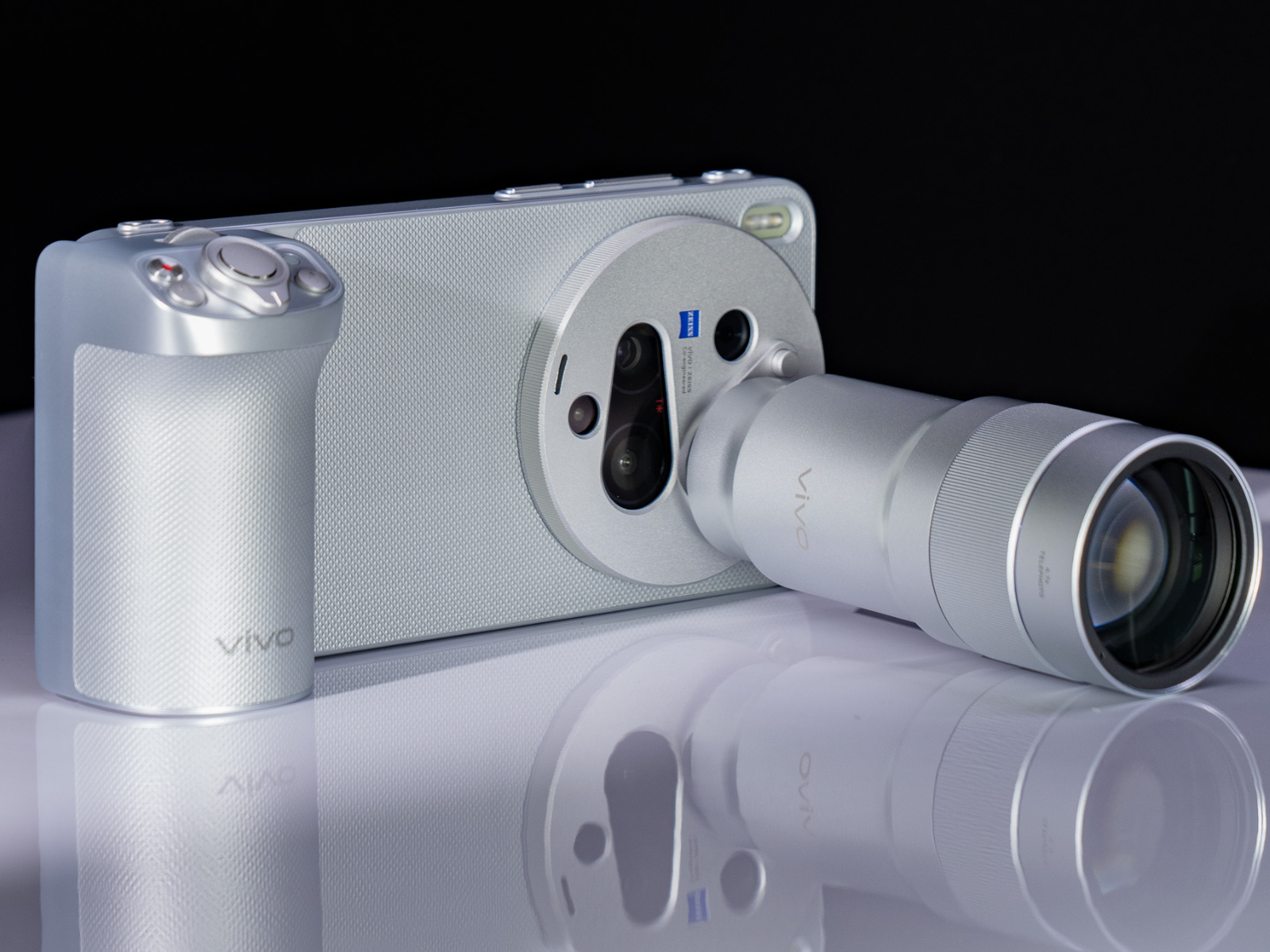
The case, grip, and lenses designed for the X300 Ultra have all been redesigned. Beyond the unified color scheme, they visually shed the impression of being mere “accessories,” instead feeling like parts of a cohesive whole. And these design changes are just the beginning.

This time, two telephoto lenses were introduced alongside the new device: the G2 with an equivalent focal length of 200mm, and the G2 Ultra at 400mm. The G2, as an upgrade to the previous generation, significantly reduces weight and size while maintaining image quality—optimistically speaking, it’s now “more portable.”
As officially stated, these lenses are no longer limited to specific shooting modes as mere “attachments.” Instead, they function just like the native lenses of the device—fully compatible with new tonal styles and 200MP high-resolution imaging, as well as top-tier video recording capabilities. Combined with the native telephoto lens’s 3° physical stabilization compensation and CIPA 7.0-level stabilization, even the G2 Ultra achieves up to CIPA 4.5 stabilization, making handheld shooting entirely feasible.
Though only a few sentences can describe it, if you’ve ever used a traditional 400mm telephoto lens on a camera, it’s hard not to marvel at what this compact setup can achieve—modern technology is truly remarkable.


I used the G2 Ultra to photograph a family of monkeys, shooting in “True Color” mode straight out of the camera. It should give you a clear sense of its image quality, color performance, and stability.
After many years of using cameras, I’ve come to believe that the real barrier to entry isn’t price or learning curve—it’s time. From being willing to carry a bulky device to instinctively anticipating the exact moment to press the shutter, it takes a long period of adaptation. Most people don’t abandon cameras because they’re complicated, but because they never develop the habit of using them. Instead of becoming the tool they hoped for, the camera turns into a burden that’s hard to justify but difficult to let go.
The gap between smartphones and cameras also can’t simply be summed up by the vague statement that “cameras take better photos.” In fact, even some mid-range smartphones today are not far behind (non-top-tier professional) cameras in terms of color and image quality. What smartphones truly lack is a sense of “ritual” tied to a dedicated creative perspective—and the flexibility to adapt seamlessly across all scenarios while maintaining consistent quality.
Against this backdrop, the X300 Ultra bridges much of the gap between smartphones and professional cameras. Through a highly refined photography kit, telephoto lenses that closely match the experience of native lenses, and its commitment to a “triple main camera” system—especially with both the primary and telephoto cameras reaching 200MP—it ensures consistent high-resolution quality across all focal lengths, along with ample room for cropping in post.
At the same time, the irreplaceable advantage of smartphones lies in something cameras take years to cultivate: instinctive usability. The ability to always be ready, to shoot instantly, to rely on muscle memory—this is something smartphones inherently possess.
That said, I don’t believe the X300 Ultra replaces cameras—nor does it need to. But why can’t it become a camera? This idea of a “new species” resonates deeply with me. From making telephoto usable, to making all focal lengths usable, and now extending usability even into extended focal ranges, vivo has spent two years of persistence to create something genuinely new in imaging. And perhaps the “single” in “V-Cam” can move beyond the traditional association with DSLRs, and instead be understood as a tool dedicated to a single purpose—imaging. It is no longer a multi-purpose device with a camera added on, but a new form of camera that incorporates smartphone capabilities.
During the media interview, Huang Tao mentioned that vivo did not limit itself to the framework of an “imaging smartphone” when creating the Ultra series. Future Ultra models may diverge even further from our current understanding of what a “phone” is, evolving entirely in form. As users, perhaps we can also step beyond that conventional perception and see it as a category of camera—one that happens to make calls, connect to the internet, and play games. In that light, everything starts to make much more sense.
Conclusion
In fact, there’s still much left unsaid—the improvements in the 200MP large-sensor 35mm lens, the high-spec video capabilities across all focal lengths, and refinements to the native camera interface and watermark system. But compared to hardware upgrades and imaging performance, what stands out most to me about the X300 Ultra is “change”—its willingness to challenge itself, and its transformation in a more fundamental sense. I didn’t want to dilute this perspective with too much focus on specifications.
Unlike previous products, I would especially recommend that users who have already used vivo devices—particularly previous Ultra models—try the X300 Ultra. You’ll truly feel the excitement when a product you’ve followed for so long finally takes that big step toward what you’ve been hoping for, and the renewed sense of anticipation that comes with it.
Leave a Reply