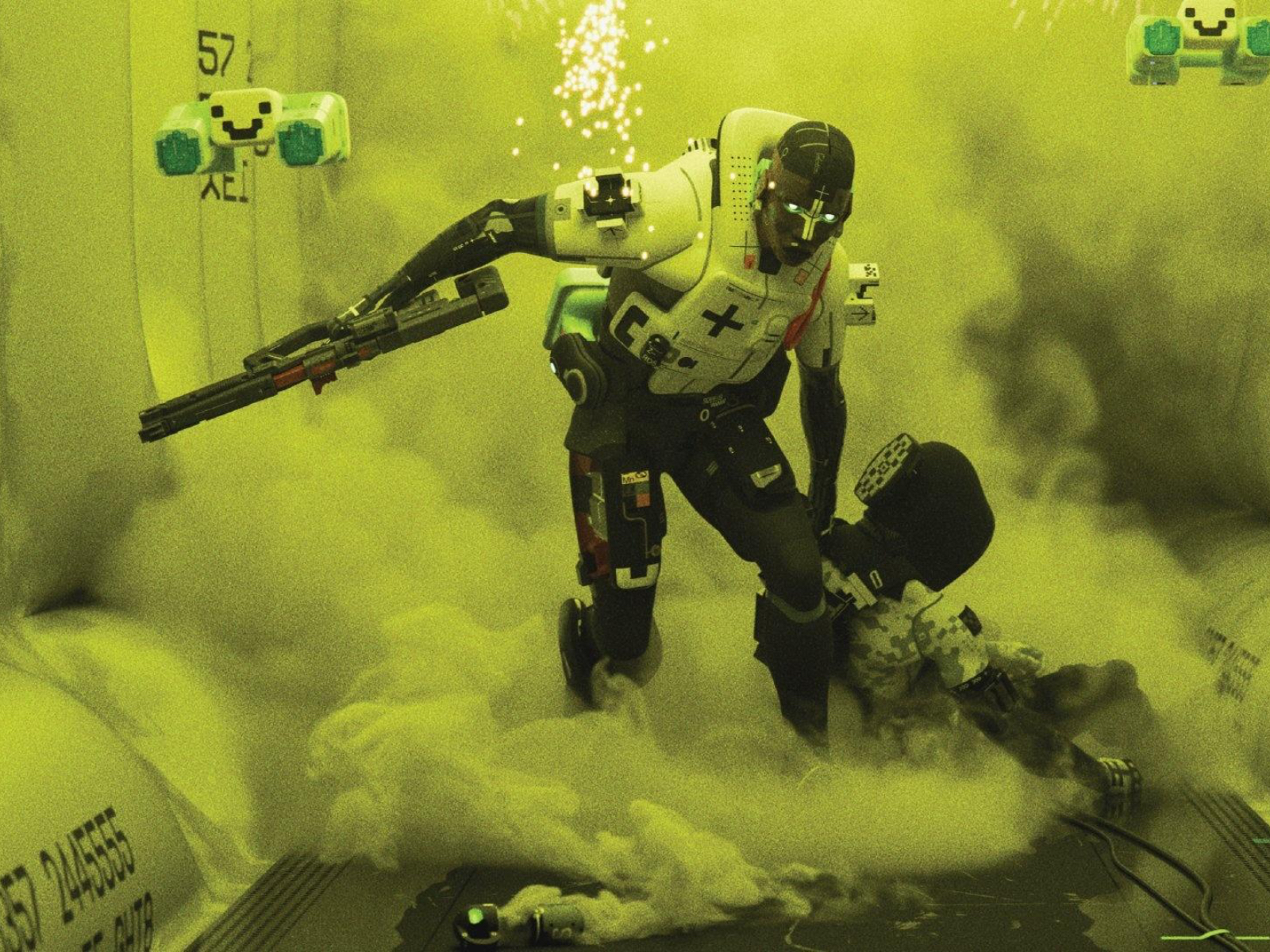
Lost Starship: Marathon / Marathon
Bungie revives this 1990s IP with a colorful, avant-garde approach, shifting the gameplay toward a PvPvE-focused extraction shooter.
- Release date: 2026.03.05
- Platforms: PS5, XS X|S, PC

From Bungie—the renowned developer behind Halo and Destiny—this is also the studio’s first new project after being acquired by Sony. The team has chosen to revive its original 1996 first-person shooter IP, Marathon. While continuing the narrative lineage and retaining first-person action mechanics, the game adopts a bold sci-fi visual style and introduces an extraction shooter framework: players spawn in teams on a large map, search for gear and loot within a time limit, evade or defeat both human and AI enemies, and ultimately either extract successfully with their haul or be eliminated and leave empty-handed.
I’ve never been particularly drawn to extraction shooters, a genre that has carved out a firm niche in the live-service market in recent years. I’ve tried well-known titles like Escape from Tarkov and Delta Force, mostly playing the latter with friends. I consider my FPS aiming skills to be below average, and the genre’s defining trait—“you don’t just lose your life, you lose your inventory too”—only amplifies the frustration. On top of that, I’ve grown somewhat fatigued with realistic settings (and their associated art styles) in recent years—perhaps Cyberpunk 2077 is to blame—so I’ve never fully committed to any major title in the genre, even ones like Arc Raiders that initially caught my attention with their logo and interface.
That changed with the sudden arrival of Lost Starship: Marathon. (Unless otherwise specified, “Marathon” below refers to this game.)
In the original Marathon trilogy, humanity sends a colony ship named “Marathon” to an alien planet called Tau Ceti IV, where a series of bizarre events unfold, including AI rebellion and battles between humans and extraterrestrials. This new title advances the timeline by 99 years beyond the previous entries. The long-lost Marathon ship suddenly sends out a distress signal, sparking a scramble among various factions for the resources on Tau Ceti IV, with players entering the conflict as mercenaries. In this game, players take on the role of “Runners,” a concept reminiscent of Ghost in the Shell: a Runner’s “consciousness” is separate from their “body,” and can be transferred into specialized cybernetic bodies tailored for missions. Even if a Runner dies in action, their consciousness can safely escape and inhabit a new body—though everything collected on the previous body is lost.
This combat-oriented, clean, and efficient setup, in my view, reflects the fast-paced nature of Marathon. After spending over a dozen hours with the game, a few impressions stand out:
- First, the combat density is quite high. Each match features around six teams of three players, and even if eliminated, teammates can revive you indefinitely. Neutral AI enemies are scattered across the map, and they are no pushovers—their health, damage, and behavior are all solid, and defeating them can trigger stronger reinforcements. While there’s no traditional battle royale “shrinking zone,” dynamically spawning extraction points gradually draw players together, resulting in frequent encounters.
- Second, the movement and combat feel are excellent. This is admittedly subjective, but compared to more realism-oriented games like Escape from Tarkov or PUBG: Battlegrounds, I personally prefer sci-fi shooters like Destiny and Apex Legends—and Marathon clearly reflects careful design in this regard. I didn’t feel like I needed any adjustment period at all.
- Third, progression outside of combat is relatively low-maintenance. You can pick up currency during matches that doesn’t require extraction to retain, and after extraction, the system automatically sells what needs to be sold. Various factions in the game provide a large number of permanent upgrades and mission rewards, effectively forming an out-of-match progression tech tree. According to community analysis, this system has a significant impact, helping offset the frustration of losing matches—to the point that after upgrading my storage twice, I felt much more at ease.
What truly surprised me about Marathon is its audiovisual presentation. The color palette is striking, high-contrast, and vibrant yet cohesive, with bold use of modern, industrial, sci-fi, and geometric visual elements. The UI and interaction design incorporate ASCII, glitch effects, retro aesthetics, and complex animations, making it visually overwhelming in the best way. At the same time, electronic music tracks appear at just the right moments, further enhancing immersion. From what I’ve seen in the community, Marathon’s style hasn’t been universally embraced—its eccentric and flashy design has even been a dealbreaker for some players. But that’s often the case with avant-garde art. For me personally, it evokes nothing but excitement and admiration—it’s rare to encounter a work that aligns so perfectly with one’s own aesthetic tastes.
According to The Guardian editor Keith Stuart, the original Marathon—first released on Apple Macintosh—was once a go-to after-work “team-building” game among the editors of Edge magazine, highlighting the IP’s significance among early FPS players. Regardless of what lies ahead, I believe the 2026 Marathon has already earned its place as a landmark in gaming history purely through its dazzling artistic vision.
What I hope even more is that the game’s live-service operation proves to be long-lasting and engaging—that will depend on Bungie. Marathon’s debut is nothing short of stunning, but starting fast doesn’t guarantee victory, especially given the current challenges facing the gaming industry.
Pokémon Pokopia / ぽこ あ ポケモン
A sandbox simulation and management game that may become one of the most influential Pokémon spin-offs in recent years.
- Release Date: March 5, 2026
- Platform: NS2

In recent years, mainline Pokémon titles have often been criticized for lacking innovation and refinement—and occasionally even taking steps backward—creating room for “superior alternatives” like Palworld. However, from years of observation, I’ve found that Pokémon’s spin-off titles often hide many delightful gems. Older entries like Pokémon Mystery Dungeon: Rescue Team and more recent ones like Pokémon Quest have both left a strong impression on me.
This game is developed by Omega Force under Koei Tecmo, the studio behind sandbox simulation titles like Dragon Quest Builders 2. Its gameplay blends elements from classics such as Minecraft, Animal Crossing, and Story of Seasons.
Pokopia follows a similar path, organically combining the Pokémon IP with simulation and management gameplay, resulting in another milestone among the series’ spin-offs. In the game, players take on the role of a Ditto, even customizing a humanoid form at the start. Early dialogue reveals that humans have mysteriously disappeared from the world, and Pokémon have become scarce. The Ditto you play as seems to maintain the appearance of its former trainer out of longing. Entrusted by Professor Tangrowth, the player begins restoring the post-human ecosystem, gradually attracting more Pokémon to settle in. These returning Pokémon are not only companions but also teachers—they share abilities and crafting recipes, allowing players to acquire new skills, build more complex tools, and expand interactions with the environment.
Collecting as many resident Pokémon as possible is one of Pokopia’s key objectives. The story hints early on that perhaps when all Pokémon return, humans might come back as well. To attract specific Pokémon, players must create particular environmental conditions—for example, four patches of grass arranged in a grid may attract Bulbasaur, while placing trees next to flowers might bring in Scyther. As such, the gameplay loop revolves around acquiring skills, tools, and environmental recipes, transforming the landscape, befriending new companions, and unlocking new areas—all while enjoying the charm of having Pokémon by your side.
These are my initial impressions after recently picking up an NS2 and spending a little time with Pokopia. Overall, I really enjoy this take on the Pokémon world. By moving away from capturing and battling, and focusing instead on management and companionship, the game amplifies the sense of wonder and relaxation that defines the Pokémon universe. As a longtime Koei Tecmo fan, I once heard a joke that Omega Force—the “Musou” team—often makes their IP crossover titles more interesting than their original Dynasty Warriors series, because they excel at distilling the essence of each IP. I never expected that one day this “blessing” would extend to Pokémon—but here we are, and it’s truly a delightful surprise.
Fatal Frame: Crimson Butterfly REMAKE / 零 ~紅い蝶~ REMAKE
A remake of a classic Japanese-style horror game, where beauty and terror exist as two sides of the same coin.
- Release Date: March 12, 2026
- Platforms: PS5, Xbox Series X|S, NS2, PC

The Fatal Frame series may not be the most mainstream name in horror gaming, but its defining traits are widely recognized: an eerie, Japanese-style narrative setting; ghostly girls that appear and vanish without warning; the “Camera Obscura,” which shifts into a first-person perspective to perceive the hidden world; and an obscure yet deeply unsettling storyline.
This title is the second remake of the original 2003 game. The original was developed by Tecmo, while this remake is handled by Team NINJA under Koei Tecmo. As the second mainline entry in the Fatal Frame series, the original is often regarded as one of the scariest games ever made. The protagonists are a pair of twin sisters whose fate is closely tied to a cursed village and a mysterious sacrificial ritual. Players take on the role of the older sister, venturing into a village steeped in resentment to search for her missing sibling. According to official information, the remake introduces a number of modern enhancements, including refined controls, a new over-the-shoulder camera perspective, additional side content, and new endings—aimed at making the experience of fear more accessible and immersive.
To be honest, I’m quite afraid of horror and thriller works. Without powerful weapons at hand, I rarely dare to engage with them, so the entire Fatal Frame series falls outside my usual interests. Although I’m unlikely to play it, I do resonate with the creators’ perspective on horror expressed through this series. In an interview with GamesRadar+, the development team noted that true Japanese horror doesn’t need to rely heavily on jump scares or explicit gore—“what is frightening can also be beautiful.” Elements like mist, ruins, masks, and butterflies—these subtle, symbolic images—are more than enough to weave an atmosphere of oppression and fear.
your ai slop bores me
Here, every question you ask a “large model” is powered by human brainpower.
- Release Date: March 2, 2026
- Platform: Web

your ai slop bores me is created by indie developer Mihir Maroju. It’s not a game in the traditional sense, but more like an online social experiment wrapped in a gamified interface: when you open the webpage, you’re presented with a very cartoonish AI chat UI. You can choose to play as a “human,” asking the system questions and deciding whether you want text or images as answers—or you can play as the “large model,” receiving questions from “human” players. Answering earns you Credits, while asking questions consumes them.
In an interview with Fast Company, the developer mentioned that the inspiration for this project came from Maroju’s fatigue with low-quality, overabundant AI-generated content: “If AI is going to take our jobs, then we’ll just take AI’s job instead.” The statement may sound a bit tongue-in-cheek, but I really enjoy this kind of fleeting idea. During my own time with the game, due to the lack of a strong matching system (everything is randomly assigned), I often found myself unsure what to ask—worried my questions might be too specific or hard to understand. On the other hand, when answering, I would struggle whenever I encountered topics outside my expertise.
After quite a bit of head-scratching, I eventually felt a strange sense of relief. Playing your ai slop bores me feels like looking into a mirror: even though you may not type much, you gradually realize that your own thinking isn’t as sharp or active as you might have imagined. And when reading the responses you receive, you also sense that the person on the other side is just as confused. It’s oddly fun.
From my personal experience, viral multiplayer games like this rarely maintain their popularity for long. About two weeks ago, when I first tried it, there were around 2,000 “humans” and “models” online on each side. When I checked again just now, both numbers had dropped to around 500–600. So if you’re interested, you’d better try it soon.
The above is a roundup of some recently released games worth discussing, shared from a personal perspective for reference only. This article also features a giveaway interaction: do you enjoy “loot, shoot, extract” games, and what are your thoughts on the titles you’ve been playing recently? Thanks in advance for your sincere sharing.
Leave a Reply