Author: kiwi

  • SSPAI App Picks: Must-Try Apps This Month

    SSPAI App Picks: Must-Try Apps This Month

    TabTab: A Feature-Enhanced Window Switcher

    • Platform: macOS
    • Keywords: window switching, tab switching

    @ElijahLee: TabTab is a window switcher designed specifically for macOS. It is similar to macOS’s native ⌘ Command + Tab feature, but more powerful. In addition to switching between application windows, TabTab can also switch browser tabs and tabs within certain apps, helping you quickly locate your target among multiple windows and tabs and improve multitasking efficiency.

    First is the window-switching feature. To distinguish itself from the system’s default shortcut, TabTab uses ⌥ Option + Tab to trigger window switching. Its switcher interface is displayed in a vertical layout, and the app offers three positioning options: docked to the left edge of the screen, the right edge, or centered, which users can choose freely. Holding down the shortcut cycles through app icons, and releasing it switches to the selected window, consistent with the native behavior. For users accustomed to the default shortcut, the app can also be configured to use ⌘ Command + Tab to replace the system’s built-in function.

    TabTab supports search. Using the shortcut Shift + Command + L brings up the switcher window and activates search. By typing keywords, you can search across app names, window contents, and more. It supports searching by app name, window title, tab title, and even URL.

    Based on this, TabTab also supports tab switching. For applications that support tabs—such as browsers (Safari, Google Chrome, Arc, etc.), development tools (VS Code, Xcode, Cursor, etc.), system apps (Finder, Terminal, etc.), as well as apps like Notion and Figma—it allows you to search directly for content, locate the corresponding tab, and switch to it. This is faster and more precise than macOS’s native switching. However, based on my brief testing, the search function is basically unusable on systems set to Chinese.

    TabTab emphasizes an experience close to native macOS usage. Its interface is clean, performance is lightweight, memory usage is extremely low, and everything runs locally. In the settings, the app also provides various customization options. The mouse-trigger feature is disabled by default; when enabled, moving the cursor to the edge of the screen will bring up the switcher. The tab-group feature is enabled by default; disabling it will list all tabs individually. You can also set a blacklist for specific apps to prevent them from being included in window or tab switching.

    You can download TabTab for free from its official website. The free version supports switching between only five windows and tabs, and search is also limited to five windows and tabs. The paid version unlocks all features, including unlimited windows and tabs and full search functionality. Pricing is based on the number of devices activated: USD 15.19 for one device, USD 19.99 for two devices, and USD 26.39 for three devices. It is a one-time purchase with lifetime access.


    KashCal: Syncing Your Calendar with iCloud on Android

    • Platform: Android
    • Keywords: calendar sync

    @Peggy_: For many users who use both iOS and Android devices, keeping data in sync has always been a headache. As a syncing solution deeply rooted in Apple’s ecosystem, iCloud can be said to be almost unbeatable within that ecosystem.

    However, for various reasons, I first used a Google account as my primary account, then later switched to Outlook because of syncing issues. After all that back and forth, calendar syncing—something that was never a problem before—has now become one. At present, I mainly use Apple products, and while iCloud’s syncing is far from perfect, it is indeed the most convenient option. So I started thinking about migrating my data again. Around that time, I came across a calendar app that can sync iCloud account data on Android: KashCal.

    As a calendar app, KashCal claims to prioritize privacy, so it can be used completely offline. However, doing so means giving up syncing, making the data visible on only a single device—something most of us probably don’t need from a fully offline local calendar app.

    When it comes to data syncing, KashCal says it has implemented multiple security measures. It does not analyze user data, and its codebase is open source, which means anyone can audit the code to help ensure security. As its killer feature, KashCal allows you to use your iCloud account as the syncing account.

    Open the app’s settings, and you can choose to sign in to iCloud. On this screen, you need to enter your Apple ID and generate an app-specific password online exclusively for this application. The app provides detailed instructions on how to generate this password on the login page. This way, you don’t have to worry about your main Apple ID password being exposed. Once logged in, you can use your iCloud account to sync calendar events across devices.

    Of course, KashCal also includes the basic features found in other calendar apps. For example, you can subscribe to calendars to bring in calendars from other accounts or even shared calendars created by other people. You can also import local calendar files in .ics format, or export the calendar data from within the app.

    If you want to use your iCloud account to sync schedules across both iOS and Android devices, there are currently not many options available. KashCal may be one of the more hassle-free solutions you can find right now. You can download and try KashCal via F-Droid. The app is open source and completely free to use.


    aShell You: An ADB Command Tool with Material You Design

    Platform: Android
    Keywords: command-line tool, ADB

    @大大大K: The fun of tinkering with Android is not just about installing countless apps. A deeper level of play lies in using ADB commands to query system outputs and parameters. In the past, using ADB usually meant connecting to a computer. Later, a number of apps emerged that made it possible to run ADB commands locally through various methods—one of which is the aShell You app introduced here.

    Unlike the “clunky and utilitarian” command-line tools people might be used to, aShell You adopts a Material You design. Its interface is not only modern and visually appealing, but also supports dynamic theme colors and linear motor haptic feedback. Even the gear icon on the settings page has an animation, giving the whole app a very polished feel.

    In terms of functionality, aShell You supports three ADB debugging modes. If you want to run higher-privilege commands directly on the local device, you must execute them via Root or Shizuku. Given that rooting phones has become increasingly impractical in recent years, Shizuku is probably the simplest and most straightforward option. Alternatively, you can connect to the current device via wireless ADB debugging, similar to how Shizuku is activated. aShell You also supports connecting to other Android devices via wireless debugging and OTG mode, making its usage highly flexible.

    In practice, however, aside from professional developers, even Android enthusiasts with some technical background are unlikely to remember so many ADB commands. To address this, aShell You has many of them built in. Tap the button to the right of the input box to view and search preset commands. For each command, the app thoughtfully adds attribute tags, such as whether it accesses a file or a directory, or whether it is a system command.

    For your own frequently used custom commands, in addition to adding them to the preset list, you can also bookmark them for easier access. If you use many custom commands, it’s recommended to save them as bookmarks to avoid mixing them up with the built-in presets.

    ADB command functionality is already included in many all-in-one system utility apps, but few do it with this level of refinement and attention to detail. If you’d like to try this convenient tool, aShell You is available for free on GitHub and F-Droid.


    Lexibird: An All-Around AI-Powered Translation Tool

    AI-based applications have been booming over the past year or two, and translation tools are one of the most important categories among them. However, few products truly integrate language translation with language learning. The tool introduced today, called Lexibird, is more like a comprehensive AI toolkit designed to help users learn languages more effectively.

    In addition to the text translation features commonly found in translation apps, Lexibird also bundles a series of tools useful for language learning, including a built-in dictionary, text-to-speech, writing tools, and transcription. Take text and image translation as examples: compared with web-based translators that we often use, I personally encounter far more situations where I need to translate local documents.

    When I want to check the meaning of a paragraph of English or another language in a document, I used to open Google Translate and copy and paste the text. Lexibird solves this pain point: I only need to copy the text into the app’s translation dialog box to get the result instantly. What’s more, I can choose different types of large language models to make the translation sound more “human.”

    Beyond text translation, Lexibird also supports image OCR translation and voice translation. For images, you simply upload the file, and Lexibird will first perform OCR recognition and then translate it into your target language. As for audio translation, you can upload an audio clip and have it converted and translated into the desired language, which is especially useful for work scenarios that involve speech transcription.

    Another highly practical feature of Lexibird is its writing tools, which are particularly useful for people working in publishing, journalism, or self-media. For example, if I need to adjust the style of a piece of English news text, I can open the “Rewrite” option, paste the text directly, and wait for the model to analyze and rewrite it. For more fragmented content such as meeting minutes or communication records, the “Summarize” function can be used to extract key points. And for content you’ve already written, you can use “Proofread” to check and correct it.

    The final feature, in my view, is even more helpful for language learning: the dictionary. If you encounter a word you don’t understand at all during your studies, you can look it up to see its meaning, example sentences, and translations, helping you quickly grasp how the word is used.

    Overall, Lexibird covers most of the scenarios involving language translation and learning that we encounter in both work and daily life. With AI, tasks that used to be time-consuming—such as transcription, organization, and proofreading—become much easier. In terms of pricing, the free basic version provides 100,000 AI credits per month along with full access to features like text translation and transcription. You can also purchase a Pro subscription to get more credits or use more advanced AI models. You can download the desktop client from the official website or use the web version directly, and you can also pair it with a browser extension for better translation while browsing the web.


    Halo: Can AI Really Help You Build Better Habits?

    • Platform: iOS
    • Keywords: habit building

    As one of the evergreen categories on the App Store, habit-tracking apps should be familiar to almost everyone. SSPAI has also published detailed reviews and comparisons of various popular habit apps in previous articles. With the arrival of the AI era, habit-building apps have naturally entered a phase of “upgrading and transformation.” Halo is one such app. It comes from the developer of the well-known read-it-later tool Matter and adds an AI assistant on top of traditional habit-tracking features, aiming to help users cultivate habits more effectively.

    When you open Halo for the first time, the app guides you to create a habit you want to build. Most habits can automatically pull data from system APIs such as HealthKit and Screen Time to complete check-ins automatically. This is nothing new—veteran habit apps like Streaks have been doing this for years. Tap the plus button in the top-right corner to add new habits. Halo provides many built-in templates you can use directly, and of course you can also create custom habits based on your needs. For each habit, you can freely adjust the check-in frequency, reminder method, and detailed goals.

    After completing a habit for three consecutive days via the app or home screen widgets, you unlock Halo’s Progress and Toolkit sections. As the names suggest, the Progress page shows each habit’s development score and duration, while the Toolkit page offers a collection of video tutorials about habit building. Halo categorizes and organizes these YouTube videos to help you acquire relevant knowledge and build habits more effectively.

    Naturally, the most eye-catching feature is Halo’s AI Coach. However, Halo’s AI functionality is not built directly into the app. Instead, it provides an entry point to the Messages app, where all interactions take place. Before starting a conversation with the Coach, you need to add Halo as a contact, verify your phone number, and then communicate with the Coach via SMS. The AI Coach provides personalized advice based on your habit-building progress.

    If you have a strong need for a habit-tracking app, Halo is worth trying. Its basic features are free to use, and its overall design and interaction are quite polished. As for the AI Coach, however, it feels more like a gimmick—the annual subscription price of RMB 398 is hard to justify.


    WidgetWall: A “Wall” of Desktop Widgets for macOS

    • Platform: macOS
    • Keywords: widgets

    @Snow: Since macOS Sonoma introduced support for desktop widgets, the macOS desktop—long overlooked—has returned to users’ attention. Unlike the “Swiss Army knife” widget apps on iOS, which let standalone widgets of different sizes blend into the native home screen layout and truly shine, similar apps on macOS—such as DeskWidgets or Widgetify—mostly adopt the approach of creating a new “desktop overlay.” It’s like a transparent glass wall attached to your desktop, on which you can freely arrange built-in widgets. WidgetWall, which we introduced previously, has recently added multiple style options and new widget choices in its latest update, so it’s worth revisiting.

    The current version of WidgetWall includes 29 functional widgets. Common tools such as clocks, timers, photos, calculators, and music controls are all there, along with some widgets designed to boost your work (or “slacking-off”) efficiency. The app provides a web browser widget that supports layouts up to 2×4 and 4×2, adapting well to both landscape and portrait screens. You can “pin” any webpage to your desktop for quick viewing. On top of that, it comes pre-optimized for TikTok and Pinterest—after logging in, you can start scrolling short videos and image feeds right away.

    WidgetWall is also one of the few apps that supports video widgets. You can play specified video files or videos from the system photo library, and it even supports playing Live Photos as videos on the desktop. The video widget offers basic playback controls such as a progress bar and play/pause, as well as adjustable size and volume, making it a very practical video preview tool.

    Pomodoro timers and white noise have both been proven to help improve focus. If you don’t yet have tools you’re satisfied with in these areas, you can make do with the built-in widgets here.

    Beyond productivity, WidgetWall also includes some widgets with a strong sense of ritual. One example is the nostalgia-filled iPod widget. Functionally it’s just a simple music player, but its four size options mimic several generations of classic products like the iPod shuffle and iPod nano. Long-buried memories start flooding back.

    If you’ve just finished writing a piece of code or completing a proposal, you can enable the built-in confetti widget and treat yourself to an explosion of colorful paper as a burst of positive energy. And if confetti alone isn’t enough to brighten your dull workday, you can also use the built-in sticker tool to further decorate your desktop and add a bit more fun.

    WidgetWall’s desktop overlay is adapted to the grid size of macOS native widgets, so you can either use it on its own with freely arranged widgets or combine its grid with native widgets. Unfortunately, WidgetWall does not currently support automatically changing colors based on desktop activity. Even though it supports light and dark modes and offers four levels of adjustable widget materials, there is still some visual mismatch when used alongside native widgets.

    The app includes an in-app “Pro” upgrade that unlocks all widgets and stickers. You can subscribe for RMB 15 per month or RMB 148 per year, or make a one-time purchase of RMB 298 for lifetime access. If you are a Setapp subscriber, you can use the Pro version for free.

    You can download WidgetWall for free from the App Store.


    App Brief

    • Dozens of iOS apps have been found by security agencies to contain serious vulnerabilities that could lead to the leakage of sensitive information such as chat records, user IDs, and contact details. Most of these apps are related to AI technologies or categories. Source
    • A cooperation agreement worth USD 800 million between Epic Games and Google has come under court review. The deal involves licensing of Unreal Engine technology and joint promotion efforts. The court’s focus is on whether the transaction could affect Epic’s stance on the Android app ecosystem and its antitrust claims. Source

  • SSPAI Morning Brief: Are CO₂ Levels Too High on China’s High-Speed Trains?

    SSPAI Morning Brief: Are CO₂ Levels Too High on China’s High-Speed Trains?

    Morning Brief

    1. High-speed train customer service and experts respond to “excessive CO₂ levels on high-speed trains”
    2. cURL to terminate its bug bounty program after being overwhelmed by AI-generated reports
    3. China Unicom launches “Apple Fan” mobile plan
    4. Microsoft confirms handing over BitLocker encryption keys to the FBI
    5. Meta layoffs spark concerns over a “VR winter”
    6. First-generation Pokémon becomes a popular method for testing AI models
    7. Rumors You Can Just Glance At

    High-speed rail customer service and experts respond to “excessive CO₂ levels on high-speed trains”

    According to reports by The Beijing News and other outlets, a video showing carbon dioxide concentration measurements taken inside a second-class carriage on a high-speed train has recently sparked heated discussion online. The footage shows that before passengers boarded, the CO₂ concentration inside the carriage fluctuated at around 880 ppm (parts per million, a unit of concentration). As passengers were boarding and taking their seats, the CO₂ level had already begun to rise. After the train had been running for some time, the CO₂ concentration inside the carriage exceeded 2,000 ppm, at which point most of the passengers shown in the video had already fallen asleep. The report noted that under China’s current Indoor Air Quality Standard, the standard limit for indoor carbon dioxide (CO₂) concentration is ≤ 1,000 ppm (i.e., ≤ 0.1%). The CO₂ levels shown in the video were therefore far above this limit.

    In response, different 12306 customer service representatives gave varying explanations. One said that if passengers feel unwell during the journey, they can “use oxygen on their own.” Another claimed that “there is currently no such standard.” Yet another said that air is replaced in real time during operation, and system checks are carried out both before departure and after arrival, so “there is definitely no problem with the air,” adding that the higher CO₂ concentration might be due to increased passenger density.

    Later, Xinhua News Agency interviewed Tao Guidong, an expert on high-speed trainsets from CRRC Qingdao Sifang Co., Ltd., a manufacturer of multiple-unit trains. Tao explained that China’s standard for controlling indoor CO₂ concentration in passenger trains follows TB/T 3493-2017, Railway Vehicle Air Conditioning – Pressure Protection Device, under which the standard limit under normal operating conditions is no more than 2,500 ppm. European standards, he added, allow up to 5,000 ppm. The civil building standards used by some netizens for comparison do not apply to passenger trains.

    Tao also said that air exchange inside high-speed train carriages is entirely handled by the air-conditioning and ventilation system. When operating in non-tunnel sections, continuous air exchange can be achieved, and CO₂ concentrations generally do not exceed 1,500 ppm. When passing through continuous groups of tunnels, pressure protection measures are taken to close off channels to outside air, during which CO₂ levels inside the carriage may rise for a short period of time.


    cURL to terminate its bug bounty program after being overwhelmed by AI-generated reports

    On January 22, the globally well-known open-source data transfer tool cURL announced that it will officially terminate its bug bounty program at the end of this month. The updated security.txt file on cURL’s website (a file commonly used in the industry to specify channels for submitting security reports) now states: “We do not offer any reward or other form of compensation for reported issues, but we will clearly express our thanks and recognition in the documentation confirming the issue. If you waste our time with garbage reports, we will ban you and ridicule you in public.”

    In response, project founder and lead developer Daniel Stenberg said that the team has recently been inundated with large numbers of low-quality vulnerability reports generated by artificial intelligence, leaving the maintainers overwhelmed. To safeguard the “mental health” of team members and ensure the project can continue to operate normally, the official team had no choice but to make this decision.

    For a long time, the cURL team, like many software developers, has used cash rewards to encourage external researchers to submit high-severity security vulnerabilities. However, since May last year, Stenberg has been warning that AI-generated “slop” has been surging. Large numbers of speculators blindly use large language models to generate reports, which are filled with hallucinations, including fabricated CVE IDs, nonexistent function signatures, and even code snippets that cannot be compiled at all. This invalid information forces maintainers to spend huge amounts of time on verification and investigation.

    Despite its massive user base, cURL is in fact a small open-source project run by only a handful of core maintainers. Stenberg said the team has no ability to change the reality of people abusing AI tools, and can only respond by cutting off the source of incentives. It is worth noting that the project is not completely opposed to AI-assisted security research. In September last year, Stenberg publicly praised a researcher who used an AI-based code analysis tool (ZeroPath) to discover and help fix 22 real vulnerabilities. He stressed that the core problem lies not with the tool itself, but with speculative behavior by people who neither understand code nor perform even basic checks on AI outputs before submitting them directly.


    China Unicom launches “Apple Fan” mobile plan

    On January 23, China Unicom announced the launch of the “Apple Fan · King Card” plan. This product is a derivative version of the “King Card 3.0” plan, with its core selling point being the integration of AppleCare Services benefits into the mobile tariff. The discounted monthly fee for the first year is RMB 49. After activating the SIM card and making an initial top-up of RMB 50, users can receive up to 24 months of benefits, including unlimited accidental front-screen repairs, free battery replacement (when capacity drops below 80%), and Apple officially certified technical support.

    In terms of basic mobile services, the plan includes 30 GB of dedicated data, 20 GB of general data, and an additional 30 GB of general data provided as a promotional bonus each month. China Unicom also highlights features such as eSIM support, “one number for two devices” for smartwatches and phones, and international roaming packages priced at RMB 9.9 per day.

    According to the terms of the benefits, users must claim AppleCare Services within 90 days after activating the SIM card. The bound iPhone must be a new mainland China model activated within the past 30 days, and its IMEI must be verified. The system checks eligibility on a monthly basis; if the actual monthly fee paid for the plan is below RMB 59, or if the account is not in normal active status, the AppleCare benefits for that month will automatically become invalid. If users choose not to claim AppleCare Services, they may instead opt for internet subscription benefits such as Tencent Video, iQIYI, or QQ Music.

    It is worth noting that, unlike AppleCare+ sold through Apple’s official channels, AppleCare Services is a protection plan provided by Apple via third-party suppliers, and the specific scope of coverage depends on the supplier. For example, the AppleCare Services offered through the “Apple Fan · King Card” plan does not include repairs for damage other than screen breakage and battery issues. In the past, Apple has also sold AppleCare Services through authorized retailers that covered only screen repair.


    Microsoft confirms handing over BitLocker encryption keys to the FBI

    According to Forbes, Microsoft recently confirmed that it had handed over BitLocker recovery keys to the U.S. Federal Bureau of Investigation (FBI) in compliance with a legal order, helping unlock three laptops involved in a suspected fraud case. This is the first known case in which Microsoft has directly provided such encryption keys to law enforcement. BitLocker is a built-in disk encryption tool in Windows designed to protect hard-drive data from unauthorized access.

    In response, a Microsoft spokesperson said that the company receives about 20 such key-access requests each year, and stressed that as long as there is a valid legal search warrant and Microsoft has access to the keys, it will cooperate. In this case, because the users had chosen to back up their keys to Microsoft’s servers, Microsoft technically had the ability to assist law enforcement. The spokesperson also pointed out that while cloud-based recovery provides convenience, it does carry the risk of external access. If users choose to store their keys locally on hardware such as a USB drive rather than in the cloud, Microsoft would be unable to provide assistance.

    The incident highlights differences between Microsoft’s privacy architecture and that of other tech giants. Companies such as Apple and Meta adopt stricter “end-to-end” encryption strategies, under which even the service provider itself cannot access users’ decryption keys. For example, Apple refused to help the FBI unlock the iPhone of a suspect in the 2016 San Bernardino shooting, and has implemented technical designs in FileVault and its cloud services that prevent law enforcement from requesting such keys. By contrast, Microsoft’s current default settings leave cloud-backed-up keys in a state that the company itself can read.


    Meta layoffs spark concerns over a “VR winter”

    According to CNBC, Meta has recently carried out large-scale layoffs in its Reality Labs division, which is responsible for the company’s metaverse business. About 10% of employees were affected, involving roughly 1,000 people. The layoffs mainly targeted VR teams working on the Quest headsets and the virtual social platform Horizon Worlds, and some internal studios were also shut down. The move is widely seen as a sign that Meta’s strategic focus is shifting from virtual reality (VR) to AI and wearable devices such as its Ray-Ban co-branded smart glasses, triggering industry concerns that a “VR winter” may be approaching.

    Market data supports this shift. According to the latest IDC report, while overall shipments of extended reality (XR) devices are expected to grow by 41.6% in 2025, the growth will be driven mainly by AI smart glasses rather than traditional VR headsets. IDC forecasts that shipments of VR and mixed reality headsets will plunge by 42.8% in 2025 to 3.9 million units. By contrast, shipments of AI glasses are expected to more than double. Analysts note that market feedback shows VR headsets remain largely confined to a niche group of gamers, and that mainstream consumers have little interest in wearing bulky headsets for long periods.

    In response to the criticism, Meta’s chief technology officer said the company is not abandoning VR but adjusting the scale of its investment. He acknowledged that the VR market is growing more slowly than expected, making it necessary to rebalance spending. Oculus co-founder Palmer Luckey also said that while the layoffs are regrettable, they may benefit the industry’s long-term health. Since the end of 2020, Reality Labs has accumulated losses of more than USD 70 billion.

    The strategic shift has dealt a blow to third-party developers that rely on Meta’s ecosystem. The head of Owlchemy Labs, a VR studio under Google, likened the current VR market to the Atari era before the U.S. video game crash of 1983, arguing that VR is undergoing a necessary market correction. According to IDC, Apple’s China-based manufacturing partner Luxshare Precision has stopped producing the Vision Pro headset, indicating that even high-end VR devices are facing weak demand.


    First-generation Pokémon becomes a popular method for testing AI models

    According to The Wall Street Journal, AI labs in Silicon Valley are widely adopting an unconventional benchmarking method: using Nintendo’s classic 1990s game Pokémon to evaluate models’ reasoning and decision-making abilities. Companies including Anthropic, OpenAI, and Google have been having their AI models play Pokémon Red/Blue to visually demonstrate progress in long-term planning and complex task handling.

    The trend was initiated by David Hershey, head of applied AI at Anthropic, who launched a “Claude Plays Pokémon” Twitch livestream in February last year, which was soon followed by similar efforts from OpenAI and Google. At present, developer-built projects such as “GPT Plays Pokémon” and “Gemini Plays Pokémon,” with the help of specialized auxiliary frameworks, have successfully completed the original games and are moving on to their sequels; meanwhile, Anthropic’s latest model, Claude Opus 4.5, is currently attempting a full playthrough live on stream.

    Researchers point out that, unlike traditional question-and-answer benchmarks, Pokémon requires sustained reasoning and decision-making over long periods. Models must navigate mazes, assemble teams, and devise battle strategies based on opponents’ attributes. This nonlinear and complex environment is less constrained than traditional board games and more accurately simulates the challenges AI systems face when handling long-horizon, multi-step tasks in the real world, making it an ideal testbed for evaluating AI agent capabilities.

    Beyond evaluating the models themselves, the project has also become a hands-on exercise in developing AI support software, known in the industry as a “harness.” To enable smooth gameplay, developers need to build external tools such as memory systems to help models retain key information. David Hershey said that he has already applied the experience gained from building Claude’s in-game memory module directly to advising enterprise clients on deploying complex commercial AI systems.


    Rumors You Can Just Glance At

    • Recently, JD.com and Tmall announced that they will launch a special promotion for the iPhone Air at 20:00 on January 25. After stacking a RMB 2,000 platform coupon and a RMB 500 national subsidy available in some regions, the 256 GB model will drop to RMB 5,499 on both platforms; JD.com will also offer an additional RMB 400 subsidy for trade-ins. The offer is limited by promotional stock. Previously, supply chain sources and media reports suggested that the iPhone Air has underperformed expectations. For example, blogger @数码闲聊站 recently claimed that cumulative activations of the iPhone Air currently stand at fewer than 200,000 units. By comparison, all models in the iPhone 17 lineup have each surpassed 4 million activations over the same period, with the iPhone 17 Pro Max exceeding 8.26 million units. In addition, Apple launched its Chinese New Year limited-time promotion on January 24, mainly covering the previous-generation iPhone 16 series, iPad, and Mac product lines. Among them, MacBook Pro models with M4/M5 chips receive discounts of up to RMB 1,000, while the iPhone 16 series is discounted by up to RMB 300.
    • According to Bloomberg, citing people familiar with the matter, the owner of German camera maker Leica Camera AG is considering selling a controlling stake in the company, in a potential deal that could value it at around EUR 1 billion. Potential bidders include HSG (formerly Sequoia China) and private equity firm Altor Equity Partners. Leica’s current major shareholders are the family of Austrian billionaire Andreas Kaufmann and Blackstone Inc. Sources said the Kaufmann family may choose to reinvest after a deal is completed, retaining part of its stake. Discussions are still at an early stage, and there is no guarantee a transaction will be finalized. Blackstone, HSG, and Leica all declined to comment. Although Leica faced severe financial difficulties in 2005, its performance has been steady in recent years after being taken private by the Kaufmann family in 2012. In the fiscal year ending March 2025, Leica’s revenue rose 7.6% to about EUR 596 million, mainly driven by growth in its core photography equipment and mobile imaging businesses.
    • Mark Gurman claims that the first batch of features in the new version of Siri is expected to officially launch with iOS 26.4, scheduled for release in March or April. Although internally codenamed Apple Foundation Models v10, its core computing power is in fact provided by Gemini and will initially run on Apple’s private cloud servers. Later, at the WWDC developer conference in the summer, Apple will unveil a brand-new Siri architecture codenamed “Campos,” to debut with iOS 27. This version will feature deep multi-turn conversations and contextual understanding similar to ChatGPT, and plans to directly use Google’s cloud TPU infrastructure to improve response speeds.
    • Gurman also claims that Apple plans to intensively refresh the MacBook Pro, MacBook Air, and Mac Studio product lines in the first half of the year, and may release a long-unupdated Studio Display. A low-cost MacBook powered by an A-series chip is under development, targeting the education and entry-level markets. In addition, development of the next-generation M6 chip is reportedly ahead of schedule and may debut sooner than expected.
    • According to Android Authority, text strings such as “unverified direct install,” “unable to verify app developer,” and “online verification required” have appeared in the latest version of Google Play’s code. This suggests that when users attempt to install APK files, installation will still be possible, but they will have to go through a cumbersome confirmation process, with mandatory pop-up warnings about risks. Matthew Forsyth, director of developer experience and product management for Google Play, confirmed that a “high-friction” sideloading process will be introduced into Android, with the goal of “layered responsibility.” Previously, Google announced a controversial policy last summer that initially planned, starting in 2026, to require all Android developers—regardless of whether they distribute via the Play Store—to register and verify their identities with Google. After strong backlash, Google compromised, promising to retain manual installation options for “advanced users.” Based on the latest confirmation, this feature has entered the preparation stage, and the barrier for ordinary users to obtain third-party apps will effectively be raised. The aforementioned verification plan is expected to begin pilot implementation this September in Brazil, Indonesia, Singapore, and Thailand, before gradually rolling out globally.
    • According to Sherwood, as of early January 2026, the number of registered .ai domain names worldwide has officially surpassed one million, bringing substantial fiscal windfalls to Anguilla, a British Overseas Territory in the Caribbean. It is estimated that the region generated about USD 70 million from domain-related business alone over the past year. Anguilla has a population of only around 15,000. In the mid-1990s, the Internet Corporation for Assigned Names and Numbers (ICANN) assigned .ai as the country-code top-level domain (ccTLD) for the territory. Currently, the standard fee to register a .ai domain is typically USD 140 for two years, with a renewal rate as high as 90%, providing the local government with stable cash flow. In addition, expired-domain auctions held by registrar Namecheap have been highly profitable. Data shows that the domain you.ai sold for USD 700,000 last September; in just the past week, 31 expired domains have been auctioned for a total of about USD 1.2 million.
    • On January 24, Tencent QQ announced via its official Weibo account that it will bring back the QQ Show feature. The new version of QQ Show can be generated by AI based on uploaded images, replacing avatars on personal profile pages and in chat interfaces, and can generate animations together with other users’ avatars in group chats. The company also teased the return of more classic features. QQ Show first appeared in QQ2000C as a virtual avatar design system. Virtual clothing, scenes, and characters in the QQ Show store could be used to decorate users’ avatars displayed in the PC version of QQ. Tencent once launched a “Red Diamond” subscription service priced at RMB 10 per month, allowing paying users to use all QQ Show items for free. In 2020, the Red Diamond service stopped accepting renewals and top-ups. In November 2021, most QQ Show display sections were removed from the PC version of QQ. At the time, “QQ Show discontinued” trended on Weibo.
  • U.S. Dietary Guidelines 2025–2030 Explained: Why “Eat Real Food” Is the New Core Principle

    U.S. Dietary Guidelines 2025–2030 Explained: Why “Eat Real Food” Is the New Core Principle

    On January 7, 2025, the U.S. Department of Health and Human Services and the Department of Agriculture jointly released the new Dietary Guidelines for Americans, 2025–2030. On the official U.S. government website, the guidelines are described as follows: “Under the bold leadership of President Trump, this edition of the Dietary Guidelines for Americans will reset federal nutrition policy, put our families and children first, and move toward a healthier nation.” Accompanying this is a very Trump-style slogan: “Make America Healthy Again.”

    Why the need to be “healthy again”? Because the United States is facing a severe public health crisis: 50% of Americans have prediabetes or diabetes, 75% of adults have at least one chronic disease, and nearly 90% of healthcare spending goes toward treating chronic conditions. Most of these diseases are closely linked to diet and lifestyle.

    In response, the new guidelines position themselves as a “reset of nutrition policy”—a phrase that is itself quite thought-provoking. Is the U.S. government openly “slapping itself in the face” over decades of past dietary advice? In theory, as a global leader in nutrition research, such a major policy shift should carry considerable guiding significance. Yet the heavy Trump imprint on the document also makes it feel somewhat less reliable.

    So what does this set of guidelines actually say? What does it emphasize? And how much reference value does it really have? Setting other factors aside, let’s focus on the substance and talk about this latest edition of the U.S. Dietary Guidelines.

    Author’s note: The following content is my own reorganization and summary based on reading the guidelines and consulting additional sources. It does not fully follow the original structure or wording of the official document and represents only my personal views. Readers who are interested can consult the original guidelines via the link at the beginning; it is only about 10 pages long and easy to read.

    One Core Principle: Eat Real Food

    On the very first page of the guidelines, a simple and direct core principle is stated upfront: “Eat Real Food.”

    At this point, some readers might ask: real food? So what have I been eating before—fake food?

    So what exactly counts as “real food”? On the official website, I found a clear definition:

    Foods that are whole or minimally processed and still recognizable as food. Prepared with very few ingredients, and without added sugars, industrial oils, artificial flavors, or preservatives.

    This definition highlights two key characteristics. The first is the integrity and original form of the food—for example, whole fruits and vegetables are preferred over juices or extracts. The second is the purity of the ingredients. A popular way to put it is: if your grandmother can’t understand the ingredient list, then it probably isn’t “real food.”

    Why emphasize this? Because real food is a “whole system,” not just a simple stack of nutrients. Take an orange and a glass of orange juice as an example. On a nutrition label, the vitamin C content of the two might look similar. But a whole orange contains intact dietary fiber, which slows digestion, leads to a steadier blood sugar response, and provides greater satiety. Once it’s juiced, the fiber is gone and the sugars are concentrated—drink a glass and your blood sugar spikes, and you’re hungry again soon after. The source is the same, but the effects on the body are completely different, and this difference is something nutrition labels cannot capture.

    The guidelines also use the term “nutrient-dense”: real food provides more nutrition with fewer calories. Ultra-processed foods are the opposite. To extend shelf life, improve taste, and reduce costs, they often remove some natural components and add sugar, salt, fats, and various additives, delivering what is essentially “empty calories.” In a previous randomized controlled trial, researchers found that even when the nutrient composition was matched as closely as possible, participants ate more and gained weight more easily during the ultra-processed food phase than during the unprocessed or minimally processed diet phase.1

    Source: Ultra-Processed Diets Cause Excess Calorie Intake and Weight Gain: An Inpatient Randomized Controlled Trial of Ad Libitum Food Intake.

    This also helps explain why the previous line of thinking had its limitations. Over the past few decades, mainstream discourse has leaned heavily toward a nutrient-centered framework (such as low fat, low calories), which has produced side effects in the context of the modern food industry. For example, how many grams of protein we should consume per day, how many grams of carbohydrates, how strictly we should control calories and fat—as if healthy eating were a precise math problem. When experts tell you that “fat is the enemy and must be controlled,” food manufacturers respond by rolling out all kinds of “low-fat” products. These products do contain less fat, but to make up for the loss in taste, they often add more additives. Under the old framework, such foods were considered perfectly “compliant,” yet they are in fact典型 examples of ultra-processed foods.

    Once you understand this, the logic behind the current shift becomes much easier to grasp.

    And this shift is not a spur-of-the-moment decision. A large umbrella review published in The BMJ in 2024 (an umbrella review further analyzes the results of multiple meta-analyses and therefore carries a higher level of evidence) compiled data from nearly ten million people. The results showed that ultra-processed foods are significantly associated with multiple health risks: a 21% increase in all-cause mortality, a 66% increase in death from heart disease, and a 40% increase in the risk of type 2 diabetes. What is even more telling is that not a single study found any health benefit from ultra-processed foods.2

    It is clear that this viewpoint is actually in line with the mainstream direction of research in recent years and is by no means some “earth-shattering” new discovery. Personally, I even find the term “reset” a bit overstated, carrying a hint of political messaging. But setting the wording aside, it does represent a shift in official thinking. Academia has been moving in this direction for quite some time; this is simply the moment when the authorities formally acknowledged and summarized that shift.

    In any case, at least with regard to this core principle, it is backed by solid research and evidence.

    Three Priority Shifts: The Inverted Food Pyramid

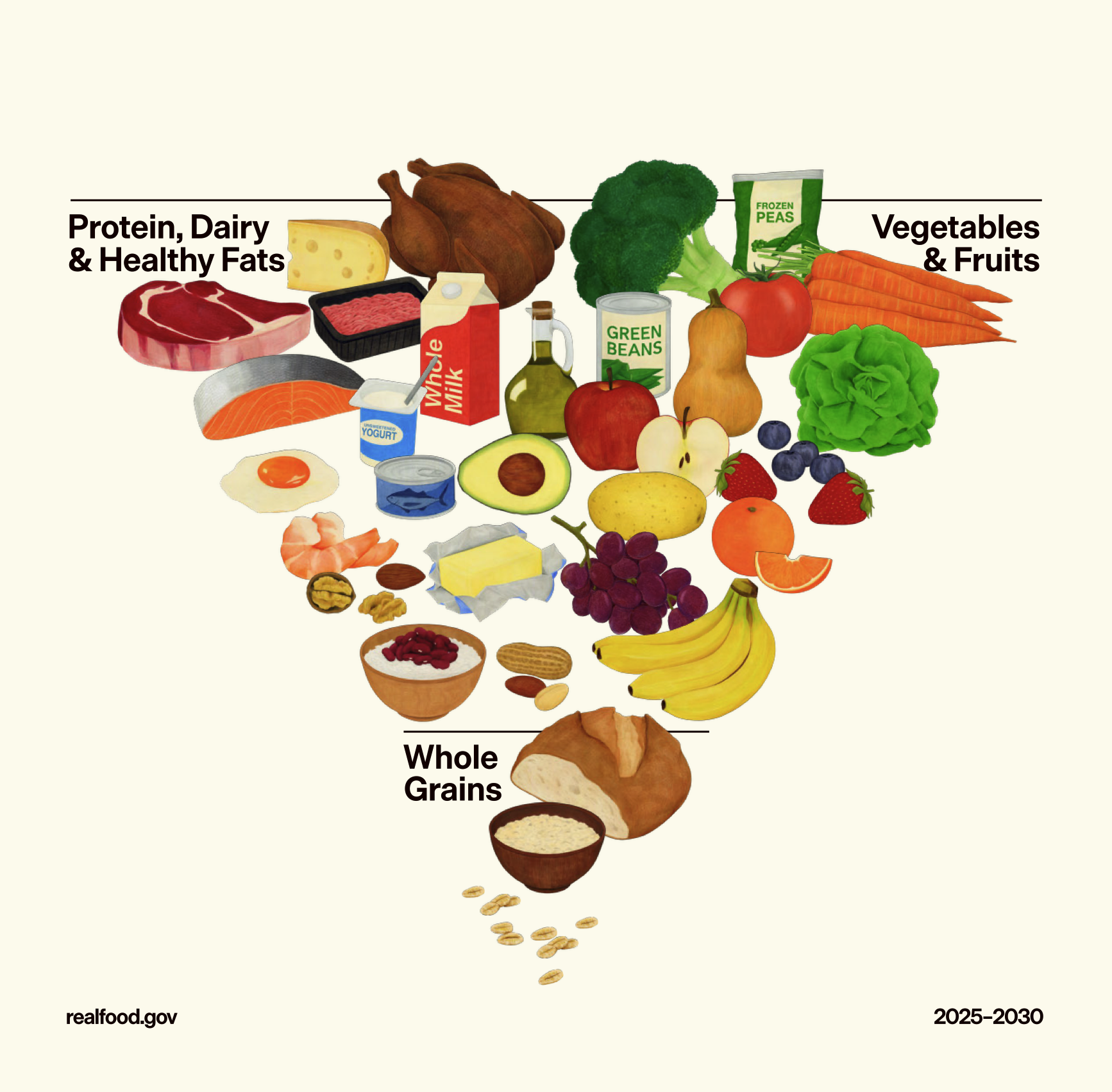
    Beyond the change in core philosophy, the most striking update in the new guidelines is the inversion of the food pyramid. This visual shift is not merely a design refresh, but a reordering of priorities in the overall nutritional structure.

    Back in 1992, the United States introduced a very classic food pyramid model: bread, rice, noodles, and other grains sat firmly at the base, recommended for the highest intake; above them were fruits and vegetables; higher still were dairy and meat; and fats and sugars were squeezed into a tiny triangle at the very top. This image shaped an entire generation’s understanding of what “healthy eating” looks like.

    In the new pyramid, the top section—the part that should be prioritized the most—is divided into two sides: on the left are protein, dairy, and healthy fats; on the right are fruits and vegetables. Grains, once considered the “foundation” of the diet, have now been compressed into the narrowest section at the bottom, with a special emphasis on “whole grains.”

    This change directly reflects a restructuring and reprioritization of the three major macronutrients—protein, fat, and carbohydrates.

    Left: the classic 1992 food pyramid; right: the new inverted food pyramid

    Change One: Protein First — Make Sure You Get Enough Protein at Every Meal

    The most eye-catching shift in the new food pyramid is that protein has jumped from a middle position—where it was something to be limited—to the very top as the highest priority. The wording in the guidelines is quite direct: “Prioritize high-quality protein at every meal.” In other words, if conditions allow, you should aim to meet your protein needs first, and then consider pairing it with other foods.

    The specific target is 1.2–1.6 grams per kilogram of body weight per day, almost double the previous recommendation of 0.8 g/kg. For a 70-kg adult, this means about 84–112 grams of protein per day instead of the old 56 grams. That number may sound abstract, so translated into food it looks roughly like this: 100 grams of protein is about 500 grams of lean meat (two large chicken breasts or two large steaks), or about 1 kilogram of tofu, or around 15 eggs. Of course, no one eats just one food source; in practice, it’s better to mix high-quality animal and plant sources such as eggs, poultry, seafood, red meat, legumes, and nuts.

    At its core, this change is a correction—from “preventing deficiency” to “promoting optimal health.”

    Starting in the 1950s, “saturated fat causes heart disease” gradually became the mainstream consensus in nutrition science. Meat, eggs, and dairy—major sources of high-quality protein—also contain fat, so they were lumped together and labeled as foods to be restricted. Once protein and fat intake were limited, the remaining calorie gap naturally had to be filled by carbohydrates. Because carbs are very low in fat, they were seen as a “safe” energy source and took center stage.

    There were also some less-than-glorious forces at work in this process. In the 1970s, the U.S. had a grain surplus, and dietary guidelines became, to some extent, a policy tool to clear inventory. Research funded by the sugar industry deliberately downplayed the harms of sugar and shifted the blame onto fat. Lobbying from the meat and dairy industries even delayed the release of the original 1991 pyramid by a year, and in the final version the recommended grain intake was higher than what nutrition scientists had initially proposed. Science, politics, and business were all stirred together in the same bowl, and the “authoritative advice” eventually served up was no longer a purely scientific conclusion.

    In recent years, however, research has begun to shake the assumption that “fat is harmful” (more on this below). Naturally, protein-rich foods that were restricted simply because they contained fat deserve to be re-evaluated. Scientists have also realized that the old recommendation of 0.8 g/kg was set as a minimum to “prevent deficiency.” It’s like a passing score of 60—no one would argue that scoring 60 is the optimal state.

    On one hand, evidence supporting higher intake has been accumulating. Multiple large studies in recent years show that higher protein intake is closely associated with better blood-glucose control, stronger satiety, and healthier muscles and bones. For middle-aged and older adults in particular, adequate protein is key to preventing muscle loss.

    On the other hand, there is currently no solid evidence that high-protein diets are harmful. A 2018 meta-analysis found no adverse effects of high protein intake on kidney function in healthy adults, and similarly found no evidence of harm to liver function.3

    But “no problems found” is not the same as “proven to be completely safe.”4

    First, most existing studies last no more than six months, so long-term effects remain uncertain.

    Second, the source of protein matters. A study involving nearly 12,000 people found that higher intake of red and processed meat significantly increased the risk of chronic kidney disease, while replacing red meat with plant protein was associated with lower risk. In other words, even at the same “high-protein” level, fish, poultry, eggs, and legumes may have very different effects on the body compared with bacon, sausages, and deli meats.5

    In addition, it’s worth being alert to the potential digestive burden of high protein intake, the risk of acid–base imbalance, and possible immune or inflammatory responses. If you usually consume little protein or have a sensitive digestive system, you should increase your intake gradually. If you already have kidney disease, liver disease, gout, or other immune or metabolic conditions, raising protein intake rashly may carry risks, and it’s best to consult a doctor before adjusting your diet.

    Moreover, in research terms, a diet is generally considered “high protein” only when daily intake exceeds about 1.5–2.0 g per kilogram of body weight. The guideline’s recommendation merely sits around this threshold; it is not blindly promoting “high-protein diets.”

    In short, elevating the “priority” of protein is a good choice for most healthy people, but it does not mean unlimited consumption. A more sensible approach is to prioritize high-quality protein sources, moderately increase the proportion, and stay cautious about processed meats.

    Change Two: Clearing Fat’s Name — Moderate Intake of Healthy Fats

    If protein is an “upgrade,” then fat is more like a “rehabilitation.”

    The fear of fat in the past stemmed from the hypothesis that “saturated fat causes heart disease.” In recent years, however, this hypothesis has been increasingly questioned, and the evidence now calls for a more nuanced view. A meta-analysis published in The BMJ in 2015, combining data from hundreds of thousands of people, found no significant association between saturated fat and either cardiovascular mortality or all-cause mortality. 6In 2020, the Cochrane Database—widely regarded as one of the highest standards of evidence-based medicine—published a systematic review with a more complex conclusion: reducing saturated fat intake does lower the risk of cardiovascular events by 17%, but it has no significant effect on all-cause mortality or cardiovascular mortality.7

    Saturated fat may not be the “final boss” we once thought it was, but it is not completely harmless either. It may not be a health food, but it is far from so evil that it must be eradicated at all costs. Moreover, fat itself is an essential nutrient and plays multiple roles in the human body. A lack of fat can impair the absorption of vitamins A, D, E, and K; affect the synthesis of steroid hormones, including estrogen and testosterone; and disrupt energy metabolism and blood sugar stability.

    What truly deserves vigilance is trans fat. Studies show that trans fat is significantly associated with a 34% increase in all-cause mortality and a 28% increase in deaths from coronary heart disease.8The key difference lies in their sources: saturated fat mainly comes from natural animal fats and some plant oils, whereas trans fat is primarily a product of industrial processing, commonly found in hydrogenated vegetable oils, margarine, puff pastries, and fried foods. In the past, we lumped “natural fats” and “artificial fats” together. While this did not spare the latter, it likely led us to over-demonize the former.

    The guidelines also clearly list sources of healthy fats: meat, eggs, seafood rich in omega-3 fatty acids, nuts, seeds, full-fat dairy products, olives, and avocados. For cooking oils, olive oil—rich in essential fatty acids—is recommended as a priority, while butter or beef tallow can also be considered as options.

    That said, “clearing fat’s name” does not mean “eat as much as you want.” It must be emphasized that the studies above only indicate that saturated fat is not significantly associated with those very severe health risks; they do not suggest that eating more saturated fat brings extra health benefits. This point remains debated in academia, and the guidelines do not give a definitive answer, instead recommending that saturated fat generally account for no more than 10% of total daily calories.

    What does this 10% mean in practice? For an adult consuming 2,000 calories per day, the upper limit for saturated fat is about 22 grams—roughly the amount found in 100 grams of pork belly, or three cups of whole milk, or one steak. So you still cannot indulge in braised pork or chug whole milk without restraint.

    The core message of the new guidelines is: there is no need to be overly afraid of natural fats, but moderation and balance remain the unchanging principles.

    Change Three: Carbohydrates Demoted — From Foundation to Supporting Role

    If protein is an “upgrade” and fat a “rehabilitation,” then carbohydrates are a “demotion.”

    The 1992 food pyramid recommended 6–11 servings of carbohydrates per day, the highest among all food groups. The new guidelines compress the recommended intake of whole grains to 2–4 servings per day and describe refined carbohydrates as something to be “significantly reduced.” White bread, instant breakfast cereals, and cookies are explicitly called out, while whole grains—such as oats, brown rice, quinoa, and true whole-wheat bread—are clearly favored.

    This “demotion” has a theoretical basis. From a physiological perspective, there are “essential amino acids” and “essential fatty acids”—substances the human body cannot synthesize and must obtain from food. But there is no such thing as “essential carbohydrates.” The body can produce glucose on its own through gluconeogenesis, using protein and fat. This means that in terms of calorie allocation, carbohydrates are the most “replaceable.” When we raise the priority of protein and healthy fats, the proportion of carbohydrates naturally needs to be reduced.

    Reducing refined carbs and increasing whole grains is also strongly supported by evidence. A systematic review in The Lancet analyzing hundreds of prospective studies found that people with the highest fiber intake had 15–30% lower risks of all-cause mortality, cardiovascular disease, type 2 diabetes, and colorectal cancer compared with those with the lowest intake.9 A meta-analysis in The BMJ found that increasing whole-grain intake by three servings per day reduced the risk of coronary heart disease by 19% and all-cause mortality by 17%. Refined grains and white rice, by contrast, showed almost no similar protective effect.10

    That said, this does not mean carbohydrates should be pushed extremely low. Another large study published in a Lancet sub-journal revealed a U-shaped curve: when carbohydrates provide less than 40% or more than 70% of total energy, mortality increases; the optimal range is around 50–55%.11 The new pyramid may look radical at first glance, with grains squeezed into a small corner at the bottom. But if you do the math, 2–4 servings of whole grains per day amount to roughly 150–200 grams of cooked staple foods. Add in the refined carbs that are hard to avoid completely, plus the natural carbohydrates in vegetables, fruits, and dairy, and the total is not extreme at all. This is not telling you to “eat meat as your staple,” but rather to adjust the priorities among different food groups.

    According to calculations based on the guidelines, carbohydrates still make up the largest share in terms of energy intake.

    As for replacing all white rice and white flour with whole grains, there is no need to go to extremes either. Whole grains are high in fiber, and a sudden large increase can cause bloating and digestive discomfort—especially for older adults and those with sensitive digestive systems. A more practical approach is to raise the proportion gradually: mix some brown rice or quinoa into white rice, choose whole-wheat bread, try oatmeal for breakfast—step by step rather than all at once.

    It is also important to be wary of taking these guidelines out of context to promote extremely low-carb or ketogenic diets. The guidelines do note that “some people with chronic conditions may see improvements in health when following a low-carbohydrate eating pattern,” but immediately add that this should be done “in partnership with your healthcare professional to determine and adopt an eating plan that is appropriate for you and your health status.” The same applies to ketogenic diets: they are essentially therapeutic diets, not lifestyle trends that the general public should follow casually.

    So the core message behind the “demotion” of carbohydrates is not that “carbs are the enemy,” but rather: eat less refined carbohydrates, eat whole grains in moderation, and adjust the exact proportion according to individual needs.

    Six Dietary Health Recommendations

    Beyond the reprioritization of the three macronutrients, I’ve also summarized six particularly important dietary health recommendations. These are more practical in nature: some are familiar old advice, while others are framed in newer ways.

    1. Zero tolerance for added sugar

    The guidelines state it very clearly: “No added sugars or non-nutritive sweeteners are recommended or considered part of a healthy diet.”

    The harms of added sugar have long been common knowledge—there’s probably no one who still doesn’t know this. But this may be the toughest stance an official institution has taken on sugar so far. The specific recommendation is to limit added sugar to no more than 10 grams per meal, and for children to avoid it entirely.

    It’s important to clarify that this refers to “added sugar,” not sugars that occur naturally in foods. The sugar in whole fruits coexists with fiber, vitamins, and minerals, is digested and absorbed more slowly, and has a smaller impact on blood sugar, so it is not subject to these limits. However, sweeteners that sound “natural,” such as honey and maple syrup, are essentially no different from white sugar and are also classified as added sugars.

    In addition, replacing real sugar with artificial sweeteners is not viewed favorably either. This position aligns with the World Health Organization’s 2022 review: after systematically examining a large body of evidence, the WHO explicitly recommended against using non-sugar sweeteners to control body weight or prevent chronic diseases. The reasoning is that while sweeteners may help reduce calorie intake in the short term, there is no clear evidence that they are beneficial for long-term weight control or health, and they may even carry potential risks.

    Rather than obsessing over which sugar or sweetener to use, it’s better to reduce our dependence on sweetness altogether. Sugar-free cola is not a healthy drink—it is simply “less unhealthy.”

    2. The Return of Full-Fat Dairy

    This one is easy to understand: now that fat has been “cleared of its name,” the comeback of full-fat dairy is only natural.

    As mentioned earlier, many low-fat products add sugar to make up for the loss of flavor. In addition, the fat-soluble vitamins in dairy products (A, D, E, and K) require fat for proper absorption—removing the fat means their nutritional value is effectively discounted. Some studies also show that full-fat dairy is more satiating and may help reduce overall calorie intake. Others have found no significant association between full-fat dairy and cardiovascular risk, and even links to lower risks of type 2 diabetes and obesity.

    What’s more, the core value of the guidelines is to eat real food, and full-fat dairy is clearly more “real” than its skimmed counterparts. Of course, this doesn’t mean chugging whole milk by the liter. Rather, it means that when choosing dairy products, there’s no need to deliberately go for low-fat options—unsweetened is a higher priority than low-fat. At the same time, if you’re getting more fat from dairy, you should correspondingly reduce fat from other sources.

    3. Pay Attention to Gut Health and Consume Fermented Foods in Moderation

    In recent years, the gut microbiome has become a hot topic, with a surge of related research and a growing body of new evidence.

    The guidelines state: your gut contains trillions of bacteria and other microorganisms, collectively known as the microbiome. A healthy diet supports a balanced microbiome and healthy digestion. Highly processed foods disrupt this balance, while vegetables, fruits, fermented foods, and high-fiber foods support a diverse microbiome. Fermented foods such as sauerkraut, kimchi, kefir, and miso are explicitly listed as recommended.

    When it comes to fermented foods, Chinese people certainly have a lot to say: the pickled vegetables, fermented bean curd, pickled mustard greens, soy sauce, fermented black beans, and yogurt we commonly eat all fall into this category.

    But here’s a splash of cold water. The health benefits of fermented foods mainly come from their probiotics and metabolic byproducts, which do help gut health. The problem is that traditional fermented foods are often accompanied by high levels of salt and sugar, and some may even pose a risk of nitrites. A small dish of pickled mustard greens can contain more than half of the recommended daily sodium intake. Compared with these issues, the benefits brought by probiotics may not be worth much.

    If your goal is truly to promote gut health, you should choose low-sodium, low-sugar, or even sugar-free options, such as unsweetened yogurt or genuinely low-sodium fermented products. But to be honest, many products marketed as “low sodium” are only relatively lower—if you look closely at the nutrition label, the sodium content is still quite high. Truly low-sodium fermented foods are unlikely to taste very good.

    Common “lightly salted” pickled mustard greens still contain a lot of sodium in reality. For reference, the guidelines recommend that the general population aged 14 and above consume less than 2,300 mg of sodium per day.

    4. Eat More Whole Fruits and Vegetables

    The reasoning here has already been covered in the core principle section: whole foods are better than processed or extracted forms. Fruits and vegetables are best eaten whole, rather than juiced.

    The guidelines recommend three servings of vegetables and two servings of fruit per day, and emphasize eating “a wide variety of colorful, nutrient-dense vegetables and fruits.” Different colors contain different phytochemicals, and a diverse intake is more beneficial than relying on a single type.

    If fresh produce is not easily available, the guidelines also provide a hierarchy of alternatives:

    • Best choice: fresh, whole fruits and vegetables
    • Second best: frozen, dried, or canned fruits and vegetables with no added sugar
    • Limited choice: 100% fruit or vegetable juice, diluted with water and consumed in small amounts
    • Try to avoid: fruit and vegetable products with added sugar and various additives

    5. Choose Healthier Cooking Methods

    The guidelines recommend baking, roasting, stewing, stir-frying, or grilling instead of deep-frying.

    It’s worth noting that “grilling” here most likely refers to the American cooking context: food cooked in an oven at around 180–220°C, often wrapped in foil, without open flames or heavy smoke, and not heavily charred. This is very different from the charcoal grilling we commonly see on the street, with open flames, thick smoke, and strong “smoky flavor.”

    When meat is grilled over high heat and open flames, heterocyclic amines and polycyclic aromatic hydrocarbons can form—substances associated with increased cancer risk. Eating this occasionally is fine, but it is not recommended as a primary daily cooking method.

    Another point to pay special attention to is avoiding repeated high-temperature deep-frying. The oil used in restaurants and fast-food outlets is often reused many times, leading to oxidation and the formation of harmful compounds. In home cooking, occasional deep-frying with fresh oil that is discarded afterward is not a major problem, but it can hardly be called healthy either. From this perspective, air fryers are a fairly good alternative.

    6. Limit All Alcoholic Beverages

    The guidelines state: “For better overall health, reduce alcohol intake.” People who should avoid alcohol completely include pregnant women, those recovering from alcohol use disorder, people taking certain medications, and those with a family history of alcoholism.

    Notably, the new guidelines do not provide a specific number for “moderate drinking.” In earlier years, there were claims that moderate alcohol consumption—especially wine—benefited cardiovascular health. However, studies supporting this view were later found to have methodological problems, and in 2022 the World Heart Federation stated plainly: “There is no safe level of alcohol consumption that is beneficial for cardiovascular health.”12

    At the end of the day, alcohol is a confirmed Group 1 carcinogen. It does harm and offers no health benefits—there is no such thing as “safe in moderation.” The new guidelines’ stance is simple: drink less if you can, and ideally not at all.

    Summary

    Overall, in my view, this set of guidelines represents an official summary and endorsement of the mainstream direction of research in recent years. It contradicts some points in earlier guidelines, but it is not a shocking revolution either. The inverted pyramid is a visual symbol of changing priorities, not a literal representation of how much to eat. When translated into actual grams and servings, the recommendations still fall within reasonable ranges. They are worth referencing, but it’s important to be wary of cherry-picked interpretations online.

    Recommendations such as prioritizing protein and consuming moderate amounts of fat and carbohydrates all rest on one key premise: eating amounts that are appropriate for you. Calorie needs depend on age, sex, height, weight, and activity level—everyone is different. Moderation is the true foundation; talking about health without considering quantity, whether for protein, fat, or carbohydrates, is meaningless. And there is one more basic thing: drink water. Drink more water—plain water or sparkling water is the most cost-effective health investment you can make.

    Full content summary | Generated by Nano Banana Pro

    Final Notes

    The guidelines also devote a substantial section to dietary recommendations for different population groups: infant and young child feeding (breastfeeding, vitamin D, the introduction of complementary foods, allergens, etc.), adolescent nutrition (calcium, iron, vitamin D, and avoiding energy drinks), priority nutrients for pregnant and breastfeeding women and for older adults, as well as considerations for vegetarian and vegan diets (such as limiting highly processed substitutes and monitoring key nutrients with appropriate supplementation strategies). Due to space constraints, I won’t go into detail here. Interested readers can consult the original document themselves—nowadays, with AI assistance, reading English materials is quite convenient.

    Just like the 1992 guidelines, the new version inevitably carries the imprint of business interests, politics, and other factors; it can never be completely pure. Endorsement by the U.S. government does give it some guiding significance, but its real-world impact will still need time to be tested. In China, the current standard in use is the 2022 edition of the Chinese Dietary Pagoda, which shares some common ground with these guidelines but also differs in certain aspects.

    Health is the result of many factors in balance, not something to be swayed by every new trend. If you follow whatever is praised today, then switch directions tomorrow when something else becomes fashionable, you may end up sticking with nothing at all. Take what is good, discard what is flawed, don’t follow blindly, and leave the rest to time.

    In the end, eating healthily has never been easy. It takes time, energy, and money—and sometimes it means going against your own instincts. When you truly try to put it into practice, you realize that people with time may not have the means to buy a wide variety of ingredients, while those with the budget are often trapped in cycles of overtime work and takeout food. In a sense, “eating properly” can even be a bit of a luxury.

    What’s harder still is that even if time and money are no longer problems, healthy eating also means saying goodbye to those cheap, easy pleasures. Sugar, oil, salt, refined carbs—the combinations that flood the brain with dopamine—are precisely the things the guidelines like the least.

    By the time I got here, I started to feel a little hungry.

    I looked at my desk: on one side was lactose-free, full-fat, additive-free fresh milk that perfectly fits the guidelines’ aesthetic; on the other was a deeply processed, ultimate sugar-and-fat combo that the guidelines would probably frown upon—a sugar-fried pastry. I’ll take both. Not exactly healthy, but perhaps the occasional bit of happiness is part of being healthy too.


    1. Hall KD, Ayuketah A, Brychta R, et al. Ultra-Processed Diets Cause Excess Calorie Intake and Weight Gain: An Inpatient Randomized Controlled Trial of Ad Libitum Food Intake. Cell Metab. 2019;30(1):67-77.e3. doi:10.1016/j.cmet.2019.05.008

      ↩︎

    2. Lane M M, Gamage E, Du S, Ashtree D N, McGuinness A J, Gauci S et al. Ultra-processed food exposure and adverse health outcomes: umbrella review of epidemiological meta-analyses BMJ 2024; 384 :e077310 doi:10.1136/bmj-2023-077310

      ↩︎

    3. Devries MC, Sithamparapillai A, Brimble KS, Banfield L, Morton RW, Phillips SM. Changes in Kidney Function Do Not Differ between Healthy Adults Consuming Higher- Compared with Lower- or Normal-Protein Diets: A Systematic Review and Meta-Analysis. J Nutr. 2018;148(11):1760-1775. doi:10.1093/jn/nxy197

      ↩︎

    4. French SJ, Kanter M, Maki KC, Rust BM, Allison DB. The harms of high protein intake: conjectured, postulated, claimed, and presumed, but shown?. Am J Clin Nutr. 2025;122(1):9-16. doi:10.1016/j.ajcnut.2025.05.002

      ↩︎

    5. Mirmiran P, Yuzbashian E, Aghayan M, Mahdavi M, Asghari G, Azizi F. A Prospective Study of Dietary Meat Intake and Risk of Incident Chronic Kidney Disease. J Ren Nutr. 2020;30(2):111-118. doi:10.1053/j.jrn.2019.06.008

      ↩︎
    6. de Souza RJ, Mente A, Maroleanu A, et al. Intake of saturated and trans unsaturated fatty acids and risk of all cause mortality, cardiovascular disease, and type 2 diabetes: systematic review and meta-analysis of observational studies. BMJ. 2015;351:h3978. Published 2015 Aug 11. doi:10.1136/bmj.h3978 ↩︎

    7. Hooper L, Martin N, Jimoh OF, Kirk C, Foster E, Abdelhamid AS. Reduction in saturated fat intake for cardiovascular disease. Cochrane Database of Systematic Reviews 2020, Issue 8. Art. No.: CD011737. DOI: 10.1002/14651858.CD011737.pub3. Accessed 12 January 2026.

      ↩︎
    8. de Souza RJ, Mente A, Maroleanu A, et al. Intake of saturated and trans unsaturated fatty acids and risk of all cause mortality, cardiovascular disease, and type 2 diabetes: systematic review and meta-analysis of observational studies. BMJ. 2015;351:h3978. Published 2015 Aug 11. doi:10.1136/bmj.h3978 ↩︎
    9. Reynolds A, Mann J, Cummings J, Winter N, Mete E, Te Morenga L. Carbohydrate quality and human health: a series of systematic reviews and meta-analyses. Lancet. 2019;393(10170):434-445. doi:10.1016/S0140-6736(18)31809-9 ↩︎

    10. Aune D, Keum N, Giovannucci E, Fadnes L T, Boffetta P, Greenwood D C et al. Whole grain consumption and risk of cardiovascular disease, cancer, and all cause and cause specific mortality: systematic review and dose-response meta-analysis of prospective studies BMJ 2016; 353 :i2716 doi:10.1136/bmj.i2716

      ↩︎
    11. Seidelmann SB, Claggett B, Cheng S, et al. Dietary carbohydrate intake and mortality: a prospective cohort study and meta-analysis. Lancet Public Health. 2018;3(9):e419-e428. doi:10.1016/S2468-2667(18)30135-X ↩︎

    12. Arora M, ElSayed A, Beger B, et al. The Impact of Alcohol Consumption on Cardiovascular Health: Myths and Measures. Glob Heart. 2022;17(1):45. Published 2022 Jul 22. doi:10.5334/gh.1132

      ↩︎
  • SSPAI Morning Brief: Nova Launcher Acquired, Angry Birds Set to Return, and More

    SSPAI Morning Brief: Nova Launcher Acquired, Angry Birds Set to Return, and More

    Morning Brief

    1. Nova Launcher acquired by a new Swedish owner
    2. Angry Birds to make a full return to mainland China
    3. MIIT says it will expand coverage of the “secondary number refresh” program
    4. Steam now supports completing bundle purchases for friends

    Nova Launcher acquired by a new Swedish owner

    On January 21, Swedish company Instabridge announced that it has completed the acquisition of Nova Launcher. Instabridge made it clear that Nova Launcher will not be shut down, and that its current priorities are to ensure product stability, maintain compatibility with new versions of Android, and keep up regular maintenance.

    However, the company also revealed that it is evaluating the possibility of introducing ads into the free version. Tracking components for Facebook Ads and Google AdMob have already been added to the latest version of the code, and Reddit users have reported seeing ads in the app.

    Instabridge said that the paid version, Nova Launcher Prime, will remain ad-free. As for open-sourcing the project, the company noted that responsible open-sourcing involves not only the code itself, but also licensing, security, build systems, contribution workflows, and trademark management, and therefore requires careful consideration. It added that any decision will be publicly communicated once made. Source


    Angry Birds to make a full return to mainland China

    On January 21, the well-known mobile game Angry Birds announced its return to the mainland China market. Kingsoft Seasun, a subsidiary of Kingsoft Corporation, and Rovio Entertainment today announced the establishment of a strategic partnership, paving the way for the franchise’s full return to mainland China.

    As the first step in this comeback, the two companies plan to launch two Angry Birds IP titles. The flagship game, Angry Birds: Classic Returns, will be comprehensively upgraded based on the iconic slingshot gameplay, featuring a 3D engine, dynamic level design, and a brand-new magic system. Angry Birds: Dream Blast will offer a lighthearted bubble-shooter puzzle experience, inviting players to embark on a fantastical journey.

    At the same time, to energize the creative community around Angry Birds: Classic Returns, Rovio and Kingsoft Seasun are jointly launching the “Prank Workshop” creator program, inviting community creators to contribute original content, including custom levels and visual art. Source


    MIIT says it will expand coverage of the “secondary number refresh” program

    At a press conference held by the State Council Information Office on January 21, officials responsible for the “secondary number refresh” initiative said that basic telecommunications operators have already refreshed more than 250 million recycled phone numbers in batches before reissuing them, and have unlinked them from over 1 billion internet applications. The “proactive refresh” service portals in apps and mini programs support removing historical bindings with 239 commonly used internet applications, having processed more than 360 million unbinding requests for over 5.8 million users.

    Going forward, the coverage of the “secondary number refresh” program will be further expanded, with efforts to connect more internet applications closely related to everyday life. China Mobile, China Unicom, and China Telecom began rolling out the service in May 2025, allowing users to unbind historical internet accounts with one click. Source


    Steam now supports completing bundle purchases for friends

    On January 20, third-party Steam data site SteamDB discovered that the “gift to a friend” feature on the Steam platform now supports “bundle completion,” allowing players to help friends complete game bundles they have partially purchased.

    When a player gifts a bundle containing multiple games to a friend, the system will automatically detect which titles the friend already owns and adjust the final price accordingly. For example, if a friend already has some of the games included in the bundle, the checkout price will automatically deduct the value of those owned titles. The remaining games that the friend does not yet own will still benefit from the bundle’s combined discount. The goal is to make it easier for players to help friends complete their game collections without paying again for content they already own. Source

  • SSPAI Morning Brief: Sony Announces Joint Venture with TCL, Ayaneo Releases the Konkr Fit Handheld, and More

    SSPAI Morning Brief: Sony Announces Joint Venture with TCL, Ayaneo Releases the Konkr Fit Handheld, and More

    Morning Brief

    1. Sony announces a joint venture with TCL
    2. Ayaneo releases the Konkr Fit handheld
    3. RedMagic launches the RedMagic 11 Air and multiple new products
    4. Zhipu releases and open-sources the GLM-4.7-Flash model
    5. Netflix rolls out live, real-time voting features
    6. Microsoft Copilot introduces Real Talk and video generation features
    7. Sony launches a limited-edition “Lost Starship: Marathon” game controller
    8. Rumors You Can Just Glance At

    Sony announces a joint venture with TCL

    On January 20, Sony announced that it has signed a memorandum of understanding with TCL Electronics to establish a joint venture focused on home entertainment. Under the agreement, TCL will hold a 51% stake in the new company, while Sony will hold 49%. The joint venture will fully take over Sony’s home entertainment business and will be responsible worldwide for the development, design, manufacturing, sales, logistics, and customer service of televisions and home audio products. The products will continue to use the Sony and BRAVIA brands.

    Sony and TCL plan to sign the final agreement by the end of March 2026, with the new company expected to begin official operations in April 2027. Source


    Ayaneo releases the Konkr Fit handheld

    On January 20, Ayaneo’s sub-brand Konkr unveiled its first Windows-based handheld, the Konkr Fit. The device is powered by the AMD Ryzen AI 9 HX 470 processor, featuring the Zen 5 architecture and RDNA 3.5 graphics cores. The display has been upgraded from the previous Android model’s 6-inch panel to a 7-inch OLED screen. It packs an 80Wh battery, larger than those in the Legion Go 2 (74Wh) and Legion Go S (55.5Wh). The control layout includes Hall-effect joysticks, adjustable triggers, and dual rear buttons. On the top are two USB-C ports, while the back features a large cooling air intake and exposed screws, and it will be available in Retro Gray and Yellow color options.

    Pricing and release date have not yet been announced. Source


    RedMagic launches the RedMagic 11 Air and multiple new products

    On January 20, RedMagic officially unveiled the RedMagic 11 Air along with several new products for its gaming ecosystem. The RedMagic 11 Air is powered by the Qualcomm Snapdragon 8 “Ultimate” Edition processor and RedMagic’s in-house Red Core R4 gaming chip. It features LPDDR5X ULTRA memory and UFS 4.1 storage, and comes with a 6.85-inch 1.5K under-display camera full-screen display supporting a 144Hz refresh rate and a 2500Hz instant touch sampling rate. The display also supports 2592Hz high-frequency PWM dimming and DC dimming. The phone packs a 7000mAh battery with 120W fast charging. Its cooling system consists of an active fan spinning at up to 24,000 rpm and a 0.5mm VC vapor chamber panel. The body also integrates 520Hz gaming shoulder triggers and an X-axis linear motor.

    RedMagic 11 Air

    Several other gaming ecosystem products were also announced at the event, including the RedMagic 11 Pro+, which features a carbon-fiber body, a sapphire glass back, and a “Golden Flow” liquid cooling system, as well as the RedMagic Gaming Laptop 16 Pro Golden Saga · 3D Explorer Edition, equipped with an NVIDIA RTX 5090 GPU and supporting glasses-free 3D display technology. The RedMagic 11 Air starts at CNY 3,699, while the RedMagic 11 Pro+ Golden Saga 24GB + 1TB version is priced at CNY 9,899.

    RedMagic 11 Pro+

    In addition, the RedMagic Gaming Tablet 3 Pro Golden Saga is expected to go on sale by the end of January, with pricing yet to be announced. Source


    Zhipu releases and open-sources the GLM-4.7-Flash model

    On January 20, Zhipu officially released and open-sourced the GLM-4.7-Flash hybrid reasoning model. The model has a total of 30 billion parameters, with 3 billion active parameters, and is positioned as a lightweight deployment option that balances performance and efficiency. It is now available on Zhipu’s open platform BigModel.cn with free access. In mainstream benchmarks such as SWE-bench Verified and τ²-Bench, the model’s overall performance surpasses gpt-oss-20b and Qwen3-30B-A3B-Thinking-2507, achieving open-source SOTA scores among models of the same size class.

    GLM-4.7-Flash is primarily optimized for programming scenarios, covering both front-end and back-end development tasks, and is also suitable for general-purpose use cases such as Chinese writing, translation, long-text processing, and emotional role-playing. With the release of the new version, the previous free model GLM-4.5-Flash is scheduled to be officially retired on January 30, 2026, at which time all related API requests will be automatically routed to GLM-4.7-Flash. This iteration aims to provide developers with higher-density intelligent service support by improving logical reasoning capabilities and optimizing parameter scale. Source


    Netflix rolls out live, real-time voting features

    On January 20, Netflix officially launched real-time interactive voting for live content. The feature дебuts with the talent show Star Search, allowing subscribers to participate in multiple-choice voting or star-based ratings via their TV remote controls or the mobile app. It supports real-time global vote aggregation with time-limited cutoffs, enabling viewers to directly influence the narrative progression of live broadcasts.

    Netflix said that the interactive framework was previously technically validated in August 2025 with The David Chang Live Dinner Show, and that a full rollout was confirmed at TechCrunch Disrupt 2025. Source


    Microsoft Copilot introduces Real Talk and video generation features

    On January 20, Microsoft Copilot rolled out the Real Talk interaction mode, which aims to deliver a more human-like and interactive conversational experience. It introduces multiple levels of depth for reasoning and writing style options, supports viewing chains of thought and reasoning paths, and offers long-context memory capabilities. During conversations, it can reference past interactions and user background, and will at times show curiosity or proactively challenge logical inconsistencies.

    In addition, Copilot is testing a video generation feature on Android, allowing users to generate video clips of up to 8 seconds with audio. The underlying model for this feature has not yet been disclosed and is currently being rolled out gradually, with no mandatory subscription requirement at this stage. Source


    Sony launches a limited-edition “Lost Starship: Marathon” game controller

    On January 19, Sony announced that alongside the March 5 release of Bungie’s Lost Starship: Marathon, it will roll out two limited-edition hardware products: a DualSense Limited Edition controller priced at USD 84.99 and a Pulse Elite Limited Edition headset priced at USD 169.99.

    The DualSense Limited Edition controller is deeply inspired by the world of Lost Starship: Marathon. Bungie’s design team said their goal was to create a “real-world object” that feels as if it were taken directly from the game itself. To reflect the title’s distinctive industrial aesthetic and environmental architecture, the controller features bold graphic elements and striking color combinations. The Lost Starship: Marathon Limited Edition Pulse Elite headset follows the same design language as the controller. Source


    Rumors You Can Just Glance At

    According to a January 19 post by LeicaRumors, Leica is planning to release its first 35mm focal-length lens in the Noctilux series, the Noctilux-M 1.2/35 ASPH., on January 29, 2026. This would mark the first time the series enters the 35mm documentary-style focal length category. Leaked spy photos show that the Noctilux-M 1.2/35 ASPH. continues Leica’s classic industrial design language, featuring a relatively compact aluminum body accented with the brand’s signature yellow scale markings. Notably, the lens is equipped with a fixed lens hood that users must extend by rotating it into position. Source

    On January 20, Samsung published and then withdrew an upgrade announcement for Bixby on its official website. According to the notice, the new version of Bixby will deeply integrate Perplexity AI to enable web-based, real-time natural language Q&A and information retrieval, while also introducing a new device agent architecture capable of recognizing non-specific user intents and automatically triggering the corresponding system settings. The updated assistant is set to enter testing as part of the One UI 8.5 Beta program and is planned to debut as a core preinstalled feature on the Galaxy S26 series. Source

  • SSPAI Morning Brief: Honor Launches Magic8 Pro Air and More

    SSPAI Morning Brief: Honor Launches Magic8 Pro Air and More

    Morning Brief

    1. Honor releases new models including the Magic8 Pro Air
    2. Anker and Feishu jointly launch the Anker AI Voice Recorder Buds
    3. Xiaohongshu rolls out Community Guidelines 2.0
    4. ASUS stops releasing new smartphones
    5. Rumors You Can Just Glance At

    Honor releases new models including the Magic8 Pro Air

    On January 19, Honor held a product launch event, unveiling new devices including the Honor Magic8 Pro Air, Honor Magic8 RSR, and the Honor 500 Pro MOLLY 20th Anniversary Limited Edition.

    The Honor Magic8 Pro Air is powered by the Dimensity 9500 processor and features a 6.31-inch Honor Oasis Eye-Care display. It measures 71.9 mm in width, just 6.1 mm in thickness, and weighs 155 g. The rear camera setup includes three cameras: a 50-MP 1/1.3-inch f/1.6 main camera with a 23 mm equivalent focal length and OIS support; a 50-MP f/2.2 ultra-wide camera; and a 64-MP periscope telephoto camera with 3.2× optical zoom, f/2.6 aperture, and OIS support. It also includes a color temperature sensor and a flicker sensor. The phone is equipped with a 5,500 mAh battery and supports IP68 and IP69 dust and water resistance. It supports eSIM and has dual physical SIM card slots. Color options include Light Orange, Fairy Purple, Feather White, and Shadow Black. Pricing ranges from RMB 4,999 (12 GB + 256 GB) to RMB 5,999 (16 GB + 1 TB), with an additional RMB 500 discount available through government subsidies.

    The Honor Magic8 RSR is a co-branded model created in collaboration with Porsche Design. It features an ultra-microcrystalline nano-ceramic body and has largely the same overall configuration as the Magic8 Pro, powered by the Snapdragon 8 Elite Gen 5 chipset. The Magic8 RSR supports Honor’s Hongyan dual-satellite communication (Tiantong satellite calling and BeiDou satellite messaging) and offers an optional professional imaging kit. It is available in Moonstone and Slate Gray, priced at RMB 7,999 (16 GB + 512 GB) and RMB 8,999 (24 GB + 1 TB).

    The Honor 500 Pro MOLLY 20th Anniversary Limited Edition is a collaboration with POP MART and comes with an exclusive gift box containing various themed accessories. It is priced at RMB 4,499 (16 GB + 512 GB). Source


    Anker and Feishu jointly launch the Anker AI Voice Recorder Buds

    On January 19, Anker announced via its official WeChat account that it has partnered with Feishu to introduce a new form-factor hardware product—the Anker AI Recording Bean. The device weighs just 10 grams, roughly the size of a broad bean, and features a dual MEMS microphone array. With the charging case included, the total weight is about 48 grams. It supports both Bluetooth and Wi-Fi transmission modes, offers up to 8 hours of battery life on its own, and up to 32 hours when used with the charging case. The product focuses on unobtrusive wearability and instant recording, supporting AI-powered visual real-time summaries, multilingual transcription and translation, and the generation of illustrated “fishbone diagrams” that can turn messy discussions into clear conclusions and to-do lists. It also supports one-tap syncing of recording summaries to Feishu multi-dimensional spreadsheets, where quality checks and analysis can be completed automatically based on user-defined rules. The hardware is now available on JD.com, priced at RMB 899. Source


    Xiaohongshu rolls out Community Guidelines 2.0

    On January 19, Xiaohongshu rolled out Community Guidelines 2.0, which merge the previous Community Guidelines and Community Business Guidelines into a single framework with three sections: sincere sharing, friendly interaction, and orderly operations. In the “sincere sharing” section, Xiaohongshu calls on users to proactively disclose the use of AI-assisted tools, avoid creating false personas, and refrain from flaunting consumption levels far beyond those of ordinary people. The “friendly interaction” section requires users not to maliciously speculate about the motives of content creators, to engage in rational dialogue, and to avoid posting inflammatory remarks or making unfounded accusations against others. The “orderly operations” section prohibits marketing practices such as posing as ordinary users or manipulating reviews, as well as the abuse of the reporting mechanism. Source


    Rumors You Can Just Glance At

    • According to foreign media outlet Windows Central, Microsoft is introducing an “ad-supported model” to Xbox Cloud Gaming. This would allow users who have purchased digital Xbox games but are not subscribed to Xbox Game Pass to play cloud games for free by “watching ads.” In cloud computing, “idle computing power” is one of the most expensive forms of waste. By rolling out an ad-supported Xbox Cloud Gaming service, Microsoft could increase Azure server utilization during low-demand periods, while also providing stronger commercial justification for the continued expansion of its data centers, as cloud and AI become core parts of the company’s strategy. Source
    • There are rumors that the Google Pixel 10a will be announced on February 18 and go on sale on March 5. The device is said to feature 8 GB of RAM, with overall specifications largely similar to the Pixel 9a, and a starting price of EUR 549. Source
    • Matthew Forsyth, Director of Developer Experience Product Management and Chief Product Evangelist for the Google Play Store, said on X that Android’s app sideloading process will add extra steps to ensure users fully understand the risks of installing apps from unverified developers. However, advanced users will still be able to choose “skip verification and install directly,” and sideloading will not be restricted. This explanation is largely consistent with what has been observed in recent versions of the Google Play Store: while new warning messages pop up emphasizing developer verification requirements, the need for an internet connection, and potential risks, users are still allowed to proceed with installation. Source
    • Apple’s U.S. website shows tightening supply of M4 Pro / Max MacBook Pro models, with delivery dates pushed back to after February 6. Custom configurations of the 14-inch MacBook Pro with a 16-core M4 Max chip and 128 GB of memory are now scheduled for delivery as late as March 17. Combined with earlier rumors—and considering that Apple often extends shipping times for current models ahead of new product launches—this may indicate that the M5 Pro / Max MacBook Pro lineup will quietly appear on Apple’s website on January 28. Source
    • According to insiders, Xiaomi’s second-generation in-house SoC, Xuanjie O2, may adopt TSMC’s N3P process (third-generation 3 nm) rather than the company’s latest 2 nm node. Xiaomi is also planning to apply the Xuanjie O2 to “non-smartphone” products to further expand the use of its self-developed chips, including tablets, cars, and computers—starting with tablets, followed by PCs and vehicles. Source
    • According to TechCrunch, Meta’s social platform Threads has surpassed X in mobile daily active users, reaching 141.5 million, compared to X’s 125 million. Source
    • Bungie, a studio under Sony, has announced that its new shooter Marathon (also known as Lost Starship: Marathon) will launch on March 5 at a price of USD 39.99, and will be released simultaneously on PC, Xbox Series X|S, and PlayStation 5. Source
    • Zootopia 2 has surpassed Inside Out 2 at the box office, reaching USD 1.703 billion, becoming the highest-grossing Hollywood animated film of all time and ranking ninth in global box office history. Source
  • SSPAI Review | Apps Worth Watching Recently

    SSPAI Review | Apps Worth Watching Recently

    Welcome to this episode of SSPAI Review. You can use the table of contents to quickly jump to the sections you’re interested in. If you’ve discovered other apps worth checking out, or topics you’d like us to cover, feel free to join the discussion in the comments.


    Focast: A High-Fidelity Ambient Sound App for Focus

    • Platform: macOS
    • Keywords: white noise, focus timer

    @ElijahLee: Focast is a focus app developed specifically for macOS. It offers a rich collection of high-fidelity natural ambient sounds combined with focus timers, helping you enter a concentrated state while studying, working, or reading.

    One of Focast’s biggest highlights is its library of more than 90 high-quality ambient sounds, including rain, ocean waves, forests, campfires, birdsong, and other natural soundscapes. Beyond these common options, the app also features many unique everyday ambience recordings, such as ducks quacking, the sound of whisking eggs, or footsteps walking through thick snow. All sounds are recorded on location by sound artists and can loop seamlessly without breaks, allowing you to quickly immerse yourself and stay focused while listening.

    Unlike typical white-noise apps, another distinctive feature of Focast is its mixing (Mix) function. For the built-in ambient sounds, the app offers two modes. Solo Mode allows you to play only one sound at a time, while Mix Mode lets you layer multiple tracks together—for example, rainforest (raindrops hitting leaves), birdsong (distant chirping), and backyard ambience (insects and birds at night). By combining different sounds, you can create rich, realistic soundscapes that recreate scenes from the real world. In Mix Mode, you can also save your favorite combinations for one-click playback later.

    In addition to mixing its own ambient sounds, Focast supports playing alongside Apple Music, Spotify, or YouTube. The app overlays the ambient sounds in the background and allows you to control their volume independently.

    With Focast, you can freely create focus and break sessions. The app provides default timers of 10, 25, 40, and 60 minutes, and also supports custom durations. You can start sessions quickly using keyboard shortcuts. Once a focus timer begins, the menu bar icon displays a visual countdown, making it easy to keep track of your session. When the timer ends, Focast plays a gentle notification sound to signal completion, and this sound can also be customized—a thoughtful touch.

    The Focus Calendar View lets you review your focus days and streaks. If you’re serious about building a habit of concentration, maintaining a streak through these records can be very motivating. The app also supports iCloud sync, so your sound settings, timers, and statistics can be synchronized across devices.

    You can download Focast for free from the App Store. The free version includes only very limited basic features. After subscribing, you unlock all ambient sounds, custom mixes, custom timers, and more. The price is 38 RMB per year or 88 RMB for a one-time purchase. For the annual plan, the app offers a generous 14-day trial period, so if you’re interested, you can fully experience it for two weeks before deciding.

    Samsung Internet Windows Beta Update: Regional Restrictions Lifted

    • Platform: Windows
    • Keywords: Samsung, browser

    @大大大K: Samsung Internet had previously been released on Windows, but installation was later discontinued for various reasons. Recently, however, Samsung unexpectedly relaunched a Windows Beta version, and users from any region can now download and install it via a designated link (even though the page still states that it is limited to South Korea and the United States). If you are using the international version of Samsung Internet on Android, you will also see the download link promoted on the browser’s homepage.

    In terms of UI, the new client is not very different from the version released two years ago, and it still retains the highly distinctive sidebar feature. The “Synced Devices” section can synchronize the quick-access page from the mobile browser and display web content in a mobile-device view. The calendar feature syncs directly with events in your Samsung account and also supports adding a Google account to display Google Calendar. If needed, you can add new website shortcuts at the bottom of the sidebar.

    The quick-access page has received a minor upgrade, now supporting background changes and the addition of small widgets such as device sync, privacy reports, and a weather clock. Notably, the device sync feature can display tabs from the mobile browser here. In actual testing, newly opened tabs on the phone sync very quickly, but syncing after closing tabs is noticeably slower.

    The “Browsing Assistant” feature in the Windows Beta includes summary extraction and translation. The summary function is powered by Galaxy AI, and its performance is similar to that on mobile, allowing AI to summarize webpage content for reference. However, possibly due to network or other limitations, errors may occur when connecting to the cloud-based AI, so users with the right conditions may want to test it themselves.

    The translation feature appears to be powered by Google Translate, and the browser supports a split-screen view of the original text and the translation, which is especially convenient for academic users.

    In addition, the mobile version of Samsung Internet supports saving login credentials to Samsung Pass (including for users in mainland China). The Windows Beta also supports this feature, but it requires the Samsung Pass client to be installed on the computer. Since the Samsung Pass client has device restrictions, it is currently unusable for most users. That said, as the Windows Beta is based on the Chromium 136 engine and supports Chrome extensions, it is still recommended to use a dedicated password manager and browser extensions.

    If you are a Samsung user and want a more complete Galaxy Ecosystem experience, you can try this Beta version via the official website. The browser is forcibly installed on the system drive, and during installation it will also install Samsung Account and Samsung Smart Service components and create Start Menu entries, so be sure to leave enough disk space.

    Quiche Browser: A Browser with Customizable Layout

    • Platform: iOS
    • Keywords: browser

    @Snow: Quiche Browser is a third-party browser app on iOS. In an era where everyone is “racing to add AI,” it doesn’t introduce an advanced conversational engine or use algorithms to intelligently prioritize tabs. Instead, it hands interaction control back to users, allowing them to freely arrange and combine a rich set of functional buttons to build their ideal browser.

    The toolbar at the bottom of the browser is the area with the highest degree of freedom in Quiche Browser. However, the app doesn’t simply give you a “blank sheet of paper” to do whatever you want. Instead, it offers 16 layout presets in the settings. You can choose one based on your habits and then fine-tune it further on top of the preset.

    The app provides more than 40 interactive buttons, covering everything from frequently used actions such as forward, back, refresh, and new tab, to functions usually paired with shortcuts like zoom, find, and quick navigation. You can freely select the buttons you need and arrange them within the preset framework. Taking the standard two-row layout as an example, the first row can hold up to four buttons in addition to the address bar, and the second row up to seven buttons. If you still have more frequently used functions, you can place them in the “More” menu.

    Through this kind of “limited freedom,” Quiche Browser manages to meet users’ personalization needs while still maintaining a clean and aesthetically pleasing design.

    Quiche Browser also allows fine-grained customization of how the address bar is displayed. For example, you can choose to show only the domain, the full URL, the page title, and/or the site icon, adjust the text to be left-aligned or centered, and display estimated reading time. In terms of interaction, you can assign different actions to short-press and long-press gestures on the address bar, further improving efficiency.

    Beyond page interaction, Quiche Browser adds several functional features to compensate for its lack of third-party extension support. The app enables ad blocking by default and includes three built-in rule sets that you can toggle as needed, although adding custom rules is not currently supported.

    It also supports forcing dark mode on all webpages. If you subscribe to the Quiche Plus service, you can additionally choose custom theme colors. The app further allows you to adjust many other options such as the default search engine, private browsing mode, background refresh behavior, and user agent (UA). For a more detailed introduction, you can click here to learn more.

    The app includes a subscription-based in-app purchase, priced at 22 RMB per month or 198 RMB per year. After subscribing, you can unlock multi-theme dark mode, one-handed mode, more button styles, and additional app icons. Since these features do not significantly affect the core browsing experience, it’s recommended to use the app for a while before deciding whether to pay.

    You can download Quiche Browser for free from the App Store.

    Activas: A Local AI Health Analysis Assistant

    • Platform: iOS / iPadOS
    • Keywords: health tracking, data analysis

    Some time ago, OpenAI introduced the ChatGPT Health feature, which on iOS can even directly import data from the Health app for analysis and suggestions. One can’t help but wonder whether this made Apple feel a bit uneasy, considering that its own promised “enhanced health assistant” has yet to materialize.

    If you can’t wait for that day to come, and you’d rather not share your data with OpenAI, you might want to try Activas. This app uses Apple’s on-device ML APIs to analyze data and provide corresponding suggestions based on your health information.

    After opening Activas, the app will request permission to access Apple Health data. Once you complete some basic setup, you’ll enter the Dashboard. Here, you can see an overall score summarizing your physical condition. Tapping into the details page shows the specific factors behind changes in the score.

    In the Insights module, the AI generates a summary based on your current health data. Scrolling down, you’ll find data across different categories such as Activity, Nutrition, Sleep, Vitals, and Body Measurements. Tapping any of these modules takes you to the Activas AI tab, where the AI provides analysis and recommendations tailored to that category.

    However, this health chatbot can only respond to preset questions and doesn’t allow you to freely type in your own queries, which feels somewhat limiting.

    Overall, the app’s functionality is quite simple and serves more as a technical showcase of Apple’s on-device AI capabilities. Activas can be downloaded for free from the App Store (in regions outside mainland China) and has no in-app purchases. The Insights and chat features require Apple Intelligence to be enabled, while basic functions such as data display and trend charts are available without restrictions.

    “What Time Is It”: A Fun Time App Combining Calendar, Perpetual Calendar, and the Chinese Almanac

    • Platform: iOS / iPadOS / macOS / watchOS
    • Keywords: calendar, perpetual calendar

    @化学心情下2: As a fairly traditional Chinese person, I see a calendar as more than just a way to know what day of the week it is, the date, or what appointments I have. It’s also for checking solar terms and flipping through the old Chinese almanac—functions that may look a bit “superstitious,” but are in fact part of traditional Chinese folk culture. In practice, I’ve seen many standalone almanac or perpetual calendar apps, but far fewer that combine a modern calendar, a perpetual calendar, and the traditional almanac into one. “What Time Is It” is a beautifully designed and playful time-related app I discovered recently that does exactly that.

    From the app’s name alone, it’s easy to tell that it emphasizes traditional Chinese timekeeping. When you open the home screen, you’ll see a clock along with the corresponding traditional two-hour time period (shichen), as well as the lunar month and date. The app also annotates each shichen with its pinyin pronunciation—for example, if the current time is “Wei hour (未时),” it will display the pinyin “Wei” next to the character.

    Taking the macOS version as an example, you can switch between different calendar views via the tabs at the top. In the perpetual calendar section, you can not only view dates by month, but also see the corresponding lunar calendar information, today’s “auspicious and inauspicious” activities from the almanac, and upcoming 24 solar terms and holidays. Switching to the calendar events view allows the app to read system calendar events from macOS or iOS.

    Switching to the traditional almanac view shows information such as today’s recommended and avoided activities, the auspicious and inauspicious hours of the day, today’s “fetal god” position, favorable deities to approach, and unfavorable deities to avoid. For users who are not familiar with these concepts, you can tap the help button in the top-right corner to see explanations.

    “What Time Is It” also offers two small features that I find particularly practical. The first is festival notification reminders: in addition to receiving alerts for festivals on the day itself, you can choose to enable specific categories of holidays. Currently supported categories include statutory public holidays, traditional festivals, solar terms, domestic holidays, international holidays, Taoist festivals, Buddhist festivals, the 72 pentads, the Sanfu days, and the “Shujiu” cold-day periods.

    The second is its widget support. macOS now allows widgets to be added directly to the desktop, and “What Time Is It” happens to provide a wide variety of them. Personally, I really like the widget that combines a clock with the current shichen, so I can tell the time at a glance on my desktop—it’s even more convenient than looking up to the top-right corner of the screen.

    Overall, both in terms of functionality and design, “What Time Is It” cleverly integrates multiple calendar formats into a single app, allowing you to check the modern calendar, the perpetual calendar, and the traditional almanac all in one place. If you’re looking for an elegant and full-featured traditional time app, it’s well worth a try. You can download it from the App Store, and it is priced at 8 RMB.

    App Express

    • Apple announced that it will launch the Apple Creator Studio subscription service on January 29. The service will include Apple’s professional creative apps on Mac and iPad, and Pixelmator Pro will also release an iPad-compatible version. In addition, Apple will introduce premium templates and subscription content for the iWork productivity suite and the Freeform app (at a later date). The subscription is priced at 38 RMB per month or 380 RMB per year.
    • Apple and Google also announced that Gemini will provide AI technology support for the new version of Siri.
  • Turning “Search, Fight, Extract” into a Tycoon Sim: How I Achieved “Financial Freedom” in Escape from Duckov

    Turning “Search, Fight, Extract” into a Tycoon Sim: How I Achieved “Financial Freedom” in Escape from Duckov

    Foreword

    Escape from Duckov is a PvE top-down shooter developed by the Soda Team and published by bilibili. Players take on the role of a duck scavenging for resources in a post-apocalyptic world, building shelters, upgrading gear, and trying to survive in a land full of danger. After launching on Steam in October 2025, it received a strong response and sold 1 million copies within a month. But this article is not about discussing or reviewing the game itself, nor is it about cataloging its memes. Instead, I want to share a story that has nothing to do with the main storyline at all: how I turned this game into a management simulator and became a millionaire.

    The “Duck Market” Mod

    In the game, players mainly earn items and weapons by entering different maps and looting chests and enemies. Aside from a few key items used for upgrades, most of them are simply hoarded or sold to NPCs. That changed when a creator named Cyerol released a mod called “Duck Market” on the Steam Workshop, enabling P2P (player-to-player) trading in the game for the first time.

    The “Duck Market” Mod

    The logic of this market is simple: after paying a transaction fee, players can list items for sale, and they become available for purchase by all other players. The greatest value of Duck Market is that it expresses the true worth of items in monetary terms—in other words, it monetizes item scarcity. As a result, players can sell items for prices higher than the NPC buyback rate, while also satisfying the needs of those who want to quickly obtain urgently needed upgrade materials or high-tier weapons. In-game currency is heavily spent on skill upgrades and buying ammunition, and it isn’t easy to earn much money early on, so this mod became very popular and saw considerable usage.

    Anyone with a bit of financial knowledge knows that in a fair market, if both buyers and sellers are rational and there is no information asymmetry, all goods will naturally settle at an equilibrium price, with actual prices fluctuating only slightly around it. At first, I assumed that since all items in this game can be obtained by players and there is a fixed system buyback price, price fluctuations wouldn’t be significant.

    But I was wrong. What I saw here were grotesque prices thousands of times higher than the system value, and even Bitcoin-style scams full of speculative bubbles. Still, I was one of the beneficiaries: through trading in this market, I achieved “millionaire” status in just a few hours and ultimately realized “financial freedom” in the game.

    So what does 1 million mean in this game?

    The main source of income is looting maps and selling the spoils to NPCs back at base. However, there are limits on both the number of items you can carry and their total weight, so the actual money you can earn per run in the early stages is quite limited. From my personal experience, it’s around 5,000 to 8,000 per run—and that doesn’t even include items kept for future upgrades or runs where you focus purely on missions without much looting.

    The Road to Becoming a Millionaire

    You Can Even Speculate on Bitcoin Here

    The producer of Escape from Duckov clearly has a great sense of humor, because the game includes a special item: 0.2 BTC (Bitcoin). By installing graphics cards into a “mining rig,” players can generate Bitcoin based on computing power. There is only one mining rig in the entire game. When all 12 GPU slots are filled, it produces one 0.2 BTC every 10 hours (real-world time).

    Bitcoin Mining Rig

    In the game, 0.2 BTC is practically useless for anything else, but NPCs will buy it for up to 8,000 in-game currency, which already makes it a high-priced item. At first, I always sold it directly to the chef (he offers the highest buyback price). But then I saw something astonishing in the Duck Market.

    Absurdly High Bitcoin Prices
    Bitcoin Prices in the Duck Market

    Yes, you’re not mistaken. An item with almost no practical use was listed here at a minimum price of over 26,000—more than three times the NPC buyback price. The highest listings even reached 500,000, and just to list one, you had to pay a 680,000 transaction fee upfront. It made absolutely no sense. Some of the high-priced Bitcoins were sold one by one. Later I found out that when there is only a single unit of an item, clicking “buy” does not require a second confirmation.

    After observing for a while, I noticed that Bitcoin prices would suddenly crash after a period of time, then be quickly pumped back up again, over and over in a cycle. All signs pointed to extremely irrational price fluctuations and huge arbitrage opportunities for Bitcoin in the Duck Market.

    In my view, someone was deliberately pumping the price and waiting for others to take over the bags, while a group of people knowingly joined in to muddy the waters—just like a Ponzi scheme.

    In real life, I would stay far away from something like this immediately. But this is a game (and perhaps this extreme irrationality is also tied to the virtual environment). So I abandoned the main storyline and started grinding the market, watching prices, buying low and selling high—turning a shooter into a management sim.

    Price Comparison in Bull and Bear Markets

    Bitcoin’s price fluctuates wildly. When the market is good, I list it for sale with a markup of ten or twenty thousand; when the market is bad, I buy in at a low price. If there’s no good opportunity, I just play a round or two of the game to pass the time. After doing this for two or three hours, my capital had multiplied several times and reached more than 500,000.

    Unlocking the Millionaire Achievement

    My funds had taken a huge leap forward, but new problems also emerged. Relative to my current capital, the profits were starting to look a bit thin, and I was worried that the Bitcoin bubble might burst and leave me holding the bag. So I decided to adjust my strategy as early as possible.

    After some analysis and observation, an item called “Space Crystal” caught my eye. Compared with Bitcoin, it has some obvious advantages:

    1. Rigid demand: it is a must-have item for upgrading skills in the late game;
    2. A certain degree of scarcity and high value: obtaining it requires killing special powerful monsters at specific times, and it’s easy to fail in the early stages, so even during downturns in the Duck Market its price stays above 30,000;
    3. Large price swings: ranging from 30,000 to 500,000, offering even greater arbitrage opportunities.

    To reduce risk, I adopted a two-pronged approach: using 80% of my funds to buy low at the right moments, while continuing to flip BTC on the side. I also discovered that once your listing gets pushed to the second page, it sells very slowly. If you take it down and relist it, you have to pay double the transaction fee, so the pricing and quantity of each listing need to be carefully considered.

    As I became more proficient with this strategy, my trading business flourished. In just over 30 minutes, my assets doubled again to reach 1,000,000, and I unlocked the “Millionaire” achievement.

    A High-Stakes Gamble

    Opportunity or Trap

    Sometimes, opportunities come to you when you least expect them. While checking the market for Space Crystals, I suddenly noticed a player listing 50 units of “Large Space Crystals” at a price of 80,000 each. It completely stunned me.

    Two Types of Space Crystals

    Because the keywords also matched, I already had some knowledge of this item. As far as I knew, it was the most expensive item on the market in terms of unit price, usually selling for over 300,000, with extremely large fluctuations—500,000 or even 800,000 each was not uncommon.

    This sudden “gift from the heavens” made me hesitate instead of rejoice. This wasn’t my main line of business. As the saying goes, stay true to yourself and don’t stray from your nature—what looks like an opportunity could also be a trap. At that point, I was holding quite a few regular Space Crystals, and my cash on hand was already limited. Yet I couldn’t bear to miss such a potentially huge profit. After much deliberation, I scraped together 160,000 and bought two. The market reacted quickly. The inventory count dropped from 50, to 30, to 15, and soon to single digits. The entire batch of Large Space Crystals, worth a total of 4 million, disappeared from the market, and everything returned to calm.

    It was my first time owning this item, and I hadn’t even had a chance to take a good look at it before something strange happened again. Another 50 Large Space Crystals, priced at 80,000 each, were listed! I was completely dumbfounded. My first thought was: this is bad, I might be stuck holding the bag—exactly what I feared. The market clearly hadn’t expected someone to continue dumping at such a low price either, and this time the entire category’s price structure was smashed. The selling speed was visibly much slower. Even after several minutes, there were still more than 30 left in stock.

    Another Wave of Turmoil

    Was this an opportunity? Was the 80,000 price just a fluke, with prices about to climb again? Or was it a trap? Was this category heading into a long-term decline, with 80,000—or even lower—becoming the new “reasonable” price?

    I don’t know what kind of mindset I was in when I made the decision, but I chose to buy as much of this batch as possible. I believed the price would definitely rise again. At worst, I’d just lose part of my principal. This was a bet worth taking.

    My cash was almost gone. To raise funds, I delisted all my Bitcoin and Space Crystals. I sold the Bitcoin directly to NPCs, and listed the Space Crystals at prices lower than the market. I went to the warehouse and sold all my spare weapons; even items that weren’t essential for late-game upgrades were sold off without exception. I practically emptied my entire inventory to gamble on this opportunity.

    Speed was everything. Every time I scraped together another hundred thousand or so, I rushed to place an order on the market, then ran back to NPCs to sell more items. I shuttled back and forth between the chef, the Duck Market, and the delivery box (items bought from the market and money received are first stored in the delivery box). Before my inventory was completely cleared out, I had managed to acquire more than twenty Large Space Crystals.

    Transfer Box

    Having Money Is a Boring Thing

    Luckily, my gamble paid off. After that batch of 80,000-priced items was cleared out, no listings that cheap ever appeared again. After waiting for a while, I started selling at 200,000 each, then gradually raised the price to 300,000, and eventually even sold some for 500,000. My assets grew from tens of thousands to hundreds of thousands, quickly breaking past 1 million, then 2 million, and finally exceeding 5 million.

    The Road to Financial Freedom

    At that moment, I felt I had achieved “financial freedom.”

    This string of numbers made me lose myself, and I quickly entered full-on spending mode. Items for upgrading skills and buildings, which I used to carefully save up for, I now bought directly from the Duck Market—after all, money was no longer a concern. I also completed all those tasks that required handing in special items. For a while, I felt incredibly carefree, spending money like water. I threw away my repeatedly repaired old armor and replaced it with the highest-defense, top-tier set. I switched to the strongest weapons with all the best attachments, stocked up on various injectors and medkits, and stepped back into the wasteland.

    For the first five minutes, I was still intoxicated by the thrill of using high-end weapons. But as time went on, something felt off. More precisely, my mindset had changed drastically.

    In this “search, fight, extract” game, collecting resources, completing missions, improving yourself, and upgrading gear are a crucial source of satisfaction. But now I realized I no longer had any desire to open every chest, because I knew whatever was inside would be beneath my notice. After killing enemies, I couldn’t even be bothered to loot them, since my equipment was already the best in the game. I also lost the urge to explore the vast maps, because the ultimate rewards no longer meant anything to me.

    Back at the Duck Market, I still had goods worth over a million left in my warehouse. Reaching 10 million with a bit more time wouldn’t have been difficult. But those numbers no longer meant anything to me. In the end, I exited the game and didn’t open it again for a long time.

    Afterword

    A Small Moment of Reflection

    The basic rules of the Duck Market are very simple, yet they give rise to a variety of strategies and games of chance—almost a mirror of reality. Here, I experienced the growth of wealth, market fluctuations, and changes in mindset. It showed me how strikingly similar virtual economies are to real ones: greed, fear, speculation, risk.

    More than a month later, I opened the game again and saw that cold, emotionless 5 million. It seemed to remind me that perhaps “financial freedom” in games is only virtual, and that true happiness is not about owning infinite resources, but about finding your own enjoyment within the rules. After all, whether it’s playing games or living life, what matters most is enjoying the process.

    Thank you for reading this far. I hope it was of some help to you.

    Note:

    • I didn’t deliberately keep records in the early stages, so the specific transaction volumes, prices, and other figures mentioned in the article may differ somewhat from the actual values;
    • All events took place on November 14 and 15, 2025, and the arbitrage methods described may no longer be applicable today.
  • SSPAI Morning Brief: ChatGPT to Introduce Ads

    SSPAI Morning Brief: ChatGPT to Introduce Ads

    Morning Brief

    1. ChatGPT to introduce ads
    2. National rollout of the medical insurance drug price comparison mini program
    3. New regulations ban the sale of 13 categories of food in livestreams
    4. Setapp abandons plans to open a third-party iOS app store in Europe
    5. NVIDIA blog typo misstates a unit, correction triggers copper price fluctuations
    6. Huawei smartphone shipments return to No.1 in China for the first time in five years in 2025
    7. Rumors You Can Just Glance At

    ChatGPT to introduce ads

    On January 16, OpenAI announced plans to begin testing ads in ChatGPT over the coming weeks. The initial rollout will target users in the United States, before gradually expanding to other regions worldwide. Ads will primarily appear in the free version and the low-cost “Go” plan priced at USD 8 per month (which has been tested in India for several months and will be rolled out to more markets). Users on Plus, Pro, and Enterprise tiers will not see ads for now.

    OpenAI stated that ads will not interfere with or alter the content of ChatGPT’s generated answers. They will appear as clearly labeled standalone boxes placed below the chatbot’s replies. For example, when a user asks for travel advice for New York, ChatGPT will first provide a standard itinerary, and may then display ads for local hotels underneath. The head of OpenAI’s app division also said the company will explore more interactive ad formats in the future, such as allowing users to ask questions directly about the advertised content to assist with purchase decisions.

    Regarding privacy concerns, OpenAI emphasized that it will not sell user data to advertisers, nor will it disclose specific conversation content. Advertisers will only receive aggregated performance metrics such as impressions and clicks. While the system will match ads based on conversation topics and some personalization data, users can disable data usage for ad targeting at any time in the settings. In addition, OpenAI has implemented strict restrictions: ads will not be shown in conversations involving sensitive topics such as health or politics, nor in chats with underage users.

    OpenAI is under significant pressure to commercialize. Although ChatGPT now has more than 800 million weekly active users, the vast majority are free users who generate no direct revenue. As a company founded a decade ago with roughly USD 64 billion raised in total funding, OpenAI urgently needs to develop new revenue streams beyond subscriptions to support the high costs of model training and operations, and to meet increasingly fierce competition from rivals such as Google Gemini.


    National rollout of the medical insurance drug price comparison mini program

    On January 16, China’s National Healthcare Security Administration announced that the “Designated Pharmacy Medical Insurance Drug Price Comparison” mini program has been rolled out nationwide. The program integrates real-time data from designated retail pharmacies covered by medical insurance across the country, providing regularly updated information on drug prices, stock availability, and manufacturers.

    According to the announcement, insured users can access the feature by searching for their local medical insurance service platform on WeChat or Alipay, or by using the official National Medical Insurance Service Platform app and locating the price comparison module. After entering a drug name, the system displays the price range at designated pharmacies in the user’s area along with detailed stock information, and supports sorting and filtering by options such as lowest price first or nearest distance. Once a pharmacy is selected, users can navigate to it directly using the built-in map function or place a call with one tap for inquiries, helping reduce unnecessary trips and avoid extra expenses.

    Building on the full rollout of the basic price comparison feature, local medical insurance authorities are continuously expanding service scenarios and functionality based on user feedback. For example, to address typing difficulties among elderly users, mini programs in several provinces have added a “photo-based drug recognition” feature, allowing users to simply take a picture of a medicine box to automatically identify the drug and retrieve price comparison information. Some regions have also integrated online purchasing and home delivery services, providing added convenience for residents with limited mobility or urgent needs.

    In addition, certain areas are further exploring features such as medical consumables price inquiries, prescription-based drug matching and search, and analysis of drug price fluctuation trends. These regions also display index ratings for pharmacies based on “volume–price comparisons” of insured drugs, helping the public make more informed purchasing decisions.


    New regulations ban the sale of 13 categories of food in livestreams

    According to Xinhua News Agency, China’s State Administration for Market Regulation recently issued the Regulations on the Supervision and Administration of Livestream E-commerce Operators in Fulfilling Their Primary Responsibility for Food Safety, which will take effect on March 20, 2026. The regulations clearly specify 13 categories of food that are prohibited from being sold via livestreaming, including: food produced using non-food raw materials or containing toxic or harmful substances; food with pathogenic microorganisms or heavy metals exceeding safety limits; expired, spoiled, deteriorated, moldy, or insect-infested food; meat and aquatic products from livestock or poultry that died of disease or poisoning, or that failed quarantine inspection, as well as their processed products; prepackaged food without labels; and food whose production or sale is explicitly prohibited by the state, among others.

    The regulations bring livestream e-commerce platform operators, livestream channel operators, livestream marketers, and livestream marketer service agencies all under regulatory oversight. All of these parties are required to fulfill their respective primary responsibilities for food safety in accordance with the rules. Food producers and distributors that operate livestream channels must disclose their licensing information and verify supplier qualifications, while non-food producers and distributors are required to establish strict product selection systems. Livestream marketers must strengthen screening and vetting of products. Platforms, for their part, must set up systems for review and registration, training, and risk control, appoint food safety management personnel, formulate food safety risk control lists, and establish working mechanisms for “intelligent monitoring, investigation and scheduling, and rapid response.”

    To strengthen regulatory enforcement and improve consumer protection, the regulations require market supervision authorities to include food sold via livestreaming in routine inspections and annual sampling and testing plans, and clarify that technical monitoring records may be used as electronic evidence. Platforms are also required to provide convenient channels for complaints and reports and to handle consumer requests in a timely manner.


    Setapp abandons plans to open a third-party iOS app store in Europe

    Ukrainian software developer MacPaw recently announced that it will officially shut down its third-party iOS app store for users in the European Union, Setapp Mobile, on February 16. On its official support page, MacPaw explained that the decision was made because the app marketplace’s “constantly evolving and complex commercial terms” no longer align with the company’s current business model, hinting at difficulties in achieving profitability.

    Setapp Mobile launched a public beta in the EU in September 2024, offering iOS app distribution through a subscription model. After the service is officially discontinued, all apps obtained through the platform will be removed. The company advises users to back up important data before the deadline to avoid losing access once the service ends. The Mac version of Setapp, which is also subscription-based, will continue to operate normally and will not be affected by this adjustment to the mobile business.

    Setapp Mobile came into existence thanks to the enforcement of the EU’s Digital Markets Act (DMA), which requires Apple to allow third-party app sideloading in the region. However, this emerging distribution channel faces serious challenges. In particular, Apple’s introduction of the “Core Technology Fee” rule requires apps that exceed a certain installation threshold to pay Apple a fee for each first annual installation, significantly increasing operating costs for third-party app stores and their developers.

    At present, there are still five other third-party app stores operating in the EU market, including the Epic Games Store. Epic has repeatedly criticized Apple’s fee policies for hindering competitors from gaining a foothold, but it continues to operate while awaiting further scrutiny of Apple’s rules by EU regulators.


    NVIDIA blog typo misstates a unit, correction triggers copper price fluctuations

    According to Caixin, a blog post published by NVIDIA in May 2025 has recently drawn renewed attention from the market. In the article, NVIDIA stated that a 1-megawatt (MW) rack requires 200 kilograms of copper busbars, and that the rack busbars of a 1-gigawatt (GW) data center would require 500,000 tons (half a million tons) of copper.

    Since 1 GW equals 1,000 MW, a proportional calculation would mean that a 1 GW data center should require 1,000 times 200 kilograms of copper, or 200,000 kilograms. Therefore, the “500,000 tons” figure in NVIDIA’s original text was clearly a typo. NVIDIA later corrected the mistake.

    However, the figure had already been cited by many market research reports, and NVIDIA’s correction directly led to a short-term drop in international copper prices. After reaching a record high of USD 13,407 per ton on January 14, LME copper futures retreated for two consecutive days, with a cumulative pullback of about 3.4%, temporarily falling below the 10-day moving average (MA10).

    In fact, driven by factors such as tariff arbitrage in the United States, constrained copper mine supply, and new demand from AI, copper prices had repeatedly hit new highs in the second half of 2025. LME copper rose from around USD 9,900 per ton in early September 2025 and, for the first time in history, broke through USD 13,000 per ton in January 2026. Citi expects copper prices to reach USD 14,000 per ton over the next three months.


    Huawei smartphone shipments return to No.1 in China for the first time in five years in 2025

    According to data released by IDC and cited by Nikkei, Huawei reclaimed the top position in China’s smartphone shipments in 2025, returning to No.1 for the first time in five years. In absolute terms, Huawei shipped 46.7 million smartphones in 2025, a year-on-year decline of 1.9%. However, as vivo—the top vendor in 2024—saw a sharp drop of 6.6%, Huawei overtook it to claim first place.

    Previously, Huawei had been restricted in procuring high-performance semiconductors and was unable to offer 5G, which drove consumers away. In recent years, however, the company has revived sales with its Kirin chips. The launch of its latest model, the Mate 80, in November 2025 further boosted performance, added AI features capable of automatically handling various tasks, and was priced lower than its predecessor.

    Apple of the United States ranked second, with shipments rising 4% to 46.2 million units. Sales of the iPhone 17 series, launched in September 2025, were strong. Toward the end of 2025, Apple also stimulated demand by offering a 300-yuan discount on its high-end Pro and Pro Max models through official sales channels.

    Overall smartphone shipments in China fell 0.6% in 2025 to 284.6 million units, the first year-on-year decline in two years. Although government subsidies encouraging trade-ins provided some support, in certain regions the subsidy quotas were used up early, weakening momentum. Against the backdrop of subdued consumption, IDC forecasts shipments of 278 million units in 2026, continuing to fall below the previous year.


    Rumors You Can Just Glance At

    • On the afternoon of January 16, Jia Guolong, founder of Xibei Oat Noodles Village, announced on his personal Weibo account that he would give a comprehensive response at 10 p.m. to what he described as serious slander and defamation by Luo Yonghao against Xibei, and invited media, netizens, and relevant government departments to follow the matter. Luo Yonghao soon reposted the message, saying he would try to remain patient. However, when 10 p.m. arrived, Jia Guolong’s personal Weibo account did not publish any update. At present, the accounts of both Luo Yonghao and Jia Guolong have been muted. The response Jia mentioned was eventually published in text-and-image form on Xibei Group’s verified account (@西贝人心声). Jia stated that Luo had implied in a previously published article that Jia had colluded with relevant authorities to carry out a “cross-province arrest” against him, which Jia said maliciously incited public sentiment. He demanded that Luo explain the matter clearly and go together to the relevant government departments to verify whether there had been any report to the police or request for an arrest. The post was later deleted. Weibo CEO Wang Gaofei (@来去之间) then posted, citing the Cyberspace Administration of China’s “negative behavior list for online celebrity accounts,” saying that “in the future, if people want to engage in public disputes, they should probably do so through media interviews.” Luo Yonghao later acknowledged that he had been muted for 15 days and said he would no longer comment on the Xibei incident.
    • On January 15, the mainland China App Store could no longer find the solo-living safety app “死了么” (“Are You Dead Yet”), which had recently drawn attention for its unusual name, while it remained available in App Stores in other regions. Previously, on January 13, the app announced on its official Weibo account that it would officially adopt the global brand name “Demumu” in its upcoming new version. On January 14, its official account said that the previous renaming attempt had not been satisfactory and that it was soliciting creative ideas from across the internet.
  • To See Network Speed Elegantly on My Pixel, I Let Gemini Write 90% of the Code

    To See Network Speed Elegantly on My Pixel, I Let Gemini Write 90% of the Code

    AI-Assisted Creation Statement:

    This article’s outline was generated by Gemini. I completed the content creation, and the article was polished by Gemini afterward. My personal writing isn’t great, so if you’re sensitive to AI-generated content, please accept my apologies!


    Introduction: “Network Speed Anxiety” and the “Bare-Bones House” of Stock Android

    Friends who use Pixel phones or other near-stock Android systems are probably familiar with the joke about a “bare-bones house.” While we enjoy the purest Android experience, there are always some missing localized features that drive people crazy—and “real-time network speed display” is one of them.

    In China’s complicated network environment, a speed indicator is almost a necessity for me. The awkward part is that Google seems to have never planned to support this feature at the system level. So we have no choice but to turn to third-party apps on the Google Play Store. However, after going through similar apps on the market—such as NetSpeed Indicator and Internet Speed Meter—I found that even in 2026, the experience is still far from satisfactory.

    Most of these “veteran apps” have outdated UI designs. Many of their interfaces are stuck in the Android 4.4 era or the first generation of Material Design, and they always look out of place on modern Android systems. The actual speed display isn’t great either: it’s either a tiny status-bar icon with barely readable numbers and units, or a floating window plastered with the “display over other apps” permission reminder. Feature bloat is another problem—I just want a speed indicator, yet they often bundle in traffic statistics, detailed usage analysis, and a bunch of features I don’t need.

    Most critically, they all share one fatal flaw: when a proxy tool is enabled, the reported network speed is wildly inflated. Pixel users have probably run into this—your real download speed is only 5 MB/s, but the floating window shows 10 MB/s.

    Why Is the Network Speed in These Tools Always Inaccurate?

    Simply put, this is the fault of Android’s old statistics mechanism. Traditional speed-meter apps usually read the system’s total traffic interfaces directly. When a proxy tool is enabled, data packets first pass through the physical network interface (such as wlan0) and are counted once. Then the data is unpacked and forwarded to the proxy tool’s virtual interface (such as tun0), where it gets counted again.

    Most legacy apps simply add up the traffic from all interfaces, which results in displayed speeds that are often double the real speed.

    Fortunately, AI-assisted programming has been booming lately. Since I couldn’t find a perfect alternative, an idea came to me: why not let AI help me write a network-speed app tailored specifically for Pixel?

    And that’s how Pixel Meter was born.

    What Makes Pixel Meter So Good?

    As an app built to solve my own needs, Pixel Meter mainly addresses two core problems.

    Accurate Traffic Statistics (Say Goodbye to Inflated Numbers)

    Pixel Meter abandons the outdated global-statistics approach and instead uses the new API TrafficStats.getRxBytes(ifaceName) introduced in Android S (API 31).

    This API allows an app to precisely obtain traffic data from a specific network interface. With a built-in whitelist and blacklist mechanism for network interfaces, Pixel Meter can intelligently filter out duplicate data from virtual interfaces created by proxy tools. Most importantly, this is achieved without requiring root access or Shizuku permissions—making it both efficient and accurate.

    Possibly the Most Elegant Display Method Available

    The Live Update Notification is, in my view, Pixel Meter’s biggest secret weapon. On Android 16 and some other high-version systems that support this feature, live update notifications avoid the space constraints and poor readability of traditional status-bar icons, allowing much richer information to be displayed more flexibly.

    Let’s look at a comparison:

    Traditional approach: a crowded status bar where the numbers and units are hard to read

    Pixel Meter, on the other hand, takes advantage of the notification area’s real-time update capability. Although there is a character limit (7 characters), it’s more than enough to clearly show “number + unit”:

    Live update approach vs. floating window

    More importantly, it doesn’t look like a third-party patch at all. Instead, it feels like a native system feature—clean, natural, and seamlessly integrated.

    Behind the Scenes: I Provided the Ideas, AI Wrote the Code

    The arrival of the AI era has completely changed the barrier to entry for individual developers.

    In the past, I tried building a few small tools myself (such as an app to automatically skip ads), but I often gave up halfway because of the tedious initial setup and the long wait for positive feedback. The effort required was too high, the results too slow, and enthusiasm was easily drained.

    Another incubation project that went from full of excitement to something I never wanted to open again

    But this time was completely different. During the development of Pixel Meter, I adopted a new “human–AI collaboration” model:

    • I handled: architecture design, requirement analysis, and “code reviews” plus course correction when the AI made mistakes.
    • Gemini handled: writing the concrete implementation code, generating documentation, and even preparing store-listing materials.

    I used AntiGravity together with a custom GEMINI.md rules file. It’s like giving the AI a form of “long-term memory,” allowing it to remember our previous architecture discussions and coding standards. Even in a new session, it can read these “memory files” and quickly get back into development mode.

    Letting AI recommend and decide on the tech stack
    Architecture design discussions
    Reading the “memory” files when starting a new session allows Gemini to quickly “recall” the project’s requirements.

    The final numbers were surprising: Pixel Meter has already released three versions, and about 90% of the code was generated by Gemini. Even the GitHub repository’s README, the privacy policy, and the promotional copy and featured images on Google Play were all created by it.

    You’re Invited to Try It Out

    At the moment, Pixel Meter is open-sourced on GitHub. You can also head to the Google Play Store and search for “Pixel Meter” to download and use it directly.

    Whether you’re looking for a clean, no-frills network speed indicator, or you’re simply curious about the code quality of AI-assisted development, you’re more than welcome to give Pixel Meter a try.