Foreword
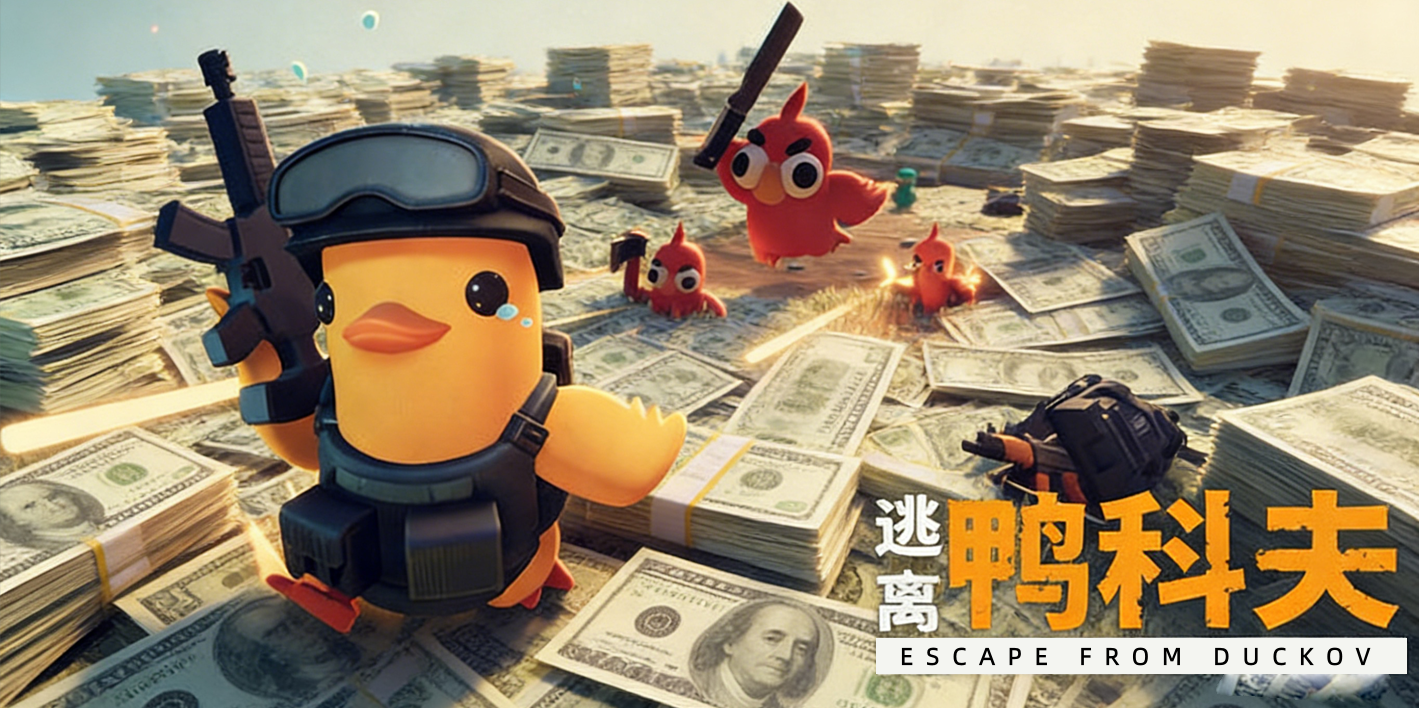
Escape from Duckov is a PvE top-down shooter developed by the Soda Team and published by bilibili. Players take on the role of a duck scavenging for resources in a post-apocalyptic world, building shelters, upgrading gear, and trying to survive in a land full of danger. After launching on Steam in October 2025, it received a strong response and sold 1 million copies within a month. But this article is not about discussing or reviewing the game itself, nor is it about cataloging its memes. Instead, I want to share a story that has nothing to do with the main storyline at all: how I turned this game into a management simulator and became a millionaire.
The “Duck Market” Mod
In the game, players mainly earn items and weapons by entering different maps and looting chests and enemies. Aside from a few key items used for upgrades, most of them are simply hoarded or sold to NPCs. That changed when a creator named Cyerol released a mod called “Duck Market” on the Steam Workshop, enabling P2P (player-to-player) trading in the game for the first time.

The logic of this market is simple: after paying a transaction fee, players can list items for sale, and they become available for purchase by all other players. The greatest value of Duck Market is that it expresses the true worth of items in monetary terms—in other words, it monetizes item scarcity. As a result, players can sell items for prices higher than the NPC buyback rate, while also satisfying the needs of those who want to quickly obtain urgently needed upgrade materials or high-tier weapons. In-game currency is heavily spent on skill upgrades and buying ammunition, and it isn’t easy to earn much money early on, so this mod became very popular and saw considerable usage.
Anyone with a bit of financial knowledge knows that in a fair market, if both buyers and sellers are rational and there is no information asymmetry, all goods will naturally settle at an equilibrium price, with actual prices fluctuating only slightly around it. At first, I assumed that since all items in this game can be obtained by players and there is a fixed system buyback price, price fluctuations wouldn’t be significant.
But I was wrong. What I saw here were grotesque prices thousands of times higher than the system value, and even Bitcoin-style scams full of speculative bubbles. Still, I was one of the beneficiaries: through trading in this market, I achieved “millionaire” status in just a few hours and ultimately realized “financial freedom” in the game.
So what does 1 million mean in this game?
The main source of income is looting maps and selling the spoils to NPCs back at base. However, there are limits on both the number of items you can carry and their total weight, so the actual money you can earn per run in the early stages is quite limited. From my personal experience, it’s around 5,000 to 8,000 per run—and that doesn’t even include items kept for future upgrades or runs where you focus purely on missions without much looting.
The Road to Becoming a Millionaire
You Can Even Speculate on Bitcoin Here
The producer of Escape from Duckov clearly has a great sense of humor, because the game includes a special item: 0.2 BTC (Bitcoin). By installing graphics cards into a “mining rig,” players can generate Bitcoin based on computing power. There is only one mining rig in the entire game. When all 12 GPU slots are filled, it produces one 0.2 BTC every 10 hours (real-world time).

In the game, 0.2 BTC is practically useless for anything else, but NPCs will buy it for up to 8,000 in-game currency, which already makes it a high-priced item. At first, I always sold it directly to the chef (he offers the highest buyback price). But then I saw something astonishing in the Duck Market.


Yes, you’re not mistaken. An item with almost no practical use was listed here at a minimum price of over 26,000—more than three times the NPC buyback price. The highest listings even reached 500,000, and just to list one, you had to pay a 680,000 transaction fee upfront. It made absolutely no sense. Some of the high-priced Bitcoins were sold one by one. Later I found out that when there is only a single unit of an item, clicking “buy” does not require a second confirmation.
After observing for a while, I noticed that Bitcoin prices would suddenly crash after a period of time, then be quickly pumped back up again, over and over in a cycle. All signs pointed to extremely irrational price fluctuations and huge arbitrage opportunities for Bitcoin in the Duck Market.
In my view, someone was deliberately pumping the price and waiting for others to take over the bags, while a group of people knowingly joined in to muddy the waters—just like a Ponzi scheme.
In real life, I would stay far away from something like this immediately. But this is a game (and perhaps this extreme irrationality is also tied to the virtual environment). So I abandoned the main storyline and started grinding the market, watching prices, buying low and selling high—turning a shooter into a management sim.

Bitcoin’s price fluctuates wildly. When the market is good, I list it for sale with a markup of ten or twenty thousand; when the market is bad, I buy in at a low price. If there’s no good opportunity, I just play a round or two of the game to pass the time. After doing this for two or three hours, my capital had multiplied several times and reached more than 500,000.
Unlocking the Millionaire Achievement
My funds had taken a huge leap forward, but new problems also emerged. Relative to my current capital, the profits were starting to look a bit thin, and I was worried that the Bitcoin bubble might burst and leave me holding the bag. So I decided to adjust my strategy as early as possible.
After some analysis and observation, an item called “Space Crystal” caught my eye. Compared with Bitcoin, it has some obvious advantages:
- Rigid demand: it is a must-have item for upgrading skills in the late game;
- A certain degree of scarcity and high value: obtaining it requires killing special powerful monsters at specific times, and it’s easy to fail in the early stages, so even during downturns in the Duck Market its price stays above 30,000;
- Large price swings: ranging from 30,000 to 500,000, offering even greater arbitrage opportunities.

To reduce risk, I adopted a two-pronged approach: using 80% of my funds to buy low at the right moments, while continuing to flip BTC on the side. I also discovered that once your listing gets pushed to the second page, it sells very slowly. If you take it down and relist it, you have to pay double the transaction fee, so the pricing and quantity of each listing need to be carefully considered.
As I became more proficient with this strategy, my trading business flourished. In just over 30 minutes, my assets doubled again to reach 1,000,000, and I unlocked the “Millionaire” achievement.
A High-Stakes Gamble
Opportunity or Trap
Sometimes, opportunities come to you when you least expect them. While checking the market for Space Crystals, I suddenly noticed a player listing 50 units of “Large Space Crystals” at a price of 80,000 each. It completely stunned me.

Because the keywords also matched, I already had some knowledge of this item. As far as I knew, it was the most expensive item on the market in terms of unit price, usually selling for over 300,000, with extremely large fluctuations—500,000 or even 800,000 each was not uncommon.
This sudden “gift from the heavens” made me hesitate instead of rejoice. This wasn’t my main line of business. As the saying goes, stay true to yourself and don’t stray from your nature—what looks like an opportunity could also be a trap. At that point, I was holding quite a few regular Space Crystals, and my cash on hand was already limited. Yet I couldn’t bear to miss such a potentially huge profit. After much deliberation, I scraped together 160,000 and bought two. The market reacted quickly. The inventory count dropped from 50, to 30, to 15, and soon to single digits. The entire batch of Large Space Crystals, worth a total of 4 million, disappeared from the market, and everything returned to calm.
It was my first time owning this item, and I hadn’t even had a chance to take a good look at it before something strange happened again. Another 50 Large Space Crystals, priced at 80,000 each, were listed! I was completely dumbfounded. My first thought was: this is bad, I might be stuck holding the bag—exactly what I feared. The market clearly hadn’t expected someone to continue dumping at such a low price either, and this time the entire category’s price structure was smashed. The selling speed was visibly much slower. Even after several minutes, there were still more than 30 left in stock.
Another Wave of Turmoil
Was this an opportunity? Was the 80,000 price just a fluke, with prices about to climb again? Or was it a trap? Was this category heading into a long-term decline, with 80,000—or even lower—becoming the new “reasonable” price?
I don’t know what kind of mindset I was in when I made the decision, but I chose to buy as much of this batch as possible. I believed the price would definitely rise again. At worst, I’d just lose part of my principal. This was a bet worth taking.
My cash was almost gone. To raise funds, I delisted all my Bitcoin and Space Crystals. I sold the Bitcoin directly to NPCs, and listed the Space Crystals at prices lower than the market. I went to the warehouse and sold all my spare weapons; even items that weren’t essential for late-game upgrades were sold off without exception. I practically emptied my entire inventory to gamble on this opportunity.
Speed was everything. Every time I scraped together another hundred thousand or so, I rushed to place an order on the market, then ran back to NPCs to sell more items. I shuttled back and forth between the chef, the Duck Market, and the delivery box (items bought from the market and money received are first stored in the delivery box). Before my inventory was completely cleared out, I had managed to acquire more than twenty Large Space Crystals.

Having Money Is a Boring Thing
Luckily, my gamble paid off. After that batch of 80,000-priced items was cleared out, no listings that cheap ever appeared again. After waiting for a while, I started selling at 200,000 each, then gradually raised the price to 300,000, and eventually even sold some for 500,000. My assets grew from tens of thousands to hundreds of thousands, quickly breaking past 1 million, then 2 million, and finally exceeding 5 million.

At that moment, I felt I had achieved “financial freedom.”
This string of numbers made me lose myself, and I quickly entered full-on spending mode. Items for upgrading skills and buildings, which I used to carefully save up for, I now bought directly from the Duck Market—after all, money was no longer a concern. I also completed all those tasks that required handing in special items. For a while, I felt incredibly carefree, spending money like water. I threw away my repeatedly repaired old armor and replaced it with the highest-defense, top-tier set. I switched to the strongest weapons with all the best attachments, stocked up on various injectors and medkits, and stepped back into the wasteland.
For the first five minutes, I was still intoxicated by the thrill of using high-end weapons. But as time went on, something felt off. More precisely, my mindset had changed drastically.
In this “search, fight, extract” game, collecting resources, completing missions, improving yourself, and upgrading gear are a crucial source of satisfaction. But now I realized I no longer had any desire to open every chest, because I knew whatever was inside would be beneath my notice. After killing enemies, I couldn’t even be bothered to loot them, since my equipment was already the best in the game. I also lost the urge to explore the vast maps, because the ultimate rewards no longer meant anything to me.
Back at the Duck Market, I still had goods worth over a million left in my warehouse. Reaching 10 million with a bit more time wouldn’t have been difficult. But those numbers no longer meant anything to me. In the end, I exited the game and didn’t open it again for a long time.
Afterword
A Small Moment of Reflection
The basic rules of the Duck Market are very simple, yet they give rise to a variety of strategies and games of chance—almost a mirror of reality. Here, I experienced the growth of wealth, market fluctuations, and changes in mindset. It showed me how strikingly similar virtual economies are to real ones: greed, fear, speculation, risk.
More than a month later, I opened the game again and saw that cold, emotionless 5 million. It seemed to remind me that perhaps “financial freedom” in games is only virtual, and that true happiness is not about owning infinite resources, but about finding your own enjoyment within the rules. After all, whether it’s playing games or living life, what matters most is enjoying the process.
Thank you for reading this far. I hope it was of some help to you.
Note:
- I didn’t deliberately keep records in the early stages, so the specific transaction volumes, prices, and other figures mentioned in the article may differ somewhat from the actual values;
- All events took place on November 14 and 15, 2025, and the arbitrage methods described may no longer be applicable today.
Leave a Reply