



A week with a Japan-market Sharp AQUOS R9 reveals a phone that trades flagship spectacle for balance: distinctive design, a much-improved display and speakers, capable cameras, and the compromises of using a SoftBank model outside Japan.
***
Editor’s note: A version of this article by WangMT appears on August 17, 2026 on SSPAI with the title “「效率至上」务实开发导向下的日系次旗舰:夏普 AQUOS R9(SoftBank A401SH)评测”. Translated and published by agreement.
Acknowledges & Disclosures
My thanks to the phone’s original owner, @GALLON23, for lending me this SoftBank edition of the Sharp AQUOS R9 A401SH and organizing a sharing program that made this article possible.
The R9 is more of a secondary device and toy to me. This review may not cover every use case and reflects only my subjective impressions. I hope readers will understand.
I made the feature image myself. This is a free-form piece, and I hope you’ll forgive its limitations.
Parts of the article were polished with WPS AI.
Introduction
Ever since Taiwan’s Hon Hai Precision Industry acquired Sharp, the company’s trajectory has undergone a long and unmistakable shift. Unsurprisingly, that change has also shaped its smartphone lineup. To me, the clearest sign was the arrival of the AQUOS sense series—a symbol of Sharp’s turn toward pragmatic product development. By targeting its audience precisely and meeting the real needs of the Japanese market, sense once rescued Sharp’s phone business. Before Google’s Pixel A series took off, it was the undisputed benchmark for Japanese midrange phones.
But when Sharp extended that pragmatic logic to AQUOS R, the flagship line meant to showcase its technology, the results were more complicated. It certainly produced mass-market phones that were easier to use and more polished as complete products. At the same time, however, enthusiasts who knew Sharp and expected it to deliver bold innovation began to feel a little disappointed, then dissatisfied. I was among them: for a long time, I had plenty to say about the rounded yet rather ordinary designs of earlier R-series phones.
Still, as the familiar saying goes, “online commenters don’t decide whether a phone maker lives or dies.” Having escaped its predicament by taking the pragmatic route, Sharp’s phone business stuck to its convictions and carried that winning formula through. Developer interviews reported by the media tell us that, beginning with the R8 generation, the R series formally split in two.
The R Pro line retained its role as a technology showcase and true flagship, built around an “Enthusiast First” philosophy. The R models without a Pro suffix became near-flagships that championed “Efficiency First,” seeking the best balance between efficient product development and the experience of their intended users.1 Their prices, accordingly, sit below both the Pro line and conventional flagships from rival brands.
The AQUOS R9 reviewed here is a textbook “Efficiency First” phone, which is precisely why I felt no great excitement about it at first.
That expectation changed after I briefly handled both the R9 and R9 Pro. Neither is quite as polished as phones from the leading global Android brands, but to my surprise, I could sense Sharp trying to strike a delicate balance: reaching for the stars while keeping its feet firmly on the ground. The market rewarded that effort. With a distinctive and controversial yet ultimately coherent design, plus tangible improvements to the display, speakers, and overall fit and finish, the AQUOS R9 sold three times as many units as the preceding R8, according to Sharp. That success even gave the company the confidence to take the series beyond Japan again.
So when I was fortunate enough to join this ambitious phone relay and spend a week with the AQUOS R9, I began to wonder: would I be more taken by its starry-eyed design ambitions? Or would its “Efficiency First” utility and pragmatic near-flagship positioning keep its feet on the ground and serve me better? Even though this Japan-market model was inevitably not quite at home in China, my time with it gave me clear answers to both questions. The rest of this article is my attempt to recount them. And with that, my life with the AQUOS R9—and China Telecom 4G2—officially begins.
Design
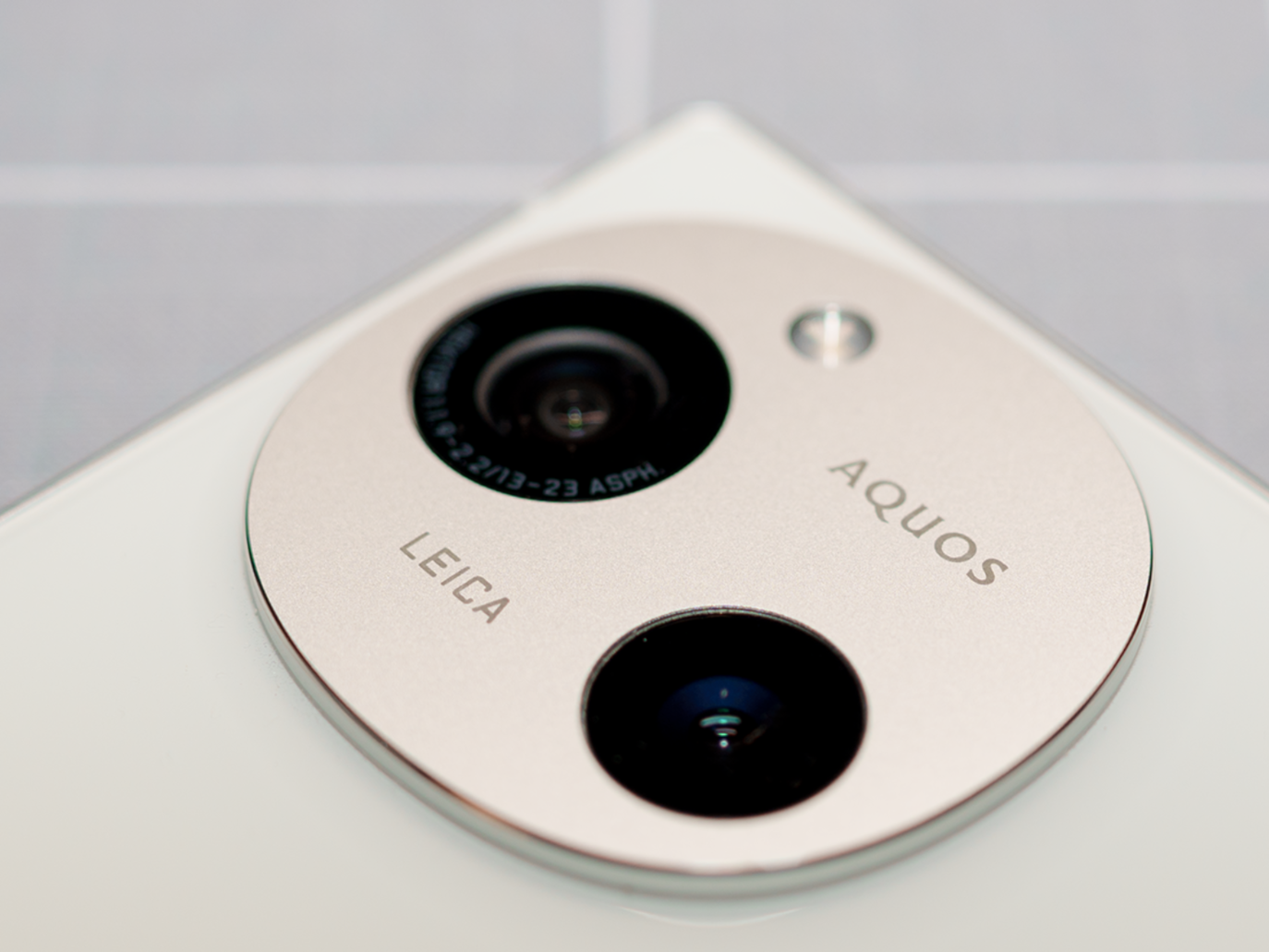
I am confident that most consumers, myself included, would identify the R9’s camera module—the element most visibly at odds with the rest of the phone—as both its most controversial feature and its most memorable one. Whether or not “love it or hate it” is the perfect description, it certainly left an indelible impression. That was exactly what Miyake Design, the studio behind it, hoped to achieve.
Smartphones have become an indispensable part of our lives. We wanted to create a product people would cherish like a planner or an item of clothing. The contrast between straight lines and free-form curves, the asymmetrical arrangement of the lenses, and powerful yet accessible specifications give the product a playful tension born from deliberate incongruity. We believe a design becomes complete only when it is held and used by people.

The irregular, near-superelliptical camera module formed by those free curves also became a family design language for the AQUOS phones released alongside the R9, extending to the midrange AQUOS sense and entry-level AQUOS wish lines. Their color combinations differ, but in my view each suits its positioning, materials, and intended audience. The midrange sense9, for example, comes in brighter, livelier colors that make the metallic sheen of its anodized aluminum unibody stand out.

Back to the R9 itself. I think the overall execution is excellent; among the R-series phones released up to that point, it was unquestionably Sharp’s finest in perceived quality. The intentionally disruptive camera module and the otherwise harmonious design language create a subtle, compelling tension. More than anything, though, the materials—and Sharp’s judicious handling of them—make this design work. The result is an AQUOS flagship you can recognize at a glance yet one that still fits perfectly into everyday life.

The noticeably slimmer display bezels are another of the R9’s important selling points. Together with the crisp, squared-off body and gently curved 2.5D edges, they gave me an unexpected glimpse of Sharp’s old EDGEST brilliance.3 That design language emerged during the industry’s early experiments with narrow bezels on three sides. Although the market and manufacturing constraints of the time kept it from breaking through, it still shines in the memories of gadget enthusiasts. One slight disappointment is that, owing to the nature of the relay project, the review unit already had a tempered-glass protector narrower than the phone’s bezels. The photos may therefore fail to convey the full visual impact of the bare device.
The narrow earpiece slit above the hole-punch camera conceals one speaker with its own acoustic enclosure. Together with the bottom speaker, it forms a Dolby Atmos stereo system. The autofocus front camera is visible in the centered hole punch directly below the earpiece.

On the upper-right edge of the aluminum frame is a tool-free tray for either a nano-SIM or microSD card. The phone supports one physical SIM plus eSIM: the SIM sits on the screen-facing side of the tray, with the microSD card on the reverse.


The AQUOS R9 has a side-mounted fingerprint sensor integrated into the power button. In my experience, it was acceptably fast but overly sensitive, leading to frequent accidental touches in daily use.

On the bottom are the microphone, USB-C port, and lower-speaker grille. The USB-C port runs at USB 3.2 Gen 1 speeds and supports DisplayPort 1.4 video output. Like other AQUOS R phones—and most Sharp handsets—the R9 also offers dust and water resistance plus MIL-STD-810G-grade durability. Corning Gorilla Glass Victus 2 covers the back, while Gorilla Glass 5 protects the front display.


Photography
Ever since the Leica-branded AQUOS R6, imaging has become an increasingly prominent marketing point for the AQUOS R line and a key way to distinguish it from the midrange sense series. Unsurprisingly, the AQUOS R9’s main camera carries the Leica Hektor name. Its specifications include a 23 mm-equivalent focal length and an ƒ/1.9 physical aperture, with both optical and electronic stabilization. Behind it sits a 50.3-megapixel OMNIVISION OV50A CMOS sensor. On the later R10, this combination gained the 14-channel color-spectrum sensor inherited from the R9 Pro, improving automatic white balance. Amusingly, the labeling for the main camera actually appears beneath the ultrawide lens within the module.
Perhaps because the Leitz Phone exists as the genuinely “Leica-enabled” device—or, more likely, to preserve the distinction from the R9 Pro—the AQUOS R9 comes with neither Leica’s signature color science nor the straight-out-of-camera looks derived from it. It also lacks the R9 Pro’s Dolby Vision video recording. To my eyes, Leica’s involvement is more a matter of optical lens design, much like Zeiss’s relationship with vivo.
In straight-out-of-camera color, I found the R9’s rendering landed somewhere between the X200s’s default “Vivid” mode and its supposedly Zeiss-tuned “Natural” mode. It is more pleasing than the iPhone’s default rendering without becoming excessively saturated. Of the three phones, the X200s offers the richest selection of first-party creative controls. After upgrading to the Android 16-based OriginOS 6, users can enable “Natural Light and Shadow,” a mode that disables HDR to produce gentler tonal transitions and less obvious sharpening. The “Palette” feature then lets them adjust parameters in advance on top of the selected color profile, improving shooting efficiency. By contrast, even after its Android 16 update, the R9 offers only a handful of basic filters beyond a Pro mode capable of RAW capture. Its photos also do not produce locally boosted HDR highlights, at least in the preinstalled Google Photos app.

The lack of a telephoto focal length is another obvious limitation of the R9’s camera system. In the samples below, it falls short of both the X200s, with its dedicated 50-megapixel telephoto camera, and the iPhone Air, whose sensor crop promises “2× optical-quality zoom.” Zoom in on the characters in “大东方广场赋” (“Ode to Grand Oriental Plaza”) for reference: to my eyes, the R9 shows the heaviest smearing.

Throughout the writing of this article, I left the R9’s Auto HDR enabled. Most of the time, “Natural Light and Shadow” was also disabled on the X200s. Below are samples from the R9, X200s, and iPhone Air in a relatively extreme high-contrast scene. HDR did its job on all three; I found the R9’s intervention more aggressive than the iPhone’s but less so than the X200s’s.

The R9’s ultrawide camera has a native 13 mm focal length and a 50-megapixel OMNIVISION OV50D CMOS sensor, putting it close on paper to the JN1-equipped X200s. Samples from both are shown below. The R9 captures a wider field of view, while the X200s offers macro photography that the R9 lacks. Both ultrawide cameras support electronic stabilization and autofocus.

Although the R9 separates its portrait mode into pet and human options, the only adjustable parameters are blur strength and either beauty processing or fur detail; you cannot switch focal lengths. The X200s offers much more to play with. In addition to freely changing focal lengths, it can simulate the bokeh of various Zeiss lenses—including Sonnar and Biotar—within portrait mode, and its live preview is better. The portrait samples below use the X200s’s simulated Sonnar bokeh, though the phone labels its actual lens construction as Tessar. Eagle-eyed readers may also notice that the R9’s watermark appears able to show only the native specifications of the lens in use, resulting in an inaccurate focal-length label.

Then night fell. Both the R9’s main and ultrawide cameras can automatically activate Night mode when conditions call for it. Switching manually to the dedicated “Night” mode reveals two additional options, “Starry Sky” and “Fireworks,” which in my experience appear to use different exposure times. Below are Night-mode samples from the R9 and X200s. In one set, the two phones adopted clearly different metering strategies, even though I did not use the R9’s ability to separate its focus and metering points.


Next are Night-mode comparisons among the R9, X200s, and iPhone Air under more demanding lighting. The iPhone Air faced the most extreme scene: the tree in the image was no longer visible to the naked eye.


From its original Android 14 release to the current Android 16 build, the R9’s camera app has continued to evolve with each system update, even as it remains behind the newer models and R9 Pro. The redesigned interface arrived with Android 15, while Android 16 finally added the in-camera filters shown below.

By current industry standards, these filters are rudimentary, with almost no room for custom adjustment and no connection whatsoever to the Leica branding. Yet in practice, I unexpectedly found several delightful options. The samples below show what they can do.


Another obvious change to the R9’s camera app on Android 16 is the watermark design. In earlier versions, the watermark could appear only inside the captured image. The item labeled “Original”—also “オリジナル” in the Japanese interface—actually lets you add a custom photographer signature.

Apart from those changes, the newer camera app differs little from the Android 14 version. It largely retains the old layout, including an extensive selection of framing guides—a long-running tradition on Sharp phones.


Performance
The R9’s quantitative specifications and test results are shown below.


From the earliest planning stage, Sharp had no intention of using the Snapdragon 8-series SoC typical of flagship phones. One important reason was its belief that the upper-midrange chips of the period already offered enough performance.4
The 7+ Gen 3 performs on par with the Snapdragon 8 Gen 2, far beyond what we had come to expect from the 7 series. We therefore did not see its performance—equivalent to the best flagships of 2023—as a downgrade at all.
But the R9 was a near-flagship released in 2024, and after two years of hardware progress, it now struggles somewhat with today’s major mobile games. The frame-rate test below, using the mainland China release of ARKNIGHTS: Endfield, illustrates the problem. One detail worth noting is that the phone’s original Android 14 software could not enable the game’s “High” graphics preset; that option became available by default only after the Android 16 update. More consequentially, the Snapdragon 7+ Gen 3 does not support frame generation in this game. Movement consequently feels sluggish, and at otherwise identical graphics settings, the experience is clearly worse than on phones that can enable frame generation.


Everyday Use
The R9’s improvements are concentrated in its display, speakers, haptics, and even sustained performance. Sharp states that its speakers are 2.5 times louder than the preceding model, for example, and this was the first AQUOS phone to use a vapor chamber. Based on the user reports and media reviews I could find, those changes worked remarkably well.

For me, however, the display is the biggest improvement to everyday use. The R9 raised its rated specifications to as much as 1,500 nits of full-screen brightness and 2,000 nits at peak. It also almost completely eliminated the temporary burn-in-like image retention and other issues that had often compromised the viewing experience on Sharp’s in-house IGZO OLED panels. The default Recommended mode and the “Virtual HDR” setting still make the screen look somewhat cool, but otherwise its real-world performance finally lives up to the promise of its specifications. Even two years after the R9’s release, it remains more than adequate for daily use. In the sunlight comparison below, it looks about as bright as the iPhone Air, whose panel has an AR coating but was fitted with a non-AR SmartDevil protector made with SCHOTT glass. Apple also advertises 2,000 nits of peak brightness for the Air.

Compared with the AQUOS sense7 I previously used—which likewise has an IGZO OLED panel and “Rich color technology for mobile”—the R9 adds more complete HDR support, including Dolby Vision, as well as more extensive display customization.


The R9 has a 5,000 mAh battery. Given the wear introduced by the relay project, the data below should be treated only as a reference; it includes outdoor use with a continuous 4G connection. Google services’ reliance on the local network environment may have played a part, as may the fact that I did not disable any carrier apps. In any case, what stood out most was the idle drain, which often exceeded 10% overnight.

Software
Sharp began calling its software AQUOS UX with Android 13, but the experience itself did not change much. To me, it remains the familiar stock-like Android interface with a handful of Sharp customizations. In keeping with broader industry trends, the R9 promises three major Android version upgrades and five years of security updates. It has indeed progressed through several major releases, from Android 14 at launch to Android 16 today. One important caveat: Japan-market phones, especially carrier editions, may receive system updates only while a recognized Japanese carrier SIM or eSIM is inserted. In my testing, even an expired SIM worked.
Yet as I continued changing primary devices—especially after using an OriginOS 5/6-equipped X200s as my main phone for six months—I reached a conclusion I had never noticed before. The differences between today’s Chinese OEM Android skins and stock-like Android are no longer limited to localization features born from China’s unusual software environment. Their visual experiences have diverged more sharply as well, gradually shaping different audience preferences. Nowhere is that clearer than in how different users respond to system animations.
Subjectively, the R9’s more responsive animations may feel efficient to devoted fans of stock-like Android. But next to OriginOS 6 and the “Gold Label”-certified ColorOS 16, users already accustomed to Chinese Android skins—or even the interaction patterns of iOS—may find that the R9 lacks carefully tuned details such as tweened transitions. In plain language, it can feel jarringly fast. That was once one of the public’s defining impressions of stock Android before Android Lollipop arrived. Still, based on my limited experience, the R9’s animations do not seem deliberately cut down relative to other stock-like Android systems. After the Android 16 update, its screen-on and screen-off behavior resembles what I remember from Pixel devices: press the power button and the wake animation expands outward from the button’s physical location; double-tap to wake and the screen lights progressively from the bottom upward.
Now back to more familiar territory. Sharp’s hub for proprietary features, previously labeled “AQUOS Tricks,” has been renamed with the friendlier Chinese-interface label “AQUOS Assistant.” Some items have also gained Chinese translations: “Rich color technology for mobile,” for instance, is now accompanied by the Chinese name “Vivid Color Display Technology.” Otherwise, the hub’s organization and features remain fundamentally unchanged from earlier AQUOS phones. For details on long-standing tools such as “Auto Scroll,” “Bright Keep,” and “Clip Now,” reviews of older Sharp AQUOS devices remain applicable.

If you are in Japan and use a local carrier, Android 16 also provides scam-call warnings based on offline recognition of the conversation.

The Game Assistant was updated in Android 15 and 16, with a cleaner set of floating in-game controls. From left to right, they enable Do Not Disturb for calls and notifications, block touches along the edges or in a selected area, and search Google or YouTube for guides using keywords. Tapping “More” opens additional settings, including performance options. The 240 Hz refresh mode, which works by inserting black frames, still requires both a compatible game and the “High-Speed Display” toggle to be enabled.


For personalization, Android 16 on the R9 adds a “Teen Home” mode, shown in the second image below. It combines the quick-contact calling shortcuts from “Simple Mode” with a conventional app drawer accessed by swiping up. Android’s native Monet dynamic-color system remains intact, and users can also choose from built-in lock-screen fonts or install third-party system font packs through Google Play.


Setting aside the built-in friction of stock-like Android and an overseas carrier edition not quite at home in China, the overall software experience is not bad by my standards. Even so, several shortcomings urgently need attention. Split-screen multitasking, for example, supports only the most traditional invocation method, making it markedly less convenient than comparable features from Samsung or even Sony Xperia. I also encountered occasional animation frame drops several times during testing. They appeared especially often immediately after overheating caused the phone to throttle, and sometimes persisted even after the temperature fell and the display returned to normal brightness.
Conclusion
Judged by the nebulous idea of “flagship character,” the R9 may fall short in the eyes of many enthusiasts. They may miss the more impressive specifications and form factors of the AQUOS R6 or Leitz Phone 1, the romantic experimentalism of the radically thin and light AQUOS zero line, or even the bygone glory of ASV LCD—a display technology whose brilliance Sharp itself has struggled to recreate.
But do not forget the distinction between the R and R Pro development philosophies discussed in the introduction. If the R Pro line’s “Enthusiast First” approach is an unrestrained showcase for Sharp’s technological ambitions, then “Efficiency First” naturally means building a more commercially viable and competitive product—one that ultimately earns broader acceptance and sells better. The R9 is precisely such a product. Its differentiated exterior design exists to make it more recognizable at retail, but its underlying logic remains thoroughly pragmatic. After using it, many owners—including me—may feel that, despite the R-series name, it behaves more like a deluxe sense Plus.
For the intended audience, that tradeoff is not necessarily bad. The R9 brings its display brightness, speaker quality, and haptics up to mainstream industry standards in one leap, delivering tangible upgrades you can immediately feel. Add still photography capable enough for everyday documentation and a software-support period competitive with domestic rivals such as Xperia, and the R9 becomes a rare well-rounded entry in the history of the AQUOS R line. Its unprecedented balance produced unprecedented market success for Sharp, just as expected. From an input-to-output perspective, “Efficiency First” is exactly right.
Perhaps you are still drawn to the R9 by the once-famous AQUOS name, along with its “foreign e-waste” bargain price—the joking Chinese label for inexpensive used imports—and distinctive design. As a grey-market phone running stock-like Android, it will always bring local incompatibilities that make it difficult to use as your primary device. Its niche position between the midrange and flagship tiers may also make the novelty wear off quickly once you spend more time with it. But if the AQUOS name has brought you here again, I believe this experience will be unlike the ones that came before. The R9 may be unexceptional, but it is unlikely to disappoint you with the enormous gap between promise and execution that characterized earlier R-series phones. At last, it has enough strength to withstand serious competition for reasons beyond the simple fact that it is “a Japanese phone.”
-
This distinction comes from an Impress Watch interview with the AQUOS R8 and R8 Pro product developers.↩︎
-
Entering
ctlteas the APN (access point name) and leaving all other fields blank enables the connection.↩︎ -
The AQUOS Crystal was also part of the EDGEST line.↩︎
-
This point and the quotation below come from an Impress Watch interview with the AQUOS R9 product developers, published on July 26, 2024.↩︎
Share:

Next
Think, Don’t Speak