

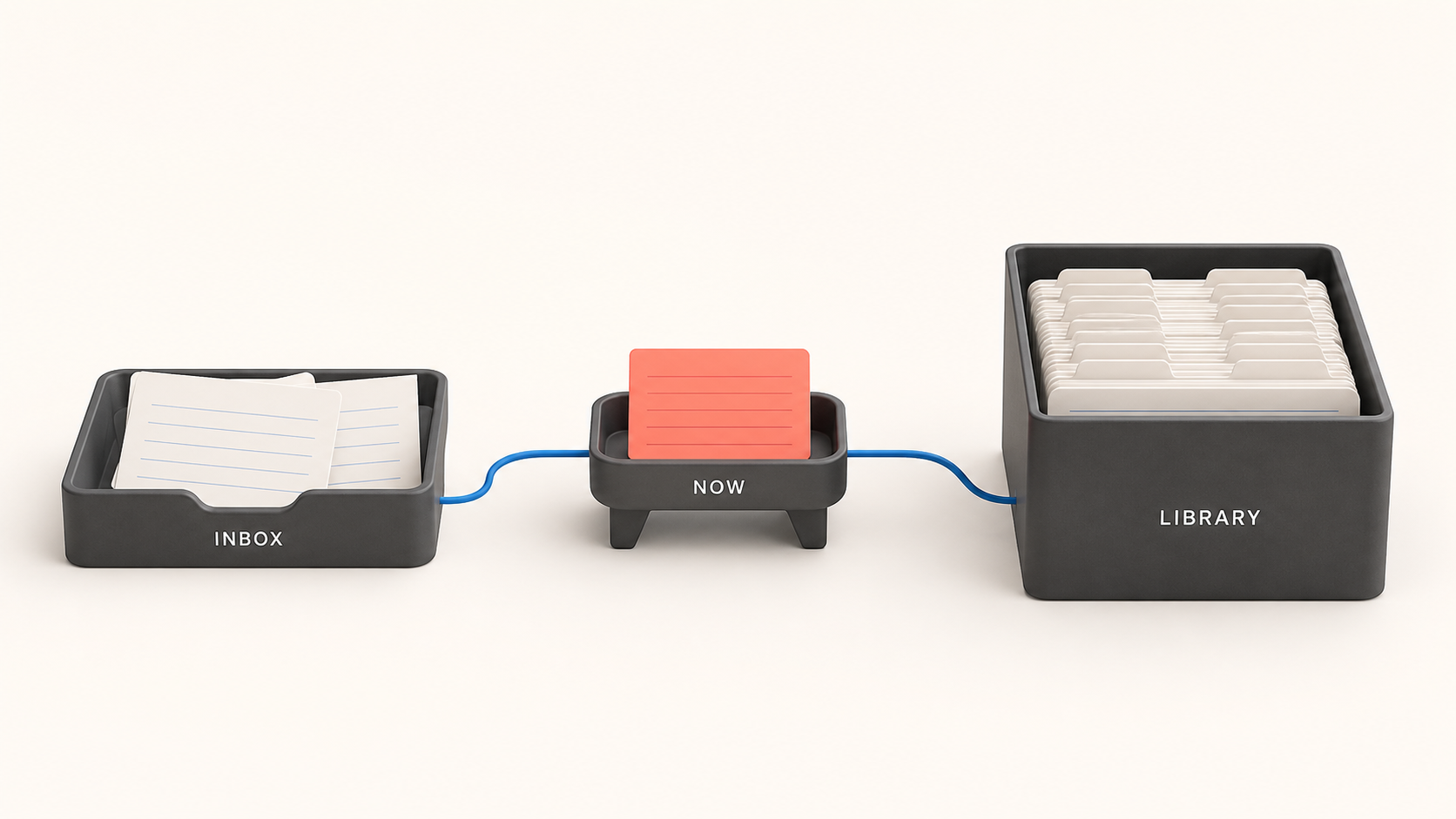
After 12 years of managing notes, the author’s most important lesson comes down to three letters: INL—Inbox, Now, and Library. This simple structure keeps priorities visible without letting a growing archive become overwhelming.
***
Translator’s note: A version of this article by 羊清乐 appears on August 17, 2026 on SSPAI with the title “分享我知识管理 12 年来最重要的经验:INL 结构”. Translated and published by agreement.
Disclosure of AI assistance:
- Video script: The script itself was written entirely by hand. Afterward, AI was consulted to help refine its structure and content.
- Converting the video script into an article: AI was used to make minimal changes to a very small number of details—for example, changing “look at this part of the video” to “look at the image below.”
Do you have hundreds of notes in such a mess that you can hardly bring yourself to open them? Today, I want to introduce a method that lets you find what matters quickly, without doing much organizing.
It takes just three letters: INL.
- I: Inbox, a staging area
- N: Now, what currently has your attention
- L: Library, your content archive
It may not look like much, but in my 12 years of working on note management, this is the most important thing I have discovered. Let’s start using it right away. Its advantages will become clearer as we go.
How to Use NL
I’ll begin with mind maps so that the structure is easy to understand. Then we’ll bring it into familiar apps such as Obsidian, Notion, and Notes.
Why do notes become hard to use in the first place? Because the notes you need right now are mixed in with all the ones you rarely touch.
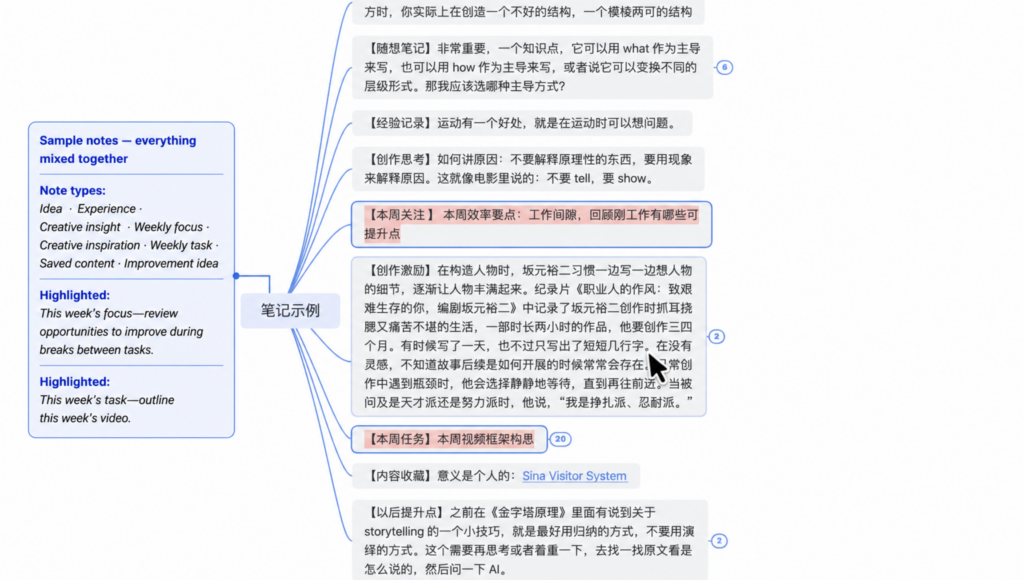
So what do we do? Separate them. Create two folders: Library and Now. Put all your notes in Library, then pull out the ones that currently have your attention and place them in Now.
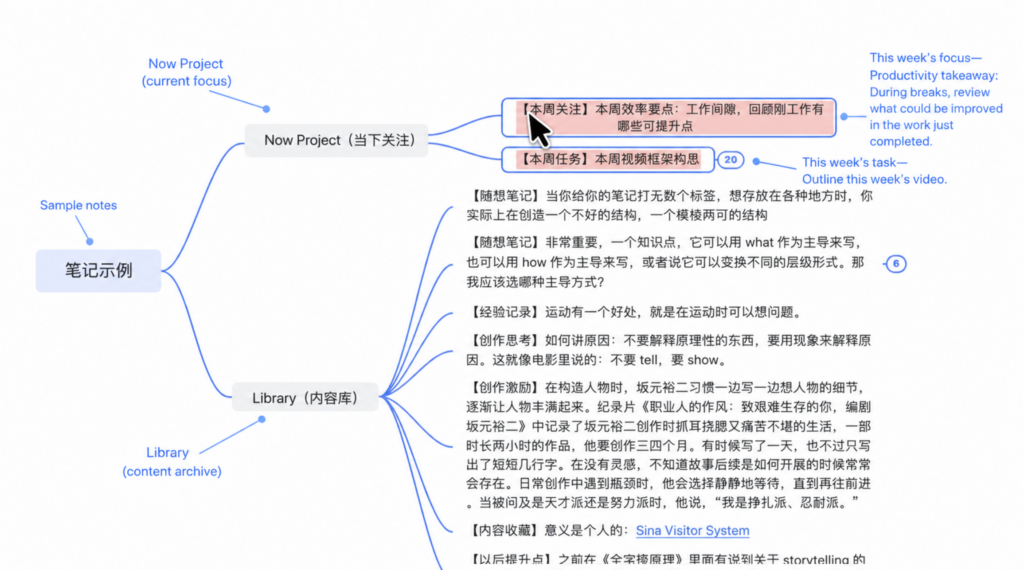
While you’re working, you only need to look at the Now folder. It contains very little, and everything in it is a current priority. That makes it genuinely useful.
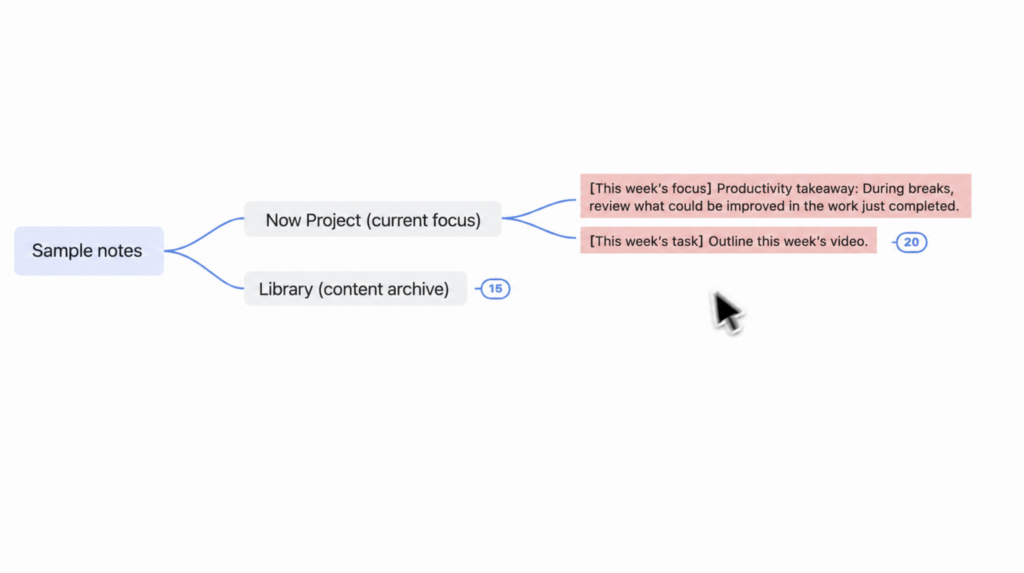
Now and Library make up the NL structure: a structure that separates what matters now from everything else. NL helps you stay focused. But as you keep using it, the notes in Library will inevitably grow in number and become messier. What if you still need to look inside it occasionally?
We can apply the same method again. Suppose Library has nine subcategories, but you regularly use only three of them.
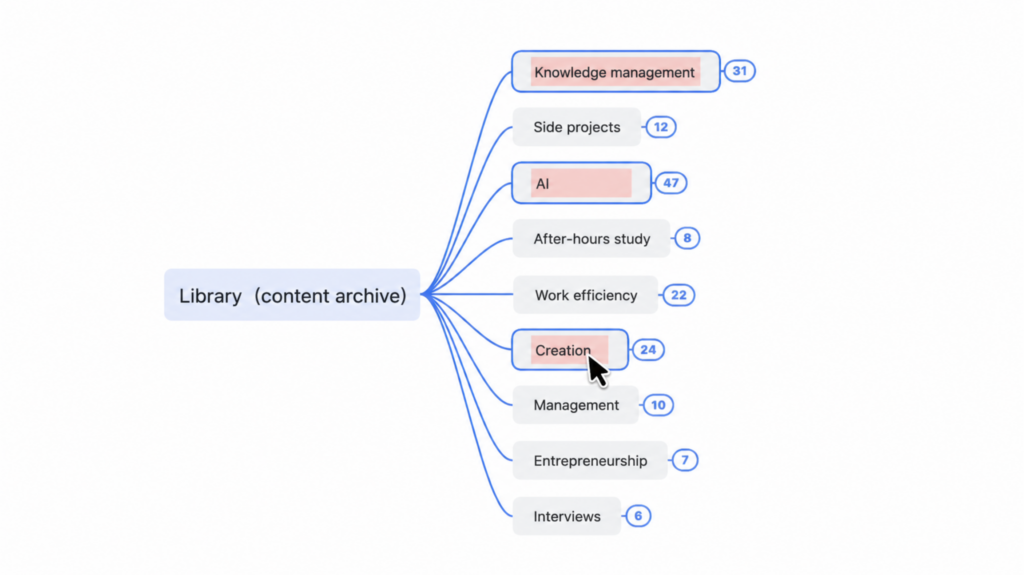
Pull those three out and place everything else under More.
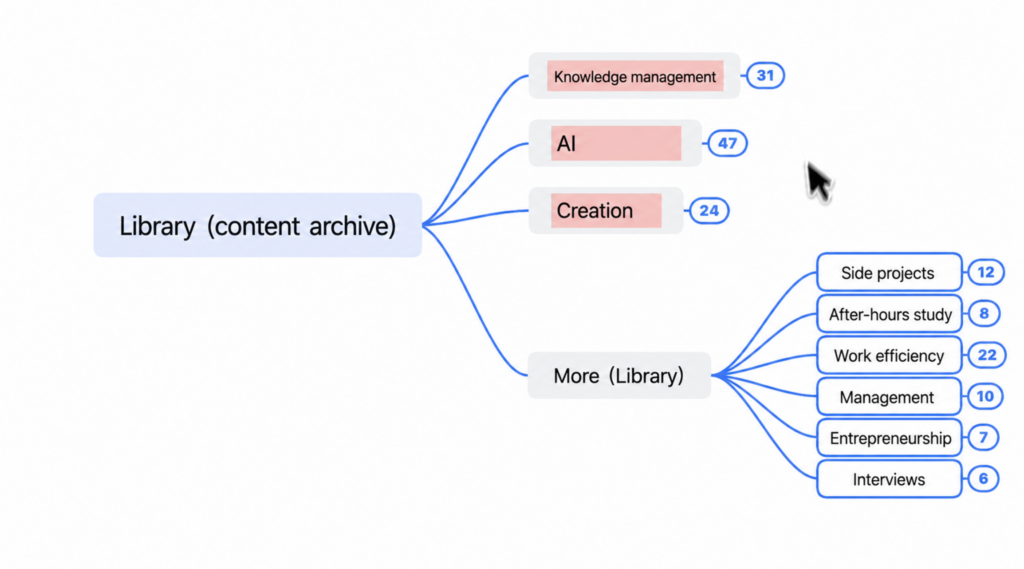
Collapse everything else.
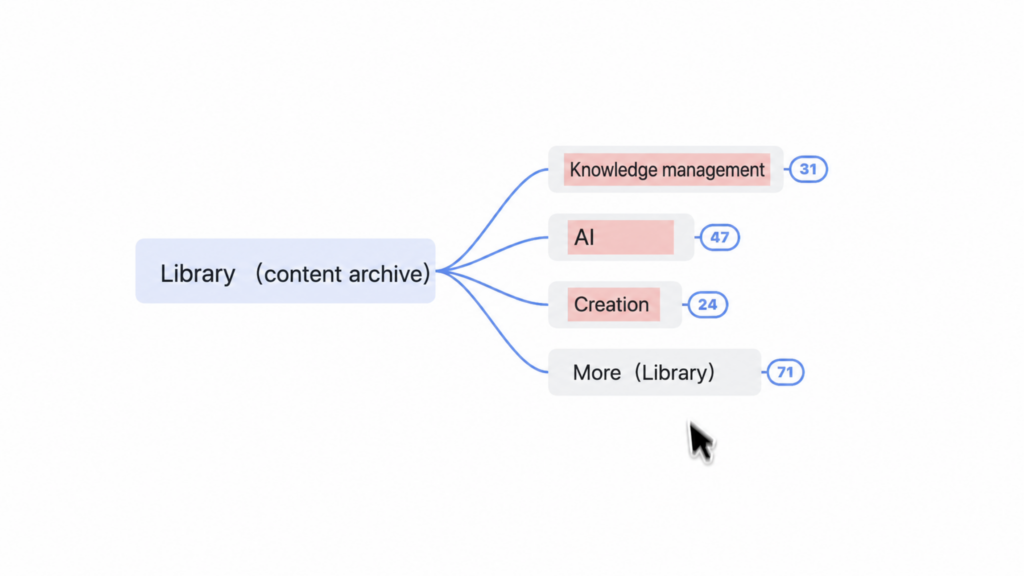
Now the important items are visible at the top, playing the role of Now, while the collapsed material is out of the way, playing the role of Library. We have created another layer of NL. The same thing can be done inside every subcategory.
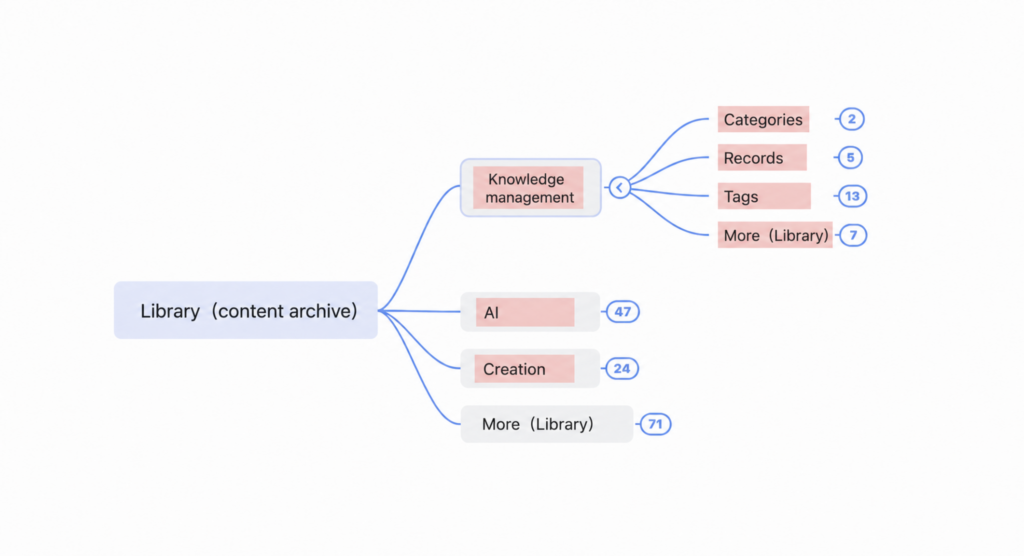
With a nested NL structure, we can pull the priorities out at every level. No matter which level you open, the first things you see are that level’s current priorities.
But even after you have pulled out the priorities, they may still contain a large number of notes. Is there a way to get the essence without having to read even those priority notes?
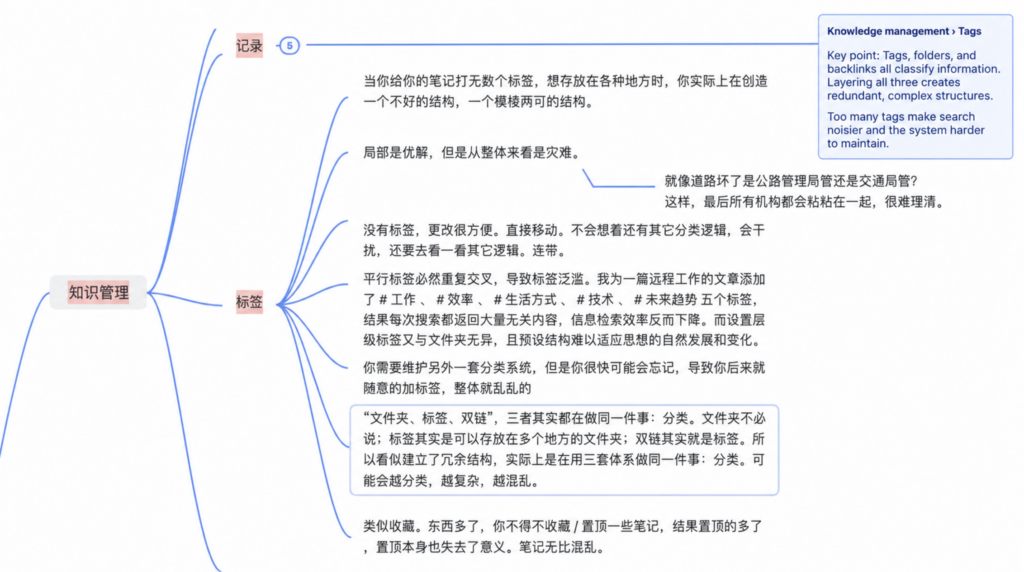
Of course. We can apply NL once more. Treat all those notes as Library. Then summarize—or distill—their essence into one or two sentences. That becomes Now.
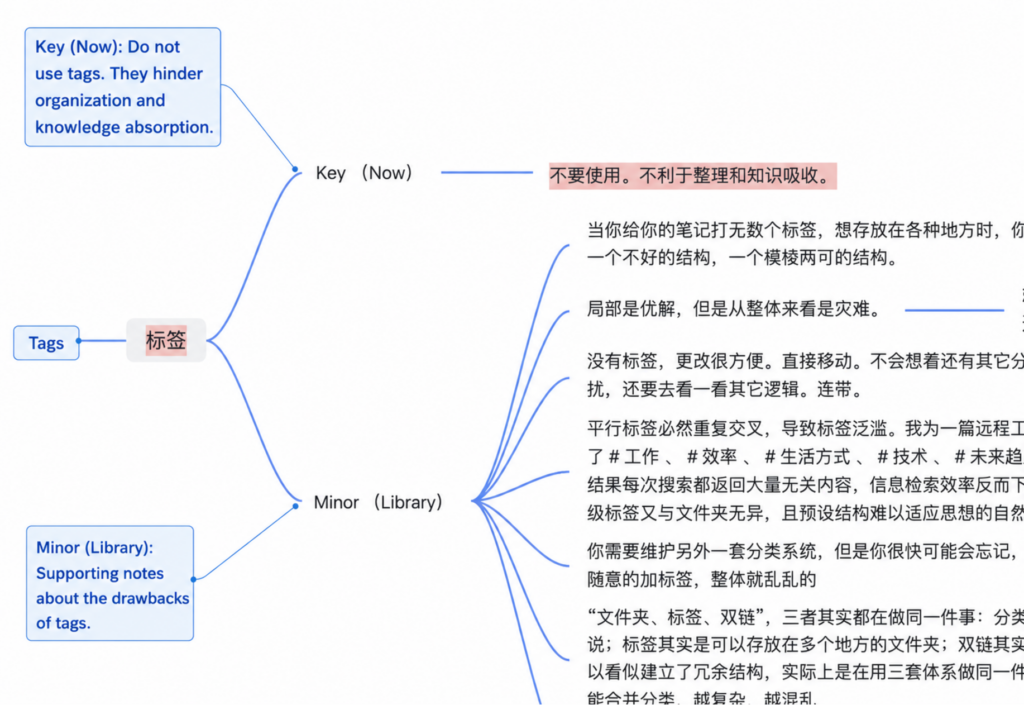
Collapse Library, and we have another NL structure.
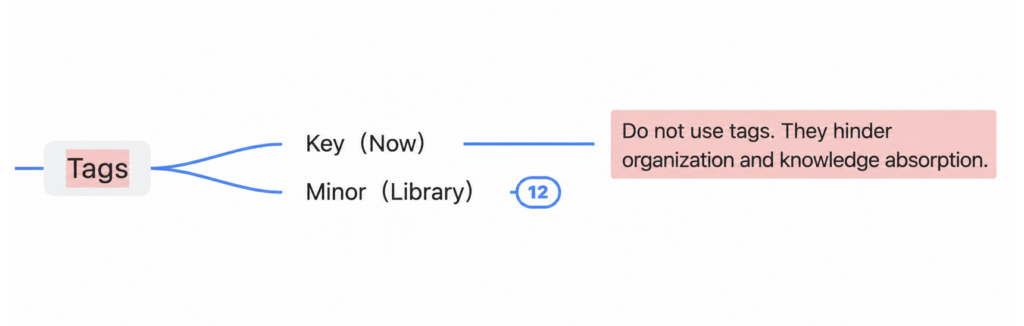
By distilling an NL structure in this way, we are once again pulling out what matters. In most situations, you no longer need to reread every note inside. You only need those one or two sentences. Pretty useful, isn’t it?
Let’s recap. We have looked at three examples, and I hope you can already see the value of NL. It is not one specific structure—the three examples do not even look the same. What they share is a way of thinking: focus on what matters now.
Once you use it, no matter where your attention goes or how deeply you drill down, what you see first is the current priority. That is the most efficient arrangement for the present moment, which also makes the system easier to use.
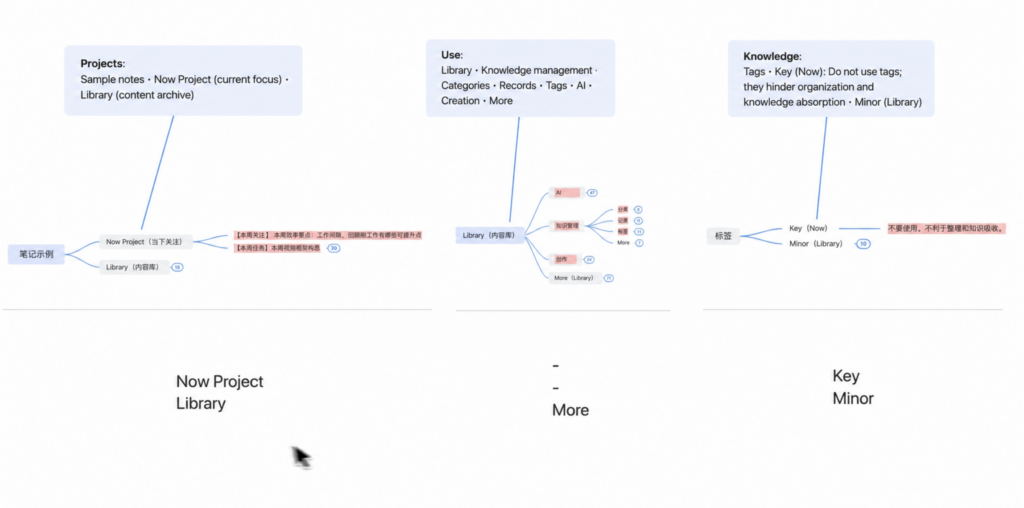
And that is not all it can do—but let’s hold that thought for a moment. First, here is how to use it in Notion: drag frequently used notes out where you can see them and collapse the rest into organized groups. That creates an NL structure.
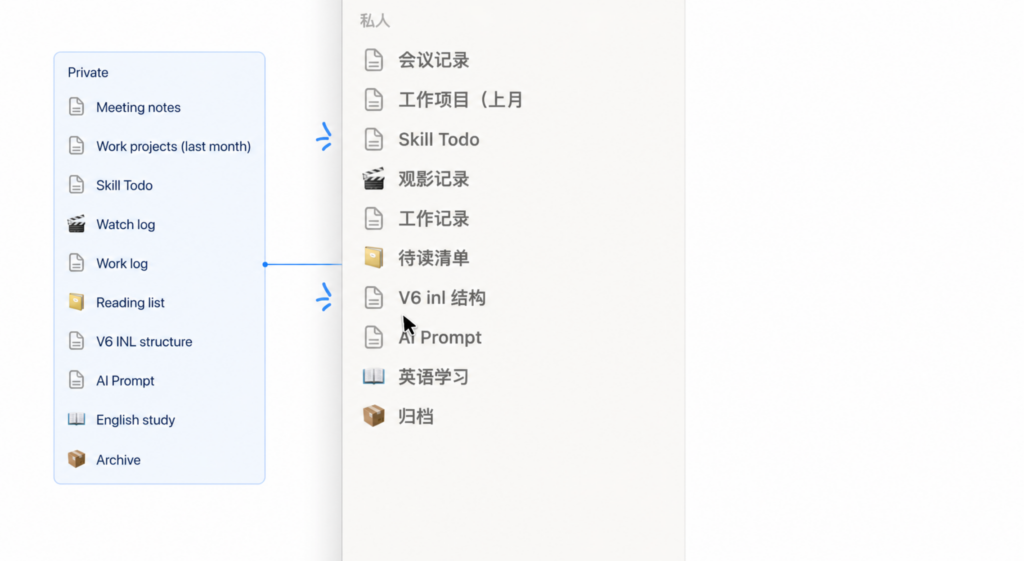
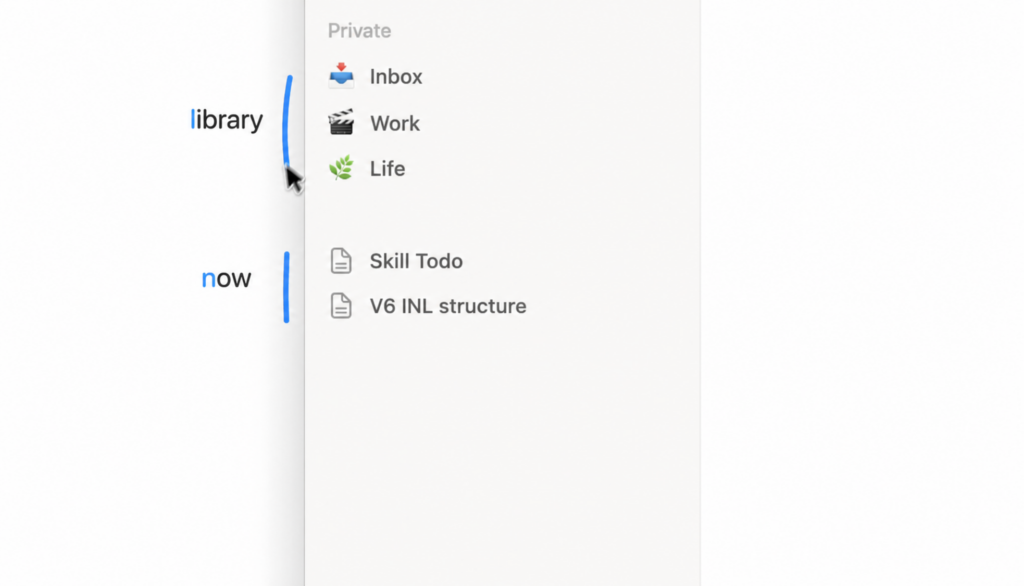
The same applies to Obsidian.
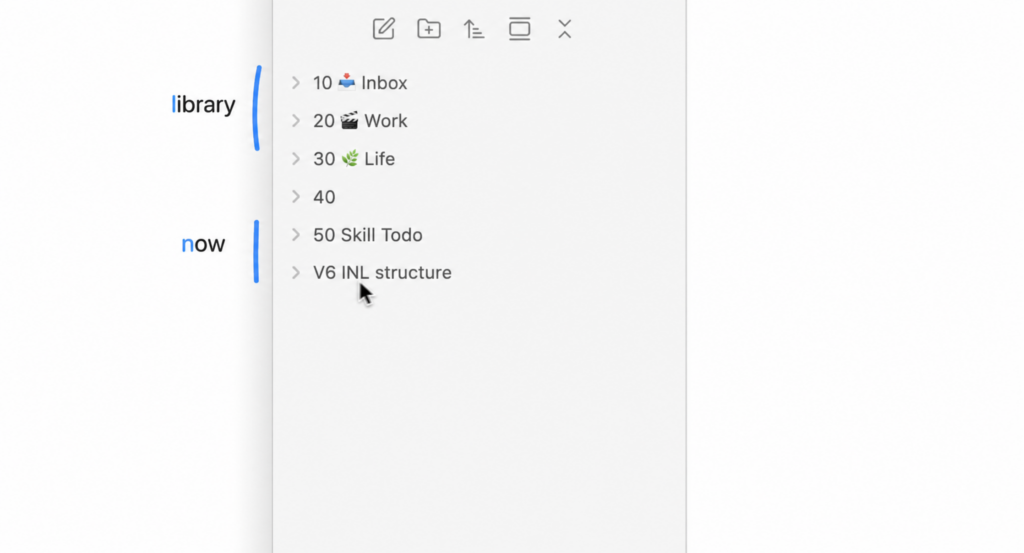
In a three-pane notes app such as Ulysses, you can create the same arrangement inside your folders. The principle is identical.
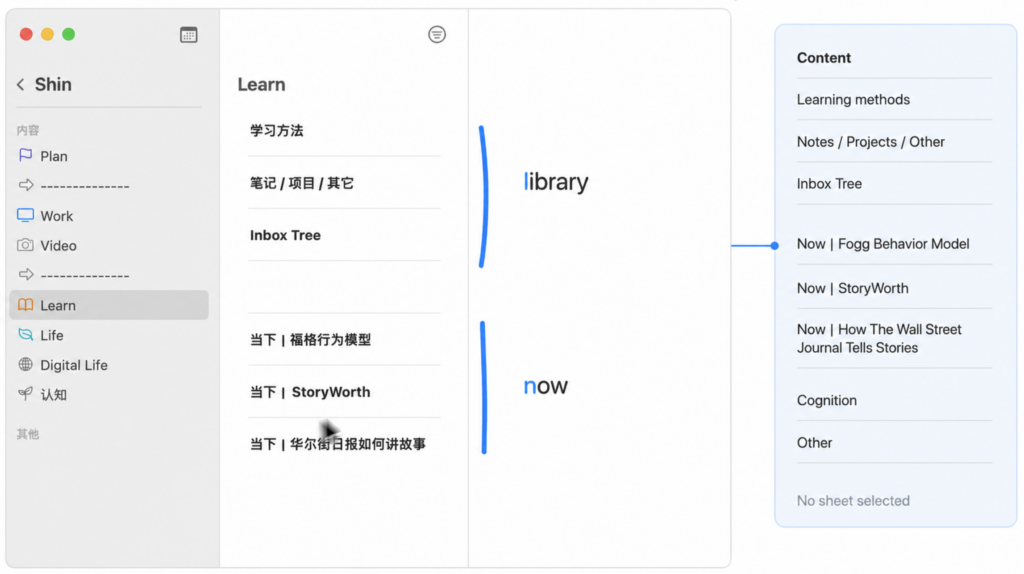
Within a note, summarize the content into key points and place the original material in annotations, comments, or footnotes. That creates an internal NL structure as well.
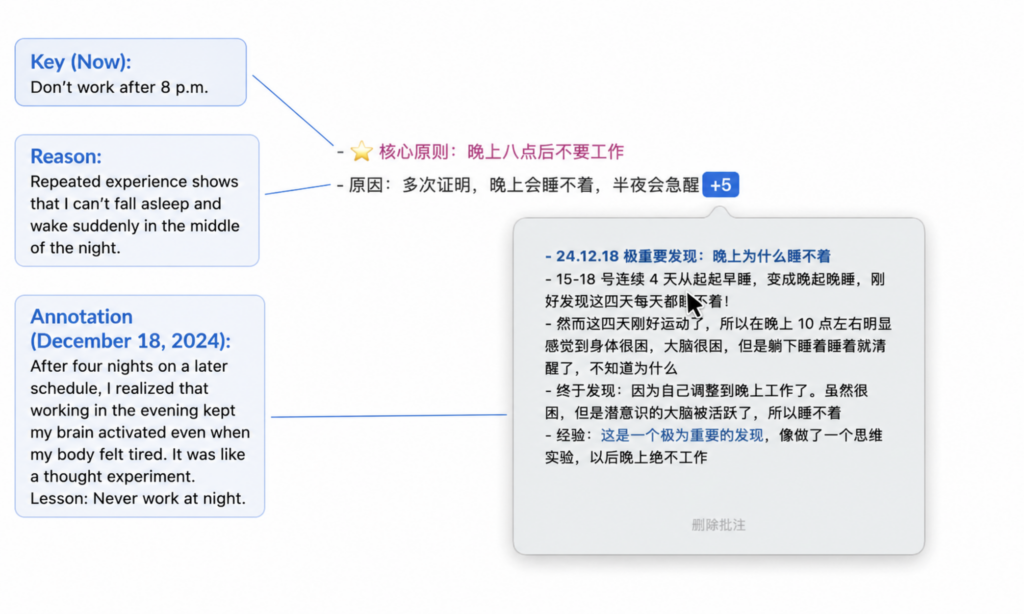
Most of the time, you then need to look at only a few Now notes, and within each section you need to read only the one or two sentences that make up its Key. The whole system becomes much easier to use.
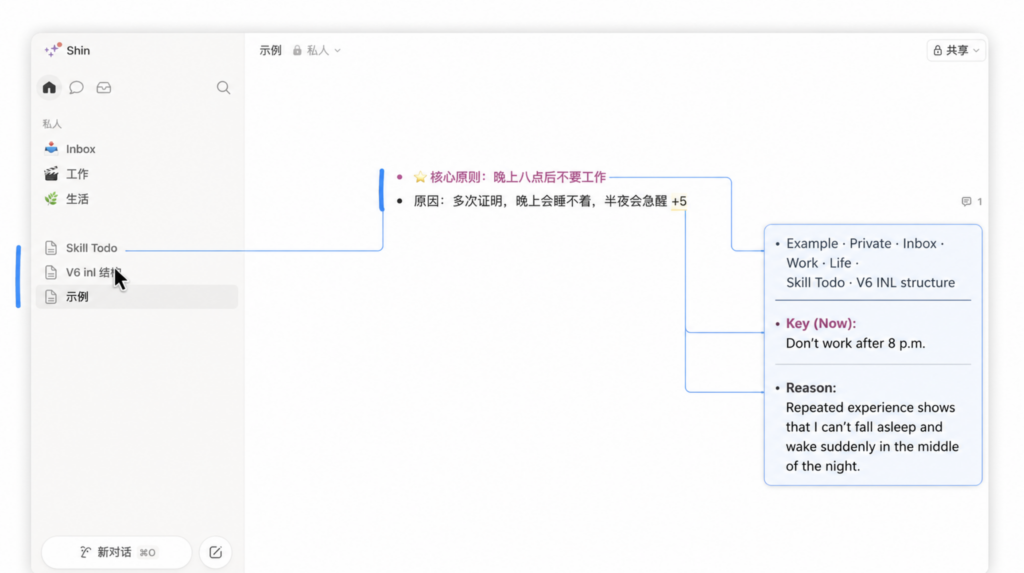
One problem remains. The system is useful, but filing new notes is still a chore. So we need a helper—the final part of INL: Inbox.
How to Use Inbox
The I stands for Inbox, a staging area. The idea is not new, but whether you should use one has always been surprisingly controversial.
Some people say you should not. Once you have a surface at home where things can be dropped—say, a coffee table—you start putting everything there, and it becomes an enormous mess. That sounds reasonable, doesn’t it? But after a full day at work, I’m exhausted. I do not have the energy to put everything back where it belongs. Without the coffee table, I would simply leave things on the TV console, the sofa, or the floor, making previously tidy places messy too.
Our energy rises and falls like the tide. Most of the time, we are lazy; every now and then, we are industrious. A good method has to follow that tide—to work with human nature—if it is going to last.
That is why an Inbox is essential. When you are feeling especially lazy or completely overwhelmed at work, you do not have to put something in its proper place. Drop it here first and organize everything together later.
How does that work for notes?
The most common approach is to capture an idea in the Notes app when you cannot be bothered to organize it, then process everything later when you have time. Relative to your knowledge base, the Notes app acts as one large Inbox.
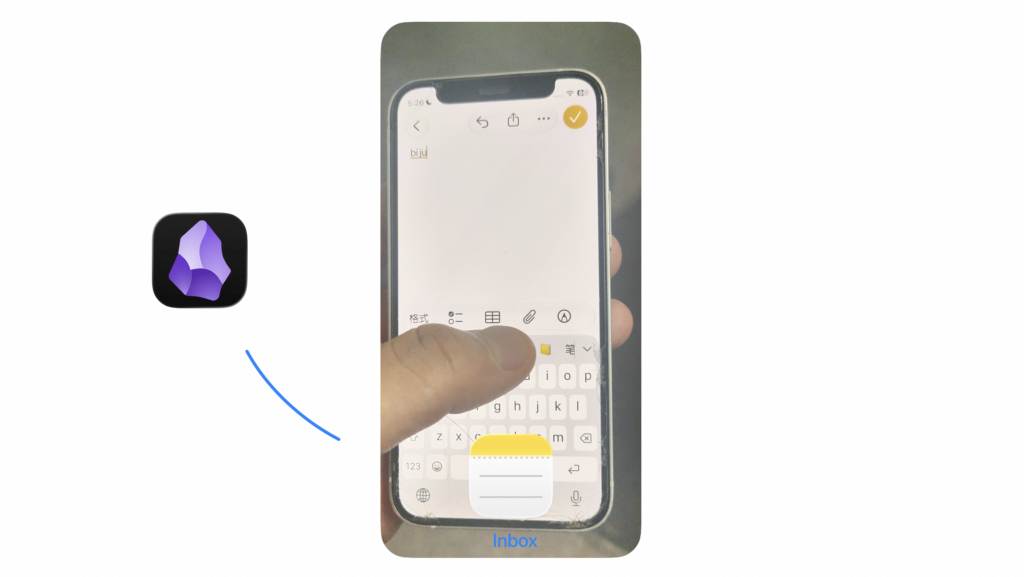
If an idea occurs to you while you are working inside your knowledge base and you do not want to classify it, add an Inbox right where you are.
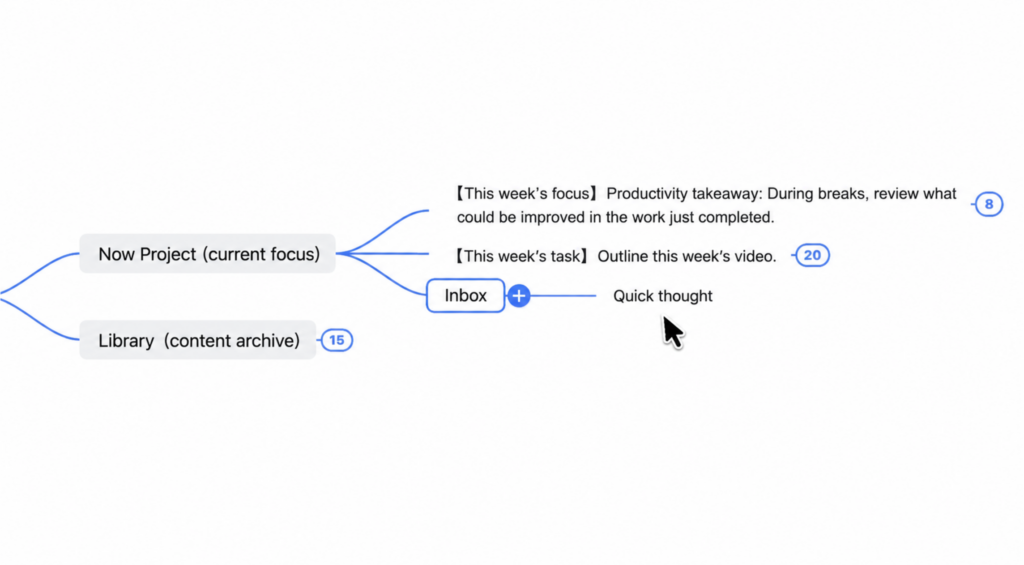
Suppose you have added a pile of material and are ready to classify it. But you have already distilled a Now Key. Adding each new note means working out how it relates to that Key and whether the Key itself should be revised. That becomes a hassle. What should you do?
The answer is the same: add an Inbox. Put the new notes there for now and leave them alone. Organize them later, when you have more energy or when you actually need them.
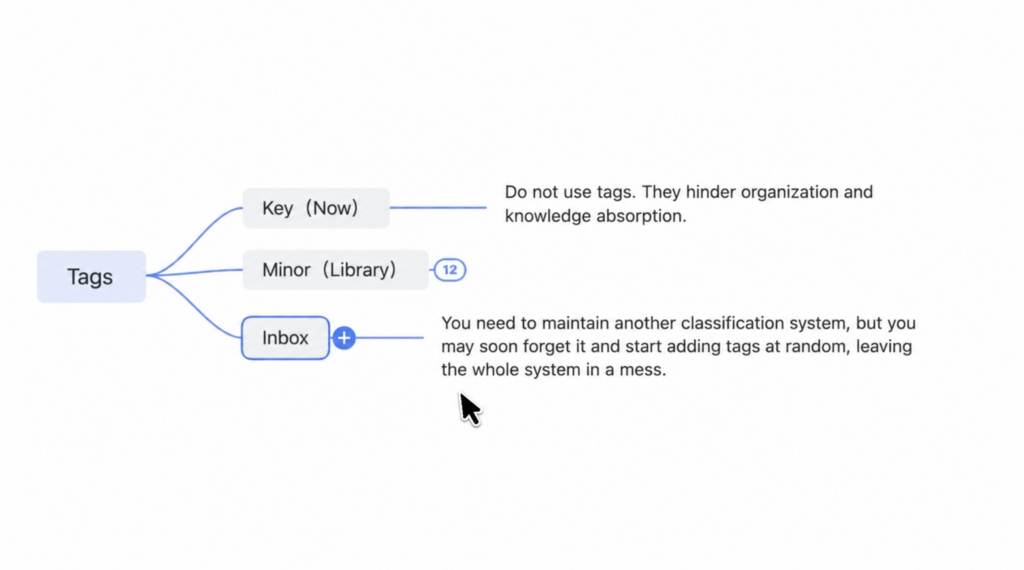
In other words, you can place an Inbox at every level and in every corner of your notes. It accommodates the natural rise and fall of your energy, keeping the system useful without letting it become chaotic.
Inbox gives the NL structure we discussed earlier some flexibility. Only when all three components come together does the system become truly practical.
We have now covered I, N, and L separately. Next, let’s look at how they work together.
Why INL Works
First, let’s talk about why notes become disorganized.
As your collection grows, you create folders and manage it layer by layer. But deep hierarchies are inconvenient, so you unconsciously start dragging folders out to the top level.
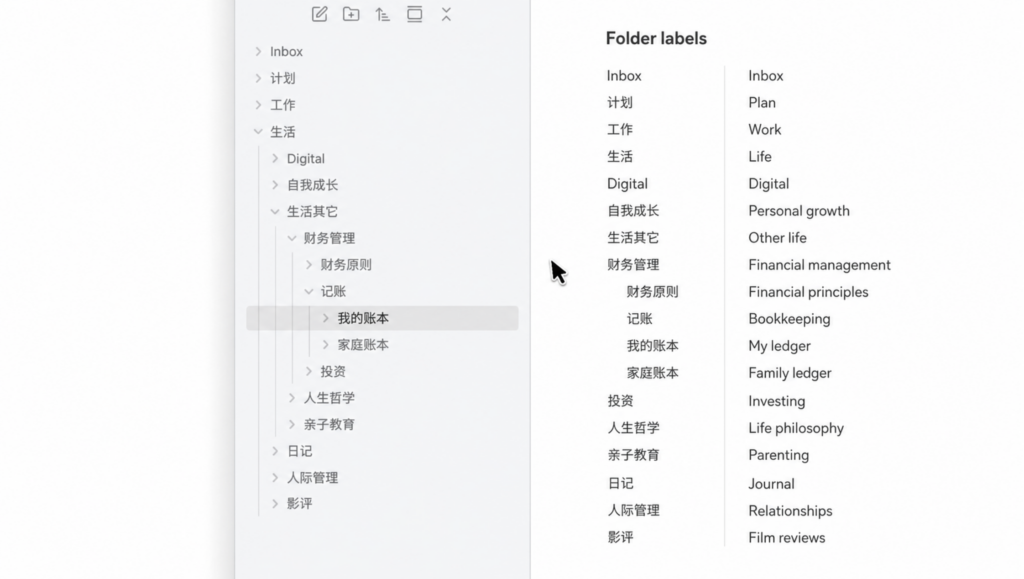
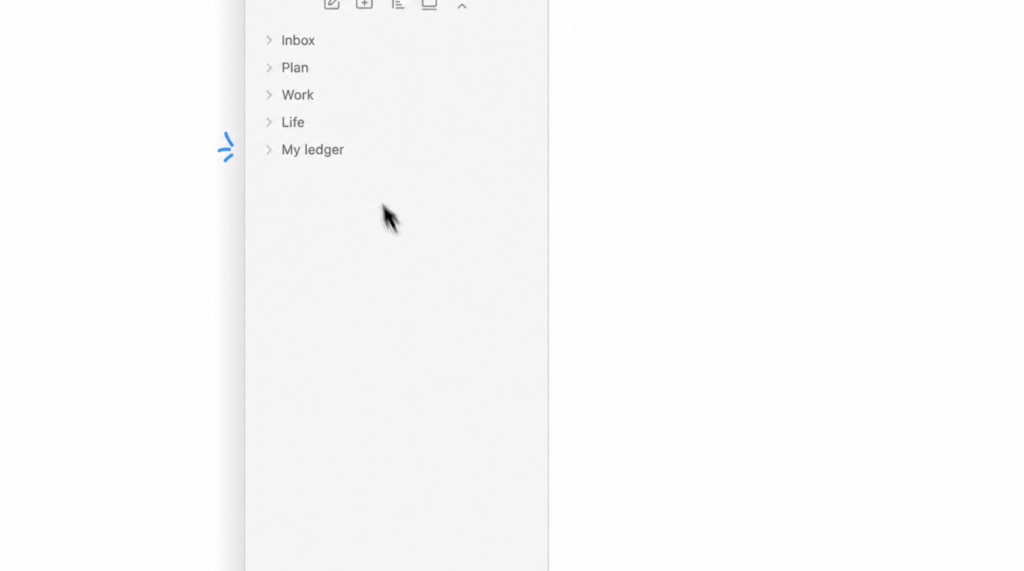
The brain has a threshold. Below it, you can stay in control no matter how untidy things are. Once the mess crosses that threshold, however, your brain can no longer process it, and the system quickly falls apart. Pulling a few folders out may work well at first, but their number keeps growing until your brain can no longer cope.
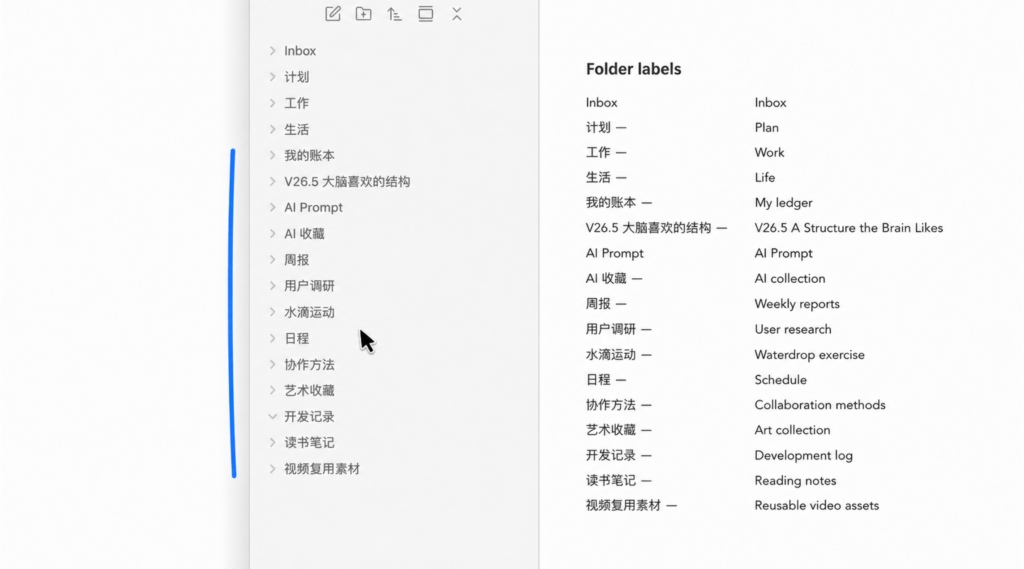
At that point, all you can do is deal with whatever is in front of you. You keep moving important things up and up, until the entire note library becomes a mess.
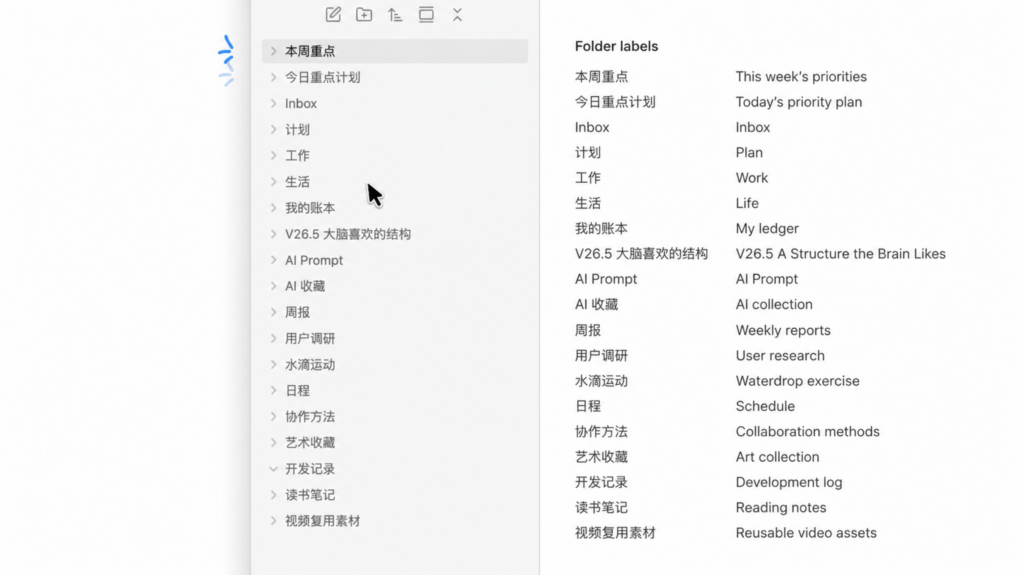
There is a fundamental conflict between complexity and usability. If you organize the mess, you create a deep hierarchy that is hard to use. If you want the system to be convenient, you need a shallow hierarchy—but then it cannot manage the complexity, and things become messy again.
Does that sound impossible to solve? INL can do it. When we dragged a folder out to the top level, we were already creating a kind of NL structure. The difference is that we did it unconsciously. Now we add a boundary—an empty folder, for example—to separate the two areas clearly and deliberately.
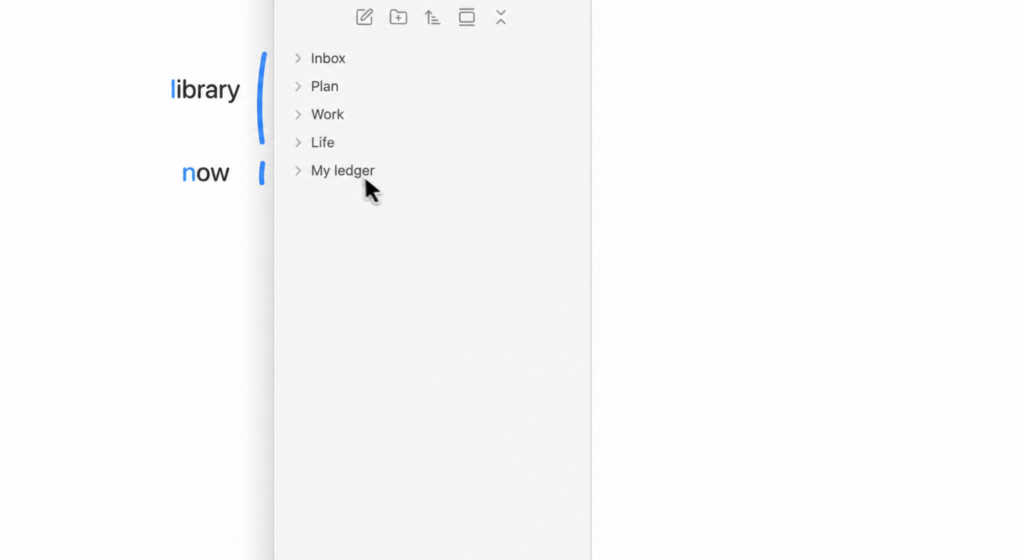
Inside Library, add an Inbox section and separate it just as clearly. If something in Now is no longer used often, drag it into Library. It will land in Inbox automatically, and you can organize it when you have time.
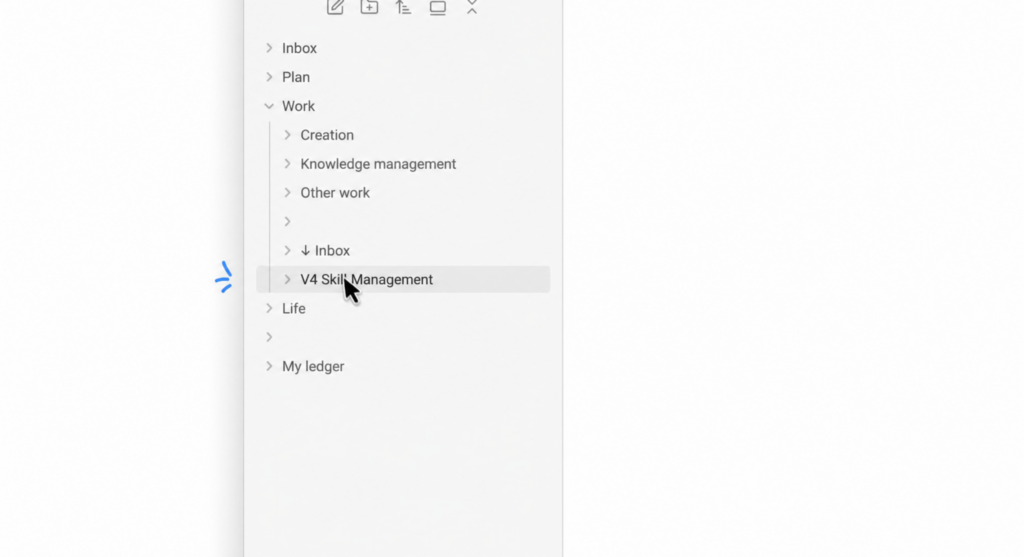
This INL structure gives you both usability, through Now, and a way to manage complexity, through Library. Inbox adds flexibility, keeping the system easy to use without damaging its underlying structure. It resolves the conflict between usability and complexity that we just described.
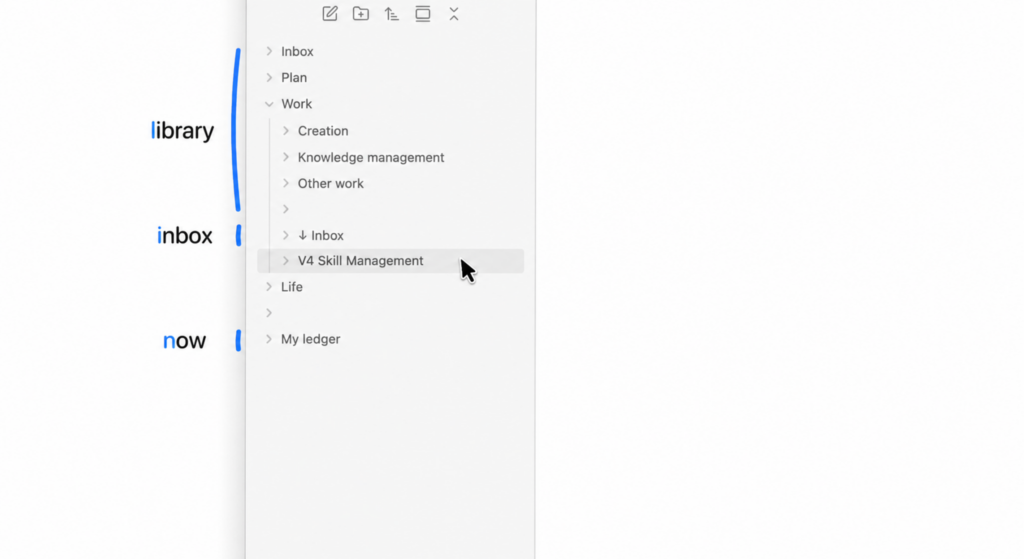
By now, I hope you can see INL’s fundamental value. It translates unconscious human behavior into an explicit, deliberate structure. That behavior is our mechanism of attention.
The world is enormously complex, so humans developed attention as a vital way to eliminate complexity. Wherever your attention goes—whatever you focus on—becomes the most important thing in that moment. As you read this article, for example, your attention is here, and you are ignoring everything outside the screen.
INL makes that attentional mechanism explicit. Let’s return to our three examples:
- When your attention is on projects, it becomes Now Project, much like PARA or Bulletproof Notes.
- When your attention is on knowledge, it becomes Now Key.
- When your attention is on use, it becomes a distinction between important and unimportant, or frequently and infrequently used.
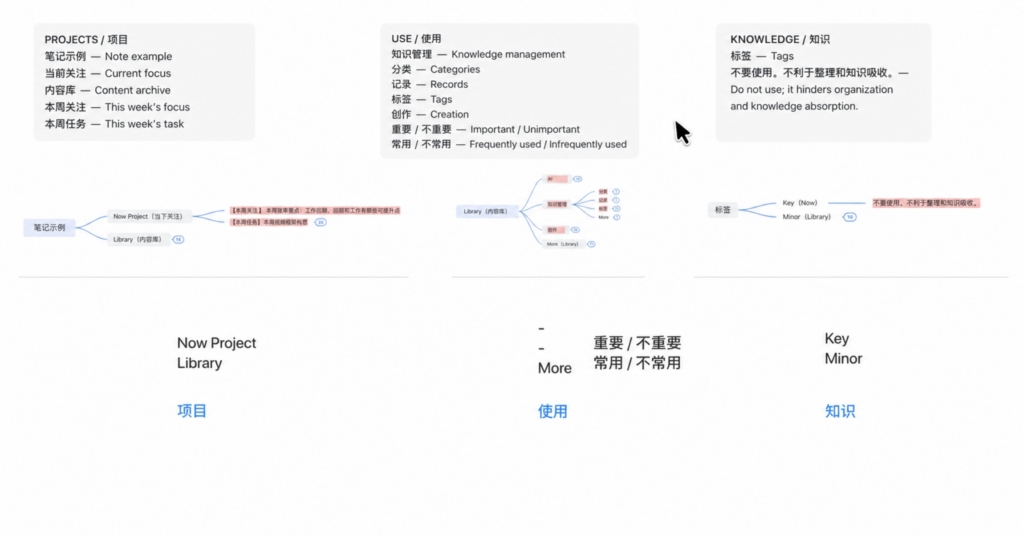
We already understood these ideas at an intuitive level, but intuition is unstable. As you keep using a system, it can drift. In the example above, everything starts out fine and gradually becomes disorganized.
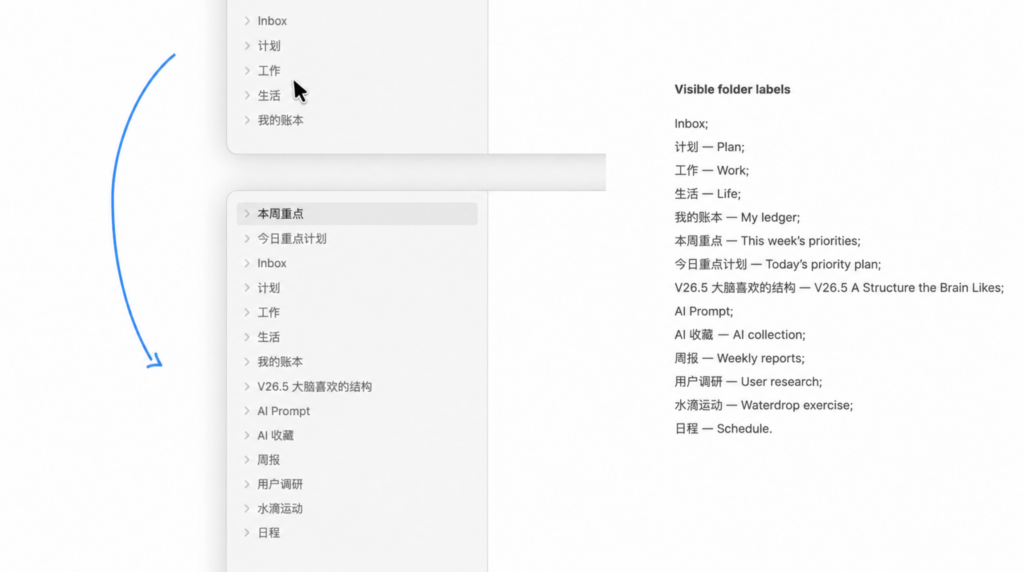
Only by making these patterns explicit can you distinguish and practice them deliberately. Then, no matter where your attention goes or how deeply you drill down, your notes can reliably show you what matters at a glance.
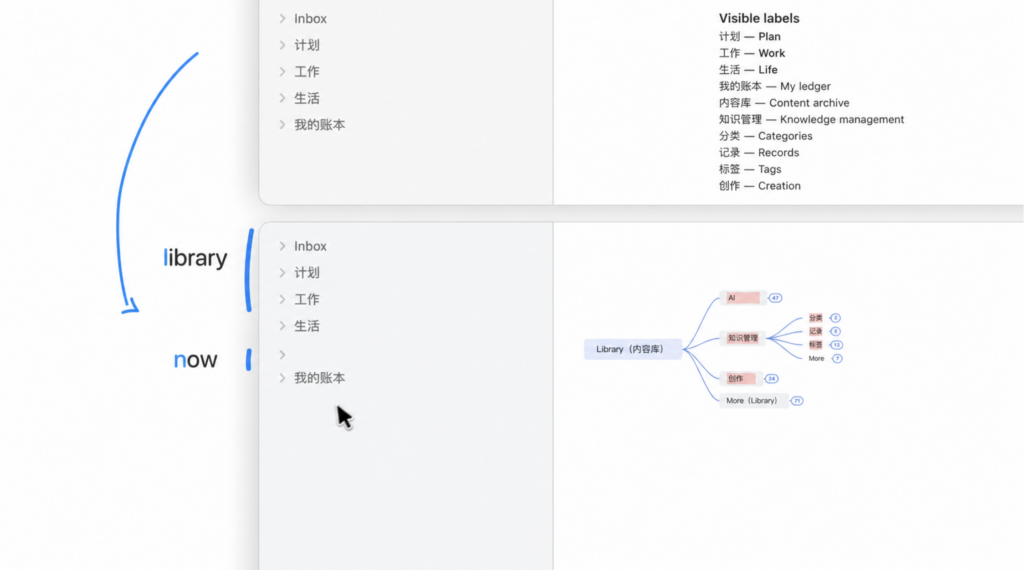
Attention is one of the deepest and most important mechanisms within human nature. It gives rise to many familiar tendencies, including the “spotlight effect” and “out of sight, out of mind.” INL puts those tendencies to work.
Notes used to feel heavy—we sometimes did not even want to open them—because the important and unimportant material was all mixed together. With INL, you do not pay attention to Library, so those notes feel unimportant and stop demanding your concern. Cognitively, it is almost as though they no longer exist. Instead of carrying the weight of your entire collection, you feel as though you have only a handful of notes. That is a tremendous psychological relief.
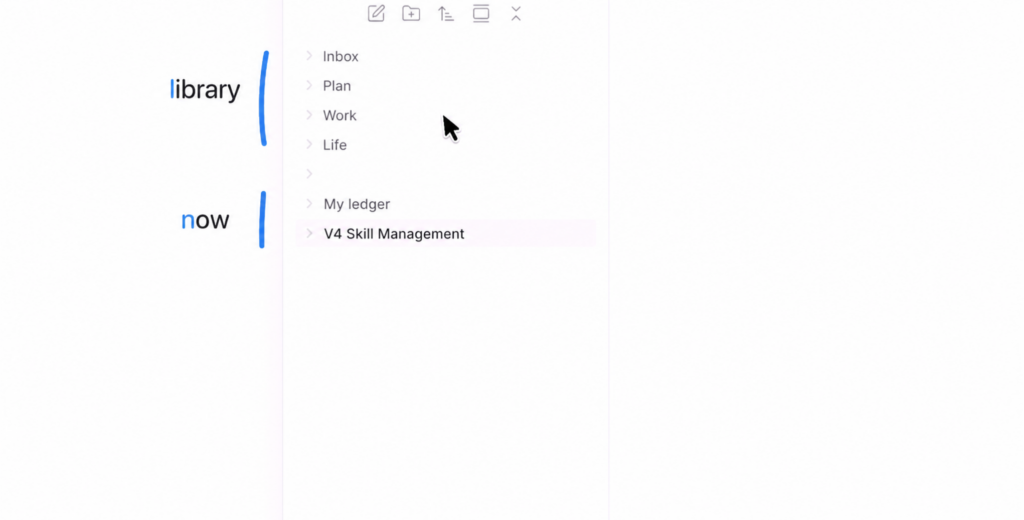
The effect is subtle; you have to use it to understand it fully. Because you no longer care about everything inside Library, you can build a deeper hierarchy there without feeling burdened. That naturally makes the material easier to manage.
Here is another example. Organizing notes used to be a major chore: you had to sort out relationships, remove filler, and merge overlapping ideas. With the Now Key described earlier, however, once you have distilled the essential point, the remaining mess stops mattering. You can leave all of it alone, dramatically reducing the work required to organize your notes.
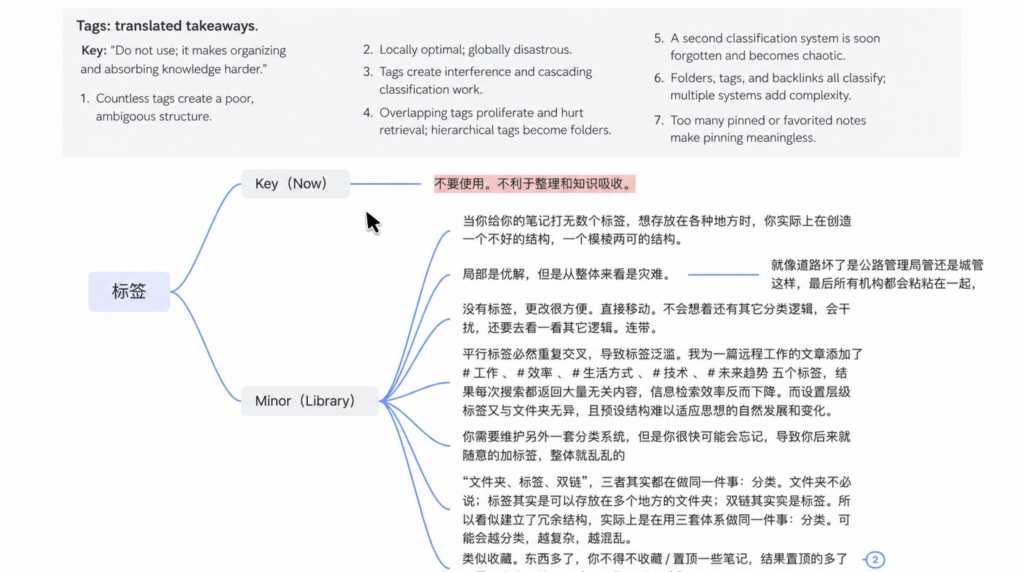
That covers how INL works and why it matters. I hope you can see that it is more than a way to classify notes. It is a foundational idea rooted in human nature, and you can apply it throughout your life.
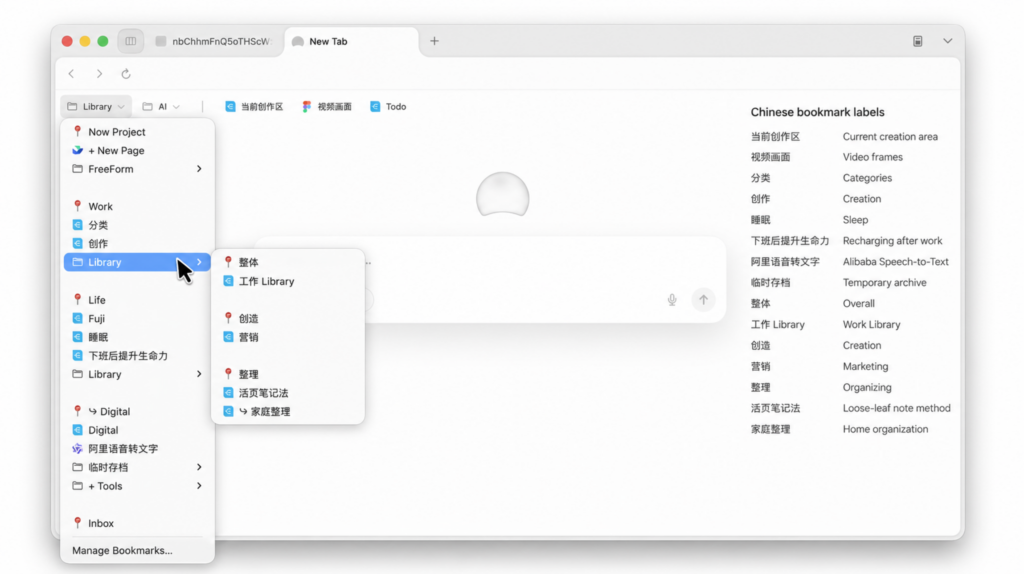
Here is one simple demonstration. If your browser bookmarks are constantly messy, you can apply INL there too.
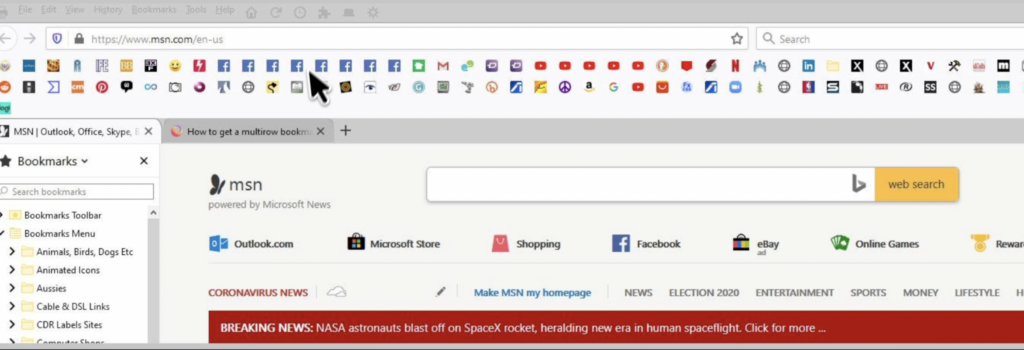
Keep your most frequently used bookmarks at the outermost level and put everything else inside Library. You can nest INL structures within it; a deep hierarchy is fine because you do not have to think about it. Add an Inbox at the bottom. Drag infrequently used bookmarks there and organize them later when you have time. Your browser becomes much easier to use.
Conclusion
I was in a library while writing this piece when I suddenly noticed the scene below. Isn’t this simply INL in real life?
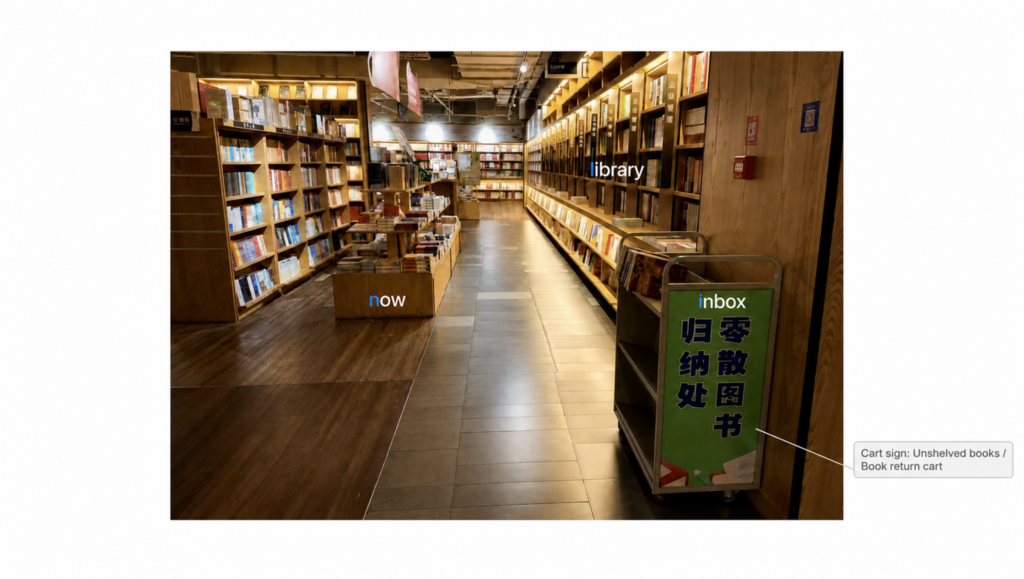
The bookshelves are Library. The popular books displayed in front are Now. Many people cannot be bothered to return a book after picking it up, so the library provides a cart as a temporary holding area. Isn’t that Inbox?
Let me emphasize this once more: INL is not some special note structure that I invented. It simply makes our unconscious human tendencies explicit.
The same is true of theories about human behavior—cognitive behavioral therapy, reframing, PDCA, and GTD, for example. People did these things unconsciously before the theories existed. And “invented” is not quite the right word: once the behavior was made explicit, you no longer needed an innate talent for it. It became a skill that anyone could practice deliberately.
The same is true of INL.
Share: