Editor’s note: The following text version is a polished, written rearrangement based on the video’s verbatim transcript. AI tools were used in the process, and the images are screenshots from the original video. The goal is to help you quickly browse the key information. It is recommended to watch the original video alongside this article for a more complete picture.
This is Vbot’s first product, “Big Head.”

I’ve been especially excited about this episode, because it’s going to be different from what we’ve done before. I’ll start with the physical design of Big Head itself, and move earlier into its mobility performance; then I’ll cover the hardware specifications that many people care about, explain why it doesn’t need a remote control, and what kind of perception capabilities it has. Later on, I’ll also talk about quite a few standout features that rarely appear in past robot reviews, many of which are highly practical. Big Head performed far beyond my expectations, and I didn’t anticipate this episode becoming so long—there are simply too many details worth talking about. I hope you enjoy it. This might well be the beginning of the next generation of home robots.
Appearance
Let’s start with the design. As a To-C (consumer-oriented) product, Big Head stands out from other small robot dogs that lack a head: with its head design, it is noticeably taller when standing and looks much more like a real puppy. Its standing dimensions are 61 cm × 34 cm × 57 cm, and it weighs about 14 kg.
The body makes extensive use of curved lines, giving it a cuter and more approachable feel. The aluminum alloy on the outer sides of the thighs is treated with a powder-coating process, so scratches and bumps are not very noticeable, and there’s no need to be overly protective during long-term use.
In terms of details, Vbot’s Big Head features larger knee joint limiters. The underside of the body is slightly raised, so when it lies down, your hand won’t get caught between the thigh and the lower leg, nor will it be pressed under the body (either would be very painful). The mass-production version adds soft material wrapping between the joints and the body, with no exposed joints on the outside, so there are no safety hazards.

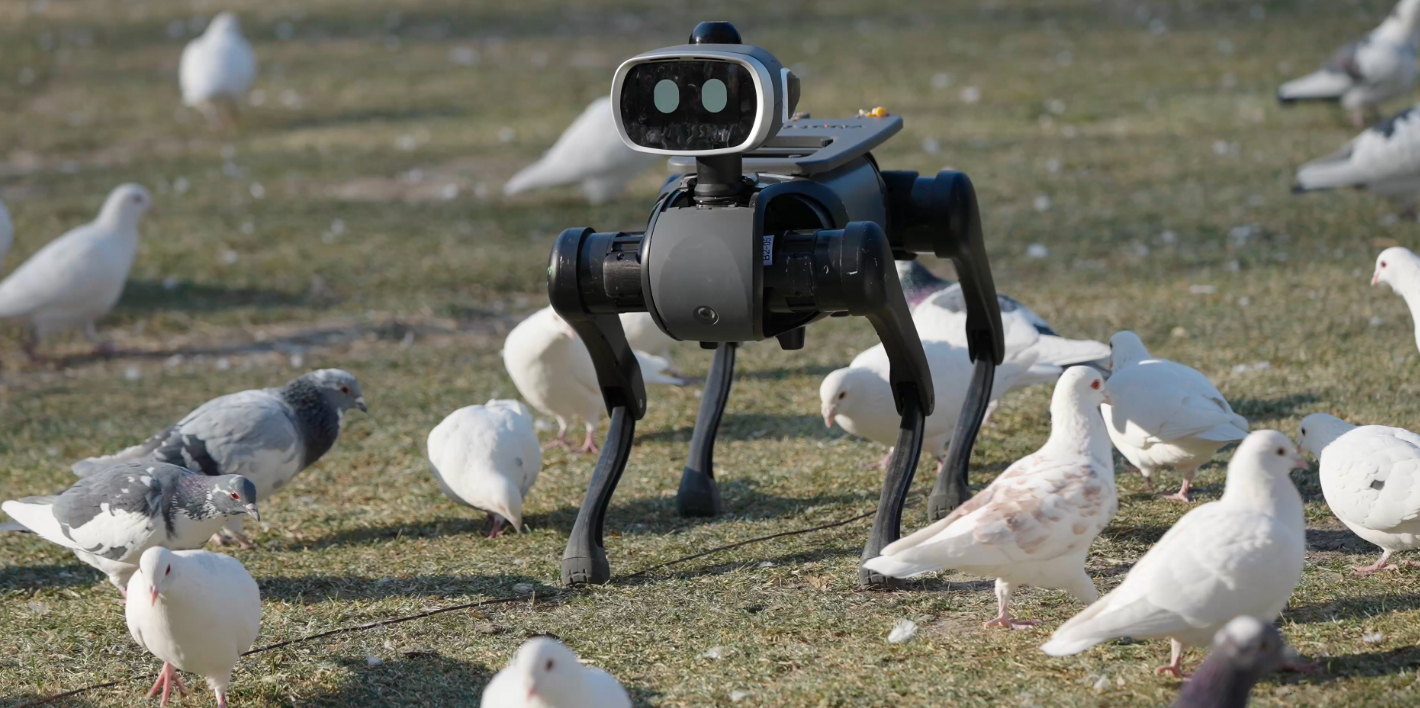
After a few days of use, I found that not only do humans like Big Head—it also attracts some small animals, mainly dogs, which become very curious about it. Alpacas and deer tend to keep a bit of distance. Whether pigeons come over doesn’t seem to have much to do with Big Head; as long as there’s food, they’ll fly in. When Big Head is still, everything feels peaceful and calm; once it starts moving, the pigeons take off.

I think its “human-friendly” and “animal-friendly” qualities come partly from its design, and partly from the fact that it runs very quietly—there’s almost no audible noise.
As a home robot dog, Big Head supports silent foot pads and is suitable for indoor use. But if it could only be used indoors or only on flat terrain, then there wouldn’t be much point in it being a quadruped robot at all. So next, let’s talk about its mobility performance.
Mobility Performance and Navigation
As you can see, this is a wild IROS obstacle course site. Any robot dog that can decisively traverse terrain like this is no simple machine. The following is a video segment of “Big Head” moving through complex terrain, showcasing several of its capabilities: first, its motion control does not require mode switching; when encountering relatively high steps, it can adjust its leg-lifting height within just a few frames to ensure passability. This detail is only noticeable in slow motion—at normal speed, you’d hardly catch it, only feeling that it walks well and that its leg adjustments are extremely fast. Everyday steps and curbs are all handled smoothly as well.

Its cruising speed can reach 14 km/h, with a top speed of 18 km/h. Overall, its mobility performance is excellent. Its disturbance rejection strategy is not overly aggressive: instead of using extremely high step frequency, it keeps its adjustments restrained and stabilizes its posture as much as possible while prioritizing user safety. In this kind of usage scenario, “Big Head” also has to account for the possibility of being messed with at close range by “rowdy kids (me).” From a safety standpoint, this design choice is very reasonable.
Next, let’s take a look at the overall hardware configuration of “Big Head.”
First, battery life—something I care a lot about, because carrying a dead robot home is both awkward and troublesome. “Big Head” offers 3 to 6 hours of runtime with a 594 Wh battery. The battery is not swappable, but that isn’t really a problem: the large capacity means you can head out without worrying about changing batteries, and there’s essentially no range anxiety. For charging, it supports both a Type-C port and a wireless “dock-and-charge” station, with a maximum charging power of up to 240 W, taking about 2.5 hours for a full charge.

In terms of perception, “Big Head” is equipped with a 16-beam LiDAR and a stereo depth camera system, supporting 1080p video transmission. It uses the DiGuA Robotics S100P chip, providing up to 128 TOPS of AI computing power. Many of the features I’ll talk about next are closely tied to these perception capabilities and hardware specs.
Lead, follow, navigate, tow—some of these functions are fun, some are special, and some are almost unheard of, yet they are all simple to use. The four-microphone array can detect the direction of sound and provide head-movement feedback—“Big Head” really is listening to me.
I give the command: “Big Head, Big Head, start leading.”
The leading function is a lot like walking a dog: “Big Head” walks in front, autonomously perceiving obstacles, finding its way, and planning routes. When it reaches an intersection, it chooses a path on its own; if I want to take a different one, I just tug the leash slightly from the side to guide it, and it will switch to the route I choose.
These visuals show the world as “Big Head” sees it: perception results, route planning, depth information, its understanding of the road, and a top-down view. You might already recognize shades of autonomous driving here. “Big Head” knows where the road is and where it can go—but it doesn’t yet know when to stop. If I want it to halt, for example to tie my shoes or greet someone, I just pull the leash from behind.

To resume leading, I don’t even need to give another voice command—just give “Big Head” a gentle nudge on the backside. The overall interaction feels very natural, a real-world version of “cyber dog-walking.”
It’s worth noting that the leading function does not require positioning systems or high-precision point clouds. It relies solely on its onboard LiDAR and vision to perceive the environment. This means “Big Head” can explore and unlock new maps with me even in unfamiliar places.
Now let’s look at following. I think this may currently be the most fully realized follow mode in the robotics industry, truly turning “Big Head” into a “little sidekick.” This uses an included accessory: a UWB beacon.
I give the command: “Big Head, Big Head, follow me.”
With obstacle avoidance enabled, “Big Head” locks onto the beacon, tracks its target precisely, and doesn’t drift or lose the subject the way vision-only solutions sometimes do. But even that alone would only count as “pretty good.”
Vbot also offers an expansion board accessory, which can be mounted on “Big Head’s” back with hand-tightened screws. A basket can be installed on top for carrying items. “Big Head” supports a payload of 10 kg, with a maximum of 12 kg. The structure is solid and also supports quick release, making it easy to carry things or remove the module—already impressive.

The expansion board also includes a standard 1/4-inch screw mount commonly used in the imaging industry, allowing you to attach action cameras, 360-degree cameras, camera gimbals, or even smartphone gimbals for follow-shot filming. I personally love this feature.
There’s another great design detail: the UWB beacon has a built-in microphone. You can press its button and speak directly to “Big Head,” avoiding wind noise or other ambient sounds interfering with command recognition.
Navigation is a feature I’ve rarely experienced on consumer robot dogs—it’s more common in industrial-grade products, mainly for scheduled inspection tasks. With “Big Head,” you first map the navigation area; usually walking it twice is enough. After mapping, you can tap a location on the map in the mobile app to name it, then give the command: “Big Head, Big Head, take me to the restaurant.”
Each navigation run may involve different people and changing street scenes, yet “Big Head” still performs very well, showing a certain level of generalization ability. Night navigation is no problem either. And it doesn’t get boring along the way—every so often, “Big Head” draws attention to itself and reports the navigation progress. For me, the most convenient part is that there’s no need to set the robot’s position or orientation on the map beforehand; you can start navigating right away. It’s very user-friendly for ordinary users.

Towing mode is for situations where you need to move faster or when the environment and obstacles are more complex: you simply pull “Big Head” along. I also made a point of confirming that its head structure has been reinforced, so using it as a leash attachment is reliable. The two degrees of freedom in the head (rotation and pitch) showed no issues at all during several days of use.
After seeing all these features, I think you can understand why “Big Head” doesn’t need a remote control. Still, a remote option exists as a safety backup, tucked away in the secondary menu of the mobile app. It supports one-handed operation and offers plenty of movements to try, so I won’t go into detail here.
But remote control doesn’t stop at remote control—there’s also a particularly interesting mode: the Avatar proxy. I can join this world in the form of “Big Head,” remotely control the robot itself, and experience extremely low network latency. With a new perspective and a different identity, I can run outdoors, greet passersby, and approach small animals. You have to realize: a person in their twenties or thirties chasing pigeons on a lawn looks pretty strange to others—that’s the kind of self-restraint adults impose on themselves.

Remotely controlling a robot dog, however, is different. If I want, I can lie on the couch and chase pigeons until “Big Head” is almost out of battery. I can greet puppies and, within safe limits, interact with children. In truth, every adult was once a child—only a few still remember it. At this moment, I am one of those few.
While playing, I once asked, “Can we turn on ‘Big Head’s’ microphone for live voice chat?” The answer I got was: “Absolutely not!” On second thought, that makes perfect sense. If you came across such an adorable robot dog and it suddenly spoke in the deep voice of a grown man, the sense of mismatch would be overwhelming—like when Disney’s LinaBell character head falls off and the staff inside greets you in a thick Beijing accent. The fairy tale would shatter in the most terrifying way.

Of course, you can now type what you want to say (or use speech-to-text) and have “Big Head” speak it in its own voice. You really should try this—it gets some hilarious reactions.
I believe many people can find a kind of pure, genuine, age-independent joy in “Big Head,” or in things that seem childish on the surface. I haven’t felt this way in a long time.
There’s also a feature called “Dance to the Beat”: “Big Head” can recognize audio waveforms picked up by its microphone and generate movements according to the rhythm of the music, focusing on hitting the beat. In the past, whether robot dogs danced on beat largely depended on how accurately you pressed the play button for the music. Now, letting “Big Head” listen and generate beat-matched movements on its own solves that problem.
A Sense of Life
If the features mentioned earlier already show “Big Head’s” playfulness and technical autonomy, then what comes next is what fascinates me the most about it: its sense of life.
Where does this sense of life come from? I see unpredictable autonomous decision-making, and movements that align with biological intuition.
Here is an example of “Big Head’s” chain of thought. The command was: “Let Big Head look for something it finds interesting.” No one knows what it will choose, so every time I’m eager to see what kind of response it gives.

The most surprising instance was when “Big Head” noticed an advertisement display. It wanted to get a closer look: first walking over, then lifting its head to look up. That head-raising motion matched biological instinct perfectly, but I had no expectation of it at all—seeing it for the first time was genuinely stunning. “Big Head” knows what it is interested in, knows that tall things need to be looked at by raising its head, and can even recognize that the image in the ad is a robot dog, judging it to be one of its “own kind.”
Another time, many people stood in front of “Big Head” and asked it to find someone it found interesting. No one knew who it would pick, but being chosen by a robot dog is truly a delightful experience. “Big Head” would actively walk up and interact with the person it was interested in.

Its spatial-agent capabilities allow “Big Head” to complete complex, multi-step tasks in the real world, such as going to find someone to get a bottle of water and then bringing it back. You might think that’s not particularly hard—but this is only the beginning.
In past reviews, we were used to using a product to gaze into the future. This time, I hope you can look at the present instead: using today’s existing technologies, Vbot has already delivered a large number of innovative experiences for everyday users, listening to user needs and polishing the details thoroughly. Many things that usually require DIY modifications already have official solutions among the original accessories. For me, “Big Head” has almost no barrier to entry.

Even though I understand what hardware and technologies are behind these features, I still find myself immersed in the “magic” they create. Sometimes “Big Head” leads the way ahead of me; sometimes I have a little sidekick at my side. A huge number of its movements and expressions are designed by animators, to the point that it can even give you the illusion of a cartoon character—and you never once need to think about “where the remote control is.”
Epilogue
The past few days with “Big Head” have felt more like the future—yet they’re happening right now.
This robot dog is already far beyond the level of a mere “early taste” product. I genuinely want to have “Big Head” with me for the New Year, and I’d be happy to keep it by my side for a long time to come.
Alright, thank you for reading all the way to the end. I hope you enjoyed this episode, and that you liked seeing all the different sides of “Big Head” in the review. Thanks to Vbot for creating such an amazing product—this was a truly satisfying review to make. Thanks as well to the Vlight Club at Beijing Forestry University for their support, which made it possible for us to complete this episode smoothly. There’s more robot review content currently in production, so stay tuned. See you in the next video.
Leave a Reply