This is TDS Studio’s seventeenth article on SSPAI, once again released as an all-platform exclusive.
Faced with such a complex model name, it’s only right that we begin an Audio-Technica review by explaining the naming. CKS indicates the Solid Bass series, which emphasizes low frequencies; 50 places it in the mid-range tier; and TW2 means it’s a true wireless model and the second-generation mainline entry in this series. That explanation sounds straightforward enough—but in reality, the CKS50TW2 is actually the third-generation product in the lineup. The progression goes roughly like this: CKS5TW → CKS50TW → CKS50TW2. One defining trait that runs through this series is its notably strong single-charge battery life, rather than an all-out focus on sound performance like the TWX7 or CKR7TW lines. This time, we borrowed the Star Wars Edition CKS50TW2 purchased from Version V; we previously mentioned this release in RKTALLK Episode 059, while the standard retail version had appeared earlier. Many thanks to Version V for the loan.

Package & Accessories
The retail packaging of the CKS50TW2 follows Audio-Technica’s familiar white-based design language, while the Star Wars Edition comes with a bespoke design and is priced USD 30 / JPY 3,520 higher than the standard version. Inside the box, you’ll find a short USB-C to USB-A charging cable and four sizes of ear tips.
Design, Fit & Acoustic Structure
Including both the standard retail colors and the Star Wars special editions, the CKS50TW2 is currently available in seven colorways: the retail off-white, black, and dark green, plus the Star Wars editions—R2-D2 white/blue, Darth Vader black/red, Grogu light green, and Mandalorian silver-gray. Notably, the Mandalorian version appears to have been sold via a limited-time lottery on the official store and is currently unavailable.

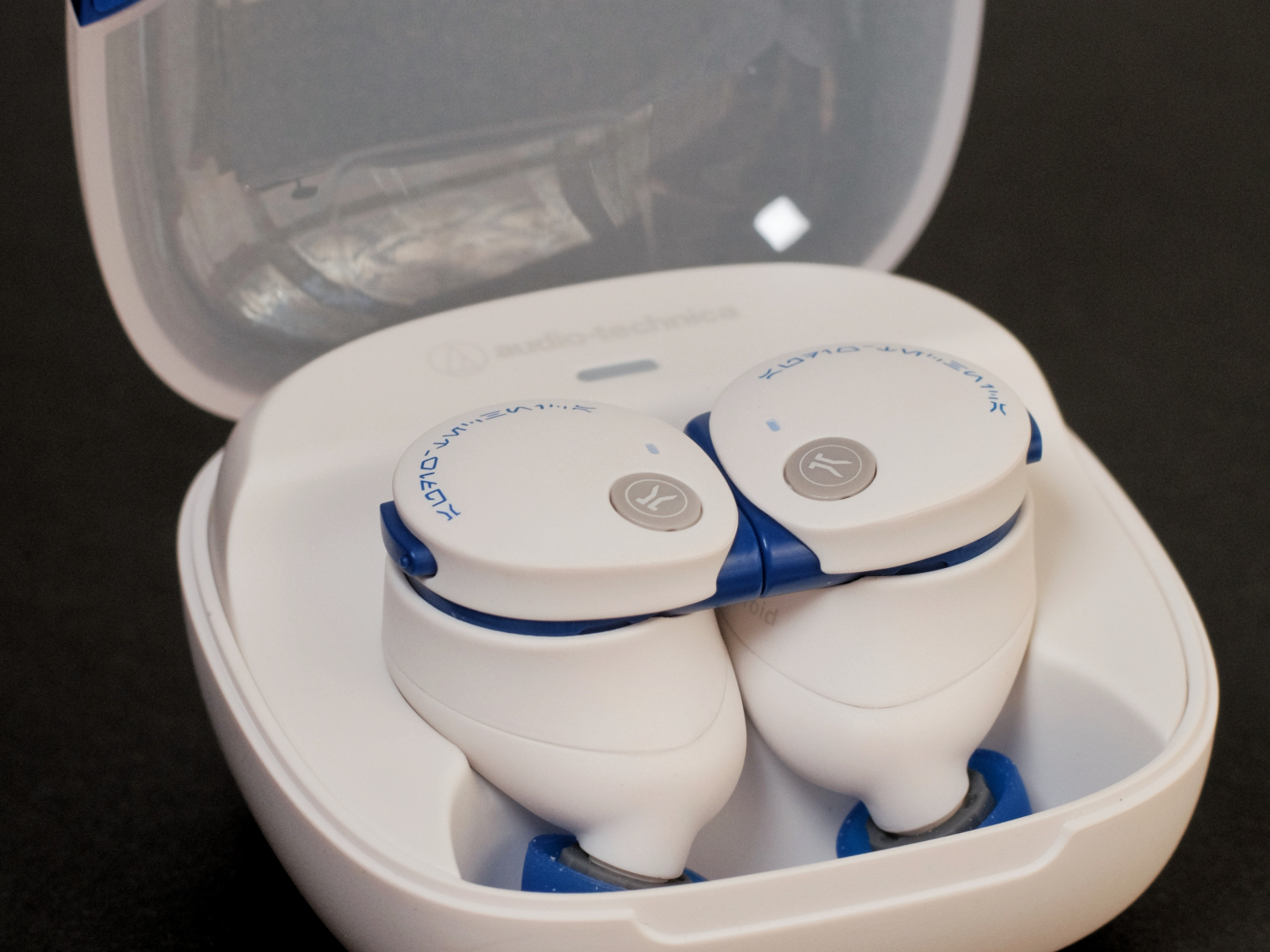
All seven variants feature a semi-transparent charging case lid. The R2-D2 white/blue version we have uses a frosted white semi-transparent lid, paired with a pure white base that has no warm or cool tint, accented only by blue detailing around the magnetic latch. The case can be opened and closed with one hand, though it feels a bit lightweight. The earbuds rest flat inside the case, with the LED indicators also located within.

The earbuds themselves use a “buds”-style in-ear design. In fact, within Audio-Technica’s TWS lineup, only the TWX series adopts a stem-style “pods” design—everything else uses this buds form factor. The CKS50TW2 housings are fairly large. Compared with the familiar CK3TW, they’re noticeably bigger by about two sizes, and larger than models like the recently reviewed LinkBuds Fit, WF-1000XM5, and AZ100—roughly on par with the TE-ZX1. That said, the inner side of the housing features some contouring, so the portion that actually contacts the concha and cymba isn’t extensive. Much of the visible faceplate sits above the surface of the ear. As a result, unless you have particularly small ears, the CKS50TW2 is reasonably comfortable to wear. Side-lying use, however, is essentially out of the question.

The two earbuds can magnetically attach to each other via a set of contact points and also integrate a Hall sensor. This design is quite rare in the TWS space but is common—almost standard—in neckband-style Bluetooth earphones. The reason Audio-Technica chose this structure ties directly into the model’s excellent battery life, which we’ll discuss later. In any case, thanks to the reliable magnetic connection, you’re unlikely to lose a single earbud when carrying them outside the case; the two snapping together feels reassuringly secure.
The CKS50TW2 is rated IP55 for dust resistance and splash protection, meaning light rain and regular workout sweat should pose no real problem.
Control & App
The circular ornament on the faceplate is not a touch surface. Control is handled via a physical button located toward the front edge on the rear side of the housing. It supports single, double, and triple presses, as well as two long-press durations, all of which can be customized in the app. You can also adjust the button response speed. At the default setting, there’s about a one-second delay when pausing playback, while other actions feel relatively snappy.
Notification sounds are naturally a major highlight for a co-branded product. On the R2-D2 version, system events such as power on/off, connection, disconnection, low battery, noise-canceling toggles, and mode changes are all accompanied by R2-D2 voice samples. Both clarity and volume are more than adequate.

Like the TWX7 and others, the CKS50TW2 uses Audio-Technica’s Connect app for control and fine-tuning. The default interface is laid out clearly, though the settings section packs in many options without further sub-categorization. Fortunately, the UI is intuitive. Below is an overview of the main screens and a closer look at what each function does.

On the main page, the features are arranged as follows: ambient sound control, equalizer, low latency, timer, soundscape, and playback controls. The custom settings page is divided into Audio Settings and System Settings. All told, the range of controls available via the Connect app is extensive—more detailed than most TWS control apps I’ve used.
The Private Timer is a standalone countdown tool independent of the system timer. It offers three alert tones and supports countdowns longer than one minute, making it handy for reminders during long listening sessions or as a simple alarm when wearing the earbuds for a nap.
Sound Scape
As with the TWX7, the CKS50TW2 supports the Sound Scape feature. To recap, many manufacturers—and even iOS itself—offer similar functions. For example, iOS “Background Sounds” includes three types of white noise plus ocean, rain, and stream sounds. Audio-Technica’s implementation, however, is a bit different. Apple’s background sounds are already among the better-sounding options in this category, with file sizes exceeding 60 MB and a fairly natural listening experience. Audio-Technica’s Sound Scape samples, on the other hand, are recorded using the company’s own professional microphone lineup.
Sound Scape can be used in conjunction with the timer mentioned above. By default, it offers thirteen sounds: three white noises, four “healing” sounds, and six natural soundscapes.

In the white noise category, beyond standard white noise and pink noise, there’s also “Quiet Office,” which sounds like a calm office with air conditioning running. The sense of space isn’t cramped, and the proportion of AC noise can be freely adjusted. Combined with active noise canceling, it creates a surprisingly convincing environmental simulation. It can be useful for those who work better with ambient sound—assuming you don’t mind AC noise.
The natural sound category includes six options, all rendered with convincing realism and a strong sense of space. In the ocean soundscape, the stereo imaging of waves rolling in is particularly impressive. Wind in a forest is notoriously difficult to record, yet the sound of wind moving through leaves is recreated here with notable fidelity. I won’t go into each one in detail—you can try them yourself in person.
More distinctive are the four sounds categorized as “healing.”
“Rejuvenation” blends synthesized choral vocals with forest ambience, flowing water, and birdsong. “Tranquility” is built on pad-style synthesizer tones, lightly accented with natural sounds. “Journey” also uses pad tones, but with slower, subtler pitch changes, resulting in a deeper, more subdued feel. “Serenity” sounds fuller and richer, combined with subtle effects—very much the kind of audio you might listen to at night. In short, these are well suited for meditation, breathing exercises, and similar scenarios, carrying a clear sense of zen-like calm.
Beyond the features shared with the TWX7, the Star Wars edition of the CKS50TW2 adds three exclusive custom sound effects: random R2-D2 sounds, white noise from inside the Millennium Falcon, and cockpit signal tones from an X-wing fighter. All are fun and surprisingly authentic. As a fan of another niche sci-fi IP myself, I can’t help but say—if there’s ever a Doctor Who collaboration with a TARDIS interior soundscape, I’d buy it without hesitation.
ANC, Transparency & Call
Thanks to its relatively large housings, the CKS50TW2 already offers decent passive isolation. Compared with the TWX7, however, the overall improvement in noise cancelation isn’t just down to passive isolation—it also reflects tangible progress in active noise cancelation. This may be the first time an Audio-Technica mainstream product has made me think its ANC is genuinely “quite good.” With ANC enabled, the CKS50TW2 noticeably suppresses steady low-frequency noise, and it also does a respectable job of reducing the lower body of human voices. While in very noisy environments you can still sense a gap in effective bandwidth coverage compared with most Skyline Level models, it’s already very usable in practice. On top of that, ear pressure is reasonably well controlled, with no obvious discomfort.
As for wind noise, the CKS50TW2 doesn’t include a dedicated wind-noise reduction mode. In real-world testing, however, wind interference was only mildly noticeable when facing away from strong wind. Wind coming from the front or sides is largely cleaned up once ANC is enabled, barely affecting normal listening—an area where it performs quite satisfactorily.

In transparency mode, the naturalness of ambient sound is good, with no deliberate boosting of specific frequency bands. Although there is still some roll-off in the high frequencies and it’s not a fully high-fidelity passthrough, among Japanese brands aside from Sony, this places it firmly in the top tier. The wearer’s own voice does sound slightly muffled, something to keep in mind during conversations. Wind noise in transparency mode isn’t particularly severe either, becoming noticeable mainly when the wind comes from the side or behind.
The talk-through feature also carries over. Audio-Technica defines this as automatically switching to transparency mode and lowering music volume when enabled. You can adjust it in three levels within the app.
For calls, pickup volume is moderate, and clarity is usable though not outstanding. In carrier-network call tests, voices remain somewhat emphasized even in noisy environments. The tonal character sounds a bit muffled, but stability is good. Wind noise during calls depends heavily on direction: frontal wind has minimal impact, while side or rear wind introduces more noticeable interference.

Overall, the CKS50TW2’s noise cancelation is practical and well-rounded. It doesn’t excel dramatically in any single area, but its combined ANC performance, wind-noise handling, and transparency naturalness all place it toward the upper end of the Fine Level tier. That said, the depth of active noise cancelation doesn’t offer a strong advantage over similarly priced competitors and still trails the Skyline Level group. For everyday use, however—especially when combined with its passive isolation—it’s more than sufficient. Taking everything into account, we believe the CKS50TW2’s overall noise-cancelation performance earns it a place in the TDS Noise Cancelation Pyramid at the In-Ear Fine Level, with an above-average ranking within that tier.
Connection & Battery
It doesn’t support high-bitrate codecs, so we tested it under AAC as usual. In our standard signal test environment, paired with the Xperia 5 III using AAC, packet loss and stuttering were minimal whether WLAN was on or off. At a distance of 7 meters with a load-bearing wall in between, there was no noticeable increase in stuttering, while packet loss began to meaningfully affect the experience at around 9 meters.
In terms of latency, it supports a dedicated low-latency mode. Following our test procedure—AAC codec, Xperia 5 III as the source, and streaming video playback—subjective latency with low-latency mode enabled stayed under half a syllable at normal speech speed. This is perfectly usable for most video viewing and gaming scenarios that don’t demand ultra-tight synchronization. Without low-latency mode enabled, latency exceeded half a syllable and became more noticeable.

Battery life is where things get truly impressive. Official figures list 15h/25h of continuous playback from the earbuds alone (ANC on/off), and up to 40h/60h total with the charging case (ANC on/off)—frankly, staggering numbers. During our loan period, it wasn’t feasible to run a single uninterrupted test of that length, but several simplified half-cycle tests largely confirmed the claims. Whether it’s Audio-Technica or AVIOT, non-flagship sound-focused models still seem wildly “overpowered” when it comes to single-charge endurance.
In charging tests, the CKS50TW2 was able to charge steadily at a power level of around 1.2 W, with no issues regarding PD support. It also supports wireless charging. Below are the results of the wireless charging test.
| Charging Type | Charger | Audio-Technica ATH-CKS50TW2 |
|---|---|---|
| Qi Wireless | TESTV “KuaiLeNengLiang” Teardown Test Pad | Front charging position: 2 W; rear charging position: no charging |
| Qi Wireless | Lǜli Qi2 2-in-1 W702 | Primary charging position: 1 W; secondary charging position: no charging |
| Wired | Anker Nano II 100 W | All three ports supported; input power stable at around 1.2 W |
Driver, Sound Modes & Codec
The CKS50TW2 is equipped with a 9 mm dynamic driver. Supported codecs include SBC, AAC, and LC3.
In our previous article on the TWX7, we mentioned that when enabling the equalizer, Audio-Technica displays a specific prompt indicating that the sampling rate will be limited to 48 kHz. The impact of EQ on sound is well known, and limiting the sampling rate to enable EQ is a reasonable trade-off. With the CKS50TW2, however, the highest supported codec is AAC, so this prompt no longer appears. The five default presets are Original, Bass Boost, Clear Vocal, V-shaped, and Treble Enhance, and their sonic effects largely align with what their names suggest.
The custom equalizer allows adjustment across five frequency bands with a ±12 dB range. You can also independently set left/right channel balance in the app, as well as fine-tune volume in 16-step, 32-step, or 64-step increments—particularly useful for users who find one volume step too loud and the next too quiet.
Sound Description
Based on ANC off, AAC codec, and default sound mode.
The low end has slightly elevated quantity, with generous thickness and fullness. Elasticity is good, and sub-bass extension is acceptable. Decay is not especially fast, leaving some residual reverberation. There is a noticeable sense of ambience and bloom, but it never feels excessive. The bass presentation is very much in line with what you’d expect from a bass-focused series, yet in most everyday tracks it doesn’t come across as overpowering. It recalls the tuning approach of earlier Audio-Technica CKS wired earphones—rather than simply piling on energy, it presents bass with a thick, relaxed texture. Bass imaging is on the larger side, and instruments with fundamentals in the lower mids exhibit a slight forward tilt.
In the midrange, vocals are positioned relatively close, with slightly larger mouth shapes and limited emphasis on fine articulation. Texture takes priority over line definition, with moderate thickness. Grain is smoothed out, resulting in generally good overall smoothness. There is a mild warm coloration; the tonality isn’t strictly neutral, but it also avoids any sense of energy buildup. Throat tones are well behaved, breathiness is sufficient, and details like saliva sounds are polished and kept from protruding. Sibilance is present but softened—audible without being sharp or piercing. Overall, vocals are not dark, with a subtle lift in brightness that seems designed to balance the bass-forward character.

For instruments, texture again takes precedence over sharp outlines. Among strings, violins, violas, and guitars lean slightly warm, with plucked and bowed details that aren’t particularly forward or attention-grabbing. Cellos feel a bit loose in body definition and occupy a larger portion of the soundstage. Brass instruments convey a good sense of power; trumpets and other brightness-dependent instruments have adequate sparkle but roll off relatively early. Woodwinds show a slight enhancement in airiness, with a natural presentation. Harmonic content is relatively rich. In percussion, kick drums have a clear presence, snares decay a bit slowly, and cymbals are bright enough without sounding harsh or overly metallic.
Treble overall has moderate brightness, though the upper-mid transition region is somewhat thickened. The response is generally smooth, without pronounced sharp peaks. Ultra-high-frequency extension is not particularly strong, with an earlier and steeper roll-off compared with the TWX7.

Soundstage width is average. The forward-leaning imaging of the low and lower-mid frequencies makes the space feel less expansive, with a noticeable sense of boundaries. Both horizontal and vertical dimensions feel just sufficient rather than spacious. Combined with a decent sense of height, the overall spatial shape resembles a spindle. Separation between vocals and instruments isn’t especially strong, though coherence is good. Resolution doesn’t stand out at the sub–¥1,000 RMB price point, falling into a second-tier level of detail for its class. It sounds less clear than the TWX7, but this restrained sense of “resolution” contributes to a more fatigue-free, listenable presentation. Dynamics are adequate, while transient response is unremarkable.
Overall Impression

Compared with the TWX7 we discussed earlier, the CKS50TW2 doesn’t devote all its effort to sound tuning. Instead, it positions itself as a product with a wide range of interesting and practical features. The ANC performance is a pleasant surprise, and the sound tuning suits mainstream listening preferences, though it doesn’t stand out in terms of versatility or technical prowess. Its real strengths lie in its exceptionally long battery life, stable connectivity, and thoughtful functional details.
The standard retail version has remained stably priced below ¥18,000 JPY for an extended period. The Star Wars collaboration edition carries only a modest premium, and at the time of writing, some retailers are even offering discounts that bring it close to the standard version’s price when converted to RMB. For readers who can accept a small premium, this makes it a genuinely interesting option.
KT MARK at the time of evaluation:
Audio-Technica ATH-CKS50TW2: IV (Recommend)

TDS ANC Pyramid
Audio-Technica ATH-CKS50TW2: In-Ear Fine Level
For details on the KT MARK rating system and our “non-interference in evaluation” policy regarding commercial interests, please search for TDS Studio Rating Standards & Content Notes V202502 on major search engines.
KingTsui, TDS Studio
Feb 2026
It’s a TDS production.
Some images are sourced from Audio-Technica. All other content is original. Unauthorized reproduction or imitation of content or structure is prohibited. All rights reserved.
Leave a Reply