


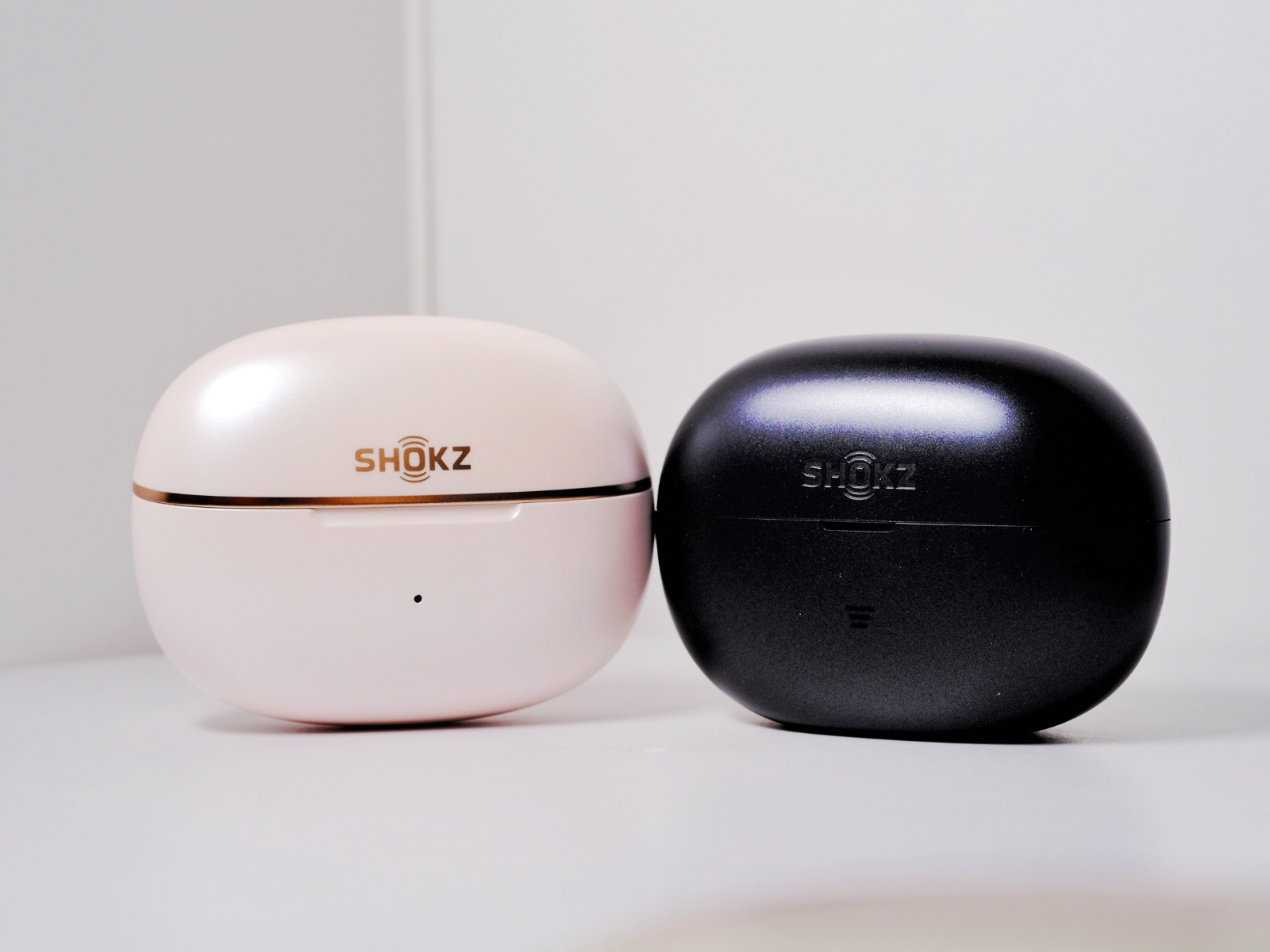
Shokz’s latest clip-on open-ear earbuds take two different approaches to comfort, sound, and everyday usability.
***
This is the 23rd article from TDS Studio on SSPAI, and as always, it is being published exclusively here first.
For a long time, we have regarded the Shokz OpenDots ONE as one of the best clip-on earbuds available. It offers clear advantages in both user experience and sound quality, to the point that even today we still consider it a highly worthwhile purchase.
Recently, Shokz unveiled its second generation of clip-on earbuds. One model serves as the direct successor to the OpenDots ONE and is called the OpenDots 2. The other follows a strategy similar to what Shokz previously did with the OpenFit lineup: the OpenDots Air comes in at a lower price point while theoretically retaining most of the performance of its more premium sibling. We purchased both at launch and put them through extensive side-by-side testing.
Since the review unit of the original OpenDots ONE had long since been returned to Shokz after our initial review, this comparison is based on two self-purchased new models and an OpenDots ONE kindly loaned to us by a reader. Special thanks to The Boy in the Rye for lending us the unit. As you’ll discover after reading this review, several of the first-generation model’s strengths have held up remarkably well.
Package & Accessories|Package & Accessories

The OpenDots 2 packaging largely follows the same approach as the first generation, featuring environmentally friendly paper packaging with generously rounded corners. The OpenDots Air, on the other hand, comes in a more conventional octagonal cardboard box. Neither package is particularly large, and both use disposable seals. The OpenDots 2 also includes a USB-C to USB-C charging cable, while the Air comes with no accessories at all (which is certainly one way to stay “lightweight”).

Design, Fit & Acoustic Structure|Design, Fit & Acoustic Structure

The overall design of the OpenDots 2 closely follows that of its predecessor. In fact, it is difficult to spot any tooling changes with the naked eye. At launch, it is available in three colors. The unit we are showcasing is the “White Gold Kintsugi” version, which adds decorative accents compared to the previous generation’s white-and-gold finish. Ironically, these details make it feel a little less minimalist.
According to Shokz, the White Gold Kintsugi colorway draws inspiration from the Japanese art of kintsugi, where cracks are repaired with gold powder. To be honest, however, the additional detailing slightly reduces the seamless visual appearance. The other options include “Black Meteor” and the subtly blue-tinted “Silver Cedar.” The OpenDots Air comes in “Midnight Black” and “Dawn Purple.” Based on what we observed in retail stores and our own subjective impressions, our color recommendations, from most to least appealing, are:
- OpenDots 2 Silver Cedar
- OpenDots 2 Black Meteor
- OpenDots 2 White Gold Kintsugi
- OpenDots Air Dawn Purple
- OpenDots Air Midnight Black
Midnight Black simply lacks a premium look. In fact, it is difficult to distinguish it visually from many budget earbuds in the entry-level segment. It is also more prone to attracting fingerprints and grease, making it harder to keep clean.

The charging case of the OpenDots 2 is almost identical to that of the first generation. The White Gold Kintsugi version adds a champagne-gold trim around the case, while retaining the same shape and button layout. The surface finish has been changed to a pearl-like texture that feels somewhat reminiscent of a cosmetic product. The tactile feel has improved, but the smoother finish also makes one-handed opening and closing slightly more slippery. The hinge has been adjusted as well, resulting in a different lid-opening feel.
The Air’s charging case is noticeably larger. The pairing button has been replaced with a touch-sensitive control located on the front, and the bottom has been flattened to allow it to sit more securely on a desk. The Air’s more budget-oriented positioning is also reflected in its build quality. At least on our unit, shaking the case makes it obvious that the earbuds are not held quite as securely by the magnets, loose enough that you can hear them move around inside. The OpenDots 2, by contrast, maintains the same solid build quality as the first generation, which remains commendable.

The overall earbud design of the OpenDots 2 is also very similar to that of its predecessor. The rear module retains its capsule-shaped form, while the front module remains a relatively compact sphere. According to Shokz, the Dynamic Titanium Arc has been upgraded with improved flexibility. In our direct comparison, the rebound force does indeed feel slightly reduced, although this does not translate into any major difference during actual wear. The first-generation fit was already excellent to begin with. Each earbud weighs 6.4g.

In terms of fit, the OpenDots 2 remains consistent with the first generation, offering moderate clamping force without creating excessive pressure at the front of the ear. Compared with Bose’s flexible C-Bridge design, Shokz’s Dynamic Titanium Arc offers better resistance to twisting. The wide titanium strip controls the relative movement between the front and rear modules, making accidental twisting and dislodging less likely. The “uneven silicone spacing” structure also contributes meaningfully to comfort. Areas more prone to pressure are cushioned with thicker silicone, distributing force more effectively across the complex contours of the ear compared with traditional hard plastic housings. In our opinion, both the first- and second-generation OpenDots remain among the most comfortable and secure clip-on earbuds currently available.

The OpenDots Air adopts a different structural approach. Its titanium strip is slightly thicker and better suited to users with thicker ear contours. As a result, it is also more elastic, with noticeably stronger rebound force compared with the flagship series. Each earbud weighs 6.3g. The rear module resembles the more common clip-on earbud designs seen on the market. While it still uses soft silicone, it does not emphasize the uneven-thickness silicone structure found on the OpenDots 2. In our experience, the Air actually provides slightly better rear-ear contact, and its slightly smaller front chamber makes it more accommodating for users with smaller conchas.

Overall, both products offer a very good wearing experience and are easy to position correctly on the first try. The OpenDots 2 is better suited to users with smaller ears, while the Air is more comfortable for those with thicker ear contours. Both provide a high level of stability.

Compared with the first generation, the OpenDots 2 upgrades its dust and water resistance to IP57, while the charging case now carries an IP54 rating. This allows it to handle more demanding everyday environments. That said, as an open-ear wearable stereo (OWS) product, we still would not recommend using it in extremely humid conditions or underwater. The Air is rated IP55 for dust and splash resistance, which is more than sufficient for light rain and daily outdoor use.
Controls & App|Control & APP

Both the OpenDots 2 and OpenDots Air rely on pinching the upper and lower parts of the rear module, as well as tapping gestures, for controls. On the OpenDots 2, the default configuration assigns a single pinch or double tap to playback control, double actions for track switching, and long presses for volume adjustment. On the Air, a single pinch adjusts volume, a double pinch changes tracks, and a double tap controls playback. The control logic is not entirely consistent between the two models, and we would prefer to see greater standardization. Overall, however, the controls are reasonably responsive, and sensitivity can be adjusted through the app.

The voice prompt volume is fairly average, though it can be adjusted independently. Both earbuds feature an ambidextrous design that eliminates the need to distinguish between left and right units. Internal sensors automatically detect wearing orientation in real time. Both models also include wear-detection sensors, which proved highly reliable during testing. However, after removing the earbuds, there is a roughly two-second delay before playback actually pauses.
The Shokz app remains intuitive and easy to navigate, with clearly organized feature categories. Through the app, users can perform firmware updates, switch EQ presets, enable multipoint connectivity, customize controls, and locate misplaced earbuds. At present, the Find My Earbuds feature still relies solely on emitting a sound from the earbuds rather than providing actual location tracking. In noisy environments, this functionality is only marginally useful. A new drop-alert feature has also been added.
Call Quality|Call
The OpenDots 2 is equipped with a bone-conduction microphone working alongside traditional microphones, creating what Shokz calls a “Bone-Air Triple Microphone” system (a rather unusual name, admittedly). The Air continues to use a dual-microphone setup. Both models incorporate AI-powered noise reduction.
We conducted our call-quality testing over a standard cellular network. The original OpenDots ONE still delivers very solid call performance and remains among the best in the clip-on earbud category. However, possibly due to early firmware optimization, the OpenDots 2’s voice pickup sounds slightly less clear than its predecessor, although overall loudness remains more than sufficient. In high-noise environments, however, the OpenDots 2 shows noticeable improvement in isolating the speaker’s voice, and wind noise during calls is kept to a minimal level.
The OpenDots Air, by comparison, falls noticeably behind both flagship-series models in terms of pickup volume and clarity. Wind noise also has a much more pronounced impact on recording quality and call performance.

Connection & Battery|Connection & Battery
Since neither model supports high-bitrate audio codecs, we conducted our testing as usual using AAC.
Moving to our familiar signal-testing environment, both earbuds performed well when connected via AAC to our standard test device, the iPhone 14. Whether WLAN was enabled or disabled, both models experienced very few instances of stuttering or packet loss at close range. The OpenDots 2 showed no significant increase in connection instability at a distance of 7.5 meters with a load-bearing wall in between. Beyond 8 meters, however, the listening experience began to degrade noticeably. The OpenDots Air started to experience occasional packet loss at around 6.5 meters with a load-bearing wall separating the device and earbuds, and performance became noticeably affected beyond 7 meters1.

The OpenDots 2 delivers impressively strong wireless performance, placing it comfortably among the top tier of AAC-based TWS and OWS earbuds. The Air, by contrast, encounters more difficulties in complex signal environments and during longer-range transmission. That said, after updating to the second firmware version, its performance improved somewhat, with packet loss only becoming noticeable beyond 7 meters through a wall.
As for latency, neither model includes a dedicated low-latency mode. Under default settings, using the AAC codec and prioritizing signal stability while connected to an Xperia 5 III, the OpenDots 2 exhibited roughly half a spoken syllable of delay during both streaming and locally stored video playback. This is fairly average performance. Surprisingly, the Air managed to perform even better in this regard, which was not something we expected.
Both models also support multipoint connectivity with two devices simultaneously.

When it comes to battery life, Shokz officially rates the OpenDots 2 for up to 10 hours of continuous playback from the earbuds alone and up to 40 hours with the charging case. The Air is rated for 9 hours and 36 hours respectively.
Driver, Sound Modes, Leak Control & Codec|Driver, Sound Modes, Leak Control & Codec
Both the OpenDots 2 and OpenDots Air are equipped with dual opposing 11.8mm dynamic drivers. They feature Bassphere 2.0 low-frequency aggregation technology (the Air uses the first-generation version) along with OpenBass 2.0+ dynamic compensation. Supported codecs are limited to SBC and AAC. Both models include four built-in EQ presets, including a Privacy Protection mode. This mode reduces overall volume while also trimming some low-frequency and ultra-high-frequency energy. The effect is noticeably less aggressive than Sony’s implementation. Custom EQ is also available, offering adjustment across five frequency bands within a ±5dB range, which is fairly standard.

For OWS earbuds, actual sound pressure levels and leakage control are particularly important, so we compared both models using an iPhone 14 in standard listening mode. System volume was set to 50%, with the earbuds worn normally. Personally, at this volume level, most modern remastered tracks can be heard clearly in a quiet indoor environment, though listeners with hearing similar to mine may find the sound slightly lacking in fullness. At around 70% volume, however, both become more than sufficient for general listening. As always, different devices, operating systems, and hearing conditions can significantly affect perception, so keep that in mind. In terms of sound pressure, the two models perform similarly and remain broadly comparable to the original OpenDots ONE. The Air’s brighter upper-mid and treble tuning means that outdoors it can sometimes feel less full-bodied than the OpenDots 2 even when the volume is increased.

When it comes to sound leakage, the OpenDots ONE in standard mode at 50% volume produces only faintly perceptible leakage beyond 15cm, becoming virtually inaudible beyond 20cm. In Privacy Protection mode, leakage is already almost imperceptible beyond 10cm, and even sitting very close makes it difficult to make out specific content. The OpenDots 2 improves upon the ONE in this area. At 50% volume in standard mode, leakage is only faintly noticeable beyond 10cm, and in Privacy Protection mode it becomes virtually undetectable beyond 5cm. The Air performs similarly to the ONE overall, though its Privacy Protection mode is more effective and approaches the OpenDots 2’s level.
Simply put, both models remain among the very best clip-on earbuds currently available when it comes to leakage control.
A few additional words about Dolby Audio support on the OpenDots 2. Compared with the Dolby implementation on the OpenDots ONE, low-frequency quality is noticeably improved, avoiding the occasional distortion that sometimes felt almost like a rendering bug on the previous model. During spatial audio testing with an iPhone 14, the compression-like sensation of rear-channel information is also reduced. At present, Dolby Audio on the OpenDots 2 is clearly moving in the right direction for Atmos playback. It still falls short of Apple’s own ecosystem products, but it has finally reached a point where it is genuinely worth enabling and experimenting with—a significant improvement.
OpenDots 2: Subjective Sound Impressions|Sound Description
Tested using AAC connected to an iPhone 14 with the default tuning.
The bass carries slightly more quantity than the OpenDots ONE while maintaining good control over thickness and fullness. It remains reasonably punchy, with respectable extension for a clip-on design. Decay speed is moderate, preserving a small amount of reverberation. Atmospheric bloom remains relatively restrained, though there is slightly more richness than on the ONE.
The OpenDots 2’s bass is noticeably more prominent than the ONE’s, with greater weight and body. Low frequencies are easier to perceive in noisy environments, and impact feels somewhat stronger. However, overall detail retrieval is not dramatically improved; technical performance remains broadly comparable. Instruments whose fundamentals sit in the lower-midrange gain a slight sense of forwardness. The OpenDots Air, by contrast, exhibits lower bass cohesion than the OpenDots 2, transitioning more gently with a slightly diffuse imaging presentation.
In the midrange, vocals are positioned relatively close to the listener, with slightly larger imaging. Resolution remains reasonably high. Vocal texture takes precedence over edge definition, giving voices a pleasing sense of body. Compared with the ONE, vocal outlines are somewhat more pronounced, though not to the extent of becoming an analytical or line-focused presentation. There is no obvious bias toward either male or female vocals, though lighter vocal styles tend to work best. Grain has been smoothed out effectively, resulting in good overall refinement. The silver model presents a generally neutral tonality with a slight touch of warmth, avoiding excessive coloration or artificially enhanced excitement. Throat resonance sits relatively high, while breathiness is slightly more prominent than on the ONE. Sibilance and mouth sounds are both controlled well, contributing to a smooth and natural presentation. Overall transparency in the vocal range is strong, without obvious artificial brightness.

Instrument reproduction strikes a balance between texture and definition. Among string instruments, violins, violas, and guitars sound more substantial than on the ONE, though they still stop short of sounding particularly thick. Details of bowing and plucking remain relatively abundant for a clip-on design. Cellos gain a more convincing sense of body compared with the ONE, though their scale within the soundstage remains somewhat compact. Brass instruments deliver respectable presence, while brighter instruments such as trumpets retain an appropriate sense of sparkle. Woodwinds sound natural, with slightly more air than on the ONE. Harmonic overtones are fairly natural, though not especially rich. Among percussion instruments, kick drums lack a strong sense of dominance, while snares decay slightly quickly. Cymbals exhibit moderate brightness without becoming harsh or excessively metallic.
Treble brightness overall is moderate. There is enough energy to avoid sounding dull, but it never feels excessive or congested. Smoothness remains good. Ultra-high-frequency extension and information retrieval are both improved over the ONE, though roll-off still occurs somewhat earlier than ideal. Fortunately, when paired with an iPhone, the attenuation does not feel overly premature.

The soundstage is reasonably spacious, with respectable width and depth. While not perfectly symmetrical, the relaxed and diffuse presentation around the edges contributes positively to the sense of space. Combined with an average but adequate perception of height, the OpenDots 2 creates a slightly flattened spherical soundstage. Separation between vocals and instruments is solid, and overall coherence is maintained. Resolution is quite good for a clip-on earbud, with a modest improvement in information retrieval compared with the previous generation. The improvement is not transformative, however. In terms of technical performance, it roughly matches the level of two generations of Huawei FreeClip operating without high-bitrate codecs, which is appropriate for the price range. The sense of analytical detail is present but restrained. Dynamic performance shows some improvement, while transient response remains moderate.
OpenDots Air: Subjective Sound Impressions|Sound Description
Tested using AAC connected to an iPhone 14 with the default tuning.
The Air has a noticeably more colored sound signature than both the OpenDots 2 and the OpenDots ONE. Bass quantity is moderate, but its thickness and fullness are not as substantial as the OpenDots 2. Elasticity is decent, though extension into the sub-bass is less impressive. Decay speed is moderate, with very little lingering reverberation. Both the atmospheric bloom and overall richness are relatively restrained, resulting in a presentation that lacks a sense of solidity. To borrow a rather audiophile-style expression, it occasionally sounds a bit like “tapping on sheet metal.” At similar volume levels, the Air’s bass sounds thinner than both the ONE and the OpenDots 2, with more energy shifted toward the upper-midrange. Instruments whose fundamentals reside in the lower registers do not exhibit any obvious forwardness.
In the midrange, vocals maintain a certain distance from the listener, with imaging slightly smaller than average. Resolution remains fairly respectable. Neither vocal texture nor edge definition is emphasized—both are present but not particularly strong. Vocal outlines are somewhat highlighted, though not especially focused, while body and thickness are noticeably lighter than on the ONE and OpenDots 2. There is no obvious preference for either male or female vocals, but slightly fuller vocal timbres tend to sound thinner and brighter than intended. Grain is minimal, while smoothness is merely average, largely because the upper registers receive greater emphasis. As a result, the overall tonality feels more energetic and youthful. Throat resonance sits relatively high, and breathiness is even more prominent than on the OpenDots 2. Mouth sounds are more noticeable than on the OpenDots 2, and sibilance is slightly more pronounced as well. Transparency in the vocal range is somewhat higher, accompanied by a clearly elevated sense of brightness.

When it comes to instruments, most exhibit slightly stronger edge definition. Among string instruments, violins, guitars, and violas do not carry much body, though their energy is somewhat enhanced. While the amount of plucking and bowing detail is not as rich as on the OpenDots 2, those details are more prominently presented. Cellos have relatively vague imaging and occupy only a modest presence within the soundstage. Brass instruments do not deliver a particularly grand sense of scale, though brighter instruments such as trumpets possess plenty of sparkle. Woodwinds exhibit enhanced airiness at the expense of some naturalness. Instrument overtones are also somewhat emphasized. For percussion, kick drums remain relatively understated, while snares decay slightly quickly. Cymbals are brighter, carrying a certain degree of sharpness and metallic character.
Treble overall has more body than both the ONE and the OpenDots 2. Energy levels are quite prominent, though without excessive peaks. Ultra-high-frequency extension is average and lacks the smoother, more natural roll-off exhibited by the OpenDots 2.
Soundstage performance remains relatively spacious. Width is more expansive than depth, while the boundaries are not overly emphasized. Combined with an average sense of height, the OpenDots Air presents a soundstage that resembles a flattened spindle shape. Separation between vocals and instruments is respectable, and overall coherence is acceptable. Resolution falls slightly behind both generations of the flagship series, though the sensation of “detail retrieval” is more obviously highlighted. Dynamic performance is average, while transient response remains satisfactory.
Overall Impression|Overall Impression

Overall, the OpenDots 2 does improve upon the original Shokz clip-on earbuds in several areas, including better Dolby Audio implementation, superior bass quality, and even stronger sound leakage control. In most other respects, however, it largely maintains the performance level established by the first generation.
Provided budget is not a concern, we still consider the OpenDots 2 and Huawei’s FreeClip 2 to be our primary recommendations among clip-on earbuds priced above the RMB 1,000 mark. At the same time, the original OpenDots ONE was already mature enough in most key areas that many aspects—particularly fit, build quality, and mid-to-high-frequency performance—leave little room for immediately noticeable improvements.

Considering that the original OpenDots ONE remains available and can now often be found for a little over RMB 700, we would continue recommending it as the first choice for most consumers for quite some time. It already delivers more than enough in the areas that matter. Likewise, we do not believe existing OpenDots ONE users need to rush into upgrading, as the second generation does not provide a dramatically different user experience.
As for the OpenDots Air, which launched at a price point above RMB 800, its main advantages seem limited to maintaining strong battery life and offering better compatibility for users with thicker ear contours. Its sound tuning is considerably more stylized, while build quality details and industrial design also involve certain compromises. At its current pricing, it is difficult to recommend over simply purchasing the discounted OpenDots ONE. It also falls behind competitors such as the LinkBuds Clip and AeroClip in direct comparisons. For now, we would give it a rating of III. Should its price eventually drop into the RMB 500 range, our evaluation would likely become somewhat more favorable.

As for Shokz’s flagship clip-on series, our biggest wish remains unchanged: support for high-bitrate audio codecs. Beyond that, the products are already more than competent. Over the next two weeks, we’ll also be bringing hands-on impressions of OPPO’s and Xiaomi’s latest clip-on earbuds. We’ve already purchased both—and yes, the reviews are currently being written.
The KT MARK ratings for the models discussed in this review, based on the market conditions at the time of evaluation:
Shokz OpenDots 2: V (Excellent)

Shokz OpenDots Air: III (Average)

Reference firmware versions:
- OpenDots 2: EU_V_04
- OpenDots Air: EU_V_01
- OpenDots ONE: EU_V_07
For details regarding the KT MARK rating methodology and our conflict-of-interest policy under the “Non-Interference Review Principle,” please search for TDS Studio Rating Standards & Content Guidelines V202502. The document can be found through major search engines.
KingTsui, TDS Studio.
June 2026
It’s a TDS production.
All content is entirely original and independently produced. Unauthorized copying, plagiarism, imitation of writing structure, or derivative reproduction is prohibited. All rights reserved.
- After upgrading to the second firmware version, the situation has improved; packet loss now only occurs when the device is more than 7 meters away from a wall. ↩︎
Share:

Exploring technology, digital culture, and better ways to live and work.