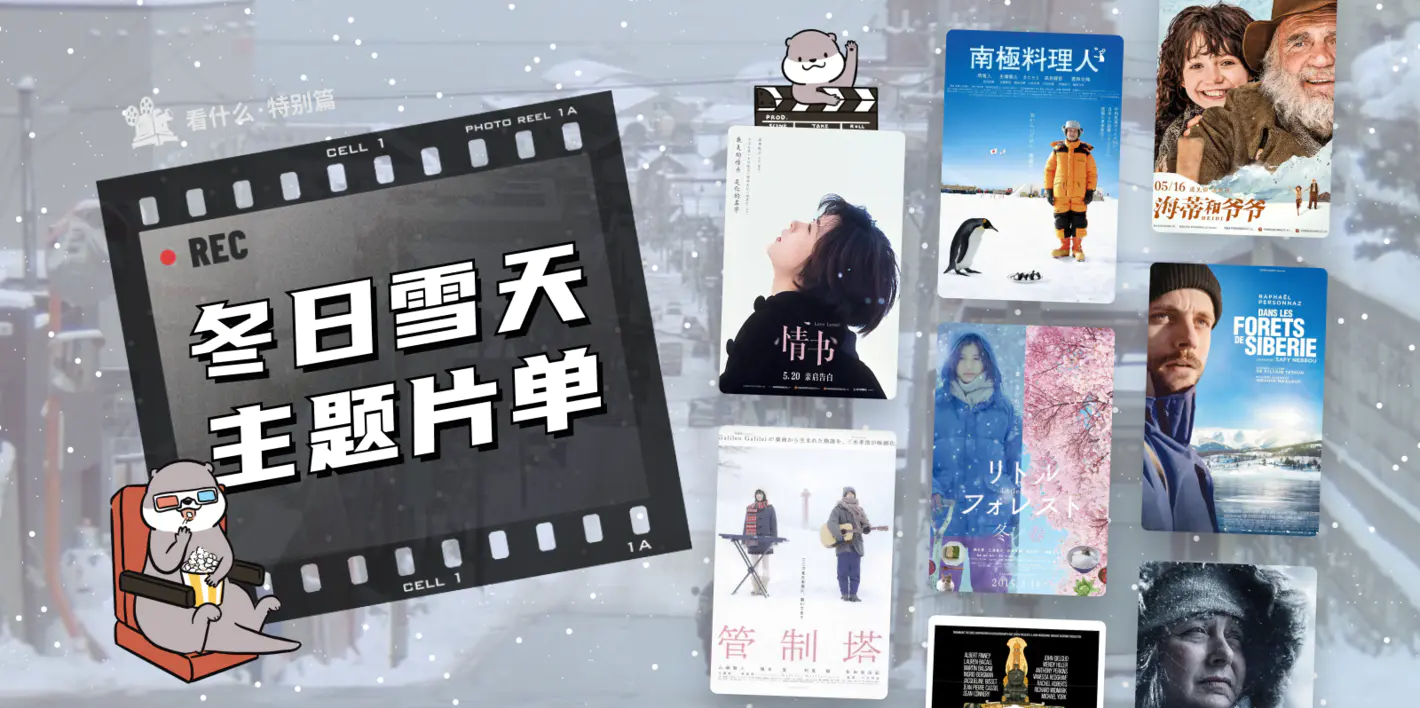
Snowy Day Movie Watchlist: Romantic Films to Watch This Winter
Perhaps you look forward to a heavy snowfall every winter—envying those far away when snowflakes drift through the air, as people gather on snow-covered fields at night, singing together with an accordion in hand. How many of your memories of snow come from classic films and TV shows? On those winter days when it doesn’t snow, why not watch a movie instead?
In this special edition of What to Watch, themed around “Winter Snowy Days,” we’ve selected nine film and TV titles for you. From youthful romantic love stories and healing journeys through food and nature, to wilderness survival adventures and thought-provoking mysteries—there’s something for everyone. 🙋 When you think of a snowy day, which films or shows come to mind? Feel free to share the most memorable snow scenes in the comments.
Editor’s Note: Thank you for your continued support of our content over the past year. During the Spring Festival, the SSPAI editorial team has also prepared a limited number of “Mata” red envelope covers for our homepage readers. These will be hidden as content Easter eggs within hyperlinks in homepage articles published throughout the holiday—stay tuned.
For previous recommendations, click here or tap the tag #What to Watch at the end of the article. To explore more in-depth film and TV content, follow our spin-off column “What to Watch Café.” If you have any other suggestions, feel free to leave a comment. Thank you for your continued love and support for the What to Watch series.
[Film] Love Letter

- Keywords: Drama / Romance
- Runtime: 117 minutes; Release Year: 1999
- Available on: Bilibili / Tencent Video; Douban Link
The confession left unspoken was eventually heard.
@Voyager_1: Anyone who hasn’t watched Love Letter by 2024 will surely be moved to tears by this subtle story of unspoken love. And for those who have already watched it many times, winter is always the perfect season to revisit this tale of secret admiration and heartfelt confession.
The film begins with a mistakenly sent love letter. After losing her fiancé, Fujiwara Hiroko writes to his old address as a way of coping with grief—only to unexpectedly receive a reply from someone with the same name, Fujii Itsuki. One woman lives in the snowy landscapes of Hokkaido, the other in the city of Kobe. Through their correspondence, a long-forgotten story from their school days gradually comes to light.

Love Letter features a clever narrative structure, using letters to intertwine past and present, life and death, love and friendship, creating a romance that transcends time and space. The film’s snowy scenery—pure and tranquil—adds a poetic touch to this bittersweet love story. Director Shunji Iwai’s delicate style and emotionally rich visual language allow audiences to feel warmth amidst the cold snow, and to appreciate what is lost by learning to cherish what remains. Miho Nakayama delivers an impressive performance in dual roles, portraying two very different versions of Fujii Itsuki. The film’s soundtrack is equally memorable, perfectly complementing the visuals and together evoking a gentle sense of melancholy and nostalgia.

On a snowy winter day, curl up in a warm room and watch Love Letter, and relive that pure yet profound emotion that everyone has experienced in one way or another.
[CN] Go Ahead, Don’t Be Friends with Me

- Keywords: Comedy / Romance / Fantasy
- Runtime: ~45 minutes per episode × 24 episodes; Release Year: 2020
- Available on: Mango TV; Douban Link
Reply 2000.
@潘誉晗: Seventeen-year-old Li Jinbu has never met her father. For years, she has lived with her mother, Li Qingtong, and life has not been easy for them. In Li Jinbu’s eyes, Li Qingtong—always busy with work and social obligations—is far from a reliable mother. In an effort to provide her with a better education, Li Qingtong frequently moves and transfers schools with her. But from Li Jinbu’s perspective, this only deprives her of a stable life.
One day, after a huge argument with her mother, Li Jinbu refuses to go home and decides to spend the night at a bathhouse. By a strange twist of fate, she finds herself transported back to December 25, 1999. On the eve of the new millennium, she meets her 18-year-old mother. Determined to help her avoid the hardships that lie ahead, Li Jinbu decides to push Li Qingtong to study hard and get into college.

Stories about traveling back in time to meet one’s young parents are no longer particularly novel these days. Yet this low-budget series still earned considerable acclaim and attention upon its release, thanks to its strong storytelling. Even though the ending may feel somewhat regretful—and looking back, there may be a few plot inconsistencies—the overall quality far outweighs its flaws.
With meticulous production design, the show recreates a retro yet pure era. We see the distinctive Northeastern Chinese accent paired with barbecue and soda, public bathhouses, and breathtaking northern snowfall. A lonely girl meets a group of endearing friends in the past and begins to rediscover her mother—and this is where the series truly shines.


Although it appears to be a coming-of-age school drama on the surface, the story goes beyond the youthful friendships of Northeastern teenagers. Through Li Jinbu’s experience of living alongside her young mother, the girl—once confused and insecure about her family background—comes to understand her mother’s actions, recognize the sacrifices she had overlooked, and ultimately achieve self-reconciliation and personal growth.
[Film] The Chef of the South Polar

- Keywords: Drama / Comedy
- Runtime: 125 minutes; Release Year: 2009
- Available on: iQIYI; Douban Link
The aurora? Who cares—the noodles will get cold.
@Voyager_1: The penguin on the poster is quite a clever misdirection. In reality, the entire story takes place at Dome Fuji Station in Antarctica, where you won’t find the cute animals children dream about—only seven expedition members and their dedicated chef, Jun Nishimura. As the endless polar day and night cycle through the frozen landscape, Nishimura spends his days crafting meals in creative ways. He becomes the key figure in this Antarctic journey, responsible for providing the greatest comfort to each researcher through food.
Adapted from the essay collection The Funny Antarctic Chef written by Jun Nishimura himself—who once served as a cook for the Japanese Antarctic Research Expedition—the film’s episodes are far from fictional. That said, there isn’t much in the way of narrative logic or sequence; it’s more like an impressionistic portrayal of everyday life. Despite limited ingredients, the Antarctic chef demonstrates enough imagination to satisfy everyone’s different tastes, presenting a culinary feast that includes Japanese cuisine, Chinese dishes, Western meals, desserts, fried foods, and barbecue.


Loneliness may be overwhelming for one person, but the loneliness of a group can turn into a chain of shared stories. The director uses countless details to paint a vivid picture of dormitory life in Antarctica—from imaginative snowfield baseball and work scenes filled with shouts for fried shrimp, to tea gatherings simulating bar-like confessions, ice-cutting for water, assisting in the extraction of ancient ice cores, and even homemade alkaline ramen. The quirky personalities and little inner schemes of each team member lead to a series of events that anyone who enjoys the atmosphere of communal living will appreciate.
On a snowy day, watching The Chef of the South Polar from the warmth of your bed allows you to experience the human warmth of Antarctica—like soaking in a hot spring amid icy winds while sipping a cup of warm milk.
[Film] Heidi

- Keywords: Drama / Family / Adventure
- Runtime: 111 minutes; Release Year: 2015
- Available on: Bilibili / Tencent Video / Mango TV; Douban Link
If you think something in this world will make you happy, go for it—no matter what others say.
@Voyager_1: Adapted from the renowned novel Heidi by Swiss author Johanna Spyri, the film is set against the snow-covered winter of the Alps, where snowflakes sparkle in the sunlight, adding a fairytale-like charm to Heidi’s story. It is both a warm portrait of a grandfather and granddaughter living harmoniously in the mountains, and a coming-of-age tale about an optimistic and spirited girl who remains kind and positive in the face of fate.
After losing both parents, Heidi is brought by her aunt to live with her reclusive grandfather, who nearly sends her away at first. However, her innocence and kindness gradually move him, and the two form a deep familial bond. In the mountains, Heidi also befriends Peter, a young shepherd boy, and together they grow freely in the embrace of nature. In the grandfather’s cabin, Heidi and her grandfather sit by the fireplace as snow falls outside the window. Even in the cold of winter, the cabin is filled with warmth and harmony. Traveling through the mountains in winter can be difficult, so in order for Heidi to play with Peter at the foot of the mountain, her grandfather builds a sled and takes her racing across the vast snowfield. Their smiling faces bloom alongside the flying snowflakes as they glide through the winter landscape.

Far away in Frankfurt, Clara—a wealthy girl who lost her mother at a young age and became unable to stand after a serious illness—remains confined to her mansion and wheelchair. Deprived of her father’s affection, she clings to the warmth offered by her companion Heidi. From that moment on, the two girls from entirely different worlds form a unique bond. Heidi brings Clara to herd sheep in the snowy mountains, to rest on green grass in the cabin, and to embrace the beauty of nature in the valleys. Everyone can rediscover kindness and vitality through Heidi’s spirit. On a snowy day, immerse yourself in the pure warmth of family and friendship through this film—and find the courage to face the world once again.
[Film] Little Forest: Winter/Spring

- Keywords: Drama / Food / Healing
- Runtime: 120 minutes; Release Year: 2015
- Available on: Tencent Video; Douban Link
Cold weather may be a hassle, but some dishes can only be made when it’s cold.
@宽治: Every winter, I revisit Little Forest—as if doing so helps me feel at ease about welcoming the new year. The Little Forest film series is adapted from the manga of the same name by Daisuke Igarashi, and is divided into two parts following the four seasons: Summer/Autumn and Winter/Spring. In Winter/Spring, the protagonist Ichiko continues her solitary life in the rural village of Komori in northeastern Japan. As autumn gives way to winter and snowfall approaches, the film follows her daily life—watching snow accumulate around her home and in the surrounding woods, while witnessing, through the meals she prepares, the fruits of a year’s labor gathered in winter and her reflections on life’s many circumstances.
For me, entering the world of Little Forest each time is an incredibly comforting audiovisual experience. The film’s characters, landscapes, food, nature, and sounds are presented with perfect balance, unfolding at an unhurried pace. The manga-like montage and transitions complement the distinctly Japanese aesthetic that permeates every frame.


Yet behind this immersive beauty lingers an unavoidable sense of melancholy—like a sky divided between blue and looming clouds. Ichiko, who once struggled in a big city, ultimately found herself unable to adapt to urban life. Returning to her childhood hometown is both an act of courage and a form of escape. Moreover, with her mother long gone, what awaits her there is merely an empty house. This blend of serenity and solitude seems to gently remind urban viewers who romanticize returning to the land that rural life, too, comes with its own bitterness.
These contradictions remain unresolved, but the film does not dwell on them. Instead, it brushes past such tensions lightly, dedicating more time to everyday details. This slow and quiet strength seeps into Ichiko’s growth, much like the changing of the seasons. After all, some things can only be done at the right time—too early or too late simply won’t do.
[Film] Control Tower

- Keywords: Drama / Romance / Music
- Runtime: 68 minutes; Release Year: 2011; Douban Link
In that heavy snowfall in Hokkaido, we found the sweetness and pain of our youth.
@潘誉晗: Wakkanai is the northernmost city in Hokkaido. Fifteen-year-old Fujita seems much like the weather in this northern land—cold and subdued. He is the “invisible” one in class, always keeping to himself. But his quiet life changes with the arrival of a transfer student, Mizuho. Two kindred souls, bound by similar circumstances, find resonance in each other—and through an old wooden guitar, they decide to form a band and write a song that belongs to them.
This is a gentle coming-of-age film. Even though the youth it portrays isn’t flamboyant and carries a touch of melancholy, that restraint is precisely what makes it so fitting. Fujita begins as an isolated individual, with no friends or attention at school. Mizuho is like a beautiful piece of music—her presence in his life is brief, and although they never get the chance to properly say goodbye, she leaves behind a deep and lasting impression.


Fujita enjoys riding his bicycle with her through the fleeting winter scenery, taking her to different places. Though they live in such a small city, these moments become the greatest adventures of their youth. He feels the lightness of her body leaning gently against his equally slender back. He also cherishes the time they spend making music together, learning to write songs. For Fujita, it is his first attempt—but perhaps it is precisely because it is his first that it makes his heart race.
The film is short, just about an hour long. You might find its abrupt ending somewhat jarring—like a snowfall you had been waiting for that never quite arrives; like when you are immersed in a winter landscape, only for the snow to suddenly stop falling. Just as we are still savoring the tremors of youth and the sweetness before us, it’s already time to part. Fortunately, we do get to hear Fujita sing in the end. His clear, boyish voice—untrained and without technique—carries an abundance of sincerity.
[Film] Murder on the Orient Express

- Keywords: Drama / Mystery / Crime
- Runtime: 128 minutes; Release Year: 1974
- Available on: Bilibili; Douban Link
Let the snowfall bury every truth.
@潘誉晗: One day, the great detective Poirot boards the Orient Express bound for London. On the train, he encounters a man named Ratchett, who warmly invites him to dinner and asks for his protection. However, Ratchett’s unsettling demeanor leads Poirot to firmly refuse. That very night, as the Orient Express is forced to halt mid-journey due to heavy snowfall, the crime finally occurs.
Agatha Christie’s novel of the same name is immensely famous, and there have been numerous film adaptations over the years. The 1974 version is undoubtedly one of the most outstanding (the 2010 David Suchet version is also excellent). The all-star cast is impressive, and the performances are equally remarkable. Of course, what truly deserves praise is the story crafted by Christie herself.


Many viewers are likely already familiar with this story, yet even with such familiarity, the premise remains astonishing: a sudden murder in a luxurious compartment places the entire train in peril, eventually bringing it to a standstill in the snowy wilderness. Twelve suspects offer conflicting testimonies, and through careful analysis—unraveling each layer of deception—the truth is finally revealed. The final answer delivers a profound lesson in both morality and the law.
Poirot himself must feel both conflicted and contemplative. As a detective, he uncovers the truth. But as a man of conscience, whether that truth represents the right answer is far less certain. Perhaps the very fact that this case unfolds at this moment is answer enough—snow can erase all traces, and so the truth may as well be buried beneath the falling flakes.
[Film] In the Forests of Siberia

- Keywords: Drama / Adventure
- Runtime: 105 minutes; Release Year: 2016
- Available on: Youku; Douban Link
You’ve already come a long way—keep going. Don’t be afraid. You are free.
@潘誉晗: In search of freedom, media professional Teddy ventures deep into the forests of Siberia, determined to live there on his own. Leaving behind the conveniences of modern life, he settles into a cabin by Lake Baikal. One day, he loses his way during a violent snowstorm and collapses from exhaustion. He is rescued by a man named Aleksei—someone Teddy had heard about before arriving. Ten years earlier, Aleksei had killed a man and fled into the Siberian wilderness to escape capture.
Adapted from an essay of the same name, the film presents a remarkable adventure. While we can understand Teddy’s yearning for freedom, his approach is difficult to comprehend. Though he is fairly capable—repairing the cabin and cutting through ice for water with relative ease—and even enjoys life in the frozen wilderness, his survival skills are still lacking in such a remote place where brown bears occasionally roam.


When his guide first brought him here, he described it as “a place suitable for suicide.” But for Teddy, exhaustion had already taken its toll. The dazzling allure of city life and the chaos of a busy existence had left him feeling suffocated, as if his shirt had been pulled too tight around his neck. So even if others couldn’t understand his choice, he decided to heal himself through this wild, primal, and simple way of living. Yet he underestimated the human need for companionship. What began as a year-long challenge of solitary survival gave him the courage to move forward—but the one who ultimately saves him is Aleksei, a man forgotten and cast aside by the world.
The landscape before them is breathtaking: the pure white of nature, solemn and majestic, as the vast expanse of Lake Baikal freezes into a thick sheet of ice. In this bone-chilling cold, a man seeking escape from society and another fleeing the law form a deeply moving friendship.
[Documentary] Life Below Zero

- Keywords: Nature / Documentary / Reality TV
- Runtime: ~45 minutes per episode × 10 episodes; Release Year: 2012
- Available on: Bilibili / Tencent Video; Douban Link
Below zero, build a life from scratch.
@宽治: The Arctic Circle in Alaska—North America’s northwesternmost frontier, surrounded by the Arctic Ocean, the Bering Sea, and the North Pacific—is a land of year-round wilderness where humans, as a species, hold no absolute advantage. Yet some people have chosen to live here. Among them are the Iñupiat who have inhabited this land for generations, middle-aged women who have left their families to live in solitude, and couples who rely on their sled dogs for survival. They are not heroes—just ordinary individuals who struggle against nature day after day. But they are undoubtedly different, because their daily lives are often a matter of life and death.
As the boundary between survival and living begins to blur, what urban dwellers often refer to as a “lifestyle” sheds its polished veneer and becomes a plain and simple “way of survival.” Gathering, hunting, building, storing, maintaining—these fundamental activities reveal the life force and survival philosophy hidden within the wilderness.


Here, humans face freedom directly—and freedom may take the form of boundless landscapes or a wild beast ready to bite your head off. In doing so, we come to understand that the opposite of freedom is not restriction, but the inability to choose how to live with those restrictions. Living does not necessarily require following paths designed by others—you can carve out your own. Because this is true wilderness. One can choose to live on their own terms, and the wilderness will deliver the outcome, plain and simple.
I once deeply resented the artificiality of modern life, feeling that titles, identities, and desires were all floating illusions that obscured the true vitality of existence and blurred my understanding of my relationship with the world. Life Below Zero showed me another way of life—concrete, restrained, necessary, self-sufficient, and beautiful. It is a raw relationship between humans and the world, as immediate as life and death, and as enduring as time itself.
More
[J-Drama] First Love (2022)
[Film] Moonlit Winter (윤희에게) (2019)
[Film] The Looming Storm (2017)
[Film] Black Coal, Thin Ice (2014)
[Film] The Hateful Eight (2015)
[Film] 8 Women (2002)
[Film] Wind River (2017)
[Film] Fargo (1996) | [TV Series] Fargo (2014)
🎬 Related Reading
Tags: [Documentary] Life Below Zero, [Film] Control Tower, [Film] In the Forests of Siberia, [Film] Little Forest: Winter/Spring, [Film] Love Letter, [Film] Murder on the Orient Express, [Film] The Chef of the South Polar
Leave a Reply