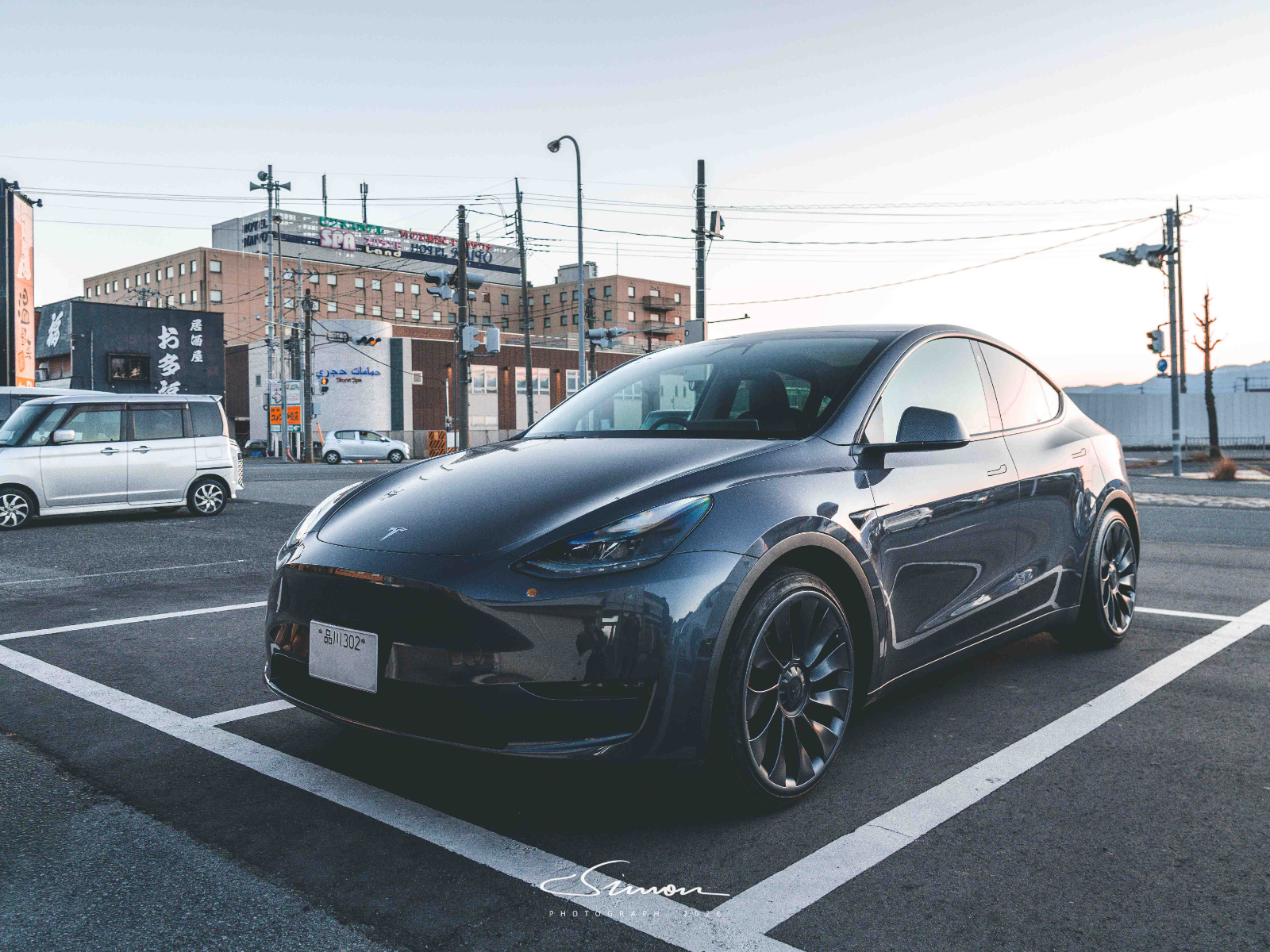
As everyone knows, the pace of iteration for electric vehicles in China over the past few years has been astonishing. New models seem to arrive almost monthly, wave after wave. Japan, by contrast, remains very much a gasoline-car country. Gas-powered vehicles still dominate the streets, hybrids are seen as a more practical compromise, and fully electric cars are relatively rare in everyday life.
As one of the most representative EV brands, Tesla entered the Japanese market as early as 2010. By 2026, the brand has been operating in Japan for a full 16 years. From nothing to something, Teslas can now occasionally be spotted driving on the streets of Tokyo.
Having lived in Japan for many years, I had never actually experienced driving an EV here. Naturally, I was curious: in Japan—especially in a city like Tokyo, which is relatively EV-friendly and has a higher density of charging stations—what is it really like to drive a Tesla? To satisfy my curiosity and to keep up with the times by finally driving a Tesla myself, I decided to rent one through a Japanese car rental platform and give it a try.
Car Rental Platform
That’s where the trouble began.
Although I’ve used almost all of Japan’s major car rental companies, after some searching I realized that none of them offered Tesla—or EV—rentals at all. Left with no choice, I had to take a step back and look elsewhere. Through a search engine, I found a company I had never heard of before, one that specializes exclusively in Tesla rentals: BOXIV SHARE.

The company isn’t well known, but its website presentation looked quite appealing: a dedicated rental app, fully contactless rentals, complimentary access to Tesla Superchargers, a decent selection of models, and the ability to connect with Tesla’s official app.
After reading through all of this, I decided to stop overthinking it and place an order directly. I rented a Model Y Performance. The cost was 20,000 yen for one day, plus an additional 4,400 yen for insurance. For comparison, renting a GR86 for a day costs only around 16,000 yen—making it clear that renting a Tesla is significantly more expensive than renting a traditional gasoline car.
“Picking Up the Car”

This Model Y Performance was parked in a lot in Shinagawa. BOXIV leases several parking spaces long-term to store Teslas specifically for rental. In addition to the Model Y shown in the photos, I also spotted several Model 3s and refreshed Model Y units.

Because it’s a fully contactless rental, all procedures are handled through the BOXIV app. First, you complete a pre-departure check in the app: walk around the car to inspect the body for scratches. If there are any scratches not already recorded in the system, you need to take photos and upload them for documentation. Once the check is complete, you can unlock the vehicle directly via the app.

After getting into the car, there’s a key card placed in the center armrest, along with a printed instruction sheet for users to review. The armrest also contains a power adapter for voltage conversion when using public charging stations.

Since Tesla’s infotainment system supports multiple languages (whereas most Japanese in-car systems only offer Japanese and English), I immediately switched the interface to Simplified Chinese. From the screen, I could see that this Model Y had already driven over 100,000 kilometers, and even with 85% battery remaining, the estimated range was only 354 km.

The parking lot where the car was located is equipped with Panasonic chargers rather than Tesla Superchargers, so charging power is relatively limited. To avoid leaving the next renter with insufficient battery, BOXIV offers a charging discount policy: if you charge at a Tesla Supercharger and meet certain criteria, you can receive a few hundred yen off the rental fee.
Setting Off for Shōsenkyō!

The destination for our one-day trip was Shōsenkyō, a scenic spot located in Yamanashi Prefecture, just outside Tokyo. From Tokyo, it’s about a two-hour drive, covering roughly 138 kilometers. However, given this car’s limited range and our desire for a more relaxed itinerary, we decided to head to a Tesla Supercharger first, planning to enjoy lunch while charging.

As of 2016, Tesla had installed more than 700 charging stations in Japan. While Japan’s land area is much smaller than China’s, 700 stations is still a very limited number for the country. From the Supercharger map on Tesla’s official website, it’s clear that Superchargers are relatively dense within Tokyo, but once you leave the city, they become few and far between.
Take Yamanashi Prefecture, our destination, as an example: there is only a single Supercharger nearby. The map also shows two other charging stations—one in front of a restaurant and another in front of a hotel—but both offer power outputs of only around 10 kW, which can essentially be ignored.

Yamanashi’s only Supercharger is located in front of an electronics store and consists of six charging stalls, supporting up to 130 kW charging. Before setting off, the estimated remaining battery upon arrival was 30%; in reality, we arrived with 35% remaining.

After plugging in the charger, we headed to a nearby sushi restaurant for a meal, then stopped by a popular dessert shop in the area, where we ordered coffee and pudding and chatted while eating. BOXIV’s app allows you to check the battery level in real time, and by the time the battery was fully charged, it was just about time for us to head back.
Shōsenkyō

Shōsenkyō is located in the northern part of Kōfu City and is one of Yamanashi Prefecture’s most representative gorge landscapes. It is designated a national “Special Place of Scenic Beauty” and is often referred to as “Japan’s most beautiful gorge.” What makes the gorge so striking are the sheer cliffs formed by granite that has been carved by flowing water over long periods of time. Jagged rock formations stand side by side with clear streams, and the walking paths along the creek allow visitors to observe these geological changes up close.

At the same time, the granite mountains around Shōsenkyō are known as the “birthplace of crystal,” so the area around the gorge is dotted with shops and workshops selling crystal products. Visitors can also take part in crystal polishing experiences and create their own crystal accessories.

Overall, the Shōsenkyō route is relatively gentle and is a very popular hiking trail during the autumn foliage season. Deep within the valley along the route lies Sengataki Falls, one of Shōsenkyō’s most iconic waterfalls, which has been selected as one of the “Top 100 Waterfalls of Japan.” The name “Senga” (written with characters also used for Chang’e, the moon goddess from Chinese mythology) is borrowed here to evoke the waterfall’s cool, ethereal atmosphere.
The waterfall has a drop of about 30 meters, with water cascading down the granite rock face. The valley walls are close on both sides, and standing on the viewing platform, you can feel the sheer force and presence of the falling water at close range.

Along the walking path near the waterfall, you can also spot many coins. This stretch is known as the “One-Yen Road.” It’s said that the “tradition” of wedging coins into the cracks between stones here has been going on for over a decade. Staff from the scenic area regularly collect these coins and use the proceeds to purchase cleaning and maintenance supplies for the site.

After a short hike, we took a ropeway up to the summit of Mount Rakanji. Although the elevation is only 1,058 meters, you can still look out from the top and see Mount Fuji in the distance. The weather that day was good, and Mount Fuji was clearly visible on the horizon.

There aren’t any particularly famous attractions here, and since it wasn’t peak foliage season, there were relatively few visitors. We sat on a bench at the summit for quite a while, taking in the unobstructed view of the surrounding mountains.
The wind rose up from the valley below, carrying a hint of coolness without being biting. The ridgelines layered one after another, their colors fading from specks of green nearby to softer browns in the distance, as if gently brushed over by mist.
The Return Trip

On the way back, we also tried out the automated driving currently available in Japan. Unfortunately, the experience was not very good. While it was still daylight, the Tesla failed to correctly detect road barriers at a turn and headed straight toward them without hesitation. Thankfully, human intervention came in time, and no accident occurred.

At night, the highway portion was something the Tesla handled with relative ease, requiring almost no manual intervention. That said, this isn’t particularly worthy of praise—based on my three years of driving experience, almost all Nissan models can achieve a similar level of performance on highways.

Before returning the car, we stopped by a Supercharger near Shinagawa to top up the battery. This Supercharger is located in the underground parking garage of a large commercial complex and offers charging speeds of up to 240 kW. However, since parking fees apply after 30 minutes, the optimal choice is to finish charging and leave within that half-hour window.

Returning the car was also handled entirely through the app. You need to take and upload 12 photos of the vehicle from different angles, confirm whether there are any new bumps or scratches, plug the car into the parking lot’s built-in charger, and finally lock the car to complete the return process.
Conclusion

At present, in order to promote electric vehicles, Japan has introduced a series of subsidy policies in 2026. Taking the Model Y as an example, if all subsidy requirements are met, it can be purchased for around 4.3 million yen (approximately 190,000 RMB). Combined with Tesla’s five-year zero-interest financing, this is indeed attractive to many white-collar buyers considering a new car.

However, based on this one-day experience, I found that there are still quite a few “issues” with driving a Tesla in Japan today. The first is the distribution of charging infrastructure. As mentioned at the beginning of this article, once you leave the Tokyo metropolitan area, the number of charging stations drops sharply. From the charging map, it’s clear that regions such as Shikoku and Kyushu have very few Superchargers. While CHAdeMO or J1772 chargers can also be used, charging speeds are often difficult to guarantee.

Second, electricity at these charging stations is not cheap. Based on feedback from Japanese users, electricity prices average around 30–55 yen per kWh. Coupled with the fact that Tesla’s driver assistance features in Japan are still fairly underwhelming, this makes the proposition less suitable for most people.
Taking all of these factors together, I feel that “driving a Tesla in Japan” is better suited to commuting between cities when you have stable charging conditions at home, a clear daily route, and only take short trips on weekends without too much anxiety. Teslas are more ideal for those living in detached houses with parking spaces that can accommodate home chargers, or even with rooftop solar panels. You plug in when you get home, let it charge slowly overnight, and head out the next day with a full battery. Combined with Japan’s common “work during the day, return home at night” rhythm, the car can almost always operate within a personally controlled charging ecosystem. If solar power can cover part of the electricity usage, or if paired with battery storage to shift peak and off-peak loads, both costs and peace of mind become easier to manage.
To be fair, EVs like Tesla have many advantages over most traditional gasoline cars in Japan: quicker acceleration, easier operation, and a higher level of intelligence. Yet this brief Tesla experience made it easier to understand why Japan continues to move more steadily with gasoline and hybrid vehicles. As long as the certainty around EVs isn’t strong enough, pure electric cars are unlikely to become a “no-brainer choice.”
Teslas work quite smoothly in cities like Tokyo and Osaka, but once you leave these resource-dense urban areas, many issues quickly become magnified. For people who see a car primarily as a “tool,” the most ideal scenario is still charging at home, rather than charging on the road.

Leave a Reply