


Ten days across northeast China reveal distinctive cities, winter landscapes, local food, and a slower approach to understanding the region.
***
“City scenery” is a broad concept. Most of the time, it refers not just to a specific place, but to somewhere we have experienced, grown familiar with, and carry deep memories of. Its charm may be obvious to everyone at first glance, or it may remain a secret known only to ourselves.
Memories surge forward, ready to surface. Here, the authors share them calmly, sincerely, and with quiet storytelling. Through the “City Walk Guide” series, we hope to take you through every fascinating and extraordinary urban landscape.
When I was young, my family helped transport fruits and vegetables for hotel suppliers. I often saw truck plates that started with “Hei, Ji, Liao.” Back then, I knew little about the world. I only thought those shirtless uncles had interesting accents, and I would mimic them to make them laugh. That was probably my first impression of Northeast China. In middle school, I encountered a turning point in my life. A married couple from Harbin—both my teachers—pulled me away from being a teenager addicted to online games and helped me get back on track. Now, I have finally set foot on the true black soil of the Northeast.
Planning
I had only visited Liaoning among the three northeastern provinces—Heilongjiang, Jilin, and Liaoning. I never found the right chance to explore Jilin or Heilongjiang. The region is vast, and even a fast-paced “special forces style” trip requires at least seven or eight days. To truly experience the defining “cold” of the Northeast, winter is the best season. But after China’s National Day holiday in early October, only the New Year holiday remains in the latter half of the year. It is difficult to piece together enough time for a proper trip, so I had postponed the idea for quite a while.
After finishing my previous journey, “Border Patrol,” I used the gap between trips to finally start a real journey through the Northeast with my friends. Four of us planned a ten-day route starting from Beijing, traveling through Shenyang and Changchun, then heading to Changbai Mountain, and finally ending in Harbin before returning to Beijing. We bought plenty of winter gear for the trip—long heavy down jackets, thick gloves, and more—to face the deep cold of the season. I named this journey “White Mountains and Black Waters.”
Our general itinerary looked like this. First, we traveled from Beijing to Shenyang. In Shenyang, we wanted to visit the morning markets and experience the famous bathhouses. From there we continued to Changchun, stayed overnight, and woke early the next day to see the rime ice in nearby Jilin. After that came the highlight of the trip—Changbai Mountain—where we planned to visit Tianchi Lake and try the outdoor hot springs in temperatures below minus twenty degrees Celsius. The final stop was Harbin, where we planned to see Saint Sophia Cathedral, stroll along Central Street, and explore the Ice and Snow World. We ended the journey with a visit to the former site of Unit 731.
Shenyang
The moment we stepped out of the high-speed rail station, the biting cold hit us immediately. If you laugh outside for too long, your teeth start to hurt—it is surprisingly amusing. We arrived at Shenyang North Station around two in the afternoon, which gave us just enough time to catch the opening hours of the Industrial Museum. That became our first stop.
Located in the Tiexi District of Shenyang, the museum’s full name is the China Industrial Museum. It stands on the site of a former foundry that was once the largest specialized casting enterprise in Asia during the 1950s. The scale becomes obvious the moment you enter the “Foundry Hall.” I had never seen such a massive indoor structure before. Standing in one corner, visitors appear as small as ants. However, the other major exhibition area—the Machine Tool Hall—did not interest me much. As a child, I often saw aluminum window pressing machines at home, so seeing these oil-stained machine tools again only made me feel a bit uneasy. I quickly moved through that section.

After checking into our hotel, we headed out to explore the night markets. Shenyang has two main ones: the Color TV Tower Night Market and the Xita Night Market. Each has its own character. The Color TV Tower market feels more local, offering classic northeastern snacks like chicken racks, while Xita is almost entirely a Korean Peninsula food zone. There is even an official North Korean restaurant there famous for its cold noodles. We visited both markets. At the Color TV Tower market, we tried vinegar-sprayed chicken racks and blueberry candied hawthorn with an icy shaved texture. Both snacks felt incredibly unique. It was my first time eating chicken racks with vinegar seasoning, and the flavor surprised me in a good way.
The next morning, we went specifically to the Xiaoheyan Morning Market. The moment we stepped out of the car, we saw a large sign that read “Northeast China’s No.1 Morning Market.” Morning markets usually do not excite me much, but if something claims to be the best in the Northeast, it must have something special. After walking through it, I realized the market truly had a huge variety. If you started eating from the entrance and continued stall by stall, you could probably spend several days without repeating anything. Some stalls even had very long lines. We joined one queue to try an egg burger. It tasted excellent and felt completely different from versions I had eaten elsewhere.

Further inside the market, we passed several wonton shops. A few elderly northeastern women stood outside wearing floral cotton jackets and holding red fans, loudly calling out to passersby: “Baby, baby, come here!” The first time I saw this scene, it surprised me. I had never seen such a style of selling food before. Yet I have to admit it worked. It caught my attention immediately. As we continued exploring, I kept thinking about going back later to try a bowl of wontons from their stall. Eventually I returned and sat down for a bowl—only to realize afterward that the taste was very average. The more creative the sales pitch, the less impressive the food sometimes turns out to be.
The Xiaoheyan Morning Market is quite large and always crowded. Food stalls line the entire route, offering so many choices that it becomes difficult to decide. Besides the egg burger, we tried several other local snacks, including sticky bean buns—the strangest food of the trip. Because of the name “bean bun,” I imagined something soft and sweet. I ended up buying six at once. The vendor said there were three flavors worth trying. When I finally tasted them, I discovered the buns were neither soft nor particularly sweet. They simply did not suit my taste. Later, when the hotel breakfast offered sticky bean buns, I skipped them entirely.

After the morning market, we returned to the hotel for a short rest and then headed to the Liaoning Provincial Museum. Among the museums I had visited before, my personal ranking was simple: Luoyang Museum firmly held first place, Hebei Provincial Museum ranked second, and third place remained empty. Now the Liaoning Provincial Museum shares first place with Luoyang and almost surpasses it. It is absolutely worth a dedicated visit. The four of us booked a guided tour for 30 yuan per person. The museum impresses not only with its extensive collection but also with the diversity of exhibitions spread across three floors. You can see Ming and Qing porcelain, decorative patterns, seals, and many other specialized displays. No wonder people online say you need at least two days if you want to explore it thoroughly.
In the afternoon we returned to the hotel to pick up our luggage and happily headed for the bathhouse. Choosing one turned out to be surprisingly difficult. It was Sunday—not as crowded as Saturday perhaps, but plenty of people still had free time.
If we chose well-known bathhouses like Paopao Forest or Muli Muwai, we would probably have to queue for many activities, though they likely offer richer food and entertainment. If we wanted to avoid waiting in lines, the experience might become simpler with fewer options. We even considered booking a private hot spring. By the time we returned to the hotel to collect our stored luggage, we were still searching. In the end we picked Yonglihui Bathhouse, which balanced our needs: comfortable bathing pools, a buffet with fruit and drinks, and a guest room for overnight stays.
I had already visited many bathhouses during company team-building events before—places like No.9 Hot Spring and Qushui Lanting in Beijing, or Tangqi in Shenzhen—so it is hard to impress me now. Those venues offer countless facilities, excellent environments, and top-tier food. Even so, the sheer size of Yonglihui’s bathing pools in Shenyang still surprised me. A body scrub costs only 79 yuan, about half the price in Beijing. The food was fairly average, which I expected. One unexpected detail was a small stage in the entertainment area where singers performed live. Sitting in a tent or lounging on a chair while listening to music felt quite relaxing.
After sleeping in the bathhouse guest room, we set off for Changchun. In the end, the entire bathhouse experience cost just over 300 yuan per person for the four of us—quite reasonable. If you have never visited a bathhouse before, you can definitely try one after exploring Shenyang. But it is probably not necessary to travel to Shenyang solely for that experience.
Changchun
We arrived in Changchun in the afternoon as well. Our first stop was the “This Is a Mountain” mall. At first, I did not understand why we had deliberately set aside time to visit a shopping mall. But after stepping inside, I realized it really is quite unique. The shops inside are literally “built along a mountain,” stacked upward along a slope. Visitors climb flight after flight of stairs while browsing the stores. The whole design feels playful and interesting.
We still had some time left, and we noticed that the Changchun Film Museum across the street was still open. So we decided to add an unplanned stop and take a look. What we did not expect was the ticket price—90 yuan per person, with an additional 170 yuan for a guided tour. Since we had already come this far, we bought the tickets anyway. The museum used to be the Manchuria Film Association, funded by the Japanese and the government of Manchukuo during that period, commonly known as “Man’ei.” Later, as the war situation changed, the studio moved several times to protect its valuable legacy before eventually returning to Changchun.
When the guide introduced the early period of black-and-white, politically themed film history, I did not feel particularly engaged. But as the story moved forward—especially into the years after China’s reform and opening up—I began recognizing more films and actors. The sense of familiarity returned. I had no idea that Changchun Film Studio had contributed to so many outstanding and memorable films, including classics like Five Golden Flowers and The White-Haired Girl, and even more recent titles such as YOLO and 731. Still, I felt the 90 yuan ticket was overpriced, and the 170 yuan guide fee was not cheap either. Although I did learn some things, the cost left me slightly uncomfortable.


The next day we woke up at 4 a.m. just to catch the earliest high-speed train from Changchun to Jilin to see the rime ice. The train departed at 5:22 a.m., and we arrived in Jilin shortly after 6. A taxi took us to the Xiao Wusong Island area, a scenic spot known as “Ten Thousand Silver Threads.” Dawn arrived just as we reached the riverbank, and the rime had not yet fallen from the trees. The day before our visit had produced five-star rime conditions, while we only saw two-star rime. Even so, it still amazed us. I had never seen rime ice before, and standing beside the freezing Songhua River felt unforgettable.
The “Ten Thousand Silver Threads” location sits beside a small riverside park along the Songhua River. There is no entrance fee and no staff managing the area. If you arrive late—especially on a weekend with five-star rime—the roads become completely jammed around seven in the morning. In the park, many people carry small foxes and invite tourists to take photos with them. Foxes handle cold weather well, but I strongly dislike using animals for profit, just like in many zoos. Taking a photo with a fox costs only ten yuan, yet animals always have their natural instincts. No one knows what people might do behind the scenes to suppress those instincts.


We stayed to watch the rime for about an hour. The cold was simply too intense. We had not anticipated how freezing the riverbank would be before sunrise, and we did not wear our thickest clothes. That morning became the coldest moment of our entire trip in Northeast China. The chill ran from my toes to my fingers, and even my camera froze with a layer of frost. When I removed my gloves and touched the camera, the cold shot through my hands with a sharp sting.

After seeing the rime, we immediately took the high-speed train back to Changchun. On the ride to Jilin Station earlier that morning, our Didi driver shared some interesting local history and jokingly criticized Changchun, saying everything there is new, unlike Jilin, which carries a deeper historical atmosphere. I could understand his point. Travelers like us rushed to Jilin just to see the rime and left quickly without spending time exploring the city. For a local resident, hearing tourists constantly arrive and depart so quickly probably makes them want to defend their hometown.
Back in Changchun, we even managed to catch the hotel breakfast. After a hot meal, we returned to the room to rest. The cold had left our whole bodies aching. I gained even more respect for people who live in Northeast China year-round. Once we warmed up, my girlfriend and I took a taxi to Jingyuetan Park after reading online about a place where you can see “blue ice.” Blue ice refers to large ice blocks cut from the reservoir and stacked together to form a striking modern landscape.
Jingyuetan actually holds a 5A national scenic rating. The park road forms an 18-kilometer loop. While riding the shuttle bus, we even saw running groups training in the park despite the freezing winter. Thinking about it, the distance makes sense—an 18-kilometer loop is perfect for long aerobic runs. Besides the blue ice display, Jingyuetan also offers many ice-related activities. None of us felt particularly interested, so after taking photos in the blue ice area, we boarded the shuttle again and returned to the hotel.
Our final stop in Changchun was the Puppet Manchukuo Imperial Palace. I have always been interested in the late Qing Dynasty and the Manchukuo period. This era sits closest to modern times among China’s dynasties, and it left behind a large amount of historical records, photographs, and written accounts, which makes it harder to distort. Combined with the many intersecting historical events of that time, I always find the period fascinating whenever I revisit it.
My first impression of the palace came from the film The Last Emperor, which I watched in my university dormitory. It left a deep impact on me, and many scenes still remain vivid in my memory. When I stepped into the Qinmin Hall of the palace, those scenes seemed to overlap with the space in front of me. The feeling felt strangely powerful. Seeing Wanrong’s room brought the story to life—the small space made Pu Yi’s indifference toward her feel painfully real.
However, the “Xingya-style” architecture appears frequently around the palace complex and along Shuntian Street in Changchun. At first the style looked novel, but later it began to feel oddly unsettling. Some old architectural photos show rooftops that resemble fragments of Japanese castle towers placed above Roman columns. The combination feels strange—very strange.
Changbai Mountain


Changbai Mountain was the highlight of this trip. We spent a significant amount of money to book an outdoor hot spring hotel that supposedly uses natural geothermal water. After arriving in Erdaobaihe Town at the foot of the mountain, we stayed in a relatively affordable ibis hotel nearby. To our surprise, a room costing just over 400 yuan per night already counted as one of the cheaper options in this town. It was hard to believe.
During the high-speed train ride from Changchun to Changbaishan Station, we arranged our rime drifting trip for the following morning with a local driver. We also asked him to book a snowmobile tour for the afternoon. I had ridden and driven many types of motorcycles before, but I had never tried a snowmobile. The moment we planned it, my mood lifted immediately. The early mornings over the past few days had already made me quite tired.
The snowmobile ride turned out to be quite fun. A snowmobile has skis at the front and tracks at the rear. The strong smell of gasoline fills the air. Instead of twisting the throttle like a regular motorcycle, you press a lever with your right thumb to accelerate or decelerate. After riding for a while, my thumb nearly froze because you have to keep pressing the lever to move forward. In the winter forest, the cold slows blood circulation, and your hands quickly start to ache. The entire route took about forty minutes, including a stop for photos. The trail felt quite bumpy. When two people share a snowmobile, the passenger on the back seat has a tougher time because they cannot see the road ahead and cannot anticipate the bumps.

After finishing the snowmobile ride, the driver dropped us off near the Erdaobaihe River. We walked along the riverside for a while. The scenery looked beautiful, and it was clear that the local government had invested considerable effort into improving the town’s appearance. It deserves genuine praise. The Yunding Market sits right beside the river. Visitors can shop and eat there, and the area also features a large snow sculpture called the “Yunding Heavenly Palace,” which charges an entrance fee of 20 yuan per person. The sculpture probably looks impressive during the daytime, but at night the lighting felt somewhat odd and overly flashy to me.
Inside Yunding Market, we visited a Changbai Mountain cultural store and bought two refrigerator magnets shaped like small animals. Local materials such as pinecones and pine branches form the designs. I love collecting refrigerator magnets, but finding ones with authentic local character is surprisingly difficult. I had planned to stop buying them starting in 2026, but I made an exception for these two owl magnets from Changbai Mountain.
When people travel to Changbai Mountain, most plan two main activities besides visiting Tianchi Lake: exploring the mountain itself and trying rime drifting. We chose the Daqquan River drifting route. I had placed extremely high expectations on this activity and almost treated it as the centerpiece of the trip. Because of that, the reality felt slightly disappointing. First, the rime ice appeared very sparse—almost nonexistent—and did not even reach half the level of the two-star rime we saw along the Songhua River in Jilin. Second, aside from the rime itself, the scenery looked fairly ordinary and did not leave a strong impression. In the end, my expectations had simply been too high, which made the gap feel larger.
After finishing the drifting experience, we headed to the Blue View Hot Spring Hotel inside the Changbai Mountain North Slope Scenic Area—the expensive hotel I mentioned earlier. Once we arrived, we suddenly realized that our “expensive” budget apparently did not seem expensive to many others. We even had to wait in line for a while just to check in. The hotel included a three-hour ski pass with the stay. Since we were not particularly interested in skiing, my girlfriend and I simply rode the cable car around the ski resort, walked through the area, and enjoyed the views. At the highest point of the ski field, we drank a cup of coffee and looked toward the main peak of Changbai Mountain in the distance. We also made snow angels on the ground there. Unexpectedly, that small moment became the only time we made snow angels during the entire trip. Before arriving, we had assumed that in snowy Northeast China we would have endless chances to do that.
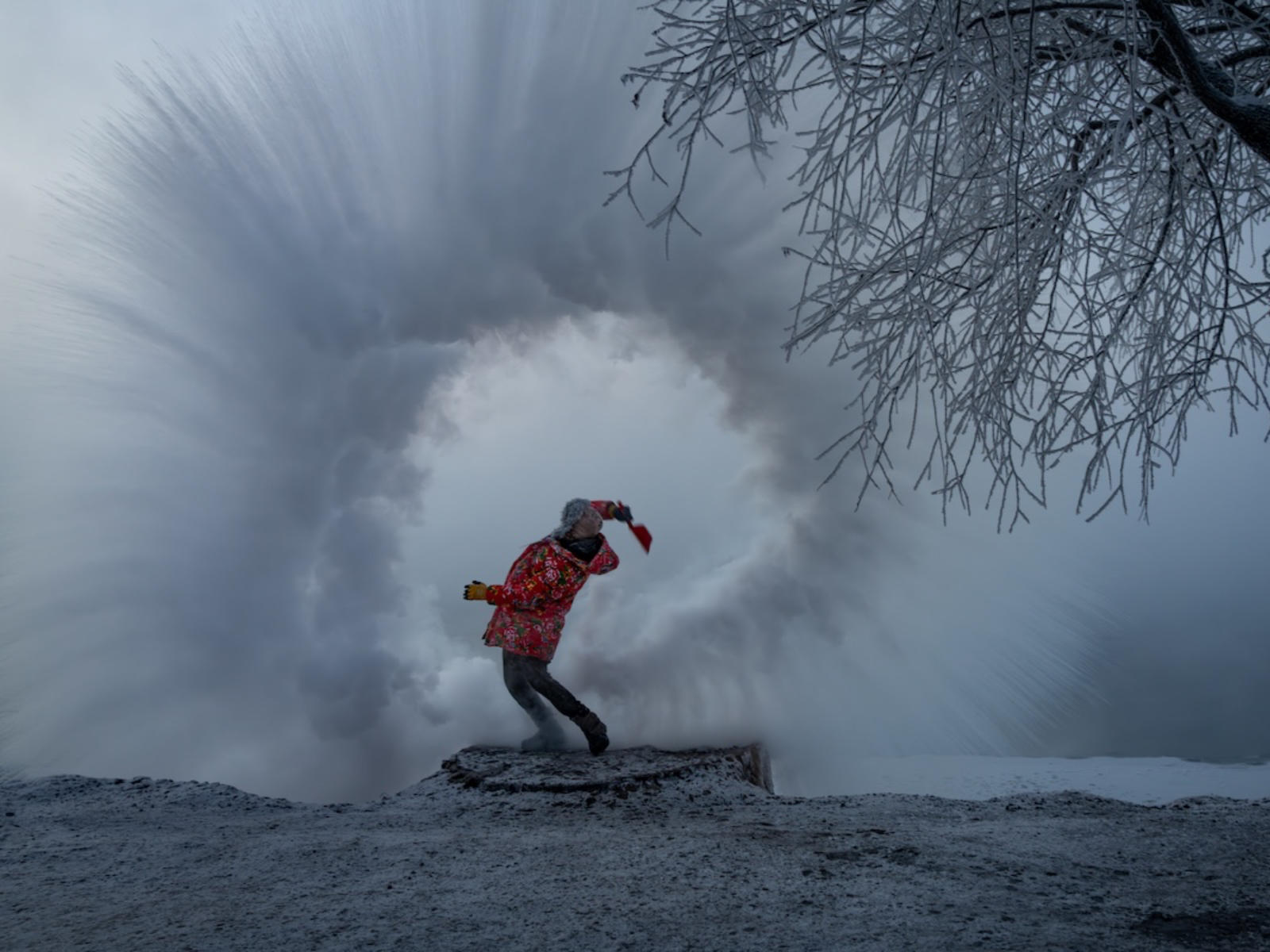
The Blue View Hotel’s hot springs enjoy a strong reputation. Local residents all recognize the name. They say the hot spring water flows down from Changbai Mountain and cools naturally after dilution. We visited the hot springs near sunset. The temperature dropped quickly. Soaking in hot water outdoors while the air hovered around minus twenty degrees Celsius created an unforgettable experience. A little water touched my hair, and the rising steam quickly froze into delicate “hair rime.” It looked fascinating. I chose a hotter pool, soaked for a while, then stepped out to feel the cold wind before returning to the water—imitating the alternating hot-and-cold bathing method. That half hour felt incredibly relaxing.

During winter, the opening window for Tianchi Lake at Changbai Mountain is very short. Often the scenic area closes for several days in a row. Then, depending on weather conditions early in the morning, it may open for just a few hours. Seeing Tianchi in winter often depends entirely on luck. Generally speaking, the West Slope offers a higher chance of reaching Tianchi than the North Slope. We initially bought West Slope tickets through a reseller. But the next morning we checked the official Changbai Mountain public account and saw that both the West and North Slope Tianchi areas were closed. We quickly contacted the reseller to refund the West Slope tickets and purchased North Slope tickets instead. Otherwise we would have had to travel in a large loop—from the North Slope back to Changbaishan Station, take a high-speed train to Changbaishan West Station, and then reach the West Slope scenic area—wasting half a day on transportation.

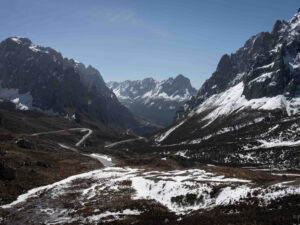
Even without access to Tianchi, the North Slope scenic area still offers several attractions, including Changbai Waterfall, the hot spring clusters, and a few smaller sites at the base of the mountain. In winter, you can only view a small portion of Changbai Waterfall from a distance, and it does not look especially remarkable. However, the surrounding peaks of Changbai Mountain form a dramatic backdrop, almost like a giant hand wrapping around the valley. That view still feels impressive. From time to time strong winds blow across the snowfields, sending fine grains of snow flying into your face. The sensation adds a bit of excitement. We did not stay in the scenic area very long. Our expectations had been quite high, and without access to Tianchi the natural scenery felt somewhat ordinary. Still, Changbai Mountain remains a place worth visiting at least once.
Harbin
Harbin was the final stop of our journey. The last time I considered visiting Harbin was in late July last year. I had planned to take an overnight green train and spend a weekend doing a quick “special forces style” trip around the city. The plan eventually fell apart. I learned that my train booking had succeeded while cycling from Beijing to Jixian. By the time I arrived in Jixian, I felt completely exhausted both physically and mentally, and I had no energy left to plan another trip for the following weekend. In the end, I canceled the whole plan.
For our first stop in Harbin, we dropped off our luggage and went straight to the largest Orthodox church in the Far East. The moment I saw Saint Sophia Cathedral, its distinctive domes and the cross above them immediately caught my attention. Orthodox crosses have a unique style. Mirrors decorate the cross itself, and a slanted wooden bar appears at the base. You can recognize an authentic Orthodox church at a glance.

The cathedral has undergone a full restoration, so it looks quite new today, though it still retains its character. The local government seemed eager to welcome a wave of weekend visitors, so performances kept happening inside the cathedral—violin music, piano pieces, and even an accordion played from the balcony above. Standing among the crowd and looking up together while the music echoed through the space created a truly memorable moment.
A short walk west of Saint Sophia Cathedral leads to Harbin’s Central Street. Central Street enjoys a huge reputation. It was once the longest commercial street in Asia and one of the earliest commercial streets in China. The street itself even carries a 4A scenic rating. Many local snacks line both sides of the street. In the middle of winter, we bought chimney bread ice cream—50 yuan including a coffee. The flavor was excellent, but the cold forced us to shiver while eating. Eventually we had to retreat indoors just to finish it.
The shops along the street sell plenty of local specialties. Harbin red sausage and Russian products occupy much of the storefront space. After sunset, the street lights look beautiful and make the area worth visiting at night. We walked from the southern end all the way to the northern end of Central Street. At the end sits the Harbin Ice and Snow Carnival, which resembles the famous Ice and Snow World. The difference is that one focuses more on activities while the other focuses more on viewing displays with a few rides included. On the frozen Songhua River, we tried a game called “ice rock-paper-scissors.” Two players squat side by side on the slippery ice and play rock-paper-scissors. The winner kicks at the loser’s feet from the side. Because the loser squats on smooth ice and cannot maintain balance, the kick usually knocks them over. The game is surprisingly fun, especially for guys.
A new day arrived, and we took the subway to Ice and Snow World. After so many days of traveling, I did not have very high expectations anymore. I was not especially excited either. Still, the event has run for twenty-seven consecutive years, so I assumed it must offer something worth seeing. Once we passed through the entrance gates, the sight of the massive ice sculptures immediately stunned us. People often say you come to Ice and Snow World mainly to admire the ice sculptures, while the giant slides and ferris wheel are just extras. After seeing the place, I completely understood why.
Among all the sculptures, I particularly loved the Yellow Crane Tower replica. The carving captured the elegance of the original building beautifully. Under the daylight, the blue-and-white ice version of the tower looked stunning. As for the amusement rides inside Ice and Snow World, they were honestly among the worst organized attractions I have ever encountered in any theme park. The park could easily provide many ways to make the experience smoother for visitors. Instead, they force everyone to keep refreshing their phones in the freezing cold just to grab time slots for rides. If you fail to get a ticket, the park treats it as the visitor’s own problem. That approach shifts responsibility away from the organizers. I strongly dislike this system, and the experience made me question whether I would return again in the future.
After dark, two stages host performances inside Ice and Snow World, each with a different style. One stage features dance music led by the host known online as “Brother Zuoyou.” I had seen viral clips before where the host shouts on stage, “Whose ID card is this?” and the crowd responds, “It’s been dropped!” Watching the videos online felt amusing. But after experiencing it in person, the situation felt a little strange. How could someone conveniently drop their ID card or lose a bag during every single performance? Standing in the audience, I began to suspect that much of it was staged for dramatic effect.

On our final day in Harbin, we visited the former site of Unit 731 of the Japanese invasion forces. Before arriving in Harbin, we watched the film 731. The story left us deeply disturbed. Sometimes I hesitate to revisit that painful period of history. It reminds me of how some governments today—such as those in Vietnam or the Philippines—choose to move forward rather than dwell too much on the past. They prioritize national development and cooperation, even with countries that once harmed them, because the future of their people matters most.
After finishing the entire visit to the Unit 731 site, we left with heavy hearts. Many feelings are difficult to express in words. Most people understand the meaning already. As the saying goes: “Never forget history, and strive to make ourselves stronger.”
Conclusion
During these ten days across the three northeastern provinces, we truly experienced what it means to “play with snow.” I do not know when I will return to Northeast China again. Ten days may sound generous, but we still missed several places we wanted to visit, such as the Shenyang Imperial Palace and the September 18th History Museum.
One interesting realization came when I checked the map. The distance from Harbin to Mohe is roughly the same as the distance from Harbin to Meizhou in Guangdong. That comparison shows just how vast Northeast China really is. If I plan another trip in the future, I might try cycling across the region along the Momang Highway—from Mohe to Manzhouli, a journey of more than 800 kilometers passing through the Hulunbuir Grasslands. But who knows. I have too many things I want to do this year.
For now, the next stage of the journey is simply the trip home. I am still planning it and have not decided how I will return for the Spring Festival this year. I do not want to simply buy a plane ticket and fly home like before. I want to find a different way to return. Let’s see what happens.
Share: