Spring is here. The temperature is rising, peach blossoms are in bloom, and I just can’t sit still at home anymore—I keep wanting to go out for a run.
But when it comes to running, what many people remember isn’t joy, but pain: gasping for air after a 100-meter sprint in school fitness tests, that metallic taste in the throat after an 800-meter run, or finally mustering the courage to run once, only to end up sore for an entire week—and then never running again. I was the same. In 2024, I decided to get back into running, but I was out of breath after just a few steps and couldn’t even finish one kilometer. At the time, I thought, this doesn’t make sense—I have a master’s degree in exercise physiology from Beijing Sport University, and yet I can’t even run one kilometer? It’s honestly embarrassing. But then I realized—this might actually be perfect. Why not use myself as an experiment and figure out how to apply scientific knowledge to make running feel easier?
So I started digging into research papers, combining what I had learned in physiology and anatomy, and tackling each problem one by one: why do I get out of breath so quickly? Why do my calves hurt? Why am I sore for days after running? Gradually, I found answers in books. Then I took those answers to the park and tested them through actual runs, refining things step by step until I found a comfortable way to run. Later, I asked my flat-footed wife to try it too—she went from experiencing calf pain every time she ran to comfortably completing 3 km and even 5 km. After seeing the results with her, I brought along friends and colleagues to run together. One colleague who hadn’t run in 10 years managed to complete 5 km on his third try using my method.
Seeing how this “comfortable running” approach worked for people around me, I felt it was time to write about it so more people could benefit. It’s not about discipline or willpower—it’s about applying sports science to help more people get moving.
To help address these issues, I’ve organized a series of six articles. Each one will go into detail on specific techniques to help you start running comfortably. The tentative topics are:
Precise pre-run warm-ups to reduce pain during running
Mastering running form so you no longer get out of breath—start running light and effortless like a gazelle
Controlling breathing rhythm and monitoring training intensity to truly achieve aerobic jogging
Proper stretching to relieve soreness
Activating your strength system for injury-free running
Turning your watch into a coach on your wrist
The content may be adjusted based on your feedback. If you have any running-related questions, feel free to leave a comment.
Why Do We Need a Pre-Run Warm-Up
When you think of warming up before running, what comes to mind? Stretching your legs, or putting your hands on your knees and rotating them a few times? These warm-up moves we learned in PE class are not only inefficient—they can even damage our knees.
Leg stretching like “pressing your legs” is a form of static stretching. It only lengthens the muscles without activating their ability to contract, meaning the muscles can’t function like springs to absorb impact and protect the joints. That’s why static stretching is better suited for post-run cooldowns, not pre-run warm-ups. As for the so-called “knee circles with hands on the knees,” they may actually harm the knee joint—because when the knee is in a flexed position, rotating it can compress and shear the meniscus inside the joint.
In addition, a proper warm-up should not only activate your “sleeping” muscles, but also wake up your “lazy” cardiovascular system. Only then can you reduce side stitches and muscle soreness during running.
Activate Sleeping Muscles
Before running, we need to activate the muscles in the front of the lower leg, the inner and front thighs, and the glutes. This not only allows muscles to better protect the joints, but also helps reduce muscle soreness during running. As for soreness in the back of the lower leg, that is better addressed with post-run stretching—because everyday walking already provides sufficient stimulation to those muscles, so there’s no need to specifically activate them before running.
Relieve Front Shin Pain: Foot Dorsiflexion
If you feel pain in the front of your lower leg while running, it’s very likely that your tibialis anterior wasn’t properly activated beforehand. In daily walking, this muscle isn’t heavily engaged, so its activation level is relatively low. As a result, when you start running, it isn’t ready—unable to generate enough force—so the impact absorption falls onto the bones in the front of the shin, making pain more likely.
The simplest way to activate the tibialis anterior is foot dorsiflexion. Make the movement large and slow so the front of the lower leg is fully engaged. Do 10 repetitions before running, or continue until you feel a clear burning sensation in the front of the shin—after that, you typically won’t experience pain when you start running.
An advanced version is the leaning dorsiflexion. Stand upright, step one foot slightly forward, and then perform 10 repetitions of dorsiflexion. This movement not only warms up the front of the lower leg, but also dynamically stretches the calf muscles at the back and the hamstrings in the back of the thigh—achieving multiple benefits in one exercise.
Prevent Knee Pain: Cossack Squat
Knee pain is one of the most common and concerning injuries among runners. Many runners even wear knee braces out of fear of knee pain. However, what they often don’t realize is that the muscles around the knee are actually the body’s natural knee braces. When these muscles aren’t activated, the “natural brace” can’t do its job. So before running, we should activate this natural protection—the muscles around the knee—rather than relying on external braces long-term, which can lead to disuse and weakening.
The Cossack squat is an excellent movement for activating these muscles. It is similar to a lateral lunge, as both involve shifting your body side to side, effectively activating the glutes and the inner and outer thigh muscles. However, compared to a lateral lunge, the Cossack squat includes lifting and rotating the toes at the end of the movement. While activating the muscles around the knee, it also improves ankle and hip mobility. Greater mobility in the ankle and hip further reduces the impact on the knee during running, offering additional protection.
Prevent Patellar Tendon Pain: Squat Jumps
Among different types of knee pain in runners, patellar tendon pain is also very common, often worsening during running or landing from jumps. This happens because the quadriceps at the front of the thigh fail to decelerate effectively during landing, allowing abnormal movement of the patella (kneecap), which repeatedly pulls on the patellar tendon and causes inflammation and pain. A common solution among runners is to use a patellar strap to externally stabilize the kneecap. However, in the long run, the key is to fix the underlying issue—restoring the “braking function” of the quadriceps and activating your body’s natural patellar support. Strengthening the eccentric control of the quadriceps improves this braking ability, helping you stabilize the kneecap during landing.
Squat jumps 1are a great exercise for activating the quadriceps. The key is to consciously control your landing, keeping it light and soft—like a gazelle. At the same time, squat jumps also activate your glutes and nervous system, preparing your body for the run ahead.
Pre-run Warm-up Summary
Now, let’s briefly summarize the warm-up exercises and their purposes. You can choose the appropriate movements based on your needs.
Bent-over ankle flex and point × 10 reps
Activate the anterior tibialis and hamstrings
Prevent and relieve pain in the front of the lower leg during running
Cossack squat × 10 reps
Activate the glutes and inner thigh muscles, while improving mobility in the hips, knees, and ankles
Prevent and relieve pain on the outer side of the knee during running
Jump squats × 20 reps
Activate eccentric control of the quadriceps
Reduce pain in the front of the knee
Wake Up Your Cardiopulmonary System
Many of us have had this experience: the first 10 minutes of a run feel the hardest—you’re out of breath and struggling. But after 10 minutes or around 3 kilometers, running suddenly feels easier. Compared to muscles, the cardiopulmonary system takes longer to adapt to the intensity of running. Physiologically, this is known as “visceral inertia.” So in addition to warming up your muscles, you also need to warm up your heart and lungs to avoid side stitches during running.
The American College of Sports Medicine suggests a general principle to overcome “visceral inertia”: perform at least 5–10 minutes of low- to moderate-intensity muscle and cardiopulmonary warm-up before exercise. This can effectively reduce side stitches and initial discomfort2.
Moderate intensity is roughly the level of brisk walking just before transitioning into a run. The talk test is the simplest way to judge: at moderate intensity, you can talk but not sing. If you wear a watch, your heart rate at moderate intensity is typically around 135–150 bpm. Before your actual run, you can jog at a moderate pace for 5–10 minutes to wake up your cardiopulmonary system, making the run feel easier.
A Flexible Warm-up Strategy
After reading this, you might feel a bit frustrated: “I barely have enough time to run, and now I have to spend an extra 20 minutes warming up muscles and my cardiopulmonary system. Do I really need to warm up for 20 minutes before every run?” Answer: Not necessarily—adjust based on your situation. Cheetahs in Africa never warm up before chasing prey because they are constantly active every day. But for those of us who sit for long periods, maintaining a warm-up habit is still important.
If you can run or exercise daily, you can reduce both the number of warm-up movements and the duration. If not, you can choose targeted warm-up exercises based on any discomfort you experience while running. If you feel no discomfort, you can start your run with shorter strides and a higher cadence, engaging the relevant muscles while simultaneously completing your warm-up. This way, muscle activation, cardiopulmonary preparation, and training are combined into one.
Conclusion
We hope this warm-up strategy helps you take your first running steps with ease. In the next article, we’ll explain how to master proper running form and start as lightly as an antelope.
Staying healthy isn’t just about running—reducing prolonged sitting in daily life is equally important. Long periods of sitting not only cause back pain and wrist discomfort, but also increase the risk of hypertension and diabetes. If you’re struggling with this, I’ve compiled a “Sedentary Health Guide” based on exercise science principles to help you address these issues specifically—so you can relieve pain and stay healthier even at your desk.
Jiang Zihao, Wang Guanglan, Chen Peng, Sun Xianghong, Wang Ting, Jia Shaohui, and Zheng Cheng. “Treatment of Patellar Tendonitis Using a Combination of Centrifugal Training and Whole-Body Vibration Training at Different Frequencies.” Chinese Journal of Tissue Engineering 28, no. 4 (2024): 493–98. ↩︎
American College of Sports Medicine. ACSM Guidelines for Exercise Testing and Prescription. Translated by Wang Zhengzhen, 2010. https://book.douban.com/subject/5272053/. ↩︎
If you watch a lot of films and TV dramas, you’re probably no stranger to the “amnesia” plot device. In tearjerker K-dramas especially, amnesia, car accidents, and terminal illness are often treated as a standard trio—a go-to formula for emotional storytelling. But how common is amnesia in real life, and what actually causes it? In this article, we’ll take a closer look at the typical “amnesia” scenarios found in classic film and television, while also introducing some basic neuroscience along the way—so the next time you encounter such a storyline, you’ll be ready with a sharp and informed critique.
Car Accident Amnesia: Who Am I? Where Am I? Who Are You?
This is probably the most common type of amnesia seen in film and television.
The protagonist typically suffers a series of physical head injuries—car crashes, being struck by a heavy object, tumbling down stairs or off a cliff, or getting severely beaten—and falls into a coma. In the next scene, they wake up in a hospital room, touching the bandages on their head, staring blankly at the concerned faces around them, and uttering the ultimate existential questions: Who am I? Why am I here? Who are you? What happened? At this point, we can predict the rest of the plot with our eyes closed: the hero mistakes their true love for a stranger, treats their enemy as a friend, and after countless twists and turns, falls in love all over again (not really, but you get the idea).
Psychogenic Disorders: Dissociative Amnesia
In reality, complete and global memory loss is extremely rare—but such cases do exist. The condition is known as dissociative amnesia.
We often see that the protagonist forgets who they are, who their parents and lovers are—these are all forms of episodic memory, more precisely, autobiographical memory1. Dissociative amnesia can indeed affect a person’s sense of personal identity, while leaving intelligence and everyday skills largely intact. So when the protagonist wakes up clear-eyed and articulate, yet unable to recognize themselves or their loved ones—strictly speaking, that part is not entirely implausible.
The biggest scientific flaw in these storylines lies in the triggering mechanism. In reality, dissociative amnesia is a psychogenic disorder, not the result of structural brain damage. In other words, true dissociative amnesia is a defense mechanism of the brain, usually triggered by extreme psychological trauma. Survivors of severe violence, sexual assault, war massacres, or catastrophic natural disasters may find reality too brutal to bear. To protect the individual from overwhelming pain, the brain essentially strips away the concept of “self” along with the traumatic memories.
Moreover, even when memory loss occurs, patients in real life are more likely to exhibit localized amnesia—for example, forgetting the period during which they were abused, or being unable to recall the death of a loved one—rather than wiping out decades of memories, including their own name and parents, as TV protagonists often do. If someone truly forgot that thoroughly, it would likely indicate a severe psychiatric disorder, not something that could be cured by yet another car accident or a second fall.
Stills from “The Delivery Master” (formerly titled “GIFT”)
In psychology, “dissociation” is a core concept. Put simply, it refers to a state in which consciousness becomes detached from reality. Everyday experiences like zoning out or daydreaming can be seen as mild forms of dissociation. Under increased stress, some people may experience a sense of detachment, feeling that the world around them is unreal, or that their body does not belong to them—as if they are watching themselves from the outside, like a movie. In more severe cases, dissociative amnesia may occur, or even dissociative identity disorder—commonly known as “multiple personality disorder”—in which the mind splits consciousness into several identities to distribute psychological pain, typically as a result of trauma.
There is also a more dramatic phenomenon called “dissociative fugue,” a rare subtype of dissociative amnesia. In real life, a person may suddenly leave their familiar environment and embark on unplanned, purposeless wandering. During this period, they remain conscious, capable of self-care, and able to interact normally with others, yet cannot recall their past. After the episode ends, they may also be unable to remember what happened during the wandering itself—it is almost like sleepwalking while awake. The good news is that this type of amnesia is usually reversible, and memory often returns quickly once the fugue state ends. The wandering trope is also popular in film and television: the protagonist not only loses their memory but relocates to another city, adopts a new name, and builds an entirely new identity. As someone with a strong attachment to logical consistency, I can’t help but complain every time I see this: wouldn’t their family report them missing? Wouldn’t someone who doesn’t know who they are go see a doctor? Why does the plot always prioritize romance above all else?
Traumatic Brain Injury: Post-Traumatic Amnesia
If someone in real life is involved in a car accident or sustains a severe concussion in a boxing match, what does waking up actually look like? There is a specific term for this: post-traumatic amnesia. It typically manifests as a memory gap lasting from a few minutes to several hours. The person not only cannot recall what happened at the moment of impact, but may also have no memory of a period of time before and after the accident. Moreover, this missing segment of memory is usually permanent and cannot be recovered.
Why does this happen? To understand that, we need to introduce an important structure in the brain—the hippocampus.
Location of the hippocampus in the brain
Many people know that the hippocampus is related to memory, but it’s easy to misunderstand its role and assume that it is where memories are stored. In fact, the hippocampus functions more like a computer’s RAM. Its core job is not to store memories, but to process and transfer them. Whether we experience an event or learn a new fact, the information is first temporarily held as short-term memory. After being organized and encoded by the hippocampus, it is then uploaded to different regions of the cerebral cortex and stored as long-term memory. This process is known as memory consolidation.
However, the hippocampus has a critical weakness: it is extremely sensitive to oxygen deprivation and physical shock. When a severe concussion occurs, the hippocampus can temporarily shut down. At the moment of impact, although the person may see blinding headlights or hear screams around them, the information enters short-term memory but cannot be further processed or consolidated because the hippocampus is not functioning properly. Even memories from the minutes before the accident—still “queued up” in the hippocampus awaiting consolidation—may vanish permanently. It’s like losing power while writing a document: no matter how many times you restart the computer, the unsaved lines are gone for good.
Memory tip: “Retrograde” means forgetting earlier events; “anterograde” means forgetting more recent events.
When memory loss is defined by the time of an accident or illness, the inability to remember events that occurred before it is called retrograde amnesia. The dissociative amnesia discussed earlier also falls under retrograde amnesia, though the time span of forgotten memories is usually much longer and the underlying mechanism is entirely different. In contrast, anterograde amnesia refers to the inability to form new memories after the event, meaning the person cannot remember anything that happens afterward.
In fact, for concussion patients, retrograde amnesia is not the only issue. What often causes greater alarm is anterograde amnesia—a period of “short-term memory loss” lasting minutes or even hours after regaining consciousness. The car accident is over, the patient is awake and able to speak, yet they cannot retain newly occurring information: they may repeatedly ask what happened, or forget a doctor’s instructions moments after hearing them. It’s understandably frightening, raising concerns about whether something is seriously wrong with the brain.
This happens because although the person has regained consciousness, the hippocampus has not fully recovered its function. The brain is effectively operating with malfunctioning “RAM,” unable to transfer short-term memories into long-term storage. The good news is that this type of anterograde amnesia is usually functional and temporary. For most concussion patients, a few hours of rest is enough for the hippocampus to come back online and restore normal memory consolidation. However, if a patient still cannot form new memories after 24 hours, the condition is no longer considered a simple concussion, or mild traumatic brain injury. It may indicate moderate to severe brain injury, potentially involving structural damage such as bleeding or contusions—situations that are far more serious.
A classic of psychological suspense and a Douban Top 250 staple—say one word too many and you risk spoilers. Leonardo DiCaprio plays Teddy, a U.S. federal marshal who arrives at an isolated island to investigate a case. As the story unfolds, the truth takes a dramatic turn. A textbook-level thriller with strong scientific grounding, and absolutely worth watching.
Starring Matt Damon. The protagonist is shot in the back and rescued at sea, with no memory of who he is, yet possessing elite combat and language skills. The amnesia here mainly serves to create suspense, but it does attempt some scientific plausibility, attributing memory loss to both physical and psychological trauma. The plot isn’t overly cerebral, but it’s incredibly entertaining—especially the first three films, all highly recommended.
A 1997 Fuji TV Wednesday Theater production. Takuya Kimura appears in a different Gucci haute couture suit each episode, with bold scenes that give it the vibe of a late-night drama. It was later banned following Japan’s infamous butterfly knife incident, adding a layer of mystique. This darkly humorous episodic series portrays various social outsiders. The cause of the protagonist’s amnesia is ultimately revealed, incorporating psychogenic elements into the narrative. Well worth a positive review.
A classic early Conan theatrical release. After witnessing Inspector Sato being shot, Ran develops psychogenic amnesia due to intense guilt and psychological trauma, awakening unable to recognize even her parents or Shinichi. While the amnesia setup is dramatically exaggerated, the film includes detailed medical touches—upon waking, Ran is immediately tested on semantic memory (e.g., “What is 5 times 8?” “What is the capital of the United States?”) and procedural memory (e.g., whether she can use a ballpoint pen). Compared to later films featuring increasingly explosive “Conan science” moments—like stopping a high-speed train with an inflatable soccer ball or triggering an avalanche to block a dam collapse—this installment truly stands the test of time.
The forefather of car-accident-amnesia melodrama, with tear-jerking power off the charts. Bae Yong-joon’s character is involved in a car crash on his way to meet the heroine and awakens with complete memory loss. After yet another accident, his memory conveniently returns. The amnesia here mainly serves to alter the protagonist’s identity and generate dramatic conflict. As for scientific plausibility—best not to think too hard. Just enjoy the visuals and let yourself cry. Similar K-dramas include Stairway to Heaven, The Last Dance, and The Moon Embracing the Sun—there’s no shortage of amnesia-themed works.
The original domineering-CEO idol drama. Ming Dao plays the heir to a major corporation who loses his memory, adopts a new name, becomes a simple villager, and eventually falls in love with the spirited female lead. Same formula, same flavor—some viewers have even accused it of heavily borrowing from The Last Dance. Rewatching these childhood idol dramas as an adult may leave you questioning your younger self’s intelligence and taste. Recommended for those feeling nostalgic for their youth (tongue firmly in cheek).
Memory Reboot: Constantly Meeting a Brand-New Self
Another form of amnesia frequently portrayed in film and television is the idea of repeated “memory reboots.”
In Christopher Nolan’s mind-bending film Memento, the protagonist suffers from a rare memory disorder and can only retain memories for about a dozen minutes at a time. To avenge his wife’s death, he must use every tool at his disposal to preserve information, gather clues, and piece together the truth. The investigative difficulty is exponentially higher than for an ordinary person, which greatly amplifies the film’s tension.
Beyond the “minute-based” memory reset, there is another variation in which the protagonist’s memory resets after each period of sleep—essentially on a “daily” basis. In this setup, every awakening is equivalent to a rebirth. The character must leave behind carefully prepared clues to inform their future self: Where am I now? What has already happened? What am I supposed to do next?
Organic Brain Damage: “The Eternal Present Tense”
In the real world, the first scenario—frequent, short-term memory loss—is more consistent with scientific reality.
One of the most famous textbook cases in neuroscience is H.M., whose real name was Henry Molaison. He became a research model for constant memory reboot. At age 27, in order to treat severe epilepsy, surgeons removed parts of his bilateral medial temporal lobes, including the hippocampus and surrounding structures such as the amygdala. After the surgery, his intelligence and personality remained intact, but his memory suffered severe, irreversible, and permanent damage.
Image source: A Comic Guide to the Brain
First, Henry could no longer form long-term memories of anything that happened after the surgery. In other words, his episodic and semantic memory systems were devastated—this is a classic case of anterograde amnesia.
For example, he could engage in simple back-and-forth conversations with visitors. As long as the interaction was not interrupted, it could continue smoothly. However, if the visitor stepped out of the room and returned, or if the conversation was interrupted by someone else, Henry would completely forget everything that had just been discussed. This phenomenon is closely tied to the principles of short-term memory (working memory) discussed earlier.
With his hippocampus removed, Henry could no longer consolidate new long-term memories. He had to rely on short-term memory and sustained attention, passing information along in his mind like a relay baton to maintain continuity in what he was doing or saying. But this state was extremely fragile. The moment his attention was disrupted—by glancing out the window, someone interjecting, or even taking a bathroom break—the brain’s “cache” would instantly clear. The previous conversation, even the identity of the person in front of him, would vanish. Even researchers who had followed him for years were greeted each time as strangers, with Henry politely asking, “Hello, have we met before?”
Image source: A Comic Guide to the Brain
For Henry, time was permanently frozen in the present. There was no yesterday and no tomorrow. In his internal clock of self-awareness, he was forever 27 years old. If Henry looked into a mirror and saw an elderly man with white hair, he would feel confused—but the moment he turned away, he would forget the startling discovery and return to calm.
Second, Henry not only failed to form new memories but also lost some memories from before the surgery, exhibiting a degree of retrograde amnesia. Follow-up studies found that he had almost no recollection of events from the ten years prior to his operation, yet he vividly remembered his early childhood, including events before the age of ten.
To explain this pattern, researchers concluded that long-term memory is not stored in a single step. It requires a prolonged consolidation process, possibly spanning years or even a decade. In the first few years, although memories leave traces in the cerebral cortex, they still require assistance from the hippocampus for retrieval. Once the hippocampus is damaged, these not-yet-fully-consolidated memories lose their “index” and become inaccessible. In contrast, more remote memories are securely stored in the cortex, which is why, even without a hippocampus, Henry could still remember fundamental facts about himself—such as who he was and who his parents were.
Henry’s mirror-drawing experiment
Perhaps most astonishing to scientists was that although Henry could not remember new knowledge, he could still learn new skills. In one famous experiment, researchers asked him to perform a mirror-drawing task: tracing the outline of a double-bordered star while looking only at its reflection in a mirror. This is far from easy. At first, Henry’s drawings were clumsy and inaccurate, but with repeated practice, his performance improved dramatically. Interestingly, even though he eventually became highly proficient, Henry had no recollection of ever practicing. He would express surprise, saying, “That’s strange—this was easier than I expected.”
It was through studies of Henry that scientists came to understand that the brain contains multiple memory systems, each with distinct functions. Although the hippocampus—responsible for semantic and episodic memory—was permanently offline, the basal ganglia and cerebellum, which support skill learning, remained functional. This latter system is what we now call procedural memory, commonly known as muscle memory.
In 1986, Henry Molaison at age 60 at MIT
There is a small consolation: although Henry lived his entire life with memory impairment, he truly became someone who lived “in the present.” He led a peaceful life. This was partly due to his innate temperament, and partly because the surgery also removed his amygdala, eliminating much of the physiological basis for anxiety and fear. In daily life, he helped with household chores, prepared lunch, made the bed, accompanied family members on errands, played crossword puzzles, chatted with others, and watched television to relax. Although his consciousness remained anchored at age 27, his body continued to learn how to care for itself over time. Living in each brand-new present moment, he reached the age of 82.
Thus, in real cases of organic brain injury, forgetting is generally not measured in days—it happens continuously, moment by moment.
Besides Henry Molaison, another well-known amnesia patient was Clive Wearing, a musician from Cambridge University. Due to irreversible hippocampal damage caused by herpes encephalitis, his memory span was reduced to just 7 to 30 seconds—literally a “goldfish memory.” For Clive, unable to remember what had happened mere seconds earlier, every moment felt like waking from unconsciousness into a bewildering void. His wife wrote in her memoir:
Clive is in a constant state of feeling as if he has just regained consciousness. He once said, “I haven’t heard, seen, touched, or smelled anything. It’s like being dead.” His diary entries are heartbreaking to read:
2:00 p.m.: I have just woken up for the first time.
2:14 p.m.: I am now conscious.
2:19 p.m.: I have just woken up.
…
Rare Exception: “A Life That Resets Every Day”
Compared with these real-life cases, the film and TV trope in which a person is fully lucid during the day and only loses all memory after sleeping is, scientifically speaking, very difficult to justify.
If the hippocampus were severely damaged, a person would not be able to rely on short-term memory alone to sustain an entire day’s worth of experiences. A more plausible hypothesis is that during wakefulness, these memories have already entered the hippocampus and undergone initial encoding, with the problem arising later during the stabilization process. This in itself suggests that the hippocampus is functioning—at least participating in memory formation. If that is the case, then why would already-formed memories fail to stabilize after sleep, or become inaccessible upon waking? That is the truly puzzling part.
Michelle Philpots and her husband
That said, screenwriters are not creating these stories entirely out of thin air. There are indeed rare real-world cases that resemble this setup. One example is Michelle Philpots, a British woman who suffered two car accidents, resulting in brain injury accompanied by epileptic seizures. Her memory abilities deteriorated significantly afterward. Her long-term memory remains anchored in the 1990s, while newly formed memories last only briefly. She relies on sticky notes, video recordings, and reminders from her husband to manage daily life. The media often describe her condition as “a life that resets every day,” but from a medical perspective, this is not a literal daily memory wipe. Rather, it reflects difficulty in consolidating new memories over the long term. The romantic film 50 First Dates, with its premise of “waking up with a blank slate every day,” may well have drawn inspiration from this real case.
It is important to emphasize that such cases are extraordinarily rare, and even within neuroscience, they remain controversial. One relatively plausible explanation involves a failure of memory consolidation. Research suggests that the transfer of memories from the unstable hippocampus to the more stable cerebral cortex primarily occurs during sleep. If a patient experiences severe nocturnal epilepsy, abnormal brain activity may disrupt this consolidation process, preventing memories from becoming permanently stored or making them difficult to retrieve upon waking.
So while this type of storyline has a real-world prototype, it is largely an artistic exaggeration designed to heighten dramatic tension. It should not be taken as general medical knowledge.
Christopher Nolan’s breakthrough masterpiece and a definitive mind-bending classic. The protagonist suffers anterograde amnesia after a brain injury, with memories lasting only a dozen minutes. To avenge his wife, he relies on tattoos, photographs, and handwritten notes to piece together clues. Beyond its intricate plot, Nolan’s editing masterfully simulates the fragmented experience of an amnesia patient, creating an immersive viewing experience. High on both scientific plausibility and cinematic ingenuity, it’s worth watching multiple times.
Similar film: Ghajini, a Bollywood remake that retains the same amnesia premise but adds more action and musical elements. Starring national treasure Aamir Khan—whose physique alone is worth noting—it’s an entertaining adaptation.
A classic romantic comedy and perhaps the most famous “sleep-reset” amnesia story. The heroine suffers memory damage after a car accident and wakes up each morning with her memory reset to the day of the accident. The science is shaky, but the emotional impact carries the film. The hero’s daily efforts to make her fall in love with him all over again are undeniably romantic. As a love story, it’s well worth a watch.
Similar film: the Japanese remake 50 First Kisses, starring Takayuki Yamada and Masami Nagasawa. The plot closely follows the original, with few notable innovations. In my personal view, the on-screen chemistry is minimal—recommended mainly for fans of the actors.
A well-received recent Japanese medical drama, with each episode centered on a neurosurgical case. The protagonist, played by Hana Sugisaki, is a neurosurgeon who develops a memory disorder after an accident. Her memory resets each morning, and she must rely on rereading her diary to reconnect the threads of her life. Unlike the purely romantic focus of 50 First Dates, this series uses the “daily reset” premise to explore classic neurological disorders and the psychological struggles of amnesia patients. In that respect, it does a commendable job. Personally, the most moving aspect is the romantic subplot. The lead actors (Hana Sugisaki and Ryuya Wakaba) are a real-life couple, and their genuine chemistry shines through on screen.
A manga-adapted mystery comedy starring Yui Aragaki and Masaki Okada. The heroine, Kyoko, is a white-haired detective whose memory resets whenever she falls asleep. As a result, every case must be solved within a single day, and she writes crucial clues on her arms and legs with a marker. Masaki Okada plays an unlucky man who always finds himself near crimes—and frequently suspected as the culprit. The amnesia premise here exists purely for narrative convenience and has no scientific grounding whatsoever. Fortunately, the show is lighthearted and humorous, with straightforward mysteries that require little mental strain. A casual watch for relaxation, though personally I’d rate it as average.
Alzheimer’s Disease: The Eraser in the Mind
If the first two types of amnesia are relatively uncommon in real life and largely shaped by artistic dramatization, memory loss caused by Alzheimer’s disease is, for ordinary people, the most common—and the most closely intertwined with everyday life. Just two years ago, my grandmother passed away. In the decade before her death, she had likely been living with Alzheimer’s, though at the time I did not recognize it. I only felt that she was becoming increasingly forgetful, gradually failing to recognize people, and that her temperament had changed dramatically—growing unusually stubborn. Looking back now, I still feel deep guilt and regret.
For the sake of dramatic conflict and aesthetic appeal, films often focus on the rare cases of early-onset Alzheimer’s. A classic example is the Korean romantic film A Moment to Remember, in which Son Ye-jin’s character begins, in the prime of her youth, to slowly and smilingly forget the person she loves most, rendering the disease tragic yet strangely romantic.
In reality, however, Alzheimer’s disease is typically a condition of old age. The vast majority of patients develop it after the age of 65. Moreover, the prevalence increases exponentially with age. Among people over 85, approximately one-quarter to one-third are affected. For a scientific overview of the disease, one might watch the TED talk by Harvard neuroscientist Dr. Lisa Genova.
From a symptomatic perspective, Alzheimer’s has an extremely long course. From initial mild forgetfulness to eventual profound dementia and loss of function, patients and their families often endure a decade or more of slow decline. For most families, daily life is marked less by romance than by exhaustion and despair. As the disease progresses, cognitive confusion, incontinence, personality changes, wandering, hallucinations, and even aggression may follow. Even when family members understand the condition and prepare themselves intellectually and emotionally, the relentless burden of caregiving can gradually erode patience and resilience.
For further reading, popular science books such as The Thief of the Mind are recommended, along with memoir-style works like When My Mother Had Alzheimer’s, On Call: A Harvard Physician and His Wife’s Ten-Year Journey with Alzheimer’s, and Being My Mother’s Mother. As a broader social issue, caregiving can also be explored through NHK documentary series such as Missing with Dementia and Bankrupt in Old Age.
Disease Mechanism
Why does Alzheimer’s disease not only cause memory loss but also such profound changes in personality and function? How does it differ from ordinary age-related forgetfulness? The answer lies in its underlying pathology.
Normal age-related forgetfulness is primarily due to a natural decline in brain function. Neuronal responses slow, and some neurons die with age, but the overall structure remains intact. Core memories and personality are largely preserved. In contrast, Alzheimer’s involves irreversible physical changes within the brain. Under a microscope, two abnormal protein pathologies are visible: beta-amyloid plaques, which accumulate like toxic debris between neurons and disrupt communication, and tau protein tangles, which damage the internal transport systems of neurons, leading to widespread cell death.
Brain Structure of Alzheimer’s Patients (Image source: The Illustrated Brain User’s Manual)
The structural damage caused by these pathologies follows a clear pathway and sequence, which directly determines the symptoms observed at different stages of the disease.
Stage One: Hippocampal Damage and Short-Term Memory Impairment (Typically 2–4 Years) The hippocampus is the first region attacked. Once it is damaged, patients develop classic anterograde amnesia, unable to retain new information. This is the earliest and most common symptom of Alzheimer’s. Patients may repeatedly ask the same question, forget they have just eaten, or become lost in a familiar neighborhood. At this stage, long-term memories stored in the cortex remain intact, so patients may vividly recall distant events while failing to remember what happened moments ago.
Stage Two: Spread to the Cerebral Cortex, Affecting Long-Term Memory and Cognition (Typically 2–10 Years) As the disease advances, toxic protein accumulation spreads outward from the hippocampus to the cerebral cortex. The cortex not only stores long-term memories but also governs language, logic, spatial reasoning, and emotional regulation. During this longest stage of the illness, patients begin to exhibit retrograde amnesia, gradually forgetting events from recent years or even decades past, eventually failing to recognize loved ones. Personality and behavior may change dramatically. Language abilities may deteriorate; words may no longer come easily. Some individuals become stubborn, suspicious, or aggressive. When families observe striking personality changes and behavioral disturbances, they are often witnessing this stage.
Stage Three: Widespread Brain Involvement and Total Functional Decline (Typically 1–3 Years) In the final stage, pathological changes sweep through nearly the entire brain. Severe brain atrophy becomes evident. Patients may completely forget who they are. The brain progressively loses control over bodily functions. Walking becomes impossible; eventually even basic physiological abilities such as chewing, swallowing, and bladder and bowel control are lost. At this point, patients depend entirely on round-the-clock care, until complications ultimately lead to the end of life.
Regrettably, humanity has yet to develop a treatment capable of curing or reversing Alzheimer’s disease. Even when scientists succeed in clearing the toxic protein plaques from patients’ brains, the disease often continues its irreversible progression. This remains one of the most formidable challenges in modern medicine.
A textbook example of an Alzheimer’s-themed film. The original novel was written by Lisa Genova, a Harvard-trained neuroscientist who has authored multiple works of fiction and popular science centered on neurological disorders. The story follows a linguistics professor with a happy marriage and three children who develops familial Alzheimer’s disease at age 50. The film captures, with painful realism, the fear and helplessness of an intellectual confronting the gradual loss of self-awareness. Julianne Moore delivers an exceptional performance. Highly recommended.
Previously recommended in our “What to Watch This Week” column. Adapted from the stage play of the same name, this is widely regarded as a masterpiece among Alzheimer’s films, with remarkable artistic depth. Told largely from a first-person perspective, it immerses viewers in the daily confusion and fragmented memories of a father living with Alzheimer’s. The sense of immersion is powerful. Many viewers may feel disoriented while watching—but as one comment aptly put it: how fortunate are those who cannot fully understand this story. Anthony Hopkins (best known to many as “Hannibal”) delivers a godlike performance, and the portrayal of the daughter’s despair and inner conflict is equally compelling. Strongly recommended.
Another film on a similar theme, Familiar Touch, is also worth watching; you can refer to the detailed recommendation in our weekly column.
A Spanish animated film—realistic and deeply sobering. The protagonists are elderly residents confined to a nursing home. The film delicately portrays different stages of the disease’s progression: early disorientation, mid-stage hallucinations, and the late-stage despair of being “moved upstairs,” a euphemism for complete loss of function. I personally enjoy animated films, and this one resonates with me in its storytelling, emotional depth, and visual style. Strongly recommended.
A classic Korean tearjerker. The film focuses on early-onset Alzheimer’s, which accounts for less than 10% of real-life cases, primarily for dramatic purposes. As a romance, it is undeniably moving; as a depiction of disease, it is highly stylized and romanticized, and remains somewhat removed from the harsher realities of Alzheimer’s.
A romance drama written by Shizuka Oishi, starring Erika Toda and Tsuyoshi Muro, whose on-screen chemistry is unexpectedly strong. Once again featuring an early-onset premise—a young, capable female doctor developing Alzheimer’s—the series offers a relatively detailed portrayal of the male lead’s pain and perseverance as he cares for his gradually declining partner. The first half, focused on romance, is especially engaging. The latter half, after the illness progresses, becomes somewhat melodramatic, and some side romances feel less convincing. Still, it is undeniably tear-inducing.
Final Thoughts
While gathering material for this article, I discovered that beyond the types of amnesia discussed above, there are many other unusual and complex memory disorders, each with different triggers. It would be impossible to cover them all here. Drawing from the book The Neuroscience of Memory, here is a summary for further reference:
Medication side effects (especially anticholinergics, antihistamines, typical antipsychotics, and benzodiazepines) Vitamin deficiencies (particularly deficiencies in vitamin B12, vitamin B1, and vitamin D) Hormonal imbalances (including thyroid disorders) Physical stress, infection, and illness (including Lyme disease, COVID-19, encephalitis, diabetes, major surgery and anesthesia, organ failure, and sleep deprivation) Neurological disorders (including brain tumors, epilepsy and seizures, multiple sclerosis, stroke, transient global amnesia, and traumatic brain injury) Psychiatric disorders (including anxiety, depression, ADHD, bipolar disorder, schizophrenia, electroconvulsive therapy, dissociative amnesia, and alcohol or toxin use) …
This article is the second installment in our “Memory” learning series, using film and television as an entry point to explore the science of memory. In the next piece, I plan to return to the core theme of learning and discuss the importance of procedural memory and practice. If there are topics you’re particularly interested in, feel free to leave a comment and share your suggestions.
Combining episodic memory (specific past events) and semantic memory (abstract personal knowledge), it involves the cognitive reconstruction and narration of one’s personal life history. For example: Where is my hometown? Am I married? How did I leave my hometown back then? ↩︎
On January 7, 2025, the U.S. Department of Health and Human Services and the Department of Agriculture jointly released the new Dietary Guidelines for Americans, 2025–2030. On the official U.S. government website, the guidelines are described as follows: “Under the bold leadership of President Trump, this edition of the Dietary Guidelines for Americans will reset federal nutrition policy, put our families and children first, and move toward a healthier nation.” Accompanying this is a very Trump-style slogan: “Make America Healthy Again.”
Why the need to be “healthy again”? Because the United States is facing a severe public health crisis: 50% of Americans have prediabetes or diabetes, 75% of adults have at least one chronic disease, and nearly 90% of healthcare spending goes toward treating chronic conditions. Most of these diseases are closely linked to diet and lifestyle.
In response, the new guidelines position themselves as a “reset of nutrition policy”—a phrase that is itself quite thought-provoking. Is the U.S. government openly “slapping itself in the face” over decades of past dietary advice? In theory, as a global leader in nutrition research, such a major policy shift should carry considerable guiding significance. Yet the heavy Trump imprint on the document also makes it feel somewhat less reliable.
So what does this set of guidelines actually say? What does it emphasize? And how much reference value does it really have? Setting other factors aside, let’s focus on the substance and talk about this latest edition of the U.S. Dietary Guidelines.
Author’s note: The following content is my own reorganization and summary based on reading the guidelines and consulting additional sources. It does not fully follow the original structure or wording of the official document and represents only my personal views. Readers who are interested can consult the original guidelines via the link at the beginning; it is only about 10 pages long and easy to read.
One Core Principle: Eat Real Food
On the very first page of the guidelines, a simple and direct core principle is stated upfront: “Eat Real Food.”
At this point, some readers might ask: real food? So what have I been eating before—fake food?
So what exactly counts as “real food”? On the official website, I found a clear definition:
Foods that are whole or minimally processed and still recognizable as food. Prepared with very few ingredients, and without added sugars, industrial oils, artificial flavors, or preservatives.
This definition highlights two key characteristics. The first is the integrity and original form of the food—for example, whole fruits and vegetables are preferred over juices or extracts. The second is the purity of the ingredients. A popular way to put it is: if your grandmother can’t understand the ingredient list, then it probably isn’t “real food.”
Why emphasize this? Because real food is a “whole system,” not just a simple stack of nutrients. Take an orange and a glass of orange juice as an example. On a nutrition label, the vitamin C content of the two might look similar. But a whole orange contains intact dietary fiber, which slows digestion, leads to a steadier blood sugar response, and provides greater satiety. Once it’s juiced, the fiber is gone and the sugars are concentrated—drink a glass and your blood sugar spikes, and you’re hungry again soon after. The source is the same, but the effects on the body are completely different, and this difference is something nutrition labels cannot capture.
The guidelines also use the term “nutrient-dense”: real food provides more nutrition with fewer calories. Ultra-processed foods are the opposite. To extend shelf life, improve taste, and reduce costs, they often remove some natural components and add sugar, salt, fats, and various additives, delivering what is essentially “empty calories.” In a previous randomized controlled trial, researchers found that even when the nutrient composition was matched as closely as possible, participants ate more and gained weight more easily during the ultra-processed food phase than during the unprocessed or minimally processed diet phase.1
Source: Ultra-Processed Diets Cause Excess Calorie Intake and Weight Gain: An Inpatient Randomized Controlled Trial of Ad Libitum Food Intake.
This also helps explain why the previous line of thinking had its limitations. Over the past few decades, mainstream discourse has leaned heavily toward a nutrient-centered framework (such as low fat, low calories), which has produced side effects in the context of the modern food industry. For example, how many grams of protein we should consume per day, how many grams of carbohydrates, how strictly we should control calories and fat—as if healthy eating were a precise math problem. When experts tell you that “fat is the enemy and must be controlled,” food manufacturers respond by rolling out all kinds of “low-fat” products. These products do contain less fat, but to make up for the loss in taste, they often add more additives. Under the old framework, such foods were considered perfectly “compliant,” yet they are in fact典型 examples of ultra-processed foods.
Once you understand this, the logic behind the current shift becomes much easier to grasp.
And this shift is not a spur-of-the-moment decision. A large umbrella review published in The BMJ in 2024 (an umbrella review further analyzes the results of multiple meta-analyses and therefore carries a higher level of evidence) compiled data from nearly ten million people. The results showed that ultra-processed foods are significantly associated with multiple health risks: a 21% increase in all-cause mortality, a 66% increase in death from heart disease, and a 40% increase in the risk of type 2 diabetes. What is even more telling is that not a single study found any health benefit from ultra-processed foods.2
It is clear that this viewpoint is actually in line with the mainstream direction of research in recent years and is by no means some “earth-shattering” new discovery. Personally, I even find the term “reset” a bit overstated, carrying a hint of political messaging. But setting the wording aside, it does represent a shift in official thinking. Academia has been moving in this direction for quite some time; this is simply the moment when the authorities formally acknowledged and summarized that shift.
In any case, at least with regard to this core principle, it is backed by solid research and evidence.
Three Priority Shifts: The Inverted Food Pyramid
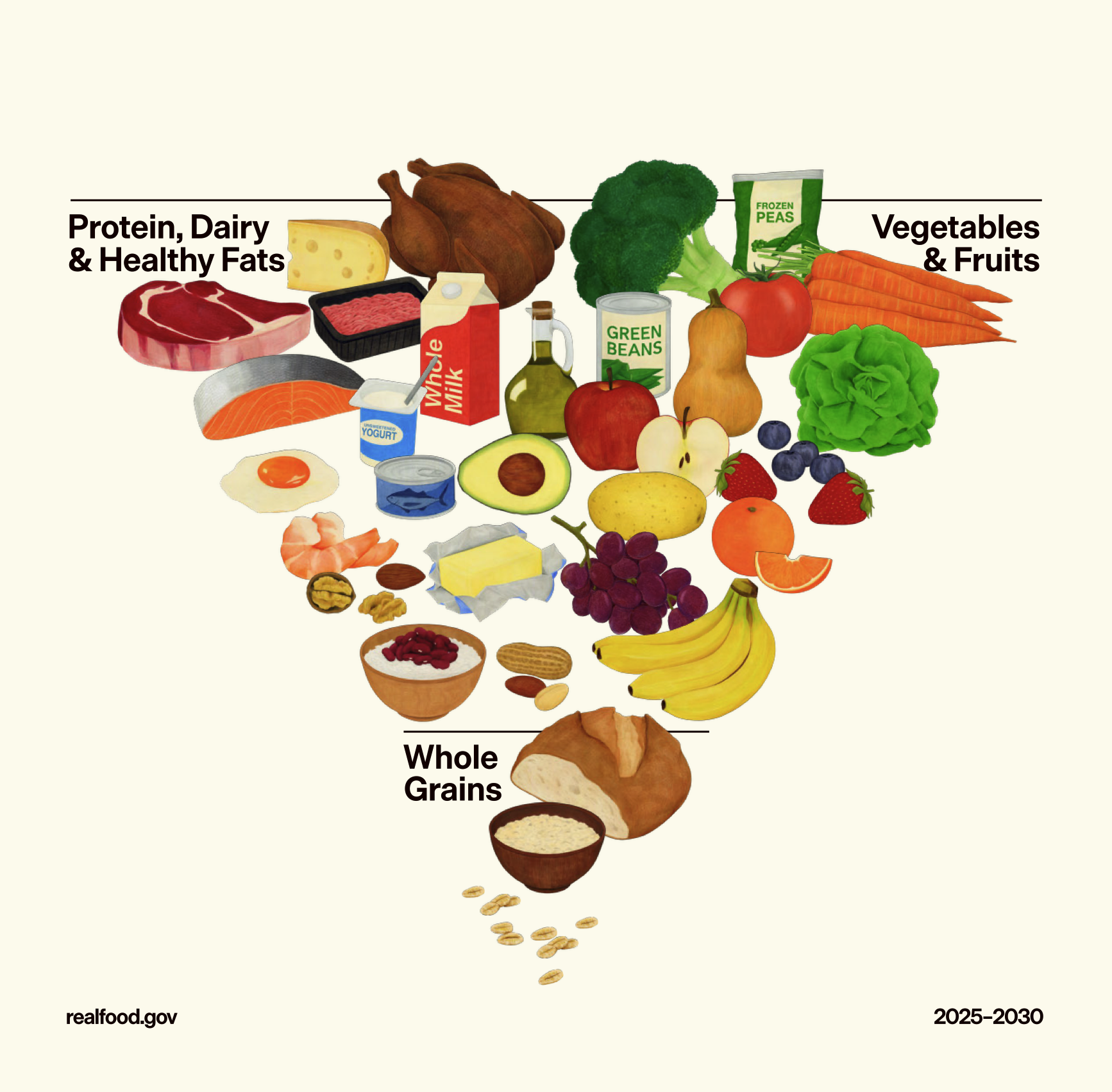
Beyond the change in core philosophy, the most striking update in the new guidelines is the inversion of the food pyramid. This visual shift is not merely a design refresh, but a reordering of priorities in the overall nutritional structure.
Back in 1992, the United States introduced a very classic food pyramid model: bread, rice, noodles, and other grains sat firmly at the base, recommended for the highest intake; above them were fruits and vegetables; higher still were dairy and meat; and fats and sugars were squeezed into a tiny triangle at the very top. This image shaped an entire generation’s understanding of what “healthy eating” looks like.
In the new pyramid, the top section—the part that should be prioritized the most—is divided into two sides: on the left are protein, dairy, and healthy fats; on the right are fruits and vegetables. Grains, once considered the “foundation” of the diet, have now been compressed into the narrowest section at the bottom, with a special emphasis on “whole grains.”
This change directly reflects a restructuring and reprioritization of the three major macronutrients—protein, fat, and carbohydrates.
Left: the classic 1992 food pyramid; right: the new inverted food pyramid
Change One: Protein First — Make Sure You Get Enough Protein at Every Meal
The most eye-catching shift in the new food pyramid is that protein has jumped from a middle position—where it was something to be limited—to the very top as the highest priority. The wording in the guidelines is quite direct: “Prioritize high-quality protein at every meal.” In other words, if conditions allow, you should aim to meet your protein needs first, and then consider pairing it with other foods.
The specific target is 1.2–1.6 grams per kilogram of body weight per day, almost double the previous recommendation of 0.8 g/kg. For a 70-kg adult, this means about 84–112 grams of protein per day instead of the old 56 grams. That number may sound abstract, so translated into food it looks roughly like this: 100 grams of protein is about 500 grams of lean meat (two large chicken breasts or two large steaks), or about 1 kilogram of tofu, or around 15 eggs. Of course, no one eats just one food source; in practice, it’s better to mix high-quality animal and plant sources such as eggs, poultry, seafood, red meat, legumes, and nuts.
At its core, this change is a correction—from “preventing deficiency” to “promoting optimal health.”
Starting in the 1950s, “saturated fat causes heart disease” gradually became the mainstream consensus in nutrition science. Meat, eggs, and dairy—major sources of high-quality protein—also contain fat, so they were lumped together and labeled as foods to be restricted. Once protein and fat intake were limited, the remaining calorie gap naturally had to be filled by carbohydrates. Because carbs are very low in fat, they were seen as a “safe” energy source and took center stage.
There were also some less-than-glorious forces at work in this process. In the 1970s, the U.S. had a grain surplus, and dietary guidelines became, to some extent, a policy tool to clear inventory. Research funded by the sugar industry deliberately downplayed the harms of sugar and shifted the blame onto fat. Lobbying from the meat and dairy industries even delayed the release of the original 1991 pyramid by a year, and in the final version the recommended grain intake was higher than what nutrition scientists had initially proposed. Science, politics, and business were all stirred together in the same bowl, and the “authoritative advice” eventually served up was no longer a purely scientific conclusion.
In recent years, however, research has begun to shake the assumption that “fat is harmful” (more on this below). Naturally, protein-rich foods that were restricted simply because they contained fat deserve to be re-evaluated. Scientists have also realized that the old recommendation of 0.8 g/kg was set as a minimum to “prevent deficiency.” It’s like a passing score of 60—no one would argue that scoring 60 is the optimal state.
On one hand, evidence supporting higher intake has been accumulating. Multiple large studies in recent years show that higher protein intake is closely associated with better blood-glucose control, stronger satiety, and healthier muscles and bones. For middle-aged and older adults in particular, adequate protein is key to preventing muscle loss.
On the other hand, there is currently no solid evidence that high-protein diets are harmful. A 2018 meta-analysis found no adverse effects of high protein intake on kidney function in healthy adults, and similarly found no evidence of harm to liver function.3
But “no problems found” is not the same as “proven to be completely safe.”4
First, most existing studies last no more than six months, so long-term effects remain uncertain.
Second, the source of protein matters. A study involving nearly 12,000 people found that higher intake of red and processed meat significantly increased the risk of chronic kidney disease, while replacing red meat with plant protein was associated with lower risk. In other words, even at the same “high-protein” level, fish, poultry, eggs, and legumes may have very different effects on the body compared with bacon, sausages, and deli meats.5
In addition, it’s worth being alert to the potential digestive burden of high protein intake, the risk of acid–base imbalance, and possible immune or inflammatory responses. If you usually consume little protein or have a sensitive digestive system, you should increase your intake gradually. If you already have kidney disease, liver disease, gout, or other immune or metabolic conditions, raising protein intake rashly may carry risks, and it’s best to consult a doctor before adjusting your diet.
Moreover, in research terms, a diet is generally considered “high protein” only when daily intake exceeds about 1.5–2.0 g per kilogram of body weight. The guideline’s recommendation merely sits around this threshold; it is not blindly promoting “high-protein diets.”
In short, elevating the “priority” of protein is a good choice for most healthy people, but it does not mean unlimited consumption. A more sensible approach is to prioritize high-quality protein sources, moderately increase the proportion, and stay cautious about processed meats.
Change Two: Clearing Fat’s Name — Moderate Intake of Healthy Fats
If protein is an “upgrade,” then fat is more like a “rehabilitation.”
The fear of fat in the past stemmed from the hypothesis that “saturated fat causes heart disease.” In recent years, however, this hypothesis has been increasingly questioned, and the evidence now calls for a more nuanced view. A meta-analysis published in The BMJ in 2015, combining data from hundreds of thousands of people, found no significant association between saturated fat and either cardiovascular mortality or all-cause mortality. 6In 2020, the Cochrane Database—widely regarded as one of the highest standards of evidence-based medicine—published a systematic review with a more complex conclusion: reducing saturated fat intake does lower the risk of cardiovascular events by 17%, but it has no significant effect on all-cause mortality or cardiovascular mortality.7
Saturated fat may not be the “final boss” we once thought it was, but it is not completely harmless either. It may not be a health food, but it is far from so evil that it must be eradicated at all costs. Moreover, fat itself is an essential nutrient and plays multiple roles in the human body. A lack of fat can impair the absorption of vitamins A, D, E, and K; affect the synthesis of steroid hormones, including estrogen and testosterone; and disrupt energy metabolism and blood sugar stability.
What truly deserves vigilance is trans fat. Studies show that trans fat is significantly associated with a 34% increase in all-cause mortality and a 28% increase in deaths from coronary heart disease.8The key difference lies in their sources: saturated fat mainly comes from natural animal fats and some plant oils, whereas trans fat is primarily a product of industrial processing, commonly found in hydrogenated vegetable oils, margarine, puff pastries, and fried foods. In the past, we lumped “natural fats” and “artificial fats” together. While this did not spare the latter, it likely led us to over-demonize the former.
The guidelines also clearly list sources of healthy fats: meat, eggs, seafood rich in omega-3 fatty acids, nuts, seeds, full-fat dairy products, olives, and avocados. For cooking oils, olive oil—rich in essential fatty acids—is recommended as a priority, while butter or beef tallow can also be considered as options.
That said, “clearing fat’s name” does not mean “eat as much as you want.” It must be emphasized that the studies above only indicate that saturated fat is not significantly associated with those very severe health risks; they do not suggest that eating more saturated fat brings extra health benefits. This point remains debated in academia, and the guidelines do not give a definitive answer, instead recommending that saturated fat generally account for no more than 10% of total daily calories.
What does this 10% mean in practice? For an adult consuming 2,000 calories per day, the upper limit for saturated fat is about 22 grams—roughly the amount found in 100 grams of pork belly, or three cups of whole milk, or one steak. So you still cannot indulge in braised pork or chug whole milk without restraint.
The core message of the new guidelines is: there is no need to be overly afraid of natural fats, but moderation and balance remain the unchanging principles.
Change Three: Carbohydrates Demoted — From Foundation to Supporting Role
If protein is an “upgrade” and fat a “rehabilitation,” then carbohydrates are a “demotion.”
The 1992 food pyramid recommended 6–11 servings of carbohydrates per day, the highest among all food groups. The new guidelines compress the recommended intake of whole grains to 2–4 servings per day and describe refined carbohydrates as something to be “significantly reduced.” White bread, instant breakfast cereals, and cookies are explicitly called out, while whole grains—such as oats, brown rice, quinoa, and true whole-wheat bread—are clearly favored.
This “demotion” has a theoretical basis. From a physiological perspective, there are “essential amino acids” and “essential fatty acids”—substances the human body cannot synthesize and must obtain from food. But there is no such thing as “essential carbohydrates.” The body can produce glucose on its own through gluconeogenesis, using protein and fat. This means that in terms of calorie allocation, carbohydrates are the most “replaceable.” When we raise the priority of protein and healthy fats, the proportion of carbohydrates naturally needs to be reduced.
Reducing refined carbs and increasing whole grains is also strongly supported by evidence. A systematic review in The Lancet analyzing hundreds of prospective studies found that people with the highest fiber intake had 15–30% lower risks of all-cause mortality, cardiovascular disease, type 2 diabetes, and colorectal cancer compared with those with the lowest intake.9 A meta-analysis in The BMJ found that increasing whole-grain intake by three servings per day reduced the risk of coronary heart disease by 19% and all-cause mortality by 17%. Refined grains and white rice, by contrast, showed almost no similar protective effect.10
That said, this does not mean carbohydrates should be pushed extremely low. Another large study published in a Lancet sub-journal revealed a U-shaped curve: when carbohydrates provide less than 40% or more than 70% of total energy, mortality increases; the optimal range is around 50–55%.11 The new pyramid may look radical at first glance, with grains squeezed into a small corner at the bottom. But if you do the math, 2–4 servings of whole grains per day amount to roughly 150–200 grams of cooked staple foods. Add in the refined carbs that are hard to avoid completely, plus the natural carbohydrates in vegetables, fruits, and dairy, and the total is not extreme at all. This is not telling you to “eat meat as your staple,” but rather to adjust the priorities among different food groups.
According to calculations based on the guidelines, carbohydrates still make up the largest share in terms of energy intake.
As for replacing all white rice and white flour with whole grains, there is no need to go to extremes either. Whole grains are high in fiber, and a sudden large increase can cause bloating and digestive discomfort—especially for older adults and those with sensitive digestive systems. A more practical approach is to raise the proportion gradually: mix some brown rice or quinoa into white rice, choose whole-wheat bread, try oatmeal for breakfast—step by step rather than all at once.
It is also important to be wary of taking these guidelines out of context to promote extremely low-carb or ketogenic diets. The guidelines do note that “some people with chronic conditions may see improvements in health when following a low-carbohydrate eating pattern,” but immediately add that this should be done “in partnership with your healthcare professional to determine and adopt an eating plan that is appropriate for you and your health status.” The same applies to ketogenic diets: they are essentially therapeutic diets, not lifestyle trends that the general public should follow casually.
So the core message behind the “demotion” of carbohydrates is not that “carbs are the enemy,” but rather: eat less refined carbohydrates, eat whole grains in moderation, and adjust the exact proportion according to individual needs.
Six Dietary Health Recommendations
Beyond the reprioritization of the three macronutrients, I’ve also summarized six particularly important dietary health recommendations. These are more practical in nature: some are familiar old advice, while others are framed in newer ways.
1. Zero tolerance for added sugar
The guidelines state it very clearly: “No added sugars or non-nutritive sweeteners are recommended or considered part of a healthy diet.”
The harms of added sugar have long been common knowledge—there’s probably no one who still doesn’t know this. But this may be the toughest stance an official institution has taken on sugar so far. The specific recommendation is to limit added sugar to no more than 10 grams per meal, and for children to avoid it entirely.
It’s important to clarify that this refers to “added sugar,” not sugars that occur naturally in foods. The sugar in whole fruits coexists with fiber, vitamins, and minerals, is digested and absorbed more slowly, and has a smaller impact on blood sugar, so it is not subject to these limits. However, sweeteners that sound “natural,” such as honey and maple syrup, are essentially no different from white sugar and are also classified as added sugars.
In addition, replacing real sugar with artificial sweeteners is not viewed favorably either. This position aligns with the World Health Organization’s 2022 review: after systematically examining a large body of evidence, the WHO explicitly recommended against using non-sugar sweeteners to control body weight or prevent chronic diseases. The reasoning is that while sweeteners may help reduce calorie intake in the short term, there is no clear evidence that they are beneficial for long-term weight control or health, and they may even carry potential risks.
Rather than obsessing over which sugar or sweetener to use, it’s better to reduce our dependence on sweetness altogether. Sugar-free cola is not a healthy drink—it is simply “less unhealthy.”
2. The Return of Full-Fat Dairy
This one is easy to understand: now that fat has been “cleared of its name,” the comeback of full-fat dairy is only natural.
As mentioned earlier, many low-fat products add sugar to make up for the loss of flavor. In addition, the fat-soluble vitamins in dairy products (A, D, E, and K) require fat for proper absorption—removing the fat means their nutritional value is effectively discounted. Some studies also show that full-fat dairy is more satiating and may help reduce overall calorie intake. Others have found no significant association between full-fat dairy and cardiovascular risk, and even links to lower risks of type 2 diabetes and obesity.
What’s more, the core value of the guidelines is to eat real food, and full-fat dairy is clearly more “real” than its skimmed counterparts. Of course, this doesn’t mean chugging whole milk by the liter. Rather, it means that when choosing dairy products, there’s no need to deliberately go for low-fat options—unsweetened is a higher priority than low-fat. At the same time, if you’re getting more fat from dairy, you should correspondingly reduce fat from other sources.
3. Pay Attention to Gut Health and Consume Fermented Foods in Moderation
In recent years, the gut microbiome has become a hot topic, with a surge of related research and a growing body of new evidence.
The guidelines state: your gut contains trillions of bacteria and other microorganisms, collectively known as the microbiome. A healthy diet supports a balanced microbiome and healthy digestion. Highly processed foods disrupt this balance, while vegetables, fruits, fermented foods, and high-fiber foods support a diverse microbiome. Fermented foods such as sauerkraut, kimchi, kefir, and miso are explicitly listed as recommended.
When it comes to fermented foods, Chinese people certainly have a lot to say: the pickled vegetables, fermented bean curd, pickled mustard greens, soy sauce, fermented black beans, and yogurt we commonly eat all fall into this category.
But here’s a splash of cold water. The health benefits of fermented foods mainly come from their probiotics and metabolic byproducts, which do help gut health. The problem is that traditional fermented foods are often accompanied by high levels of salt and sugar, and some may even pose a risk of nitrites. A small dish of pickled mustard greens can contain more than half of the recommended daily sodium intake. Compared with these issues, the benefits brought by probiotics may not be worth much.
If your goal is truly to promote gut health, you should choose low-sodium, low-sugar, or even sugar-free options, such as unsweetened yogurt or genuinely low-sodium fermented products. But to be honest, many products marketed as “low sodium” are only relatively lower—if you look closely at the nutrition label, the sodium content is still quite high. Truly low-sodium fermented foods are unlikely to taste very good.
Common “lightly salted” pickled mustard greens still contain a lot of sodium in reality. For reference, the guidelines recommend that the general population aged 14 and above consume less than 2,300 mg of sodium per day.
4. Eat More Whole Fruits and Vegetables
The reasoning here has already been covered in the core principle section: whole foods are better than processed or extracted forms. Fruits and vegetables are best eaten whole, rather than juiced.
The guidelines recommend three servings of vegetables and two servings of fruit per day, and emphasize eating “a wide variety of colorful, nutrient-dense vegetables and fruits.” Different colors contain different phytochemicals, and a diverse intake is more beneficial than relying on a single type.
If fresh produce is not easily available, the guidelines also provide a hierarchy of alternatives:
Best choice: fresh, whole fruits and vegetables
Second best: frozen, dried, or canned fruits and vegetables with no added sugar
Limited choice: 100% fruit or vegetable juice, diluted with water and consumed in small amounts
Try to avoid: fruit and vegetable products with added sugar and various additives
5. Choose Healthier Cooking Methods
The guidelines recommend baking, roasting, stewing, stir-frying, or grilling instead of deep-frying.
It’s worth noting that “grilling” here most likely refers to the American cooking context: food cooked in an oven at around 180–220°C, often wrapped in foil, without open flames or heavy smoke, and not heavily charred. This is very different from the charcoal grilling we commonly see on the street, with open flames, thick smoke, and strong “smoky flavor.”
When meat is grilled over high heat and open flames, heterocyclic amines and polycyclic aromatic hydrocarbons can form—substances associated with increased cancer risk. Eating this occasionally is fine, but it is not recommended as a primary daily cooking method.
Another point to pay special attention to is avoiding repeated high-temperature deep-frying. The oil used in restaurants and fast-food outlets is often reused many times, leading to oxidation and the formation of harmful compounds. In home cooking, occasional deep-frying with fresh oil that is discarded afterward is not a major problem, but it can hardly be called healthy either. From this perspective, air fryers are a fairly good alternative.
6. Limit All Alcoholic Beverages
The guidelines state: “For better overall health, reduce alcohol intake.” People who should avoid alcohol completely include pregnant women, those recovering from alcohol use disorder, people taking certain medications, and those with a family history of alcoholism.
Notably, the new guidelines do not provide a specific number for “moderate drinking.” In earlier years, there were claims that moderate alcohol consumption—especially wine—benefited cardiovascular health. However, studies supporting this view were later found to have methodological problems, and in 2022 the World Heart Federation stated plainly: “There is no safe level of alcohol consumption that is beneficial for cardiovascular health.”12
At the end of the day, alcohol is a confirmed Group 1 carcinogen. It does harm and offers no health benefits—there is no such thing as “safe in moderation.” The new guidelines’ stance is simple: drink less if you can, and ideally not at all.
Summary
Overall, in my view, this set of guidelines represents an official summary and endorsement of the mainstream direction of research in recent years. It contradicts some points in earlier guidelines, but it is not a shocking revolution either. The inverted pyramid is a visual symbol of changing priorities, not a literal representation of how much to eat. When translated into actual grams and servings, the recommendations still fall within reasonable ranges. They are worth referencing, but it’s important to be wary of cherry-picked interpretations online.
Recommendations such as prioritizing protein and consuming moderate amounts of fat and carbohydrates all rest on one key premise: eating amounts that are appropriate for you. Calorie needs depend on age, sex, height, weight, and activity level—everyone is different. Moderation is the true foundation; talking about health without considering quantity, whether for protein, fat, or carbohydrates, is meaningless. And there is one more basic thing: drink water. Drink more water—plain water or sparkling water is the most cost-effective health investment you can make.
Full content summary | Generated by Nano Banana Pro
Final Notes
The guidelines also devote a substantial section to dietary recommendations for different population groups: infant and young child feeding (breastfeeding, vitamin D, the introduction of complementary foods, allergens, etc.), adolescent nutrition (calcium, iron, vitamin D, and avoiding energy drinks), priority nutrients for pregnant and breastfeeding women and for older adults, as well as considerations for vegetarian and vegan diets (such as limiting highly processed substitutes and monitoring key nutrients with appropriate supplementation strategies). Due to space constraints, I won’t go into detail here. Interested readers can consult the original document themselves—nowadays, with AI assistance, reading English materials is quite convenient.
Just like the 1992 guidelines, the new version inevitably carries the imprint of business interests, politics, and other factors; it can never be completely pure. Endorsement by the U.S. government does give it some guiding significance, but its real-world impact will still need time to be tested. In China, the current standard in use is the 2022 edition of the Chinese Dietary Pagoda, which shares some common ground with these guidelines but also differs in certain aspects.
Health is the result of many factors in balance, not something to be swayed by every new trend. If you follow whatever is praised today, then switch directions tomorrow when something else becomes fashionable, you may end up sticking with nothing at all. Take what is good, discard what is flawed, don’t follow blindly, and leave the rest to time.
In the end, eating healthily has never been easy. It takes time, energy, and money—and sometimes it means going against your own instincts. When you truly try to put it into practice, you realize that people with time may not have the means to buy a wide variety of ingredients, while those with the budget are often trapped in cycles of overtime work and takeout food. In a sense, “eating properly” can even be a bit of a luxury.
What’s harder still is that even if time and money are no longer problems, healthy eating also means saying goodbye to those cheap, easy pleasures. Sugar, oil, salt, refined carbs—the combinations that flood the brain with dopamine—are precisely the things the guidelines like the least.
By the time I got here, I started to feel a little hungry.
I looked at my desk: on one side was lactose-free, full-fat, additive-free fresh milk that perfectly fits the guidelines’ aesthetic; on the other was a deeply processed, ultimate sugar-and-fat combo that the guidelines would probably frown upon—a sugar-fried pastry. I’ll take both. Not exactly healthy, but perhaps the occasional bit of happiness is part of being healthy too.
Hall KD, Ayuketah A, Brychta R, et al. Ultra-Processed Diets Cause Excess Calorie Intake and Weight Gain: An Inpatient Randomized Controlled Trial of Ad Libitum Food Intake. Cell Metab. 2019;30(1):67-77.e3. doi:10.1016/j.cmet.2019.05.008
Lane M M, Gamage E, Du S, Ashtree D N, McGuinness A J, Gauci S et al. Ultra-processed food exposure and adverse health outcomes: umbrella review of epidemiological meta-analyses BMJ 2024; 384 :e077310 doi:10.1136/bmj-2023-077310
Devries MC, Sithamparapillai A, Brimble KS, Banfield L, Morton RW, Phillips SM. Changes in Kidney Function Do Not Differ between Healthy Adults Consuming Higher- Compared with Lower- or Normal-Protein Diets: A Systematic Review and Meta-Analysis. J Nutr. 2018;148(11):1760-1775. doi:10.1093/jn/nxy197
French SJ, Kanter M, Maki KC, Rust BM, Allison DB. The harms of high protein intake: conjectured, postulated, claimed, and presumed, but shown?. Am J Clin Nutr. 2025;122(1):9-16. doi:10.1016/j.ajcnut.2025.05.002
Mirmiran P, Yuzbashian E, Aghayan M, Mahdavi M, Asghari G, Azizi F. A Prospective Study of Dietary Meat Intake and Risk of Incident Chronic Kidney Disease. J Ren Nutr. 2020;30(2):111-118. doi:10.1053/j.jrn.2019.06.008
de Souza RJ, Mente A, Maroleanu A, et al. Intake of saturated and trans unsaturated fatty acids and risk of all cause mortality, cardiovascular disease, and type 2 diabetes: systematic review and meta-analysis of observational studies. BMJ. 2015;351:h3978. Published 2015 Aug 11. doi:10.1136/bmj.h3978↩︎
Hooper L, Martin N, Jimoh OF, Kirk C, Foster E, Abdelhamid AS. Reduction in saturated fat intake for cardiovascular disease. Cochrane Database of Systematic Reviews 2020, Issue 8. Art. No.: CD011737. DOI: 10.1002/14651858.CD011737.pub3. Accessed 12 January 2026.
de Souza RJ, Mente A, Maroleanu A, et al. Intake of saturated and trans unsaturated fatty acids and risk of all cause mortality, cardiovascular disease, and type 2 diabetes: systematic review and meta-analysis of observational studies. BMJ. 2015;351:h3978. Published 2015 Aug 11. doi:10.1136/bmj.h3978↩︎
Reynolds A, Mann J, Cummings J, Winter N, Mete E, Te Morenga L. Carbohydrate quality and human health: a series of systematic reviews and meta-analyses. Lancet. 2019;393(10170):434-445. doi:10.1016/S0140-6736(18)31809-9↩︎
Aune D, Keum N, Giovannucci E, Fadnes L T, Boffetta P, Greenwood D C et al. Whole grain consumption and risk of cardiovascular disease, cancer, and all cause and cause specific mortality: systematic review and dose-response meta-analysis of prospective studies BMJ 2016; 353 :i2716 doi:10.1136/bmj.i2716
Seidelmann SB, Claggett B, Cheng S, et al. Dietary carbohydrate intake and mortality: a prospective cohort study and meta-analysis. Lancet Public Health. 2018;3(9):e419-e428. doi:10.1016/S2468-2667(18)30135-X↩︎
Arora M, ElSayed A, Beger B, et al. The Impact of Alcohol Consumption on Cardiovascular Health: Myths and Measures. Glob Heart. 2022;17(1):45. Published 2022 Jul 22. doi:10.5334/gh.1132
Welcome to this episode of SSPAI Review. You can use the table of contents to quickly jump to the sections you’re interested in. If you’ve discovered other apps worth checking out, or topics you’d like us to cover, feel free to join the discussion in the comments.
Focast: A High-Fidelity Ambient Sound App for Focus
Platform: macOS
Keywords: white noise, focus timer
@ElijahLee: Focast is a focus app developed specifically for macOS. It offers a rich collection of high-fidelity natural ambient sounds combined with focus timers, helping you enter a concentrated state while studying, working, or reading.
One of Focast’s biggest highlights is its library of more than 90 high-quality ambient sounds, including rain, ocean waves, forests, campfires, birdsong, and other natural soundscapes. Beyond these common options, the app also features many unique everyday ambience recordings, such as ducks quacking, the sound of whisking eggs, or footsteps walking through thick snow. All sounds are recorded on location by sound artists and can loop seamlessly without breaks, allowing you to quickly immerse yourself and stay focused while listening.
Unlike typical white-noise apps, another distinctive feature of Focast is its mixing (Mix) function. For the built-in ambient sounds, the app offers two modes. Solo Mode allows you to play only one sound at a time, while Mix Mode lets you layer multiple tracks together—for example, rainforest (raindrops hitting leaves), birdsong (distant chirping), and backyard ambience (insects and birds at night). By combining different sounds, you can create rich, realistic soundscapes that recreate scenes from the real world. In Mix Mode, you can also save your favorite combinations for one-click playback later.
In addition to mixing its own ambient sounds, Focast supports playing alongside Apple Music, Spotify, or YouTube. The app overlays the ambient sounds in the background and allows you to control their volume independently.
With Focast, you can freely create focus and break sessions. The app provides default timers of 10, 25, 40, and 60 minutes, and also supports custom durations. You can start sessions quickly using keyboard shortcuts. Once a focus timer begins, the menu bar icon displays a visual countdown, making it easy to keep track of your session. When the timer ends, Focast plays a gentle notification sound to signal completion, and this sound can also be customized—a thoughtful touch.
The Focus Calendar View lets you review your focus days and streaks. If you’re serious about building a habit of concentration, maintaining a streak through these records can be very motivating. The app also supports iCloud sync, so your sound settings, timers, and statistics can be synchronized across devices.
You can download Focast for free from the App Store. The free version includes only very limited basic features. After subscribing, you unlock all ambient sounds, custom mixes, custom timers, and more. The price is 38 RMB per year or 88 RMB for a one-time purchase. For the annual plan, the app offers a generous 14-day trial period, so if you’re interested, you can fully experience it for two weeks before deciding.
Samsung Internet Windows Beta Update: Regional Restrictions Lifted
Platform: Windows
Keywords: Samsung, browser
@大大大K: Samsung Internet had previously been released on Windows, but installation was later discontinued for various reasons. Recently, however, Samsung unexpectedly relaunched a Windows Beta version, and users from any region can now download and install it via a designated link (even though the page still states that it is limited to South Korea and the United States). If you are using the international version of Samsung Internet on Android, you will also see the download link promoted on the browser’s homepage.
In terms of UI, the new client is not very different from the version released two years ago, and it still retains the highly distinctive sidebar feature. The “Synced Devices” section can synchronize the quick-access page from the mobile browser and display web content in a mobile-device view. The calendar feature syncs directly with events in your Samsung account and also supports adding a Google account to display Google Calendar. If needed, you can add new website shortcuts at the bottom of the sidebar.
The quick-access page has received a minor upgrade, now supporting background changes and the addition of small widgets such as device sync, privacy reports, and a weather clock. Notably, the device sync feature can display tabs from the mobile browser here. In actual testing, newly opened tabs on the phone sync very quickly, but syncing after closing tabs is noticeably slower.
The “Browsing Assistant” feature in the Windows Beta includes summary extraction and translation. The summary function is powered by Galaxy AI, and its performance is similar to that on mobile, allowing AI to summarize webpage content for reference. However, possibly due to network or other limitations, errors may occur when connecting to the cloud-based AI, so users with the right conditions may want to test it themselves.
The translation feature appears to be powered by Google Translate, and the browser supports a split-screen view of the original text and the translation, which is especially convenient for academic users.
In addition, the mobile version of Samsung Internet supports saving login credentials to Samsung Pass (including for users in mainland China). The Windows Beta also supports this feature, but it requires the Samsung Pass client to be installed on the computer. Since the Samsung Pass client has device restrictions, it is currently unusable for most users. That said, as the Windows Beta is based on the Chromium 136 engine and supports Chrome extensions, it is still recommended to use a dedicated password manager and browser extensions.
If you are a Samsung user and want a more complete Galaxy Ecosystem experience, you can try this Beta version via the official website. The browser is forcibly installed on the system drive, and during installation it will also install Samsung Account and Samsung Smart Service components and create Start Menu entries, so be sure to leave enough disk space.
Quiche Browser: A Browser with Customizable Layout
Platform: iOS
Keywords: browser
@Snow: Quiche Browser is a third-party browser app on iOS. In an era where everyone is “racing to add AI,” it doesn’t introduce an advanced conversational engine or use algorithms to intelligently prioritize tabs. Instead, it hands interaction control back to users, allowing them to freely arrange and combine a rich set of functional buttons to build their ideal browser.
The toolbar at the bottom of the browser is the area with the highest degree of freedom in Quiche Browser. However, the app doesn’t simply give you a “blank sheet of paper” to do whatever you want. Instead, it offers 16 layout presets in the settings. You can choose one based on your habits and then fine-tune it further on top of the preset.
The app provides more than 40 interactive buttons, covering everything from frequently used actions such as forward, back, refresh, and new tab, to functions usually paired with shortcuts like zoom, find, and quick navigation. You can freely select the buttons you need and arrange them within the preset framework. Taking the standard two-row layout as an example, the first row can hold up to four buttons in addition to the address bar, and the second row up to seven buttons. If you still have more frequently used functions, you can place them in the “More” menu.
Through this kind of “limited freedom,” Quiche Browser manages to meet users’ personalization needs while still maintaining a clean and aesthetically pleasing design.
Quiche Browser also allows fine-grained customization of how the address bar is displayed. For example, you can choose to show only the domain, the full URL, the page title, and/or the site icon, adjust the text to be left-aligned or centered, and display estimated reading time. In terms of interaction, you can assign different actions to short-press and long-press gestures on the address bar, further improving efficiency.
Beyond page interaction, Quiche Browser adds several functional features to compensate for its lack of third-party extension support. The app enables ad blocking by default and includes three built-in rule sets that you can toggle as needed, although adding custom rules is not currently supported.
It also supports forcing dark mode on all webpages. If you subscribe to the Quiche Plus service, you can additionally choose custom theme colors. The app further allows you to adjust many other options such as the default search engine, private browsing mode, background refresh behavior, and user agent (UA). For a more detailed introduction, you can click here to learn more.
The app includes a subscription-based in-app purchase, priced at 22 RMB per month or 198 RMB per year. After subscribing, you can unlock multi-theme dark mode, one-handed mode, more button styles, and additional app icons. Since these features do not significantly affect the core browsing experience, it’s recommended to use the app for a while before deciding whether to pay.
Some time ago, OpenAI introduced the ChatGPT Health feature, which on iOS can even directly import data from the Health app for analysis and suggestions. One can’t help but wonder whether this made Apple feel a bit uneasy, considering that its own promised “enhanced health assistant” has yet to materialize.
If you can’t wait for that day to come, and you’d rather not share your data with OpenAI, you might want to try Activas. This app uses Apple’s on-device ML APIs to analyze data and provide corresponding suggestions based on your health information.
After opening Activas, the app will request permission to access Apple Health data. Once you complete some basic setup, you’ll enter the Dashboard. Here, you can see an overall score summarizing your physical condition. Tapping into the details page shows the specific factors behind changes in the score.
In the Insights module, the AI generates a summary based on your current health data. Scrolling down, you’ll find data across different categories such as Activity, Nutrition, Sleep, Vitals, and Body Measurements. Tapping any of these modules takes you to the Activas AI tab, where the AI provides analysis and recommendations tailored to that category.
However, this health chatbot can only respond to preset questions and doesn’t allow you to freely type in your own queries, which feels somewhat limiting.
Overall, the app’s functionality is quite simple and serves more as a technical showcase of Apple’s on-device AI capabilities. Activas can be downloaded for free from the App Store (in regions outside mainland China) and has no in-app purchases. The Insights and chat features require Apple Intelligence to be enabled, while basic functions such as data display and trend charts are available without restrictions.
“What Time Is It”: A Fun Time App Combining Calendar, Perpetual Calendar, and the Chinese Almanac
Platform: iOS / iPadOS / macOS / watchOS
Keywords: calendar, perpetual calendar
@化学心情下2: As a fairly traditional Chinese person, I see a calendar as more than just a way to know what day of the week it is, the date, or what appointments I have. It’s also for checking solar terms and flipping through the old Chinese almanac—functions that may look a bit “superstitious,” but are in fact part of traditional Chinese folk culture. In practice, I’ve seen many standalone almanac or perpetual calendar apps, but far fewer that combine a modern calendar, a perpetual calendar, and the traditional almanac into one. “What Time Is It” is a beautifully designed and playful time-related app I discovered recently that does exactly that.
From the app’s name alone, it’s easy to tell that it emphasizes traditional Chinese timekeeping. When you open the home screen, you’ll see a clock along with the corresponding traditional two-hour time period (shichen), as well as the lunar month and date. The app also annotates each shichen with its pinyin pronunciation—for example, if the current time is “Wei hour (未时),” it will display the pinyin “Wei” next to the character.
Taking the macOS version as an example, you can switch between different calendar views via the tabs at the top. In the perpetual calendar section, you can not only view dates by month, but also see the corresponding lunar calendar information, today’s “auspicious and inauspicious” activities from the almanac, and upcoming 24 solar terms and holidays. Switching to the calendar events view allows the app to read system calendar events from macOS or iOS.
Switching to the traditional almanac view shows information such as today’s recommended and avoided activities, the auspicious and inauspicious hours of the day, today’s “fetal god” position, favorable deities to approach, and unfavorable deities to avoid. For users who are not familiar with these concepts, you can tap the help button in the top-right corner to see explanations.
“What Time Is It” also offers two small features that I find particularly practical. The first is festival notification reminders: in addition to receiving alerts for festivals on the day itself, you can choose to enable specific categories of holidays. Currently supported categories include statutory public holidays, traditional festivals, solar terms, domestic holidays, international holidays, Taoist festivals, Buddhist festivals, the 72 pentads, the Sanfu days, and the “Shujiu” cold-day periods.
The second is its widget support. macOS now allows widgets to be added directly to the desktop, and “What Time Is It” happens to provide a wide variety of them. Personally, I really like the widget that combines a clock with the current shichen, so I can tell the time at a glance on my desktop—it’s even more convenient than looking up to the top-right corner of the screen.
Overall, both in terms of functionality and design, “What Time Is It” cleverly integrates multiple calendar formats into a single app, allowing you to check the modern calendar, the perpetual calendar, and the traditional almanac all in one place. If you’re looking for an elegant and full-featured traditional time app, it’s well worth a try. You can download it from the App Store, and it is priced at 8 RMB.
App Express
Apple announced that it will launch the Apple Creator Studio subscription service on January 29. The service will include Apple’s professional creative apps on Mac and iPad, and Pixelmator Pro will also release an iPad-compatible version. In addition, Apple will introduce premium templates and subscription content for the iWork productivity suite and the Freeform app (at a later date). The subscription is priced at 38 RMB per month or 380 RMB per year.
Apple and Google also announced that Gemini will provide AI technology support for the new version of Siri.
Welcome to this episode of Pai Review. You can use the table of contents to quickly jump to the sections you’re interested in. If you’ve discovered other apps worth checking out, or topics you’d like us to cover, feel free to join the discussion in the comments.
New Apps Worth Paying Attention To
Although SSPAI has long been dedicated to discovering and introducing quality apps across platforms, there are still many excellent apps—impressive in design, functionality, interaction, and overall experience—that we haven’t yet covered. They might be long-standing apps, or newly released ones, and we’ll introduce them to you here.
Bauhaus Clock: A New macOS Screensaver Option
Platform: macOS
Keywords: screensaver, clock
@PlatyHsu: Screensavers already sound like a concept from a bygone era. Today, their role is more about visual decoration and temporary screen masking. Especially on larger external displays, a good-looking screensaver tends to draw quite a bit of attention. Perhaps because macOS already comes with a rich set of built-in screensavers—and because the screensaver development framework has long been neglected—it’s been rare in recent years to see truly good third-party screensavers (those cash-grab listings on the App Store don’t count).
Bauhaus Clock is the first genuinely good macOS screensaver I’ve discovered in a long time. If you’ve used iOS 6, you probably still remember the Swiss railway clock in the Clock app back then. Bauhaus Clock follows a similar idea: its core function is simply to display a realistic Bauhaus-style clock on the screensaver screen.
Displaying a clock isn’t difficult in itself, but Bauhaus Clock gets the details remarkably right. From the metallic sheen of the hands, to the shadows cast on the dial, to the recessed luminous coating on the markers, everything is rendered with great fidelity. There are three movement styles to choose from: quartz (one tick per second), mechanical (one-quarter tick per step), and digital (smooth movement). In quartz mode especially, the developer even recreated the subtle wobble of the hands as they move.
The dial comes in 13 color themes. When switching themes, the markers, numerals, and hands all change to matching colors along with the dial. I especially recommend Glacier blue, Pistachio green, and Lavender purple—color combinations that make you want to steal them outright for a blog theme.
At night, Bauhaus Clock automatically switches to dark mode along with the system theme. The effect resembles a wall clock after the lights go out: luminous markers glow softly with a grainy texture against a pure black background (14 colors available), faintly outlining the hands.
The other “small touches” in Bauhaus Clock are equally well executed. For example, none of the controls in the settings panel use standard system styles; instead, they’re custom-drawn, with highlights and shadows that feel distinctly skeuomorphic. Another detail is that the clock markers subtly jitter at intervals to prevent burn-in (even though Macs don’t currently use OLED displays—perhaps this is for users with OLED external monitors, or simply preparation for future OLED MacBooks).
If there’s one downside… anything with “Bauhaus” in its name is rarely cheap, and Bauhaus Clock is no exception. At $19, its price is already on par with many indie apps. The developer spends quite a bit of space in the FAQ explaining why it’s worth the price—no need to read it to guess the reasons: meticulous craftsmanship, free updates, never discounted, and so on. At this price, it’s hard for me to strongly recommend it. If it perfectly matches your aesthetic, or can serve as visual material (à la MKBHD), then this clock is genuinely beautiful and worth what it costs. Otherwise, saving the money might already buy you a month’s worth of emotional value from ChatGPT.
Bevel: An All-in-One Health Assistant That Covers Both Fitness and Nutrition
Platform: iOS / watchOS
Keywords: health data, fitness training
@Vanilla: Bevel is a health app on iOS that also offers an Apple Watch companion, enabling integration across health monitoring and workout training. Recently, Bevel made its core features free to use, keeping only Bevel Intelligence as paid, unlockable content. As a health app, Bevel offers an extremely comprehensive feature set, covering most of our needs related to fitness and overall health. Let me walk you through it.
The Bevel app is divided into four tabs: Home, Journal, Fitness, and Vitals. As the name suggests, the Home tab serves as a dashboard, aggregating data such as stress, energy, nutrition, and various health metrics. The Journal tab allows us to manually log health-related behaviors such as caffeine intake, mood, added sugar, ketogenic diet, hydration, alcohol, device usage in bed, and pre-sleep meals. It also displays automatically recorded data, including steps, strength-training time, and cardio duration.
The Fitness section presents workout-related data such as monthly views, activity summaries, effort output, muscle balance, and training frequency. This is also where you can add, manage, and sync strength-training modules. The Vitals tab shows metrics like VO₂ max, HRV baseline, resting heart rate baseline, body weight, and body fat percentage.
That said, my favorite features in Bevel are tucked away behind the plus button in the bottom-right corner. Tapping it opens an add menu, where functions are mainly split into two categories: nutrition and training. For nutrition, you can log each meal in multiple ways, including text input, image import, taking photos, scanning, or direct search. For training, you can automatically generate templates based on your needs, view existing templates, or log individual activities.
Here I want to focus on Bevel’s strength-training template feature. Whether you’re using automatically generated templates or creating your own, you can choose exercises from a large movement library and add them to your templates. Each exercise comes with animated demonstrations and detailed guides, clearly showing primary and secondary muscle groups. Once a workout starts, the Apple Watch client syncs automatically, and you can record the weight and reps for each set at any time. Doesn’t this moment remind you of the Strong app?
As a paid feature, Bevel Intelligence can chat with you in real time, offer personalized suggestions based on your condition, and even generate nutrition and training plans directly for you, which is very convenient. If you’re looking for a health or fitness tracking app, Bevel is well worth trying—it offers most features for free and is exceptionally feature-rich.
Bevel is available for free on the App Store. All features except the AI functions are free to use, with a subscription price of RMB 328 per year.
Qie Ting: Luo Yonghao Launches an AI Book Explanation Tool
Platform: iOS
Keywords: audiobooks, AI narration
@Snow: Last week, Luo Yonghao unveiled an AI audiobook app incubated by his team, called Qie Ting, at his so-called “Tech Spring Festival Gala.” Unlike traditional audiobooks that focus on vividly reading texts aloud, Qie Ting relies on an AI engine to first understand the full content and then reinterpret it, using scripts of 30,000–40,000 words or 1–2 hours of audio to help you absorb information efficiently.
Qie Ting carries forward the refined, light-skeuomorphic design language of Smartisan OS. Its main bookshelf screen currently includes content from more than 10,000 books. If you’re not sure where to start, you can narrow things down using the category buttons at the top, or jump to the rankings page and explore included titles from lists such as Douban Hot Picks or recommendations from The Beijing News.
As mentioned at the beginning, Qie Ting’s core feature is not “audiobooks” in the sense of word-by-word narration, but rather book “explanations.” By tapping the “Play Book Explanation” button, you can access key points distilled by the AI engine, along with supplementary background and extended information. It’s essentially the book equivalent of film or TV explainers: the AI creator helps condense the core storyline, organize the structure and logic, cite references to broaden context, and even convey its own interpretations and takeaways. Because this kind of secondary creation is constrained in length, it can only present certain facets of the original work and cannot fully reproduce it. For this reason, I don’t think Qie Ting can completely replace reading the original book. I’d recommend using it more as a way to filter interests or as a supplementary follow-up. Qie Ting currently does not support directly reading e-books; if an explanation sparks your interest, you can tap the in-app purchase link to buy the corresponding physical book via JD.com.
Each explanation in Qie Ting is available in both text and audio formats. You can choose to read the text in full screen, or have it read aloud by an AI voice. The AI narration supports basic features such as fast forward and rewind, playback speed adjustment, sleep timers, shuffle, and continuous playback. You can choose from four voice models: Xiao Wen (male), Xiao Su (female), and their respective “Late Night” versions. Compared with the standard voices, the late-night versions are deeper and more soothing, making them especially suitable for listening before sleep. You can also optionally add background music to the AI narration to further enhance the listening atmosphere. Unfortunately, the celebrity voice models and timbre-cloning features demonstrated at the tech event have not yet been rolled out in this version, so overall vocal expressiveness falls slightly short of expectations.
In addition, Qie Ting currently does not support importing or analyzing local books. Given that the existing library is still relatively limited in scope, it may not cover everyone’s reading needs. That said, considering its relatively low paywall—free users have no limits on reading volume, with differences mainly in audio quality and ads—it works well as a supplementary reading tool.
You can download Qie Ting for free from the App Store.
FunKey: Bringing Realistic Mechanical Keyboard Typing Sounds to the Mac
Platform: macOS
Keywords: typing sounds
@化学心情下2: Beyond the clear sense of rhythm that provides positive feedback while typing, the mechanical sounds produced by a mechanical keyboard can also bring auditory pleasure to the act of input—whether your colleagues or roommates sharing the space find it pleasurable is perhaps another matter. On Mac keyboards, the relatively “short” key travel inevitably makes some users who are already accustomed to mechanical keyboards feel that the experience lacks a certain “punch.” Fortunately, a developer has finally noticed this “problem” and released a mechanical keyboard sound effect app for Mac users: FunKey.
Although it may sound a bit like an absurd case of overengineering, after actually buying and using it, I found FunKey to be quite entertaining. The app doesn’t just offer mechanical keyboard sound effects—it even includes mouse click sounds. You could say that if you can think of it, FunKey probably provides it.
In FunKey, there are more than a dozen mouse sound effects alone, which you can freely choose from according to your preferences. As for mechanical keyboard sounds, FunKey also offers a wide variety, with the settings menu describing the general tonal characteristics of each option. There are simply too many variations to describe one by one, so if you’re interested, it’s best to try them out yourself.
You can download FunKey from the Mac App Store. It is priced at RMB 22.
Anx Reader: A Cross-Platform Reader Integrated with Large AI Models
@大大大K: I’ve recently been reading some English novels, and quite often I still need to rely on Chinese translations for reference. Manually creating bilingual files is too much trouble, while the built-in translation tools in most reading apps feel overly mechanical and fail to capture the “spirit” of literary works. I later stumbled upon Anx Reader, an open-source and free app that supports integration with large AI models. It not only translates quickly, but also enables a range of Q&A features.
Anx Reader supports true cross-platform use and runs on Windows, Android, iOS, macOS, and HarmonyOS. The app mainly adopts a Material 3 design style, with some controls on iOS featuring a liquid-glass-like effect. Anx Reader also offers dedicated optimizations for E-Ink devices: when E-Ink mode is enabled, the app switches to black text on a white background and adapts to the refresh behavior of e-ink screens.
When it comes to reading features, Anx Reader’s standout strength lies in its AI support. There is a dedicated AI tab in the app’s navigation bar; tapping it opens a conversational mode where you can ask the AI to summarize, explain, or analyze a specific book, or to provide summaries and suggestions based on your overall reading activity within the app. You can also dive into the AI settings to define custom prompts for specific conversation types, enabling more targeted and relevant responses.
During reading, you can tap the AI button in the top-right corner to have the AI generate a mind map and reading guide for the book. You can also use word selection search or full-text translation to assist with reading foreign-language materials. The AI-generated translations are more natural than those from typical translation tools, and they do a better job of conveying the colloquial expressions often found in novels.
In addition, Anx Reader supports data synchronization via WebDAV, delivering a more seamless cross-platform experience. However, during synchronization, Anx Reader may upload your book files. If you’re using services that charge based on data usage, such as Nutstore, you’ll want to keep an eye on your bandwidth consumption.
Anx Reader is currently available for free download from its official website and GitHub. Note that iOS users need to pay when downloading via the App Store, though the developer encourages users to install it for free on iOS devices through self-signing.
App Updates You Shouldn’t Miss
Beyond “new” apps, many familiar names on the App Store continue to iterate and roll out updates, adding more interesting and practical features. SSPAI aims to help you filter through App Store updates worth paying attention to, so you can quickly catch up on the latest developments from apps and their developers.
Life Footprints 2: Annual Summary and 3D Globe Mode Added
Platform: iOS
Keywords: location tracking, annual summary
@ElijahLee: The location-tracking app Life Footprints has released a major 2.0 update, introducing a 2025 annual summary, a new 3D globe mode in the trajectory overview, an ink-black map style, and custom time-range viewing.
First up is the 2025 annual summary, which appears on the map on the app’s home screen. The summary consists of 10 pages, analyzing the 10 cities you visited in 2025, the total number of location points recorded throughout the year, the average number of points recorded per day, as well as various daily habits. At the end, you can generate a concise annual recap to save or share on social media. If you don’t see the annual summary entry in the app, you can tap the globe icon in the bottom-right corner to reprocess the data.
In the trajectory overview, the new version adds a 3D globe mode that displays your global footprints on a three-dimensional Earth. Notably, this is a real-time, data-rendered 3D globe that you can freely rotate to explore. It also includes small delightful touches such as stars, airplanes, and meteors. Tapping the globe lets you enter full-screen mode, where a lively BGM soundtrack plays automatically. For users who travel across countries or continents, this feature is particularly appealing—your footprints are no longer flat data points, but transformed into a kind of spatial memory.
The update also adds an ink-black map style, which—along with the turquoise green option introduced in the previous version—looks especially refined. Custom time-range viewing is available on the home screen: you can view trajectory statistics by default ranges such as a single day, a month, or a full year, or manually select start and end times to generate a trajectory map for a specific period. This feature is ideal for recording life stages such as travel or business trips, slicing your footprint data into meaningful time segments for easier reflection later on.
You can download Life Footprints for free from the App Store. Most features are available at no cost, while a subscription unlocks exclusive profiles, trajectory analysis, sports modes, and more. The subscription fee is RMB 12 per year.
As in previous years, toward the end of the year I reviewed my annual spending using Qianji’s statements and a Notion database. Based on my actual usage throughout the year, I then consolidated everything into this annual favorites list. On the one hand, this serves as part of my year-end self-review; on the other, it’s also a relaxed and enjoyable way to share and exchange thoughts with everyone in the sspai Matrix community.
Before officially getting started, I want to clarify four points:
All of the products mentioned were purchased with my own money; there is no brand collaboration involved, so please feel free to read with confidence;
“Lightweight” is a new idea I introduced this year. Before buying anything, I ask myself: if I had to move to a new city and start a new life next month, would I bring this item with me;
When selecting my annual favorites, I try to prioritize products that are either “highly cost-effective” or genuinely “eye-opening.” Expensive products don’t really need my recommendation—everyone already knows how good they are;
This year, I experimented with using AI to create the accompanying images, making the article look a bit more polished overall. Of course, this also has its downsides: the lack of real-world photos makes the piece feel slightly less “human.” I’d really appreciate any feedback you have on this.
Digital Products
Since this is an article for the sspai Matrix community, let’s start with what many of you are probably most interested in: digital products.
Angry Miao Infinity Mouse
I put the Angry Miao Infinity Mouse in first place because it’s my personal choice for hardware of the year. I also want to give a quick shout-out to Tao—back in early August, he managed to snag the new Cloud White version as a birthday gift for me. Nearly five months have passed, and every time I use the Angry Miao Infinity Mouse, I still get that “can’t put it down” feeling.
The biggest difference between the Angry Miao Infinity Mouse and a typical mouse lies in its battery-swap design (something NIO car owners will probably appreciate even more). Angry Miao designed two hot-swappable magnetic batteries: one attaches to the mouse for normal use, while the other attaches to the 2.4G receiver module and charges in real time. Swapping batteries takes less than two seconds from start to finish, so you never have to worry about the mouse running out of power. I’d go so far as to call it a “genius-level design.”
Beyond the core battery-swap system, the design of the Angry Miao Infinity Mouse also hits my aesthetic sweet spot. Inspired by the Cloud White colorway from Isle of Dogs, it features a UV-coated finish and a hollowed-out magnesium-aluminum alloy body. Combined with its ultra-light weight of 49 grams (39 grams in wired mode), it delivers top-tier performance in both looks and hand feel.
If you’re considering the Angry Miao Infinity Mouse for gaming, there’s no need to worry about performance. It’s equipped with the PAW3950 sensor, offering 30,000 CPI native sensitivity, 750 IPS tracking speed, and 50G acceleration. The 2.4G receiver supports up to an 8000 Hz polling rate. As for the switches, it uses TTC Orange Dot optical switches V2, with the switch lifespan extended to hundreds of millions of clicks. The Angry Miao Infinity Mouse also supports the AM Master driver platform, allowing you to customize button mapping, RGB lighting effects, DPI settings, macros, and more.
NuPhy Node 75
Because my daily workflow involves both a desktop computer (for work) and a MacBook Air (for personal use), I needed an external keyboard that could connect to two machines at the same time. This not only saves what is already limited desk space, but also avoids the hassle of constantly swapping keyboards. Last month, I happened to see someone on Weibo sharing NuPhy’s low-profile keyboard, the Node 75. Both the price and the design fit my needs perfectly, so I picked it up for 325 RMB.
The biggest drawback of the WOB Rainy75 I used before was its weight. It was inconvenient to move around on the desk and couldn’t be placed on top of the MacBook Air’s keyboard area for use. As a result, I was constantly picking up and putting away this heavy chunk of aluminum, occasionally bumping into other items on the desk in the process. The NuPhy Node 75, on the other hand, is made entirely of plastic, which naturally makes it much lighter and a perfect fit for my needs. It’s easy to pick up and store, and in daily use I simply place it directly on the MacBook Air’s keyboard area, saving desk space. Even when I occasionally need to use Touch ID, lifting such a lightweight keyboard is effortless. I connect it to the MacBook Air via Bluetooth and to the desktop via the 2.4G receiver, switching quickly with FN + number keys, which is very convenient. One thing worth mentioning is that switching to 2.4G mode is almost instantaneous, with virtually no latency. Switching to Bluetooth takes about one to two seconds to reconnect, which is still acceptable.
I chose the low-profile version of the NuPhy Node 75 (Super Red switches, 45 gf). The typing feel is well-balanced: quiet enough for office use, yet not as soft and bouncy as the low-profile optical switches on the ROG Azoth RX LP. The retro white design is also very clean and understated, making it low-key enough for an office environment without drawing too much attention from colleagues. The dot-matrix design on the top of the keyboard is another highlight. The dot-matrix light on the left indicates the currently connected device, while the dot-matrix area on the right can be slid to adjust the system volume. It’s genuinely practical rather than a gimmick.
Anker Capsule Power Bank
As iPhone batteries have grown larger and battery life optimization has continued to improve, I’ve found that iPhones released in recent years can basically cover a full day of use for me. As a result, power banks have become more of an optional accessory—something I only really need for occasional business trips or travel. A product in the form factor of the Anker Capsule Power Bank fits this kind of usage perfectly.
This Anker power bank measures 77 × 36 × 25 mm and weighs just 100 grams, so it’s no burden at all even when carried in a pocket. The 2900 mAh capacity isn’t enough to fully charge an iPhone, but it’s more than sufficient for an emergency top-up. It also comes with a built-in Type-C connector, allowing you to plug it in and charge directly, eliminating the need to carry a cable and avoiding the awkward “dangling power bank” situation.
Mac mini M4
Since its launch last year and its subsequent inclusion in national subsidies, the Mac mini M4 has enjoyed an excellent reputation. I bought the “16 GB + 256 GB + 10-gigabit Ethernet” version earlier this year for around 4,000 RMB, which I already thought was a great deal. I didn’t expect that during the 618 shopping festival, with national subsidies and education discounts stacked together, the price would drop to below 3,000 RMB—arguably the most cost-effective Apple product ever.
Turning to the Mac mini M4 itself, performance upgrades are clearly the main highlight. With the M4 chip and a 16 GB base memory configuration, the Mac mini has transformed from an entry-level macOS experience machine into a standard Mac that’s powerful enough for most people. On top of that, the Mac mini M4 now supports HDMI-CEC and HDMI 2.1. For LG C4 users like me, this means enjoying a 4K HDR display with a 120 Hz variable refresh rate, along with synchronized sleep and wake control between devices—an excellent overall experience.
Pixel 9 Pro
The Pixel 9 Pro I bought in January may be the most emotionally conflicted piece of tech I’ve owned this year. In fact, before buying a Pixel, I had already managed my expectations—and that’s also why, despite being a long-time Google fan, I had put off buying a Pixel phone for so many years. Next, I’ll talk in detail about my love-hate relationship with the Pixel 9 Pro.
First of all, a major reason I finally decided to buy the Pixel 9 Pro was its design. In my view, this is the first generation where Pixel can truly be called “good-looking.” I don’t like large foreheads, and I don’t like rear fingerprint sensors. While it’s true that the Pixel 9 series’ display (uniform narrow bezels on all four sides, flat panel) and frame design (flat edges, polished metal) look very similar to the iPhone 14 Pro series, good design often converges. At the same time, the Pixel 9 Pro is lighter and has more rounded edges, making its in-hand feel far superior to Apple’s Pro lineup.
Second, stock Android is undoubtedly the core selling point of this phone. On the Pixel 9 Pro, I get to experience the latest features and UI interactions of pure Android. Every time I unlock the phone, there’s a refreshing, almost uplifting feeling. Gemini deserves special mention here: the leading model combined with deep, system-level integration turns Pixel phones into a benchmark for AI hardware in today’s market. The only issue is that, as someone deeply invested in the Apple ecosystem, it’s very difficult for the Pixel to become my primary phone. The lack of seamless sharing, the inability to pair with an Apple Watch, and the absence of certain ecosystem-exclusive apps are all very real constraints. Of course, this isn’t a problem with Pixel or Android itself, but rather an ecosystem choice dilemma faced by me as a regular consumer.
Finally, there’s the unavoidable and unsolvable issue of localization. As everyone knows, Pixel has never officially entered the mainland Chinese market, so 5G doesn’t work properly. Google also tightened restrictions even further in an October system update this year. Initially, with help from @Clyde, I enabled 5G connectivity through Root and tools like PixelIMS and Network Signal Guru. Later, I managed to “keep it alive” using Shizuku and an IMS plugin. The problem is that 5G enabled through these methods is unstable, and I frequently encountered dropped data connections and call failures. The final straw for me was emergency calling: once, after getting into a traffic accident while driving and needing to call the police, I discovered that my Pixel couldn’t dial emergency numbers like 110 or 122 at all.
As a result, the Pixel 9 Pro became my favorite phone—yet one I rarely use. Eventually, I restored it to factory settings, with no OEM unlocking and no Root. This way, I can normally use features like Google Wallet and Pixel Studio, and easily update to the latest version of stock Android without flashing. I take the Pixel 9 Pro with me when traveling abroad, using it for contactless payments, navigation, photography, and public transportation. But once I’m back home, the Pixel 9 Pro’s greatest role may simply be serving as an emotional connection between me and Google.
Clothing & Accessories
This year can be considered the first year in which I seriously reflected on my personal style, everyday outfits, and systematically learned about fabrics, materials, and functional use cases. With Tao’s help, I carried out a “carpet-bombing” cleanup of my wardrobe, recycling everything that didn’t fit, was worn out or faded, or had strange, mismatched styles. What remained were only the pieces I genuinely like and am willing to wear. When adding new clothing, in addition to brand, price, and fit, I also consider fabric characteristics and how each piece fits into an overall layering system. Using the “three-layer clothing system” as a foundation, I make targeted additions to fill specific gaps.
Watch the Wind — Three Pieces
I’ve actually known for a long time that Uncle Bo has been running his own clothing brand, but due to price and design considerations, I never pulled the trigger. During this year’s Singles’ Day sale, however, a post he shared on social media gained some traction and reminded me of the brand. I checked out this year’s releases on the Taobao store and found a few pieces that suited me quite well, so I ended up ordering three items over time. None of these are from this autumn/winter’s new releases, though—I haven’t managed to snag anything since Drop 5. Hopefully Uncle Bo will produce more in the future.
The piece I’m most satisfied with is the WtW half-placket pullover fleece mid-layer. It uses a 160 gsm lightweight fleece fabric that balances warmth and lightness very well. I especially like the half-placket collar design: it looks distinctive, and the snap closure is more convenient than either zippers or buttons.
The second piece is the WtW stretchable, machine-washable merino wool fitted base layer. The fabric is composed of 96% merino wool and 4% elastane, and with a fiber diameter of 19.5 microns, it’s very comfortable even when worn directly against the skin, without the itchiness commonly associated with regular wool. In terms of fit and design, this piece is more stylish than comparable products from Icebreaker, and it works fine even when worn on its own—unlike Icebreaker pieces, which tend to look more like thermal underwear. That said, the construction quality isn’t as good as Icebreaker’s. After one hand wash, I noticed significant seam tape peeling at the edges. At 350 RMB, it’s about 130 RMB cheaper than the Icebreaker Oasis 200, so it really comes down to personal trade-offs.
The third piece is the WtW garment-dyed lightweight dynamic insulated half-placket sweatshirt. It uses the increasingly popular PrimaLoft Active Evolve fabric (95 gsm version) from the past couple of years. As a mid-layer, it’s impressively lightweight while still offering decent warmth. For me, though, the half-placket design on this piece feels a bit restrictive, and visually it’s not as appealing as the half-placket pullover fleece mid-layer mentioned earlier.
Lululemon ABC Flannel Elastic-Waist Pants
Lululemon is a brand that offers almost no value at full retail price, but once you pick things up at deep discounts during shopping festivals, it becomes a clear “worth it.” After reorganizing my wardrobe this year, I realized that all the pants I had left were either too thick or too thin—nothing suitable for temperatures around 10°C. That’s when I set my sights on these Lululemon ABC flannel elastic-waist pants. I paid 479 RMB after the Singles’ Day discount; the regular price outside of promotions is 1,080 RMB. Even more interestingly, this pair is actually a new release for the winter of 2025.
In terms of fit, these pants lean toward a business-casual style. They’re made from brushed flannel fabric with a small amount of wool added, giving them a soft and comfortable feel. When worn directly against the skin in winter, they don’t have that “instant chill” sensation. I especially like wearing them on workdays: the relaxed cut is particularly important for long hours of sitting at a desk, and they’re also very easy to style. The “Heathery Black Pine” color looks more like black indoors, but under bright outdoor light, it takes on a subtle dark green tone.
OriginalGear Evolve Multi-Purpose Pants
In winter in the Jiangsu–Zhejiang–Shanghai region, I try to get by with just a single pair of pants. Only when temperatures drop to around freezing and I really can’t take it anymore do I consider adding long underwear. The biggest problem with long underwear is that it’s hard to balance comfort, warmth, and looseness. That’s why the OG Evolve pants—ultra-light yet warm—completely changed my winter pants-wearing habits.
The OG Evolve multi-purpose pants use PrimaLoft Active Evolve fabric (95 gsm), with a CLO value above 0.55. The entire pair weighs around 100 grams, almost perfectly balancing lightness, thinness, and warmth at the same time. The material is also very skin-friendly, making it comfortable to wear directly against the skin.
Of course, PrimaLoft Active Evolve isn’t without its drawbacks. Its biggest weakness is wind resistance—or rather, the lack of it. Even indoors, walking around at home wearing only the Evolve pants, I can feel a noticeable chill on my legs. Because of this characteristic, the Evolve pants are actually better suited for layering. At home, I usually throw on a pair of lounge pants over them. Outdoors, I layer an Arc’teryx Gamma Pant on top for wind protection. This combination easily fends off the “winter magic attacks” of the Jiangsu–Zhejiang–Shanghai region. If I could offer one suggestion to OG’s founder, it would be to make the pants slightly longer in the next iteration.
Speaking of PrimaLoft Active Evolve, some of you might be curious how it compares to Polartec Alpha Direct. I actually own a pair of Alpha Direct pants from another domestic brand. The cut and overall weight are similar to the OG Evolve pants, but the price is nearly double. To put it simply: when stationary, their warmth is about the same; when moving, Alpha Direct has better breathability; in terms of comfort, PrimaLoft Active Evolve feels more skin-friendly. For me, that makes PrimaLoft Active Evolve the more cost-effective choice.
Smartwool Merino Wool Socks
I actually mentioned Catman’s wool socks in last year’s annual recommendations, but after wearing them for a while, I realized they have two major drawbacks. One is poor breathability—they make my feet sweat easily. The other is that once my feet sweat, they become very slippery. As a result, they’ve basically been demoted to winter house socks. Still unwilling to give up, I picked up a pair of the famously well-regarded Smartwool socks while shopping at Paddy Pallin in Melbourne this year, just to hit the free-shipping threshold. There were so many styles that I didn’t do any research and simply chose one at random.
The first time I wore them after returning home, I was convinced that Smartwool truly deserves its reputation as the “god of wool socks.” First, the fit is excellent—the socks conform well to the shape of the foot, and the wool isn’t itchy at all. They’re comfortable and snug, forming a stark contrast with Catman’s wool socks. Second, Smartwool socks are anti-slip. Since they’re designed specifically for outdoor activities, this is something you don’t have to worry about at all. Finally, they’re sweat-absorbing and odor-resistant. To test this, I wore the same pair for five consecutive days, and there was genuinely no noticeable odor (at a normal distance—not by sticking my nose right up to them). The only issue is the price: at full retail, they’re hard to justify. When they’re discounted by half, though, they’re well worth buying via overseas shopping.
Montane PROTIUM XT Fleece
To be honest, I hesitated for quite a while about whether to include this piece. Before Links and Li Xian released their hiking video in Kulagangri, this “British Maotai” brand was still relatively niche in the outdoor world. But starting from the third day after the video went live, the “Li Xian same model” effect kicked in. The PROTIUM XT fleece and the “custard bun” KAMEN XT down jacket quickly sold out.
My original reason for buying this fleece was to fill a gap in my mid-layer lineup—a hooded fleece. My Patagonia R1 Air is a fleece jacket, and on windy winter days, I really want a warmer hood when heading out. A hooded fleece fits this scenario perfectly.
Once I had it in hand, I realized the PROTIUM XT fleece was much thicker than I expected—thicker even than Tao’s Patagonia R2 CrossStrata—yet it costs only about half to two-thirds of the price. This means that in addition to serving as a mid-layer, the PROTIUM XT can also be worn directly as an outer layer when the wind isn’t too strong. One morning in Zhejiang, with temperatures around 3°C, I tried heading out wearing a combination of “PROTIUM XT fleece + a POLARTEC PolarSport fleece sweatshirt + Icebreaker Oasis 200 merino long-sleeve base layer.” The warmth and insulation were excellent—I even broke a sweat after finishing a bowl of soy milk for breakfast.
As a British brand, Montane is actually quite reasonably priced in the UK. Some colorways of the PROTIUM XT fleece sell for as little as £65 on third-party platforms, making it possible to get one at a relatively low price through overseas shopping or purchasing agents. Prices on the domestic Tmall flagship store are slightly higher than on Montane’s UK official site, but still well within a reasonable range—unlike some other popular outdoor brands where the price gap between domestic and overseas markets is huge.
As for downsides, personally I find Montane’s tailoring and finishing not quite on par with top-tier brands like Arc’teryx or Patagonia. That said, considering the price, I’m perfectly willing to accept this relatively minor difference.
Home & Daily Essentials
Tanita Body Weight Scale
I’ve actually bought quite a few so-called smart body fat scales. Setting aside build quality and data accuracy, their “smart” features basically boil down to connecting to various apps and giving you a health analysis based on weight and body fat. Without exception, those apps are all incredibly annoying—crammed with shopping malls, communities, and check-in features—and syncing data to HealthKit is also a hassle.
So I decided to go back to basics. No more body fat measurements, no more health diagnostics, no more data syncing. I just wanted a simple, straightforward scale. After some searching, I ordered this Tanita scale, and after using it for a year, I’ve been very satisfied. First, the design is extremely minimalist—completely different from those smart body fat scales—and it blends in nicely at home without looking out of place. Second, the all-plastic body means that stepping on it barefoot in winter doesn’t feel icy cold. By contrast, smart body fat scales usually have four metal contact areas, and stepping on those barefoot in low temperatures is genuinely freezing. Finally, saying goodbye to all those bizarre apps also means saying goodbye to data anxiety. All I need is a simple number showing my weight.
Hero Thunder Distribution Tool (WDT Needle)
I’ve always been pretty laid-back when it comes to coffee distribution, so channeling during extraction was almost inevitable. I figured I’d buy a cheap distribution needle—basically just a few steel wires stuck into a cork. To be honest, the results were terrible, and it still couldn’t achieve even distribution. Of course, there are plenty of expensive options on Taobao. Press down on them and the needles rotate automatically, achieving very even distribution by design, since vertical movement is eliminated and only horizontal concentric rotation remains. But at around 300 RMB, I really couldn’t bring myself to buy one.
So instead, I found a lower-cost alternative in the same category. It replaces the downward pressing action with manual rotation, costs only 62 RMB, and works very well—one of those results that’s immediately intuitive and easy to understand.
Feather Double-Edge Razor Blades
I might be one of the few people left who still sticks with a manual razor. Since college, I’ve used various Gillette razors, but honestly, they were never that great. Around 2018, on a former colleague’s recommendation, I bought a Rockwell razor on Amazon. It’s very old-school, with replaceable blades, and it shaves smoothly and cleanly. However, after Amazon exited the Chinese market, I could no longer buy replacement blades for the Rockwell.
That changed this year when I found Feather’s Tmall flagship store. Seeing that five blades cost just 30 RMB, I decided to give them a try. To my surprise, these Feather double-edge blades fit my Rockwell razor perfectly and perform beautifully—smooth and clean shaves, a perfect replacement for the original Rockwell blades. At this rate, it looks like I’ll be able to use this Rockwell razor for the rest of my life.
Qinghexun Air Purifier Filters
After moving into a new office building last year, I was worried about formaldehyde, so I moved one of my Xiaomi air purifiers from home to my desk and kept it running 24/7. The problem is that official Xiaomi filters are too expensive. I tried buying third-party filters on Xianyu—they were cheap, but I never really felt at ease using them. Later, I happened to come across the brand Qinghexun on Xiaohongshu. I learned that it’s a subsidiary of Beijing Hengjianlun, a strategic partner of Toray in Japan, with its own dust-free production facilities and seven filter production lines. Their filters are compatible with various Xiaomi air purifier models and use Toraymicron triple-protection filter paper from Japan’s Toray. That convinced me to place an order on Taobao.
Once the filters arrived, I could tell immediately that even the packaging was on a completely different level compared to the small workshop products I’d seen on Xianyu. The filter itself looked well made, and the RFID chip was perfectly recognized by my Xiaomi air purifier. During the Double 12 sale, I stocked up on two more Pro All-in-One flagship filters, which support antibacterial, anti-mold, antiviral, anti-allergen functions, as well as formaldehyde removal. Calculated out, each filter cost just 86 RMB.
Xiaomi Air Circulation Fan
Because my apartment is on the top floor and the bedroom faces south, it cools down very slowly in summer even with the air conditioner on. As someone with fairly high demands for a good sleep environment, I decided to add a circulation fan to address the persistently high indoor temperature. After some comparison, I chose the Xiaomi Air Circulation Fan for three reasons: first, the design is quite minimalist and doesn’t look out of place in the bedroom; second, it runs very quietly—when sleep mode is enabled at night, it’s almost inaudible; third, it can be integrated into HomeKit via Home Assistant and the official Mi Home plugin, allowing me to turn the air conditioner and fan on or off together with a single tap in the Home app or via Siri.
As a circulation fan, the Xiaomi Air Circulation Fan also met my expectations perfectly. On the one hand, it helps disperse the cold air blown out by the air conditioner, preventing it from quickly sinking to the floor. On the other hand, it directly lowers the surface temperature of the body. With the low airflow in sleep mode, there’s no need to worry about getting chilled.
Food & Wellness
Yourongnaida Coffee Beans
Ever since I downed two cups of Yourongnaida’s Saturday-limited cold brew (Panama Altieri Mimosa Geisha) in one go back in June, Yourongnaida has basically supplied almost all of my coffee beans for the second half of the year. I checked my Taobao order history and realized that since June, I’ve bought 19 bags of Yourongnaida beans—safe to say I’m a loyal fan.
For espresso blends, you can buy the seasonal limited editions without overthinking it. They’re slightly more expensive than the regular blends, but the quality is consistently high. I’ve bought everything from the spring and summer editions all the way through the fall and winter ones, with multiple repeat purchases for each season—never a miss. For pour-over beans, I recommend a cost-effective option with a very distinctive flavor: Colombia Milan Estate Caturra anaerobic washed. It works well for pour-over and SOE Americanos. The first time I tried this bean was at Slab Town, where I ordered a combo featuring it—the hot Americano left a particularly strong impression. I won’t recommend the expensive beans, because expensive beans are almost always good, and don’t really need recommending.
Code Black Coffee Beans
For international beans, I’d like to recommend the Australian brand Code Black. When Tao and I were in Melbourne, we visited a Code Black café in person, and both the milk-based drinks and cold brew were excellent. So when I came back to China, I brought home a bag of the Santuario Project, a Colombian SOE. I’ve used it for Americanos, pour-over, and cold brew, and it’s been great every time—so good that even Tao, who usually doesn’t like black coffee, really enjoyed it.
Later on, I bought another bag through an Australian proxy: Code Black’s Ex-Wife espresso blend. It’s a blend of beans from Brazil, Guatemala, and Ethiopia, and the overall impression is very balanced. It works equally well for milk-based drinks and black coffee. If it weren’t for the long proxy shipping times, this would be a blend I’d repurchase endlessly.
Guanghua Silver Rice Vermicelli
As non-Cantonese, Tao and I learned about this rice vermicelli from Houpi Orange. After trying it once, there was no turning back—we’ve been repurchasing it ever since.
In terms of texture, silver rice vermicelli is quite similar to the rice noodles from my hometown. However, it has a slightly rougher bite, and even if you cook it longer, that texture remains. This is completely different from the softer, chewier texture of my hometown’s rice noodles. As for cooking methods, it works well boiled or stir-fried. I usually boil it—it cooks very quickly, is low in calories, yet surprisingly filling. This makes it an excellent staple for fat-loss meals. Just add some beef and vegetables, plus half a spoon of garlic crisp oil, and the scale starts dropping fast. For storage, just keep it in a cool place. Since it’s dehydrated and vacuum-sealed, there’s no need to worry about spoilage. One pack per meal—just cut it open and toss it into the pot.
Midea Dishwasher UP2Pro
Tao and I had wanted to buy a dishwasher for a long time, but our old apartment didn’t have space reserved for a built-in model, and countertop models often involve complicated plumbing and drilling, so we kept putting it off. This year, however, considering the upcoming arrival of a baby and the need to thoroughly clean and sterilize tableware and baby bottles, we finally decided to get one. After looking around, we chose the Midea UP2Pro dishwasher. With national subsidies and various discounts, it cost less than 1,400 RMB, and it supports three installation methods: countertop, semi-built-in, and wall-mounted.
Before the installer arrived, we cleared off the kitchen countertop and made space next to the sink, where there happened to be a power outlet. When the installer came, he told us that drilling into a stainless-steel sink is quite difficult and suggested drilling into the marble countertop instead. We agreed. In the end, the setup involved drilling a single hole for the inlet hose, while the drain hose was inserted directly into a small compartment of the sink, saving us from having to drill a second hole.
The Midea UP2Pro supports features like one-touch baby-care sterilization washing and one-touch hot-air drying. On the control panel, you can directly select modes such as fruit and vegetable wash, baby-care wash, quick wash, intensive wash, and standard wash. In the Midea app, there are additional options like eco wash, self-cleaning, and seafood wash. In daily use, we usually give the dishes from all three meals and our coffee cups a quick rinse, load them into the dishwasher, and after dinner run a “quick wash,” which takes 30 minutes, followed by up to two hours of drying as needed. We’re extremely satisfied with both the washing and drying results—the dishes come out very clean, with almost no water marks. Ever since we bought the Midea UP2Pro, our willingness to cook at home has increased significantly. It ensures food safety, saves money that would otherwise go toward eating out or ordering takeout, and even helps us improve our cooking skills—truly a win on all fronts.
Decathlon EL520 Elliptical Trainer
Whenever Tao and I go to the gym for cardio workouts, the elliptical is always our first choice. So when it came time to choose home fitness equipment, an elliptical was our top priority as well. Compared with a treadmill, an elliptical takes up less space and weighs less, making it easier to transport and install. After considering factors such as stride length, flywheel weight, and brand after-sales support, we ultimately chose the Decathlon EL520 elliptical trainer. Once we had narrowed it down, we went straight to a Decathlon brick-and-mortar store to try it out. After the trial, we were very satisfied with the stride length, stability, and smoothness, so we placed an order on Taobao.
The morning after placing the order, the unit was delivered directly to our home, and in the afternoon an installer came to set it up. The entire installation took about 30 minutes. We’ve been using it ever since without any issues. Using an elliptical at home is probably one of the most suitable forms of exercise: it doesn’t disturb downstairs neighbors, and you can work out while watching TV, which greatly reduces the boredom of cardio. It’s now become a daily must-do activity for both Tao and me.
That wraps up my 2025 annual favorites. If you have any questions or other recommendations, feel free to share and discuss them in the comments.
Author’s Note: The initial inspiration for this article, as well as the research data and theories referenced throughout, comes primarily from my instructor Dr. Sylvain Laborde at the German Sport University Cologne. He has long been active on the front lines of HRV research and application. My sincere thanks to Dr. Laborde.
The author is a current master’s student in the Department of Sport Psychology at the German Sport University Cologne (Deutsche Sporthochschule Köln). The author has no financial ties to any researchers, devices, or app providers mentioned in this article.
Introduction: Starting With Questions You May Not Know You Have
What is HRV?
You might know that HRV stands for Heart Rate Variability, and that its Chinese translation is “心率变异性.” You may know that your wearable device can measure HRV; that the human heart is not a metronome; and that HRV represents the variation in time intervals between consecutive heartbeats. You might also know that trends in HRV relate to health or “readiness.”
You may also know that HRV levels vary from person to person and cannot be compared across individuals; and perhaps you’ve heard about how and when HRV should be measured.
But beyond that—how much do you really understand about HRV?
Do you focus only on the HRV value changes shown under “Health” on your device, without knowing the evidence-based meaning behind an increase or decrease in HRV? Do you know that your device claiming to measure HRV might actually be estimating it?
This highly sensitive and constantly fluctuating metric—when exactly should it be measured, and under what conditions? How should it guide lifestyle adjustments, including—but not limited to—exercise? And going a step further, are there specific forms of training that can enhance or improve HRV?
If these questions interest you, then this article (and the follow-up pieces to come) may be well worth your time.
HRV and the Parasympathetic Nervous System: A Reflection of Decision-Making and Adaptive Capacity
In a world full of constant change, we need the ability to regulate our physical and mental states in response to shifting conditions, and to make decisions and take actions that best serve our goals and interests. HRV is an important metric that quantifies this adaptive capacity.
The autonomic nervous system has two branches: the sympathetic nervous system, which acts as the “accelerator,” and the parasympathetic nervous system, which serves as the “brake.” This is common knowledge. But do you know which system is more important for modern-day adaptation?
The answer is the parasympathetic nervous system.
Take heartbeats as an example. Our heartbeat is governed by nerve signals originating from the medulla and realized through the sinoatrial node (SA node) in the heart. The SA node functions as the body’s natural “pacemaker.” Its intrinsic firing rate is 100 beats per minute. In other words, if nothing else intervened, our resting heart rate would naturally be 100 bpm. It is the parasympathetic nervous system—the “brake”—that slows a healthy individual’s heart rate down to 60–80 bpm, or even lower.
With this brake engaged, we maintain a lower heart rate and deeper calm during rest, conserving energy and reserving resources for unexpected changes. Counterintuitively, when faced with a sudden threat, our body does not always activate the sympathetic “fight or flight” response immediately. Such instinctive, primitive reactions can often lead to very poor decisions.
Why would a world-class athlete make an amateur mistake at the most crucial moment of their career? One possible reason is the overwhelming physical and mental stress that triggers a “fight or flight” response.
More often—and more adaptively—when encountering a challenge, we first hit the brake and engage the parasympathetic nervous system. Our heart rate slows; our body enters a “freezing” state. In this state, our senses sharpen and our mind becomes more focused, allowing us to make better decisions. Once a decision is made, we release the brake and hit the sympathetic “accelerator” to carry out the most effective action.
A quick side note: some people “freeze” when facing danger. This doesn’t necessarily mean they lack courage. More likely, the danger is too great or too unfamiliar (requiring more processing time), or their ability to smoothly switch between parasympathetic and sympathetic activation is underdeveloped. These limiting factors can and should be trained. There is no need to judge yourself harshly for freezing in fear.
The caption: “Left figure from Karin Roelofs and Peter Dayan (2022); the viewpoint on the right is my own summary based on Krav Maga training practice.”
Back to the main topic. The “brake” signal from the parasympathetic nervous system reaches the heart through the tenth cranial nerve—the vagus nerve (C10). Eighty percent of vagal fibers carry information to the brain, while the remaining 20% carry information from the brain to the body. All of this 20% belongs to the parasympathetic branch. Their electrical signals intervene in the firing rhythm and waveform of the sinoatrial node, creating variations—these variations form the basis of the HRV signal.
If the parasympathetic system is functioning well and vagal efferent activity is strong, it sends a stronger “brake” signal. This leads to larger and richer variations in the intervals between heartbeats, which is observed as increased HRV. In such moments, the body spends more time in a state of rest and relaxation.
Conversely, if vagal activity is inhibited—or if sympathetic influence increases while parasympathetic activity weakens—the intervals between heartbeats become more uniform, resulting in decreased HRV. In this state, the body leans more heavily into the “fight or flight” mode—in other words, a heightened state of tension.
When the body is tense and the parasympathetic system is suppressed, decision-making quality and executive function decline. Moreover, people who remain in a tense state for prolonged periods experience elevated inflammation levels. Evidence suggests that vagal afferent fibers can detect increases in inflammatory markers in the body, while vagal efferent fibers can activate the immune system—especially the spleen—through the noradrenergic system, prompting T cells and macrophages to combat inflammation (Bazoukis, Stavrakis & Armoundas, 2023). In other words, the vagus nerve and the parasympathetic system not only act as a “brake” but also as a “firefighter.”
In summary, HRV positively reflects the function of the parasympathetic nervous system and indicates the body–mind system’s adaptive capacity when faced with environmental changes. For this reason, tracking HRV allows us to understand and assess our adaptability and overall “health status” in a broad sense.
Are You Really Measuring HRV? : The Principles Behind HRV Measurement, and How to Choose Devices and Software
There are many consumer electronic products on the market claiming to measure HRV—smartwatches, fitness bands, smart rings, even smart mattresses. Focusing solely on HRV measurement, how reliable are these devices, and how much of what you’re paying is essentially a “tech tax”? To answer this, we need to begin with the basic principles behind HRV measurement.
If a device isn’t mentioned in this article, it’s clearly not being recommended. If it is mentioned, that doesn’t necessarily mean it is recommended.
The term HRV itself is somewhat misleading, because HRV does not measure variation between two “heartbeats.” Instead, it measures variation between two cardiac cycles—more precisely, between two R-peaks on an electrocardiogram (ECG). A more accurate term might be Heart Period Variability (Quigley et al., 2024). But since “HRV” is already widely used, we’ll stick with it for convenience. The key point is: HRV measurement fundamentally depends on collecting ECG data. Therefore, only devices that can record and analyze ECG waveforms can truly measure HRV.
At the very least, it needs to look something like this…
The most typical ECG monitoring devices are the multi-lead systems used in hospitals and laboratories. Clinical HRV monitoring often relies on such multi-lead setups, collecting long, continuous ECG recordings and calculating average interval variation between R-peaks. This method produces the gold-standard HRV data. Consumer wearables cannot provide multi-lead ECG recordings and cannot operate continuously for 24 hours. Whether it’s an Apple Watch, Garmin band, or Oura Ring, they all rely on a compromise solution.
A common method they use is photoplethysmography (PPG). Devices using PPG emit green light into the skin to detect periodic changes in blood flow (pulse). They then infer HRV by analyzing the variability of pulse intervals—what we might more accurately call “PRV” (Pulse Rate Variability). Next time you open the HRV or heart rate feature on your smartwatch or fitness band, lift the device and check whether the back is flashing green. In short: your device does not record ECG data—not even close. It measures pulse changes and then uses algorithms to approximate HRV.
The back of the Apple Watch
Different manufacturers use different sensors with varying quality and parameters. Cheaper or smaller sensors may be inaccurate to begin with. PPG accuracy depends heavily on stable contact with the skin, meaning that in non-resting conditions—especially during movement—accuracy drops significantly due to micro-slips between the device and the skin. Combined with HRV’s inherent sensitivity to measurement conditions (discussed in the next section), HRV “averages” that mix rest and activity data can be highly inaccurate and misleading. Additionally, different brands use different sensor models and algorithms, making HRV data across devices incomparable. Stop comparing your Apple Watch HRV with your friend’s Oura Ring—it simply doesn’t make sense.
Perhaps for these reasons, major HRV software platforms do not import data from many watches, bands, or rings—because these devices do not measure HRV, and their estimates aren’t reliable enough. As technology improves, consumer devices using PPG may eventually achieve HRV inference with high enough accuracy. But aside from quality and algorithm guarantees, they will require extensive ECG comparison data to validate their accuracy. Until such evidence exists, I cannot recommend using these devices to monitor your HRV. Wear them for fun, check heart rate, tell the time—that’s all fine. But that so-called HRV number? Don’t take it too seriously.
Polar’s native app also tracks exercise load, which is not bad
Among consumer-grade electronic devices, the most reliable tools for actually measuring HRV—with acceptable accuracy—are chest-strap heart rate monitors. The most common model on the market is the Polar H10. This device is supported by a wide range of measurement and analysis apps, and it is the preferred wearable HRV device among researchers at the German Sport University Cologne. The H10 consists of a detachable sensor and an elastic chest strap. To use it, simply snap the sensor onto the strap and fasten the strap firmly around the lower chest.
I currently pair the H10 with two main apps: HRV4Training and Elite HRV. HRV4Training allows you to measure and store one HRV reading per day (if you measure again, the new data replaces the old). Combined with a post-measurement questionnaire, HRV4Training helps track correlations between HRV and daily habits such as exercise, alcohol intake, and sleep, as well as the long-term trends in your HRV.
Image from Altini, M., & Plews, D. (2021).
If you need continuous HRV measurement over a specific time window within the day—such as during and after a workout—Elite HRV is the tool for the job. It can track your real-time HRV curve throughout the measurement session and generate data logs. Elite HRV data can also be exported into desktop software such as Kubios HRV, allowing you to build and manage detailed “HRV health profiles” for yourself or others, tied to training and lifestyle patterns.
The non-commercial version of Kubios HRV is free and can directly import data exported by Elite HRV.
Across various apps (including Apple Health’s “Heart Rate Variability” section), the most commonly used HRV indicator is RMSSD (Root Mean Square of Successive Differences). RMSSD represents the average variance in time between consecutive heartbeats over a given period, measured in milliseconds (ms). Because it is less affected by breathing and is time-based, RMSSD reflects vagal influence on heart rate quite intuitively. The higher your RMSSD, the higher your HRV—and the stronger your body’s adaptive capacity.
Although we shouldn’t (and don’t need to) compare ourselves to others, it’s hard to resist the urge when we see our own RMSSD value. HRV4Training provides normative data from all its users, separated by age groups. If you collect your HRV using a chest strap or ECG device, you can compare your readings to these norms. Kubios HRV automatically calculates your “parasympathetic recovery index” and “sympathetic stress index” from the imported data and compares them with its built-in norms. There is currently no nationwide HRV normative sample for China. However, a 2018 Dutch study collected RMSSD averages from 13,943 participants (van den Berg et al., 2018). You can check how your adaptive capacity compares to Dutch individuals in your age group.
Is Your HRV “Good” or “Bad”?
HRV as a Resource: The Vagal Tank Theory and the “3Rs”
HRV does not directly reflect how much stress we are under, nor does it correspond in a strict one-to-one manner with indicators such as cortisol levels or gut microbiota composition. HRV—especially RMSSD—reflects the functional state of the parasympathetic nervous system and the availability and condition of our resources for coping with stress.
With this understanding, we can naturally think of HRV as an internal “battery” or “energy bar.” When we are relaxed, the energy tank is full. As life events unfold, the tank drains bit by bit. When it runs low, we experience physical and mental fatigue, increased subjective stress, and diminished self-regulation. If the tank fully depletes, the body and mind may “shut down,” much like a smartphone that suddenly turns off with no battery.
This is precisely the core of Laborde’s Vagal Tank Theory (Laborde, Mosley & Mertgen, 2018b). The theory revolves around the 3Rs. The first R, Resting, refers to our baseline parasympathetic activity—the “full tank” state. The stronger and healthier you are, the higher your baseline HRV (explained below), the higher your upper limit for resource capacity, and the better your ability to deal with stress.
The second R, Reactivity, describes how we expend our tank when responding to challenges in life. Your challenge might be a difficult math problem, a fight with a friend, or a literal pile of bricks. In such moments, the vagus nerve “opens the valve,” draining the tank (“consuming blue”), allowing you to mobilize physical and mental resources to solve the problem.
Once the challenge ends, we enter the third R, Recovery, where we replenish our energy tank. Some people recover poorly or use ineffective methods—their bodies behave like an outdated phone battery that never charges fully, or worse, becomes swollen. Others recover efficiently or use the right strategies, allowing the tank to refill quickly, sometimes even exceeding baseline—raising the upper capacity of the tank.
The 3Rs vividly illustrate why we must resist burnout culture, reject 996 schedules, and avoid endless self-exploitation. If we constantly drain our tank in the name of productivity but fail to replenish it, our bodies and minds will inevitably collapse. Even if we force ourselves to continue, we will become like a phone that never reaches a full charge—always hovering near empty until one day it can no longer charge at all.
I personally experienced such a collapse a little over a month ago. For a week and a half, I attended classes during the day and worked at night, with no rest days and less than six hours of sleep daily. Then I spent Friday to Sunday at the Essen Game Fair, commuting four hours a day, working twelve, and sleeping only four. After returning, I caught a mild cold but didn’t rest; instead, I continued the same schedule for another two weeks. After a month of this, my body finally fell apart—diarrhea, fatigue, low fever, chills, and insomnia. But none of this was due to infection—it was simply collapse from lack of rest. On my worst days, my HRV dropped to nearly single digits (which is borderline “corpse mode”).
Realizing this was unsustainable—and life-threatening—I completely rested for two days and then significantly reduced my workload. After about two weeks of gradual recovery, coinciding with a trip to Japan, my HRV finally returned to—and exceeded—its baseline level.
“Recovery” Doesn’t Mean You Must Lie Still: Doing What You Love Can Also Be Rest
This is my personal experience and not something to generalize to everyone. I share it to illustrate that our energy tank is not infinite, and the consequences of draining it completely can be severe. To allow the tank to refill, we must grant ourselves adequate rest and recovery. When a battery swells, you can replace the battery—or even the device. But when your mind and body “swell,” sorry to say, with the little money earned through burnout culture, you truly can’t afford to replace anything.
When talking about rest and recovery, the natural questions arise: What kinds of activities drain us the most? How can we tell when our energy tank is nearing depletion? How do we know if we’ve rested “enough”? Which activities help the tank recover (or even increase) most effectively?
The answers to these questions can all be found through HRV. By measuring and tracking our HRV across time, we can clearly see which activities consume the most energy—and which forms of rest replenish it the fastest.
More Sensitive Than You Think: Measuring and Tracking HRV
That said, you cannot simply buy a wearable device, strap it on, and trust the HRV number it “measures.” Numerous studies (Fatisson, Oswald, & Lalonde, 2016; Laborde, Mosley & Mertgen, 2018a) show that HRV is extremely sensitive. Daily physiological fluctuations—including blood pressure, body temperature, and endocrine activity—affect HRV. Respiration and heart rate especially interfere with HRV measurements. If your device cannot even filter out these sources of noise, its readings are essentially meaningless.
Age, sex, weight, BMI, and genetics (including ethnicity) also influence HRV. For example:
HRV declines steadily with age.
Women generally have higher HRV than men in the same age group.
People with obesity tend to have higher resting heart rates and lower HRV.
Travel, frequent commuting, or increased training loads tend to lower HRV.
Illness, alcohol consumption, medications, and circadian rhythms can significantly reduce HRV.
To correctly interpret your HRV, you need to not only measure it but also know what state your body is in at the time of measurement.
But that’s still not the whole picture. HRV is so sensitive that even small changes in your physical state during measurement can cause immediate fluctuations in the recorded values. In class, Laborde once led us through a live demonstration. Several students (myself included) wore heart-rate chest straps and opened Elite HRV to track our HRV in real time. We first lay flat on the floor for two minutes, then quickly stood up, and after holding a standing posture for one minute, quickly sat down again. During those brief moments of “standing up” and “sitting down,” our HRV values shifted dramatically. Afterwards, we switched between different physical activities and breathing patterns—and every switch produced significant changes in HRV.
For this reason, if you want valid HRV data, you must ensure that measurements are taken under the most consistent conditions possible. If you measure HRV at different times of day, in different physical or mental states, or even in different body postures, the readings may become inconsistent or meaningless.
If we want to measure HRV once per day, keep each measurement within 3–5 minutes, and use long-term trends as the key indicator, then the best approach is to measure at a consistent time and in a stable physiological state. The ideal moment is right after waking up. Here is the HRV measurement routine I currently follow:
Alarm rings (wake up)
Put on clothes, get out of bed, go to the toilet (morning urination)
Wash hands—but do not brush teeth or wash your face yet
Return to the bedroom, put on the heart-rate chest strap, sit down, and regulate breathing for one minute
Open HRV4Training and measure HRV (default duration: one minute)
Fill out the behavior-related questionnaire in HRV4Training
Remove the chest strap and continue with morning activities (brushing teeth, washing face, breakfast, etc.)
If using a chest strap is inconvenient, you can use an arm-worn optical band (e.g., Rhythm 24). HRV4Training currently supports reading HRV data from the Apple Health app. However, as noted earlier, because the Apple Watch measures HRV multiple times per day—and wrist-based HRV accuracy during movement is limited—the best approach (if you only have an Apple Watch) is to follow the same morning routine and measure HRV as soon as possible after waking. Alternatively, you can enable continuous overnight HRV tracking so the watch records your HRV throughout sleep.
May 21 was the first day after I returned to Germany from intensive training and long-distance travel from Israel.With your HRV data and your personal diary, you can regularly review what’s been happening in your life and how those events have influenced you.
After collecting at least 4–6 weeks of data, HRV4Training will let you review your HRV trends and gradually understand how your exercise, rest, and lifestyle habits affect your parasympathetic system and overall “adaptive capacity.” With this foundation of data and knowledge, you can begin using HRV to guide your training and undertake targeted practices to improve HRV and adaptability. For details, please see my next article.
Some Key Takeaways (Take-home Message)
If you forget all the technical terms after reading this article, at least take with you the following core understandings about your body’s “energy tank”:
HRV is the variability of your heartbeat rhythm—and also your capacity to adapt to the world. Don’t treat it as a simple health score, and don’t become anxious by comparing it with others. High HRV means your body has the resources and ability to respond more effectively to challenges—whether that’s a major exam, high-intensity training, or a night of poor sleep. Low HRV is a warning that your “blue bar” is nearing zero, and you should avoid making major decisions or performing demanding tasks in that state.
Your body needs the brake more than the accelerator. Modern life doesn’t lack stimulation. If something goes wrong with your physical or mental state, it’s unlikely because your “accelerator” isn’t working—but very likely because your “brake” has gone rusty from underuse. Your HRV reflects the energy level of your vagus nerve and parasympathetic nervous system (the brake). This precious braking system not only keeps you calm, but also quietly helps fight inflammation and repair your immune system. Maintaining and improving HRV is essentially maintaining the brake pads that keep you alive.
Manage your “energy tank” wisely: resting isn’t laziness—it’s strategic action. Remember the Vagal Tank Theory and the 3Rs (Resting, Reactivity, Recovery). Your energy tank is finite. Whenever you must expend significant energy (Reactivity) to face life’s challenges, you must follow up with high-quality recovery. When HRV remains low over time, lying down to rest isn’t weakness—it is the smartest, most necessary tactical adjustment to prevent system failure.
Reject “junk data”: good decisions require accurate measurements. HRV is extremely sensitive—affected by breathing, posture, mood, and even tiny movements. Not all devices can measure HRV accurately. Don’t overly trust your wristband, smartwatch, or ring—their HRV data may be estimates, not measurements. If you want to use HRV to guide training or understand your body, use more accurate equipment such as a chest-strap monitor, and collect HRV under fixed conditions during a consistent “morning routine.”
Welcome to this week’s edition of SSPAI Review. You can use the article directory to quickly jump to the content you’re interested in. If you discover other apps or topics worth discussing, feel free to share them with us in the comments.
New Apps Worth Noticing
Although SSPAI has always been committed to discovering and introducing quality apps across platforms, there are still many well-designed, highly functional, thoughtfully crafted apps that haven’t yet been spotlighted. They may be older apps or newly released ones — and we’ll feature them here.
The Outsiders: Workout Analysis and Training Load Management Tool
Platform: iOS, watchOS
Keywords: Workout analysis, training load
@ElijahLee: The Outsiders is a workout-analysis app designed for athletes and fitness enthusiasts. Developed by the team behind Gentler Streak, The Outsiders focuses more on performance, training load, and functional recovery management.
The app’s Home / Today page shows your daily status. At the top is Training Readiness, calculated through multiple data sources such as sleep, heart rate variability, and recent workout performance. This score helps you determine whether you’re prepared for high-intensity training on that day.
Next is the Training Load section, which compares your short-term and long-term training volume to calculate your training load ratio. Based on the interval your ratio falls into, the app helps you identify whether you need a recovery period to avoid overtraining and reduce injury risks. A ratio between 0.8–1.3 is optimal; higher values enter high-intensity or even danger zones, while lower values indicate detraining.
Wellbeing displays key bodily indicators pulled from the Health app, including heart rate, HRV, wrist temperature, blood oxygen levels, and more. Finally, the Sleep section offers a simple breakdown of total sleep duration, restorative sleep time, and other essential charts.
The Progress page visualizes your past four weeks of training trends and load changes with a unique circular dot chart — giving you an intuitive overview at a glance. You can also filter for more metrics such as training load, duration, distance, and more. Intensity Distribution then focuses on aerobic intensity and heart rate zones, using clear bar charts to show the distribution of high, moderate, and low aerobic workouts. Whether you’re training for fat loss or muscle gain, these distributions help you plan future exercise intensity.
The Workouts page provides both an overall summary and detailed analysis of your training sessions, integrating heart rate, pace/power, load, and recovery to help optimize training plans. Overview charts display weekly/monthly/yearly trends for workout count, total duration, distance, and energy expenditure. A filter button allows you to view specific sports independently. The workout history section provides detailed analysis for each session, including aerobic distribution, heart rate, segmentation, pace, and other sport-specific metrics.
If you run, cycle, or train regularly — and have clear goals around results, recovery, or long-term improvement — The Outsiders is absolutely worth trying. It provides more professional trend analysis and actionable advice than typical fitness apps. Though built by the same team, Gentler Streak focuses on lifestyle-friendly health habits suitable for everyday users, while The Outsiders is a training-oriented tool designed for serious athletes.
You can download The Outsiders for free from the App Store. Most core features are available at no cost; subscription unlocks wellbeing metrics, long-term training load charts, sleep analytics for any day, extended workout history, and more. Pricing: ¥28/month, ¥198/year, or ¥538 lifetime.
Radiance+: Make Your Photos Look More Realistic and Bright
Platform: iOS
Keywords: Photography, HDR
@化学心情下2: When we use an iPhone to take photos or record videos, HDR mode is often enabled automatically. By presenting a high dynamic range, HDR makes images look brighter and clearer. The principle behind HDR photography is not complicated: the camera captures multiple exposures and stacks them into a single image in which both shadows and highlights retain detail. Even when the real shooting environment isn’t ideal, HDR can still produce an image filled with information and depth.
As display technology continues to advance, people’s expectations for image quality have also moved beyond traditional HDR. Thanks to displays with higher peak brightness and more precise local dimming, Apple introduced EDR (Extended Dynamic Range), a display capability that offers even greater visual enhancement for images and videos on compatible devices.
Unlike HDR, EDR is not a shooting or content-encoding standard — it’s a display-level capability. Instead of relying on multiple exposures, it uses system-level adjustments to brightness mapping, allowing existing SDR or HDR content to present higher localized brightness and more lifelike lighting effects on devices equipped with XDR displays. As a result, even existing HDR images can appear closer to real-world lighting when viewed in an EDR environment.
Radiance+ is a tool designed to rebuild traditional iPhone photos into EDR images using image-processing and machine-learning techniques. It’s extremely easy to use: when you open the app, it first checks whether your device supports XDR displays. If the light ring on the right appears brighter, your device can display EDR images — and you can move on to selecting photos.
Tap “Choose Photo” or “Choose Sample Photo,” then select the image you want to process. The app automatically enters the editing page. By default, it immediately applies processing with its preset configuration. You can hold the “Compare” button in the lower-left corner to see a before/after comparison. If you tap “Adjust” in the lower-right corner, you can fine-tune processing — adjusting areas, strength, and more.
Once adjustments are complete, you can export the image in different formats. Radiance+ supports exporting as HEIC, JPG, and a file type optimized specifically for Xiaohongshu; it can also embed EDR information into the original photo. The default compression quality is 70%, which you can modify in export settings. Photos exported without a Pro subscription will include a watermark.
Radiance+ also supports batch processing. The app automatically adds its processing actions to the system Shortcuts app, allowing you to combine them with other built-in actions to create more complex automated photo workflows.
You can download Radiance+ on the App Store. The monthly subscription costs ¥20, making it convenient to subscribe only when needed.
Whistle: Fully Offline Speech Transcription and English Translation
Platform: Android
Keywords: Translation, Speech Transcription
@大大大K: The biggest obstacle when traveling abroad is often the language barrier. Even if we prepare our network setup in advance to ensure translation tools work properly, we can never be fully certain about the network conditions at our destination. Once the connection becomes unreliable, translation tools become useless — especially in non-English-speaking countries, where unfamiliar pronunciations can make even asking for directions difficult.
Whistle is a fully offline speech-transcription tool that supports real-time transcription of multiple languages. It can even serve as a communication aid for people with hearing impairments. For most of us, though, I recommend keeping this app as a backup option when traveling abroad. Not only can it recognize English, but it also supports many smaller languages such as Japanese, Korean, Thai, and more, converting them directly into English for easy reading. This means that even if the network fails during a trip in a non-English region, you can still understand the general meaning of what people are saying.
Whistle comes with three speech-transcription models of different sizes. The Quicker model transcribes the fastest but with lower accuracy, making it suitable for simple and rapid conversations. The Average model is more balanced in speed and accuracy, ideal for everyday use. The Slower model is unique — it is the slowest but also the most accurate. Because of its large size, it is not bundled with the app and must be downloaded separately from Google Play before use.
If you need translation, you must enable it in the settings by toggling the “Translate to English automatically” option. In this mode, the app uses the Quicker model to display real-time previews — which may be inaccurate for non-English languages — but once the recording ends, the app will reprocess the audio using the model you selected. You can then view a more accurate translation in the transcription history.
Whistle also supports importing audio files from local storage for transcription, although processing long audio files may take more time due to the limitations of offline models.
Pixel Play: Let Your Music Playback Become More Vibrant
Platform: Android
Keywords: Music Player, Audio
@Peggy_: When I first started using smartphones, I loved hunting down music from my favorite artists, neatly organizing everything into folders, setting cover art and track info one by one, and then listening for hours on the bus between home and school using a local music player. With the rise of the streaming era, I cycled through Apple Music and Spotify before finally settling on Spotify — and ever since, I’ve lived within its colorful, jet-black interface.
But while the market for local music players has been shrinking, and many once-familiar apps have faded away, there are still developers brave enough to dive into this thankless niche. Pixel Play is one such emerging local music player still in development. As the name suggests, it embraces platform-native aesthetics and incorporates the latest Android design language, M3E.
What sets Pixel Play apart from other local players is its vibrant design. On launch, the home page greets you with album covers displayed in various shapes that immediately draw the eye. These covers correspond to a randomly generated daily playlist — tap “shuffle play” and your music journey begins. Each shaped album tile can also be tapped to jump directly into that album’s tracklist.
Also featured prominently on the home page is the listening statistics section. As you continue using the app, Pixel Play compiles your listening habits and generates daily, weekly, monthly, and even yearly reports. The depth of these statistics can rival those offered by some major streaming services.
In the playback interface, Pixel Play dynamically extracts colors from the currently playing album cover to theme the UI. You can adjust the queue or tap the heart icon to favorite the current track. Very considerately, the developer even built a lyrics feature: you can search for matching lyrics online or upload your own local lyric file. When matched correctly, Pixel Play syncs the lyrics with playback, and tapping a line of lyrics will jump to the corresponding part of the song.
Even though Pixel Play is still in testing, its level of polish is already impressive. Seeing my favorite artists’ albums spread across the home page brought me right back to those bumpy bus rides — reminded of the pure, unfiltered joy that music brought me before algorithms took over.
If you want to rediscover the local music you once collected, you can try Pixel Play by downloading it from its project page.
App Updates You Shouldn’t Miss
Beyond brand-new apps, many familiar names in the App Store continue to iterate and evolve, adding new, interesting, and useful features. At SSPAI, we want to help you filter out the App Store updates most worth your attention, allowing you to quickly understand what developers are working on and what’s new in your favorite apps.
Reader Public Beta #13 Update: Improved iPad Support and More AI Features
Platform: iOS / iPadOS / macOS / Windows / Web
Keywords: Read-it-later
@Vanilla: Reader is a reading app developed by Readwise and has been featured many times on SSPAI. As one of the earliest reading tools to fully embrace AI, Reader has deeply integrated large language models such as ChatGPT into its architecture and feature designs. The newly released Public Beta #13 brings major updates, including improvements to the iPad reading experience and several new AI-powered utilities.
First, let’s look at the updates for Reader on iPad. As one of the best devices for reading long-form content, the iPad has received a number of meaningful improvements. In landscape mode, a dual-column layout is — in my opinion — the most efficient viewing option, making full use of the iPad’s width. Reader finally supports this in the latest update. Although still in beta, it already works quite well. Whether viewing clipped web articles or EPUB ebooks, you can enable “Horizontal pagination (Beta)” in the appearance settings.
The redesigned sidebar is also much more useful. In landscape mode, you can keep the sidebar open at all times, allowing you to jump between sections instantly — a huge efficiency boost for readers who frequently reference different parts of a document. Additionally, Reader now includes native Apple Pencil support, enabling you to highlight text and swipe pages directly on the iPad client.
Next, let’s look at Reader’s AI enhancements. The web version now supports the full GhostReader experience, allowing you to chat with a large language model inside any document and quickly obtain answers. Notably, GhostReader v3 on the web also supports rapid prompt access, custom prompts, and clickable citations in AI responses that take you back to the referenced section of the original text.
While Reader has long supported importing podcast episodes, the new version adds a transcript-conversion feature. You can import a podcast via the share sheet or by copying the link, and Reader will attempt to convert the episode into text for easier reference. However, in my testing, the transcription accuracy was not particularly high, and punctuation was completely missing, which made readability quite poor. This beta feature clearly needs more work.
My favorite new feature in this update is the custom theme summarization tool. You can create themes in the settings, configure highlight counts, frequency, timing, and more, and Reader will then push curated highlight bundles that match your chosen theme — a perfect “review and recall” workflow.
Reader also now supports two new third-party integrations. One is Zapier, which allows automations based on predefined triggers. The other is a ChatGPT browser plugin that lets you save text from ChatGPT conversations into Reader with one click.
Additionally, Reader has rewritten its offline functionality. Improvements include faster document downloads, a new “Offline Documents” management panel, and modified default download settings. Most documents will retain text only when offline, while EPUB files preserve both text and images.
You can download Reader for free from the official website or the App Store, but a subscription is required for full functionality. Pricing is USD 12.99 per month or USD 119.88 per year, covering all features of both Readwise and Reader.
ColorfulClouds Weather Update: Warning Map Added, AQI Reporting More Detailed
Platform: iOS / Android / iPadOS / watchOS
Keywords: Weather
@Snow: While many weather apps compete fiercely on design and interaction polish, ColorfulClouds Weather maintains its own steady update rhythm — leaving “liquid glass” aesthetics and other trendy features aside, focusing instead on making weather forecasting stronger and more accurate.
Last week’s 7.48.0 update introduced a new warning map feature. From the “More” button on the map page, you can open the warning map to view weather alerts for any chosen location and its surroundings. This significantly expands the coverage compared to the old “nearby warnings.” If you’re planning a trip, you can use the warning map to quickly check for potential weather risks along your route and adjust your plans accordingly.
In addition to the warning map, ColorfulClouds also added an AQI station map. Turn on the toggle in the air quality map page, and you’ll see real-time air-quality data from monitoring stations nearby, along with historical data and future forecasts. Compared to regional averages, real-time readings from local monitoring stations are clearly more meaningful. If unexpected pollution occurs in a specific area, the AQI map can alert you much more quickly.
Several weeks ago, ColorfulClouds also extended AQI forecasting to 15 days and exposed concentration data for six major pollutants: PM2.5, PM10, O₃, NO₂, SO₂, and CO. If you’re sensitive to any particular pollutant, these readings can help you plan protective measures accordingly.
Version 7.44.0 also introduced improvements to operational efficiency. The app now supports jumping directly to specific data views via Spotlight search or Shortcuts. ColorfulClouds currently allows quick navigation to the home page, air-quality layer, typhoon details, hourly forecast, 40-day extended forecast, and 3-hour precipitation layer. You can use this to build more efficient lookup routines or automation workflows.
Life presents us with countless questions. Where did I come from, and where am I going? What is the meaning of life? What are truth, goodness, and beauty?… Yet no matter how many profound questions exist, we still have to live day by day. Any answer to a grand question must eventually come down to this: How should I live today? What kind of life counts as a good life, and how does one live such a life? I think these are questions everyone cares about — and ones to which everyone has their own answers.
A few days ago, a friend and I talked about this topic. Only then did I realize that, without noticing, I had accumulated many thoughts and experiences related to living well. Although the answer to what constitutes a good life is deeply personal, communication between individuals is still meaningful. Through imitation, we break through our own limitations; through borrowing ideas from others, we discover our own potential. Much of what I’ve gathered comes from the people around me. After several rounds of conversation, these thoughts gradually took shape. I felt it was necessary to write them down — to offer them to you, and to constantly remind myself as well.
What Is a Good Life
In my view, a good life is a kind of structure. Sleep, diet, and exercise form the foundation — they safeguard my health and keep my energy steady. Reading, friendships, and creative hobbies are the decorative layer on top, bringing joy and motivation to my days.
The Foundation of a Good Life: Sleep, Diet, Exercise
Let’s start with the basics. The importance of sleep has been discussed countless times, so here I’ll share a bit of my own experience. I’m someone who tends to overthink, often feeling anxious or troubled by distant, abstract problems. But I’ve noticed a pattern: negative emotions most often appear on days when I haven’t rested enough and my body feels depleted. Many times, nothing about the bad situation has been resolved — but after a good night’s sleep, my mood simply lifts. Of course, you might say, “Everyone knows sleep is important — the real problem is wanting to sleep but not being able to.”
On that point, I think the most common cause is that modern people’s minds are wound too tightly. Work and life bring constant pressure; during rest hours, social media keeps tugging at our emotions. The brain remains in a state of hyperarousal, unable to wind down into sleep. A Buddhist teacher once told me that even if you ignore the supposed supernatural benefits of chanting or copying scriptures, the act itself is a way of gathering the mind, slowing the thoughts, and calming the heart. For me, my own “mind-slowing devices” are reading and handwriting practice. Many books stir emotions, but far less intensely and less frequently than short videos. And when it comes to dense, difficult books, the effect is even better — they slow you down almost automatically.
The second essential pillar is diet. People often say the stomach is also an emotional organ — and as someone with a sensitive digestive system, I deeply agree. A few years ago, when I was emotionally unwell, I often resorted to binge eating. Bloating and diarrhea became routine, and sometimes I would even experience acid reflux late at night. Later, when I started 5:2 intermittent fasting to lose weight, I found that although the fasting days made me slightly hungry, my body felt lighter, my stomach finally settled down, and my mental state improved dramatically. Now I can clearly sense the pattern: when I eat balanced meals with vegetables, fruit, quality carbs, and protein, my stomach behaves. If I eat fatty or heavily spiced food, bloating and discomfort follow. After eating a lot of red meat, I can even sense a change in my body odor, and my skin seems to become oilier. As these self-observations accumulated, my food preferences naturally shifted — I didn’t have to force myself. Emotional overeating still happens occasionally, but most of the time, connecting what I eat with how I feel that day has truly led me to eat more healthily.
Earlier this year, I read a book called The Diet Myth, which gave me many new ideas. The book points out that 15,000 years ago, our ancestors ate about 150 different foods per week, while most modern people eat fewer than 20. Making matters worse, highly processed foods now dominate our diet. The nutrients listed on the label may look healthy, but food processing destroys natural structures, breaks down complex components into simpler ones, and adds many substances that negatively impact health — additives, antibiotics, and more. All these changes harm or reduce the diversity of our gut microbiome, which in turn affects appetite, destabilizes digestion, and leads to nutritional imbalance. The author suggests eating as many varieties of whole foods as possible; rather than focusing only on calories, we should pay attention to how processed a food is. He also recommends consuming fiber-rich foods, fermented foods that are not fully sterilized, and doing periodic light fasting — all of which help cultivate the gut microbiome, enhancing the digestive system’s ability and resilience.
Lunch on a Fasting Day, May 24, 2025
The third foundational element is exercise. And for me, talking about exercise inevitably means talking about nature. I simply do not like going to the gym — a sealed, dull space filled with machines I don’t understand and people who look fitter than I do. I’ve bought gym memberships several times, only to waste them in the end. I first started exercising to lose weight, because my weight had reached a point where it was a real health risk. After considering all the options, I found that the only exercise I could truly stick with was walking. Suzhou is indeed a city made for walking — parks, lakes, and open spaces are everywhere. Day after day, I walked, and saw the sunset again and again. Spring buds and cherry blossoms, summer’s cotton-candy clouds, the scent of osmanthus in autumn, the winter sun tilting south… As someone long removed from farmland, the rhythm of seasons and nature returned to my life through movement.
Walking requires little concentration (other than when crossing streets), so I gave my ears something to do during that time — I listened to audio programs. I’ve always been interested in philosophy and other abstract subjects, but reading original texts is tremendously difficult. Fortunately, more and more university professors now offer accessible explanations for the public. They say walking aids thinking — Aristotle and his students studied philosophy by strolling through gardens as they discussed ideas. I imagine the two truly complement each other. With a beautiful sky overhead and programs I enjoy in my ears, walking several kilometers became easy; the weight gradually came off, and my mood grew lighter.
June 27, 2025
Exercise is hard to maintain, often because we frame it around long-term goals and forget to appreciate the joy of movement itself. After over a year of walking, I lost fifty jin, but the goal had been far too distant to motivate my daily effort in the beginning. Beyond scenery during walks or the thrill of competitive sports like badminton, exercise can dramatically improve your mental state for the entire day. I soon noticed that during periods when I maintained my exercise routine, my work efficiency improved noticeably, and my focus and output in hobbies after hours also increased significantly.
One evening, I was in a terrible mood due to something that had happened. When I got home, I suddenly realized I had forgotten to clock out after work, so I had to walk back to the office in the cold wind. Unexpectedly, just those few steps outdoors made my bad mood vanish. It was the first time I understood so vividly the emotional power of movement. Many times, even when I intellectually understand why I feel a certain way, bad moods still linger — perhaps the mind alone isn’t enough; sometimes the body needs to send a signal before emotions can truly unwind.
Some readers may have already noticed that when explaining why good living requires these foundational elements, I’m not emphasizing their long-term effects, but rather their impact on the present moment — or at least on the present day. Healthy sleep, diet, and exercise can indeed keep the body fit, help with weight loss, and potentially extend life. These statements are true, but distant goals rarely motivate us to practice good habits in our everyday lives. What is immediate are the physical comfort, improved mental state, and positive emotions that follow. When you can clearly feel these benefits and consciously associate them with your good habits, your motivation to maintain them increases dramatically.
Enhancements to Life: Reading, Friendship, Hobbies
Having covered the foundations, it’s time to talk about the fun, joyful, and enriching parts of life — reading, friendship, and hobbies.
When speaking of reading, we must mention the classic phrase: “Read ten thousand books, travel ten thousand miles.” I used to think the two halves were parallel ideas, but later realized how deeply intertwined they truly are. If one only reads without experiencing life, the content of books remains inert — mere dry wordplay. But if one only experiences life without reading, it becomes difficult to extract deeper meaning from one’s own stories, and nearly impossible to transcend the grip of everyday emotions. I’m fond of a remark by Professor Wang Defeng, who said, in essence, that one must read two books in life: the book without words — life itself — and the book with words — the classics of the humanities. Only by moving back and forth between the two can one truly understand either.
April 5, 2024, Erhai Lake
Reading also serves another purpose: it can help us overcome loneliness. As Alain de Botton writes in The Art of Travel:
These books can effectively prevent us from sinking into the melancholy that arises from feeling we do not quite belong to the human family: we feel isolated, misunderstood. Our more hidden sides — our confusion, our anger, our guilt — occasionally leap out at us from a page, and a sense of self-recognition arises. The writer uses precise words to describe situations we thought only we ourselves experienced. For a moment, we’re like two lovers who arrived early for dinner, excitedly discovering how much they have in common. We may close the book for a moment, smiling at the spine with a mischievous tenderness, as if saying, “How lucky I am to have met you.”
It is astonishing — so many subtle emotions that even close friends or family cannot grasp, yet a distant stranger, perhaps even someone from another country and another era, understands completely. I’m deeply grateful they chose to share their feelings and write down those words. Reading is only one form of this; I believe any high-quality, focused intake of information (such as documentaries or films) can have a similar effect.
The second joyful element is friendship. Here, I want to emphasize the importance of breaking out of one’s immediate social circle and seeking “distant” friends based on your own personality and interests. In school or at work, we naturally encounter close friends — those friendships are precious. But staying too long within the same circle easily leads to an information cocoon. Everyone enjoys similar things, worries about similar problems, and life starts to look like it has only one path, only one possible future. Only by stepping outside this circle can you witness the diversity of real lives. Even though the internet exposes us to countless possibilities, witnessing them in person still carries a different kind of power.
The influence of role models is immense. When a real person stands before me living in a way I admire, a new confidence rises in me — a sense that another way of life is genuinely possible. In recent years, many of my new hobbies — cooking, calligraphy, Buddhist studies — and even shifts in my personality can be traced back to certain friends. Without meeting them, I would not be who I am today, nor would this article exist.
In The Four Loves, the author contrasts friendship and romantic love, saying: “Lovers stand face to face, while friends stand side by side.” In his view, true friendship is not built on demands or dependency, but on two people sharing common interests and being able to exchange insights on a particular subject. In Chinese terms, this would be akin to being zhiyin — soul companions. Friends we meet in familiar social circles may accompany and support us, but for me there is still a subtle difference between that and the feeling of encountering a zhiyin. To maintain the latter, what is required is simply my own growth and enrichment.
We don’t necessarily need frequent communication. But every so often, when we have a long conversation or meet up, I share my new observations, feelings, and thoughts, and the other person does the same — and that alone brings immense comfort and joy. I’ve also found that as I enrich myself, I naturally meet more friends. Every time I pick up a new interest, such as calligraphy, I naturally meet people along that path. I used to think that maintaining friendships competed with my time, but now it seems the two things might actually be one and the same.
The final piece is hobbies — or more precisely, creative hobbies. Although films, reading, and exercise all count as hobbies, creative hobbies hold a special place. They represent the impact I have on the world around me, like a stone falling into a pond and sending ripples outward — a quiet, indisputable proof of my existence. It is said that one of the happiest moments in a baby’s life is when they first realize they can affect the world around them. Yet as adults, we gradually forget this joy, perhaps because of the alienation inherent in modern work. As Marx wrote in Economic and Philosophic Manuscripts of 1812:
Thus the worker feels himself only when he is not working, and when he is working he does not feel himself at all. He feels at home only when he is outside his labor, and in his labor he feels outside himself. His labor is therefore not voluntary but forced; it is not the satisfaction of a need but only a means to satisfy needs external to it.
[…]
The result is that man (the worker) feels himself freely active only in his animal functions — eating, drinking, procreating, at most in his dwelling and in dressing-up. But in his human functions he no longer feels himself to be anything but an animal. What is animal becomes human, and what is human becomes animal.
This passage is thought-provoking. Today, if we use our minds or bodies to create something, it seems it must result in some form of benefit. When people consider a hobby like drawing or writing, many ask, “Will I make money from this?” or “Can I do better than AI?” At the very least, we want likes. We forget that as children we played with mud and built things with blocks, happily absorbed for hours with no rewards whatsoever. Requiring a reward for doing something is the logic of work — a logic we’ve been taught from school through adulthood.
Why did early humans leave handprints and paintings on cave walls? Why did hunters and villagers create dances and folk songs? These things had nothing to do with external reward — people simply enjoyed doing them. Today, many feel both the pain of work and the need for work to give their life meaning, trapped in an impossible dilemma. Doing meaningful work is wonderful, but ideal jobs are rare. If the workplace cannot provide meaning for now, perhaps we should look to our hobbies.
A few years ago, my mother retired after decades of working. What seems to younger people like an enviable stage of life can actually be difficult. She called me several times, wondering anxiously whether she was now “useless.” I work away from home and have little vacation time to spend with my family, though I fully understood how she felt. She mentioned that she liked drawing as a child, so I enrolled her in an art class at the senior center. As expected, her skills improved rapidly, and she soon became one of the top students. When I returned home for the New Year, the reason for this quick progress became clear.
My old bedroom had been transformed into a studio, filled with stacks of sketches — on the table, in the cupboards, even under the bed. Our conversations shifted away from old topics. Previously, my parents mainly worried about my life — my health, my relationships. Now, our conversations were full of her creative joy. Whenever she finished a piece she liked or received positive feedback, she would happily share it with me. And I was genuinely happy for her.
At this point, some might ask: “But I’m not retired. Work already exhausts me. After work, all I want is to lie down and scroll on my phone. How could I possibly do all this?” Yet scrolling isn’t truly restful. Apps keep users hooked by constantly tugging at their emotions — joy, anger, envy, anxiety — creating a roller-coaster effect designed to maximize screen time, not wellbeing. Under constant emotional agitation, fatigue and stress only worsen. After hours pass, what remains is an amplifying emptiness. In contrast, hobbies engage the brain differently from work. Though they may appear effortful, once you focus, worries fade, and the “work-brain” finally gets to rest.
More importantly, hobbies help build a second narrative outside of work. We all want to accomplish something, to feel recognized or needed. Some people feel both the pain of their jobs and the belief that their worth depends entirely on their work. In such cases, creative hobbies can become a second pillar. They might not earn money, but they prevent one’s self-esteem and sense of meaning from becoming entirely tied to work. Even in difficult times, one can find comfort and confidence in what one creates.
September 27, 2025 — A calligraphy collage inspired by Su Shi’s Linjiangxian
This is the basic structure of a good life as I understand it: sleep, nourishment, and movement as the foundation; reading, friendship, and hobbies as the sources of joy. This explains only one half of the title. When it comes to good living, we all have our own ideals — the bigger question is how to achieve them. And that is the focus of the next section.
Self-Consistency Gives Me Freedom
Most people wouldn’t be surprised by the list of ingredients for a good life. Sleep, diet, exercise, reading, friendships, hobbies — these are all familiar concepts. The real challenge lies not in knowing what a good life entails, but in actually living it. How do we do the “right” things — many of which seem uncomfortable or inconvenient — amid the pressures of work and life, and the temptations of food delivery, ads, and endless online content? In this part, I’ll go into some concrete methods and approaches.
Self-Consistency, Not Self-Discipline
When talking about how to move toward a better life, there’s a famous slogan that seems to represent the mainstream belief: “Self-discipline gives me freedom.” I don’t deny that some people truly can achieve difficult goals through sheer discipline. But for most of us, the idea of self-discipline is like trying to quench thirst by imagining plums — it sounds good but rarely works. We often make grand resolutions, only to abandon them again and again. Not only do we return to square one, but our willpower and confidence take damage, making the next attempt even harder.
In my view, for the vast majority of people, the better goal is self-consistency, not self-discipline. There’s a famous metaphor called the “octopus of desires.” It suggests that each of us has many different wants and needs — like an octopus’s tentacles — pulling in different or even opposite directions. For example, I might want to lose weight, yet also desperately want the ice cream in front of me. I might want to travel, but I also need to work to earn money. To resolve such conflicts, two approaches naturally emerge: one is to let one desire suppress all the others; the other is to let them negotiate with each other, reaching a kind of balance or harmony. The first method requires little thought but is nearly impossible to sustain. Willpower is an extremely limited resource — it can be used in bursts, but rarely holds over long periods. We see this constantly in dieting. People often take extreme measures: suppressing appetite, eliminating all tasty food, eating only “clean” plants, and forcing themselves into intense workouts. I admit the results can show quickly, but fighting against natural human desires is a losing battle. Even if someone reaches their target weight, it’s easy to rebound afterward. The path of self-consistency works differently. It demands careful thought and observation — truly analyzing each of your desires. Which ones align with your goals? Which ones can be compromised or redirected? Which ones are illusions — implanted by external expectations and irrelevant to your real life? Once you observe clearly, it becomes possible to get back on track in a gentler, more comfortable way. Returning to the example of weight loss: there are many foods that are both healthy and delicious, and exercise can be done in ways that are fun rather than torturous. Good lifestyle habits require good psychological foundations as well. Moving toward self-consistency still takes effort — but the effort required is wisdom, awareness, and self-understanding, rather than brute-force suppression of your natural wants.
Self-Love and Awareness
Now let’s talk about the concrete steps toward self-consistency. People often say that love is an innate human ability, yet in real life, love frequently mutates into resentment, or good intentions end in disappointment. Genuine love requires subtle balance, but in practice our attempts often swing to extremes. When it comes to self-love, it tends to become either narcissistic indulgence — leading to self-centeredness and lack of restraint — or harsh self-punishment in the pursuit of excellence, where any shortfall triggers worthlessness and despair. Between these two, the latter is more insidious and harder to break free from, because it masquerades as being “for your own good.” I have been trapped in this myself. Later, while reading, I discovered that these self-attacking thoughts persist for their own reasons:
When we judge and attack ourselves, we occupy both roles — critic and criticized. By identifying with the hand holding the whip and the figure trembling on the ground, we allow ourselves to feel righteous indignation toward our own shortcomings — and indignation feels very good.
…
By setting unrealistically high standards, then feeling crushed when we fail, we subtly reinforce the sense of superiority tied to those high standards. Complaining about size-6 jeans being too large, or reacting to a critical annual review from a boss, we seem to broadcast a message that makes us feel above others. For someone accustomed to excellence, “good” is never good enough.
— from The Power of Self-Compassion
Looking back years later, I realized I didn’t dare to love myself unconditionally because I feared that if I did, I would lose all restraint. But the truth is this self-attacking state was rooted in pride. To protect that pride from being punctured, I avoided trying, avoided making effort, and stayed stuck. That version of “self-love” didn’t improve me — it kept me from growing.
Erich Fromm writes in The Art of Loving that healthy love requires a combination of unconditional and conditional love. Unconditional love alone becomes indulgence; conditional love alone becomes judgment and self-attack. So where is the middle way? I once saw a line in the film The Volcano Love that puzzled me for a long time:
Understanding is another word for love.
This sentence lingered in my mind. Later, through other readings, I finally understood: the secret to genuine love lies here. We’ve all experienced this — elders telling us “it’s for your own good” when we face major choices in work or marriage. Their intentions may be sincere, but without understanding our real circumstances, their love gets distorted. When faced with praise or setbacks, we judge ourselves solely based on immediate outcomes, forgetting why we ended up where we are. And yet the real possibility of change lies in the details of lived experience. For example: during a diet, I once encountered my favorite ice cream on a scorching day, and ended up eating a huge serving. The easiest reaction is self-blame. But a better approach is to understand why I acted that way. That day the heat was intense, my first choice of shop had a long line, I walked a lot searching for alternatives, and I forgot my water bottle and sunhat in my rush to leave the house. Coming across an ice cream shop when I was exhausted and dehydrated — giving in was simply human. Once I saw all these details, self-attack became unnecessary. The solutions emerged naturally: maybe I shouldn’t chase viral shops; maybe on hot days I should schedule indoor activities; maybe I should prepare better before leaving home… This is how awareness works. The original word “understanding” sounds slightly stiff — I prefer “awareness” or “seeing clearly.” Because this observation isn’t about rationalizing your behavior with neat logic, nor about judging from an omniscient perspective. It is about noticing every step that led you here and empathizing with your past and present self.
A close look at the human heart reveals many paradoxes. In reality, it seems far more common for people to love others — or objects — than to love themselves. People pour their feelings into partners, idols, pets, beloved brands, or into organizations and nations. Yet they forget that everything else is just passing through their lives. From beginning to end, the only companion who never leaves is yourself. Love — especially unconditional love — is simplest and most “reasonable” when directed at oneself. “There is no need to seek outward,” the saying goes. Many people toil tirelessly seeking love like a traveler in the desert searching for an oasis, forgetting that the oasis was at the place where they began.
Designing a Life
Self-love and awareness help us identify the real problems and prevent us from falling into the abyss of self-attack. But solving problems requires something more — a bit of creativity. And here, at last, my professional background becomes relevant: design thinking is surprisingly useful in everyday life.
When I talk about design thinking, I’m not referring to making objects pretty or visually appealing. Modern designers care far less about superficial aesthetics and far more about how people interact with things. They study and leverage human cognition to guide users toward specific behaviors — often for commercial goals. This sounds abstract, but in daily life, various apps are built exactly this way. Algorithms analyze your preferences and push content you’ll like; vibrant colors and animations highlight key elements to capture your attention; layers of cleverly designed coupon rules encourage spending and increase user engagement. These designs are not necessarily for the user’s benefit — many drain our time and money — but they share one core principle: They make users “voluntarily” do what the designers want. Douyin (TikTok) doesn’t force us to scroll two hours a day — yet countless people do. But when it comes to building good habits, we often rely on discipline and self-forcing. I believe the same design thinking that created Douyin can absolutely be transferred to habit-building in everyday life. With a bit of observation and thought, we can gradually design ourselves into a better life.
Here are a few examples from my own life. The first one, again, is about weight loss. Losing 50 pounds was mainly thanks to intermittent fasting. When people hear “intermittent fasting,” most think of the 16+8 method, where all food must be consumed within an eight-hour window each day. I believe it works — but I also think it’s extremely difficult for ordinary working people. Life is rarely regular: today you work late, tomorrow you have dinner plans. Eating schedules inevitably shift. If you’re starving after a long day but forbid yourself a late meal… If a friend visits from afar and you “aren’t allowed” to feast together… That’s just cruel. But if you break the rule “just this once,” it easily triggers the broken window effect — one failure leads to another, and soon you abandon the whole plan. To escape this dilemma, I abandoned 16+8 and chose the 5+2 method instead. With 5+2, you simply pick two days a week to moderately reduce food intake and adjust nutrition. If something unexpected happens, you can move the fasting day to another — much more flexible. If I can’t cook on fasting days, I’ll buy buns, eggs, or ready-made protein from convenience stores. Yes, they contain additives and lack vegetables, but at least they provide protein and prevent excessive sugar and fat intake. 5+2 may not yield instant results, but it’s sustainable for life. I gradually found that the light hunger on fasting days actually sharpened my mind, and my daily diet naturally shifted toward a more balanced pattern. I had tried strict dieting and intense workouts many times in the past — each time I rebounded. But with this simple, slow method, I finally succeeded. Sometimes the secret to achieving goals is not hardship, but gentleness.
The second example concerns posture. Modern office workers are plagued by neck and back problems. Countless products exist to address this: balms, supplements, massagers, lumbar supports, ergonomic chairs… And of course, the belief that we should use sheer willpower to sit up straight. But none of these truly solve the root problem. Massagers and medicine treat symptoms, not causes. Willpower is too limited to rely on — who can consciously maintain perfect posture for eight hours a day? So is there a way to solve this once and for all, preventing posture-related pain at the source?
After I started working, I began noticing this problem too, and unexpectedly, the answer had been sitting in my university ergonomics lecture notes all along. We’ve all seen those illustrations of the “standard sitting posture,” and people usually focus on the person sitting up straight in the center. But I gradually realized that the real protagonists are the desk, chair, computer, and footrest arranged around that person. The person isn’t sitting upright through sheer willpower — they are being guided into proper posture by the well-positioned furniture. Take the elbows, for example. Standard posture requires that when someone is sitting upright, their arms hang naturally, forming a 90-degree angle at the elbow. This means the desk and chair must be at just the right height. Yet in real life, people rarely pay attention to this. When the desk is too high, the arms must stretch outward, twisting the joints and pulling the upper body forward, resulting in slouching. When the desk is too low, one must lean downward to rest the arms on it, once again causing a hunched posture. There are other details as well: if a chair is too tall, the feet can’t rest flat on the floor, compressing the underside of the thighs and affecting blood flow; if the keyboard is placed too far back, it pulls the whole body forward; if the monitor is too high or too low, the angle of the head is inevitably affected. If we observe carefully and adjust every piece of furniture accordingly, we’ll find that maintaining proper posture requires no effort at all. As for lumbar pillows or ergonomic chairs mentioned earlier — they may be good designs, but if they’re not placed at the correct height and position, they simply cannot work.
The last example is about clothes hangers. A year or two ago, my clothes often piled up on the sofa. Lack of seating wasn’t the real issue — the bigger problem was that clothes stacked together would wrinkle, and I wouldn’t want to wear them the next day, which meant washing and drying them all over again. Later, I examined the situation more carefully. I always hung freshly washed clothes in the wardrobe. After wearing an outfit for a day, the clothes were still good for a few more days, but since they had picked up dust, I didn’t want to put them back into the wardrobe and “contaminate” the clean clothes. Once I noticed these details, the solution became clear. I needed an additional rack outside the wardrobe, specifically for clothes that had been worn but weren’t yet dirty enough to wash. When I moved to a new room, I immediately set aside a space and bought a clothing rack. With this setup, lightly worn clothes now hang in their designated area instead of piling up on the sofa. This frees up space and prevents wrinkles, reducing how often I need to do laundry. A problem that once felt troublesome simply resolved itself.
By observing daily life closely and designing subtle cues that guide our behaviors, good habits can become effortless. My own experience shows that this approach truly works. We don’t always need to restrain or force ourselves — often, change requires awareness, care, creativity, and a little patience.
Letting Change Happen
On the road toward a good life, understanding the principles and methods is one thing; actually improving your life is another. So I think it’s necessary to talk specifically about how to make change happen.
The first thing we must be clear about is this: plans do not change your life — only action does. This sounds simple, but in daily life we often confuse planning with action, or even mistake planning as part of taking action, which ironically delays and obstructs the behaviors that truly matter. For example, if my spending is too high and I need to save money, most people’s first thought might be, “I should start budgeting.” But budgeting itself doesn’t reduce expenses — only changing spending habits after tracking them does. I’ve done many similar things: I once listed all the weekly chores in a neat checklist, only to discover that the most efficient approach is simply to clean whenever I see something dirty; I also tried to organize a comprehensive knowledge base to aid my writing, only to realize that what I end up writing has very little to do with the information I collected — the time spent organizing would be better used actually creating things. Of course, what doesn’t work for me may still work for someone else, but the key is distinguishing what is essential from what is secondary. In all these examples, it’s the action that matters — the preparation, no matter how perfect, is only a tool or a means, not the action that leads to real change.
Now, suppose we’re ready to take action. Another obstacle appears: goals. This might feel counterintuitive — aren’t goals supposed to motivate us rather than hinder us? If a goal fills you with excitement and longing, then yes, it can be a powerful driver. But in real life, we often treat goals not as a source of inspiration or reward, but as standards — as things we “should” meet. When we compare our imperfect present with an ideal standard that feels obligatory, discouragement naturally follows. It’s like learning calligraphy, music, or any craft: in the beginning, your attempts will inevitably be clumsy, and the results will look terrible. This is a process everyone must go through. Comparing yourself after just a few days of learning with professionals who have practiced for more than a decade is absurd — yet this is exactly the kind of absurd comparison we often use to crush our confidence, causing us to quit halfway.
The absurdity of strict goals lies also in how easily we overestimate our ability to predict the future. Human thinking is linear, but the development of things is not. Take my own life as an example: when I first started cooking, I simply threw random ingredients into a pot every day — just to be healthy and save money. I never thought about doing it well. After a while, I found boiling food too boring. Then I watched the movie Julie & Julia, recommended by a friend, and realized that cooking itself could enrich life. So I began putting effort into improving flavor and presentation. After making meals I felt satisfied with, I posted them on social media, and friends soon asked whether they could come to my place for dinner. Now, inviting friends over for meals has become part of my social life. And through these gatherings, I’ve filled in the ingredients and steps I used to skip out of laziness, and gradually improved my cooking. The results I’ve achieved now are far beyond what I ever imagined when I began. Yet each stage quietly prepared me for the next. Those early, sloppy dishes — though simple — helped me become familiar with the kitchen, reduced waste, and made cooking a habit. My playful attempts eventually earned friends’ recognition, giving me confidence to serve meals as a host. And hosting dinner gatherings helped me organize my prep process, pay more attention to ingredients, and refine my sense of flavor. This October holiday, I finally had the ability to cook a full table of dishes for my family. All of this made my parents proud — they finally acknowledged my ability to live independently. I don’t know what this hobby will bring me in the future; I only know that what it has already given me far exceeds my original goal — and I will keep going.
Aristotle once discussed the hierarchy of “goods.” (Here, “good” means something far more abstract than moral goodness.) He believed the lowest kind of good is something desired only for its utility — such as money, whose value lies in its ability to be exchanged. A higher form of good is something desired both for itself and its utility — such as morality, where doing good brings inner fulfillment but also reputation or practical benefits. Both of these point toward something external. From this, Aristotle inferred the existence of a highest kind of good: something desired purely for itself, without regard for any external utility. I’m not sure what examples Aristotle would choose.
For me, the highest kind of good is simple: to let go of all goals and utilitarian concerns, and devote myself completely to one thing. When I practice calligraphy, I am not aiming for any achievement — I merely focus on writing this one character well, noticing the movement of the ink and the subtle motions of my fingers. Reading is the same: I no longer read for diplomas or qualifications, but simply for the joy of discovering new ideas.
In short, goals should not be tools for judging ourselves or crushing our will; nor should they lock us into rigid paths or predetermined futures. The most appropriate goal is, at most, a direction — like standing at the foot of a mountain and pointing at the distant peak, saying, “I want to go there.” But the route from the base to the summit is never obvious. There are wide paths and narrow ones, winding detours and routes that seem to lead the wrong way. Many stretches are dense with trees, where you can’t even see the peak at all. Perhaps after a long journey, you get lost, wander off course, and end up by a lakeside rather than the mountaintop. What harm is there in that? The peak may be the reason you started, but it is not where the joy of the journey lies. The joy lies on the winding paths, in the dark forests, among the unfamiliar birds and flowers you encounter, in the swaying treetops and drifting mountain fog. The scenery unfolds along the way, like an ancient handscroll painting gradually unrolled. When you think of it this way, which mountaintop you reach doesn’t matter anymore. What matters is taking that first step.
The Art of Living
The idea that a human being is an eternal, unified whole is false — and you know well how much misfortune this belief brings. You also know that a person is composed of many souls, of countless “selves.” To break apart this false unity into its many images is often dismissed as madness; for this purpose, science even invented the term schizophrenia…
Its value lies merely in sparing the teachers and caretakers employed by the state from the trouble of thinking or experimenting — their work becomes simpler. Because of this error, many who should be considered difficult-to-heal madmen are instead regarded as “normal,” even useful to society. And conversely, certain geniuses are labelled insane…
We perform for those who have experienced the dissolution of the self, for they can recombine the broken pieces of themselves at any moment, as they please, to achieve the endless variations of the theatre of life. Just as a writer creates plays with only a handful of characters, we continuously build new combinations from the many images of the fragmented self — combinations that stage new plays again and again, shift into new scenes, and keep the drama ever fresh with tension and allure. Please, watch!
This passage comes from Hermann Hesse’s Steppenwolf. In the book, the author believes that “schizophrenia” — in his metaphorical sense — is the true and normal state of human beings, while a unified psyche is false, unstable, and rare. Of course, in everyday language, schizophrenia refers to a severe mental illness. What Hesse describes is not that, but something closer to what I previously called the “octopus of desires” — the inner life filled with countless forces, longings, and contradictions that create tension and even internal tearing. Much of what I discussed in the latter half — awareness, self-alignment — is precisely an attempt to respond to these tensions. Not to eliminate them, but to help them find a balanced, vital coexistence.
I often experience imbalance myself, sometimes great, sometimes small. Even when the things I do are things I want or need, prolonged focus on any single one inevitably grows dull or leads to practical problems in life. Studying philosophy brings joy, but staying too long in abstract knowledge detaches one from lived experience, even causing one to look down upon simple delights like food or scenery, adding unnecessary trouble to life. Spending time with friends is delightful, but if all time is consumed by socializing and there is no solitude, thoughts cannot settle, hobbies cannot be practiced, creativity cannot flourish — eventually leaving one empty. Life, I think, is like cooking: it requires all five flavors and a balance of meat and vegetables. Helping the different facets of oneself coexist harmoniously does not mean forcing them to sit stiffly in the same room — it means letting them get up from their seats, talk kindly to one another, play, tease, mingle. Only then does life become lively and interesting.
Though I keep emphasizing that a good life requires no self-coercion, the fact that I’ve now written more than ten thousand words already shows how troublesome this matter is. Is life really worth such trouble? Camus said that a person’s fate is like Sisyphus, forced by the gods to push a boulder up a mountain again and again. After hearing this, I often wondered: today, many people have long passed the threshold of hunger and deprivation; some live comfortably, without fear of survival or hardship. If the threat of competition has faded, how does the divine still punish humanity? Now I understand: the divine command is no longer external — it resides in the human heart. People must do something. It need not be a career or anything grand, but one must accomplish, must strive, to feel life is not wasted, to ignite vitality. There seems to be a minimum requirement for human suffering. Either you take the initiative, using wisdom and action to choose your own path, or you passively accept the tests life hands you. Between the two, I would far rather choose the former. That, after all, is the true meaning of freedom: to be the master of one’s own life.
Everyday Miracles
I’m very fond of an anime called Nichijou. Beyond the plot itself, what moved me most was one line: “What we experience as ‘everyday life’ is actually a series of continuous miracles.”The fact that I’m able to write all of this now is thanks to my friends and family. Most of the insights I’ve gathered were learned from them. Of course, the chain of cause and effect didn’t begin here. Why I came to Suzhou, why I encountered this lovely group of people, why I became who I am — the vast and intricate web of conditions has no starting point, and will have no ending. They have become part of my life, and for you who are reading this now, this has already become part of your life as well.
I originally organized these thoughts to share with friends. I must confess: though I can write all this down, I don’t always manage to live up to it. After giving the first version of this talk back in June, I was surprised to find my own life improved quite a bit. The workout routine I had procrastinated for months finally began, and my daily rhythm became much smoother. It felt as if, while organizing and telling these things, I myself had also become a listener. I quit the workouts after two and a half months, but lately I’ve started swimming regularly again and returned to writing — so in the grand scheme of things, life hasn’t really slipped backward. An article can be finished, but when it comes to living well, there is probably no such thing as a once-and-for-all solution.
Aurelius said, “Life is more like wrestling than dancing, for it requires us to stand firm and ready for every unexpected attack.” A bit pessimistic, perhaps, but not wrong. The only constant is change, and the best thing I can do is pour my whole heart into living this one, singular, unrepeatable day.
Welcome to this week’s edition of SSPAI Review. You can use the article directory to quickly jump to the content you’re interested in. If you discover other compelling apps or topics worth discussing, feel free to join the conversation in the comments section.
New Apps Worth Your Attention
Although Minority Report has always been dedicated to discovering and introducing high-quality apps across platforms, there are still many apps—with outstanding design, features, interactions, and user experience—that have yet to be uncovered and showcased by us. They may be long-standing apps, or they may be newly released. We’ll introduce them here for you.
GO Club: Supporting a Healthier Life, Starting With Walking and Hydration
Platform: iOS / watchOS
Keywords: Fitness & Health
@Vanilla: Over the past year, I’ve personally experienced the benefits of taking a walk after meals—who would have thought that maintaining a low-intensity routine of just 40 minutes a day could produce such noticeable results? GO Club is a minimalist-style health and fitness app whose core features are step tracking and water-intake logging, enhanced by modern AI technology to assist with exercise planning. Naturally, I was intrigued, hoping it could help me further optimize my good habit of post-meal walking. It’s also worth noting that despite being newly launched, GO Club has already been shortlisted for this year’s App Store Awards.
The first time you open GO Club, the app walks you through setting up your fitness goals: primary objective, duration, weight-loss target, current activity level, weekly frequency, and daily step goals. After granting permission to sync with Apple Health, you’re taken to the main interface.
GO Club’s latest version supports the Liquid Glass design. The bottom navigation bar contains three tabs: Steps, Plan, and Profile. In the Steps tab, the app displays your walking data—steps, distance, calories, and flights climbed—with day, week, and month views. Tapping any bar in the chart reveals the detailed data for that period, and the upper-left corner updates to show days that met your goal, overall completion rate, daily target, and comparisons.
In the upper-right corner of the Steps tab is a water-cup icon—tap it to enter the hydration tracker. Here, you can set your daily water-intake goal, add water-intake logs, review your history, and monitor your current progress in real time.
In the Plan tab, GO Club creates walking plans based on your goals, activity history, and local factors such as GO Clubld Hour. It generates a weekly schedule with daily targets for distance, duration, and step count, guiding you step-by-step toward your long-term health goals.
In the Profile tab, you can adjust your daily step and hydration targets, as well as customize elements such as Focus Mode appearance, shoe icons, and cup designs to better personalize your experience.
GO Club is a beautifully designed fitness app available for free on the App Store. If—like me—you hope to use walking as a sustainable long-term approach to better health, you might consider the GP Plus subscription, which unlocks advanced features such as AI-generated plans, Home Screen widgets, and Focus Mode.
Picmal: One-Click Media Format Conversion
Platform: macOS
Keywords: Media Processing, Format Conversion
@化学心情下2: Picmal is a multimedia format conversion app for macOS that I recently discovered. Compared to long-standing professional conversion tools, its biggest strength is its simple, intuitive workflow.
No complicated steps or settings—just select a file and get the format you need. With built-in queue support, you can also batch-convert multiple files at once, significantly improving efficiency.
Beyond format conversion, Picmal also supports compression for media files. You can adjust the quality of an image or change the resolution of a video. The app applies default presets for images, audio, or video during compression, and, of course, batch compression is supported as well.
If you need more fine-grained control over compression quality (the default for audio and video is 85%), you can manually adjust parameters in the settings menu. For images, switch the “Compression quality setting” to “Customize” to individually configure compression levels for different formats. For audio and video, you can adjust quality percentages or enable Advanced mode to further refine bitrate, resolution, and more.
You can download Picmal from its official website. A single-device lifetime license costs $9.99 USD.
Scanve: Tap-to-Search for Effortless Vocabulary Learning
Platform: Android
Keywords: Vocabulary Learning
@Peggy_: The rapid rise of AI has given birth to many excellent apps. CapWords, developed by a Chinese team, has surged in popularity and even made the shortlist for the App Store Awards 2025. This proves that although foreign-language learning apps are numerous, there is still plenty of room for creativity and quality. Similar to CapWords, Scanve aims to make English vocabulary learning more casual and accessible in everyday life.
Scanve’s core functionality can be summed up simply: take a photo, tap to select, let the app recognize the object, and then translate it. Users can save translated items afterward. When you first launch the app, its onboarding screens clearly explain its main features, and you’ll need to grant camera and other necessary permissions. From the main interface, you can switch the target translation language. According to the developers, the app currently supports high-accuracy translation for more than 30 languages, which means its use cases go far beyond just Chinese–English translation.
Using it is straightforward—point your phone at the object you want to identify, select it with the on-screen selection box, then tap the shutter. The app analyzes the object and instantly generates a recognition result, providing translations in the two selected languages and even pronouncing the word in the target language. If the object has an irregular shape, you can freely adjust the selection box to improve recognition accuracy.
After recognition, Scanve allows you to save the item and generate a vocabulary list. For words in your list, Scanve further creates flashcards to strengthen memory. As your vocabulary grows, the built-in matching mode can be used as a mini-game for word and position-matching practice.
In terms of visual polish, Scanve still lags behind CapWords; however, as a utility-focused app, it integrates recognition, saving, memorization, and practice as effectively as possible—definitely helpful for vocabulary learning. Another app in the same category, KaChiKa JA, further extends this learning chain from words to full sentences, making it an even better option for learners focused specifically on Japanese.
You can download Scanve from the Play Store. The app is currently completely free.
HarmonyOS StarRiver Connect: Seamless Sharing With Apple Devices — Even Live Photos Work Without Being on the Same Wi-Fi
Platform: iOS / iPadOS
Keywords: HarmonyOS, File Transfer
@侧脸君: Following Xiaomi, OPPO, and vivo, Huawei has now introduced cross-device file sharing between HarmonyOS 6 and Apple devices. Huawei devices must be updated to HarmonyOS 6 (build suffix 112 or above), while Apple devices need to install the HarmonyOS StarRiver Connect app.
After enabling Huawei Share on the HarmonyOS device and switching it to “Visible to all”, you can open StarRiver Connect on the iOS device, and the Huawei device will appear directly in the share sheet. You can also add the app shortcut to Control Center and move StarRiver Connect to the front of the system share options to make file transfers easily accessible from any screen.
In actual use, two things stood out as particularly impressive. First, the app has no network requirement — file transfers work even when the two devices are not on the same Wi-Fi network. When you select a file and choose a target device, a prompt appears asking whether to “allow the device to join the local network.” After confirming, the file transfer proceeds normally.
Second, Live Photos can be shared across platforms. Live Photos taken on Huawei devices retain full motion playback when sent to iOS, and you can edit them, change their key photo, or export them as videos just like native iOS Live Photos. However, in testing, Live Photos taken on iOS only appeared as static images on HarmonyOS, so it’s unclear whether this is a limitation or just an isolated issue.
Currently, the HarmonyOS StarRiver Connect app is not yet available for Mac. While Macs with M-series chips can download the iPad version from the App Store and even see other devices in the share list, files cannot be successfully transferred at this time. Mac users will need to wait for an official version optimized for macOS.
@Snow: Most fitness-tracking apps are built to push you to “outperform yourself”—walk farther, run longer, burn more calories, and constantly chase higher goals. Yet this “faster, higher, stronger” competitive-sports mindset doesn’t necessarily align with the needs of everyday people whose primary goal is simply staying healthy. Blindly pursuing numerical breakthroughs can even introduce health risks. The newly released FitWoody 2.0 aims to become a more human-centered AI health coach. Instead of demanding perfection or pushing you toward ever-higher targets every day, it focuses on helping you understand your body and build consistent long-term habits that make you a better version of yourself.
FitWoody 2.0 redesigns its UI around iOS 26’s Liquid Glass aesthetic, highlighting three key parts: daily stats, fitness-goal progress, and the all-new Health Passport. On first launch, the app presents a series of multiple-choice questions to assess your physical condition. Powered by its AI engine, your daily activity target will automatically adjust based on your sleep, recovery, and stress levels. On the main screen, FitWoody presents a concise text summary telling you whether today is the day to burn a little extra or to call it early and rest instead.
Below this summary you’ll find metrics related to calorie expenditure, sleep performance, heart-rate variability, and other metabolic indicators. If you already have a good understanding of your physical capabilities, you can manually adjust your plan based on this data.
Tap the “Run” button in the top-right corner to open your workout log, which includes workout duration, calories burned, route, cardio reports, heart rate, and more. FitWoody also provides written summaries and recommendations for each workout to help you fine-tune your intensity.
In the second tab, you can set personalized fitness goals in four dimensions: distance, elevation, workout duration, and workout frequency. FitWoody calculates recommended goal values based on your past activity and your chosen time period, though manual adjustments are always available. After setting your goals, you can track your completion rate, progress, and trend charts.
The third tab introduces the new Health Passport. In addition to your basic profile, it displays year-based statistics that summarize twelve months of fitness data through polished, insightful charts. You can see how metrics such as aerobic capacity, workout type distribution, and sleep quality evolve over time—offering a long-term view of your physical development.
FitWoody uses a “free + in-app purchase” model. Advanced analytics and long-term insights require a subscription, currently available at a discounted ¥56.8/year. However, I strongly recommend that users of mainland China iPhones hold off for now. Due to Apple’s privacy model, FitWoody relies on Foundation Models for its health insights; at this stage, most mainland users will repeatedly encounter the same “Welcome back,” followed by various “unable to generate analysis” results. It’s better to wait until Apple Intelligence officially rolls out before deciding whether it’s worth subscribing.
Beyond “new” apps, many long-standing favorites in the App Store continue to iterate and evolve, adding more interesting and practical features. At sspai, we aim to help you filter out noteworthy updates so you can quickly understand what’s new from apps and their developers.
Lightroom Mobile: Major Update with Multiple Practical Features
Platform: iOS / iPadOS / Android
Keywords: Image Editing, AI Assistance
@ElijahLee: Both the iPad and iPhone versions of Lightroom recently received several highly practical updates, including adaptive landscape presets, assisted culling, and automatic dust removal.
First, eight adaptive landscape presets have been added—covering skies, waterscapes, snow scenes, and more. Powered by AI, Lightroom can now automatically identify different landscape elements in your photos, including newly supported skies, water, and snow, as well as people, food, architecture, and others. After detecting these elements, adaptive presets will adjust detail parameters and visual effects accordingly. With a single tap, you can instantly apply a curated look. In addition to presets, the Masking tool can also use AI to automatically detect skies, waterscapes, snow, and create independent masks for each element for further fine-tuning.
Lightroom has also added object detection to its Remove tool. Users only need to roughly brush over the person or object they want to remove, and the app will automatically detect the selected subject and analyze associated shadows, reflections, and related elements. This results in a much cleaner, more natural, and more precise removal.
Compared with manual selection, this AI-assisted feature significantly improves accuracy and workflow efficiency. Beyond strengthened removal tools, Lightroom now also offers generative repair and clone capabilities. It can remove unwanted elements, intelligently fill backgrounds, fix damaged areas, and replicate textures and details—all while keeping the overall image consistent and natural, enabling users to complete complex retouching tasks with ease.
Lightroom Desktop and Web versions also introduced several new features. First up is color labels—you can now tag photos with colors such as red, blue, or yellow, making it easier to organize and filter images by color. This is especially helpful when managing large photo libraries or doing initial culling. Assisted culling allows the app to automatically identify your best photos based on criteria like subject focus, eyes open, and more, greatly improving selection efficiency. The Dust Removal tool can detect lens dust and help manually remove its impact on your final image.
You can download Lightroom for iPad and iPhone from the App Store. Premium features—such as the Remove tool, Lens Blur, and Masking—are unlocked through a subscription at $4.99/month, with a 7-day free trial.
Little Star Accounting 3.7: A Major Update Is Coming Soon
Platform: Android
Keywords: Bookkeeping
@大大大K: The Android version of Little Star Accounting recently rolled out updates 3.7.0 and 3.7.1. According to the developer, this update serves as the final transition phase before the major 4.0 release. It focuses on ensuring data compatibility so users can upgrade—or roll back—smoothly while keeping all data secure. In addition, the 3.7 series includes several experience optimizations. Let’s take a look.
During the recent food-delivery promotions, many of us likely picked up plenty of bargains. I tried ordering several times through JD Daojia. Although the experience wasn’t great, the prices indeed were. Little Star’s automatic bookkeeping can already recognize JD Wallet and JD Finance bills, but previously didn’t differentiate the JD Food Delivery category. With this update, users can now control JD Food Delivery recognition independently in the automatic bookkeeping settings. Little Star has also adapted to UI changes across various payment apps that occurred during this period.
Another optimization to the automatic bookkeeping feature focuses on SMS recognition. Little Star Accounting previously allowed reading SMS content from the clipboard for transaction recognition, but it could only be triggered from the main screen. However, many times we may have been browsing the transaction list or managing accounts, and switching back to Little Star prevented the trigger. Now, the app expands recognition triggers to more screen contexts, making manual SMS-based bookkeeping far more convenient. Do note, however, that this may cause your phone’s clipboard privacy prompts to appear more frequently.
Additionally, for auto-generated balancing records (such as refunds or adjustments), users can now hide them in the settings for a cleaner interface. For devices where the system displays duplicate app icons, Little Star also thoughtfully provides icon-display control, ensuring users of the “classic style” notification bar won’t see two identical icons anymore.
You can now download Little Star Accounting for free on CoolAPK. It is also highly recommended to update to this version to ensure a seamless transition to 4.0 later on.
App Quick News
Ulysses (macOS | iPadOS | iOS): Updated to v39, now supporting Liquid Glass. The Library and Sheet List gain new swipe actions, hardware keyboard navigation is improved, project sharing/import is now supported, and two new editor themes have been added.
Vivaldi (Android | iOS): The mobile version has been updated to v7.7. On Android, users can now add custom search engines, bookmark import has been added, and dark mode has been improved. On iOS, the update focuses on further optimizing compatibility with iOS 26.