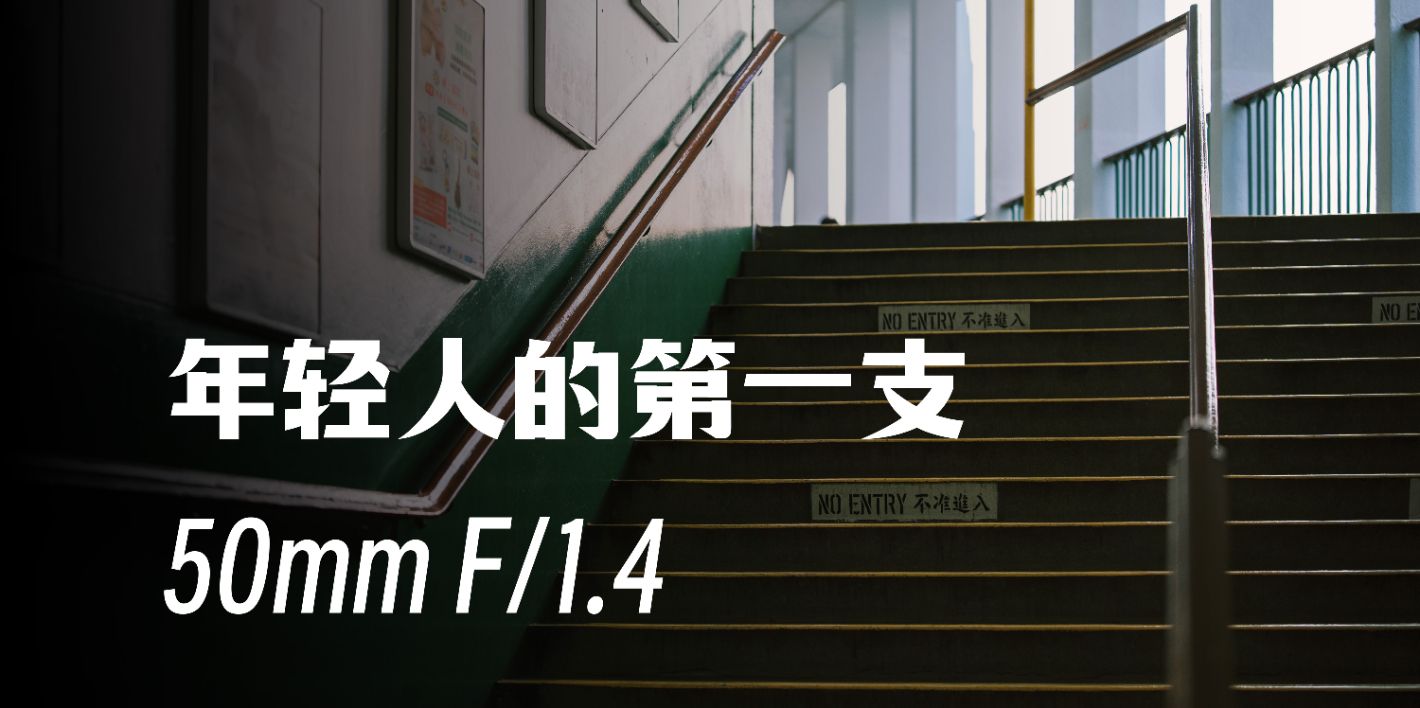
50mm is one of the most classic—and most frequently discussed—focal lengths in photography. It doesn’t have the wide-angle tension of 35mm, nor the spatial compression of 75mm and above. Its perspective is straightforward and close to what the human eye sees, making it adaptable to a wide range of shooting scenarios. For many photography enthusiasts, it’s an indispensable lens.
My 50mm Journey
I’ve always had a soft spot for 50mm lenses. In 2018, I bought the much-talked-about Sigma 50mm F1.4 DG HSM. With its excellent optical design, it significantly improved image quality at wide open apertures, challenging the then-common belief that “large apertures must be stopped down to be usable.” That experience left a deep impression on me.
After that, however, I went a long time without buying any new lenses. Despite a steady stream of new releases, as an ordinary consumer I didn’t feel that my choices had really increased. The 50mm market seemed to have settled into a fixed pattern: if you wanted top-tier image quality, you had to choose a Japanese-brand original lens priced above 5,000 RMB; if your budget was limited, your only options were lenses around the 1,000 RMB range—lightweight, but requiring compromises in handling and build quality, typically domestic F1.8 lenses. For users with a 2,000–3,000 RMB budget who wanted a well-balanced lens in terms of image quality, handling, and build, the middle ground was almost completely empty. That changed with the arrival of the Viltrox AF 50mm F1.4 Pro FE. It gave me the same eye-opening feeling I had seven years ago when I first used that Sigma lens, to the point where I started to think that this lens really could be young photographers’ first 50mm F1.4.

Differentiated Competition
To explain why this lens stands out, it helps to start by comparing it with original-brand lenses. A few years ago, domestic autofocus lenses were often seen as mere “budget alternatives.” They lagged noticeably behind originals in autofocus performance, coatings, and overall experience, and were chosen only out of necessity. The Viltrox 50mm F1.4 Pro represents a different approach: instead of focusing solely on low price, it aims to match Sony’s mid-to-high-end original lenses in key areas like image quality and build.
Its competitive strategy is quite clear. In terms of handling, for example, it features a metal barrel, a physical aperture ring, and customizable buttons—configurations usually reserved for high-end original lenses. This clearly sets it apart from entry-level lenses that use plastic bodies and simplified controls (such as Sony’s own FE 50mm F1.8 or some domestic lenses). In hand, it feels solid, with precise and reassuring operational feedback. Its self-developed dual HyperVCM autofocus motors also deliver noticeably better quietness, speed, and decisiveness than the FE 50mm F1.8.
When it comes to the most important aspect—image quality—especially background blur at large apertures, it performs very well. The out-of-focus transitions are smooth, highlights are clean, and I didn’t notice obvious “double-line” bokeh or “cat’s eye” shapes. This places it ahead of some early domestic fast lenses, and even certain original-brand entry-level lenses, bringing it closer to high-end performance. These aspects of the shooting experience and image rendering will be discussed in more detail later.
Of course, compared with the Sony FE 50mm F1.4 GM, it still falls short in autofocus speed and overall system integration—but it also costs less than one-third of the price. It has found its position with remarkable precision: offering a compromise for users who are dissatisfied with the image quality and feel of entry-level F1.8 lenses, yet find flagship original F1.4 lenses too expensive. It proves that domestic lenses can win photographers’ active choice through solid performance and accurate positioning—not merely through low prices.
Lens Design Language
Opening the box, its design language feels very similar to that of Japanese manufacturers: clean and restrained, with no unnecessary information. Three sides of the box are printed with the English brand logo, while the other two display illustrations of this Viltrox 50 Pro lens, along with the specific model and corresponding mount information. A serial number label and the manufacturer’s contact details are affixed to the bottom.
The lens itself is tightly secured in thick foam. The package also includes a lens pouch with a pleasantly solid feel, as well as a lens hood.
In the hand, the lens barrel feels smooth, yet after being tested by someone like me who tends to have sweaty hands, it doesn’t easily retain fingerprints. A closer look reveals a finely textured surface that enhances grip stability while reducing the risk of slipping. The lens features an aperture ring near the base, with clear, well-defined clicks when rotated. There is also an orange weather-sealing gasket around the mount, further improving protection and reliability. For users who value operational efficiency, the lens is equipped with customizable buttons that can be assigned according to personal shooting habits.

Mounted on a Sony camera body, the lens gives a strong sense of cohesion. From the materials used to the overall shape and even the logo design, everything feels well integrated. Without prior knowledge, it would be hard to tell it apart in overall build quality from products made by major international brands.
The lens uses a 77mm filter thread. For a 50mm F1.4 lens, it is indeed slightly on the larger side. That said, considering the image quality and autofocus performance it delivers, I find this compromise in size acceptable. After all, for many users, this will be their “first F1.4 autofocus standard prime,” and such a minor inconvenience is easy to live with.
That said, the aforementioned sense of “slight imbalance” mainly applies to compact bodies without a pronounced viewfinder hump, such as the A7C. When mounted on models like the A7M4 or A7R5, the overall proportions are likely to feel much more balanced.

Optical Design
| Item | Specification |
|---|---|
| Focal Length & Format | 50mm, full-frame |
| Maximum Aperture | F1.4 |
| Optical Construction | 15 elements in 11 groups, including 3 ED (Extra-low Dispersion) elements, 1 UA (Ultra-high-precision Aspherical) element, and 8 HR (High Refractive Index) elements |
| Autofocus | Equipped with a self-developed dual HyperVCM motor, supporting face/eye detection and tracking |
| Minimum Focusing Distance | 0.45 m |
| Filter Thread | 77mm |
| Weight | Approx. 800 g (E-mount version) |
| Professional Features | Dust- and splash-resistant construction, customizable Fn button, clicked/de-clicked aperture ring, and a Type-C port for firmware updates |

According to the official MTF charts, this lens performs exceptionally well at its maximum aperture of F1.4. The field curves are relatively flat, and overall performance remains stable. In particular, at the center of the frame, the MTF values approach the theoretical limit of 1, in some cases even outperforming the results at F8, demonstrating outstanding resolving power.
As the image field transitions toward the edges, from the center to roughly the mid-frame area, the MTF values at maximum aperture remain above 0.8. Even at the extreme edges of the frame, overall MTF values largely stay above 0.6, indicating that edge performance degradation is well controlled.
It is also worth noting that at maximum aperture, the solid lines representing contrast and the dashed lines representing resolution closely track each other and follow similar curves. This suggests that the lens is capable of delivering smooth transitions and pleasing bokeh with good texture. Its real-world image rendering will be demonstrated in detail in the upcoming shooting samples section.
Q&A Before You Start Shooting
Q1: Why does the lens often hesitate after pressing the shutter, or sometimes not respond at all?
A1: Follow the instructions in the manual to check whether the latest firmware is installed. I encountered this issue as well. After updating to the newest firmware, it was largely resolved. Autofocus responsiveness can reach about 80–85% of original-brand lenses. There is still slight lag, but since I don’t mainly shoot sports or other scenarios that demand extremely low latency, the overall experience is acceptable to me.
Q2: Why can I hear a slight sound inside the lens barrel when slowly shaking the lens?
A2: This lens uses Viltrox’s self-developed HyperVCM floating focus structure. When the lens is not powered on, the internal lens group is not locked in place and may produce a slight sound when the lens is moved. This is a normal physical phenomenon, similar in principle to the loose sound of a camera’s in-body stabilization mechanism when the camera is powered off. Once the lens is powered on, the sound disappears. If you still hear obvious abnormal motor noise during normal powered-on shooting, it is recommended to contact Viltrox customer support for inspection.
Real-World Shooting Experience
I tested this lens in both portrait and documentary-style shooting scenarios, hoping to provide some useful reference for everyone.
Portrait photography: Even at maximum aperture, images remain sharp with clear detail, fully meeting the sensor demands of bodies like the A7C. I believe it can also handle high-resolution sensors such as the A7R5 with ease. When placing the subject at one-third of the frame (for example, using a golden ratio composition), the lens’s excellent field flatness still delivers solid image quality, with no need to worry about edge degradation.

The lens also performs consistently across different focusing distances. Some lenses look fine at around one meter but start to show weaknesses at very close or very distant focusing ranges. This is mainly because their optical designs are optimized for common shooting distances; at extreme close-up or long-distance focus, the balance of aberration correction (such as spherical aberration and field curvature) can be disrupted, leading to a drop in sharpness. With this lens, however, whether shooting close-up facial portraits or distant full-body shots, the subject remains consistently clear.


Soft out-of-focus rendering: In actual shooting, I could clearly feel that the out-of-focus highlights are round, with smooth edge transitions and almost no harsh “double-line” bokeh. This is thanks to the ultra-high-precision UA aspherical element, which effectively suppresses spherical aberration and “onion ring” artifacts. At the same time, the inclusion of three ED elements ensures clean, color-pure bokeh, while the 11 rounded aperture blades allow highlights to remain nicely circular even when stopped down. Even in complex scenarios such as rows of figurines, the lens is able to deliver smooth and pleasing background transitions. It can be said that Viltrox’s comprehensive balancing of aberrations in its optical design allows the F1.4 aperture to represent not just light-gathering capability, but a high-quality expression of bokeh.


Night scenes and low light: The F1.4 aperture shows a significant advantage at night. I can lower ISO for cleaner images, or increase shutter speed to capture motion while keeping noise under control, giving me much greater creative freedom. I strongly agree with the view of a certain Bilibili creator: in creative work, the only thing that should limit you is your imagination. This lens gives me a tool to explore more possibilities.


Humanistic and Landscape Photography:50mm is a true “sweet spot” focal length. In real-world shooting, I’ve noticed that when something catches my attention and I raise the camera, the distance is usually around 2–3 meters. At this range, photographing people allows for half-body compositions that include environmental context; photographing architecture lets you focus on specific structural details. When using a 50mm lens for landscapes or architecture, I find myself less obsessed with capturing the entire scene (since it’s often impossible anyway), and more focused on the relationships between lines and structures, and between structure and light and shadow—often resulting in unexpected perspectives.


Backlit Performance:In backlit situations, thanks to excellent coating technology, the lens controls chromatic aberration very well. Image contrast and detail remain strong, and even when the light source enters the frame directly, there is no obvious purple fringing or color dispersion at the edges. Overall performance is impressive.

Expectations and Conclusion
Looking back on the time spent with the Viltrox AF 50mm F1.4 Pro FE, what it brought me was far more than just satisfying images—it was a long-missed sense of things being “just right.”
At the 3,000 RMB price point, it precisely enters a market segment that had been vacant for a long time. It does not compromise the core experience because of labels like “domestic” or “high value for money.” Instead, with Pro-level optical performance, professional-grade handling and protection, and a mature design language, it convincingly demonstrates that domestic lenses are fully capable of breaking free from the stereotype of being merely “cheap substitutes,” and can become creative tools that photography enthusiasts actively choose—and take pride in using.


Of course, I have no intention of putting it on a pedestal. After using it for some time, I do hope that its size can be further reduced without sacrificing image quality, and that firmware tuning can continue to mature. But no matter how much one talks about performance, ignoring the reality of budget may be theoretically correct, yet practically unhelpful. For a beginner photographer who wants to step into the world of large apertures and explore the layers of dreamlike beauty hidden behind glass elements, it is hard to avoid considering this “first 50mm F1.4 for young photographers.”
This lens opens a door to a much broader creative space for enthusiasts on a limited budget. When evaluating whether a lens is worth buying, the meaning of “budget” goes far beyond the number itself. When you own a lens that offers strong performance at a reasonable price, you naturally feel more at ease—you don’t have to constantly worry about whether the oils on your hands might seep into the barrel through tiny gaps every time you hold it, nor imagine that every accidental bump could cause hidden internal damage. Instead, you can devote yourself fully to creating, confidently leveraging its strengths: creamy bokeh, richly detailed subject rendering… everything serving the single purpose of capturing that precious moment in your mind.
Within a limited investment, it delivers an almost complete professional-level experience and performance. For users searching for a versatile standard prime—whether newcomers looking to move beyond a kit lens, or experienced photographers in need of a high-quality backup—this Viltrox lens offers an option that is hard to ignore and highly persuasive. Its release clearly shows that the path forward for domestic lenses lies not in blindly piling on specifications or racing to the bottom on price, but in directly competing on key aspects of the user experience while maintaining sincerity in pricing.
For me, this lens feels more like a clear signpost, marking the moment when domestic lenses have finally crossed the difficult exploratory stage of “the long road as hard as iron,” and truly stepped onto a new starting point of renewal and progress. From the Sigma 50mm F1.4 DG HSM | Art a decade ago to this AF 50mm F1.4 Pro FE today, I’m glad to witness the continuous growth of domestic lenses—gradually shedding the labels of “cheap” and “imitative,” and earning their place in the market through genuine competitiveness and quality. The road ahead is still long, but with this solid first step, we have good reason to believe that the future will bring more products with distinctive character, excellent performance, and reasonable prices—offering users truly rich choices. For the future of Made in China, we can hold even higher expectations.
Leave a Reply