
Bose revives the wired noise-cancelling earphone after a decade with the Noise Cancelling Wired Earbuds. The ANC and transparency hold up; the fit and the tuning do not, and the sound is hard to justify at this price.
***
Editor’s note: A version of this article by KingTsui appears on November 17, 2026 on SSPAI with the title “TDS REVIEW|Bose 有线消噪耳塞体验”. Translated and published by agreement.
This is TDS Studio’s 35th article for SSPAI, once again published here first across all platforms.
We reviewed Feile’s Hong — a budget Chinese IEM — some time ago, and in the comments a few readers wondered how it compared with the Bose QC20. Before TWS took over, the wired noise-cancelling IEM was a thoroughly mainstream form of ANC earphone: Sony and Bose, both of which still sell mature ANC products, built them, and so did the traditional audio brands, Audio-Technica and AKG among them. In a market where DAC circuitry has become routinely tiny, the fact that so few new wired ANC earphones appear strikes us as a genuine shame. It was also one reason we were a little sceptical when word got out that Bose was reviving the format; of all these companies, Bose is hardly the one most enamoured of integration. When the China price appeared, we bought one at launch. The result was… a disappointment mostly of the expected kind.
Package & Accessories
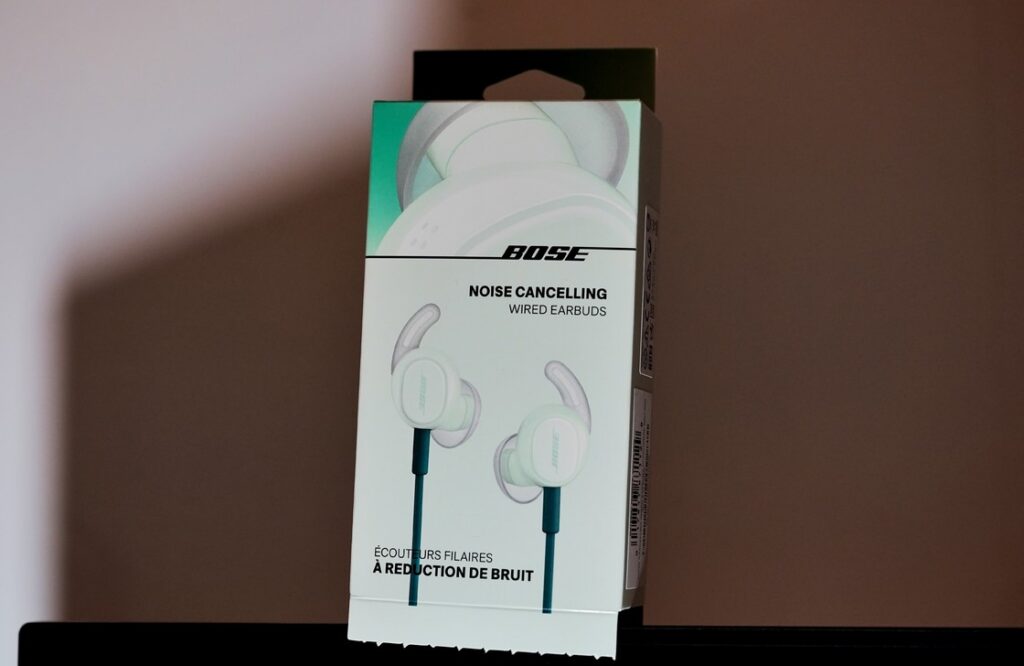
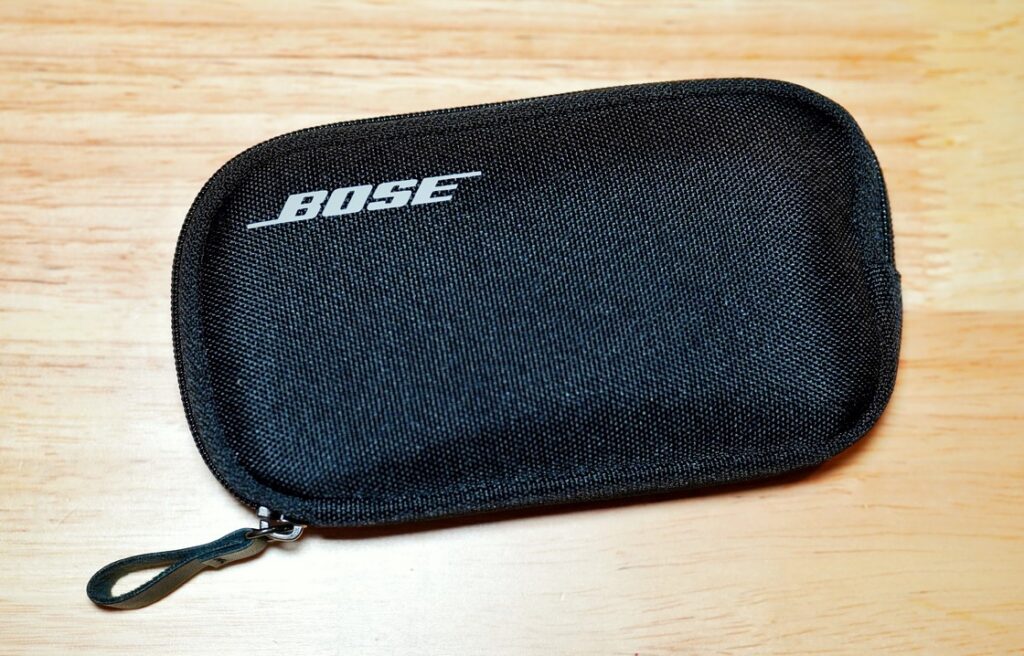
The packaging is extremely flat, and the overall design tracks Bose’s true-wireless line. Inside are three pairs of ear tips and two sets of fins. The tips insert very shallowly, carry a mesh filter at the nozzle, and have a dedicated hard retaining ring where they meet the nozzle.
Design, Fit & Acoustic Structure
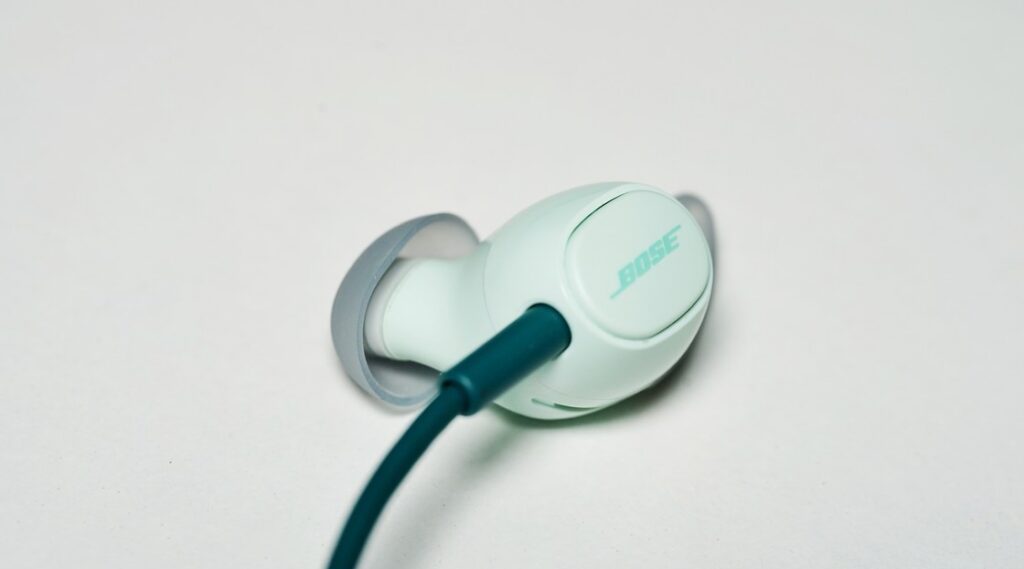
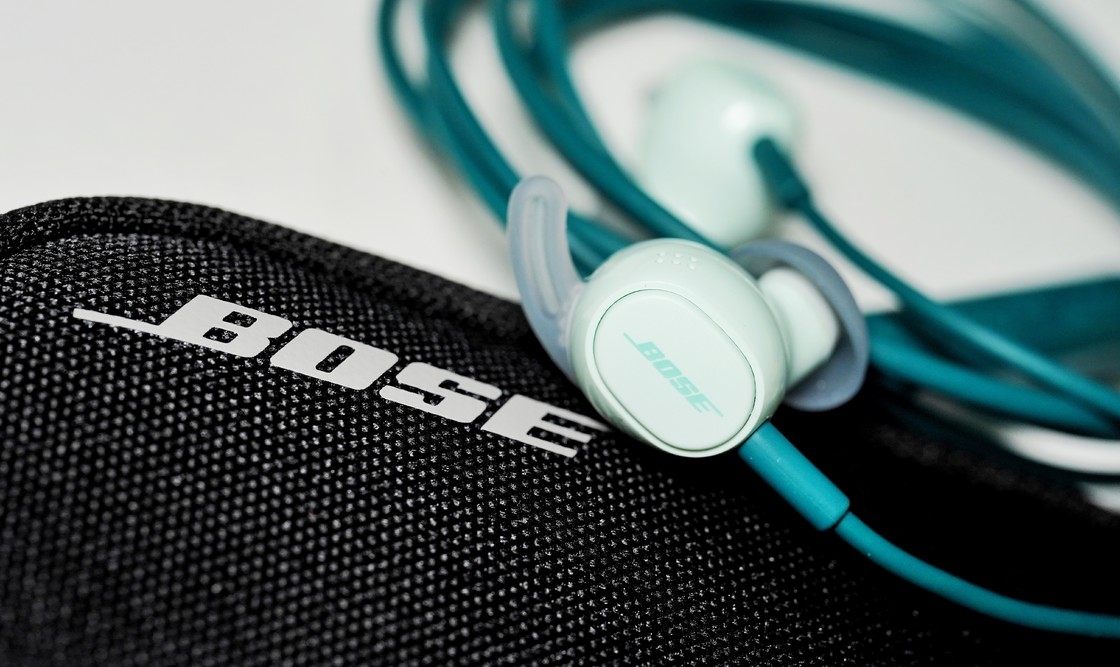
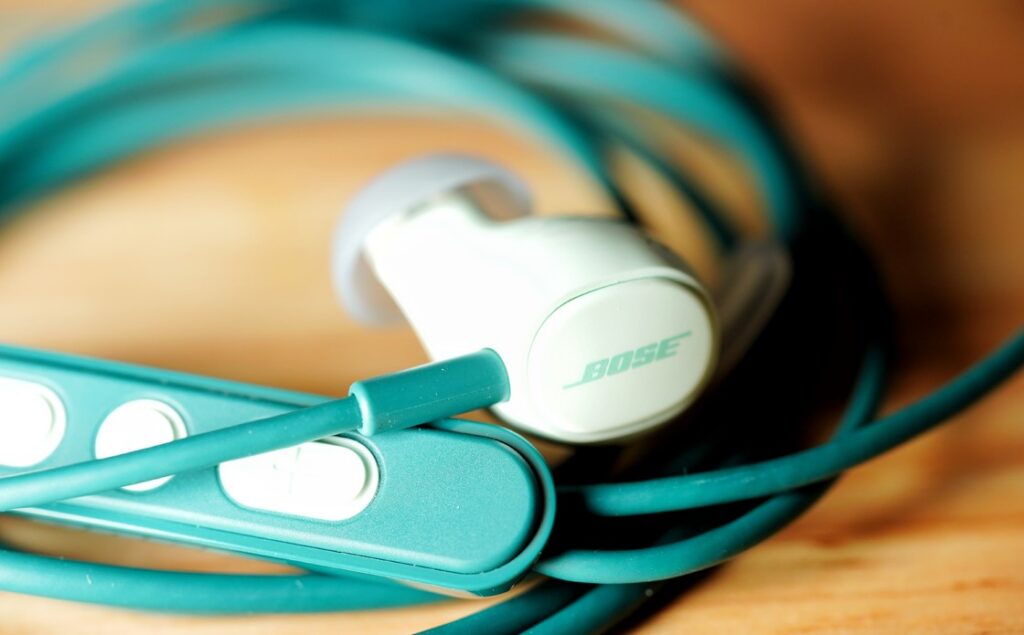
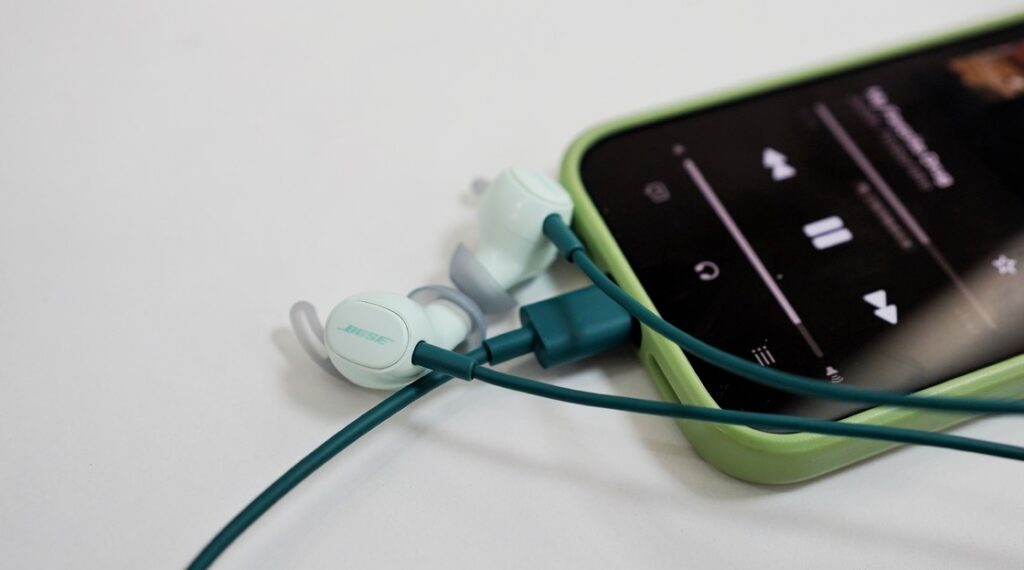
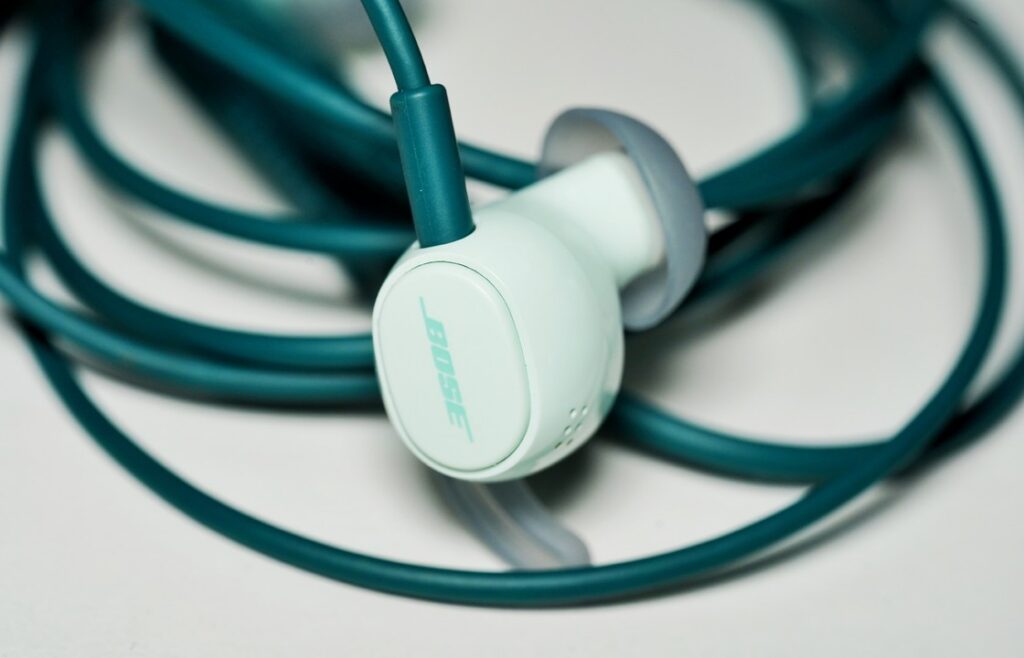
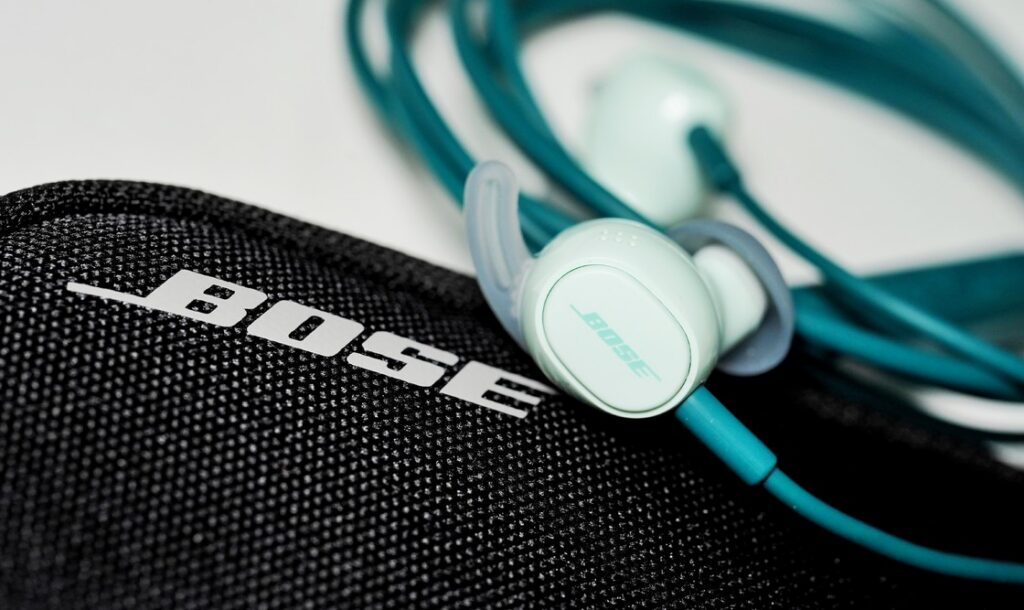
Three colours at launch: black with blue accents, white with pale green, and the pair we have, Cool Mint — in practice a two-tone of dark teal and light blue, with a darker cable. The shell is glossy plastic throughout. Build quality raises no issues; it looks like what it is, a plastic-shelled wired IEM. The housing is mid-sized — smaller than the QC Ultra true-wireless models, and smaller than our memory of the QC20. The ANC microphone ports are smaller than the QC20’s, and once the earphones are seated there is almost nothing to distinguish them from an ordinary USB-C earphone.
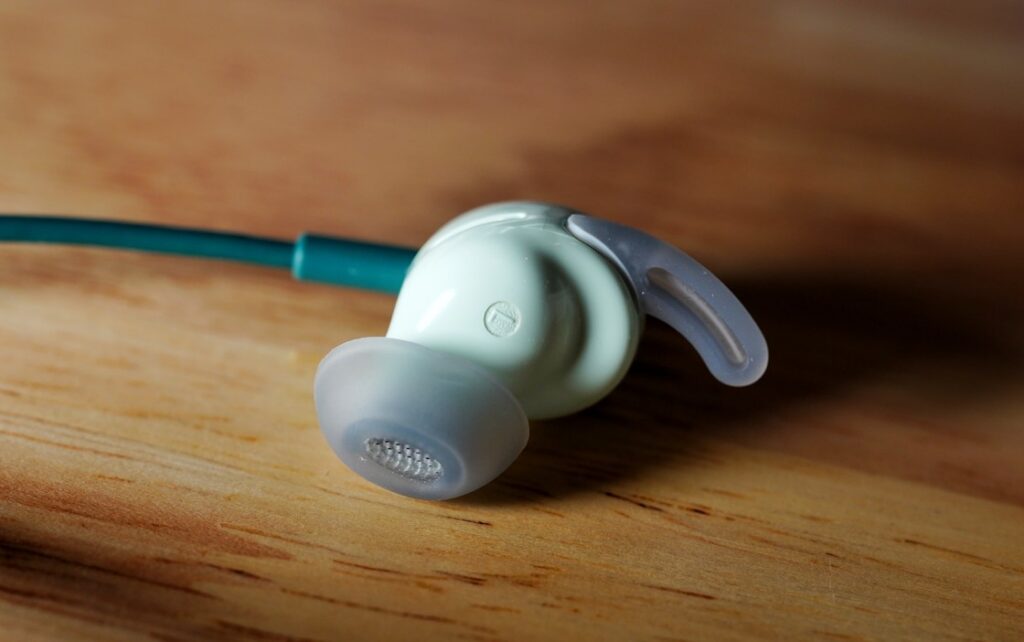
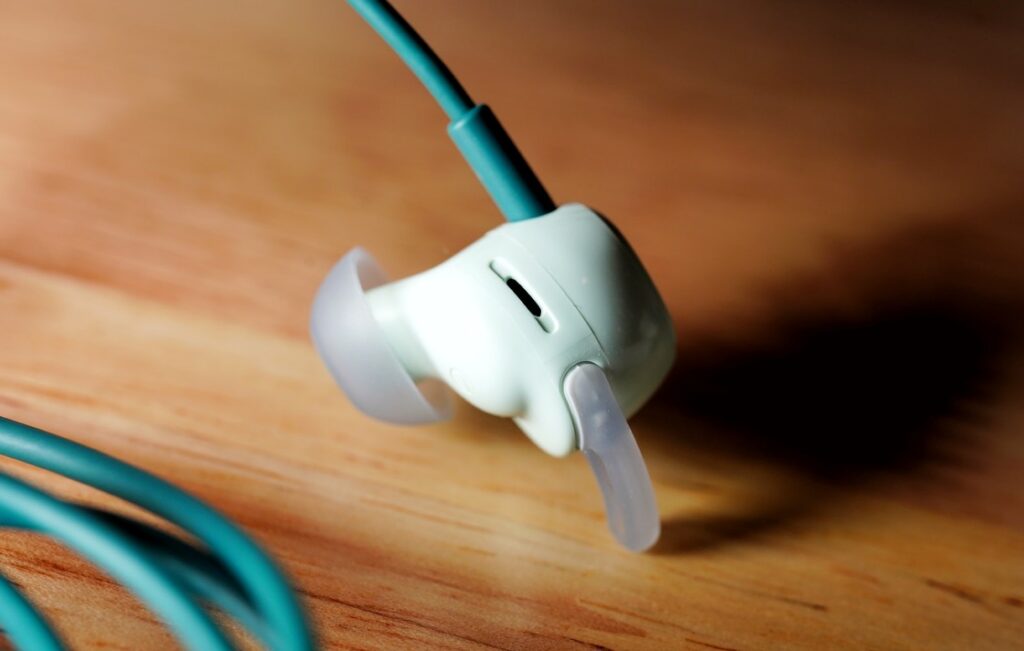
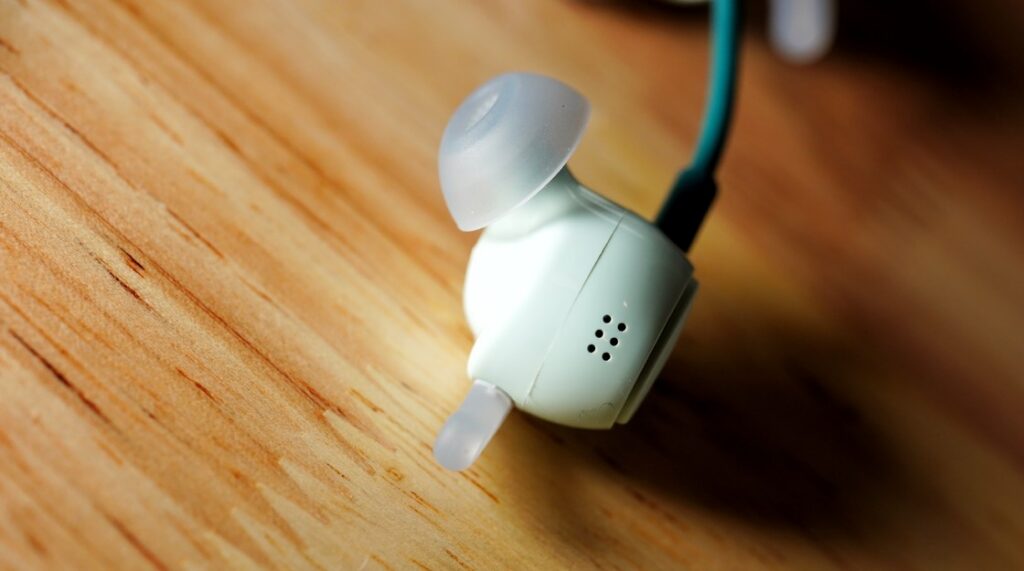
The inside of the housing is not shaped like the QC20’s, which clearly separated front and rear chambers. It is closer to Bose’s current TWS line, with a certain amount of concha-ridge protrusion and no fully wrapping shark fin. For the wired model Bose has gone with a split fin plus a shallow-insertion tip, and only the protruding wing is replaceable — which means that for some users with larger conchas, even the supplied parts may not reach the upper edge of the cymba conchae.
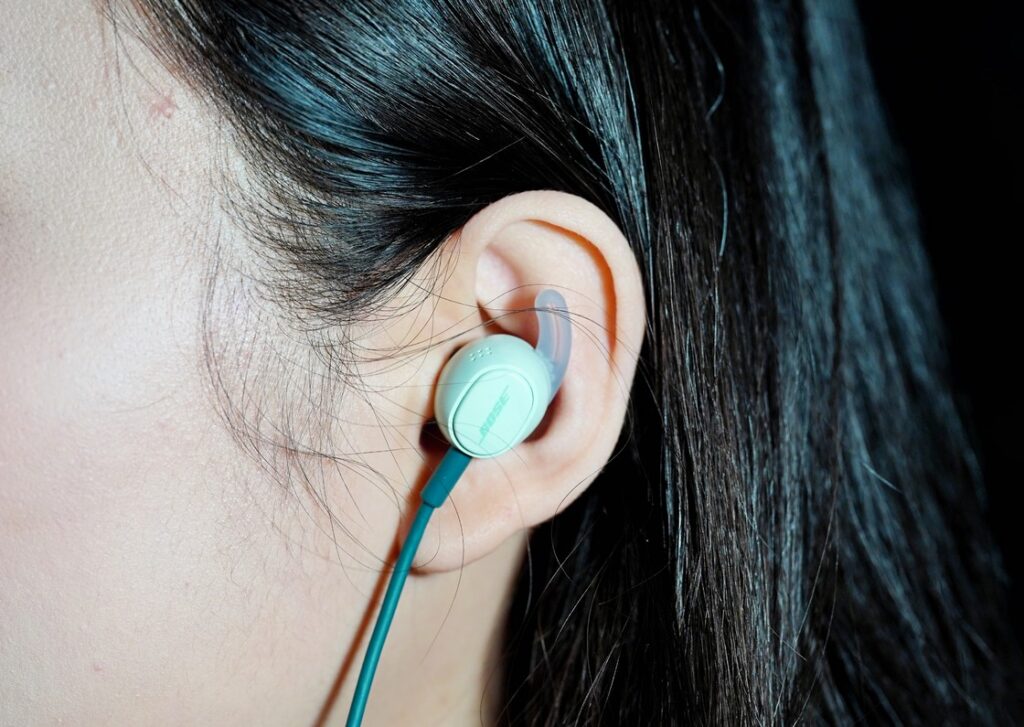
When we later asked other people to try them, another class of problem turned up — thanks to Mr. F for helping with this. The original StayHear fin is almost coplanar with the tip and the front-chamber shell, so it still does its job in a shallow fit. The wired model makes the wing a separate part, which changes its position, and combined with the flatter front chamber, users with small conchas can run into front-chamber coupling problems that leave the whole fin sitting outside the plane of the concha, where it does nothing at all… In short, a new problem of a kind rarely seen on Bose earphones. That aside, the earphones themselves are comfortable: unless your concha is unusually narrow, most people can wear them comfortably and securely for long stretches. The housing has some depth, so we would not recommend lying on your side with them.
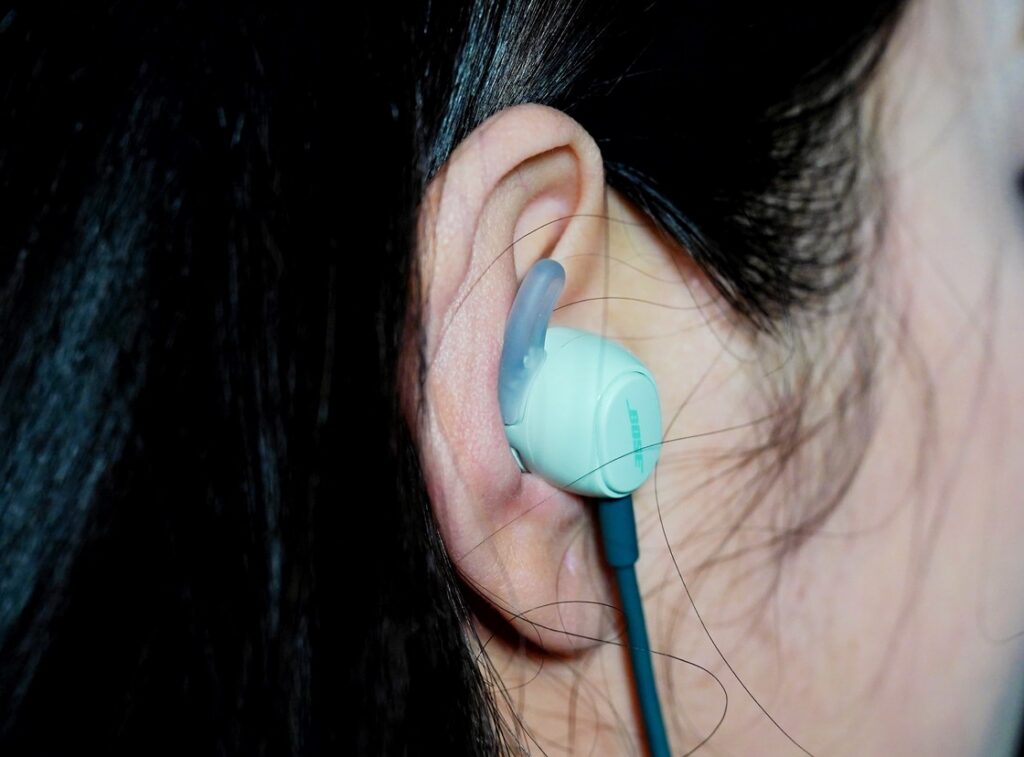
The nozzle is very short, but ordinary ear tips still fit. Bose rates them IPX4, which is enough for light sweat or a drizzle.
ANC, Transparency & Call
With ANC off, the passive isolation is merely adequate — a consequence of the shallow insertion and the openings in the housing. With good coupling we measured slightly more high-frequency leakage than the Big Sharks, but for a straight-plug shallow-fit design it is respectable. Switch ANC on and the suppression of steady low-frequency noise is pronounced, reaching Skyline Level, and the midrange has some depth as well. The lower half of vocals is suppressed noticeably while the attack is preserved, and the bandwidth is good for the money, with no league-level gap against several good mid-priced ANC TWS models. Compared with the third- and fourth-generation Big Sharks you also get slightly less ear pressure. On noise cancelling alone, the Bose Noise Cancelling Wired Earbuds live up to the name, and the faint hiss is rarely a problem.
On wind noise: with ANC on, wind from the front and from the side produces some interference, though in a low band; face away from the source and it all but disappears.
Transparency is the surprise. Bose’s earphones have mostly treated transparency as an afterthought, but this wired model reproduces the environment fairly naturally. There is still some attenuation at the extremes, but it comes close to the first tier, and your own voice does not sound excessively muffled — a normal-volume conversation is unimpeded. Wind noise in transparency is mild.
For calls, the microphone sits in the Y-splitter, so in theory it picks up from lower down than the usual inline module; in practice both loudness and clarity are good. Next to the USB-C EarPods we habitually use as a reference, the tone is darker and sounds as though it has been through a compressor, with low dynamics. For voice calls that is a virtue: the voice is louder.
Overall, the noise-cancelling side of the Bose Noise Cancelling Wired Earbuds upholds the usual Bose strengths, and it is the best all-round wired in-ear ANC we have measured — transparency especially. Against flagship ANC TWS, though, it lacks adaptivity and mode options, and the felt strength of the cancellation is a step behind the newest leaders. At this price, if all you need is a wired ANC earphone for long flights, it is serviceable, and it saves you the charging anxiety of a QC20. It enters the TDS ANC Pyramid at In-Ear Skyline Level, in the lower half of that tier.
Control & Driver
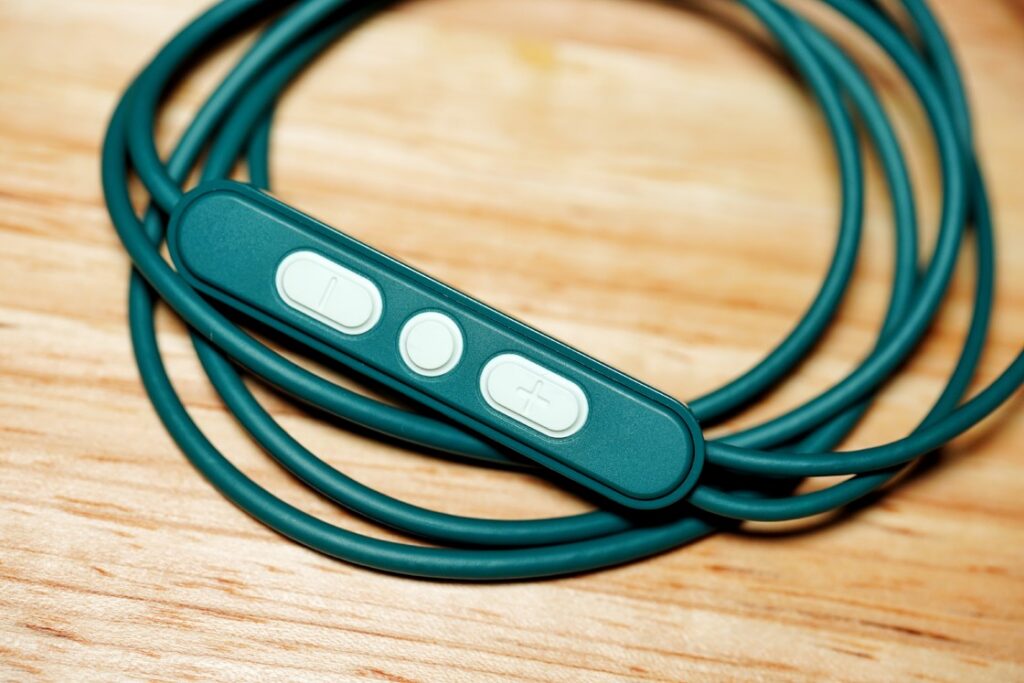
Control runs through a three-button inline remote at the splitter: a volume pair plus a central multifunction key — single press for play/pause, double or triple press to skip, long press to cycle ANC modes. The voice prompts are clear, much like the company’s TWS line. Note, though, that the wired earbuds do not support the Bose app, so there is no remapping and no firmware updates. One more thing: the cable is not especially soft, and together with the straight-plug fit, the microphonics are quite audible.
The driver is entirely undisclosed — classic Bose. Being a USB-C earphone, though, we can at least read the sampling specs: PCM decoding up to 96 kHz/24-bit and a 48 kHz/16-bit ADC for the microphone, which is a fairly basic configuration for a USB-C digital earphone.
Wired ANC earphones have historically been built in one of two ways. The first puts the ANC processing in the phone or player and the pickup microphones in the earphones, adding conductors to an analogue connector so the captured audio travels back to the device and the processed signal returns to the drivers. That approach needs hardware support at both ends and a specialised jack — Sony’s digital noise-cancelling line (the MDR-NC31, NC750 and so on) used a five-pole 3.5 mm plug — and such earphones need an adapter cable to work with anything else.
The second puts the processing and the power in an external module: before the USB-C era, the usual solution was a battery-and-circuit block on the cable ahead of the 3.5 mm plug, leaving the phone or player out of it entirely, exactly as with an ordinary earphone. The Bose QC20 and the Sony MDR-EX750NA worked this way. The Bose wired model is closest to the second approach, except that integration is now good enough and power draw low enough for USB-C to supply both the ANC processing and the audio decoding from the host device.
Sound Description
Measured over USB-C, with the stock tips and fins.
Bass quantity is moderate; thickness and fullness are both in short supply, elasticity is average and extension is average. Attack and release are not fast, and some decay remains. There is a little too much bloom in the ambience it creates and not enough density. The low end of the Bose wired earbuds is loose and lean: the upside is that it never masks vocals or booms inside your head; the downside is that it has no texture, no energy and no sense of support. Instruments whose fundamentals sit in the lower midrange do not step forward noticeably.
In the midrange, vocals keep their distance rather than pressing against your face; mouth size is moderate and the refinement is emphasised in the upper register while the lower body is unsteady. Timbre and line are both handled indifferently — in a way, that counts as having no particular bias either… Thickness is low, the line is blurry, yet some details protrude unnaturally. There is no strong lean towards male or female voices; the voices that suit it need to be fairly solid without leaning on thickness. The timbre carries some upper-register treatment and sounds thin and brittle, though it is not optimised for catchiness. The throat sits too high, breathiness is not abundant, and the result sounds hollow — at last I get to use “hollow” as an adjective. Lip and mouth noise sit forward and sibilance is audible; neither is smoothed over nor globally suppressed. Clarity through the vocal range is average, with an audible artificial brightening.
With instruments it is mostly hard to say anything good. Texture is difficult to claim, and the line sits somewhere between diffuse and protruding. Among strings, violins, guitars and violas lack body, and the amount of bowing and plucking detail is on the low side for the price, with mild emphasis. The cello’s image is vague and its proportion in the space is small. Brass has very little sense of scale; trumpets, which need brightness, get a slightly protruding gloss (though not body). Woodwind air is acceptable and naturalness is middling. Instrumental harmonics are dry and lag in richness. Among percussion, the kick has little presence, the snare decays a touch fast, and cymbals are bright, with a mild metallic edge and bite retained.
Treble is middling in overall brightness but has two prominent peaks, so there is no shortage of edge. Upper-treble extension is thoroughly ordinary, rolling off early without being abrupt.
Soundstage is where the Bose wired earbuds try something different. Most midrange images sit some distance from the ears, with width and depth opened up a little, but the space is not filled in, the two axes are not consistent, and with slightly diffuse edges it reads as empty. Combined with a middling sense of height, the result is a flattened ellipsoid. Separation between voices and instruments is average, and overall cohesion suffers because of the treble peaks. Resolution is ordinary; the total information on offer is well behind Chinese wired IEMs of recent years at the ¥600 mark, and even in the very narrow category of wired USB-C call earphones we did not feel the driver was comprehensively better than an IER-EX15C or a CX80S. There is also a certain unnatural “sense of resolution” pushed forward. Dynamics are poor; transients are acceptable.
Overall Impression
Taken as a whole, we think the noise cancelling on the Bose Noise Cancelling Wired Earbuds is reasonable. It is not obviously better than new mid-priced TWS from the phone makers, but neither is it a league behind, transparency is generally better, and the wired form brings a microphone advantage for calls — none of which invites complaint. What we would criticise is the sound and the fit, the two things most central to an earphone. That sound quality would be poor for the price we had expected; that the tuning would be this odd we had not. The more freely adjustable fin has not produced better concha compatibility, and the housing shape is unfriendly to users with small conchas. Unless you specifically need a wired ANC earphone to avoid battery anxiety on long flights and specifically dislike over-ear noise cancelling, the Bose wired earbuds are not the product that will open your wallet at this price. Without usable noise cancelling, it would have been one of the rare cases where we award a Grade II.
KT MARK for the models covered here, in the market context of the time:
Bose Noise Cancelling Wired Earbuds: III (Average)

TDS ANC Pyramid:
Bose Noise Cancelling Wired Earbuds: In-Ear Skyline Level
For the KT MARK scoring system and the conflict-of-interest “non-interference” principle, search for TDS Studio Scoring Standard and Content Statement V202502; it can be found directly through the mainstream search engines.
KingTsui, TDS Studio.
Nov 2026
It’s a TDS production.
All content is original. Please do not copy the text or imitate the structure of the writing; all rights reserved.
Share: