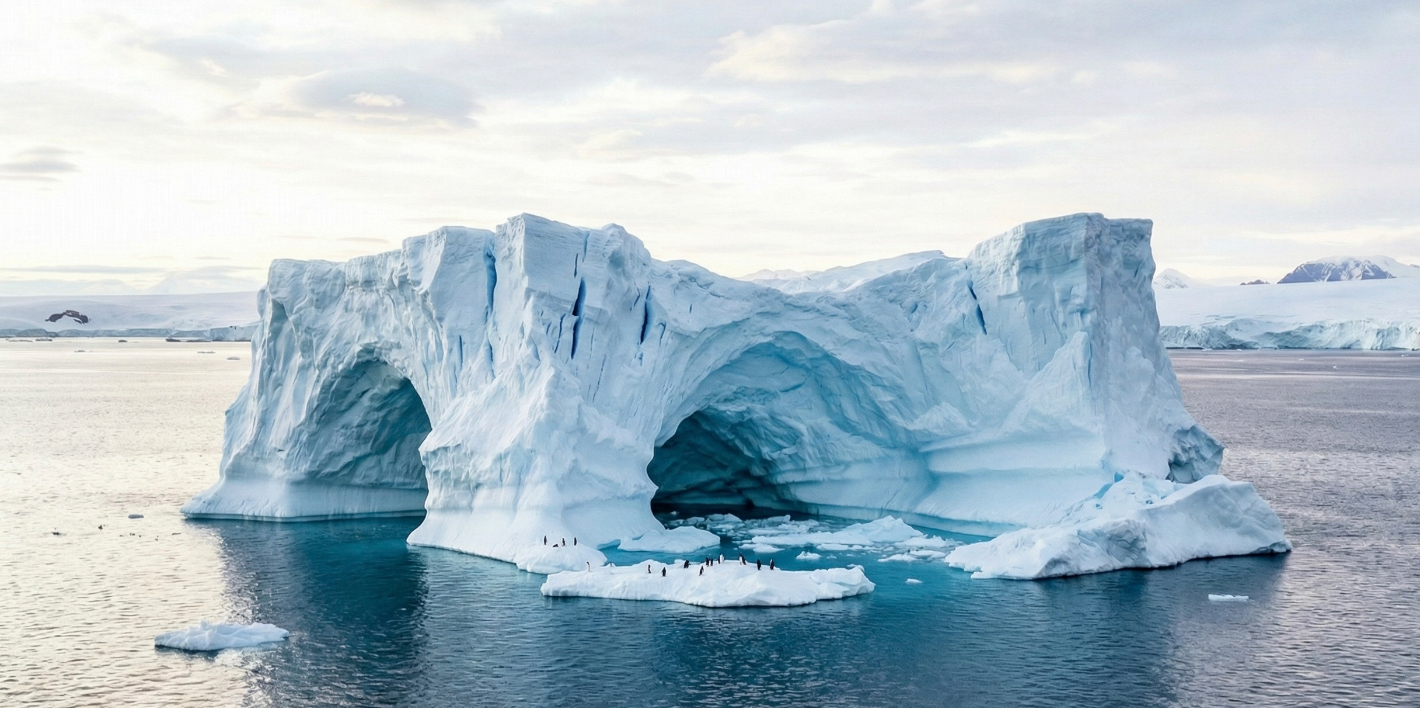
Antarctica doesn’t often appear on the Chinese internet’s trending lists. Its most recent appearance, however, was rather unusual—sparked by an internal letter sent by a well-known company founder during a trip to Antarctica.
Glaciers, penguins, and the polar day were suddenly placed in the same public arena as overtime, KPIs, and annual performance reviews. Naturally, people interpreted the situation in different ways. “The boss is at the end of the world, while employees are stuck at their desks” was the first reaction for many after reading that company-wide email. But for others, it was the first time they realized that Antarctica is no longer just a scene from documentaries—it’s a real place that can be “consumed” as a travel destination.
For example, my partner. Her preferred vacation destination for next year has already shifted from Japan to Antarctica. I strongly suspect this incident had something to do with it. Following the principle of “she proposes, I execute,” I had to start digging into the details and figure out how “going to Antarctica” actually works. First comes the feasibility study, then a proper project plan. As for whether it will really happen next year—that depends entirely on how cooperative my wallet decides to be.
This article isn’t meant to judge that letter, nor to discuss corporate management. It’s simply trying to do one thing: clearly explain what Antarctic travel itself is all about.
When we talk about “going to Antarctica” today, what are we actually talking about?
Who Governs Antarctica?
Let’s start by clearing up a basic fact: Antarctica is not a country, and it does not belong to any country. It is the only place in the world that falls outside the sovereignty of any nation.
Between 1908 and 1941, the United Kingdom, Australia, New Zealand, France, Norway, Chile, and Argentina successively made territorial claims over Antarctica.

Based on the so-called “sector principle,” these seven countries took the South Pole as the apex, used meridians and parallels as boundaries, and drew sectors whose bases were defined by a country’s coastline or a specific latitude. The resulting wedge-shaped areas became their claimed territories. In this way, the combined claims of the seven countries covered more than 80% of the Antarctic continent.
However, the international community did not recognize these sovereignty claims, instead calling for Antarctica to be regarded as the “common heritage of all humankind.” That stance is easy to understand. Still, the seven claimant countries and the rest of the world could not reach a consensus. As a result, on December 1, 1959, Argentina, Australia, Belgium, Chile, France, Japan, New Zealand, Norway, South Africa, the Soviet Union, the United Kingdom, and the United States signed the Antarctic Treaty, temporarily setting aside the issue of sovereignty.
The Antarctic Treaty, signed in 1959 and entering into force in 19611, established several fundamental principles for Antarctica:
- Use exclusively for peaceful purposes;
- Priority given to scientific research;
- A freeze on all sovereignty claims;
- A ban on military activities and nuclear testing.
Today, the treaty has 50 member states, including 28 consultative parties and 22 non-consultative parties. As for the territorial claims made by the seven consultative parties, the remaining 43 member states neither recognize those claims nor have they put forward claims of their own.
Thankfully, no one recognizes the seven countries’ demands—otherwise, traveling to Antarctica might require a U.S. visa, and diplomats could end up being posted to the South Pole. Still, even though there’s no passport stamp on entry, Antarctica is far from a free-for-all “no man’s land.”
Antarctica today is a highly institutionalized and tightly managed space. Almost all legitimate Antarctic tourism activities must be conducted through companies that are members of IAATO (the International Association of Antarctica Tour Operators)2. Operators are responsible for managing visitor behavior, limiting landings, protecting the environment, and ensuring emergency evacuation capabilities.
Who Goes to Antarctica?
Many people assume that traveling to Antarctica is reserved for a tiny group of explorers, but that reality has changed dramatically.
In the late 19th century, Antarctica truly was the last undeveloped continent on Earth. Whalers and seal hunters were likely the first humans to set foot on the Antarctic continent in search of opportunity. In the early 20th century, countries such as Japan, Germany, the United Kingdom, Sweden, and Norway all launched plans to explore Antarctica, and competition among them was at times extremely fierce.
On December 14, 1911, a five-man expedition led by Norwegian polar explorer Roald Amundsen reached the South Pole, becoming the first team in human history to do so3. Just over a month later, on January 17, 1912, a five-man party led by British explorer Robert Falcon Scott arrived at the South Pole, only a little more than 30 days behind Amundsen4. The two men even visited each other’s ships at the time. Some readers might be interested in the stories of these two legendary figures—perhaps I’ll write about them in a separate piece someday.
Today, the 29 consultative parties to the Antarctic Treaty operate 70 permanent research stations on the continent, while tourism around Antarctica began as early as the late 1950s. Over the past two decades, the number of Antarctic tourists has continued to grow—from just a few thousand per year in the early days to tens of thousands annually in recent years (with a temporary interruption during the pandemic). Most visitors come from Europe, North America, Australia and New Zealand, as well as Asia, where growth has been particularly noticeable in recent years. According to data from the International Association of Antarctica Tour Operators, in the pre-pandemic 2018–2019 season, 56,000 people traveled to Antarctica, with the largest number coming from the United States and the second-largest from China.
The reasons behind this growth are not hard to understand.
It is now 2025 (editor’s note: referring to the time of writing), and traditional “end-of-the-world” destinations have largely been developed. Whether it’s Machu Picchu, Easter Island, or even tourism within the Arctic Circle, these places are no longer rare. Prices for such destinations have been driven down significantly—I can even find Machu Picchu tour packages for just a few thousand yuan on platforms like Ctrip or Fliggy. For middle- and high-income groups, there is a clear desire for “non-replicable experiences.” Perhaps this also contains an element of what The Theory of the Leisure Class describes as “conspicuous consumption.”
People’s growing desire for better travel experiences—and for producing truly unique photos to post on social media—has come into direct conflict with the limited capacity of Antarctic cruise ship berths.
Although the cruise industry and polar equipment have become highly mature, and expedition ships are no longer the life-or-death gamble they were in the 19th century, Antarctica is still subject to numerous treaties that cap visitor numbers at a relatively low level. Even though tens of thousands of people now visit each year, that figure may still be lower than the single-day foot traffic at some popular national holiday attractions. I’m looking at you, Shanghai Disneyland.5
Antarctica has shifted from an “exploration narrative” to a form of symbolic consumption. It symbolizes freedom of time, freedom of resources, and the act of “having been there” in an extreme environment.
That said, I’m not criticizing consumption. On the contrary, I think consumption can be a good thing.
The importance of tourism to Antarctica is self-evident. Carefully controlled tourism is not only unproblematic, but can be genuinely beneficial. Antarctica has no indigenous population to advocate on its behalf—it needs people to speak for it. Tourism can help build a global community that is willing to support and fund the protection of Antarctica. Many people have probably seen that iconic photo of a polar bear standing on a piece of floating ice. My view, shared by many others, is this: compared with being ignored entirely, a certain degree of responsible tourism is the better option.
How Do You Go About It?
Timing Window
Antarctic tourism is only open during the Southern Hemisphere summer, typically from November to March of the following year. During the rest of the year, Antarctica enters a period of polar night, extreme cold, and extensive ice formation. Sea ice closes in, winds become uncontrollable, and the region is virtually unsuitable for any commercial navigation or landings.
Even within this short five-month window, the experience varies significantly by month:
November marks the transition from Antarctic spring into early summer, when the season is just beginning. Temperatures range from about −2°C to −1°C, with 18–21 hours of daylight. At this time, ice coverage remains thick and sea ice is dense, making the overall scenery closest to what many people imagine Antarctica to look like. However, wildlife activity is relatively limited: penguins have not yet entered their most active breeding phase, and landing site options are more restricted.
As a result, prices in November are generally more affordable, with a slight increase in December.
December to January is the peak season for Antarctic travel. Temperatures hover around 0.3°C to 0.5°C, with 16–20 hours of daylight. This is when Antarctica enters the polar day period, with nearly 24 hours of sunlight. Conditions are relatively mild, and penguins are in their nesting, incubation, and chick-rearing stages, making it the best time for wildlife observation. Most first-time visitors to Antarctica choose this window.
From February to March, Antarctica takes on a different character. Ice begins to melt, improving maritime access and making conditions more flexible for zodiac cruises and photography. Juvenile penguins gradually grow, while adults begin taking their chicks out to sea. Whale sightings become more frequent, offering a richer visual experience. Late March is considered the prime time for whale photography.
Routes
Getting to Antarctica isn’t as simple as buying a plane ticket, the way you would for Iceland or Alaska.
I usually break the journey into three segments. The first is flying from China to Argentina or Chile. The second is traveling from those countries’ major cities to the Antarctic gateway ports. The third leg is the journey from a sovereign country to Antarctica itself. In practice, most Antarctic trips rely primarily on sea routes, meaning you’ll be traveling by ship.
Flying from China to Argentina or Chile
Aside from China Eastern’s direct route from Shanghai (with a stopover in Auckland) to Buenos Aires, there are currently no other nonstop flights from China to Argentina or Chile. In most cases, you’ll need at least one connection to reach Buenos Aires (Argentina’s capital) or Santiago (Chile’s capital), and then take another flight to Ushuaia or Punta Arenas.
China Eastern’s quasi-direct flight typically costs over RMB 20,000 round trip, and it’s unclear whether there will be significant discounts in the future.
With some patience and luck, connecting flights can be much cheaper. However, many transit routes require transit visas, so preparation in advance is essential. That said, if you’re already planning a trip to Antarctica, visas are probably not your biggest concern.
It’s also worth noting that on July 21, 2025, the Argentine government announced that Chinese passport holders with a valid U.S. visa can enter Argentina visa-free for up to 30 days. 6In other words, if you have a B1/B2 U.S. visa, you can enter both Chile and Argentina without applying for separate visas. If you overstay, you can either apply for an extension at immigration or pay a fine upon exit, without affecting future entries to Argentina.
Based on my experience, it’s best to book international flights and South American domestic flights separately. This approach usually offers two practical advantages. First, splitting the tickets often results in a lower overall price. Second, it gives you greater flexibility, making it easier to add side trips within South America—such as Buenos Aires, Perito Moreno Glacier, Iguazú Falls, or even extending the trip to Torres del Paine in Chile or Peru.
In real-world searches, round-trip international tickets from Beijing to Buenos Aires can often be found in the RMB 10,000–14,000 range if you monitor prices in advance, including options from higher-quality carriers like Turkish Airlines and Emirates.
Once your Antarctic cruise dates are confirmed, it’s advisable to start watching international airfare trends right away. If you see prices that are clearly below the norm, that’s usually the time to buy. In general, I wouldn’t recommend waiting until less than a month before departure to book long-haul flights. The same applies to domestic flights within Argentina—booking early not only saves money, but also makes it easier to find flight times that connect smoothly.
From International Cities to Antarctic Port Cities
Whether you choose Ushuaia in Argentina or Punta Arenas in Chile as your embarkation port, the basic flight-planning logic is very similar. You’ll fly from Buenos Aires to Ushuaia, or from Santiago to Punta Arenas.
One critical detail to watch out for is Buenos Aires’ airport layout. Ministro Pistarini International Airport (Ezeiza) mainly handles international flights and is quite far from the city center. Aeroparque Jorge Newbery Airport, on the other hand, serves mostly domestic flights and is much closer to downtown. If possible, avoid switching between these two airports on the same day. If you must transfer between them due to time constraints, be sure to leave a generous buffer—at least five hours. During peak times, the commute alone between the two airports can take more than three hours.

Before boarding your Antarctic cruise, it’s highly recommended to reserve at least one buffer day in Ushuaia to account for flight cancellations, delays, or lost luggage. If you miss the ship due to upstream flight issues, there is usually no way to recover the cost of an expensive cruise ticket.
The return journey also requires careful planning, since Antarctic cruises can be delayed when returning to port. Flights departing Ushuaia should ideally be scheduled after 11 a.m. International flights leaving Buenos Aires are best booked for the day after disembarkation. If time is truly tight, flights departing after 10 p.m. on the same day tend to carry a relatively manageable level of risk. As everyone knows, plans often struggle to keep up with reality.
One more word of caution: be wary of the low-cost airline Flybondi. While its fares are cheap, flight cancellations and schedule changes are frequent. I have friends who received four schedule-change notifications from Flybondi in just three days. If your itinerary requires precise coordination with an Antarctic cruise or international flights—especially if you’re planning quick side trips—choosing a more reliable airline is usually the safer bet.
If your South American journey extends beyond Antarctica, a more efficient approach is to book an open-jaw or multi-city ticket. For example, you could fly from China into Buenos Aires and return home from Lima or Santiago. This is often cheaper than buying two separate one-way tickets and also avoids unnecessary backtracking. Some European transfer routes (such as via Paris or Amsterdam) may require a Schengen visa, so be sure to check requirements in advance.
From Argentina or Chile to Antarctica
From Ushuaia in Argentina or Punta Arenas in Chile, there are generally two ways to reach Antarctica: a fly–cruise combination or a full voyage by ship.

In recent years, a small number of high-end products have emerged that “fly over the Drake Passage,” taking passengers directly by plane to the Antarctic Peninsula before boarding a ship for activities. These options are more expensive, extremely limited in availability, and have not become mainstream. Antarctica21, for example, operates exclusively on a fly–cruise model.
In simple terms, you fly across the Drake Passage and then board a ship near the Antarctic Peninsula. A two-hour flight replaces what would otherwise be two days of rough seas in the Drake Passage. However, flights to Antarctica are highly weather-dependent, and delays or cancellations are not uncommon. Across an entire Antarctic season, fewer than 10% of all visitors choose routes that include at least one flight.
This model relies entirely on an extremely fragile logistics node: Teniente Rodolfo Marsh Martin Airport (IATA: TNM) on King George Island in the South Shetland Islands. In such a resource-constrained environment, flight windows are often measured in minutes. Flights are scarce, prices are higher than traditional ship-in/ship-out itineraries, and discounts are virtually nonexistent.
A typical product is Antarctica21’s fly–cruise route, which departs from Punta Arenas in Chile, flies across the Drake Passage, and offers an 8–10 day itinerary, with prices starting at RMB 100,000–200,000.
Wait—how did this start sounding like an advertisement for Antarctica21? To be fair, the company does claim to be the first in the world to pioneer fly–cruise Antarctic travel. They say so, and I believe them. I’m that easygoing as a consumer.
Fly–cruise itineraries usually depart by plane from Punta Arenas and land at Chile’s Frei Station on King George Island in Antarctica. That means your flight-tracking app will record an exceptionally rare “Antarctica” check-in.
Frei Station is Chile’s research station on King George Island, the largest island in the South Shetland Islands. The surrounding area hosts a dense cluster of international research stations, including China’s Great Wall Station7, Russia’s Bellingshausen Station, Uruguay’s Artigas Station, and South Korea’s King Sejong Station, making it one of Antarctica’s most concentrated scientific hubs.
For the vast majority of travelers, however, a trip to Antarctica is fundamentally a voyage by sea.
The most mainstream route today departs from the southernmost port cities of South America—most commonly Ushuaia in Argentina, or for some itineraries, Punta Arenas in Chile. Travelers board specialized polar expedition ships at the port, then cross the Drake Passage to reach the waters around the Antarctic Peninsula. This leg of the journey typically takes about two days.
Before reaching the port city, tour operators may add stopovers in places like Santiago or Buenos Aires to raise the overall package price and increase margins.

The Drake Passage, located between South America and Antarctica, is one of the roughest and most meteorologically unstable seas in the world. With no continental landmass to break the winds, the westerlies rage year-round, and wave heights can reach several meters or more. Ships inevitably endure constant rolling and pitching. For passengers, this often means prolonged physical discomfort, disrupted sleep, and a serious test of mental resilience.
So promise me one thing: bring motion sickness medication. Antihistamines are the most common “seasickness pills” and are suitable for preventing mild to moderate motion sickness. They work by suppressing vestibular nerve signals to reduce dizziness and nausea, and are most effective when taken 30–60 minutes before sailing.
| Drug name | Suitable use |
|---|---|
| Dimenhydrinate tablets (commonly used for motion sickness/seasickness) | Suitable for people with mild or occasional motion sickness; some users may experience side effects such as drowsiness or dry mouth. |
| Diphenhydramine tablets | Has antiemetic effects; adults can take it before departure. After taking it, avoid driving or performing tasks that require fine motor skills. |
| Promethazine hydrochloride tablets | Also a commonly used antihistamine that helps suppress motion sickness; should be taken according to the instructions or a doctor’s advice. |
These medications are widely available in pharmacies in China. You can simply ask the pharmacist for motion sickness or seasickness medication.
Anticholinergic drugs are suitable for moderate to severe motion sickness. They work by blocking neurotransmitters such as acetylcholine, and are more effective for severe nausea and vomiting.
| Drug name | Suitable use | Notes |
|---|---|---|
| Scopolamine patch | This is a commonly used “patch-style seasickness patch” in China, usually applied to the skin behind the ear. Its effects typically last for dozens of hours. It should be applied about 4 hours in advance, making it suitable for long sea journeys or people who are prone to seasickness. | Anticholinergic drugs have certain contraindications; people with conditions such as glaucoma or prostate enlargement should avoid using them. It’s best to consult a doctor or pharmacist before use. |
That said, ships usually carry seasickness medication on board. You may need to pay for it, but the price is generally not high—I’ve seen prices of around €1 per pill mentioned on social media. Seasickness is one of those things you don’t truly understand until it hits you. Once it does, you may find yourself unable to even get out of bed. I speak from painful personal experience.
Ship Selection
In Antarctic travel, a ship’s passenger capacity is a critical factor because it directly affects the quality of the experience. IAATO categorizes cruise ships operating in Antarctica into four classes:
| Type | Passenger capacity | Landing capability | Characteristics |
|---|---|---|---|
| YA | Fewer than 12 | Most flexible | Mostly sailing yachts or small yachts, with the widest choice of landing sites. |
| C1 | 13–200 | Very strong | Traditional small expedition ships with many landing sites and in-depth experiences. |
| C2 | 201–500 | Limited | Mid-sized cruise ships; landings are possible but with fewer site options. |
| CR | Over 500 | No landings | Large luxury cruise ships, limited to scenic cruising only. |
Why does passenger capacity matter so much? Because Antarctic landings are governed by strict rules: only one ship may enter a site at a time; each landing site allows only one ship to land at once; and no more than 100 passengers may be ashore at any single landing. Ships carrying more than 500 passengers are not permitted to dock in Antarctica at all. As a result, ships with fewer than 100 passengers can land everyone at once without rotating groups. When weather conditions allow, these ships can usually conduct landings both in the morning and the afternoon.
Unless there is a specific local requirement to further limit numbers, at any given time a maximum of 100 passengers from a single ship may be ashore.
How Passenger Capacity Affects the Actual Experience
- Around 100 passengers: Best experience. Everyone can land at the same time, with no need for rotation and plenty of time ashore.
- Around 200 passengers: Good experience. Landings are done in rotating groups (half landing while the other half cruises by Zodiac), generally ensuring sufficient activity time.
- Around 300 passengers: Noticeably reduced experience. Multiple rotations are required, leading to significantly longer waiting times.
- 500 passengers and above: Not recommended. Ships of this size are prohibited from conducting landings, and passengers can only view Antarctica from offshore.
The advantage of smaller ships lies in their flexibility: they have access to more landing sites, and each passenger gets more opportunities and more time ashore. Larger ships, on the other hand, benefit from greater tonnage, making crossings of the Drake Passage more stable under similar conditions. As for ice-class ratings, they are a lower priority for travelers—operators will have already taken those considerations into account.
Pricing
When it comes to Antarctic travel, price is a topic you can never really avoid.
Peace of mind and saving money rarely come together. Planning everything yourself doesn’t necessarily make it cheaper either—the pros and cons need to be weighed carefully. As mentioned earlier, if you go with a travel agency for a customized itinerary, the trip often includes more than just Antarctica itself.
The so-called “ship ticket” to Antarctica (which is actually a cabin on an Antarctic expedition cruise) is usually purchased in one of the following ways. For Chinese travelers, agents and specialized travel agencies are the most common channels.
Buying via online platforms or OTA agents
Ctrip / Tufeng (Ctrip’s polar travel section) is the most widely used platform among Chinese users. Simply searching for “Antarctic cruise” will bring up many package tours offered by different agencies. The platform typically handles cabin bookings, flights, and hotels as a bundle. As a customer, you usually only need to pay a deposit upfront, with the balance due around 120 days before departure. One odd thing is that most listings on Ctrip seem to be based on double occupancy, with prices shown per person. At first glance, they often appear to be under RMB 100,000 per person. In practice, prices usually start at around RMB 100,000 and go up from there, with no real upper limit.
I even saw a package priced at RMB 18,000 per person. This was the route map:

Other platforms such as Fliggy, Qunar, and Mafengwo also offer Antarctic travel products, but Ctrip remains the dominant player. After all, Ctrip and its affiliated Tongcheng together account for roughly half of the domestic market.
Buying through specialized polar travel agencies
These agencies often charter entire ships or blocks of cabins, and typically provide Chinese-speaking tour leaders, expedition teams, and guaranteed landing arrangements. They tend to be more professional. Priority should be given to agencies that are IAATO members.
That said, I won’t recommend any specific Chinese travel agencies. I don’t know them well enough, so I won’t comment or endorse.
Booking directly through international operators’ official websites
Common operators include Antarctica21, Quark Expeditions, Ponant, Silversea, Hurtigruten, and others. You can find full details and official website links on the IAATO operator list.
With this option, you book the cabin directly on the operator’s website, and handle South American flights, hotels, and transfers yourself. Payments are usually in U.S. dollars, with generous early-bird discounts. Prices can fluctuate significantly, and occasionally there are substantial last-minute deals. The downsides are the lack of Chinese-language support and more complex visa and itinerary coordination. That said, when you see prices like USD 5,995 per person, these inconveniences suddenly don’t seem like such a big deal. Here’s the route map for one such itinerary—I’d say it’s better value than that RMB 18,000 package on Ctrip, at least it actually goes past Frei Station:

If you’re considering a fly–cruise itinerary, there are currently four operators offering this model: Antarctica21, Aurora Expeditions, Quark, and Silversea. While the itineraries differ slightly, the general structure is similar. On Day 1, all except Silversea begin in Punta Arenas in southern Chile (Silversea includes round-trip flights between Santiago and Punta Arenas). On Day 2, travelers fly from Punta Arenas to King George Island in Antarctica. After several days cruising in Antarctica, the second-to-last day typically involves flying back to Punta Arenas.
For Antarctica21, the ticket price includes one night at the Cabo de Hornos Hotel or a similar property in Punta Arenas on the first day of the fly–cruise journey, and one night at the same or equivalent hotel on the day you return from Antarctica (breakfast included). Onboard, daily breakfast and lunch are buffet-style, with a three-course dinner served each evening. Most operators structure their packages in a similar way. What’s not included are accommodations, meals, activities, and transportation outside the listed itinerary and emergency plans, as well as meals in Punta Arenas on the day you return from Antarctica.

Things to Keep in Mind
- Book early: Popular departures—such as around the Lunar New Year or during the December–January penguin chick-rearing season—usually need to be booked 6–12 months in advance. The best cabins and early-bird discounts sell out quickly.
- Price range: As you can tell from the examples above, prices vary widely. A classic Antarctic Peninsula trip of 8–12 days typically costs around RMB 100,000–250,000. More in-depth itineraries reaching the Antarctic Circle or including South Georgia Island usually last 15–25 days, with prices also starting from around RMB 100,000. There’s effectively no upper limit to Antarctic travel pricing—how high it goes depends on how far you’re willing to push it. That said, solo travelers can sometimes keep costs below RMB 100,000.
- Essentials: Purchase travel insurance that covers medical evacuation. There are no hospitals in Antarctica, though ships usually have a medical room. Pay attention to baggage limits (for flights to Antarctica, carry-on luggage is often limited to 5 kg, with checked baggage capped at 15 kg), and make sure your passport has sufficient validity.
- Risks: Weather has a major impact and may cause flight delays or cancellations. Choose operators with clear contingency plans and refund policies.
- Compliance first: Only travel with IAATO member operators to avoid unregulated vessels and environmental risks.
- Children: Based on my review of operators’ policies, the minimum age is generally 8 years old (12 years for routes that involve crossing the Drake Passage by ship, such as Antarctic Express). Children must be accompanied by a fully responsible adult who signs a liability waiver.
At first glance, Antarctic travel may seem like a “luxury trip,” but once you break down the cost structure, it becomes clear that it’s not simply about brand premiums.
The high price of Antarctic tourism mainly comes from three categories of non-compressible costs.
First, the cost of ships and people. Vessels capable of navigating polar waters must meet polar-class standards, with double hulls, reinforced propulsion systems, professional crews, and onboard doctors. The construction, maintenance, and operation of such ships are far more expensive than those of ordinary cruise liners.
Second, environmental protection and safety compliance costs. Every landing and every route must comply with the Antarctic Treaty System and IAATO regulations. Limits on visitor numbers, restrictions on landing rotations, and comprehensive emergency plans all deliberately reduce efficiency and raise costs.
Third, the cost inherent to scale itself. Antarctic tourism is destined to remain small-scale. The black tire tracks of mass development have not yet been pressed onto the white continent. There is no “high volume, low margin” model here—only “few people, high costs.” When a ship carrying just one or two hundred passengers must shoulder safety and environmental responsibilities comparable to those of a research station, per-person prices naturally cannot come down.
Packing
For Antarctic travel (specifically Antarctic Peninsula expedition cruises that go beyond Frei Station), packing should follow three core principles: warmth, wind and water protection, and sun protection. During the Antarctic summer, temperatures typically range between −5°C and 5°C, but conditions are windy, damp, and UV radiation is extremely strong. Cruise ship interiors are warm, usually around 20°C; full protective gear is only needed during landings and Zodiac cruises.
Many cruises provide waterproof outer jackets and tall waterproof landing boots—be sure to check with your operator in advance.

Baggage limits are stricter for fly–cruise itineraries. Each passenger is usually limited to a total of 20 kg of carry-on and checked baggage combined; excess weight cannot be taken on the aircraft and must be stored at the hotel. Classic ship-in/ship-out itineraries generally don’t impose such strict limits, but it’s still best to keep total luggage under 30 kg. IAATO regulations prohibit drones in Antarctica (surely no one is planning to fly a drone there… right?). When landing, remember: “Leave nothing but footprints, take nothing but memories.”
| Category | Recommended Items | Notes & Advice |
|---|---|---|
| Clothing (onboard leisure) | Casual pants, T-shirts, hoodies, light jacket, slippers/sandals | Ship interiors are warm and comfortable, much like a normal vacation; dinners are occasionally slightly more formal. |
| Base layers (warmth) | Thermal underwear (merino wool or synthetic quick-dry) 2–3 sets | Wicks moisture close to the skin; avoid cotton (gets colder once damp). |
| Mid-layer insulation | Fleece jackets / wool sweaters / lightweight down jackets, 2–3 pieces | Layer for landings; in good weather, one layer may suffice; also useful on deck for viewing. |
| Outer protection | Waterproof shell pants (essential; bring your own or rent onboard) Waterproof gloves (one thick pair, one thin pair) | Shell jackets are usually provided by the ship; pants often need to be brought. Waterproofing is crucial for Zodiac splashes. Thin gloves make photography easier. |
| Head, neck, hands & feet | Warm hat (ear-covering), scarf/neck gaiter, windproof face mask Thick wool socks 4–5 pairs Thin touchscreen gloves | Heat loss from the head is significant—hat is essential. Wear two pairs of socks for landings; boots get damp and socks need frequent changes. |
| Footwear | Non-slip casual shoes for onboard use Tall waterproof boots for landings (provided by the ship) | Personal shoes are worn only onboard; landing boots are rented/borrowed on the ship. |
| Sun & skin protection | SPF 50+ waterproof sunscreen, lip balm, sun hat Hand cream/body lotion, sunglasses or snow goggles (polarized preferred) | UV radiation is extremely strong; apply even on cloudy days. High risk of snow blindness—snow goggles are essential for glare reduction. |
| Medication & health | Seasickness pills/patches (essential for ship crossings), personal medications Band-aids, stomach medicine, cold medicine | Fly-cruise routes reduce seasickness, but the classic Drake Passage often causes it. Bring sufficient prescription medication. |
| Photography & electronics | Camera/phone, telephoto lens, spare batteries/power bank Memory cards, waterproof pouch/dry bag | Strong Antarctic light—polarizing filters help. Batteries drain quickly in cold; bring extras. Waterproof protection is essential. |
| Other essentials | Waterproof backpack/dry bag (to protect cameras), insulated bottle Swimsuit (ship hot tubs/sauna), earplugs (ship noise) | Zodiacs splash water easily. Hot water is free onboard; bringing a bottle is convenient. Swimsuit optional (polar plunge activities). |
| Documents & misc. | Passport, printed visa/flight tickets, travel insurance policy Cash/credit cards (onboard spending), plug adapters | Insurance must include medical evacuation (no hospitals in Antarctica). USD and credit cards are accepted onboard. |
Extra Tips
- Pack light, prepare smart: Don’t bring too many clothes. Most ships offer laundry service, or you can hand-wash with detergent sheets.
- Color suggestions: Choose bright-colored hats or scarves. During landings, everyone often wears similar expedition jackets, and bright colors make it easier to identify each other.
- Environmental awareness: Avoid single-use plastics. Before landing, ships will vacuum clothing to prevent bringing in foreign seeds or contaminants.
- Photography: Bring a good-quality lightweight pair of binoculars (7× or 8× magnification recommended) and a solid zoom lens. Pack plenty of memory cards and spare batteries—battery life drops dramatically in cold conditions.
- Gear: Affordable fleece layers and shell pants can be found on Taobao or at Decathlon; for high-end options, consider Arc’teryx or Patagonia.
Check in advance with your travel agency or operator to confirm what gear is provided (such as expedition jackets and boots), so you can travel lighter.
Here, I want to reiterate something every expedition leader says on every trip—and something someone always ignores: follow the instructions and guidance of your team leaders at all times. Never separate from the group. In Antarctica, the distance between life and death can be just a matter of minutes, especially in cases of acute hypothermia.
What Do You Do in Antarctica?
In Antarctica, visitors are not encouraged to “do more.” Instead, they are constantly reminded that there isn’t much you can do to begin with8.
The core activity is landing visits, but “landing” does not mean free movement. In fact, many people who travel to Antarctica never get the chance to go ashore at all. Of the 37,000 visitors who went to Antarctica in 2015, about 10,000 never set foot on land.
Every landing is strictly limited in terms of the number of people, the duration, and the area of activity.
Before landing, staff provide detailed briefings, clearly outlining which areas may be entered and which must be avoided. The entire process is more like a controlled field study than traditional sightseeing. During landings, unless local conditions require additional guides, a guide-to-passenger ratio of 1:20 must be maintained at all sites.
Before passenger boats approach Antarctica, visitors must first attend a safety briefing, then gather in the ship’s changing area to undergo biosecurity procedures. Clothing and personal items are vacuumed, and footwear is disinfected to ensure no non-native species are brought ashore. That said, non-native species have indeed been introduced to Antarctica due to mistakes—but as far as we know, these were not caused by tourists. Some studies suggest that scientific research activities have a greater environmental impact than tourism910.
A typical expedition ship may carry hundreds of passengers, but at any given time only a few dozen are allowed ashore, with the rest waiting their turn in rotation.
Landing sites are usually islands or stretches of coastline near the Antarctic Peninsula, rather than the core areas of research stations. Ships do not dock; instead, they anchor offshore, and passengers transfer to shore via small boats that have undergone biosecurity checks.
Under staff supervision, visitors walk along preplanned routes and remain ashore for a limited time, usually between one and two hours. This brief and restrained presence is intended both for safety and to minimize long-term environmental disturbance.
Just as important as landings is wildlife observation.

Penguins are the most common “stars” of Antarctic tourism, followed by seals, while whales are more often encountered during coastal cruising. But unlike zoos or nature reserves, Antarctica imposes extremely strict boundaries on the act of “watching” itself. Visitors must keep a distance of at least five meters from all Antarctic wildlife, and must not actively approach, touch, or attempt to influence an animal’s behavior.
Scientists have, on several occasions, studied and compared penguin colonies that receive regular visitors with those that have little contact with humans. The results were surprising: no definitive conclusion could be drawn. Among frequently visited colonies, some deteriorated, some remained stable, and some were even more vibrant than before11.
In addition, a greater safety distance must be maintained from potentially dangerous or territorial wildlife, such as fur seals. Where feasible, a distance of at least 15–25 meters should be kept.
If penguins approach humans on their own initiative, it is the humans who must step back. This rule may sound counterintuitive at first, but it is one of the most important principles of Antarctic tourism—animals have absolute priority over their own behavior. Of course, there are also cases where animals chase people. Generally speaking, being chased by a penguin is not a problem. But any wild animal, even a penguin, can cause serious injury to humans. Never underestimate the risk.

At sea, Zodiac cruising is one of the most common and most representative activities. Visitors board small inflatable boats in groups and move slowly between icebergs, sea ice, and coastlines. These excursions are not about speed or thrills, but about getting closer to ice formations and wildlife habitats.
Running throughout the entire journey is a constant stream of science-oriented interpretation. Almost all legitimate Antarctic expedition ships are staffed with onboard teams made up of geologists, biologists, climate researchers, or experienced polar explorers. Through lectures, briefings, and on-site explanations, they help visitors understand the scientific context behind what they are seeing: how glaciers form and melt, how penguin breeding cycles are linked to changes in sea ice, and what role Antarctica plays in the global climate system.
These explanations are not “optional extras,” but one of the key reasons Antarctic tourism is allowed to exist at all. To some extent, visitors are regarded as potential “nodes of dissemination,” rather than mere consumers.
Of course, that is the theory.
In my experience, as Antarctic tourism becomes increasingly commercialized, it is hardly surprising that the quality of guides is not always guaranteed. You may well encounter a guide who has no answers to even basic questions. My suggestion is to download some BBC documentaries onto your phone or tablet in advance—not only to learn something, but also to help pass the time during days without cellular service. Just remember to keep your devices warm. My iPad mini, for instance, couldn’t even charge properly in the cold.

Antarctic tourism comes with exceptionally strict behavioral requirements. Before every landing, visitors must clean the soles of their boots and their equipment to prevent introducing non-native species or microorganisms into the Antarctic ecosystem; no natural objects may be taken away, whether stones, feathers, or seemingly insignificant fragments of ice; nothing may be left behind either, so please do not spit. Photography is allowed, but any form of interference is explicitly prohibited—even if it is “for a better shot.”
You can download the Chinese version of the general visitor guidelines for Antarctica produced by IAATO here.
Environmental Controversies
Almost every discussion about Antarctic tourism eventually leads to the same question: in a place that is inherently fragile yet critically important to the climate system of all humanity, should humans be there at all?
There is no easy answer. The question is often reduced to an emotional standoff—either the guilty indulgence of the wealthy, or the moral fastidiousness of environmentalists.
It is true that Antarctica itself is not suited to human activity. Any entry entails additional emissions: fuel burned by ocean-going vessels, the carbon footprint of transporting supplies, and the potential pollution risks brought by concentrated human presence. No matter how careful one is, “zero impact” is impossible.
More importantly, once tourism is treated as a replicable and scalable business model, an unavoidable question arises: if it is ten thousand people today, will it become a hundred thousand tomorrow?
Antarctica’s ecosystem is extremely simple. Once disturbed, recovery often takes decades, or even centuries. A single disrupted breeding season for an Adélie penguin population affects not just one animal, but the generational continuity of an entire colony. From this perspective, any form of “recreational entry” seems hard to justify.12
That said, compared with industrial fishing, resource exploration, or even potential geopolitical competition, tourism is at least a low-intensity, regulatable, and accountable form of human activity. More realistically, much of the political consensus, scientific funding, and public support for Antarctic protection stems precisely from the cognitive shift people experience after they have “seen” Antarctica. For many firsthand visitors, Antarctica is not a commodity, but a powerful form of environmental education.
Antarctica is not an abstract existence completely isolated from human society. In fact, its fate has long been deeply entangled with ours. Global warming, ocean acidification, plastic pollution—none of these are problems Antarctica “created” on its own. Even without tourists, Antarctica is not a pristine, flawless utopia.
Antarctic tourism is certainly not harmless, but neither is it inherently out of control. The reason it is still “reluctantly accepted” by most countries and research institutions is not because it is fundamentally right, but because it is confined within an extremely narrow institutional framework.
This is why the existence of IAATO is so crucial. It is not a perfect organization, but at least at this stage it fulfills three core functions: limiting the number of passengers per vessel and per landing site, establishing and enforcing unified environmental codes of conduct, and providing a traceable system of accountability when accidents or violations occur.
The premise that allows Antarctic tourism to exist is not “visitor self-discipline,” but systematic distrust combined with strict regulation. As I mentioned earlier, “compared with being completely ignored, a certain degree of responsible tourism is better.”
As a brief aside on the Antarctic Treaty and resource extraction. The treaty declares Antarctica a natural reserve devoted to peace and science, and prohibits any activities related to mineral resource exploitation except for essential scientific research. However, this is not a permanent agreement. Fifty years after the treaty was concluded—that is, in 2048—this part of the agreement may be subject to review. The clauses banning mining and resource development could, and quite possibly will, be amended or repealed.
We cannot know what the world will look like in 2048. But assuming the worst, I hope that before planetary-engine-like excavators appear on the Antarctic continent, I will have had the chance to see the white end of the world for myself.
Conclusion
After finishing everything about routes, timing, prices, and rules, looking back at the public debate surrounding Antarctica makes it easier to understand why it was amplified so quickly.
What makes Antarctica unsettling is not simply that it is expensive or remote, but that too much symbolic meaning has been layered onto it in public narratives: it is framed as “the end of the world,” used as a counterpoint to the fatigue of everyday life, and treated as an experience meant to be displayed. When all of these projections converge on a single trip, Antarctica ceases to be just Antarctica, and becomes a screen onto which emotions and imaginations are cast.
But when placed back on a realistic scale, Antarctic tourism is in fact an unusually restrained affair. It does not center on “arrival” as the core experience, nor does it emphasize personal conquest or a sense of achievement. Instead, it is composed of constraints, waiting, rules, and uncertainty.
You cannot move freely. You cannot leave traces. You cannot even be sure that you will be allowed to land. All you can do is observe and listen within what is permitted, and try your best not to disturb anything.
Precisely because of this, Antarctica is better understood as a journey about “boundaries”: boundaries that tell you what you cannot do, and remind you that you are not important.
As a travel destination, it does not offer answers, nor does it attempt to restructure everyday life. The only thing it provides is a sense of scale—that the world is larger than the individual, and that nature is quieter than narrative.
If this guide must have an ending, perhaps Antarctica can be understood this way: it is not a place meant to prove anything, nor a place meant to escape from anything.
If one day I truly set foot on that white continent, what I will remember is not “I was there,” but that I was allowed to pass through, briefly.
Hopefully, my wallet will allow it too.
- China formally acceded to the Antarctic Treaty in 1983 and attained consultative status in October 1985. ↩︎
- As of December 28, 2025, IAATO members are: https://iaato.org/about-us/member-directory ↩︎
- On December 14, 1911, a five-member expedition led by Norwegian explorer Roald Amundsen reached the South Pole, becoming the first humans in history to reach that location. https://zh.wikipedia.org/wiki/阿蒙森南极探险队 ↩︎
- Scott led two expeditions to the Antarctic region. During his first expedition, he set a new record by reaching 82° south latitude and discovered the Antarctic Plateau, upon which the South Pole is situated. On his second expedition, Scott led a five-man team that reached the South Pole on January 17, 1912. https://zh.wikipedia.org/wiki/羅伯特 ↩︎
- Beijing News: On the first day of the National Day and Mid-Autumn Festival holiday, Shanghai welcomed 3.58 million visitors, marking an 18.5% year-on-year increase.
↩︎ - Electronic Travel Authorization (AVE). Chinese citizens intending to travel to Argentina and holding a valid U.S. visa may apply for an Electronic Travel Authorization (AVE) from the Argentine Immigration Authority. For details, please visit: https://echin.cancilleria.gob.ar/zh-hans/visas ↩︎
- The station features infrastructure comparable to that of a small village, including essential living facilities such as a hospital and school, serving as a vital node in the Antarctic scientific research cooperation network. ↩︎
- The Antarctic Visitor’s Guide aims to ensure that all visitors understand and are therefore able to comply with the Treaty and the Protocol. Visitors are, of course, subject to the national laws and regulations applicable to activities in Antarctica.https://iaato.org/system/files?file=2025-01/ATCM-General-Visitor-Guidelines-A3-Poster.CN_190780.pdf
↩︎ - Chown et al. (2012): “Continent-wide risk assessment for the establishment of nonnative species in Antarctica”https://doi.org/10.1073/pnas.1119787109 ↩︎
- Loss of research and operational equipment in Antarctica: Balancing scientific advances with environmental impact.https://doi.org/10.1016/j.jenvman.2023.119200
↩︎ - [1] CARNEY K M, SYDEMAN W J. A review of human disturbance effects on nesting colonial waterbirds[J]. Waterbirds, 1999, 22(1): 68-79. https://doi.org/10.2307/1521995 [2] COBLEY N D, SHEARS J R. Breeding performance of Gentoo Penguins (Pygoscelis papua) at a Christopher site exposed to high levels of tourism[J]. Polar Biology, 1999, 21(6): 355-360. https://doi.org/10.1007/s003000050373
↩︎ - opert-Coudert, Y., Kato, A., Meyer, X., & Pellé, M. (2015). A complete breeding failure in an Adélie penguin colony correlates with unusual and extreme environmental events. Ecography, 38(2), 111-113. https://doi.org/10.1111/ecog.01182
↩︎
Leave a Reply