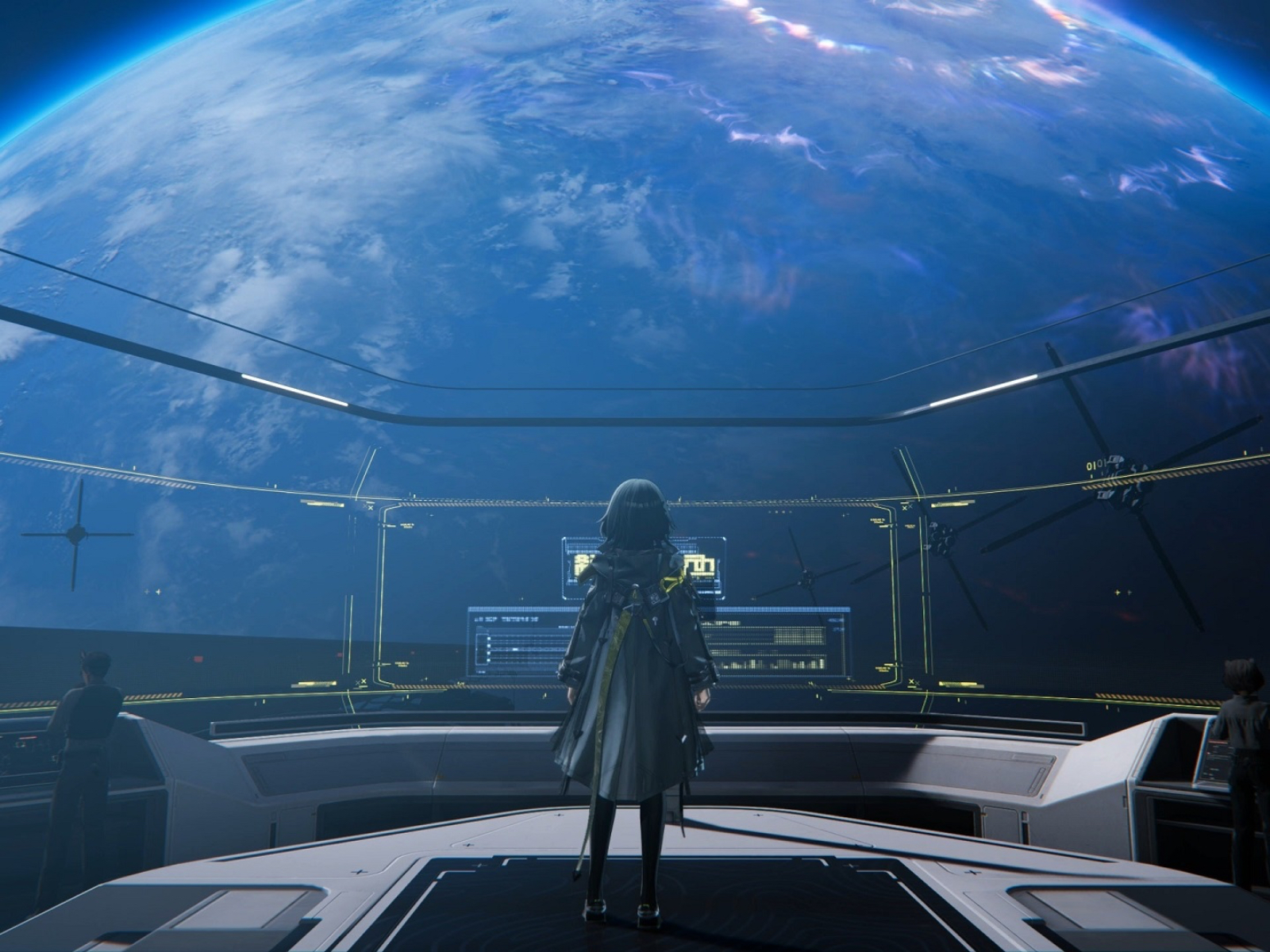
Arknights: Endfield / 明日方舟:终末地
A spin-off of Arknights, blending ARPG, open-world exploration, factory-style production lines, card elements, and more.
- Release date: 2026.01.22
- Platforms: PS5, PC, Mobile

A derivative title based on Hypergryph’s Arknights IP, Endfield pushes the original timeline forward by a century. Its core combat system makes a bold leap from the main game’s top-down tower-defense gameplay to a fully 3D open-world ARPG, while also daringly incorporating automated production-line building reminiscent of Factorio.
The story of Endfield takes place on the alien planet Talos-II. Players assume the role of the “Endministrator,” the administrator of the fictional organization Endfield Industries. Awakening from a long period of hibernation, the Endministrator has lost memories of having once led the organization—and seemingly saved the world. Yet from the moment of reawakening, it is clear that new and urgent crises await the intervention of this “chosen one.” This parallels the role of the Doctor, whom players embody in Arknights as part of the Rhodes Island organization.
Although Endfield is launching on platforms far beyond mobile devices, its business model still follows the familiar free-to-play approach common on mobile. The game encourages players to spend in-game currency or real money on gacha pulls: characters obtained can be deployed in combat, and powerful weapons can significantly reduce combat difficulty. Both characters and weapons come with rarity tiers—higher-tier ones tend to be far stronger and more impressive audiovisually, while also being much harder to obtain.
Automated production-line construction is also introduced as one of the core gameplay pillars. Players are required to build production, transportation, and defense facilities, gather resources in the wild, and set up manufacturing lines on designated plots of land. Ziplines, defense towers, warehouses, and other infrastructure can be placed wherever needed. You can clearly feel the influence of Factorio-style factory gameplay, as well as the asynchronous online concepts proposed by Death Stranding, both of which Endfield seems to have absorbed.
Many of the characters in Endfield appear to be “isomorphic variants” of characters from Arknights. Within these paired, similar characters, the Endfield versions are, in lore terms, “replicas” of their Arknights counterparts, known as “Re-Travellers.” According to Hypergryph’s creative leads in an interview with Gcores, some of these new designs originate from “the fulfillment of a certain long-held wish (within the Arknights setting)” or “another self seen in a dream.” Beyond characters, the game world itself is no longer the abstract, condensed space of Arknights. We are finally able to step directly into vast wildernesses, jungles, cliffs, and urban landscapes, experiencing Hypergryph’s distinctive brand of Chinese fantasy aesthetics firsthand. As a long-time Arknights player, seeing familiar figures come alive on screen in a more grounded 3D form—and watching pavilions and terraces once glimpsed only in static CG now standing vividly before me—genuinely stirred a sense of closeness and nostalgia.
Over the past month or so, aside from spending time clearing the fourth and fifth endings of the Arknights Integrated Strategies event themed around “Realm Within,” most of my free time has gone to Endfield, a game I had personally been anticipating for a long while. In interviews with Gcores, the core creative team mentioned that their first priority was to put into the game things they genuinely loved, and then hope that players would develop a similar affection for them. For me, this meant recognizing plenty of familiar influences—from Control, Destiny, God of War, NieR, Final Fantasy XV, and more. I like those games too. At the same time, I also see Hypergryph’s aesthetic sensibilities, cultivated since Arknights, being pushed to new heights in Endfield, especially in its interactions and architecture. So even when laying power lines and drawing conveyor belts drives me up the wall, I still feel, so far, that the game is worth savoring slowly.
With its fully 3D presentation and open-world framework, Endfield opens the door to many more gameplay experiments. It remains to be seen what kinds of “metaverse”-like modular expansions the developers might build atop this platform in the future—but for now, we watch with anticipation.
Cairn / 孤山独影
A hardcore, realism-driven climbing experience.
- Release date: 2026.01.30
- Platforms: PS5, PC

I previously introduced Jusant, a climbing game developed by DON’T NOD. This time, DON’T NOD’s French counterpart—the indie studio The Game Bakers—serves up a much more hardcore climbing dish with Cairn. If you’ve played The Game Bakers’ earlier titles Furi and Haven, you’ll recognize the studio’s tendency to focus intensely on a single theme or mechanic in each project, supported by strikingly stylized art direction. Furi centered on boss-rush combat, Haven on the bond between partners and its gliding mechanics, while this new work is devoted entirely to climbing and survival challenges.
In Cairn, players take on the role of the professional climber Aava, attempting to conquer an “unclimbed peak,” with climbing segments alternating with moments of rest. On a micro level, players must precisely control the protagonist’s body, using combinations of sticks and buttons to select and extend one of the four limbs, repeating this process to move upward. On a macro level, the game grants players near-total freedom in route selection, rather than confining them to predefined “anchor points.” That freedom still demands careful planning: venture into overly dangerous terrain and the protagonist will suffer from intense stress and rapidly rising stamina costs; choose a reasonable, less taxing route and Aava can place pitons and recover stamina. After climbing for a while, players will reach overnight campsites, where they can pitch a tent, restore condition, repair gear durability, and cook food.
To further heighten the sense of extreme challenge, The Game Bakers put considerable care into sound design, inviting Martin Stig Andersen—renowned for his work on Limbo and Control—to craft an immersive audio landscape for the game. An editor at Aftermath mentioned in their impressions that the sound effects were so enticing they often ended up overeating during rest breaks, only to find themselves short on supplies when it was time to recover stamina—an anecdote that speaks volumes about the game’s attention to detail.
Creative director Emeric Thoa noted in interviews with outlets such as GamesRadar+ that the team hopes Cairn can become a Death Stranding of climbing-themed games: one where highly concrete, hands-on climbing mechanics form the core experience, rather than a superficial simulation. More importantly, the underlying theme they aim to explore is an “emotion”—the yearning for absolute freedom, and the willpower, endurance, and sacrifice that inevitably accompany it. Taking all of this together, I’m inclined to trust The Game Bakers’ confidence in their focused vision, and it’s enough to count myself among this game’s potential audience.
Don’t Stop, Girlypop! / 暴走甜心
Hello everyone—welcome to the Y2K special.
- Release date: 2026.01.30
- Platform: PC

One of my personal favorites from Day of the Devs ahead of The Game Awards 2024, this is a retro FPS developed by Funny Fintan Softworks and published by Kwalee.
The game’s framework is close to DOOM, but its audiovisual elements are completely replaced with a full-on Y2K aesthetic. The premise is delightfully absurd: guided by the great, bright, and unquestionably righteous force known as “Love,” players must take on a mining corporation called Tigris Nix, wiping out the evil company’s robots and destroying its filthy shareholder interests.
Its wildly exaggerated, highly stylized art direction is easily one of Don’t Stop, Girlypop!’s most celebrated calling cards: ultra-saturated pinks, retro-futurism steeped in Y2K vibes, hearts and sparkles practically bursting out of the screen (the Steam page is literally filled with heart symbols)…paired with fast-paced electronic music, it becomes an unapologetic sensory assault. If you’re tired of shooters being perpetually tied to traditional war iconography—whether medieval or futuristic—or if you’ve already been swept up by the game’s infectious vibe, you’re more than welcome to jump into this high-speed shooting spree. Just remember: the faster you move, the more you heal, and the higher your damage climbs.
Pathologic 3 / 瘟疫 3
The same dish, cooked three times over twenty years—and each time with something new.
- Release date: 2026.01.10
- Platforms: PS5, XS X|S, PC

If you’re a hardcore narrative enthusiast, seeing the name Ice-Pick Lodge might make your spine tingle—another painful artistic journey is on the way, and the only question you’ll want to ask is, “When can I get on board?” The Pathologic series debuted with its first installment in 2005. The previous entry launched more than six years ago and, by sheer coincidence, later intersected with the global outbreak of COVID-19. The series has long been known for its use of infectious-disease themes, obscure and demanding text, brutal survival mechanics, and frequent breaking of the fourth wall.
To be clear up front, I’m not deeply familiar with the series myself. However, I’ve had friends enthusiastically recommend it to me, which sparked my interest in the IP, so I’ll offer a brief overview here. In a sense, both sequels in the Pathologic series can be considered remakes: the second and third entries respectively remake—or perhaps reimagine—two storylines that already existed in the first game. Pathologic 2 focuses on the Haruspex, while Pathologic 3 centers on the Bachelor.
All three Pathologic games share a similar framework. Players are given just twelve days, during which they must contain the spread of the plague, converse with a large number of NPCs to gather clues, and uncover the truth hidden within the town. Each route’s protagonist has unique abilities. In Pathologic 3, the Bachelor’s powers revolve around time manipulation and logical reasoning. Players can formulate various epidemic-control policies and preview the consequences those decisions will bring, while also bearing the costs of meddling with time itself. The logic-based mechanics also lend conversations with NPCs a strong deductive flavor, making this entry the most detective-like of the three.
While browsing the game’s Steam reviews, I came across a particularly striking comment. The reviewer noted that with the same characters, the same locations, and the same motivations, the developers somehow managed to tell the same story three times—yet each version was just as intricate and gripping as the last. I think it’s precisely this kind of logical intrigue that makes Pathologic 3 the installment I’m most eager to experience.
One Turn Kill
Expanding a single tactical idea into an entire game—an intriguing concept.
- Release date: 2026.01.15
- Platform: PC

A deck-building roguelike developed by the indie game collective DenDen and published by Waku Waku Games. The core idea of this title is both radical and immediately compelling: players must defeat their enemy within the very first turn. If the game ever reaches the enemy’s turn, the chances of victory drop to almost zero.
“One Turn Kill” is a term most commonly used in card games, referring to winning outright on the first turn through chained effects triggered from the opening hand. The Yu-Gi-Oh! scene, in particular, is full of such legends—I’ve seen videos where players go on an elaborate first-turn monologue, assemble all five limbs and the body in hand, activate Exodia (エクゾディア), and instantly obliterate their opponent. This game, sharing the same name as the term, turns that miraculous scenario into its central mechanic. The entire goal is to build a deck capable of winning in a single turn—kick-start the card-filtering engine the moment the match begins, and secure a deeply satisfying victory.
I’ve always had a strong fondness for TCGs, and in recent years I’ve been especially immersed in titles like Legends of Runeterra, Magic: The Gathering, and GWENT: The Witcher Card Game. While I’ve never actually achieved the lofty feat of a true “One Turn Kill” myself (if anything, Magic probably offers the best odds), that hasn’t stopped me from fantasizing about it. According to feedback from the player community, this game appears to be relatively small in scope, which is admittedly a bit of a shame—but I’d argue that getting an explosive, high-impact experience out of a short game can be a delight in its own right.
Leave a Reply