Preface
As the year draws to a close, the intense pace of work often leaves me feeling breathless. I inevitably start to think about spending some time living elsewhere to truly rest both physically and mentally. Many content creators have recommended cities suitable for long-term stays, and I’ve been wondering which place would suit me best. A good climate is essential for any place to live, which is why I’ve been flying to Yunnan more frequently over the past two years to explore cities known for their spring-like weather all year round. Tengchong and Mangshi are often mentioned as ideal places to live, so this year I took some annual leave to briefly experience what it’s like to stay here. Aside from the climate, what I value most are good food and beautiful scenery. This article focuses on these two aspects to document my experience, along with a brief comparison of which small town in western Yunnan might be more suitable for long-term living.
Staying in an Ancient Town
Food in the Ancient Town
Tengchong does not have a high-speed rail station, and its airport is relatively small, making direct transportation somewhat inconvenient. We first transferred through Kunming before flying here. Alternatively, you can fly to Mangshi or Baoshan and take a bus to Tengchong, which takes about an hour.
After arriving in Tengchong, we chose to stay at a homestay called “Tang Tang’s Home” in Heshun Ancient Town. The suite costs 472 RMB per night, and the homestay offers airport pickup service. It takes about 20 minutes to reach the town from the airport. To enter the ancient town, visitors need to purchase a ticket using their ID card—55 RMB for adults, with discounts available for students and seniors. Each ticket is valid for seven days and allows entry and exit using the same ID.


The four Pomeranians kept by the homestay owner, along with the stray cats by the roadside
When we first arrived in Tengchong, we chose to stay in the ancient town mainly because of the airport pickup service and the convenience of finding food nearby. Within a ten-minute walk from the homestay, there are many restaurants to choose from. Passing by “Cuixi Lou” near Wild Duck Lake, we noticed a promotional sign offering a plate of Da Jiu Jia (stir-fried rice cakes with pork and other ingredients) for only 9.9 RMB, along with free barley tea. Another restaurant called “Mom’s Taste” offers stir-fried Jian Shou Qing mushrooms for 98 RMB and stir-fried porcini for 88 RMB. Sitting by the window, you can enjoy the sunset while dining.

In addition to the many restaurants, the main street is filled with local snacks worth trying. One popular shop, “Heshun Crispy Roast Pork Trotters,” sells braised pork trotters that are roasted upon order and take about 20 minutes to prepare. You can choose either a whole or half portion—the half portion costs 25 RMB. The shop cuts it into pieces, each consisting of a small section of bone attached to tender meat, making it easy to eat. The skin is crispy while the inside remains juicy and rich without being greasy.
The morning market on the century-old Caijie Street offers even more snack options. Thin pea flour paste, made from ground peas, is one of the must-try local foods. “Auntie Yang’s Breakfast Shop” serves a 6 RMB set of this dish, which can be paired with flatbread or fried dough sticks. Street vendors also sell pine blossom cakes everywhere—three pieces for 5 RMB—which taste somewhat similar to mung bean cakes.

Scenery of the Ancient Town
The ancient town is not only known for its food but also for its long history. According to ancient texts such as the Old Book of Tang, Tengchong was historically known for producing rattan, and its name originally meant “a place abundant in rattan.” During the Ming Dynasty, Tengchong Prefecture was established and it was known as “the First City at the Frontier.” In the Qing Dynasty, troops stationed here resisted British incursions. During the Republican era, Japanese forces invaded western Yunnan and occupied the area. Two years later, the Chinese Expeditionary Force launched a counteroffensive in western Yunnan and successfully recaptured Tengchong. After the founding of the People’s Republic of China, Tengchong was peacefully liberated and placed under the administration of Baoshan.
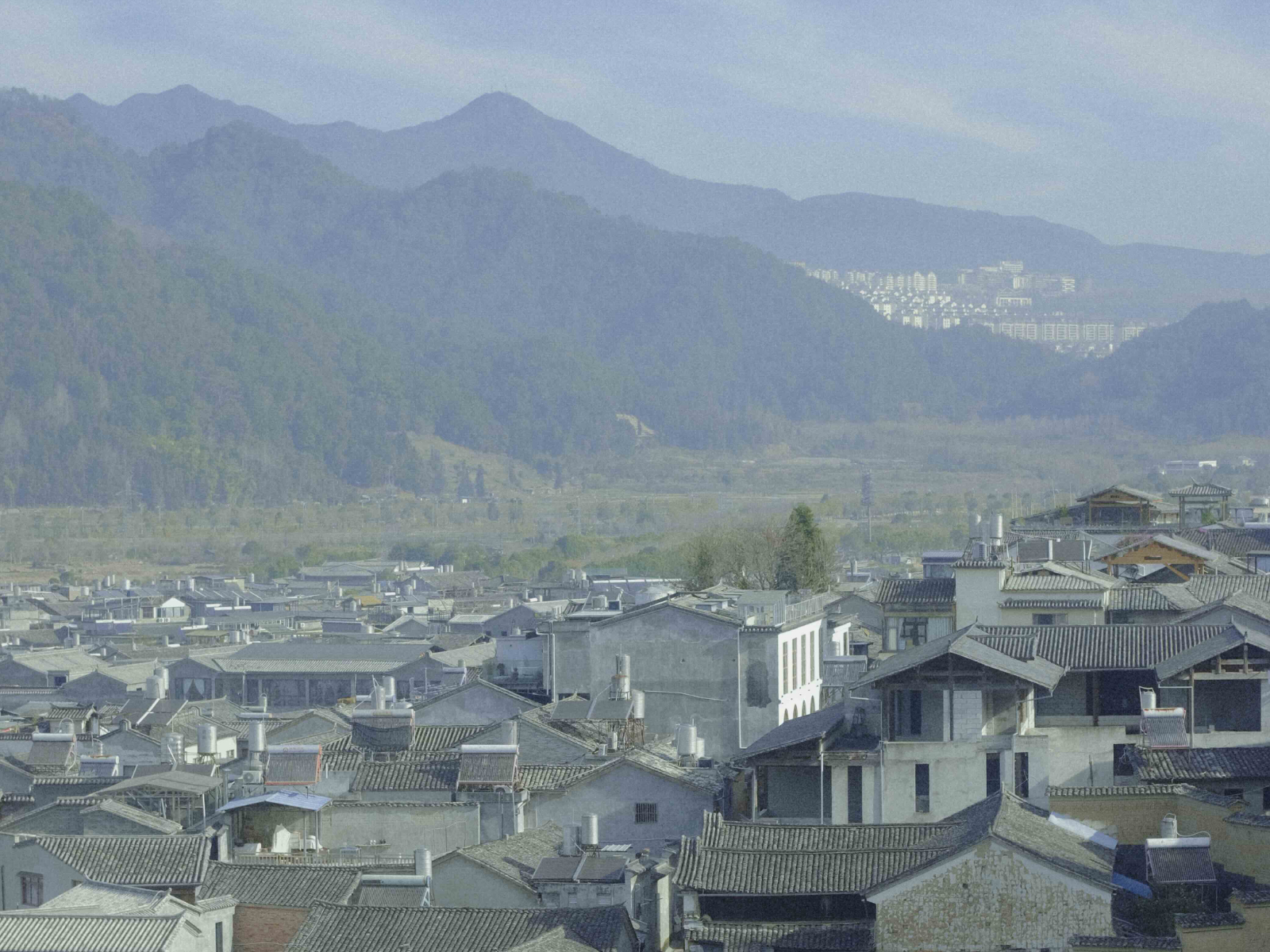
The town’s architecture is well worth exploring at a leisurely pace. Not far from our homestay stands Yuanlong Pavilion, in front of which lies Longtan Pond. In the early morning, the pavilion is often surrounded by mist, creating an ethereal atmosphere. The Liu Clan Ancestral Hall and Li Clan Ancestral Hall are adorned with numerous inscribed plaques and couplets, set within tranquil surroundings. The ancient town is home to nine ceremonial archways, built to commemorate achievements and virtues such as loyalty and filial piety, and they have now become popular photo spots.


The highly rated Chinese TV drama My Chief and My Regiment was primarily filmed in Heshun Ancient Town. We passed by filming locations such as “Milong’s Home” while riding the sightseeing shuttle. The driver grew up in the town, and the crew had filmed near his home at the time—he was even recruited as an extra. The crew gave him a bunch of bananas, which he thought were for him to eat, so he shared them with his friends. Only later did he realize the bananas were actually props for a scene depicting villagers welcoming returning troops with fruit and food.

The town is not limited to ancient buildings—there are also many cafés and bookstores ideal for spending a slow afternoon. “Shu Shu Bookstore” is a multifunctional space that combines a bookstore, café, and hotel. The bookstore features a unique layout where you can read on tiered steps surrounded by bookshelves, or head to the café to overlook the panoramic view of the ancient town. If you wish to stay longer, you can even spend a few nights here, and guests are allowed to borrow any unsealed books for free. My only slight regret was that the bookshelves were somewhat disorganized, and there were very few detective novels available—only a few copies of The Adventures of Sherlock Holmes.

Volcanoes and Hot Springs
Food in Tengchong
To experience the volcanoes and hot springs, we left the ancient town and headed to the city center. I wasn’t as familiar with the food scene here as I was in the ancient town, but I had heard that Tongpiao Beef was worth trying. The copper pot used for Tongpiao Beef originates from the Bai ethnic group’s copper utensils along the Ancient Tea Horse Road, and the charcoal-heated hotpot style continues the tradition of gathering around a stove at roadside stations along the route. We visited “Ma Dong Halal Tongpiao Beef Restaurant” and ordered a clear broth base with ingredients such as Chinese cabbage and white radish. At least 500 grams of beef must be ordered, and each slice is cut very thin—ready to eat after about a minute in the pot. Dipped in a variety of sauces, the beef was tender and flavorful. The meal cost 110 RMB.

Our homestay in the city was located in the newer northern district. Nearby, there was a well-known wild mushroom hotpot restaurant called “Shanzhen Guan,” with photos at the entrance showing actor Shen Teng dining there. We chose a chicken broth base, with truffle and Huanglaitou mushrooms in the pot, and also ordered a portion of fried rice with dried Ganba mushrooms.
After the broth was served, the mushrooms had to be cooked for 30 minutes without stirring with chopsticks. The staff brought us oranges and stir-fried mushrooms as appetizers while setting a timer. Once the time was up, we could finally enjoy the mushroom soup. Although we ordered a medium-sized broth and half portions of each mushroom, the quantity was still quite large—we couldn’t finish it all.
The most expensive item in the meal was the truffle, priced at 154 RMB for a half portion. According to the staff, it has immune-boosting benefits, and since some fresh ones were still available, they recommended it to us. A half portion of Huanglaitou mushrooms cost 57 RMB and is best for enhancing the flavor of the soup. In total, the meal came to 462 RMB.

Our homestay host also recommended a restaurant called “Huayu Diandian,” which offers both barbecue and main dishes. When we arrived around 6 p.m., we were told there were 20 tables ahead of us, with an estimated 40-minute wait. I ordered a local specialty dessert from Dehong Prefecture called Paoluda to pass the time—it’s made with milk, shredded coconut, tapioca pearls, and other ingredients, resulting in a sweet and refreshing treat.

While waiting, I asked the owner if we still had to wait if we didn’t order barbecue. He said no, so I ordered braised noodles instead. When the dish arrived, I was taken aback—northern-style braised noodles are typically made with vegetables and meat without any chili, but Tengchong’s version was spicy. I was dealing with a sore throat at the time and couldn’t handle any spice, so I had to order another plate of Da Jiu Jia to “save the day.”

I had very few chances to eat vegetables during these days. Near Beihai Wetland, there are many farmhouse-style restaurants with kitchens stocked with fresh leafy greens. I ordered stir-fried bok choy and tofu soup with greens. The bok choy was stir-fried with chili and garlic, making it an excellent dish to go with rice. The tofu in the soup was incredibly soft, breaking apart at the slightest touch—each bite was soothing to the palate.

Aside from restaurants, the city also has plenty of street snacks. In southern Tengchong, there is a place called Qiluo Ancient Town, known for its morning market. After soaking in a hot spring one day, I went there for a meal and tried a Bai ethnic traditional snack I had never tasted before—grilled Rushan. Made primarily from milk, it is stretched into thin sheets, grilled over charcoal, and brushed with seasoning before serving. The vendor told us he wasn’t Muslim and used to sell jade, but turned to running a food stall when business declined. He was very kind—after handing us the grilled Rushan, he even gave us two passion fruits for free.

There was also a herbal medicine vendor at the market. As we had been suffering from insomnia recently, we bought some sour jujube seeds. The vendor examined our tongues and facial features, then explained some health issues we might be facing. Noticing the blackheads on my nose, he said it indicated lung-related problems and advised me to take better care of my health, sharing several stories of “friends” who had passed away due to neglect. It felt like sitting in Professor Trelawney’s Divination class in Harry Potter, listening to her predict a tragic fate.
I think the best food at the morning market was the crispy layered buns. I found a highly rated shop on the map called “Fang Jie Special Crispy Buns.” From the entrance, it takes a ten-minute walk down the alley next to the ancient town library to reach it. As the saying goes, good wine needs no bush—these buns sell out quickly. By the time I arrived, only rose rolls and mushroom buns were left. On the way back, I spotted another barbecue stall, where beef skewers sizzled on the grill, and couldn’t resist buying a few.

Scenery in Tengchong
Tengchong sits on the boundary between the Indian Plate and the Eurasian Plate. It is the region within China with the highest density of volcanoes and the largest number of volcanic sites. Tengchong is also one of China’s three major geothermal zones, earning it the nickname “China’s Hot Spring Capital.” Beyond volcanoes and geothermal activity, Tengchong boasts many other distinctive geological wonders. Beihai Wetland, formed by a volcanic lava dam, has become Yunnan’s only national wetland nature reserve. To the east of Tengchong, the Gaoligong Mountains are home to a rich variety of rare flora and fauna.
Choosing to stay in the northern part of Tengchong was driven less by “food” and more by “scenery.” Our homestay was close to the Tengchong Volcano and Geothermal National Geopark, making it easy to head out early in the morning to watch hot air balloons. The geopark’s balloons only fly before 11 a.m.; after that, flights stop due to weather conditions. I didn’t enter the park itself. Instead, I drove along County Road XM74 to the outer edge of the park. There is a broad stretch of grassland along the road, and when I arrived it was completely empty—perfect for viewing the volcanoes up close. Hot air balloons rose and fell across the sky, and I couldn’t help but think of Cappadocia in Turkey.

Continuing along the county road, we spotted a crowd feeding monkeys by the roadside—these are local stump-tailed macaques. Some villagers were selling peanuts: three bags for ten yuan. The monkeys wouldn’t touch the bread I brought, so I had no choice but to buy peanuts. The villagers told me to keep the peanuts hidden in my pocket and only take out one at a time, placing it low in my hand—then the monkeys would naturally come over and take it. It worked exactly as they said. But the clever monkeys noticed me reaching into my pocket, and one after another stood up and pawed at my pockets.
I took a few steps back, trying to feed a little monkey, but the bigger ones kept snatching the peanuts. Yet when I took out my camera to photograph the little one up close, the bigger monkeys would rush over to shield it, as if afraid I might hurt it. Their half-friendly, half-hostile attitude was honestly hard to read.

I parked in the free lot at “Xiabiayuan Mushanju.” Across the road, there’s a path leading down to the Heiyu River. This river formed after volcanic eruptions, when lava blocked an underground river channel and groundwater emerged at the surface. It’s named Heiyu River (“Black Fish River”) because every summer and autumn, tens of thousands of small black fish surge out from the spring source.
According to travel tips I’d seen on Xiaohongshu, you can reach the river by going down a set of stone steps—but few people mention how difficult the route actually is. The steps are essentially unmaintained: most are narrow, and the slope is steep, making both the descent and climb quite inconvenient. Even with a trekking pole, I was still panting the whole way, having to use both hands and feet to avoid slipping.
Heiyu River is a low-temperature hot spring river. The current is fast and the water is crystal clear. When I reached the riverbank, I tested the temperature with my hand. It wasn’t as warm as people online claimed, but it also wasn’t cold. As I walked further, the water gradually turned an emerald green. On both sides were rocky riverbanks formed as volcanic rock was eroded by the flow.
Beihai Wetland and Heiyu River share a similar origin—both were formed through volcanic activity. Lava blocked underground waterways and created a lake, giving rise to China’s only floating-mat wetland of a volcanic lava-dammed lake. Admission to the wetland is 55 yuan per adult. Inside, there are all kinds of waterbirds and wild ducks. You can take a boat into the wetland to observe plants and animals; a one-way trip takes about 15 minutes and costs 60 yuan per person.


Heiyu River and Beihai Wetland
After getting off the boat, a long wooden boardwalk stretches out, with water caltrop plants growing densely on both sides. This plant requires exceptionally clean water and is rich in gelatinous proteins, making it an excellent ingredient for skincare products. It’s nicknamed the “giant panda of plants” and the “bird’s nest in water.” From the boardwalk, you can take a cable car back to the entrance; a one-way ticket is 10 yuan per person.
Beihai Wetland in early February felt rather quiet. I only saw two or three kinds of waterbirds, and with so many paid add-on activities inside the park, I began to understand why Xiaohongshu is full of posts warning people to avoid this place. You can catch the sunset if you stay until around 7 p.m., but the wind in the wetland was strong, so we left after a short while.
Where volcanoes are active, hot springs are usually close by. Tengchong’s most famous hot springs are at Rehai’s “Big Rolling Pot,” a well-known tourist spot—and also the most crowded. All the pools there are public, and even if you arrive right at 9 a.m. when it opens, you still might not get anything close to a private soak. Tengchong hot springs mainly fall into two types: carbonated springs and sulfur springs. The driver who picked us up said locals usually go to Huangguaqing for sulfur springs.
Huangguaqing is near Rehai. The word qing generally refers to a lush, wooded valley, and this place gets its name because the valley shape resembles a cucumber. But judging from online reviews, several hot springs in Huangguaqing are described as having a “pure prison vibe” or “dungeon vibe,” so I didn’t go. “Xianren Hot Spring” is also in the Huangguaqing area. It’s said to use sulfur spring water diverted from Rehai’s “Beauty Pool.” Besides public pools, it also offers private rooms, priced at 60 yuan per room.
I arrived at Xianren Hot Spring around 10 a.m., and there were hardly any visitors yet. I called ahead to reserve a private room, and the staff told me they could start filling it early. But when we arrived, the water was still far too hot—over 40°C by touch. I turned on the cold-water tap for ten minutes before I dared to get in. There was also a ladle by the pool. I like using it to scoop hot spring water over myself until I’m completely drenched.

While soaking, I could feel my skin becoming smoother, just as people often say. But I didn’t smell the typical sulfur “rotten egg” odor, and there was no flocculent mineral sediment in the pool either. To judge whether it was truly a sulfur spring, I cupped a handful of water and sniffed carefully—what I caught was more of a gunpowder-like scent. I soaked for about an hour. Afterward, my skin was flushed and my body felt noticeably more relaxed.
After we finished, the driver who came to pick us up said that when he was a child, he used to soak at “Dongshan Hot Spring” every day. Back then it cost only a few jiao per visit. Now it has become “Dongshan Hot Spring Resort,” where private rooms cost 40 yuan per person for a one-hour session. Compared with Xianren Hot Spring, the private rooms here are larger and brighter, though this one is a carbonated spring rather than a sulfur spring. The resort also has outdoor public pools—many tucked away in the woods, so you have to search carefully to find them. I even saw people using their phones’ navigation to locate specific pools.

From Tengchong to Mangshi
Food in Mangshi
Mangshi is about an hour’s drive from Tengchong and is a small city perfect for leisurely walks. After arriving, I first went to “Best Food City” and ordered a mango juice for 15 RMB from the Xiaohongshu-recommended “Fatty’s Cold Drinks.” With the juice in hand, I headed to “Ajiji Burmese Tea Restaurant” and ordered a Thai-style lemon shrimp and a Burmese egg Shuaibaba.


Inside Ajiji Tea Restaurant and the recommended menu
Having learned my lesson from the spicy braised noodles, I specifically asked the chef not to add chili to the Thai-style lemon shrimp. The dish consisted of shrimp paired with cucumber and shredded radish, with plenty of minced garlic. Burmese egg Shuaibaba is a thin pancake made from high-gluten flour with egg wrapped inside and sprinkled with sugar on top. One dish leaned sweet, the other savory—perfectly suited to my taste.
Unlike Best Food City, “Mengbanaxi Food City” focuses on barbecue and has a more vibrant street-food atmosphere. When I arrived around 6 p.m., many stalls hadn’t opened yet. There was a long queue at a Burmese Shuaibaba stall, so I joined and bought one for 12 RMB. Next to it was a stall displaying a sign that read “Best-Looking Dish of the 2025 Mangshi Flavor Food Competition,” selling a cold mixed dish made with crushed peanuts and Houttuynia cordata, priced at 10 RMB.


Stalls at Mengbanaxi Food City
Sa Pie is a traditional Dai ethnic dish made using the bitter intestinal juices from cattle as seasoning in a cold mix. At “Su Jie Border Snacks” in Mengbanaxi Food City, various types of Sa Pie are available. I ordered the nut-based version, which was mixed with a nut paste that gave it a slightly milky aroma. It is typically served with rice noodles, beef liver, and mint—dipping the side ingredients into the Sa Pie results in a refreshing sweet-and-sour flavor.
While looking for a restroom in the city center, I stumbled upon “Baomin Ganbai Street,” known for its border-style snacks. I ordered Burmese fish soup rice noodles and stir-fried shredded potatoes, along with lemon water. The fish soup noodles were generously portioned with fish fillets, fried fish skin, and egg. The stir-fried shredded potatoes were the only version I encountered in Yunnan that didn’t include chili. The lemon water was strong and filled with pulp. Even though it was just a random roadside find, the taste was surprisingly good.
Sometimes we didn’t feel like going far and just wanted to grab something near the hotel. We stayed at “Huanman Hotel,” which had many restaurants nearby. Across the street, “Mianguihua Dai Cuisine” specializes in Yunnan dishes, and there was always a queue outside. At “Keduomi,” we ordered fried rice with dried Ganba mushrooms and were given complimentary mini bananas. “Chan Sisters Clear Soup Beef Breakfast” is known for its beef Ersi—a children’s bowl costs 6 RMB and is already quite filling, with tender beef that tastes even better when paired with condiments.


Children’s bowl of beef Ersi and condiments
Later, we also tried clear soup beef Ersi at “Lianmei Breakfast,” which was just as delicious. Sometimes when we woke up late, it would already be past 9 a.m., yet there would still be a long queue outside—waiting about 40 minutes just to get a bowl. It made me think back to my workdays, when I would hastily grab a couple of bites of breakfast at 7 a.m. every morning. The contrast felt almost surreal—slow living became tangible in that moment.
After eating so many street snacks, we wanted a proper sit-down meal. “Mandeli Burmese Tea Restaurant” is located in the city center and offers a much more elegant dining environment compared to roadside eateries. We ordered a chicken pancake and a Burmese-style vegetarian salad, paired with banana juice—just enough to fill us up. We had expected restaurant prices to be much higher than street stalls, but the total came to 96 RMB, which was quite reasonable.
After visiting an overly commercialized Dai ancient town, we lost interest in Mangshi’s old towns and almost missed “Mangwei Yunnan Cuisine” in Manghuang Village. Upon arriving, we realized the village wasn’t just full of Dai ethnic costume photography studios but also many dining options. The private rooms at Mangwei Yunnan Cuisine offered excellent privacy. Walking in from the noisy crossroads at the village entrance felt like entering another world. The egg-coated tofu had a crispy exterior and silky interior, the pineapple fried rice was generous and filling, and the tremella soup was nourishing and comforting—all dishes not to be missed. The prices here were similar to Mandeli Burmese Tea Restaurant; the total for this meal was also 96 RMB.


Private rooms at Mangwei Yunnan Cuisine and the egg-coated tofu
Scenery in Mangshi
After dinner, I often like to ride a bicycle around Peacock Lake. The entire lake area is surrounded by Leiyarang Mountain, covered with dense forests that provide exceptionally high oxygen levels in the air. An ecological walkway runs along the lake, where many people can be seen strolling or jogging. Next to “Laihui Coffee” are a few steps facing the lake—sitting there and watching egrets skim across the water is pure bliss.

Menghuan Grand Golden Pagoda sits atop Leiyarang Mountain and is a landmark of Mangshi, known as the “largest hollow Buddhist pagoda in Asia.” This pagoda is an important site for Theravada Buddhism, reflecting the long-standing cultural exchange in the China–Myanmar border region. I visited on a Sunday, and the road leading up the mountain was completely jammed with vehicles. It was difficult to find parking, so I stayed in the car and admired the pagoda from a distance.


The Grand Golden Pagoda photographed from the car, and from Peacock Lake
Another example of the China–Myanmar cultural blend in Mangshi is the Burmese-style hair washing services commonly found on the streets. I went to the main branch of “Bangbang Hair Wash House” and chose the “hair wash + back stretch with essential oil shoulder and neck massage” package. For two people, the total cost was 271 RMB, taking about 80 minutes. My therapist was a sturdy Burmese man in his twenties. He began by washing my hair and applying a facial mask before starting the massage.

His massage was quite strong, but since my fitness coach sometimes uses massage to help me relax, I was able to adapt to his rhythm. My shoulders and neck had become very stiff from prolonged use of my phone and computer, and I could feel him applying significant pressure to loosen the muscles. My back felt sore immediately after the massage, but a few hours later, there was a noticeable sense of relief and release in my shoulders and back.
Mangshi is not large, making it ideal for exploring by electric scooter. I rented a shared bike from outside the hotel and rode to the internet-famous wall near Century Hotel and Bodhi Street. Each spot is about a ten-minute ride apart. The wall is tucked into a small alley next to staff housing, while Bodhi Street is busy with traffic—both are more suitable for quick photo stops rather than lingering visits.


The internet-famous wall and Bodhi Street
The Tree-Wrapped Pagoda is a landmark formed by a Qing Dynasty-era pagoda built around 200 years ago and a Bodhi tree growing together. Compared to the previous two spots, there’s at least a small square here, allowing you to photograph the tree from all angles. Nearby residential developments are currently under construction, so we stopped by the sales center to inquire about housing prices—the average is around 6,300 RMB per square meter.

In the Bingwu Street area of Mangshi, there is a lively market where vendors from Dai, Jingpo, and other ethnic minority groups sell wild mountain ingredients and traditional clothing. The market is held once every five days, with the busiest period between 9 a.m. and noon. As I wandered through, I saw stalls selling soy pods, fruits, decorative fruit shells, and even live roosters—it was a vibrant scene.

After visiting all the major attractions in the city, we began exploring the outskirts by bicycle. Back in Tengchong, our driver had mentioned that the rapeseed flowers were about to bloom, so we rode to the ecological rural tourism area north of Mangshi. At the edge of the farmland was a large field of blooming rapeseed flowers, surrounded by potato crops, with several farmers busy at work.

Conclusion
Tengchong and Mangshi have similar living costs and both offer ancient towns, lively markets, distinctive local cuisine, and pleasant scenery—making them equally appealing for long-term stays. If I had to choose, however, Mangshi’s “small but beautiful” charm is more attractive to me compared to Tengchong. I like the towering Grand Golden Pagoda on the mountaintop, the tranquil Peacock Lake, the abundant breakfast options, and the freedom to wander around on an electric scooter. While living in Mangshi, I felt the pace of life slow down more noticeably. If given the chance in the future, I would love to stay in Mangshi for an extended period—to try the dishes I didn’t have time for and drive out to explore more distant villages.
Leave a Reply