When it comes to smartwatches, the first one that truly left an impression on me was the Moto 360. The reason was simple: it ran an open Android-based system that could install all kinds of apps — and that was back in 2014.

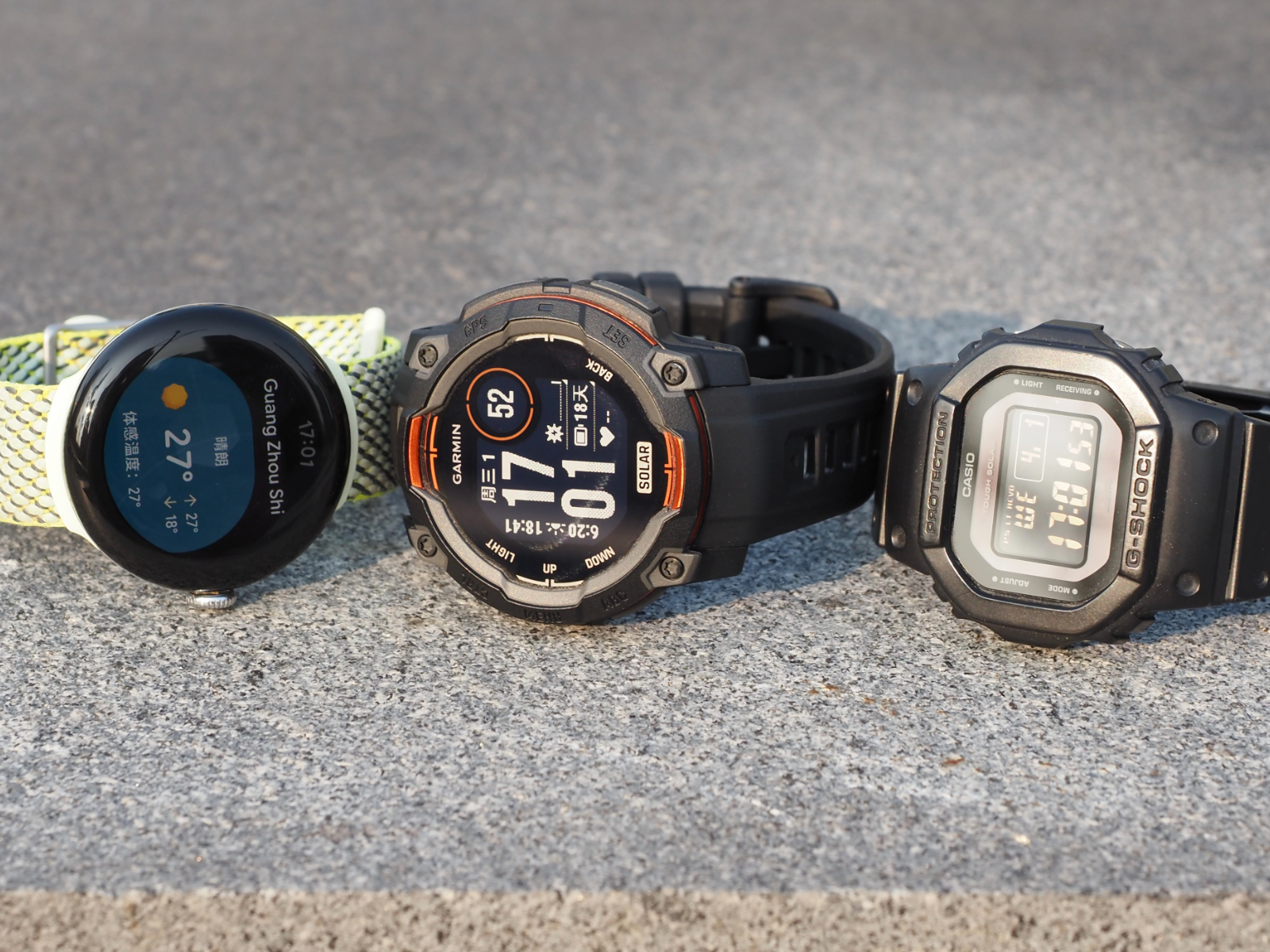
Over the years, I’ve tried the TicWatch, Samsung smart bands, G-Shock, and the Pixel Watch 2, but every one of them had something that left me unsatisfied.

Take the two watches I wore for the longest time, for example: the G-Shock GW-B5600, powered by solar charging and radio-controlled timekeeping, could practically go a decade without worrying about battery life. It was rugged and reliable. But it couldn’t satisfy my needs for health tracking and smartphone notifications.

Later, I switched to the Pixel Watch 2. Its workout and sleep tracking, along with the ecosystem integration, felt incredibly polished. But that anxiety-inducing battery life once forced me to charge it in the least graceful way possible while spending a night at the airport waiting for an early morning flight.
After using both of these watches, I realized that what I needed wasn’t an Android smartwatch packed with features but crippled by short battery life, nor a simple digital watch with incredible endurance.

What I needed was a hybrid: a watch with ultra-long battery life, professional-grade fitness and health tracking, and the ability to view smartphone notifications. At the same time, it also had to look good, feel durable, and stay lightweight.
Then, in January 2025, Garmin released the Instinct 3 Solar. And for the first time, I felt like I finally understood what kind of watch truly belonged on my wrist.

Function-Driven Design
One of the biggest reasons I was drawn to the Pixel Watch before was its appearance. The dual-sided 3D glass paired with a metal frame gave it a clean yet lively look. That kind of design works great for touch interaction and feels premium, but the trade-offs are weaker structural durability, glass that scratches easily, and touch controls that become unreliable when wet.

Looking back at the Instinct 3, it is built around one thing: toughness and durability. There is not a single overly decorative design element for the sake of appearance alone.

Since it does not rely on touchscreen interaction, the Instinct 3 recesses the display beneath the plastic bezel. Around the outer edge of the display glass is an orange aluminum alloy ring, designed to further improve the overall structural strength.
Combined with its 10 ATM water resistance rating, the Instinct 3 is probably the most rugged smartwatch in its price range right now.

Another defining characteristic of the Instinct series is its fully button-based operation. Every interaction is handled through five physical buttons. Considering outdoor scenarios where users may be wearing thick gloves, Garmin made the buttons large and tactile, with crisp feedback when pressed.

To reduce accidental presses, the two buttons on the right side are separated by their own protective frame, while the three buttons on the left use two raised ridges as guides, making it incredibly easy to locate them by feel alone.
Combined with an extremely ergonomic button layout (one on the right, one on the left), the controls become more intuitive and convenient than tapping a screen once you get used to them.

The Instinct 3 uses a fiber-reinforced polymer case. It may not look as refined as a metal case, but it is rugged, durable, and does not interfere with wireless signals like GPS or Bluetooth.


The sensor area on the back protrudes slightly on its own, paired with inward-curving lugs, allowing the sensors to stay firmly against the skin without needing to tighten the strap excessively. This avoids the common issue on other smartwatches where the watch shifts during sleep and leaks green light across your wrist in the middle of the night.


Speaking of light, the Instinct 3 features a dual-color LED flashlight at the top. Double-pressing the Light button turns it on instantly, and it is dramatically brighter than the makeshift flashlight mode on typical smartwatch displays, making it genuinely useful.

The Instinct 3 gives me the feeling that its functions were defined first, and its design came afterward. Refined elegance in form was never the top priority — durability, reliability, and practicality were. In the end, through nothing more than plastic and aluminum alloy, it manages to deliver a uniquely premium aesthetic.
Using this much plastic without feeling cheap — that is the power of design.
The Longest-Lasting Smart Sports Watch
Battery life is one of the biggest reasons I chose the Instinct 3. With my current setup (automatic backlight enabled, heart rate monitoring on, workout tracking enabled, and connected to my phone for notifications), a single charge lasts me 21 days. Charging itself is also fairly quick — going from 10% to 100% takes roughly 90 minutes.

That level of endurance is something most smartwatches cannot achieve even in their most stripped-down battery saver modes.
What is even more impressive is that the Instinct 3 supports solar charging. According to Garmin, just three hours of direct outdoor sunlight per day at 50,000 lux is enough to achieve effectively unlimited battery life.

In my own testing, leaving the Instinct 3 under the winter afternoon sun for three hours increased the battery by around 8%, while my average daily battery drain is only about 5%. In actual use, whether it was around eight or nine in the morning or four or five in the afternoon, as long as sunlight could directly hit the watch face, charging efficiency consistently reached 100%.

In other words, as long as I spend enough time outdoors and the watch face receives more than three cumulative hours of direct sunlight, I can still come home with an extra 3% of battery left at the end of the day.
From this perspective, the Instinct 3 is without question the longest-lasting smart sports watch available right now, thanks to Garmin’s two biggest advantages: its proprietary RTOS operating system and Power Glass solar charging technology.
RTOS Is the True God of Outdoor Watches
The Instinct 3 runs on Garmin’s in-house RTOS, a system refined and optimized over decades. In terms of functionality and stability, it sits firmly among the top tier in the industry, and it also has a fairly mature third-party app ecosystem.

And precisely because of that long history, Garmin’s system interaction can feel somewhat complicated, lacking the trendy polish of brands like Suunto or COROS. But when it comes to power efficiency, their RTOS systems are miles ahead.
RTOS stands for Real-Time Operating System, and at the fundamental level it works very differently from the general-purpose operating systems (GPOS) we use every day, such as Android or Windows.

RTOS is built around extreme determinism. It has no bloated background services or flashy UI layers. It manages every task with precision, waking the processor only when necessary and putting it back to sleep immediately afterward. This highly targeted way of operating dramatically reduces power consumption.

GPOS, on the other hand, is designed around versatility and visual polish. It carries the burden of countless background services and complex graphical rendering. Because the system overhead is so heavy, waking from sleep becomes expensive, making it difficult to instantly sleep and wake like an RTOS system. Most of the time, it has to stay running at relatively high power consumption, so battery drains away like flowing water.
If we compare them to people, RTOS is like a cold, hyper-efficient worker: no morning grumpiness, no staying up late, falls asleep instantly, wakes up and immediately gets to work, finishes the task and goes right back to sleep. No sweet talk, just pure efficiency. GPOS, meanwhile, is like the rest of us exhausted corporate workers: struggling to get out of bed, lying awake at night, sleeping poorly, constantly making flashy presentations and saying all the right things. It looks glamorous on the surface, but underneath it is running on low energy all the time.
Of course, there are many watches that use RTOS systems, and some products from brands like Xiaomi and Amazfit can deliver smooth and visually polished UI experiences as well. But none of them can match the battery life that Garmin delivers.

If you want to balance battery life, functionality, and professional-grade sports features all at once, there are basically only three companies left: Garmin, Suunto, and COROS. Among them, COROS does not offer a solar-powered model, and Suunto has also abandoned solar charging on its latest Vertical 2. That leaves only Garmin still fully committed to pushing solar technology forward.
Inside Garmin’s Power Glass Solar Technology
The world’s first solar-powered watch was the Synchronar 2100 released in 1972. Its surface featured two massive monocrystalline silicon solar panels, forcing the LED display to be positioned on the side instead — a compromise that accidentally gave it an incredibly futuristic appearance.

Even today, most solar-powered watches still follow a similar design philosophy: placing solar cells directly on the watch dial.

There are generally two main approaches. One uses a translucent dial with the solar cells placed underneath it, like the example on the left above. The other places a ring of solar cells around the inner bezel, allowing the watch to use far more elaborate opaque dials, like the example on the right.

Among Japan’s three major watchmakers, Seiko mainly adopts the first approach, while Casio and Citizen both use a mix of the two. My previous G-Shock GW-B5600 was closer to the second design.

Garmin took a completely different route. Their solution is called “Power Glass,” officially known as solar charging transparent lens technology. Instead of relying on those thick, bulky black solar panels, the entire surface becomes transparent glass. I even asked “Teacher G” to help create a rough illustration for everyone — if you are interested, it is worth taking a closer look.

Simply put, Garmin cuts the solar cells into a microscopic mesh structure and embeds them directly into the glass panel. To the naked eye, the pattern is almost invisible, making the surface appear completely transparent. In the non-display areas of the watch face, however, this “mesh” becomes effectively “solid,” ensuring overall solar charging efficiency remains high.

It is also worth mentioning that the Instinct 3 uses Corning Gorilla Glass as well, likely a customized version from the DX series. Compared to ordinary glass, surface reflectivity is reduced by roughly 75%, allowing more light to reach the solar layer, while scratch resistance is on par with sixth-generation Gorilla Glass.

While researching patents, I discovered something quite interesting: the original applicants behind this entire series of transparent solar panel patents were actually a French company called SunPartner Technologies. These patents were only transferred to Garmin in 2019.

Back in 2011, SunPartner Technologies introduced a transparent solar film called Wysips. The company claimed you could simply apply it like a screen protector to charge your phone, which caused quite a sensation at the time. Unfortunately, due to financial difficulties, the company filed for bankruptcy in 2019.
One of its biggest customers back then happened to be Garmin, so Garmin took the opportunity to acquire most of its patents and assets. In August of the same year, Garmin launched its first solar-powered smartwatch, the fēnix 6X Pro Solar, which also suggests that the two companies had already been working closely together long before the acquisition.

Even today, this remains a uniquely specialized business. As Garmin continues refining the technology, Power Glass keeps improving in solar efficiency, the glass panels become increasingly transparent, and production costs continue to fall. Without question, this is currently the most advanced solar solution available for mobile devices.
It is precisely this technological moat that has allowed Garmin to become the only company capable of delivering near-infinite battery life on a smart sports watch.

Of course, every technology comes with trade-offs, and Power Glass is no exception. First, its energy generation efficiency still cannot match traditional solar cells, nor can it harvest weak ambient light like moonlight or indoor lighting the way some Citizen watches can. Second, the glass itself is not perfectly transparent, which slightly affects the contrast and viewing angles of the MIP display.
Packed With Features, Powered by Customization
In terms of sheer functionality, the Instinct 3 is easily the most feature-rich watch I have ever used. The official website lists its capabilities in incredible detail, and I genuinely believe 99% of users can find everything they want here.

But because there is so much functionality, the learning curve is undeniably higher as well.
As mentioned earlier, every operation on the Instinct 3 is handled through those five buttons. On such a small screen, quickly navigating through hundreds of features to find exactly what you want is not always easy.


Thankfully, the Instinct 3 offers an extremely deep level of customization. Every page, every list, every button can be adjusted to match your own habits and workflow.
If you are lazy like me, though, the default factory settings are honestly good enough. Just customize the “Activities & Apps” page with the functions you use most often, and you are basically set.

Take cycling as an example — the Instinct 3 already has everything it should. Its biggest advantage lies in satellite acquisition speed. Usually, just a few seconds after starting a cycling activity, positioning is already locked in, and the accuracy is excellent. Even in dense urban environments surrounded by skyscrapers, the GPS remains extremely precise without drifting at all. No surprise there, considering Garmin originally built its reputation on aviation navigation technology.

ABC is one of my favorite features. Long-pressing the “Down” button instantly opens it, showing your current altitude and compass heading. Scrolling through the pages also lets you check recent changes in barometric pressure and elevation over time.
In reality, most mid-range and high-end smartwatches already include these ABC sensors. The difference is that Garmin makes them much easier to access directly, without forcing you to dig through an app list.

The Instinct 3 uses Garmin’s Elevate V4 heart rate sensor, which supports HRV tracking and strikes a solid balance between accuracy and power efficiency. For most people, it is already more than sufficient.
While Garmin’s newer V5 sensor is more advanced — supporting ECG and skin temperature tracking with even better accuracy — it also consumes more power. Of course, the bigger reason is product positioning: the V5 sensor is reserved for flagship models, and the Instinct 3 has not quite earned that status yet.
I’m Burned Out — and It Knows
Finally, let’s talk about the sleep and health tracking features that today’s exhausted corporate workers probably care about the most.
The Instinct 3 covers all the basics: abnormal heart rate alerts, sedentary reminders, stress level notifications, sleep HRV, sleep stage tracking, sleep scores, and more. The data is also presented in great detail, so there is really nothing to worry about in this area.
What stands out more is that Garmin introduced a concept called “Body Battery,” which feels a bit like the health bar in a video game.

“Body Battery” drains throughout the day based on your physical activity and stress levels. This includes passive activities like sitting around doing nothing, as well as walking, running, and other workouts. Higher stress levels consume even more energy. Resting and sleeping, meanwhile, recharge it. Broadly speaking, it follows a cycle of draining during the day and recovering at night.
And this is where the algorithm becomes almost magical: it can quantify both physical and mental exhaustion — and it is surprisingly accurate. For example, after working nonstop until 11 PM and feeling completely destroyed, I check the watch and see my Body Battery sitting at 10. Or after spending an entire day walking around shopping, feeling absolutely drained, I look down and find it at 5.

Based on this data, the Instinct 3 provides systematic recommendations for things like sleep duration and workout intensity. After several consecutive days of high-intensity work, it may suggest getting more sleep and doing lighter recovery exercises. On the other hand, if you spend days barely moving and oversleeping, it will remind you to increase your activity level and cut back on sleep a little.

I think this is what makes Garmin truly unique. It does not scold me for failing to hit a step goal after a long exhausting day, nor does it create anxiety around numbers. Instead, it makes the data work for the person.
Independent Enough, but Not Smart Enough
Unlike many smartwatches, the Instinct 3 is not merely an accessory for your phone. It can independently handle the vast majority of its functions, only requiring a phone for internet-dependent tasks such as notifications and system updates.

On the positive side, the Instinct 3 remains a fully functional watch even without a phone nearby. It can even sync its time through GPS. On the downside, its connection with the phone feels surprisingly weak, which makes it seem less “smart” overall.
By the way, the Instinct 3 can sync its data with the Apple Health app on the iPhone, so the ecosystem integration is still fairly complete.

Take something as basic as sleep mode, for example. Unlike products from Google or Apple, it cannot directly sync your system sleep schedule, Do Not Disturb settings, or alarms. Forget about automatically handling holiday schedules as well. Its scheduling system only understands Monday through Sunday, meaning you have to manually configure everything yourself. Even though you only need to set it up once, it still feels unnecessarily tedious.
Then there is automatic activity detection. I found it performs terribly with fragmented activities. A 20-minute bike ride, a 20-minute nap, or a one-hour walk simply will not be recognized or recorded automatically. The Instinct 3 follows your predefined schedule very rigidly: nighttime sleep is considered sleep, but taking a long afternoon nap will not be recorded at all.
It does include a nap feature, but honestly, I do not think it works very well either. For low-energy people like us, when it is time to sleep, we just collapse instantly — nobody remembers to manually start a nap recording on their watch.

Notifications on the watch are also strictly view-only. You cannot reply to messages, you cannot take phone calls directly from the watch, and you definitely should not expect to browse WeChat or anything similar on it. You could say the Instinct 3 has essentially zero entertainment features.
The Endgame for Smartwatches
More than a decade ago, driven by the fear of missing out — FOMO — I wanted a smartwatch that could keep me constantly connected to the world. But now, all I want is distance from the noise and the ability to quietly enjoy life.

The Instinct 3 Solar helped me break the habit I developed with the Pixel Watch 2 of endlessly swiping at the screen for no reason. It truly achieves something rare: not fighting for my attention.
Most of the time, it simply behaves like a long-lasting ordinary watch that only needs charging once every two or three weeks. I raise my wrist only to check the time, while useless notifications stay hidden away, giving me back control over my own life.
Its smart features work quietly in the background, almost invisibly. Most of the time it stays silent, yet whenever I actually need it, it appears at exactly the right moment: morning sleep feedback, nighttime reminders to go to bed earlier, relaxation suggestions during periods of high stress, and the instantly accessible LED flashlight that is always there when needed.
We live in an era obsessed with “fast-food” products, where most devices are designed to grab your attention as quickly as possible — some companies practically want you replacing them every single year.

Compared to that, the philosophy behind the Instinct 3 Solar — long-term durability and ultra-long battery life — feels increasingly rare and valuable. In fact, I cannot think of a real alternative to it anymore. And I think that is why this is the final chapter of my smartwatch journey.
Leave a Reply