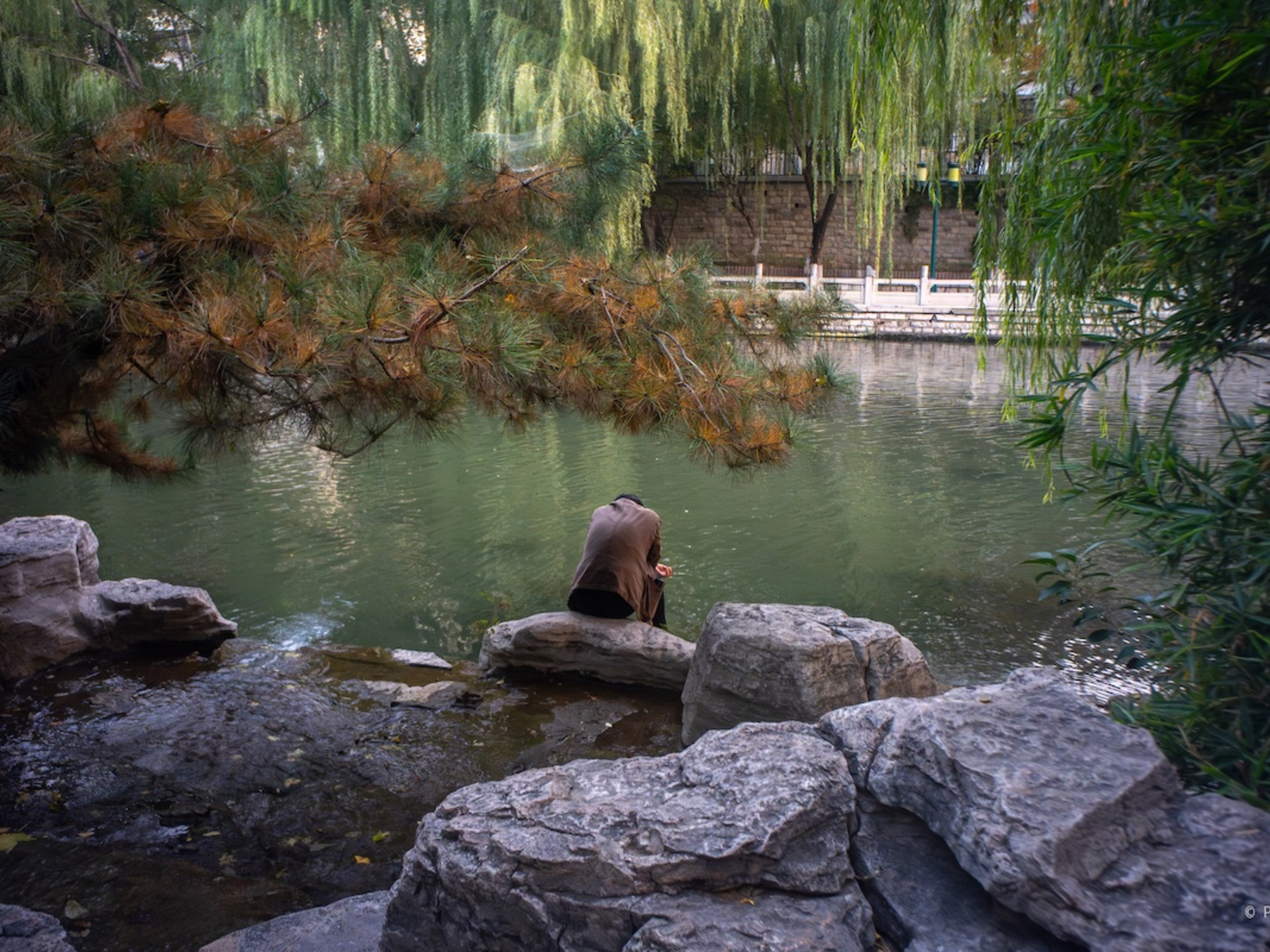
Another new weekend trip! This time, I came to Jinan, Shandong. During the peak of summer, I kept seeing posts about springs in Jinan bubbling up nonstop—so much so that even spring mouths that hadn’t flowed for years started “gurgling” again. Walking through Jinan’s old city, I really did feel that so-called “Little Jiangnan” vibe, and at times I even found myself momentarily thinking I’d arrived in Lijiang.
Later, after looking up some background, I realized that Jinan is also known as one of China’s “software hub cities.” Digging a bit deeper, I found that the well-known Inspur Group was actually born here.
Another Weekend
This is my second weekend city trip. Earlier, at the beginning of the year after pandemic restrictions were lifted in 2023, I spent some time traveling around. By the end of that stretch, I was completely worn out and couldn’t muster any enthusiasm, resting all the way until the May Day holiday before I finally recovered.
This time, the main idea was to simulate what life might look like after a major deadline passes. Beyond that point, I expect to spend a fairly long period drifting between different places around the world—though I’ll probably focus on China first. Beyond wanting to better understand my own country, I also want to take a closer look at the people living across this vast land.
Choosing Jinan this time was entirely because of what I mentioned at the beginning: throughout the summer, I kept seeing stories about many of Jinan’s springs returning to life. Even springs that had been dry for years began to gush again, with water sometimes spilling out onto the streets. I had never really seen springs bubbling up like that. I’d passed through Jinan several times on high-speed trains heading south from Jinan West Station without ever stopping. This time, I decided to properly experience the character of the City of Springs.
Departing from Beijing South Railway Station and heading south, we encountered waves of dense fog just after passing Fangshan. At first, the fog wasn’t too heavy—you could still see hints of blue sky above. As the high-speed train pushed deeper into Hebei Province, the fog grew thicker and thicker. It started as a vague sense of haze rolling in, then distant scenery became unclear, and eventually even the railway barriers outside the window blurred into obscurity. The scene brought back memories of my first trip south to Wuhan at the end of 2016 for a competition—also on a high-speed train, also wrapped in the same kind of fog. The only difference was that back then there was an acrid smell in the air as well. It became so unbearable that I had to sit there wearing a mask, creating a strangely surreal image.
After checking the weather, I realized that every autumn and winter, whenever there’s windless weather without air circulation, this vast stretch of the Hebei Plain inevitably fills with heavy fog. Combined with emissions from numerous industrial zones, fuel use, and burning within the province, scenes like the one I witnessed can appear with very little warning.
Originally, I was quite sleepy after boarding—after all, it was a high-speed train just after 8 a.m. But staring out at the thick haze outside the window, my thoughts slowly began to drift.
Jinan Old City
It was close to 10 a.m. when I arrived at Jinan West Railway Station.
The weather in Jinan was quite pleasant, completely unaffected by the heavy smog that blanketed parts of Hebei. When the weather still hadn’t improved after entering Dezhou, Shandong, I was actually worried that this trip might end up unfolding in thick fog. Thankfully, it didn’t affect Jinan at all.
Perhaps because my recent weekend trips have all been to nearby provincial capitals, I felt that prices in Jinan weren’t exactly low either. To avoid affecting my sleep after a full day of walking, I chose a Nihao Hotel under the Huazhu Group. While it can’t really be compared with the Ji Hotel series, the price still came in around RMB 240, which stung a little. The only consolation was its decent location—about 200 meters south of Quancheng Square in the Jinan old city area. Check-in was immediate, no waiting at all, and after seeing the room, I reached a conclusion: my standards for hotels could probably be set even lower in the future.

Quancheng Square itself is fairly typical—nothing out of the ordinary for a city plaza. There’s the usual square dancing, the equally familiar sunken commercial street, and even matchmaking notices. I took a closer look at those notices: the conditions listed were all quite good, hobbies sounded nice, everyone was young—mostly born in ’92 or ’93—with monthly salaries around seven or eight thousand yuan, and many were in popular professions like civil servants or teachers. The more I read, the more I felt I didn’t quite belong there. Thinking in terms of the traditional idea of “matching social status,” finding a suitable pair these days really does seem difficult.

To the west of Quancheng Square lies Baotu Spring. Walking toward the south gate, you can see from afar how the spring draws in crowds like a black hole—clearly packed with visitors. The ticket costs RMB 40, and overall it didn’t feel expensive. Apart from the small area right around the main spring that was extremely crowded, the rest of the park was fairly comfortable. To attract visitors, large numbers of koi have been released into the water. I’d seen frequent security reminders lately telling people to stop feeding the fish—they’ve grown so fat they can barely swim. As for such a fragile natural landmark that has existed for so long, the Jinan government must be providing significant subsidies to preserve this “Best Spring Under Heaven.” Otherwise, it’s entirely possible that our generation might not get to see it at all.
Baotu Spring Park features extensive classical garden landscaping. Strolling slowly, you’ll unexpectedly come across sunlight pouring onto the lake surface, illuminating the aquatic plants and koi below. That blend of red and green layers the beauty of Baotu Spring across history. I found myself repeatedly sitting by one pond, then another. During this time, I noticed that most visitors seemed unable to truly slow down and “appreciate” what was in front of them. What I heard most were remarks like “Wow, that fish is huge,” “This water is so clear,” or “This view is nice.” I wanted to see what they’d do next with those exclamations, but in reality, people just snapped a quick photo or commented while walking, then moved on.

Thinking back, I realized I’ve rarely had this kind of “passing by” mindset. Maybe it’s because I didn’t travel much growing up, and only began to gradually engage with the real world after university and entering society. Or perhaps others are simply accustomed to such scenes and don’t feel they’re particularly special. To me, though, it feels like a pity. We could have gone further—explored where the beauty comes from, why it’s beautiful, and how it makes us feel. Over time, we’d develop our own way of perceiving and experiencing beauty. Taken further, that’s how a collective or even a national aesthetic emerges.
We do have aesthetics, but they’re often too abstract. On an individual level, most people don’t really know what “beauty” is. I only came to understand it after taking a long detour through photography in recent years, constantly wanting my photos to have more depth and visual appeal. I don’t chase the decisive moment, but I do want a single image to express something—and that requires a perception and understanding of beauty.
There’s a boat pier at Baotu Spring’s north gate. I was puzzled why no one was lining up, until I asked and learned that all boat tickets—from Baotu Spring and even across the entire old city waterways—were sold out for the day. These are boats that run through the old city canals, not the kind found inside parks.
Slightly disappointed, I exited the park. Right across from the north gate is Five Dragon Pool, but I was still savoring Baotu Spring and didn’t want to jump too quickly to another spring. Spotting a very popular Shandong cuisine restaurant nearby, I took a number—only to find that even dining solo meant waiting behind nine tables, likely over an hour. After some thought, I decided to delay lunch and head to Five Dragon Pool first.
Compared with Baotu Spring, Five Dragon Pool has far fewer visitors. While its springs aren’t as bold or dramatic, if you’re not fixated on gushing water and simply want to understand what springs are like, this spot—just across the street—is an excellent alternative.
Inside Five Dragon Pool is a large lake. If you’re not in a hurry, you could easily spend half an hour there with a bowl of tea. I don’t have much interest in tea, and I prefer observing dynamic springs from multiple angles rather than sitting still, so I skipped it. The park is free, and there are many shallow water areas where children can play. The water quality feels far more reassuring than that of water parks or even swimming pools. I saw several kids barefoot in the water, and even smaller ones lying right in it.
That said, Jinan in autumn already carries a slight chill—it’s easy to imagine how lively Five Dragon Pool must be in summer.

I didn’t stay long—less than an hour—mostly because I was getting hungry. The original plan was to casually find a place to eat along the road toward Daming Lake, but restaurants were surprisingly sparse. One place I finally found was already packed; I stood there for a while without any staff approaching, so I left to keep searching. Eventually, I settled on a restaurant that looked relatively upscale and ordered several signature dishes: braised pork (ba zi rou), nine-turn intestines, sweet-and-sour yellow croaker, and milky soup cattail.
In reality, only the braised pork was genuinely delicious. The much-anticipated nine-turn intestines were shockingly bad. I couldn’t tell whether that sweet, funky flavor was authentic or just poorly done. There were nine pieces in a small clay pot—an expensive dish—and I forced myself to eat all but the last one. The final bite nearly made me spit everything out. Safe to say, I won’t be ordering it again. The sweet-and-sour fish arrived with a strange sour smell—almost like foot odor—that lingered even after the server paused for five seconds to ask if I wanted a photo. I’d always thought vinegar had a distinctive, appetite-opening aroma, not this unpleasant sourness.
I did manage to finish most of the food, but paying RMB 291 for four dishes and a bowl of rice left me feeling deeply dissatisfied. If anyone out there can change my mind about Shandong cuisine, I’m all ears—otherwise I may be avoiding it in the future. After leaving the restaurant, my stomach felt unwell—not nausea, but that uncomfortable feeling of having eaten something wrong. Walking around Daming Lake for over half an hour and drinking lots of water eventually helped.
Daming Lake is just a short walk from the restaurant. My initial impression of it had always been limited to the phrase “Xia Yuhé by Daming Lake,” without even knowing its origin. I used to think it referred to a real story involving Emperor Qianlong, but it turns out it was entirely fictional, from My Fair Princess—quite embarrassing.
Daming Lake is indeed large—comparable in size to the Summer Palace, in my opinion. But unlike the Summer Palace, which always feels like a whole event to visit, Daming Lake feels far more approachable, like a casual post-meal stroll.


The lake stretches east to west, with Chaoran Tower at the eastern end, offering views over the city. I originally planned to climb it, but with a visit to Thousand Buddha Mountain scheduled for the next day, I decided against it. Beyond the expansive water, there’s extensive landscaping on land as well. Wandering among pavilions, bridges, and flowing water, it’s a lovely place to walk—though the crowds make it hard to quietly reflect on the lake’s history.
I entered through the south gate, walked a full loop, and exited near the same area, crossing over to Qushuiting Street—the true heart of Jinan’s old city.
This area strongly evokes the feel of a southern water town. Paired with small bars along the road, it genuinely resembles Lijiang, which explains why Jinan is sometimes called “Little Jiangnan.” The further south you go on Qushuiting Street, the more enchanting it becomes. Visiting on a weekday or during the off-season would be incredibly relaxing. Unfortunately, today there were far too many people in traditional costumes doing photoshoots—nearly every decent corner was occupied, making the experience less enjoyable. I can only hope to return at a better time.
Continuing south toward Furong Street brings you to one of the old city’s snack streets—the first I encountered that day. Back in my middle and high school years, I loved snack streets so much that I’d ride over an hour by bus from the suburbs just to eat. Back then, there weren’t many snack streets, and the food reflected regional diversity. Being able to eat Guilin rice noodles in the south felt like a real treat.
By the time I reached university, everything seemed to accelerate. Nearly every city, regardless of size, now has a snack street. That’s not necessarily bad, but over time, they’ve all become identical—no local character, just copy-and-paste.
I understand this as a result of commercialization and market forces. But as a traveler, I hope to experience a city’s uniqueness—especially through food. Cuisine is often the most direct way to feel what makes a place different, and getting that right can elevate the entire travel experience.
I quickly passed through the packed snack stalls of Furong Street, enduring the overpowering smells of grilled squid and stinky tofu, until I reached the moat. Jinan’s moat isn’t as imposing as Beijing’s; instead, it has a gentler charm. If you had to find a similar spot in Beijing, the Liangma River near Dongzhimen comes close. Walking south along the moat eventually leads to Black Tiger Spring. The path there was quiet, with only a few people around. Despite it being late autumn, it didn’t feel cold at all—just comfortably moist in the air. Near the Black Tiger Spring boat pier, though, the crowds returned.

Black Tiger Spring actually consists of three separate springs in the southwest corner of the old city, with Black Tiger Spring itself boasting the largest flow. Water gushes from a small hill behind the outlet at over 400 liters per second, second only to Baotu Spring. What’s more interesting is the number of locals lining up with buckets to collect spring water. The government has even installed QR-code-operated drinking water facilities nearby. I considered filling a bottle myself, but seeing the queues, I gave up.
Black Tiger Spring is highly recommended—its combination of springs and moat creates a landscape entirely different from Baotu Spring or Daming Lake, well worth a visit.

As evening fell, I continued north along the moat and detoured to Kuanhouli, only to find it was yet another snack street. To avoid smelling like squid and stinky tofu again, I quickly found the nearest exit. By the road, I spotted Jinan’s distinctive “flower carts”—tricycles decorated with pink lights and artificial petals, giving the street a Southeast Asian vibe. Looking into it later, I found controversies around illegal operations and overcharging tourists, especially during holidays. While traffic violations are an issue, I don’t fully agree with the other criticisms. If demand remains strong despite bans, perhaps the better approach is to regulate and legitimize them—turning Jinan’s flower carts into a true city symbol rather than extinguishing them. That’s exactly what makes a city unique.
Afterward, I stopped by Jinan Hang Lung Plaza and got to try the iPhone Air. It’s genuinely impressive—the kind of device that makes you want to buy it the moment you touch it. The last time I felt that was with the iPhone 12 Pro series. I even bought an iPhone 12 mini back then, hoping to recapture the feel of the iPhone 4, but returned it after one weekend. Looking back, that feels like a real loss—the mini line is now gone, and worth keeping if budget allows. I also asked, half-hopeful, about the new dual-loop knitted strap for Vision Pro. A staff member initially said it was in stock, which got me excited, but it turned out there was no inventory. On the Apple Store app, delivery now takes a month. The dual-loop strap really is better—less facial pressure than previous designs, and well worth buying.
And with that, my first day in Jinan ended around 6 p.m. I returned to the hotel early. My stomach was still uneasy from lunch, so I bought two cartons of milk and a corn from a convenience store and called it a night.
Thousand Buddha Mountain

On the second day, I originally planned to wake up early, hike Thousand Buddha Mountain in the morning, and head to the museum in the afternoon. I set an alarm for 7:30, but somehow dragged it out until 9 before I even went to eat breakfast, and it was nearly 10 by the time I arrived at Thousand Buddha Mountain. As luck would have it, I ran straight into the Double Ninth Festival hiking event on the ninth day of the ninth lunar month. Compared with Baotu Spring yesterday, the crowd here was several times larger—everyone was jammed onto the climbing paths.
Before the “official” hike begins, the approach road is actually quite wide, but both sides were lined with vendors selling everything imaginable. From what I saw, most were selling mountain goods, local specialties, and folk handicrafts—honestly far more interesting than wandering a snack street. There was even a troupe performing something that looked very much like a model opera, with a sea of uncles and aunties sitting below. It felt a bit like the rural northern village stages I’d imagined—people gathered to watch a show.
Before you start climbing in earnest, you pass through an extra ticketed inner attraction called “Four Caves, Ten Thousand Visions.” Of China’s four great grottoes, I’ve visited all except the Maijishan Grottoes, and even so, I still think this one is worth it. “Four Caves, Ten Thousand Visions” is like a highly condensed presentation of the essence of Chinese grotto and stone-carving culture. Some pieces are 1:1 reproductions, others scaled—big and small, heavenly and earthly, everything you could want. If you’ve never experienced grotto art before, or never seen the real “four great grottoes,” you should come here even more—it’s a perfect place to build a first impression, and it will absolutely leave you stunned.
Also, I originally thought it would just be a short stretch—walk in, walk out, done. But once inside, I found myself exclaiming along with everyone else: “Huh? There’s more? You can go even deeper?” I heard that in summer, the temperature inside the caves stays at 18°C, and you can rent a blanket at the ticket counter before entering. Just imagining that felt exciting.
Thousand Buddha Mountain is one of Jinan’s three major scenic attractions. It isn’t tall at all—so easy to climb you barely need to lift your heels. But there were simply too many people. And since the summit area itself isn’t large, once you reach the top there isn’t much space to pause and really take in the view. In ancient times, people would climb high and look far, and their hearts would feel open and refreshed. Today, when we climb high and look far, it’s all noise and crowds—hard to find an environment where you can truly settle down and feel anything. Still, the skyline of Jinan’s CBD off to the northwest did look quite good. Only after I got home and looked things up did I realize Jinan is actually known as one of China’s software hub cities. And when I looked closer—turns out the famous Inspur Technologies was born in Jinan, and there’s even a road named “Inspur Road.”

By the time I reached the top, it was almost noon. I wasn’t that hungry yet. After weaving left and right through the endless stream of people still trying to climb up, I finally made it onto a ride to the Shandong Museum just after 12. I didn’t expect Jinan’s weather to be too good lately—so many people were out, so many cars on the road. I got in the car just after 12, yet it was nearly 1 p.m. by the time I stepped into the museum. I could only speed up my visit.
Museum
The moment I entered the Shandong Museum, I was stunned. The soaring atrium design creates a grand, monumental “Shandong” impression. Embedded high up on the ceiling—four or five floors above—was a massive version of the museum’s signature treasure: the large Lu-state jade bi disc. Later, after seeing the actual jade bi disc on display, I realized the one in the ceiling must be hundreds of times larger than the real object. It was genuinely overwhelming.
Maybe I still hadn’t fully stepped out of last week’s visit to the Hebei Museum, because after arriving at the Shandong Museum, the exhibits and curatorial approach felt comparatively ordinary—almost “normal.” After seeing several of the museum’s headline treasures, I didn’t feel that same shock or sense of exquisite craftsmanship; some even felt a little like they were there just to fill space. But looking back now and reconsidering the Shandong Museum’s curation and collections, I still have to say it’s a top-tier museum: richer exhibition resources than the Hebei Museum, three floors with 15 exhibition halls in total—nearly double Hebei’s nine. And at the time, I was fixated on seeing only the highlights, constantly worried about not missing my high-speed train back to Beijing. I skimmed past a lot of exhibition text without really reading it. In the end, I spent only about an hour covering a few key halls, and I didn’t even have time for many interesting temporary exhibitions.
Next time, I need to set aside at least half a day—maybe more—for a provincial museum. I absolutely can’t rush it like I did this time.
What’s even funnier is that I rushed through the museum, and when I came out, it was only around 2 p.m. I figured I might as well head to the nearby MixC, eat a proper lunch, then go to the station. I wandered around, searched as I went, and eventually ended up having Coucou Hotpot—plus I even chose the all-you-can-eat set. I ate while waiting for the dishes, then slowly worked through fruit and scrolled on my phone. By the time I paid and left MixC to grab a taxi to Jinan West Station, I saw the estimated time was 51 minutes—and my brain just blanked. It was 3:10 p.m. At that point I hadn’t even reached the roadside pickup area yet. Even if I got into a car immediately, I’d have only 19 minutes left upon arrival to clear security and boarding—and if traffic got any worse, I’d miss the train outright.
Once in the car, I made the call on the spot and rebooked. I pushed it back by 40 minutes and was forced to pay an extra 100 yuan for first class just to fix the situation. In other words: I didn’t get to enjoy the museum properly, I ate in a panic anyway, I messed up my schedule, paid more, and got home later. After all that, what was the point? I should’ve just gone straight from the museum to the station and eaten there. Even more absurd: the entire second floor of Jinan West Station is basically food—no lines. From finishing security to sitting down takes five minutes.
Sitting on the high-speed train back to Beijing, I reflected on the chaos and came away with a few lessons. First: don’t try to cram too much in. A weekend trip is barely a day and a half—already tight. If you insist on seeing this, doing that, hopping back and forth, it’s easy for things not to connect, and then everything after gets affected. Second: if you’ve decided to go and see something—then in that moment, you should be steady and grounded. Look carefully, think carefully. Stop worrying about what comes next. Worst case, you handle what’s in front of you well, and you let the rest go. If you’re doing one thing, then do it well.
Lastly: my sense of risk control still wasn’t strong enough. I always push risks to “later.” Sure, sometimes thinking too far ahead is useless—but for something that’s going to happen in just a few hours, it’s still good to plan ahead a little.
Conclusion
Jinan really is a good place. Compared with Shijiazhuang, I personally find it more livable: it has water and mountains, culture and history, depth and character. It even boasts high-tech industries that many cities envy. Most importantly, the overall quality of the population feels higher—after all, this is the provincial capital of a region where Confucian and Mencian thought has long flourished.
My original plan for this area was to climb Mount Tai first and then come to Jinan, but arranged that way, years went by without it ever happening. No matter how you slice it, that kind of itinerary needs at least two full days, which actually fits my idea of a weekend trip quite well.
Setting aside Qingdao and Weihai, this is already my third city in Shandong. Who knows when I’ll next make a dedicated trip to the province again. I’ve talked with a few friends about it—this recent stretch of travel marks what I see as my third phase. The first phase began in 2023, after pandemic restrictions ended. It was also mostly weekend trips, sometimes taking an extra day off, focusing on classic, well-known cities around Beijing—Datong, Hohhot, Luoyang, Dalian—specifically to see historical sites. The second phase started in 2024 and continues to this day: traveling abroad, taking bigger steps, wanting to personally experience different cultures, different narratives, and different people and stories.
Now I’ve reached the third phase. After going through the first and second phases, I haven’t grown tired—on the contrary, I feel even more curious about the world around me. I want to pay attention to ordinary people and small things, to go to smaller places—places like Jixian near Tianjin, Nanchang, or Kashgar—less famous than some of the cities I’ve visited before. This phase will continue for quite some time, and if opportunities arise, I’ll go to even more small places.
Beyond that, there’s a fourth phase I want even more. I want to walk freely across the land of China. There’s a book called China on the Earth, a landmark work of travel literature. In 1986, its author Paul Theroux traveled by train through more than twenty provinces and cities in China, recording what he saw and experienced, presenting the social changes of China in the early years of reform and opening up. I’d love to do something similar—but I don’t want to approach it from a grand, sweeping perspective. I just want to see the big figures and small figures living on this red earth, to visit these cities, large and small.
I don’t know when that day will come—but I have a feeling it might not be too far away.
Leave a Reply