Taking advantage of the long weekend at the end of April, I made a trip to Nanchang and Ganzhou. Jiangxi had never really been on my travel list before. It wasn’t that I was put off by those online jokes about the province being “surrounded by a ring of development,” but rather that I simply didn’t know much about it—enough to never feel the urge to explore.
The turning point came late one night while scrolling through videos. It showed a humble eatery tucked inside an old residential compound in Nanchang—just a few tables set out in the open, with two aging standing fans creaking away. On screen, the host mixed a bowl of rice noodles. Maybe it was the lighting, or maybe the seasoning had some secret to it—the noodles, coated in sauce, glistened under the light, with slices of pork stomach and chopped scallions scattered on top. As someone who loves mixed noodles, I could almost smell it through the screen. I dug a little deeper and realized that Jiangxi stir-fries weren’t all as “insanely spicy” as rumored. Plus, after over a year of “training” from my girlfriend from Hunan, I had gained some confidence in my spice tolerance.
That moment was all it took for me to decide—I had to go and taste it for myself.
Day 0: Comfort in a Late-Night Arrival
\With limited vacation days like any office worker, I took an evening high-speed train from Shenzhen, arriving in Nanchang well past 11 p.m. It had just rained, and the air carried a cool breeze mixed with the earthy scent of damp soil. On the taxi ride to the hotel, we couldn’t wait and ordered delivery: two bowls of mixed noodles and a jar of egg-and-minced-pork soup.
By the time the food arrived, the noodles had clumped a bit, but after a few vigorous stirs, they regained a soft, chewy texture. The peanuts were glossy and crunchy, the pickled radish added a sharp kick. I chose the pork stomach version—the meat was tender, not exactly mind-blowing, but for a travel-worn night, it hit the spot. The soup, with its fatty pork patty slowly simmered into the broth, offered a warm, comforting sip that balanced out the direct spiciness of the noodles.
Day 1: Freshly Stir-Fried Toppings, Museums Between Eras, Tengwang Pavilion, and Wanshou Palace
We slept in the next morning. As forecasted, a fine drizzle hung outside the window. After a quick wash, we headed to a nearby noodle shop to try freshly made versions.
The moment we stepped in, the temperature inside felt several degrees warmer. In the corner, a cook was stir-frying toppings over high heat, waves of hot air rolling toward us. I ordered beef brisket mixed noodles, while my girlfriend chose minced pork, and we added a jar of peanut pork rib soup as usual.
Freshly made beef brisket noodles were on another level. A quick toss with chopsticks and the pale noodles at the bottom were instantly coated in thick, oily sauce, turning a deep, glossy brown. One big slurp and the aroma of scallion oil and soy sauce surged upward. The brisket leaned toward the leaner cut—tender without being tough—its braised flavor blending with the rich, slick noodles in a way that felt layered and satisfying, far beyond the delivery version. My girlfriend’s minced pork noodles were just as addictive.


In the afternoon, we visited the art museum. What left the deepest impression on me was a crossover exhibition combining ceramic craftsmanship with the Dunhuang Mogao Caves. Buddhist figures were fired onto ceramic tiles, and when artificial light shone from above, the kiln-fired texture gave the Bodhisattvas a kind of frozen, tactile presence. The roughness left by the kiln fire added a sense of weight—more “lived-in” than painted figures on paper. I couldn’t help but wonder: if artisans from over a thousand years ago saw this fusion today, they’d probably find it fascinating.


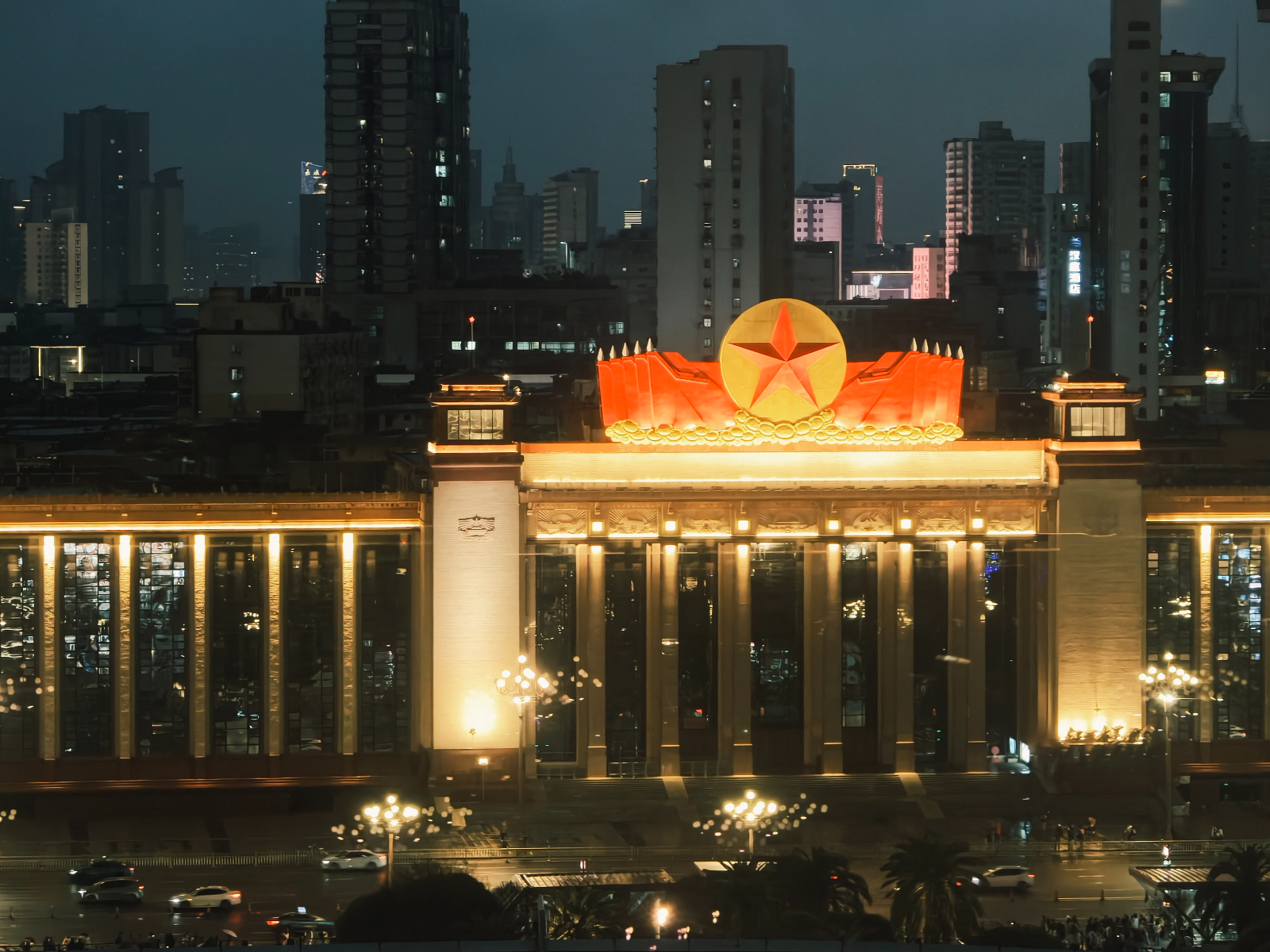
The museum building itself was also worth noting. Completed in 1969, it blends Soviet-style architecture with Chinese elements like a “mountain”-shaped layout and pavilion-like roofs with extended eaves. Taking the elevator up from the metro entrance, watching the iconic red star on the rooftop gradually emerge from behind the eaves felt like a cinematic long take.


The following museum offered a concise overview of Jiangxi’s history, including the origin of its name—derived from “Jiangnan West Circuit.” Over the next few days, I would come to feel the blend of orderly Song dynasty architectural aesthetics with the everyday warmth and the lingering charm of misty Jiangnan.
We returned to the hotel around 4 p.m. to rest. Two hours later, the rain stopped, and a few rays of sunset broke through the clouds, casting light over the monument and the gradually illuminated museum.
We found a quiet spot a few hundred meters from Tengwang Pavilion. From afar, the wooden structure’s joinery was clearly visible, with the Gan River and modern buildings across the bank forming a dialogue between past and present. Today’s pavilion is nothing like it was over a thousand years ago—but I found that acceptable. Even with an elevator installed, a hundred years from now, it will still be a historical structure—just one with an elevator. Looking up at it from below, its imposing grandeur suddenly made me understand how Wang Bo could write such majestic lines. The colorful lighting, however, felt a bit tacky—warmer tones might have suited it better. Since I couldn’t recite the “Preface to Tengwang Pavilion” to get free admission, I reluctantly skipped going inside, circling around instead, with a hint of regret over the ticket price.

We then headed to Wanshou Palace. The area has been commercially developed, with lights and crowds intertwining, yet it hasn’t lost the charm of an old city. Passing by a small building, we noticed a performer sitting by a second-floor window, veiled lightly, playing the erhu with lowered eyes. The melody drifted down into the street, unexpectedly clear amidst the noise, like a fine thread tugging gently at the heart. Some people stopped to listen, others raised their phones, while some simply stood quietly. That bright, lingering sound softened both the body and mind—reminding me that beyond its bold, fiery flavors and lively street life, Jiangxi also holds a gentle, flowing grace.


Too tired to go out again that night, we ordered delivery once more. A few dishes stood out:
Braised beef brisket with fried eggs: the egg’s surface puffed into airy pockets, soaking up the rich meat broth—an absolute rice killer.
Spicy bullfrog: chopped into small pieces, paired with pickled chili and perilla leaves, tender and aromatic. For me, as someone from Guangdong, the spice level was just at the edge of my tolerance—but the combination of heat and sweetness made it hard to stop eating.
Finally, a plate of blanched baby bok choy with hot oil rounded out the meal perfectly, balancing the richness of everything else.
Day 2: An Oasis Hidden in Living Neighborhoods, Ancient Temples, and Alleyways
The rain finally stopped on our second day in Nanchang. To avoid the crowds at major tourist spots, we chose Beihu, about a twenty-minute drive from Wuyi Square. Getting off at Dunzitang Station, we walked south along the lake before turning west, entering an area closely tied to local residential life.
Beihu turned out exactly as I had imagined—not a famous scenic destination, but more like a small lake woven into the city’s fabric, reminiscent of Shichahai. There were no overly curated landscapes; the shoreline sat right next to apartment buildings, and every few steps you’d pass a modest café. These places didn’t try to stand out too much from the old neighborhood—they blended in naturally. We passed a Jiangxi-style restaurant tucked inside a courtyard; even before stepping in, the aroma of stir-fried dishes drifted out. A few tables were scattered in the yard, and the ground floor had been opened up into a dining space. Unfortunately, we had just eaten and had to give it a miss.


A parked electric scooter by the roadside caught my attention. Nestled inside the wind cover at the footrest was a small cat, curled up peacefully. It wasn’t clear whether its owner had placed it there or it had climbed in on its own. The zipper had been thoughtfully pulled halfway, leaving a small opening for air. When we leaned closer, it didn’t move away—just stretched lazily into a more comfortable position and continued its afternoon nap.
Walking further, traces of everyday life became rougher yet more real. There were street vendors selling fruits and vegetables, and open communal spaces where people came and went freely. In an area called “T16 Oasis,” teahouses, book cafés, and small shops gathered together. It’s not somewhere worth traveling across cities to visit, but for locals, having a place to stroll and chat with friends like this is a very tangible kind of happiness.
Passing by Youmin Temple near Beihu, we didn’t have time to go inside and only paused briefly outside the walls. Beyond the temple walls, traffic and street vendors’ calls rose and fell, while the faint scent of incense drifted gently into the air. The temple sits hidden within the bustle of the city, surrounded by noise, yet it carries a quiet, weighty solemnity. That contrast—ancient architecture wrapped in modern life—creates a peculiar sense of calm. If I return, I’d definitely go in and sit for a while, to experience the stillness of the birthplace of Hongzhou Chan. It would probably form the perfect counterbalance to Jiangxi’s rich and spicy cuisine.
Our final stops were Dashiyuan and Hamma Street. You can think of them as Nanchang’s version of Taiping Street or Shangxiajiu. While the products can feel somewhat homogeneous, it remains the most convenient place to pick up souvenirs before leaving, or to grab a portion of boiled street snacks on the go.


At noon before departure, we finally found an authentic hole-in-the-wall eatery.
- Braised chicken feet with soybeans were the first pleasant surprise. The beans were soft and tender, and the chicken feet had been stewed until rich with gelatin, falling off the bone at a touch. The chili aroma had long seeped into the bones. The thick, glossy sauce was perfect over rice—this was the real definition of a “rice killer.” The chicken feet themselves tasted clean and fresh.
- The fermented black bean yellow croaker was the owner’s recommended signature dish. A spoonful revealed tender, flavorful fish, and when dipped into the soy-based black bean sauce at the bottom, the savory richness clung just right. It melted in the mouth, more delicate than expected.
- The third dish, stir-fried water spinach with garlic, was my insistence as someone from Guangdong—a touch of green on the table. However, the cooking was slightly rushed, leaving a faint raw edge to the flavor.


Day 3: Song Dynasty Relics, a Sichuan Restaurant, Climbing Towers and Wandering Alleys
By the time we arrived in Ganzhou and checked into our hotel, it was already close to 9 p.m. We ordered some barbecue nearby—reasonably priced, but the taste was underwhelming, so I won’t dwell on it.
Out of habit, I checked the weather forecast. March and April are the rainy season in Jiangxi, and it seemed our entire stay in Ganzhou would be accompanied by rain. But since we were already here, we decided to stick to our original plan.
Our first stop was the Confucian Temple in the old city. There were very few visitors. Red walls, yellow tiles, and ancient cypress trees created a quiet atmosphere that made you instinctively lower your voice. Standing in front of the Dacheng Hall, I suddenly remembered how anxious I used to feel before exams as a student. Before my high school entrance exam, I once passed by a church near my school and saw a priest praying for students. Now, looking at these young faces here praying for blessings, I felt a mix of emotions: the ancients prayed for official success—what are we seeking today? Though the forms of belief differ, whether it’s Gothic spires or traditional glazed tiles, they all seem to quietly hold a sense of compassion for the human condition.


Looking up through the trees, I spotted the nearby Ciyun Pagoda—a Song dynasty brick tower standing quietly within a primary school campus. Past and present overlap like this, and somehow it made me feel at ease: some things, even after a thousand years, still remain embedded in everyday life.

Leaving the temple and walking through a residential area, the sky cleared. Bougainvillea blooming from corners and balconies stood out vividly. A few steps further, the Song dynasty city wall stretched along the Gan River. Walking on the wall, what struck me most were the bricks—inscriptions from the Northern Song to the Republican era still clearly visible. Running my hand over them, the rough texture felt real, like flipping through a living history book, with the weight of time pressing in.


Following the wall northward, we reached Jianchun Gate. Looking down from the wall, an ancient pontoon bridge spanned the river—over a hundred wooden boats linked end to end. From above, the structure felt even more striking than from the bridge itself. Walking across, the wooden planks creaked underfoot, with pedestrians passing by. This floating bridge, in use for over 800 years, still connects both sides of the river—a living relic that has never been confined to a museum.

Shouliang Ancient Temple and Zao’er Alley were also within walking distance. Zao’er Alley is only a few hundred meters long but connects to many narrow side alleys, lined mostly with Ming and Qing dynasty buildings. Unfortunately, preservation and revitalization here seem to be struggling. Many old houses stand empty, their doors locked with warning signs of structural danger, with only a handful of restaurants still operating.


Lunch hadn’t been planned. By the time we reached the Standard Clock area, it was nearly noon and the air had turned warm, so we decided to eat nearby. A restaurant at the street corner caught our attention. Its black-and-gold sign read “Bobo Sichuan Restaurant” in both Chinese and English. With a red awning and arched glass doors, its design echoed the blend of Chinese and Western styles from the Republican era. Inside, the décor centered around wood elements, with several round tables arranged around a glass-covered courtyard. A tree stood in the middle, with natural light filtering down, complemented by warm indoor lighting, creating an intimate atmosphere. Through a side window, we could clearly see the chefs at work in the kitchen.
- The tomato scrambled eggs followed the classic sweet-and-savory style, perfect with rice.
- The stir-fried pork kidney and fresh stir-fried beef shared a similar base flavor, rich with scallion aroma and Sichuan pepper notes that boldly awakened the palate. The beef was tender, and the scored pork kidney carried no off-flavors—both dishes were executed cleanly and skillfully.


After a short rest at the hotel in the afternoon, we took bus route 1314 to the Song Dynasty Night City. The bus itself had a thoughtfully designed retro style, and the fare was affordable.
The Song Dynasty Night City sits at the confluence of three rivers. Broadly speaking, the Jiangnan Song City scenic area includes sites such as Junmen Tower, Yugutai, and the Hakka Compound. By the time we arrived, it was already evening, so for safety reasons, we focused on the streets behind Junmen Tower and Yugutai.

That night, we visited Yugutai. Standing below and looking out at the Qing River flowing north, I suddenly felt a sense of emptiness. I only remember the first half of Xin Qiji’s line—“Below Yugutai flows the Qing River, carrying countless tears of passersby”—but that feeling of inevitability, of “the green mountains cannot stop the eastward flow,” strangely contrasted with my own spontaneous trip here as an office worker. The river, blurred after the rain, carried a hazy sense of age and melancholy. I may not fully grasp the historical weight of ancient worries, but that sense of time spanning centuries hit me squarely in the chest. Missing the chance to see it under clear skies was a bit of a regret.

For dinner, we chose a restaurant converted from an old courtyard near Yugutai Park.
- The freshly simmered pear dessert soup was light, cold, and refreshing, paired with glutinous rice balls—a perfect way to cool down.
- The sizzling small yellow croaker, cooked in a clay pot with garlic and shallots, resembled Cantonese “jue jue” cooking. The fish was tender, though my girlfriend noted a slight fishy taste.
- The abalone and chili stir-fried pork, priced at 68 RMB, was not cheap by local standards, mainly due to the addition of abalone. The fatty pork combined with the chewy texture of abalone made for a richer mouthfeel than the usual version—whether this pairing feels excessive or not depends on personal preference.


Day 4: Bajing Park
On our final day in Ganzhou, the sky was overcast, but at least it didn’t rain. We took the opportunity to complete our walk along the Song dynasty city walls, starting from Yongjin Gate and making our way to Bajing Park.


Climbing up Bajing Terrace, we found ourselves at the confluence of the Zhang River and the Gong River, which merge here to form the Gan River—an extremely significant geographic point. Looking out from above, the rippling patterns where the two rivers met were clearly visible, giving a tangible form to the joys and sorrows described by ancient writers. Walking through Bajing Park, the gloomy sky actually deepened the rich, inky greens of the water and trees. One or two stone arch bridges stretched across the scene, like bright accents in a dark-toned painting, perfectly guiding the eye. Unfortunately, the rain soon picked up from a drizzle to a downpour, and we couldn’t linger long, forced to turn back in haste.


Our final meal was settled near our accommodation. The fermented rice dumplings carried a clean, mellow aroma without any harshness; the duck tongues were intensely spicy, while the tofu soaked up the rich, savory broth; the Ai Mi Guo was filled with pickled vegetables, cured meat, and dried tofu—distinctly local in character; and the home-style fried rice noodles stood out for their wok hei, brought out by scallion oil, eggs, and chili. After finishing this meal full of everyday warmth and flavor, we set off for the high-speed rail station.


Travel Notes: Clothing, Accommodation, and Photography Tips
Clothing Suggestions
In early April, Jiangxi has a mild climate. On days without rain, daytime temperatures can reach around 28°C, while at night or during temperature drops, it can fall below 20°C. A short-sleeved shirt paired with a light jacket and jeans is enough to handle the weather.
Accommodation Reference
For this trip, we chose Atour hotels in both Nanchang and Ganzhou. They are considered mid-to-high range locally, but compared to first-tier cities, the cost-performance ratio is still excellent. Both properties were relatively new, and the service was solid. However, the breakfast offerings were somewhat less impressive than what I had experienced in other cities. If you want to explore local flavors, it’s better to head to small street-side breakfast spots—you’re more likely to find pleasant surprises.
Photography Gear and Experience
Since most of the itinerary involved walking and wandering, I didn’t plan to bring a dedicated camera. Coincidentally, the vivo X300s had just been released, so I borrowed a unit from a colleague at SSPAI to try it out during the trip.


Compared to the previously used X100 Ultra, the camera module on this model is less bulky and easier to carry, reducing the overall burden. Fortunately, its telephoto performance remains solid. Throughout the trip, I used its “Street Photography” mode to document everything. Here are a few observations:
- Image characteristics: Compared to the standard mode, the Street mode applies lighter computational processing. It enhances contrast between light and shadow while preserving sufficient detail in both highlights and darker areas, avoiding the overly smoothed, “plastic” look.
- Filter preferences: I mostly stuck with the “Textured” and “Negative” presets. These come with a film-like grain and soft glow. During shooting, slight adjustments to saturation and exposure are enough to create a strong personal style. Even without post-processing, the images look very pleasing.
- Accessory expansion: When paired with the official photography kit, you can also use a teleconverter lens. This allows the phone to remain usable even at hybrid zoom levels of 200x or 400x, making it easier to capture distant subjects or architectural details outdoors.


Conclusion
What started as a spontaneous trip driven by a craving for bold, spicy flavors turned into a journey through layers of time. In Jiangxi, the boundary between past and present feels blurred: the poetry found in ancient texts is now wrapped in the rich, oil-heavy, and spicy rhythms of everyday life. The temples I didn’t visit, the small eateries I haven’t yet tried, and the parks left unexplored—all of them have become reasons to return.


Except for the phone appearance photos at the end, all travel images in this article were taken with the vivo X300s.
Leave a Reply