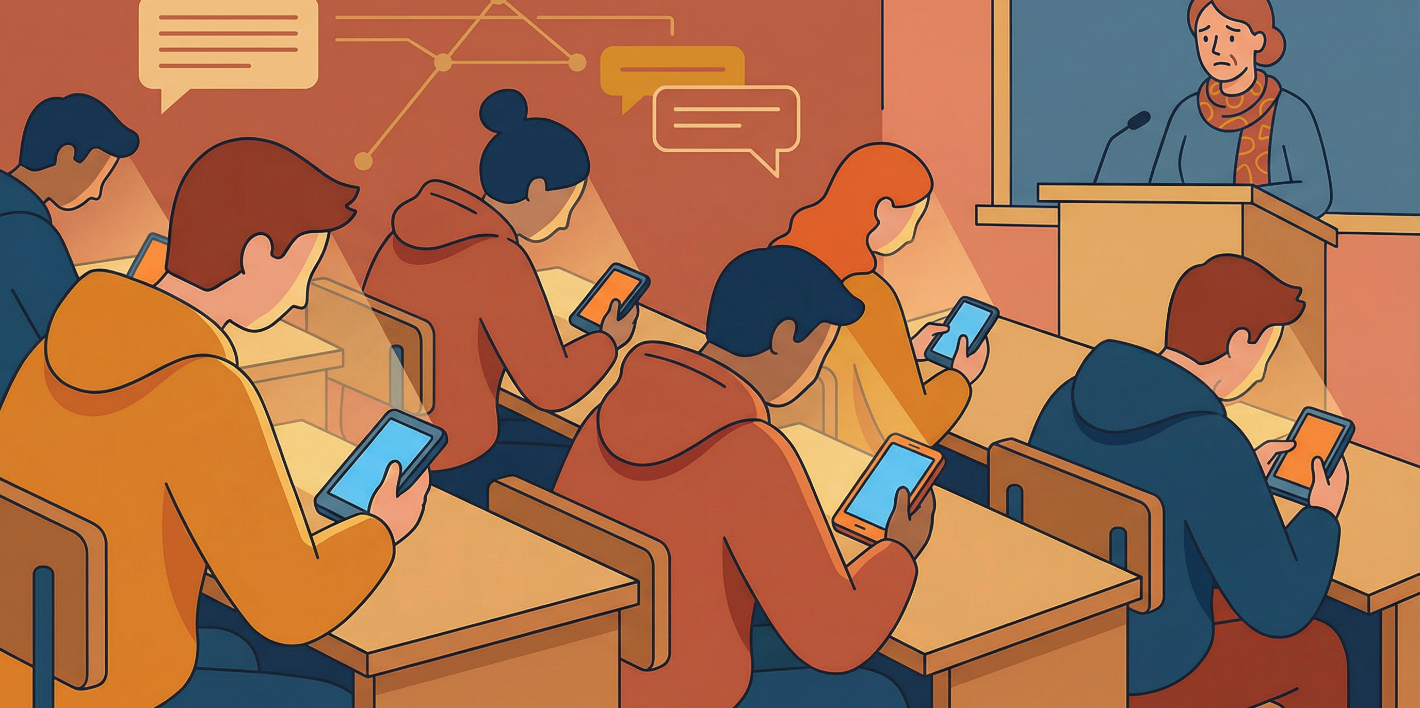
Looking Down
Today, I want to talk with you about a topic that causes a quiet ache—sometimes even a sense of frustration—for all university instructors, whether you’re a newcomer who has just stepped onto the podium or a veteran with twenty years of teaching behind you.
You’re standing at the lectern. You’ve carefully prepared your slides. You’ve just reached the point you believe is the most exciting, the concept that should spark a reaction. You lift your head expectantly and sweep your gaze across the room, ready to meet those looks of sudden understanding.
But there aren’t any. What you see is a sea of bowed heads. Worse still, that usually well-behaved student in the front row has tucked their phone inside the textbook, fingers swiping at full speed; a few guys in the corner have screen glow lighting up their faces, more focused than they ever look when listening to you; even those who seem to be taking notes stare blankly, as if they’re merely transferring text from the slides to their laptops, their minds already checked out.

In that moment, your emotions are probably all mixed together. Is it anger—how can this generation be so disrespectful? Is it disappointment—maybe I’m not teaching well enough; maybe I can’t compete with short videos? Or is it resignation—the sense that this is just the environment we’re in now, and no one can change it?
In fact, this isn’t just your predicament. It’s a shared pain point for educators around the world. But today I want to offer you a conclusion that may feel a bit counterintuitive: students looking down is not because they’re lazy, lacking self-control, or disrespecting you; nor is it because your lecture isn’t engaging enough.
The root cause is that our traditional classroom, as an attention system, has its parameters set incorrectly. Within this system, “looking down” is an inevitable, stable Nash equilibrium.
As long as the system’s parameters remain unchanged, no matter how angry you get, how earnestly you plead, or how much you perform a one-person show during those 45 minutes—so long as that equilibrium exists, students will instinctively slide toward the state that feels more comfortable for their brains: looking down.
In this article, I want to take you through this classroom system the way we would dismantle a complex engineering problem. We’ll think in terms of system redesign and use three concrete “knobs” to shift the classroom’s equilibrium—from “looking down” back to “looking up.”
Misreading
When we see students looking down, our first instinct is often to blame individual character. We think, “This class has a bad attitude.” And so our countermeasures usually revolve around control: stricter roll calls, forcing students to hand in their phones, or suddenly raising our voices to jolt them awake.
Or we turn the blame inward: “Am I just too boring?” So we try to turn the class into a stand-up routine—cramming in jokes, performing at full throttle, hoping sheer intensity will wrest attention back.
Unfortunately, these conventional fixes rarely work—and often backfire. Strict control can create opposition, turning students into “defensive look-downers”: to avoid being singled out, they bury their heads even lower, pretending to read while mentally shutting the door. And trying to out-entertain smartphones with “better lecturing” is a battle doomed from the start. Remember: the recommendation algorithms behind those phones are dopamine traps engineered by thousands of top engineers and tens of thousands of servers. How could you possibly defeat that in a one-on-one, flesh-and-blood showdown?
The more painful truth is this: the traditional lecture-based classroom is rewarding looking down. Why? Think about the core task in a typical lecture. Students are supposed to listen and take notes. That’s a one-way input process. The brain is in a low-energy, receptive mode. If, at that moment, a source appears that offers higher frequency, more immediate, and more intense stimulation—like a smartphone—the brain will almost instinctively choose it. If listening to a lecture is passive, and scrolling a phone is also passive, why not choose the one that feels better?
This isn’t a moral failing. It’s biology.
There’s also a subtler trap we need to watch out for. Many instructors think that as long as students aren’t on their phones and are staring at their laptops typing notes, “head-down” is no longer a problem. Wrong. As early as 2014, Mueller and Oppenheimer showed in their well-known study The Pen Is Mightier Than the Keyboard that students who take notes on laptops often fall into a state of mindless transcription. Like typewriters, they record every word they hear, feeling productive because they’ve captured everything—yet their brains never engage in deep processing. This kind of “mechanical looking down” is an even more deceptive form of pseudo-learning. They look busy, but they’re still not truly “online.”
So the “looking down” we need to address actually consists of three fundamentally different system states:
The first is screen-driven looking down: the classroom’s return on attention per unit time is lower than that of a phone, so attention drifts naturally.
The second is mechanical looking down: the classroom rewards recording rather than thinking, and students choose low-energy transcription.
The third is defensive looking down: the interaction cost in class is too high (for example, fear of being mocked for a wrong answer), so students lower their heads to avoid social risk.
None of these problems can be fully solved by “teaching more brilliantly.” They all point in the same direction: a design flaw in the classroom system.
Without redesigning the system, we’re pitting our bodies against the laws of nature. How good do you think our odds are?
The Vulnerability
Before prescribing a cure, we have to get the diagnosis right. Why is our classroom system so fragile—so easily defeated?
Here’s a brutal downward-spiral model you may never have consciously noticed.
First, the physiological decay of attention. Research by Bunce and colleagues shows that in lecture-based settings, as time passes, the likelihood of mind-wandering increases while memory retention declines. Without intervention, by the middle to later part of a 45-minute class, students on average drift off every 3–4 minutes.
At that point, the externality of digital devices enters the scene. This isn’t just about students actively using their phones. More troubling is that the mere presence of a phone is itself distracting. A 2023 UNESCO report synthesizing data from 14 countries found that even when a phone is simply lying on the desk, its “mere presence” consumes cognitive bandwidth—because the subconscious must devote effort to suppress the urge to “just take a quick look.”
And looking down is contagious. An OECD 2024 report (Students, Digital Devices and Success) offers a striking statistic: 59% of students said they were distracted because they saw classmates using devices nearby. This is a negative externality. Once one person in the room starts looking down, the cost of staying focused rises for everyone around them. More students then give up resisting and join the downward gaze.
Finally—and most painful for teachers—the negative feedback loop of teacher–student interaction.
This is truly a tragic closed loop. As early as 1993, Skinner and Belmont identified this pattern: the less engaged students are (heads down, silent), the harder it is for teachers to receive positive feedback. Think about it—when you throw out a joke and no one laughs, ask a question and no one responds, doesn’t your enthusiasm cool instantly? You unconsciously reduce interaction, speed up your delivery, and just want to get through the material. And the more you retreat into “reading from the script,” the more students feel the class is dull—and the lower their heads sink.
This is our current reality: lecture mode leads to attention decay → phones provide a low-cost escape → peer effects accelerate collapse → teachers and students “discourage” each other.

The system is now locked into a low-head equilibrium. To break out, will patchwork fixes suffice?
It has to be rebuilt.
Rebuilding
How do we rebuild? The core principle can be summed up in one sentence: we must turn the classroom from an information input field into a thinking workflow. By adjusting three system-level “knobs,” we can fundamentally change the game rules of the classroom. These three knobs are: output density, device friction, and feedback visibility.

Let’s look at them one by one.
Output
If pure “input” (listening) can’t fully occupy students’ cognitive bandwidth, then we use output to fill it up.
Active learning works not because it’s fun, but because it forces presence. Freeman et al.’s landmark meta-analysis published in PNAS—Active learning increases student performance—provided hard evidence long ago: the failure rate in traditional lecture classes is 1.5 times that of active-learning classes.
What we need to do is break a long 45- or 90-minute session into a series of 10–15 minute micro-cycles. The endpoint of each cycle must never be “the teacher finished explaining,” but rather “the students produced something.”
You need to build a library of high-frequency output modules. Think of them like LEGO bricks you can snap into the gaps of your lecture at any moment.
For example, the simplest one: predict–verify. Before revealing an experimental result or completing a formula derivation, pause and ask students to write down their prediction: “Which way do you think the curve will go next?” or “What effect will this parameter change have?” Give them 60 seconds—they must write it down. The moment the pen moves, heads naturally lift. Because the explanation that follows is no longer irrelevant noise; it becomes the “answer reveal” that confirms whether their prediction was right or wrong.
Another example, designed specifically to combat mechanical looking-down, is the one-minute retrieval. After explaining a complex concept, don’t ask, “Does everyone understand?”—that’s a useless question. Instead say: “Alright, close your laptops. Without looking at your notes, take one minute to write down the three key elements of the concept we just covered.” You’ll see students who were previously typing at full speed suddenly freeze, brows furrowed. This is the moment when real learning begins.
There’s also error dissection. Put a typical incorrect solution directly on the screen and ask: “At which step is this wrong? And why?” This kind of fault-finding task excites the brain far more than deriving everything from scratch.
All these activities share the same traits: low threshold, low risk, fast feedback. Don’t design big projects that require half an hour of discussion. Stick to micro-tasks that can be completed in 30 seconds to two minutes. They act like speed bumps, forcibly interrupting students’ inertia toward their phones and guiding attention back to the act of thinking in the present moment.
Friction
I know many teachers struggle with the question of whether to ban phones. Ban them, and you worry students will resent it—or even file complaints. Don’t ban them, and watching the situation unfold can be infuriating.
Let me share something from my experience sitting in on classes as a teaching supervisor: I’ve personally seen students dutifully hand in their phones at the door—only to pull out an iPad mini, prop it up on the desk, and carry on. In fact, a 2025 study by the LSE (We Shouldn’t Ban Smartphones) offers a very smart alternative: for adult students, instead of imposing bans, use guided use.
Your goal isn’t to turn phones into contraband. It’s to use physical and rule-based design to increase the friction of phones as entertainment tools, while lowering their friction as learning tools. I recommend a highly practical strategy called “closed by default, opened on demand.”
You can establish a device agreement with students in the very first class. This isn’t a one-sided decree, but a shared understanding built around protecting everyone’s attention. You should explain that phone use affects others—and if they doubt it, show them the OECD research.
The agreement is simple:
Offline on entry: Phones are placed in bags or a designated storage area (physical separation). Laptops are closed by default.
Clear on-windows: Each class includes two or three clearly defined “open-device windows.” For example, when looking up information, doing an online poll, or watching specific materials, you give a clear instruction: “Okay, open your devices—we have three minutes to complete this task.”
Immediate closure: As soon as the task ends, devices are closed again.
The benefit of this approach is that you’re not taking away their right to use technology—you’re redefining the default path. What used to be a zero-cost action (“just check my phone for a second”) now becomes a high-cost behavior that requires breaking the rules. And when phones stay in bags, the cognitive interference caused by their mere presence—to oneself and to others—naturally disappears.
Feedback
The first two knobs address what students do and what they use. The final knob tackles a deeper question: where does motivation come from? As we’ve said, the negative feedback loop in teacher–student interaction is deadly. To break that loop, we need to introduce a new variable: visible data feedback.
In traditional classrooms, feedback is invisible. Students don’t know whether they’ve actually learned anything, and you don’t know how much they’ve taken in. This ambiguity is fertile ground for disengagement. Now, we need to make feedback explicit.
Use simple classroom interaction tools—Feishu spreadsheets, Questionnaire Star, Rain Classroom, or even a show-of-hands vote—to visualize the outcome of every output point. For example, after covering a concept, put up a multiple-choice question and have the whole class vote. A few seconds later, a bar chart pops up on the screen: “Wow—60% chose B, 30% chose C.”

At that moment, something magical happens.
For students, they instantly see where they stand. “So many people made the same mistake I did!” That sense of social comparison immediately activates their competitive instinct and curiosity. They urgently want to know: Why is B wrong? Why is C correct? When you speak again at that point, every word lands. Everyone is listening, ears pricked.
For you, this is nothing short of a lifeline. You’re no longer shadowboxing against thin air—you’re seeing real evidence of learning. You know where they’re stuck and where you can move faster. That sense of control reignites your teaching enthusiasm. Your eyes light up, your tone lifts, and that energy flows right back to the students.
See? That deadly negative feedback loop can be flipped—by something as simple as a bar chart.
Validation
After all this theory, I know you might still feel uncertain. Does this actually work in a real classroom? Will it turn chaotic? Will there even be time to finish the material?
Let’s walk through a hypothetical 45-minute class.
First 5 minutes: a high-energy launch.
The moment the bell rings, do not say, “Last class we talked about…” and start reading slides. Instead, throw out a prediction question or a cognitive conflict. “Everyone, for this concept, our intuition usually tells us that A is correct. But today I want to show you that under certain conditions, B is actually the truth. Take out a piece of paper—or open the voting link on your phone. I’ll give you two scenarios. Predict which one will flip the outcome. You have one minute.” At this point, phones are in students’ hands—but no one is scrolling social media. Everyone is staring at the question. Knob A (output) and Knob B (device guidance) are activated simultaneously.
Minutes 5–15: focused explanation and closure.
Reveal the predictions, build suspense, then launch into ten minutes of dense, focused explanation. During these ten minutes, laptops stay closed and phones go away. Because of the setup, students are now listening for one thing: why their prediction was wrong. After ten minutes, cut it off immediately. “Alright, now use the theory we just covered to explain this counterexample. Turn to the person next to you and explain it to each other—30 seconds each.” Instantly, the room fills with a low buzz. This is peer mirroring, the natural enemy of defensive looking-down. No one dares to stay silent when their neighbor is watching.
Minute 25: the deep-water zone and data feedback.
You enter the hardest concept. After explaining it, drop a trap question. “On this question, 80% of students from previous years got it wrong. Give it a try.” Students submit their answers. The bar chart appears on the screen—and sure enough, it’s a sea of red. You smile and say, “See? This is exactly where everyone falls into the pit. Let’s take a look at how that pit was dug.” This is where Knob C—feedback visibility—kicks in. Students don’t feel defeated; they feel intrigued. You follow up with targeted clarification while their attention is at its peak.
Minute 40: the exit ticket.
In the final two minutes, don’t rush to assign homework. “Please take out your phones and scan the code. Fill in two blanks:
- What was the most surprising idea you learned today?
- What’s the one question you’re still confused about?”
This gives students a final metacognitive reflection—and gives you invaluable material for planning the next class.
As a bonus, it also takes attendance.
Now ask yourself: in these 45 minutes, did students have time to scroll short videos? To zone out? Their attention was fully occupied by one designed task barrier after another. Were they tired? Absolutely—more tired than listening to a one-person monologue. But this kind of tiredness is productive difficulty. It’s the bodily sensation of real learning taking place.
Risk
Rolling out this system isn’t without risk. The biggest pitfall, in fact, is student backlash driven by their subjective experience.
A 2019 study by Deslauriers (Study shows students learn more with active learning) uncovered a fascinating phenomenon: in active-learning classrooms, students’ objective performance improves, yet subjectively they feel like they’re “learning less”—and they feel worse about the experience.

Why? Because it’s cognitively demanding. Listening to a teacher deliver a smooth, polished lecture feels like watching a movie—effortless and satisfying—so students think they understand everything. This is the “illusion of learning.” But once they’re required to do the thinking themselves, friction and frustration kick in.

If you don’t manage expectations in advance, students may complain: “Why aren’t you teaching anymore? Why do you keep making us do the work ourselves? Are you just slacking off?” That’s why, before implementing this system, you must make a candid system declaration.
Put Deslauriers’ chart—subjective experience vs. actual learning—up on the screen and tell them plainly:
“Over the next few classes, you may feel more tired than before. You might even feel a bit lost. That’s normal. Research shows that this discomfort is what it feels like when your brain is building muscle. We don’t want the illusion of ‘I get it.’ We want the real thing—actually having learned it.”
At the same time, show your own vulnerability. Tell them:
“I need your feedback too. Teaching to a silent room drains my battery as well. We need to recharge each other.”
This kind of honest communication can transform the teacher–student relationship from “manager vs. managed” into an alliance of learning partners.
Of course, reform doesn’t have to happen all at once. Don’t try to deploy every tactic in your very next class—that’s asking for a crash.
I recommend following a Minimum Viable System (MVP) path:
Phase 1 (first two weeks): stop the bleeding.
Do just two things:
- Announce the device agreement (closed by default).
- Insert three simple “pause points” per class (e.g., one-minute retrieval).
The goal is simply to halt the attention leak.
Phase 2 (one month): rebuild.
Introduce peer discussion and live polling. Start putting feedback data on the screen. At this point, you’ll feel the classroom atmosphere shift—the dead, heavy silence begins to crack.
Phase 3 (mid-semester): solidify.
Turn the process into habit. Students walk in knowing phones go into bags; when you reach a hard concept, they expect a vote. Now you’re free to refine more advanced output modules.
I know by now you’ve noticed I’ve left out one crucial piece. You’re right—this also requires support from the school’s broader academic administration system.
Change
This kind of teaching reform demands more effort from instructors, but it spares them from lecturing to thin air; students endure more frustration, but gain far more training as a result. On the surface, this looks like a clear improvement.
However, if the evaluation system remains unchanged, this reform simply will not happen. As long as a teacher is psychologically tough enough to read from the same slides year after year—unfazed by a room full of bowed heads—there’s no need to invest any extra time or energy in teaching. Students may even find such teachers more “approachable,” because they don’t “make things difficult.” In the university classroom, that kind of teacher becomes a rare safe harbor.
And so, when student evaluations roll around, the teachers who quietly read their slides rank in the top 10%; those who seriously pursue reform and help students learn more end up at the bottom of the school.
This isn’t alarmism—it’s backed by solid research. Active learning improves students’ capabilities, yet their subjective evaluations decline. And student evaluations of teaching—sorry to say—are precisely a form of measurement based on subjective reporting. Unless you expect to rely on teachers who truly love the profession and run on pure passion, any rational choice will push teachers to compete at one thing: how not to trouble students.
Academic administration can change this by adjusting evaluation methods for teachers who undertake instructional reform—protecting the motivation of those willing to try and to take risks. For example, student evaluation data for these teachers could be collected but not used, with them defaulted to the top tier among evaluated faculty.
You might object: what’s to stop everyone from continuing to read slides and simply claiming they’ve reformed—free-riding on the system?
A few years ago, that might have been a real problem. Today, most universities already have full classroom video recording systems. Having multimodal AI perform simple, real-time analysis of classroom interaction poses no technical difficulty. When a claimed reform diverges sharply from the actual interaction data, the administration can assign two or three teaching supervisors from different disciplines to observe the class and make a final call.
Of course, this isn’t the whole story. Both teachers and academic systems still have many adjustments to make. One article can’t cover everything, nor can it fully anticipate the rapidly evolving technological landscape (such as AI). Conditions vary across countries and even across institutions, so the only honest approach is to respond pragmatically as challenges arise.
After all, this wave of teaching reform didn’t begin because teachers were “looking for trouble.” It was forced by dramatic changes in technology and society that have rapidly eroded the effectiveness of traditional lecturing. If things continue unchecked—teachers contentedly lecturing to empty air, students calmly present in body but wandering in mind, and both sides tacitly agreeing to a generous curve at term’s end—then the actual outcomes of education will inevitably drift away from the goals and mission of the university.
Conclusion
After all this, it really boils down to a single idea:
Don’t try to pit your individual charisma against a meticulously engineered world of digital temptation. What you need to do is design a new system—one that makes looking up worthwhile, looking down inconvenient, and thinking inevitable.
When you first see the entire class erupt into discussion over a poll result; when you first notice those once-empty gazes snap back into focus; when, after class, you receive exit tickets saying, “Professor, this class went by so fast today”…

The image above comes from an article I wrote previously. You’ll realize that all this effort is worth it—because the essence of education has never been about filling a vessel with water, but about lighting a flame. And rebuilding this system is about helping you strike that match.
May your classrooms be filled with students who lift their heads, eyes shining with light.
If you found this article useful, please support it. If you think it could help a friend, please share it with them.
You’re also welcome to follow my column, “Research Productivity Tools,” to stay up to date with future updates.
Leave a Reply