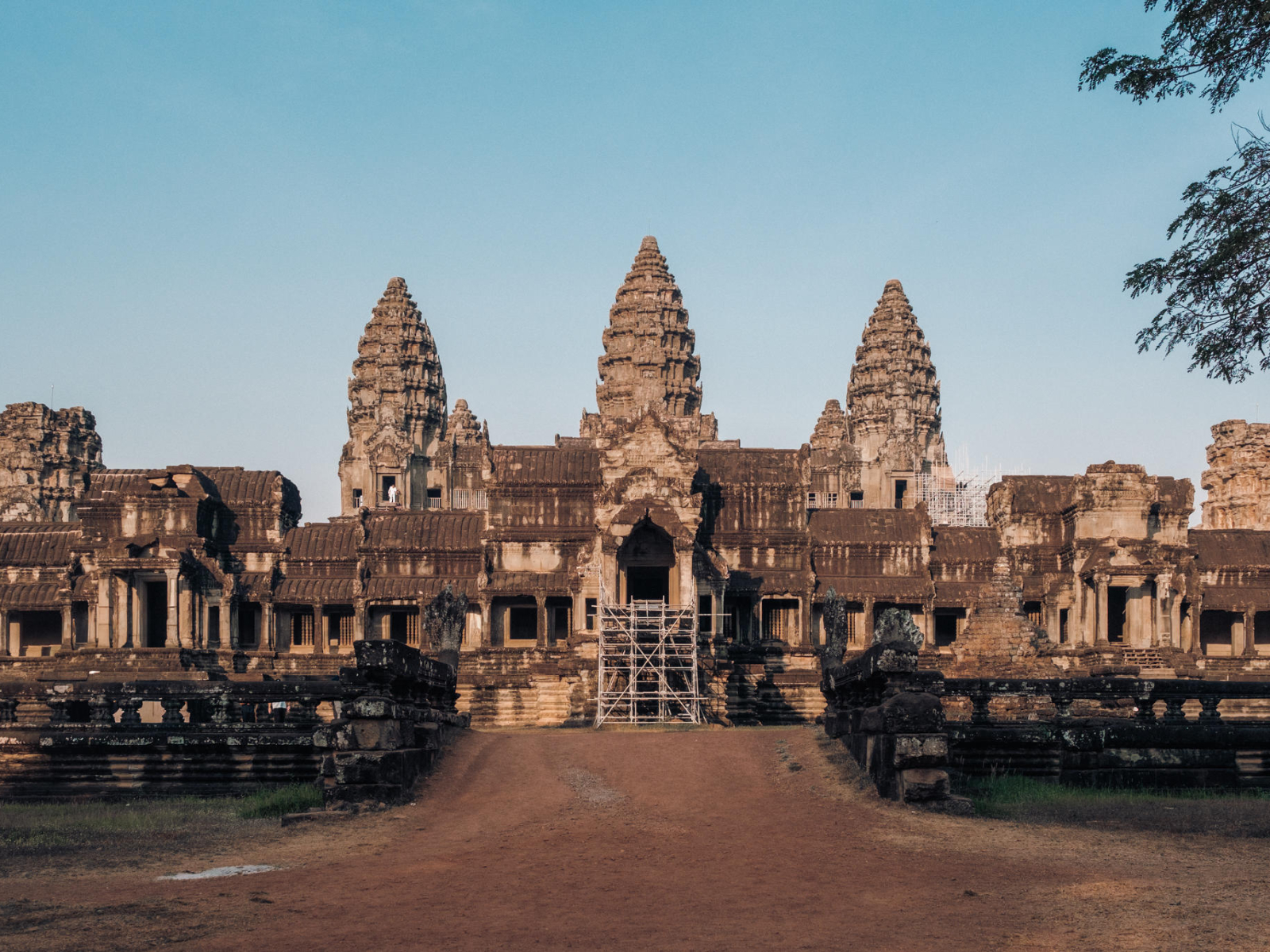
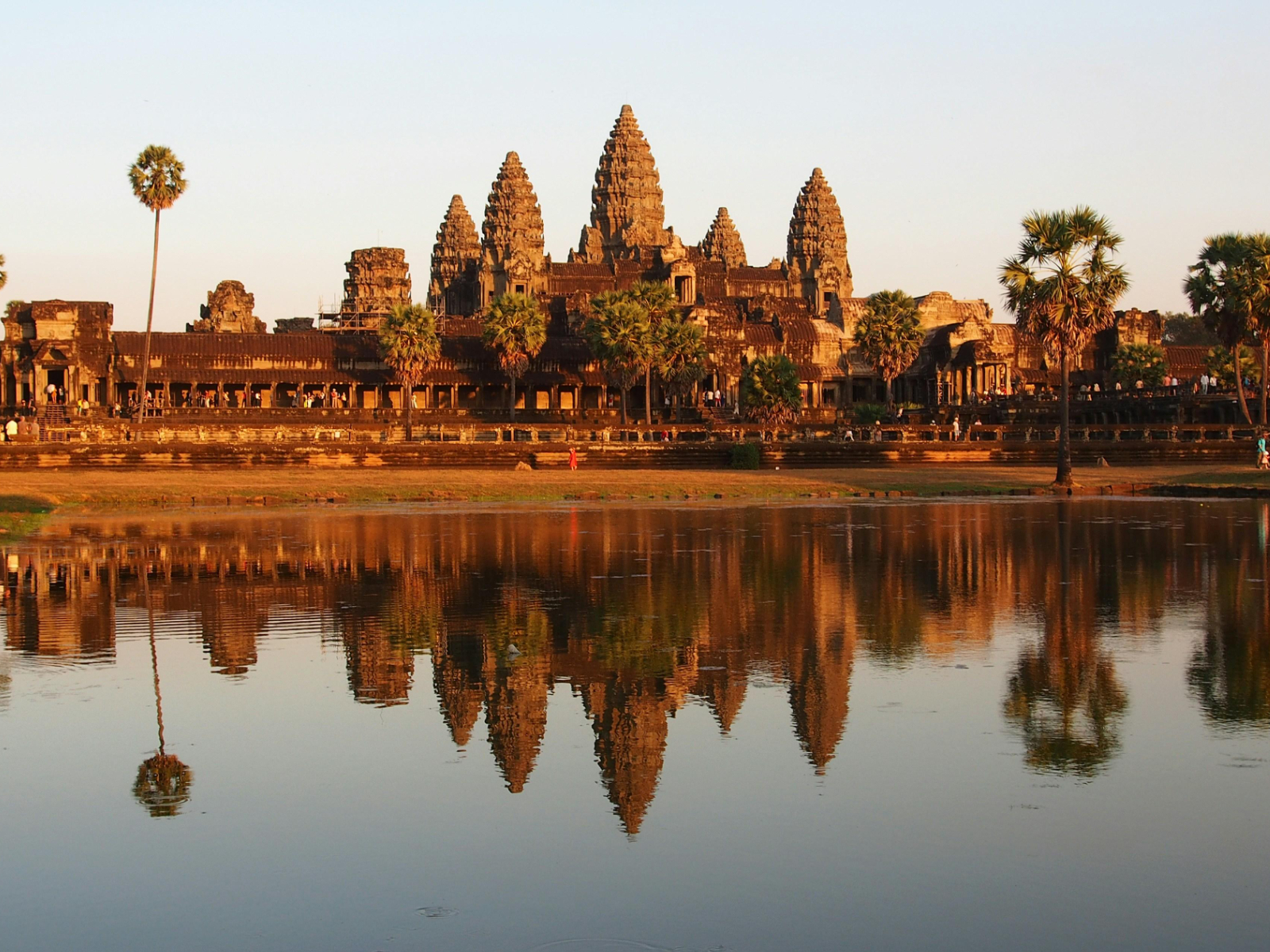
When many people say “Angkor Wat,” they are actually using the most famous single temple to refer to an entire archaeological complex. Strictly speaking, “Angkor Wat” refers to a specific temple—the state temple built in the 12th century by Suryavarman II—renowned for its moat, causeway, five towers, and bas-relief galleries. It is the core and most iconic single structure within the Angkor region.
“Angkor Monuments” (Angkor Archaeological Park / Angkor monuments), on the other hand, is a broader concept. It refers to a vast collection of ruins and historical landscapes around Siem Reap, spanning multiple dynasties. This includes Angkor Thom and its central temple Bayon, as well as Ta Prohm, Preah Khan, Banteay Srei, Pre Rup, East Mebon, the Roluos Group, and numerous other temples and urban infrastructures. It also encompasses hydraulic systems, city walls, roads, moats, and traces of residential areas. In other words, what we commonly refer to as a World Heritage Site usually points to the “Angkor Monuments” as a whole, while “Angkor Wat” is simply the most famous temple within it.
http://www.angkor360.com/angkor-maps/
Angkor Wat
Angkor Wat was built in the first half of the 12th century as a state-level project under Suryavarman II. It is the best-preserved and largest single temple in Angkor. Its defining feature lies first in its spatial organization: a wide moat and long causeway on the outside, with multiple enclosures and galleries that progressively converge toward the center. At its core stands a five-tower structure, with a clear axial layout and hierarchical order, making it feel more like a precisely planned religious complex.
The overall conception of Angkor Wat is closely tied to Hindu cosmology, with the most central image being Mount Meru. In both Hindu and Buddhist traditions, Mount Meru is regarded as the center of the universe, where the gods reside, surrounded by oceans and mountain ranges, forming a layered cosmic model. The most direct architectural expression of this idea is the five-tower layout. The central tower, together with the four surrounding towers, forms a quincunx pattern, often interpreted as representing the main peak of Mount Meru and its surrounding peaks. As you move from the outer areas inward, you pass through the moat, causeway, enclosures, and multiple galleries; the space gradually narrows and the elevation rises step by step. This progression—from the outer to the inner, from low to high—simulates the journey from the mortal world into the divine center. In particular, the steep and narrow staircases leading up through the three levels of galleries and terraces are intentionally designed to evoke a sense of physical and spiritual submission to the divine.
I find it somewhat similar to the aerial layout of Bakong in the Roluos Group. But this diagram makes it easier to understand the relationship between the temple and Mount Meru. Source: https://cambodiaballoons.comI had seen many photos before, but only after being there in person did I truly grasp the monumental scale of these structures.
The most important viewing content at Angkor Wat lies in its bas-relief galleries. The western gallery features the famous “The Battle of Lanka,” drawn from the Ramayana, with dense compositions and an astonishing number of figures. The southern gallery depicts the “Churning of the Sea of Milk,” where gods and asuras pull the serpent king Vasuki to churn the ocean and obtain the elixir of immortality—one of the most iconic mythological scenes in Angkor. In terms of religious identity, Angkor Wat was originally dedicated to Vishnu, but gradually became Buddhist over time. As a result, it accumulated layers of religious traces across different periods, making it both a Hindu state temple and later a vessel for Buddhist practice.
Throughout Siem Reap, you can often see local practitioners dressed in orange robes.
Watching the sunset from Phnom Bakheng also offers a chance to overlook Angkor Wat from above.
Angkor Thom
“Angkor” is derived from the Sanskrit word Nagara (city). It lies between Phnom Kulen and Tonlé Sap, with the Siem Reap River flowing southward from its northern source in Phnom Kulen into Tonlé Sap. It is precisely this water system, together with the surrounding large-scale hydraulic engineering, that elevated Angkor from a collection of temples into a city system capable of long-term operation.
Within this entire “urban system,” the most city-like component is not Angkor Wat, but Angkor Thom. It resembles a clearly bounded royal city: a square enclosure formed by city walls, surrounded by a wide moat, with gates distributed along the walls leading in all four directions. Outside each gate, long causeways are lined with rows of deities and asuras, forming a ritualized path of प्रवेश. The construction and expansion of Angkor Thom are closely associated with Jayavarman VII, who incorporated both the political and religious centers within the city, making it not only a container of administrative power but also a stage for state belief.
At the entrances, the two rows of figures are precisely the gods and asuras from the “Churning of the Sea of Milk” myth, with the southern gate bridge being the best preserved.
At the center of the royal city stands Bayon, which also served as the state temple during Jayavarman VII’s reign. Its most distinctive and unmistakable feature is the dense array of four-faced towers. These faces are numerous and widely distributed, creating a visual effect of “faces surrounding you” from nearly every angle. Bayon’s layout is complex, with densely packed towers, and galleries, doorways, and courtyards that constantly shift and turn. Compared to most Angkor temples, its spatial hierarchy feels more fragmented and compact.
The outer gallery bas-reliefs are extremely rich in content. Beyond religious themes, they depict a large number of scenes from warfare and daily life, including processions, boats, water activities, and market scenes. This makes Bayon not only the religious core of the royal city but also an important site preserving secular visual records. Religiously, it is primarily Mahayana Buddhist, with later Hindu additions layered onto it. This accumulation of different periods is also reflected in its imagery and structural details, giving it a stronger sense of hybridity and historical layering among Angkor temples.
Bas-relief details
Walking along the core of the royal city, you will soon encounter another structure with a completely different character: Baphuon. Built in the mid-11th century, it belongs to an earlier generation of state temples of the “temple mountain” type. Originally dedicated to Shiva, it was later converted to Buddhism. Baphuon is defined by its elevated platform and emphasis on ascent, highlighting a sense of power conveyed through height and vertical movement. The staircases are extremely steep, but once you reach the corridors above, it oddly feels like moving through the world of the game Temple Run.
Steep staircases and corridors reminiscent of Temple Run
Phimeanakas, the “Celestial Palace,” is also located within the royal city, forming part of the palace complex. Though not large in scale, its positional significance is strong, emphasizing the spatial hierarchy along the palace’s central axis. Essentially, it is a small stepped temple mountain, characterized by three tiers of platforms rising upward and its close integration with the enclosed royal living spaces.
Between the religious center and the palace complex, there are also structures that more directly served royal ceremonies, such as the Terrace of the Elephants and the Terrace of the Leper King. These consist of long stretches of bas-relief platforms forming continuous decorative bands, often featuring elephants, garudas, and guardian figures, emphasizing spaces for ceremonies, parades, and public display. The Terrace of the Elephants lies directly adjacent to the royal palace area, a spatial relationship that also gave it ceremonial significance: officials would enter the court system here, completing their audience and ritual procedures before the king.
Elephants on the terrace
A pleasant surprise is a hidden bas-relief corridor below, where you can observe many carvings up close.
Other sites on the small circuit: Ta Prohm, Ta Keo, Chau Say Tevoda, Prasat Kravan, Phnom Bakheng
Ta Prohm was built from the late 12th to early 13th century as part of the temple-city system under Jayavarman VII, with a Mahayana Buddhist background. Its uniqueness lies in the visual result of preservation status combined with the natural environment: large tree roots intertwine with walls, doorframes, and galleries, forming recognizable scenes of “roots pressing against walls” and “roots spanning gateways.” The internal space is composed of repeated combinations of gateways, corridors, and courtyards, with partial preservation of lintels, columns, and collapsed walls layered together. The original architectural order is disrupted by collapse and vegetation, so the visual focus often falls on “points of rupture and connection” rather than central towers or symmetrical compositions. Unlike Angkor Wat’s narrative clarity through bas-reliefs, Ta Prohm’s identity is more about form and condition—it represents a typical state of Angkor ruins after long-term evolution in a humid environment.
Ta Keo, located on the small circuit, is generally dated to the late 10th to early 11th century. It is a typical temple mountain built of sandstone, with an appearance that conveys a unified sense of being “unfinished.” I climbed to the top, but compared to other temples, it did not feel particularly distinctive or worth extended attention.
Chau Say Tevoda, also on the small circuit, is smaller in scale but stands out for its refinement and preservation. Together with the opposite Thommanon, it is considered a more niche temple. I passed by twice and found very few visitors. However, it is surprisingly photogenic—worth stopping by if you want good photos.
Prasat Kravan is not large, but its distinctive feature is the rare arrangement of five towers aligned in a straight line. Inside, the brick chambers preserve unusual brick bas-reliefs, most famously depicting Vishnu.
Phnom Bakheng stands at a higher elevation than most other temples, making it one of the best spots for sunset views. The ruins at the summit are not large, so there is no need to stay too long—just find a good spot, sit quietly, and wait for the sunset.
Left: the old path up the hill
Grand Circuit: Preah Khan, Neak Pean, Ta Som, East Mebon, Pre Rup
Preah Khan was built in the late 12th century and is one of the important temple-city complexes from the reign of Jayavarman VII, with a primarily Mahayana Buddhist background. Its functionality and scale are both prominent. Its defining feature is the layered progression of space combined with repeated sequences of gateways and galleries: moving from the outer to the inner zones, you continuously pass through doorways and corridors, creating a strong sense of “continuous space.” Compared to Ta Prohm, which is famous for its entanglement with tree roots, Preah Khan is more identifiable through its layout and structural system itself, making it especially suitable for observing sequences of gateways, gallery structures, and courtyard combinations. It also preserves some representative components and carvings, but overall it feels more like a “systematic grand temple,” distinguished by its scale and structural complexity.
Neak Pean (also known as Neak Pean / “Nirvana Temple”) is located along the grand circuit and is often interpreted as an architectural expression of medical and purification concepts during Jayavarman VII’s reign. Its structure is highly unique: a central island shrine surrounded by water, connected to the outside by a causeway, with four surrounding pools arranged along the cardinal directions. The entire design revolves around the “distribution and symbolism of water.” Unlike most temples defined by platforms, towers, and galleries, Neak Pean stands out as a temple built in the middle of a body of water. In ancient times, people would travel by boat to the island seeking healing; today, wooden walkways allow visitors to access it, and the experience differs between the dry and rainy seasons.
It’s said that their traditional healing method was to throw patients into one of the pools to wash their heads.
Ta Som is relatively small, a minor temple along the grand circuit. It once stood out among many temples because of a large tree growing over its rear gate, but that tree is no longer there.
If you see the iconic four-faced towers, you can almost certainly identify it as a temple built during the reign of Jayavarman VII.
East Mebon was built in the 10th century and is a typical temple mountain. It originally stood on an artificial island in the middle of the East Baray reservoir, and this geographical setting is a key part of its identity. Although the reservoir has mostly dried up today, the idea of an “island temple” still helps explain how Angkor integrated hydraulic engineering with religious architecture. The temple rises through layered platforms, often decorated with stone elephants at the corners, emphasizing elevation and symmetrical layout.
Pre Rup, also known as the “Transformation Tower,” belongs to the 10th-century temple mountain system. It is relatively large, with high platforms and open terraces, surrounded by forest, and is also a good place to watch the sunset. Scholars generally believe it was closely associated with royal funeral rites and served as one of the state temples for cremation ceremonies of deceased kings or royalty. In Khmer tradition, cremation is common, and within the Hindu framework, death and ritual are integrated into cycles of rebirth and liberation. Royal funerary rites use fire and offerings to symbolically transform the deceased, allowing them to transition from a worldly identity to a higher sacred status.
I arrived a little after 6 a.m. and saw both the sunrise and the moon at the same time. Pre Rup is, in my opinion, one of the better places—besides Phnom Bakheng—for watching sunsets and even photographing the night sky. It has five towers and sufficient height for a wide view, and being surrounded by forest helps avoid excessive light pollution.
The Koh Ker temple complex lies farthest from the city and briefly served as the political center of the Khmer Empire in the 10th century. Its significance is not just its distance, but the fact that it was once the center. Its most recognizable feature is the pyramid-style temple around Prasat Thom, with clear tiers and a highly distinctive form that differs greatly from the typical temple silhouettes of the Angkor core area. The ruins are scattered and require transportation to connect them, and the temples vary significantly in scale, preservation state, and decorative density.
The pyramid can be climbed, making it a good sunset viewpoint. However, if you’re focusing on photographing the Koh Ker pyramid, the light before 10 a.m. is better; after that, it’s not just about lighting—the heat at the top becomes intense. From the summit, if the sky is clear, you can also see Phnom Kulen in the distance. It is said that the stones used to build the Koh Ker pyramid were transported from that mountain.
Beng Mealea, located on the outer circuit, is large in scale and shares a similar layout with Angkor Wat, but its state of preservation is entirely different, giving it the feeling of an “unrestored ruin.” Its defining features are collapse, overgrowth, and traversability: fallen walls forming piles of stone, structures covered in vegetation, and pathways that require climbing over obstacles all shape the viewing experience. Unlike the main temples where you move along galleries, Beng Mealea feels more like navigating through remnants of structures. The visual focus falls on fractures, overlapping collapsed elements, and the interplay between ruins and forest. It is highly distinctive and one of the most memorable types of sites in the outer circuit.
On the way to Beng Mealea, I saw a white cow grazing. The guide said that the white cow is the mount of Shiva, symbolizing protection and witness, often appearing at the entrance or courtyard of temples dedicated to Shiva. This unexpected encounter felt like a small delight during the journey.
The Roluos Group usually includes Bakong, Preah Ko, and Lolei. Dating back to the 9th century, they represent an important starting point before the Angkor system. Their uniqueness lies in their “early forms”: more direct temple-mountain structures, simpler decoration, and proportions that differ noticeably from the mature Angkor style. The focus here is more on historical context and stylistic evolution—you can see early prototypes of later Angkor conventions, such as tower layouts, platform hierarchies, and the combination of gateways and enclosures. It does not aim to impress visually but to make the timeline tangible. Unless you are particularly enthusiastic, it may not be worth a separate trip, as it does not stand out significantly compared to other Angkor temples.
BakongLoleiThe sacred bull at Preah KoIntricately carved lintels
Banteay Srei was built in the 10th century. Though small in scale, it holds an extremely high status in craftsmanship and art history, often considered the pinnacle of Angkor’s bas-relief detail. Its uniqueness comes from its material and carving: extensive use of red sandstone allows for highly refined detailing, resulting in exceptionally dense decorative elements on lintels, columns, and pediments. Figures, deities, patterns, and narrative scenes are clearly defined and richly layered. The themes are mostly drawn from Hindu mythology and epics, making them somewhat difficult to interpret, but even without understanding them fully, the intensity of craftsmanship can be appreciated through the lines and density. It is a temple that rewards time spent on details rather than scale.
One of the most famous anecdotes about Banteay Srei is that in 1923, the French writer André Malraux stole four devata statues from the temple, causing a major scandal. He was quickly arrested, and the stolen artifacts were recovered and returned to Cambodia. Ironically, he later became France’s Minister of Culture—a testament to a certain French nonchalance. This is also one of the temples where I strongly recommend hiring a guide; without explanation and some knowledge of Hindu history, you may only get a superficial understanding.
Additionally, Banteay Srei is the only temple in Angkor where barriers have been installed, preventing close-up viewing. If you are interested in the bas-reliefs and plan to examine them in detail, I would recommend bringing binoculars or a telephoto lens for a better experience.
Left: the Dance of Shiva. In traditional imagery, Shiva is often depicted in a seated position, but when he rises to dance, it symbolizes a dramatic turning point in cosmic order. Guides often explain it in simple terms: when Shiva stands up and begins to dance, it means the force of destruction has been set in motion—the old world will end, and a new cycle will begin.
6. Other Attractions in Siem Reap
Angkor National Museum
Angkor National Museum feels more like a preparatory step before visiting the Angkor complex. Its exhibitions focus on the religious and iconographic systems of the Angkor period—such as deities, nāgas, asuras, apsaras, and symbols of royal power—helping you become familiar with these recurring motifs before entering the temples. The museum also provides some basic explanations of architectural structures, allowing you to roughly understand the relationships between galleries, gateways, tower clusters, temple mountains, and water systems. For first-time visitors to Angkor, this kind of structured introduction is very effective, reducing the sense of unfamiliarity during subsequent visits and improving your ability to interpret bas-reliefs and spatial layouts.
Admission: $12, audio guide $5 (not recommended—it essentially just reads out the printed text)
Note that you need to store your bag before entering; cameras are not allowed, and flash photography is prohibited. The storage counter at the entrance thoughtfully provides a small cloth bag for your personal belongings.
It’s also worth mentioning that the museum’s souvenir shop is well worth browsing, with many interesting items not easily found elsewhere. Across the street is Siem Reap’s largest Chinese supermarket, “Angkor Supermarket,” which also offers a wide selection of food products and souvenirs suitable as gifts.
Kompong Phluk Floating Village and Tonlé Sap Lake
During the rainy season each year, when the Mekong River reaches its peak, it triggers a reversal of flow in the Tonlé Sap River. Water is pushed into Tonlé Sap, significantly expanding the lake and surrounding wetlands. The incoming water brings nutrients, sediment, and migratory fish pathways, flooding forests and lowlands and creating vast shallow-water habitats rich in food for breeding and nurturing young. In the dry season, water levels recede, the lake shrinks, and water and aquatic life retreat into deeper channels and the lake’s center. The floating villages adjust their way of life accordingly, shifting with the changing water boundaries.
Kompong Phluk is a typical example of such a floating village. Houses are elevated to adapt to rising water levels and seasonal flooding. During the rainy season, water transport becomes the main mode of commuting, and infrastructure such as schools, shops, and even toilets is organized around the water. In the dry season, when some waterways become shallow or reveal mudflats, people spend more time living on land.
Local fishermenChildren playing beach volleyball. Our guide, who grew up in the floating village, said that as a child he loved the dry season most, when the receding water exposed land and offered more opportunities to play with friends. In the rainy season, water levels are high, and travel requires boats, which in some ways limits leisure activities.
Another part of the tour involves visiting the village itself. As soon as you disembark, you notice the dusty roads, and the houses and infrastructure are very simple—some places even resemble rural China from over twenty years ago. Along the way, we passed a donated library and school. The guide said: “Because 80% of people in Siem Reap are directly or indirectly involved in tourism, our schools have introduced English classes. English has become a compulsory subject, and because of your presence, our next generation has more opportunities and possibilities.” Hearing this was genuinely reassuring.
Another optional activity during the trip is a boat ride through the mangrove forest. Once the small boat turns from the main waterway into narrower channels, the surrounding sounds suddenly soften, and the air takes on a distinct scent—cool and slightly spicy, like lemongrass. In that moment, I suddenly understood why massage shops in Siem Reap often emphasize lemongrass essential oil. It’s because their natural environment is already infused with this scent; the oil simply concentrates it and brings it indoors, turning it into something that can be remembered in everyday life. A fellow traveler tipped the boatwoman, and we were lucky enough to hear her sing a Khmer folk tune while drifting along—an incredibly relaxing experience.
The final part of the itinerary is watching the sunset over Tonlé Sap. I brought a tripod, planning to shoot a time-lapse, only to realize after boarding that the entire sunset would be viewed from the water—the slight rocking of the boat made it impossible, and before I knew it, the sun had drifted away. The vastness of Tonlé Sap has a very direct, almost overwhelming presence. The horizon flattens into little more than water and sky, with the boat appearing as a tiny dot placed upon it. Because of this, it’s hard not to think about the past. The Khmer people lived, fished, and migrated here, with the lake expanding and contracting through rainy and dry seasons—they must have witnessed countless sunsets like this. In many places, lakes carry the imagination of the sea. For those who rarely see the ocean, a vast body of water can become its substitute. Did people in the past also imagine the sea through great lakes like this?
After sunset, we returned by boat. As we approached the dock, the lights became sparse, and the trees along the shore appeared even darker. Above the silhouette of the forest, I saw the moon again. It hung low and steady, as if it had been reserved as the final image of the day. It was truly a beautiful and peaceful journey—one I would recommend to everyone.
APOPO Landmine Detection Center
APOPO is one of the few “non-temple must-visit” spots in Siem Reap. It is backed by a European non-profit organization that trains African giant pouched rats (HeroRATs) to detect landmines, turning their keen sense of smell into a scalable tool for public health and safety. When talking about Cambodia, one cannot avoid the issue of landmines and unexploded ordnance left over from the civil war and the Vietnam War era. The impact is not limited to border or remote areas—many agricultural lands, forests, and village surroundings still pose risks, leading to long-term consequences such as injuries, unused land, and restricted infrastructure development. (Warning: images of large rats below)
The core of APOPO’s method lies in standardized training and quality control. The rats are trained in controlled environments to identify the scent of explosives and move along grid-based paths in simulated minefields or testing areas to locate suspicious spots. Their light weight reduces the risk of triggering mines. The visit also demonstrates training procedures, the principles behind real-world operations, and the significance of demining for restoring land use. At the end, there is even an opportunity to take photos with the rats—a surprisingly relaxing experience and a nice break between temple visits.
Admission: $10, advance booking recommended
Phsar Leu Thom Tmey
Phsar Leu Thom Tmey is a more local morning market in Siem Reap. The stalls are densely packed, with daily necessities, fresh ingredients, and cooked food all sold side by side. Locals ride motorcycles through the narrow aisles—it feels no different from the morning markets back in my hometown. It’s a great place to observe everyday local life: how people shop, how ingredients are displayed, and how vendors handle prepared food and seasonings. For those interested in exploring food and daily culture, you can find fresh and diverse local fruits and snacks here—it’s a must-visit for culinary explorers.
7. Conclusion
Before departure, my imagination of Cambodia was filled with uncertainty. But once I actually set foot on this land, my mind became strangely calm. The concerns didn’t disappear—they just became less important. People working in tourism here seem to treat “taking care of you” as an instinct, and even their smiles feel effortless. On the last day of the trip, I watched a sunset from inside a car. I simply sat there, waiting as the light slowly faded. After passing through airport security, I saw the moon hanging in the sky again. In that moment, it felt as if the memories of the past few days connected together: papaya smoothies at the night market, the lotus-scented body lotion I bought, the moon hanging above the jungle, the Khmer music played at temple entrances. What I wanted to take away with me were these moments—they are lighter than any souvenir, yet far more unforgettable.
8. References
Books: The Rise and Fall of the Angkor Kingdom, The Beauty of Angkor, Lonely Planet: Cambodia, Southeast Asia: Discovering a Multi-Civilization World, Cambodia: The Cursed Land
In recent years, Cambodia has not exactly enjoyed a good reputation on the Chinese internet. Whenever the country is mentioned, discussions often revolve around telecom fraud and online scams. Yet somehow, Angkor Wat seems untouched by that narrative. Many people have heard its name, but most never realize that it is located in Cambodia.
Siem Reap is only a small city, but because of Angkor Wat it has become a destination for travelers from around the world. Centuries ago, on the plains shaped by the alternating rhythms of monsoon and dry season, the Angkor Empire wrote a chapter of regional power using stone architecture and sophisticated hydraulic systems. Centuries later, those same monuments were swallowed by the jungle and buried by time, until French colonial explorers rediscovered them and returned this mysterious ancient world to global attention.
Angkor Wat had long been on my own travel list. Somehow, various reasons always prevented the trip from happening. It was not until I saw news last year about rising tensions between Thailand and Cambodia that I suddenly realized how many things in the world lie beyond my control. If you postpone something for too long, it may either be rewritten by time—or by the world itself.
So for my first trip of 2026, I chose Siem Reap as my destination. Before departure, I deliberately avoided doing too much research, hoping to experience the place more immersively. Unexpectedly, that casual approach allowed Angkor to strike me even more directly. At that moment, I finally understood why the French once said:
“Even the ruins of ancient Greece and Rome pale in comparison to Angkor.”
Image source: Unsplash @vicky_t
1. Trip Overview
I spent a total of seven days and seven nights in Siem Reap, and I entered the Angkor archaeological park on six of those days—truly getting the most out of the seven-day pass.
This trip was fairly relaxed overall. I used the first three days to join guided tours, listen to explanations, and learn the basic history while also getting familiar with local transportation. During the last three days, I hired a private driver, which gave me more flexibility and also helped me avoid the intense midday heat at Angkor Wat. If you are not aiming for a particularly in-depth experience, five days are actually enough to see most of the major sites; if you focus mainly on Angkor Wat itself, even three days can work.
Angkor tourism traditionally follows three classic routes: the Small Circuit, the Grand Circuit, and the Outer Circuit. Most tour groups organize their itineraries based on this structure. I made some adjustments on top of that framework according to my physical condition. The following is the final itinerary. The locations in bold are places I consider especially worth visiting, while the underlined ones are the parts where I joined a tour group. As you can see, there are some sites I visited twice—first with a tour group and later on my own. I will explain the reasons and compare the experiences later in the article.
Angkor National Museum – lunch break – Kampong Phluk floating village – mangrove boat tour – Tonlé Sap sunset
Angkor Wat sunrise – Ta Prohm – Terrace of the Elephants – Preah Palilay ruins – Baphuon – Bayon
Koh Ker temple complex – Beng Mealea – riverside night market
Psar Leu Market – APOPO – lunch break – Angkor Wat
Angkor Thom South Gate – Bayon – Baphuon – Ta Keo – Thommanon – Chau Say Tevoda – Ta Prohm – Srah Srang – lunch break – Phnom Bakheng sunset
Pre Rup – Banteay Srei – East Mebon – Ta Som – Neak Pean – Preah Khan – Terrace of the Elephants / Terrace of the Leper King – lunch break – Angkor Wat sunset – night market
Angkor Wat sunrise – Roluos Group (Bakong – Preah Ko – Lolei) – Wat Bo – pack up and head to the airport
Angkor site distribution map. The three colors represent the three routes most commonly used when planning a visit: the Small Circuit (red, covering the most iconic highlights), the Grand Circuit (green, located close to the Small Circuit), and the Outer Circuit (purple, featuring distinctive temples located more than 40 minutes from the city center).
I believe the itinerary can still be optimized in many ways. Below, I will provide three more practical planning options and estimated budgets: a one-day speedrun, a three-day classic itinerary, and a seven-day relaxed version.
One-Day Speedrun Itinerary
If you only have one day but still want to see the “classic highlights” of Angkor, a route like this works well:
Angkor Wat sunrise → Angkor Wat → Ta Prohm → Bayon → Baphuon → Preah Khan → Phnom Bakheng sunset
Angkor Wat represents the culmination of Angkor’s architectural style. Many temples along the Small Circuit and Outer Circuit share similar structural designs, but their bas-reliefs are less refined, and their ceremonial status is usually lower than Angkor Wat, which once served as the state temple. If you visit during the spring or autumn equinox, you may even capture the moment when the rising sun aligns perfectly with the temple’s central tower.
Ta Prohm, meanwhile, served as a filming location for Tomb Raider. Inside the temple, massive trees grow directly out of the ancient stone structures, creating an unforgettable scene that makes this stop impossible to miss. Bayon Temple is another iconic symbol of Angkor. Its most famous feature is the series of “smiling faces” carved on each tower, believed to represent King Jayavarman VII. These serene faces are often referred to as the “Khmer Smile” and have become one of Cambodia’s most recognizable cultural landmarks.
Preah Khan or Phnom Bakheng can also be replaced with Banteay Srei or Beng Mealea. Ideally you should choose between them, but in theory you could squeeze both into a single day. However, the schedule would become extremely tight and feel more like rushing from place to place, and you would almost certainly miss the sunset at Phnom Bakheng. If you really want to catch the sunset there, you can buy your ticket after 17:00 the day before. Doing so allows you to watch the sunset without using up one of your official visiting days.
This speedrun route typically starts around 5:00 a.m. and may not end until around 19:00 when you finally return to your hotel, so it requires a fair amount of stamina. Hiring a private car is recommended, as it gives you better control over the route and lunch breaks. Group tours are cheaper but offer far less flexibility.
Estimated cost: $37 entrance ticket + $20 private car (depending on distance and negotiation) + $15 per person for meals ≈ $72
Note: All prices here are listed in USD; the reason will be explained later in the article.
If you have three days, you can follow the classic Small Circuit, Outer Circuit, and Grand Circuit routes to cover most of the key highlights. The downside of this three-day itinerary is its intensity: attractions are dense, travel distances are long, and the amount of historical information can feel overwhelming. As the most commonly chosen plan, I have seen many travelers online say they couldn’t finish visiting all the temples, or that they forced themselves to see everything but ended up completely exhausted. At the same time, some seasoned “speedrun travelers” say this pace feels perfectly normal to them.
For this route, either joining a tour group or hiring a private car works well. Group tours are cheaper and follow mature, well-tested routes—you can almost choose one blindly. Hiring a car offers more flexibility. For example, temples you don’t finish on the first day can be moved to the next day, and it’s easier to avoid the busiest and hottest times of the day, resulting in a better overall experience.
Day
Morning Itinerary
Afternoon Itinerary
Evening Activities
Physical Demand
1
Angkor Thom South Gate → Bayon → Baphuon → Phimeanakas → Terrace of the Elephants → Victory Gate → Ta Keo → Chau Say Tevoda
Thommanon → Angkor Wat
Local massageRiverside night marketApsara dance performance*Phare Circus show*
High / fairly high
2
Angkor National Museum → Preah Khan → Neak Pean → Ta Som → East Mebon → Pre Rup
Ta Prohm → Phnom Bakheng sunset
—
Medium / high
3
Angkor Wat sunrise → Banteay Srei → Beng Mealea → Roluos Group
Floating village → mangrove boat ride → Tonlé Sap sunset
—
Medium / high
Items marked with * require advance reservation.
Estimated cost: $62 entrance ticket + $100 private car + $15 × 3 per person for meals + $12 museum ticket + $20 Tonlé Sap visit ≈ $250
Tomb Raider film still
Seven-Day Relaxed Itinerary
If you have seven days to spend in Siem Reap, you can explore Angkor Wat at a much more relaxed pace while still leaving plenty of time to experience attractions and activities in Siem Reap beyond the temples themselves.
I recommend going out between 6:00–10:00 in the morning, returning to town for a midday break, and heading out again between 16:00–18:00. The advantages are straightforward: cooler temperatures, softer lighting for photos, and fewer tourists at the sites. If you can reach the temples around 6 a.m. each day, you will rarely have to deal with crowds and can often capture photos with empty surroundings (except at Angkor Wat). The physical demand is also manageable, and the midday break provides a good chance to recover. Only the Small Circuit day and the Kbal Spean / Kulen Mountain trekking day tend to be more exhausting.
Underlined locations are places I think can be skipped, while bold ones are strongly recommended.
Day
Morning Itinerary
Afternoon Itinerary
Evening Activities
Physical Demand
1
Angkor National Museum
Angkor Wat → Angkor Wat sunset
Local massageRiverside night marketPub StreetApsara dance performance*Phare Circus show*
Medium, mentally demanding
2
Angkor Thom South Gate → Bayon → Baphuon → Ta Keo → Ta Prohm → Chau Say Tevoda
Preah Khan → Neak Pean → Ta Som → East Mebon → Terrace of the Elephants bas-relief gallery
Phnom Bakheng sunset
Relaxed, many temples optional
4
Angkor Wat sunrise → Banteay Srei → Landmine Museum
Kbal Spean trekking
Morning medium/low, afternoon medium/high
5
Koh Ker temple complex
Beng Mealea
—
Moderate, long driving time
6
Roluos Group
Floating village → mangrove boat ride → Tonlé Sap sunset
—
Low, not recommended for those prone to seasickness
7
Flexible day to revisit missed sites
—
—
Low overall except for Kulen Mountain trekking
Possible optional stops for the final flexible day include:
Psar Leu Market Siem Reap Botanical Garden Kulen Mountain trekking APOPO Landmine Rat Center* Phnom Krom sunset West Mebon sunset†
Items marked with * require advance reservation. Items marked with † are open only during the rainy season.
Estimated cost: $87 entrance ticket + $200 transportation + $15 × 7 per person for meals + $12 museum ticket + $20 Tonlé Sap visit ≈ $500
If you have time to visit Phnom Penh, besides the Khmer Rouge historical sites, you can also stop by the National Museum of Cambodia, which houses Khmer and Angkor artifacts from different periods, including many outstanding pieces. Outside Cambodia, the Guimet Museum in Paris is the world’s largest center for Khmer artifacts, and it is also worth visiting if you are interested.
2. Pre-Trip Preparation
Visa and Entry
Chinese passport holders usually need a visa to enter Cambodia. You can choose an e-visa, a visa on arrival, or a traditional sticker visa, with most costing around $30. Visa-on-arrival lines can sometimes be long and unpredictable, so I recommend applying for the visa in advance and filling out the electronic arrival card before entering the country.
The immigration process was fairly smooth overall. Although the queues looked chaotic, the lines moved quickly. No one asked me any questions, and both immigration and customs counters clearly displayed multilingual signs stating “No tips required.” The entire process felt straightforward and efficient.
In addition, Cambodia will implement a visa-free trial policy for Chinese citizens from June 15 to October 15, 2026. During this four-month trial period, Chinese visitors can stay for up to 14 days per entry, with no visa application or fee required. Travelers only need to fill out the electronic arrival card and can enter Cambodia multiple times during the policy window. If you plan to travel during that period, entry should be quite hassle-free.
My original plan was to buy an Airalo eSIM as usual, but after searching on Taobao I found a cheaper option. I ended up purchasing a 10-day 10GB plan for 49 RMB, which was more than enough for my trip. Compared with Airalo’s $19.5 plan, it was significantly cheaper and also saved the trouble of buying and swapping a physical SIM card locally.
The main drawback is that the plan cannot make local phone calls. In practice, however, I rarely needed to call a local number. The only situation where a local number might help is when registering for the Pass App ride-hailing service, though Grab works perfectly well as an alternative. For contacting drivers, hotels, or shops, WhatsApp or Telegram are much more commonly used. If you don’t already use those apps, having a local number might make communication easier. Some people previously mentioned that Taobao eSIMs route through Hong Kong and might affect access to AI services like GPT. I personally did not encounter any issues during this trip.
If you prefer physical SIM cards, you can buy them at the airport after landing, in local convenience stores, or online through Taobao. The most common carriers are Metfone, Smart, and Cellcard, with the latter two generally offering better signal coverage and being popular among travelers.
Payment Methods
During this trip I mainly used three payment methods: cash, Alipay, and a Visa card.
Before departure I prepared about $185 in cash (mostly $20 and $10 bills, plus around twenty $1 notes). By the time I left Cambodia I only had about $5 remaining. In the final few days I was basically stretching the remaining cash as far as possible. If you want a more comfortable margin, preparing around $50 per day in cash is a good idea.
Siem Reap is still largely a cash-based society, with both US dollars and Cambodian riel (KHR) widely accepted. Most places accept either currency. In practice, paying with cash often works out cheaper. For example, while Grab is convenient for short rides, the price is usually about $1 higher than negotiating directly with a driver. For private car hire, the difference can reach $5–10. When shopping, paying in cash also gives you more room to negotiate prices face-to-face.
The official exchange rate at banks is roughly 1 USD ≈ 4150 KHR, but in daily transactions most places use a simpler 1 USD = 4000 KHR rate. The higher 1:4150 rate usually appears only when paying in riel by card, such as at 7-Eleven or when paying via Alipay.
During the first two days I paid almost everything in cash. Only in the final days, when I realized my cash was running low, did I start using Alipay and card payments more frequently.
Most decent restaurants accept credit cards, and Apple Pay is widely supported. Only a few places require a physical card. Many shops and tuk-tuk drivers display ABA Pay QR codes, which usually means you can pay by scanning with Alipay. However, there is one important detail to note: if a single transaction exceeds 25,000 riel (about $6.25 / 45 RMB), Alipay may trigger a risk warning and block the payment.
Exchanging Cambodian riel outside Cambodia is quite difficult. It is best to exchange US dollars before departure, spend as much riel as possible before leaving Cambodia, and bring any remaining dollars back home for exchange if needed. Although there are many ATMs available for tourists, reports suggest Cambodian banks typically charge $5–$30 per withdrawal in service fees. Some travelers recommend exchanging money with Chinese tourists, but in Cambodia that approach may attract suspicion—sometimes it’s even easier to exchange with European travelers using Revolut instead (:з」∠).
According to tests shared online, ACLEDA Bank has the lowest ATM withdrawal fee at around $5.
There are also rumors that local businesses can be picky about US dollar banknotes, refusing bills that are too old, heavily folded, or damaged—especially versions issued before 2013. I personally brought a few older bills and did not encounter problems, but it is still wise to check your banknotes and bring clean, newer bills whenever possible, just to be safe.
Hotel Accommodation
Accommodation areas can roughly be divided into four geographic zones, as shown in the map.
The first area is where luxury hotels are concentrated, such as Amansara, Raffles, and Sofitel. The advantage is that these high-end hotels themselves offer excellent hardware, service, and curated experiences, including some niche activities that are difficult to find through regular travel agencies. If your travel style already leans toward this level of comfort, staying here—whether to simply relax or to experience local culture—can offer many worthwhile options1.
However, I wouldn’t recommend staying in nearby budget hotels just to benefit from the location. While it is indeed slightly closer to the Angkor temple area, and tour groups often drop you off first when returning, the trade-off is that going to the city center for food or shopping requires an extra ride each time, costing both money and time. The surrounding area also has relatively few places to eat or explore, which can feel a bit dull.
The second area is around Pub Street, essentially the very center of the city. This is where you’ll find the highest density of dining and shopping options, and it’s also the liveliest place at night. You can easily find branches of well-known international chains here—Domino’s, KFC, Burger King, and even Mixue. In fact, the latter three are all within walking distance of Park Hyatt, which makes things extremely convenient. The downside is just as obvious: constant noise from traffic, crowds, and music throughout the night, and prices in tourist areas tend to be higher. Park Hyatt sits roughly at the edge of this zone, offering a relatively balanced location that remains convenient while avoiding some of the noise.
The third area is the Wat Bo district. It’s about a 10–15 minute walk from the city center and feels much quieter overall, with fewer tourists—almost like living on the edge of the city. There are still plenty of restaurants and massage places in the area, but they’re more spread out, so you’ll often need to walk 5–10 minutes to find one. During non-peak periods, there are also fewer tuk-tuks passing by if you’re trying to hail one on the street. On the other hand, this area gives you more chances to see everyday local life, which for me is a unique and memorable experience.
The fourth area is where resort hotels are concentrated, a common choice for Western tourists who prefer a laid-back vacation. Facilities such as spas and swimming pools are usually excellent, but the drawbacks are similar to those in the luxury hotel cluster—you’ll need a 10–15 minute tuk-tuk ride to reach the city center, and the surrounding area offers fewer dining and shopping options. If your plan is mainly to relax and unwind, though, this area is still a good choice.
The Beige is also a luxury hotel, and during breakfast they even have an elephant-feeding activity.
When choosing a hotel, I looked through reviews across different areas and price ranges. Most comments were surprisingly consistent: the service is generally excellent. Staff greet you whenever they see you and respond enthusiastically to requests. Common issues mentioned include insects and geckos being more likely if you stay on lower floors, and noise at night if you stay near Pub Street. Another thing to note is that most hotels do not have elevators. Although staff can help carry luggage upstairs, if you dislike climbing stairs it’s better to confirm with the hotel before checking in.
This time I stayed at Khmer House Boutique near Wat Bo. During peak season the average price is about $50 per night, and in the low season around $30. The room was very spacious, and the balcony overlooked the pool while being surrounded by greenery, creating a very relaxing atmosphere. There was almost no noise, and staying on the third floor meant I didn’t encounter any insects or geckos in the room. The front desk also provides free mosquito repellent. The service exceeded my expectations—staff spoke good English, and by the second day even employees I hadn’t met before could greet me by name. For this price range, the level of service was honestly impressive. The hotel also offers massage, laundry services, and various tour arrangements, though these come with the usual hotel markup. If I had to point out any downsides, the restaurant’s food was nothing particularly memorable, and most nearby restaurants don’t have indoor air conditioning, so eating lunch at noon can feel a bit hot. Other than that, it’s hard to find any real faults.
Angkor Wat Tickets
Angkor Wat offers three types of entrance passes with different validity periods: 1 day ($37), 3 days ($62), and 7 days ($72). The 3-day pass can be used on any three days within a 10-day period, while the 7-day pass can be used on any seven days within 30 days, so there is no need to use them consecutively. The ticket covers most temples, with only Koh Ker ($15) and Preah Vihear ($10) requiring separate admission tickets.
You can purchase a physical ticket offline or buy an electronic version through the official website. Since ticket checks are fairly frequent, it’s generally recommended to buy the digital ticket so you don’t have to worry about losing it. One thing to note is that online tickets can only be purchased for the following day or later. However, buying a ticket offline has an extra perk: after purchasing the ticket on the same day, you can enter the temples to watch the sunset without using up one of your valid visiting days. For travelers trying to save money, this is quite a good deal.
It’s also possible to find cheaper tickets on Xianyu, where a 7-day pass can sometimes be purchased for under ¥300, seemingly taking advantage of loopholes in group tour tickets. Starting from February 2026, however, Angkor’s official management appears to have noticed this situation and has begun checking tickets more strictly, so keep this in mind before making a purchase.
There are many transportation options from Siem Reap Airport to the city center, but the two main ones are the airport shuttle bus and taxis.
The airport shuttle bus is the most cost-effective option, priced at about $8 per person. Tickets purchased offline are cash only, but you can also reserve them online. The bus will take you to a central drop-off point in the city, roughly located in the Wat Bo hotel area mentioned earlier. From that hub to nearby hotels, tuk-tuks usually charge about $1, which is also a good opportunity to negotiate private driver services for the next few days.
The advantage of the bus is that it runs on schedule and the process is relatively reliable. You can also buy tickets online in advance, which suits travelers who prefer certainty. However, the downside is the limited frequency. Buses from the airport to the city run most frequently between 3:00 pm and 5:30 pm, so delays can easily cause you to miss one. The last bus from the city to the airport departs at 7:00 pm, which isn’t ideal for late-night flights.
If you’re staying near Pub Street across the river, you can also consider the airport shuttle service operated by the Siem Reap Post Office. It’s slightly more expensive than the official shuttle at $9 one way, but it also offers a hotel drop-off service for an additional $2.
Left: Official airport shuttle; Right: Siem Reap Post Office shuttle
Some local Siem Reap travel agencies also provide hotel-based shuttle services for around $9 per person. Typically they pick you up at your hotel and take you to the airport, or pick you up at the airport and drop you at your hotel, and these can also be booked online in advance. The advantage is that you skip the transfer from the hub to your hotel, and the price is roughly the same as taking a tuk-tuk to connect with the airport bus. The downside, for me, is that you need to wait at the hotel in advance. The pickup window is usually around 30–40 minutes, during which you can’t freely plan your time, and the exact arrival time of the vehicle is uncertain. If your schedule is tight and you dislike waiting, this option may not feel more comfortable than the shuttle bus.
The most commonly chosen option is probably the airport transfer service provided by Siem Reap Shuttle Tours. If you’ve booked other tours through their official website, they often include one free airport transfer. Their schedule is also more convenient than the airport bus, running every hour from 6:30 am to 8:30 pm. On Xiaohongshu, you can also find individual drivers offering similar services, which might be worth keeping an eye on.
A point-to-point private transfer is the most hassle-free option. You can easily book one from your hotel, at the airport, or through ride-hailing apps. The “reasonable deal price” I got at the time was $25 for a one-way trip. Interestingly, the staff at the airport bus ticket counter even told me that drivers often start by quoting $30, and negotiating down to $25 is usually achievable. The advantage of this option is straightforward: no transfers and predictable timing. It’s especially suitable if you have a lot of luggage, are traveling with companions, or simply don’t want to bargain. You can also take a tuk-tuk via Grab to or from the airport, which usually costs about $15–20 and takes around 90 minutes (about 30 minutes longer than a car ride). However, part of the route goes on the highway, where there is quite a bit of dust, so the experience may not be very comfortable and it’s not ideal if you have a lot of luggage.
There’s also a way to maximize the value of a private car: on the day you head to the airport, you can book a driver to visit outer-circle temples first, such as Beng Mealea, and then continue directly to the airport. This usually adds about $5–10 on top of the normal car hire price, and there’s still room to negotiate. It sounds like a great deal, but personally I wouldn’t recommend it. Roads in the outer areas tend to be dustier, and after visiting the temples you’ll likely end up covered in dust. Siem Reap Airport lounges also don’t have showers, so if you want to clean up and change clothes, your only option is the restroom sink. If you’re transferring through another airport later where you can shower and change, this combination might make sense. But if you’re flying straight home on a long-haul flight, I would suggest avoiding this plan.
Getting Around
Most visitors either join guided tours or hire a private car, while a smaller number choose to rent a motorcycle (or an electric scooter or bicycle). Each transportation option has its own pros and cons. My suggestion is: if you’re traveling alone, consider joining a tour group—you’ll benefit from lower prices, learn more from the guide, and possibly meet travel companions along the way. If you have extensive motorcycle touring experience, renting a motorcycle for a self-guided trip can work well. If you’re traveling with multiple people or want more flexibility, hiring a private car offers the best overall balance of cost and convenience.
Joining a tour is cheap and hassle-free. The routes are well-established, so you’ll rarely miss any key sites. Even low-cost tours priced around $6–12 usually include a guide and free cold drinks2, and the group setting makes it easier to meet fellow travelers. The downside is the lack of flexibility—schedules often fall during the hottest and sunniest hours of the day, which can be physically demanding and tough on sun protection. Most tour packages can be booked through hotel front desks, and there are many travel agencies around town where you can simply explain your needs and receive several options. Online bookings are mostly concentrated on platforms like Klook and GetYourGuide, though the variety of tours available online is often smaller than what you’ll find offline.
Hiring a private car typically costs around $15–25 per day and significantly improves flexibility. You can avoid the hottest midday hours, take flexible lunch breaks, and enjoy more personal space. In the end, I chose a private car, and it turned out to be the most stable and comfortable option. There are also many ways to arrange one. Platforms like Fliggy and Ctrip have numerous agencies offering this service, and some can even match you with Chinese-speaking drivers. Locally, apps like Grab and Pass also offer private car bookings, with payment available by credit card or cash. Offline, you can ask your hotel front desk to arrange one, and drivers often volunteer their services while you’re taking tuk-tuks around town. Cases of scams or harassment by locals are quite rare, so you generally don’t need to worry too much about getting a decent experience.
Taobao private car vs Grab private car: booking through apps is usually more expensive than negotiating directly with drivers offline.
Renting a motorcycle or electric scooter is cheaper, usually around $9 per day, and offers a similar level of freedom to hiring a car. Parking near Angkor temples is generally free, and security guards at most hotels will also help keep an eye on your vehicle, so the risk of theft is very low. For me, however, renting a motorcycle has several drawbacks. First, many temples have different entrances and exits, which means you may need to take longer detours if you’re riding. Second, you’ll have to carry all your belongings while visiting sites, which can be inconvenient. Not every temple is worth bringing my full gear to, but leaving items on the bike carries the risk of monkeys rummaging through and stealing them. In addition, although renting a motorcycle in Siem Reap doesn’t require a local driver’s license—you usually just leave an ID as a deposit—lack of riding experience or unfamiliarity with Southeast Asian road conditions can increase the risk of fatigue and accidents, especially since exploring Angkor itself is already physically demanding. And if something does go wrong, local medical care and insurance claims may not always be reassuring. Taking everything into account, I wouldn’t recommend this as the main option for a first-time visit to Siem Reap.
Evidence of a crime
Should You Hire a Guide?
My attitude toward guides is fairly pragmatic: it’s worth hiring one for the first two days, and after that you can just go with the flow. The reason is simple—if you have little to no knowledge of Hindu mythology, the history of the Khmer Empire, or the spatial logic of the temples, then on the first day what you see will probably just be “big stones from afar, bigger stones up close.” But if someone can clearly explain the key concepts to you, the next time you see similar bas-reliefs and architectural structures, your brain will start connecting the dots automatically, and the experience improves dramatically.
I recommend concentrating your guide budget on two types of days. The first is the day you visit “Little Angkor + basic orientation,” and the second is the day exploring Angkor Thom (the area around Bayon, Baphuon, the Terrace of the Elephants, and the Terrace of the Leper King). Once you’ve built a basic understanding of the most central, most similar, and most easily confused temples, later visits to places like Banteay Srei, Ta Prohm, or Pre Rup will still make sense even without a guide.
As for pricing and formats, the common market rate is roughly $40–50 per day. However, you can absolutely negotiate for a half-day or even for explanations at just a single temple. If you only want a guide at Angkor Wat, you might bargain it down to around $10–15, and at that price the guide might even accompany you while you cycle around the temple complex. Chinese-speaking guides are not scarce in Siem Reap—you can find plenty through offline agencies, Taobao, or Xiaohongshu. However, many people say that the overall quality of Chinese-language explanations tends to be weaker than those given in English or Japanese, so if you’re comfortable with those languages, they may also be worth considering.
Some car rental services also provide audio guide apps. According to feedback on Xiaohongshu, these can be quite detailed, though I haven’t tried them myself so I can’t comment directly. From what I can tell, the site behind these audio guides appears to be run by the same organization as another temple explanation website. If you don’t mind reading the explanations on a webpage instead of listening to them, the experience may not actually be that different.
Of course, if you’re an introvert who prefers wandering slowly through the corridors on your own, having a guide constantly explaining things might feel more like a burden than a benefit. In that case, joining a group tour or hiring a guide may not add much value. Buying a well-written illustrated guidebook and doing a bit of research beforehand might produce a travel experience closer to what you want.
Safety for Solo Travelers
As mentioned at the beginning, Cambodia has gained a reputation in the Asian cultural sphere in recent years for rampant online scam operations. Because of that, when I told friends and family that I planned to travel to Cambodia, their unanimous reaction was: “That’s too dangerous—better not go.” Interestingly, my European colleagues reacted quite differently. Their first response was usually either “Where is Cambodia?” or “Oh, I’ve been to Cambodia before—it’s great, I recommend it!”
Before the trip, I did wonder whether the sense of safety there might be a privilege mainly enjoyed by Western tourists. But once I arrived, I found that Siem Reap is indeed a city where travelers can feel quite at ease. Whether walking in the city center or in slightly more suburban areas, I never felt that my personal safety was threatened. Locals are friendly and polite, and there’s little need to worry about scams, theft, or robbery. Overall, the comfort level felt much higher than places like Turkey or Egypt that I’ve visited before, and far less stressful than wandering around the downtown areas of major cities in Europe or the United States.
As a well-established tourism city, Siem Reap also has many travel agencies offering a wide variety of tour options. Half-day tours, full-day tours, multi-day tours—you can find them from agencies based in Cambodia, China, Europe, or the United States. There’s usually no “minimum group size” requirement either; during the off-season, it’s quite common to have the luxurious situation of a “one-person tour group.” If it’s your first time traveling abroad, joining a group can help you cover all the key sights while also giving you peace of mind. If you already have some experience traveling in Southeast Asia, most of that experience transfers easily to Siem Reap. Overall, I think Siem Reap is a city that’s very suitable for solo travel—even if you don’t have extensive travel experience, the city can still support you comfortably.
Finding travel companions along the way also turned out to be much easier than I expected. Staying at hostels naturally makes this simple, and as long as you avoid people who look extremely suspicious, most conversations turn out quite pleasant. Night market stalls are especially good places to start chatting—the tables are close together, and most people there are just finishing a day of sightseeing and coming out for food, so there are plenty of topics to talk about.
During these conversations you also learn many unexpected little bits of trivia. The most surprising one I heard was this: when traveling, you don’t necessarily have to tell your family the full truth. Even if you say Angkor Wat is in Thailand or Vietnam, your family might not notice—and it can save you from a lot of unnecessary arguments… (.
Who says Angkor Wat can’t be in Yunnan? ^_^
3. Luggage Analysis
The climate in Siem Reap generally falls into two seasons: the dry season and the rainy season. The dry season usually runs from November to April of the following year. During this time, Siem Reap sees plenty of sunshine and little rain, making it relatively comfortable and also the peak tourist season. The rainy season roughly occurs from May to October, when the southwest monsoon brings rainfall and higher humidity, resulting in short but frequent downpours almost every day.
Temperatures throughout the year typically range between about 21–35°C. The hottest period usually appears around the transition from April to May, when highs commonly reach around 35°C and sometimes higher. The most comfortable window is generally from late November to February. Although midday temperatures can still reach around 35°C, mornings and evenings are pleasant and ideal for watching sunrise and sunset. In contrast, temperatures during the rainy season are even higher, and sudden rainstorms often leave the ground muddy, making both photography and walking more challenging. However, the increased cloud cover produces softer light, and with fewer tourists around, temples with lush vegetation—such as Beng Mealea—have a unique charm.
Source: Weather Spark
So when preparing your luggage, aside from the usual travel essentials, there are three additional factors to consider:
Hot and sunny weather (and if traveling during the rainy season, rain protection as well)
Dusty conditions (a common warning on Xiaohongshu: the reddish soil around Angkor is difficult to clean once it gets on clothes or shoes)
Lots of stairs and significant walking
As long as you bring items that help solve these three challenges, they are generally the things truly worth packing.
For this trip to Siem Reap, I brought a 20L backpack and a 28-inch checked suitcase. On the way back, I added an extra carry-on bag to hold winter coats, clothes, and shoes. Overall the load wasn’t too heavy, but looking back there were three clear issues: I packed the wrong ratio of clothes, brought too many pairs of shoes, and carried quite a few disposable items that I never used. At the same time, there were also some small items that would have noticeably improved the overall experience if I had brought them. Below is my analysis of the luggage I carried on this trip, for reference.
Strongly Recommended
These are items that I think make a significant difference if you bring them:
Sun protection:
Sunglasses: When walking inside temples, it can sometimes be hard to see the path clearly, so clip-on sunglasses may be a good option.
Sun umbrella: When exploring temples themselves you may not feel the need for shade as much, but the hottest moments often happen while walking from the roadside to the temple entrance. In those situations, a sun umbrella is extremely useful.
Sun hat: An alternative if you don’t want to carry an umbrella. Consider bringing a hat clip or strap so it’s easier to store when not in use.
Sunscreen stick (face) + sunscreen spray (legs): Easy to reapply without getting your hands messy. Of course, if your physical sun protection is already strong enough, these may be less necessary.
Medical masks: Air quality locally isn’t great. When riding a tuk-tuk you’ll often smell strong motorcycle exhaust, and a mask can also block flying dust.
Electrolyte powder: Daytime travel can be extremely hot, and climbing around temples causes heavy sweating. Electrolyte powder is very useful for preventing heat exhaustion. I recommend small sachets—one packet mixed with a 500 mL bottle of water is very convenient inside the temple complex.
Wet wipes: Even with a mask, your face will still collect a lot of dust, and wet wipes make it much easier to clean up. Some temple staircases also require climbing with both hands and feet, so your hands will get quite dirty afterward—another moment when wet wipes are very useful.
Google Translate Khmer offline translation: Although Siem Reap is a tourist city, not everyone speaks fluent English or understands complex sentences. When you run into more complicated situations that gestures alone can’t solve, having offline translation available is very helpful. While GPT can translate as well, signal coverage around temples or outside the city can be unreliable, so offline translation is often the most dependable option.
Nice to Have for a Better Experience
These items can enhance the trip, but it’s not a big deal if you don’t bring them:
Air blower + lens cleaning wipes: Roads in the area are quite dusty, and camera lenses may collect particles. It’s useful to bring these just in case.
Lightweight tripod: I used it for sunrise time-lapses and a lot of self-portraits—very useful for a solo trip. However, if you want professional-looking portraits at Angkor Wat, there are many photographers offering travel photoshoots along the roadside. The average price is about $1 per photo—honestly cheaper than many scenic spots in China. If you’re traveling alone, it might not be worth the effort to shoot everything yourself. If you plan to photograph the night sky, though, bringing a camera tripod is still recommended.
Hair dryer: Hotels do provide hair dryers, but the airflow is usually very weak. In a tropical climate where you’ll likely shower at least once a day, bringing your own can save quite a bit of time.
Inflatable leg massager: My leg soreness mainly affected the front of my thighs and the back of my calves, especially the calf muscles (probably from carefully stepping down so many stairs). Massage balls weren’t very effective, and local massages didn’t do much targeted muscle release. For me, using this type of device would have been more convenient. If you have experience—and luggage space—you might also consider bringing a massage gun, scraping tool, or foam roller.
Camera belt: While exploring Angkor temples you’ll encounter many steep staircases. Wearing the camera on a chest strap sometimes feels unstable because it swings around. Carrying it on your shoulders for long periods can also cause discomfort. I did bring a camera belt, but it was simply too hot to use. In this situation, a regular belt used to adjust the length of a dress can serve as a cooler and surprisingly convenient alternative.
UV Lens (app): Useful for understanding UV intensity and for reminding you when to reapply sunscreen based on current UV levels.
iCurrency (app): Currency converter. The free version shows exchange rates with about a one-hour delay, which isn’t a big issue for travelers. My favorite feature is that it can display multiple currencies on the same screen, which is more convenient than the built-in currency converter in many calculator apps.
Left image: UV Lens; Right image: iCurrency
Not Necessary to Bring
Blister prevention patches: I personally had no problem wearing flip-flops, though some travelers I met said they experienced serious friction when wearing them. Regular band-aids are easy to buy in central Siem Reap, but hydrocolloid blister patches are harder to find. If you think you might need them, it’s better to bring some.
Mosquito repellent spray: Southeast Asia is often said to have terrifyingly high mosquito density, but apart from being bitten once on the first night while having dinner in a garden area, I didn’t really encounter mosquitoes again. If you do want repellent, you can easily buy it after arriving. Local supermarkets sell both DEET and picaridin products, as well as herbal alternatives. They come in sprays and creams, so there are options for different preferences, and the prices are quite reasonable.
Just-in-case medicines like cold medicine or painkillers: Pharmacies and supermarkets are plentiful, and many operate 24/7, so there’s no real need to worry. However, if you plan to ride a motorcycle or electric scooter, it may be wise to prepare some basic first-aid supplies for minor injuries.
MagSafe / phone suction mounts: These can be great tools for solo travelers taking selfies, but they aren’t very suitable for Angkor. Most structures here are made of stone or earth, with few surfaces that work well for magnetic attachment. While suction mounts technically work, sticking a suction cup onto a World Heritage monument feels a bit beyond my comfort level…
Plug adapter: All outlets here use the international 220V–250V universal plug standard. Unless your devices use plugs designed specifically for regions like Japan or the United States, which have different voltage standards, you generally won’t need an adapter.
Clothing and Shoe Recommendations
This time I brought 16 outfits in total. The comfort was real—but so was doing laundry for more than a week. In practice, the most useful combination can be summarized in one sentence: quick-drying, breathable tops, paired with dark-colored bottoms that resist dirt and have pockets. My lightweight wool and quick-dry tops both worked very well, since they don’t cling to the skin even when sweating heavily. Dark bottoms help hide stains from the red soil, and pockets allow you to carry essentials like your wallet, water, and phone without constantly opening your bag.
As for color choices, after comparing photos with different clothing colors, my conclusion is: white is of course the most versatile; bright colors work best if they are high-saturation shades. Bright red, orange, light blue, and light green all match the surroundings extremely well. Considering the risk of red soil stains, the safest outfit is a light-colored top with dark pants or a skirt, or a light-colored knee-length dress. Bright accessories can also add a nice visual accent.
These are some of the most common color combinations seen in Angkor photos. After analyzing many pictures, I felt the frequency roughly followed the pattern 2 > 3 > 1. From left to right, the photos were taken at Banteay Srei, Angkor Wat, and Beng Mealea. The color tone in the middle image (Angkor Wat) matches most temples in both the small and grand circuits, so if you plan to take photos, that’s the background color you’ll encounter most often. Banteay Srei and Beng Mealea belong to the outer circuit and usually require a separate day trip, so you can prepare different outfits specifically for those days if you want.
In a scenic area where you might walk 20,000 steps a day, shoe choice becomes extremely important. The key criteria when choosing shoes are simple: comfort, non-slip soles, and water resistance. If they’re inexpensive to replace, that’s an extra bonus.
Crocs and flip-flops both work well. The downside of flip-flops is that your feet will get dirty every day, but if they’re waterproof, you can simply rinse both your feet and the shoes when you return to the hotel, which actually makes things quite convenient. I understand why many people recommend sneakers, but Siem Reap’s red soil is very unfriendly to light-colored mesh sneakers, and stains may not wash out completely. It might be better not to risk your favorite shoes here.
For style reasons, I also brought a pair of leather sandals for walking around the city, though I knew that red soil stains would be difficult to clean from leather. After one evening walk in the city center, I discovered that the soles had picked up the remains of some unknown insects… Since they couldn’t be rinsed with water and had to be wiped with wet tissues instead, I would no longer recommend wearing shoes that cannot be washed with water.
In short, neither black nor white shoes are safe from the red soil—choose carefully.
Rainy Season Gear
As mentioned earlier, Siem Reap’s rainy season runs roughly from May to October. Sudden heavy rain can occur during sightseeing, so preparing in advance is important. Here are some rainy-season essentials summarized from Xiaohongshu travel posts:
Roads become muddy more easily during the rainy season, and temple stone steps can become slippery. Crocs and flip-flops are still usable, but prioritize shoes with strong traction that don’t slip on wet surfaces and can be rinsed clean easily. Water-friendly trekking or river shoes are also a good option, as they provide more protection for the upper foot.
Raincoats are more practical than umbrellas. An umbrella can block rain from above, but it won’t protect you from mud splashes or sideways rain kicked up by passing tuk-tuks. An ultralight raincoat can protect both you and your backpack. However, since umbrellas can serve both sun protection and rain protection, you may want to bring one depending on your needs. It’s also a good idea to carry a few waterproof bags to protect electronics, documents, and your wallet.
Finally, consider bringing more quick-drying clothing so that if you get caught in the rain, you won’t have to stay in damp clothes for long. Because rainfall can be unpredictable, it’s also wise to leave extra flexibility in your itinerary.
4. Expense Overview
The total spending for this trip, excluding flights, was about £1140 (≈ ¥10,000). This is considered relatively high spending locally, mainly because I spent quite a lot on shopping… If we only count essential travel expenses, the total would be about £730, which is roughly ¥1000 per day.
A pie chart of the expenses for this trip. It’s worth noting that pre-trip preparation really doesn’t need to cost that much—the reason this category is so large is because I spent ¥2000 buying clothes…
Overall, the upper and lower limits of travel expenses in Siem Reap are both quite low.
Based on my observations online, hotels with good locations and facilities typically average around $50 per night. Transportation within the city (when not visiting temples) can be managed for under $5 per day; getting to the temple complex costs about $3 one way, and private drivers for temple visits range from $15–65 per day depending on distance. Joining a tour group is even cheaper, often around $10–15 per day, and usually includes drinking water and professional explanations. However, the advantage of hiring a private driver is that you can avoid the hottest and most crowded times of the day, have greater freedom in route planning, and avoid constant interaction with a tour guide—so for me, the extra cost felt worthwhile.
For food, about $5 per meal is typical for casual local restaurants, while around $10 gets you into slightly more stylish places. If you want something cheaper, night markets and street stalls offer meals for $2–3, and simple restaurants at similar prices are easy to find. Restaurants in the busy Pub Street area with a bit of celebrity appeal usually cost around $20–30 per person. If you’re looking for fine dining and upscale environments, restaurants charging $60–120 per person are also available. However, both online reviews and my own experience suggest they’re not really worth the price. The main reason is that service in ordinary restaurants is already excellent, so higher-end places don’t offer a big difference in experience. In addition, Cambodia’s supply chain and consumption level make it difficult to obtain truly premium or fresh ingredients, so I generally wouldn’t recommend going out of your way for them.
Another trick I use to judge restaurant pricing—especially for places in tourist areas or restaurants that look fancy—is to check the price of drinks. These are the places most likely to overcharge, but it can be hard to tell at first glance. If coconut water costs $1, that usually means it’s a normal restaurant. If it’s $2, it’s probably slightly more upscale. If it’s $3 or more, it’s best to run away quickly—otherwise you should be prepared to be overcharged 🙂
Before the trip, I was also somewhat worried about food safety. After all, I once got food poisoning from KFC in Egypt =_= . But in Siem Reap the experience was quite good. Whether at street stalls or restaurants, even iced drinks seemed safe, and I didn’t experience any related problems.
Left image: a $10-per-person restaurant meal (Watbo Mealea); right image: a $2.5-per-person night market meal. I thought both tasted pretty good ☺️
Left image: a $10-per-person dining environment; right image: a $1–3-per-person night market dining environment
If you want to maintain a certain quality of life during the trip, I think preparing a daily budget of about $120–150 (≈ ¥840–1050) is quite reasonable. This allows you to visit all the major sights while still enjoying a comfortable travel experience. This budget typically includes about $50 for accommodation, $10–15 for food, and around $15–30 for transportation and sightseeing (if visiting outer-circle or more distant temples, you may need to raise the daily transportation budget to around $50–60). During the low season, this budget can be reduced by about $20 per day, mainly due to cheaper accommodation.
For solo travelers, an experience at this price range typically looks like this: staying in hotels with swimming pools, restaurants, and spa facilities; eating at local restaurants each day; and buying drinks or desserts without worrying about exceeding your budget. You can choose to hire a tuk-tuk every day or join guided day tours with explanations. For two people traveling together, you can stay in higher-standard hotels and also save some money on transportation by sharing a private car.
If you want to reduce the budget further to around $50 per day (≈ ¥350), you could stay in hostels costing $6–10 per night, eat $2–5 street food meals, and join shared tours or shared transport (the small circuit and grand circuit tours usually cost no more than $20 per day). This still provides a decent travel experience. You could also rent a motorcycle to reduce transportation and sightseeing costs further (about $10 per day, though I recommend doing this only if you have travel insurance).
The chart below shows a detailed breakdown of my expenses during this trip for reference. The purple labels indicate the actual currencies used in each payment.
In my next post, I’ll go into detail about the various attractions on my Siem Reap itinerary. You can use this post as a reference to decide which ones to visit.
Of course, since these hotels have such a high concentration of white tourists, the likelihood of discrimination against Chinese guests is also higher, so I’d recommend thinking twice before booking…
Of course, I don’t recommend drinking ice-cold beverages immediately after exercising in the sweltering heat. For the reasons why, see: https://sspai.com/post/74761 ↩︎