In the field of industrial design, designers usually don’t like holes—some even outright hate them.
The reason is simple: a hole means dust can get in, water can get in, and the messy internal circuit boards might be exposed. As a result, most electronic products have long pursued “sealing.” But if you look back at product history over the past sixty years, you’ll find that holes never actually disappeared. On the contrary, they gradually evolved—from an unavoidable functional flaw, to a standardized interface, and eventually into a decorative symbol.
To understand why today’s phone cases and power banks have holes, we need to rewind the timeline back to the 1950s.
Holes That Had to Be Made
- Representative figure: Dieter Rams
- Keywords: order, heat dissipation, untouchable
In the 1950s and 1960s, Dieter Rams, a designer at Germany’s Braun, faced a very practical physical problem: electrical devices generate heat when they operate; radios need to produce sound, and speakers cannot be completely sealed off. At the time, there was no liquid cooling, nor the acoustic guidance technologies we have today. Opening holes in the enclosure was almost an inevitable choice.
Rams’s solution was thoroughly “German.” If holes had to be made, then they should be made with absolute rigor. Take the classic T3 pocket radio as an example: its front speaker area is covered with 121 tiny circular holes.

These holes have two defining characteristics:
- Extreme regularity: they are arranged in a strict geometric grid, with perfectly consistent spacing.
- Refusal of interaction: the holes exist purely for the machine’s operation.
This kind of design conveys a sense of precision and cool industrial aesthetics. Even today, the speaker grilles on both sides of the MacBook keyboard continue this line of thinking—function only, with no room for error.
Turning the Wall into a Grid
- Representative object: pegboard
- Keywords: standards, storage, universality
In postwar America, another kind of “hole” began to gain popularity in garages and hardware stores: drill holes into hardboard at one-inch intervals, and it becomes a universal storage system.
The emergence of the pegboard marked an important turning point in the history of industrial design: the birth of standardized interfaces. As long as the hole spacing is standardized, you can go to a store and buy hooks, storage baskets, or even bungee cords from any brand. You no longer need to drill a new hole in the wall just to hang a new hammer.
From that point on, this kind of design moved from the garage into homes around the world, becoming a core logic of storage.

An Accidental Decoration
- Representative brand: Crocs
- Keywords: plug-ins, individuality, rebellion
In 2005, the design logic of holes underwent a third shift.
This time, the change came from an “accident.” Because the shoes were originally designed for boating, the large holes on the uppers of early Crocs were purely functional, meant for drainage and ventilation.
That was until a housewife named Sheri Schmelzer began stuffing handmade charms into those holes, turning functional “openings” into interfaces for personal expression. This is how Jibbitz were born.

This moment completely changed the manufacturer’s thinking, and the meaning of holes shifted with it—they could now serve as “slots” for displaying individuality.
This transformation also represents a reversal of power. In the first stage, designers had the final say; in the second, holes were a compromise made for practicality; by the third stage, users gained interpretive authority. Whether to plug in a cartoon character or a slogan spelled in letters depends entirely on the user’s mood that day.
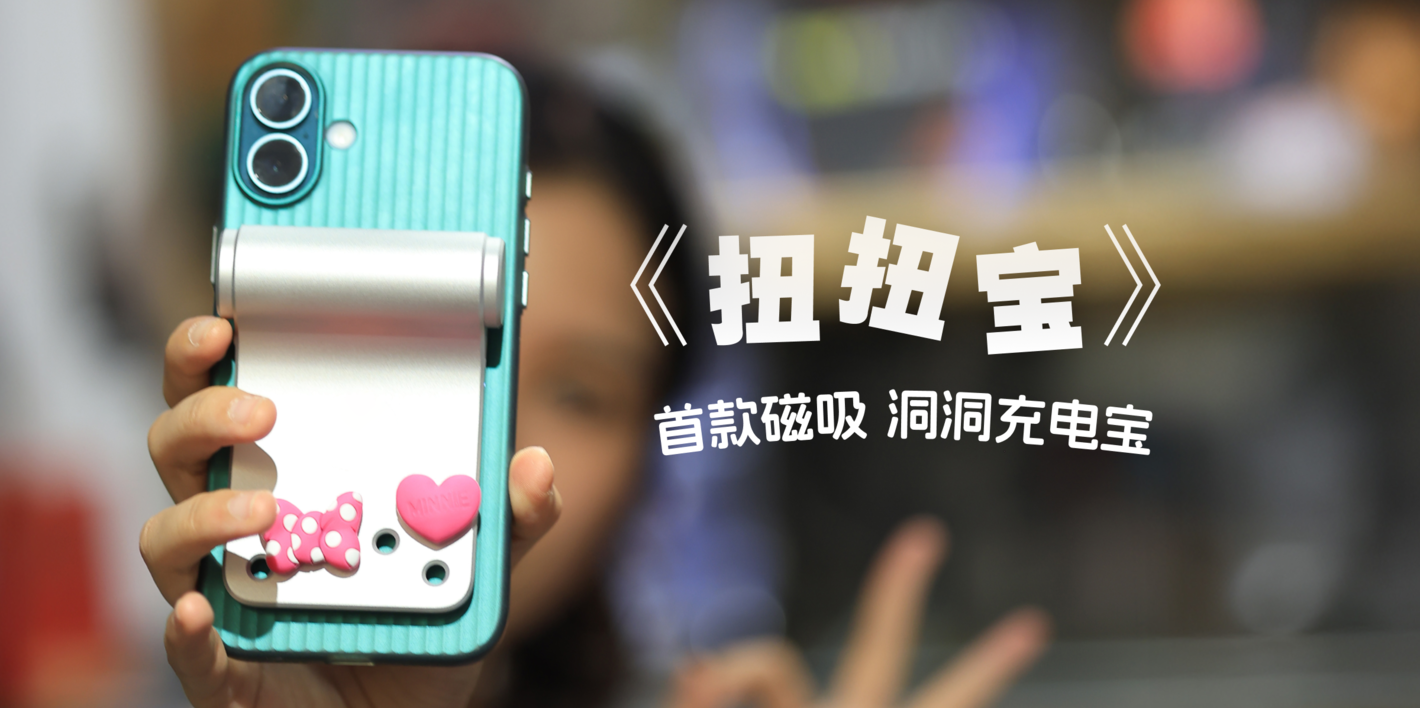
SSPAI “Twisty Power Bank”
Having walked through these three stages, we can now look at SSPAI’s newly launched “Twisty Power Bank” and clearly see where its design logic comes from.
Most power banks on the market today are still stuck in the first stage, obsessing over being “perfectly sealed.” The Twisty Power Bank deliberately goes in the opposite direction. It adopts a “third-stage” design philosophy similar to Crocs—an open interface.
This product has just passed China’s latest 3C safety certification, and its design shows three very distinct characteristics:
Physical negative space: The body uses an asymmetrical structure. The battery cell and circuit board are concentrated in the cylindrical top section (27.4 mm thick), while the lower half is an ultra-thin metal plate only 4.5 mm thick. On this metal plate, the designers directly reserved six standard circular holes.

Handing over the “right to define” to users: These six holes have no electrical function—they don’t dissipate heat or conduct electricity. They exist purely for you to “twist” things into. You can treat them like Crocs holes, snapping in the included decorative plugs; you can design and 3D-print your own stand; or you can even hang a set of keys. It turns a cold, utilitarian digital accessory into a DIY-friendly EDC (everyday carry) item.
Each of the six holes on the Twisty Power Bank has a diameter of 9 mm and a depth of 4 mm, supporting any accessory that can be secured with screws. For this launch, we’ve curated eight officially licensed Disney accessories from “Curious Hole Things,” and you can choose one of them as a free gift at checkout, so you can decorate your power bank the moment you start using it.

We’ve also included an SSPAI logo sticker, letting you freely mix and match your own style. Below are real-world photos of styled setups from SSPAI’s offline store at Houhaihui in Shenzhen:

Solid fundamentals, preserved: Beyond being fun, it’s still a competent power bank. With a 5000 mAh capacity, support for 20 W wired fast charging and 15 W magnetic wireless charging, and a weight of 146 g, it stays comfortable when attached to the back of an iPhone. Thanks to its ultra-thin bottom section, it doesn’t feel like a bulky slab in your hand.

The Twisty Power Bank is now officially on sale. Feel free to click the link below to check it out and make a purchase.
From Braun’s precise grids to the decorative holes of the Twisty Power Bank, industrial design has not become increasingly complex. If anything, it has grown increasingly relaxed.
The Twisty Power Bank is a product of that sense of ease. It doesn’t force you to accept some lofty aesthetic. It simply leaves a few holes and asks you, “What would you like to put here?”
Leave a Reply