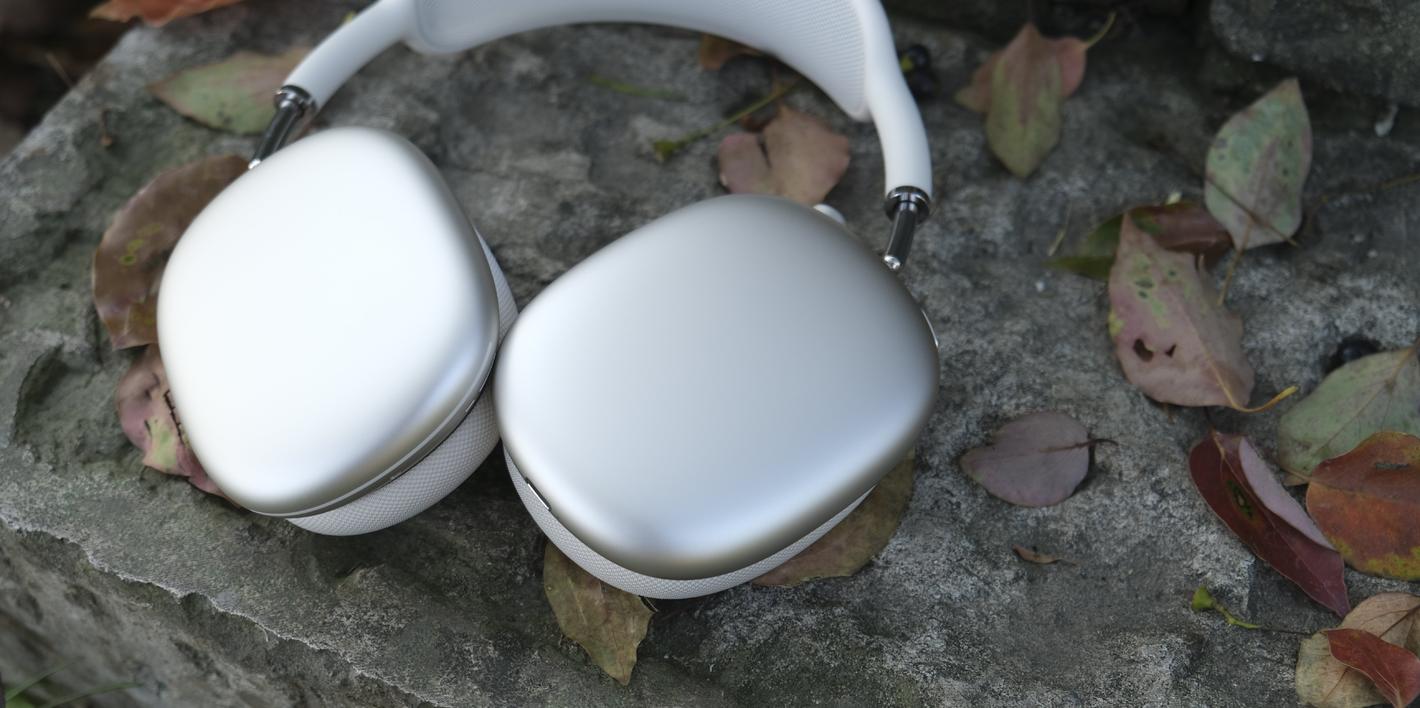
Five years later, Apple’s over-ear headphones, the AirPods Max, have finally received a second-generation upgrade.

AirPods Max 2 retains an exterior design that is entirely identical to its predecessor: finely crafted anodized aluminum ear cups, a stainless steel telescopic headband with stepless adjustment, and memory foam ear cushions with a fabric covering that offers excellent fit. Due to the extensive use of metal materials, AirPods Max weighs 386.2 grams, which, on paper, places it on the heavier side among over-ear headphones. As a result, Apple has put considerable effort into improving overall wearing comfort.
The headband features a taut, breathable mesh canopy designed to distribute weight and reduce pressure on the head; the ear cushions, made from acoustically optimized memory foam and a specially designed mesh fabric, provide a more stable and comfortable seal; and the steplessly adjustable telescopic arms allow the headphones to accommodate different head sizes, ensuring a snug yet comfortable fit.

I have been an AirPods Max user prior to this, and since AirPods Max 2 does not introduce changes in design or weight, I already have fairly extensive real-world experience using this pair in daily commuting and long listening sessions, which I offer here for reference.
Although AirPods Max is not particularly lightweight, in travel scenarios that involve continuously switching between different modes of transportation, wearing the headphones for several hours straight has not caused any clamping or pressure discomfort. Compared to in-ear models like AirPods Pro, which have a more intrusive fit in the ear canal, using AirPods Max with active noise cancellation for extended periods does not result in a stuffy or fatiguing sensation in the ears.
That said, the over-ear design of AirPods Max inherently creates a stronger physical presence compared to other types of headphones, whether it’s the feel of the mesh canopy on the head or the enveloping sensation of the ear cushions. With the recent rise in temperatures, the fully enclosing ear cushion design can quickly make the ears feel slightly warm. If there is one factor that might stop me from wearing AirPods Max outdoors, it would undoubtedly be the approaching summer heat—not only does it make you sweat more easily, but the fabric ear cushions with fine mesh can also be more troublesome to clean.
By the way, thanks to the soft deformation and rebound characteristics of the memory foam ear cushions, wearing AirPods Max with glasses does not cause any discomfort. Across nearly ten pairs of glasses with different materials and temple designs, AirPods Max has remained both stable and comfortable to wear.

That said, wearing comfort—especially for over-ear headphones like these—can vary greatly from person to person. Some of my friends have described the AirPods Max as feeling tight or causing pressure on the head. My experience is only for reference, and I would still recommend trying them on at an Apple Store before making a purchase.
After covering the functional design of AirPods Max, let’s take a look at its standout sense of style. It’s quite surprising that a pair of over-ear headphones first introduced in 2020 has, over the past six years, appeared frequently in celebrity street snaps, film and TV productions, and social media discussions—essentially becoming a widely talked-about fashion accessory.
Personally, I really like the clean yet highly recognizable design language of AirPods Max. Midnight is understated, while Starlight is timeless—these are the two colors I would recommend most. Not only are they easier to match with everyday outfits, but they also tend to remain visually appealing over time.


AirPods Max underwent a minor refresh in 2024, when Apple replaced the original Lightning port with USB-C and later enabled 24-bit, 48 kHz wired lossless audio. However, Apple did not treat that update as a true generational upgrade. It wasn’t until the release of AirPods Max 2, equipped with the H2 chip, that the product finally received a more complete iteration.
The shift from the H1 to the H2 chip essentially accounts for almost all of the upgrades in AirPods Max 2. While it may sound like “just a chip upgrade,” this is far from a routine update. Not only have existing features been noticeably improved, but the new model also brings in several core capabilities that are now standard across the AirPods lineup.
Let’s start with what has improved.
As mentioned earlier, the H2 chip is nearly the entirety of the upgrade, but compared to the previous generation, the new model also introduces a custom high dynamic range amplifier. As the name suggests, this hardware enhancement allows AirPods Max 2 to deliver a wider dynamic range in audio: preserving more detail at low volumes, reducing distortion at higher volumes, and maintaining better driver control in tracks with significant dynamic variation.

The addition of the high dynamic range amplifier also brings a change that is immediately noticeable—the overall loudness is significantly higher than on the previous AirPods Max. Playing the same track at the same volume level, you can clearly hear that AirPods Max 2 sounds louder.
It is understood that, alongside the H2 chip and the custom high dynamic range amplifier, Apple has completely reworked the tuning algorithms, resulting in a noticeably wider soundstage. In actual listening, this proves to be true: AirPods Max 2 offers better layering than both the previous AirPods Max and the AirPods Pro 3, and spatial audio sounds more natural and precise overall.
In terms of sound, the low-frequency extension on AirPods Max 2 is deeper and more full-bodied than before, with bass that is tight and impactful. Vocals, as well as mid and high frequencies, are clearer. Even when compared with the latest in-ear model, AirPods Pro 3, I still find that AirPods Max 2 delivers a slightly superior overall listening experience.

In terms of noise cancellation, I compared the previous-generation AirPods Max and AirPods Pro 3 with AirPods Max 2 across several scenarios—a noisy waiting hall, a moving high-speed train, and an elevated roadway—and in all cases, AirPods Max 2 delivered better performance.
Taking the previously best-performing Apple earbuds in noise cancellation, AirPods Pro 3, as an example: in a crowded waiting hall, the mix of chatter and background noise tends to blend together, whereas AirPods Max 2 is able to filter out more ambient noise, leaving almost only the surrounding voices. Inside a car on an elevated road, while none of the three headphones can completely eliminate the sound of traffic from different directions during rush hour, AirPods Max 2 clearly performs better—oncoming vehicles are barely perceptible. Next is AirPods Pro 3, where the traffic noise is still faint but relatively more discernible.
Lastly, transparency mode: AirPods Max 2 sounds better and more natural than AirPods Pro 3. Especially in noisy environments with multiple sound sources, the separation between different sounds is improved, and the layering feels more three-dimensional. This is likely closely related to the stronger computational power of the H2 chip and the improved algorithms. In relatively quiet environments with simpler sound sources, however, the difference between AirPods Max 2 and AirPods Pro 3 is less noticeable—both provide a sufficiently natural and clear transparency experience.

The H2 chip first debuted in AirPods Pro 2, and somewhat surprisingly, it has taken nearly four years for AirPods Max—also a flagship product—to finally receive this upgrade. With the new chip and updated algorithms, AirPods Max 2 now supports many of the core AirPods features that Apple has introduced over time, such as Adaptive Audio, Conversation Awareness, head gestures, and voice activation for “Siri.” If you’ve been hesitating to buy AirPods Max because of the lack of these features, now is a good time to reconsider.
That said, it is somewhat disappointing that AirPods Max 2, arriving five years later, does not introduce any design changes. First, the included basic case only covers the ear cups and cushions, leaving the headband and canopy unprotected—if you carry a lot in your bag, it can feel a bit worrying. Second, the USB-C charging port is located at the bottom of the right ear cup, which I find slightly inconvenient. It would be much more practical if a contact-based charging option were added, allowing the headphones to start charging simply by placing them on a stand.

As for whether to buy AirPods Max, there’s not much more to say. Unlike AirPods and AirPods Pro, which have noticeable overlap in form factor, use cases, and feature sets, AirPods Max—Apple’s only over-ear headphone—now has a clearly defined positioning and advantages in both functionality and user experience.
With up to 20 hours of continuous listening, far exceeding other AirPods models, combined with superior noise cancellation, AirPods Max 2 makes for an excellent travel companion. With support for lossless audio, musicians or small studios can also use AirPods Max 2 as monitoring headphones, enabling high-quality audio playback and editing on a Mac.

For Apple users, if you’ve already decided to choose a pair of over-ear headphones for daily use, then AirPods Max 2 is undoubtedly the best option available right now: iCloud syncing and automatic switching, spatial audio, adaptive audio, Find My support, and more—all deliver ecosystem-exclusive experiences that competing products simply cannot match. However, if portability and comfort are your top priorities, then AirPods 4 or AirPods Pro 3 would clearly be the more suitable choice—it ultimately comes down to what you value most.